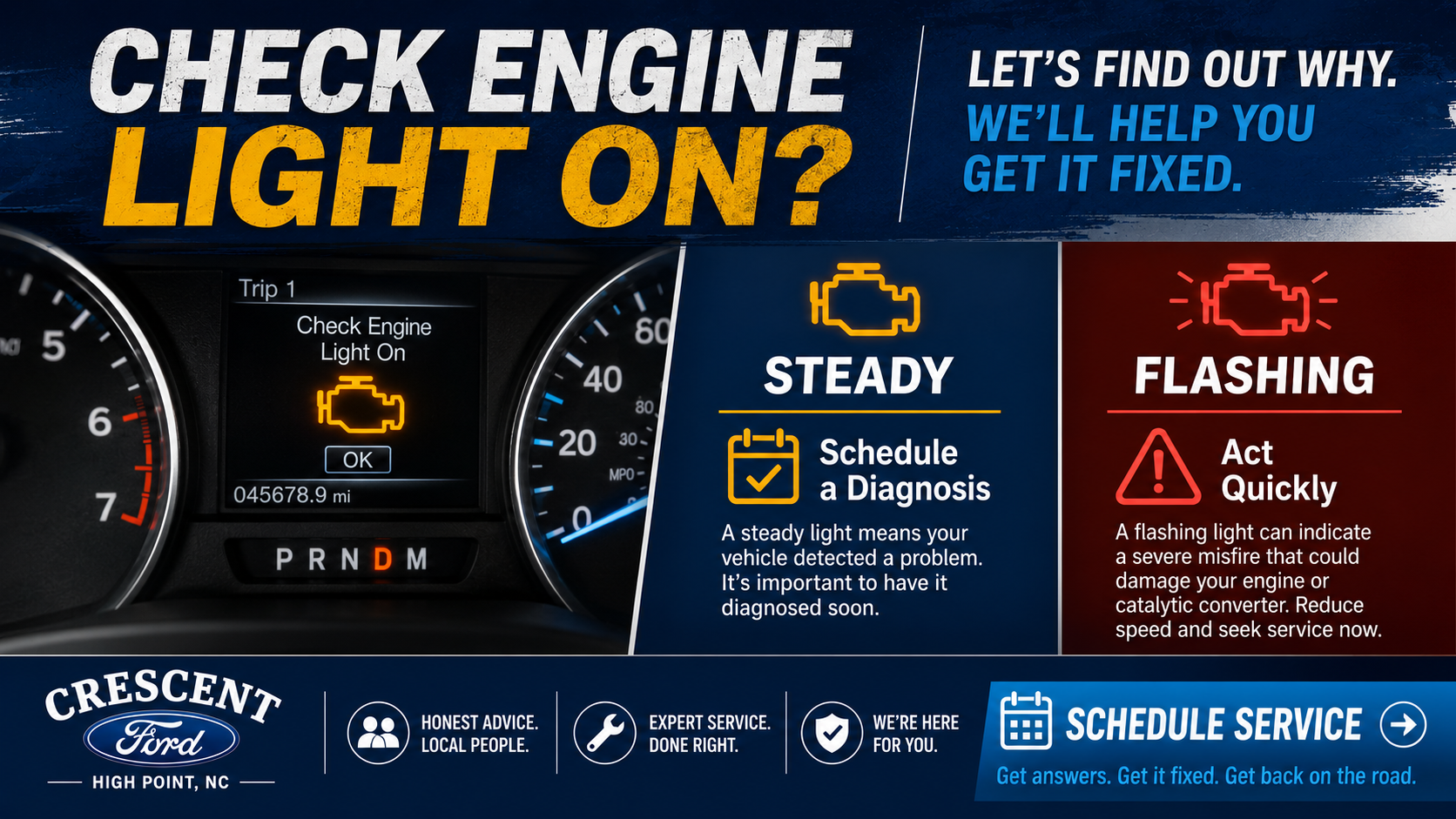
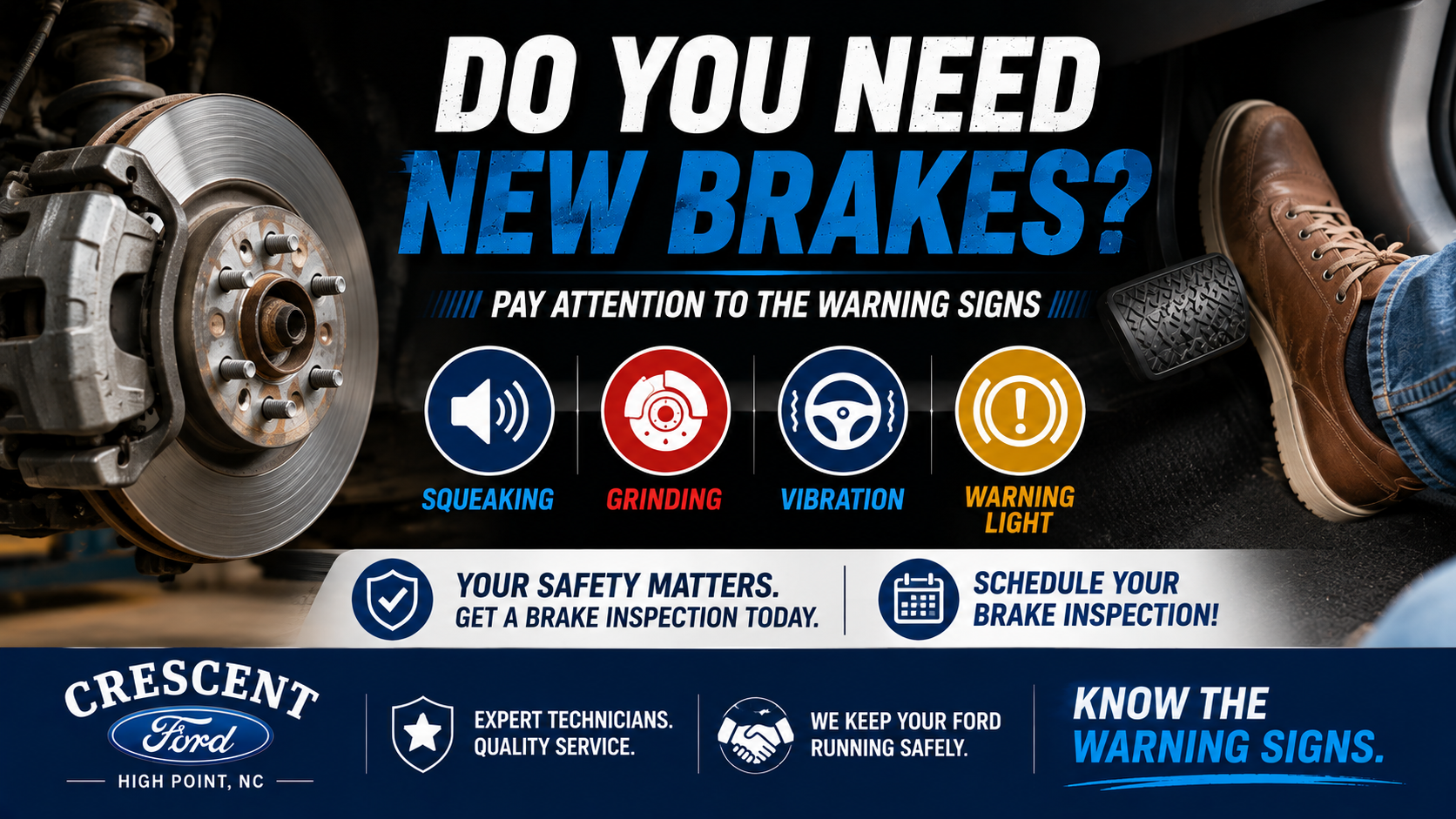
How Do You Know When You Need New Brakes? You're backing out of the driveway and hear: SQUEEEEEAK. Or you press the brake pedal at a stoplight and feel: a little vibration. Or maybe your brakes just don't feel quite like they used to. And immediately you wonder: "Do I need new brakes?" Maybe. But here's the important part: Your braking system has several components, and not every brake symptom automatically means you need new brake pads. It could involve: Brake pads Rotors Brake fluid Calipers Sensors Another part of the braking system The symptom tells you: "Something needs attention." An inspection tells you: "Here's what's actually wrong." Let's go through the most common signs your brakes may need service—and which symptoms you shouldn't ignore. Schedule a Brake Inspection at Crescent Ford Hearing a new brake noise or noticing a change in how your vehicle stops? Schedule a brake inspection at Crescent Ford in High Point. What Are the Signs You May Need New Brakes? Some of the most common warning signs include: Squeaking or squealing Grinding Vibration while braking Longer stopping distance A brake pedal that feels different Pulling while braking A burning smell Brake warning lights Visible brake wear Some symptoms develop gradually. Others deserve much more immediate attention. Let's take them one at a time. Why Are My Brakes Squeaking? This is probably the brake question we hear most often. Squeaking brakes don't always mean your brakes are failing. Brake noise can have several causes. Depending on the vehicle and circumstances, you may hear temporary brake noise because of: Moisture Surface rust Dust or debris Temperature Brake-pad material Normal conditions after the vehicle has been sitting For example, if your vehicle sits outside overnight after rain, you may occasionally hear some noise during the first few stops. That may disappear as you drive. But if you're hearing: persistent or frequent squeaking every time you brake? That's worth having inspected. Ford includes loud or frequent squeaking among the signs that brakes may need service. Is It Safe to Drive With Squeaking Brakes? That depends on why they're squeaking. A brief occasional squeak isn't necessarily an emergency. But if the noise is: New Persistent Getting louder Accompanied by vibration Accompanied by reduced braking performance Accompanied by a warning light don't just turn the radio up and hope it goes away. 😂 Get the brakes checked. Brake noises are much easier to deal with when they're investigated before they become more serious. Why Are My Brakes Grinding? Grinding is much more concerning than a little squeaking. If you hear a harsh: GRINDING or metal-on-metal sound while braking, have the vehicle inspected promptly. One possible cause is severely worn brake-pad friction material. If brake components begin making metal-to-metal contact, you may no longer be dealing with: "I need brake pads." You may now be dealing with: "I need brake pads AND potentially additional brake components." Ford specifically warns that delaying replacement of worn brakes can result in rotor damage and additional repair expense. This is exactly why waiting for the brakes to become extremely noisy isn't a great maintenance strategy. Can Worn Brake Pads Damage the Rotors? Yes, they can. Brake pads are designed to provide friction against the rotor to slow the vehicle. As the friction material wears away, the pads eventually reach the end of their useful life. If they're allowed to wear too far, additional components can be damaged. That's one reason replacing worn pads before they become severely worn can potentially prevent a more expensive brake repair. Think of it like this: Brake maintenance = normal wear item. Ignoring brake maintenance = potentially more parts. Why Does My Steering Wheel Shake When I Brake? A steering wheel that shakes or vibrates while braking is another reason to have the braking system inspected. Drivers often describe it as: shaking pulsing shuddering or vibration. Ford lists continuous steering-wheel vibration or shuddering while braking as a brake-service warning sign. The exact cause can't be diagnosed from the sensation alone. The braking system, suspension, wheels, tires and other components can all affect what you feel through the steering wheel. So don't automatically assume: "I need rotors." Have the vehicle inspected. Why Does My Brake Pedal Pulse? A brake pedal that pulses under certain circumstances may be normal if the anti-lock braking system is actively operating during a hard stop or on a low-traction surface. That's different from a repetitive vibration or pulsation you feel during ordinary braking. If your pedal consistently pulses during normal stops, schedule an inspection. The key word is: consistent. Something happening once during an emergency stop isn't the same as something happening every morning at the same traffic light. Why Does My Brake Pedal Feel Soft or Spongy? A brake pedal that suddenly feels: soft spongy or significantly different from normal deserves attention. Ford specifically lists an unusually "squishy" brake pedal as a reason to schedule brake service. Changes in pedal feel can have multiple causes, and some can affect braking performance. If the pedal suddenly feels dramatically different or the vehicle isn't stopping normally, don't keep driving simply to see whether it improves. Safety comes first. Why Is My Brake Pedal Hard to Push? The opposite can also happen. If your brake pedal suddenly becomes unusually difficult to depress, that can indicate a braking-system problem as well. Ford also lists a brake pedal that becomes difficult to depress among its brake-service warning signs. Again: A noticeable change in brake-pedal feel should be inspected. You drive your vehicle every day. You know what the pedal normally feels like. If one morning you're thinking: "Whoa. That's different." Pay attention to that instinct. Why Does My Car Pull When I Brake? If your vehicle consistently pulls to one side during braking, schedule an inspection. Pulling can have multiple possible causes, including issues involving: Brakes Tires Alignment Suspension That's why trying to diagnose a vehicle based on one symptom can be misleading. If the pull happens specifically when braking, the braking system should be part of the inspection. Why Does It Take Longer for My Car to Stop? This is one of the symptoms we don't want you ignoring. If your vehicle's stopping performance has noticeably changed, have it inspected. You may notice: You're pressing the pedal farther than before. The vehicle doesn't seem to slow as quickly. You need more distance to stop. Those are not symptoms to postpone until your next convenient oil change. If the vehicle isn't braking normally or you don't believe it can be driven safely, don't drive it. Why Do My Brakes Smell Like They're Burning? A strong burning or acrid odor around the brakes can indicate excessive heat. Ford lists a burning odor among the warning signs that warrant brake inspection. This can happen under different circumstances, including prolonged or heavy braking. If you notice a strong burning smell after normal driving—or especially if it's accompanied by: Smoke Reduced braking performance Pulling An unusual pedal Excessive heat near a wheel stop somewhere safe and have the situation evaluated. Don't touch brake components or wheels to check whether they're hot. They can become extremely hot. Why Is My Brake Warning Light On? Your vehicle can have more than one brake-related warning indicator. A red brake-system warning light may have several possible causes. First, make sure the parking brake is fully released. Ford advises that if the brake warning remains illuminated after the parking brake is released, the braking system should be inspected promptly. A brake warning light does not automatically mean: "You need brake pads." That's why diagnosis matters. RELATED READING — Why Is My Check Engine Light On? What to Do Next Brake light isn't the only dashboard warning worth understanding. See what a check engine light may be trying to tell you. Is the ABS Light the Same as the Brake Warning Light? No. The ABS warning light relates to the vehicle's anti-lock braking system. If the ABS system detects a malfunction, the warning indicator can illuminate. That doesn't necessarily mean the vehicle has worn brake pads. And it doesn't mean you should ignore it. Your owner's manual contains vehicle-specific information about dashboard warnings, and an inspection can determine what's causing the light. How Long Do Brake Pads Last? There is no universal mileage at which every vehicle needs brake pads. That's important. You may see estimates online that say: "Replace your brakes every X miles." Real life is more complicated. Brake wear depends heavily on: Driving style Vehicle weight Traffic Terrain Towing Payload Brake material Road conditions How frequently you drive The specific vehicle Two people can own the same model and need brake service at very different mileages. That's why: inspection > guessing by odometer. Do City Drivers Wear Out Brakes Faster? They can. Think about the difference. Highway driving: Drive 50 miles. Brake a few times. Stop-and-go driving: Drive 50 miles. Brake. Accelerate. Brake. Accelerate. Brake. Repeat approximately 900 times because Greensboro traffic has decided today is the day. 😂 More frequent braking can mean more wear. So someone who drives primarily around town may have a very different brake-service experience from someone who spends most of their miles cruising on the interstate. Does Mountain Driving Wear Brakes Faster? It can. Long downhill grades can place significant heat and demand on the braking system. That's particularly relevant for drivers around the Piedmont Triad who frequently head toward: Boone Blowing Rock Asheville Blue Ridge Parkway Other mountain destinations Proper driving technique matters. Riding the brakes continuously down a long grade can generate substantial heat. Your owner's manual may provide guidance specific to your vehicle for driving on steep grades or when towing. Does Towing Wear Out Brakes Faster? Potentially, yes. More weight means the vehicle has more work to do when slowing down. That's one reason trucks and SUVs used for: Towing Hauling Work Heavy payloads may experience different brake wear from the same vehicle used only for light commuting. If your Ford regularly tows, brake inspections should be taken seriously. Do Electric Vehicles and Hybrids Need Brake Pads? Yes. Hybrid and electric vehicles still have physical braking systems. However, many use regenerative braking, which can reduce reliance on the friction brakes during certain types of deceleration. That can affect how brake components wear. But: regenerative braking does not eliminate the need for brake inspection and maintenance. The vehicle still has brakes. What Is the Difference Between Brake Pads and Rotors? Think of it this way: Brake Pads These contain friction material and press against the rotor when braking. Brake Rotors These are the discs the pads clamp against. Together, they create the friction needed to slow the vehicle. The pads are designed to wear. Rotors also experience wear and can require resurfacing or replacement depending on their condition, measurements and manufacturer specifications. That's why: "How much are brakes?" is difficult to answer without seeing the vehicle. Do you need pads? Pads and rotors? Something else? We need to inspect it first. Do You Always Need Rotors When Replacing Brake Pads? Not automatically. Whether rotors require replacement depends on their: Thickness Condition Wear Surface Manufacturer specifications Other factors This is one of those areas where an inspection and measurements matter. You don't want someone replacing parts you don't need. But you also don't want new pads installed against rotors that aren't suitable for continued service. Can I See Whether My Brake Pads Are Worn? Sometimes you can see part of the brake pad through the wheel. But accurately evaluating the braking system isn't always as simple as looking through the spokes. An inspection can evaluate: Pad thickness Rotor condition Brake hardware Fluid Hoses/lines Other visible components So if you're uncertain, don't rely solely on: "They looked okay to me." How Often Should I Have My Brakes Inspected? Rather than waiting until the brakes start making noise, have them inspected as part of routine vehicle maintenance. Ford recommends regular brake-system inspection as part of vehicle maintenance and specifically emphasizes having brakes checked before they're badly worn. Your exact maintenance needs depend on your vehicle, mileage and driving conditions. Check your owner's manual for vehicle-specific guidance. Can I Wait Until My Brakes Start Grinding? We wouldn't. Grinding can indicate that you've moved beyond ordinary friction-material wear into a situation where additional components may be affected. This is the difference between: preventive maintenance and repairing damage after something has been ignored. If your brakes are telling you something? Listen. They're one of the few parts of the vehicle we'd really prefer you not procrastinate on. How Much Does a Brake Job Cost? It depends on what the vehicle actually needs. Brake service can involve different combinations of: Pads Rotors Calipers Hardware Brake fluid Sensors Other components The vehicle itself matters too. Brake components for a: Ford Maverick aren't necessarily the same as those for an: F-250 Super Duty. That's why the first step isn't: "Give me a brake-job price." It's: "Tell me what my vehicle actually needs." View Current Ford Service Specials Before scheduling your brake service, check Crescent Ford's current service offers for available maintenance and repair specials. Should I Replace My Brakes Myself? Brake service is a safety-critical repair. Some experienced DIYers have the tools, knowledge and vehicle-specific service information to perform brake work correctly. But if you're unsure how to: Inspect components Measure wear Properly lift and support the vehicle Service electronic parking-brake systems Torque fasteners correctly Bleed hydraulic components when necessary Verify proper operation afterward this isn't the repair we'd recommend learning by trial and error. Modern vehicles may also require specific procedures or service modes when performing certain brake repairs. If you're not confident in the procedure, have the brakes professionally serviced. Why Get Brake Service at a Ford Dealer? For Ford vehicles, dealer service provides access to technicians familiar with Ford braking systems, vehicle-specific procedures and appropriate parts. Ford's Motorcraft brake pads are designed and tested to meet Ford engineering standards for factors including wear, noise, dust and vibration. That doesn't mean a dealership is the only place capable of performing brake service. But if you're driving a Ford and want technicians accustomed to servicing Ford vehicles, dealership service can make sense. Schedule Ford Brake Service in High Point What Happens During a Brake Inspection? The exact inspection depends on the vehicle and symptoms, but the goal is to determine: What's worn? What's damaged? What's still serviceable? What's causing the symptom? A technician may evaluate items such as: Brake-pad condition Rotor condition Calipers Brake fluid Brake hoses and lines Warning indicators Related components Then you can make a repair decision based on what the vehicle actually needs. What If My Car Needs More Than Just Brakes? This is where service and sales can naturally overlap. Suppose you come in expecting: brake pads. Then the inspection reveals: Brakes Tires Suspension work Another major repair High mileage Additional maintenance coming soon Now you're facing a larger question: "Is this vehicle still worth fixing?" That doesn't automatically mean you should trade it. Sometimes repairing the vehicle is absolutely the smarter financial decision. But if the repair list is becoming expensive and you've already been thinking about replacing the vehicle, it may make sense to compare: repair cost vs. current trade value before making the decision. Getting an appraisal doesn't obligate you to buy another vehicle. It simply gives you another number to consider. Is My Car Worth Fixing or Should I Trade It In? If your brake inspection uncovers several expensive repairs, here's how to decide whether fixing or replacing your vehicle makes more financial sense. Should I Trade My Car Instead of Replacing the Brakes? If the vehicle only needs normal brake maintenance? Probably not for that reason alone. Brakes are wear items. Eventually replacing brake pads doesn't mean your vehicle is becoming unreliable. But if brakes are one item on a growing repair list, that's different. For example: Brakes + tires + transmission issue + 180,000 miles deserves a different conversation from: "My otherwise-great vehicle needs brake pads." Look at the whole vehicle. RELATED READING — My Car Needs Expensive Repairs—Can I Trade It In As-Is? Brake Service in High Point, NC If you're hearing squeaking, grinding or another unusual brake noise around High Point, Greensboro, Thomasville, Trinity, Archdale, Kernersville or elsewhere in the Piedmont Triad, don't wait for the noise to become dramatically worse before having it checked. Sometimes the answer is straightforward: You need brake pads. Sometimes the brakes are fine and the noise has another explanation. And sometimes an inspection catches wear before it turns into a more expensive repair. That's the value of having the vehicle looked at. You don't need to diagnose it from the driver's seat. That's our job. So, How Do You Know When You Need New Brakes? Your vehicle may be telling you. Watch for: Squeaking or squealing Grinding Vibration when braking Changes in brake-pedal feel Reduced stopping performance Pulling while braking Burning odors Brake-system warning lights But remember: A symptom doesn't automatically tell you which part needs replacement. That's what the inspection is for. And with something as important as your brakes, we'd rather find out: "You're okay for now." than have you wait until a small maintenance item becomes a larger repair—or a safety issue. Hearing Something When You Brake? Schedule a Brake Inspection Looking for Current Maintenance Offers? View Service Specials Did Your Inspection Reveal Bigger Repairs? Value Your Trade RELATED READING Why Is My Check Engine Light On? What to Do Next Is My Car Worth Fixing or Should I Trade It In? My Car Needs Expensive Repairs—Can I Trade It In As-Is? Should I Fix My Car Before Trading It In? What Actually Affects Trade Value Frequently Asked Questions About Brake Replacement What are the first signs that I need new brakes? Persistent squeaking or squealing, grinding, vibration during braking, changes in pedal feel and reduced braking performance can all indicate that your braking system needs inspection. The symptom alone doesn't necessarily tell you which brake component needs replacement. Does squeaking mean I need new brake pads? Not always. Moisture, surface rust, temperature and other conditions can sometimes cause temporary brake noise. Persistent or frequent squeaking should be inspected, especially if it's accompanied by other braking symptoms. Is grinding worse than squeaking brakes? Generally, yes. Grinding can indicate a more serious condition and should be inspected promptly. Continuing to drive with severely worn brake components can potentially damage additional parts such as the rotors. How many miles do brake pads last? There isn't one replacement mileage that applies to every vehicle. Brake-pad life varies based on driving habits, traffic, terrain, vehicle weight, towing and other conditions. Regular inspection is more useful than relying solely on mileage. Why does my steering wheel shake when I brake? Brake-related vibration can have several possible causes. Because tires, wheels, suspension and braking components can all contribute to vibration, an inspection is the best way to identify the actual cause. Do I need rotors every time I replace brake pads? Not automatically. Rotor replacement depends on condition, wear, thickness and manufacturer specifications. The rotors should be evaluated when brake pads are serviced. Can I drive with my brake warning light on? First verify that the parking brake is fully released. Ford advises having the braking system inspected promptly if the brake warning remains illuminated. If braking performance is affected or you don't believe the vehicle can be driven safely, don't drive it. Why does my brake pedal feel spongy? A soft or spongy brake pedal can have multiple possible causes and should be inspected. A sudden or significant change in brake-pedal feel deserves prompt attention. Do hybrids still need brake replacements? Yes. Hybrid vehicles still use friction brakes even though regenerative braking can reduce their use under certain driving conditions. Their braking systems still require inspection and maintenance. Does towing wear brakes faster? Towing adds weight and can increase the demand placed on the braking system. Driving conditions, trailer weight, vehicle configuration and driving habits can all affect brake wear. Should I trade my car because it needs brakes? Normal brake replacement alone generally isn't a reason to replace an otherwise reliable vehicle. Brakes are wear items. If the vehicle needs brakes plus several other expensive repairs, however, comparing total repair cost with its current trade value may help you make a better decision. Where can I get Ford brake service in High Point, NC? Crescent Ford's service department in High Point can inspect your Ford's braking system, diagnose brake noises or warning lights and recommend service based on the vehicle's actual condition.
What Is the Best Ford for a First-Time Buyer?
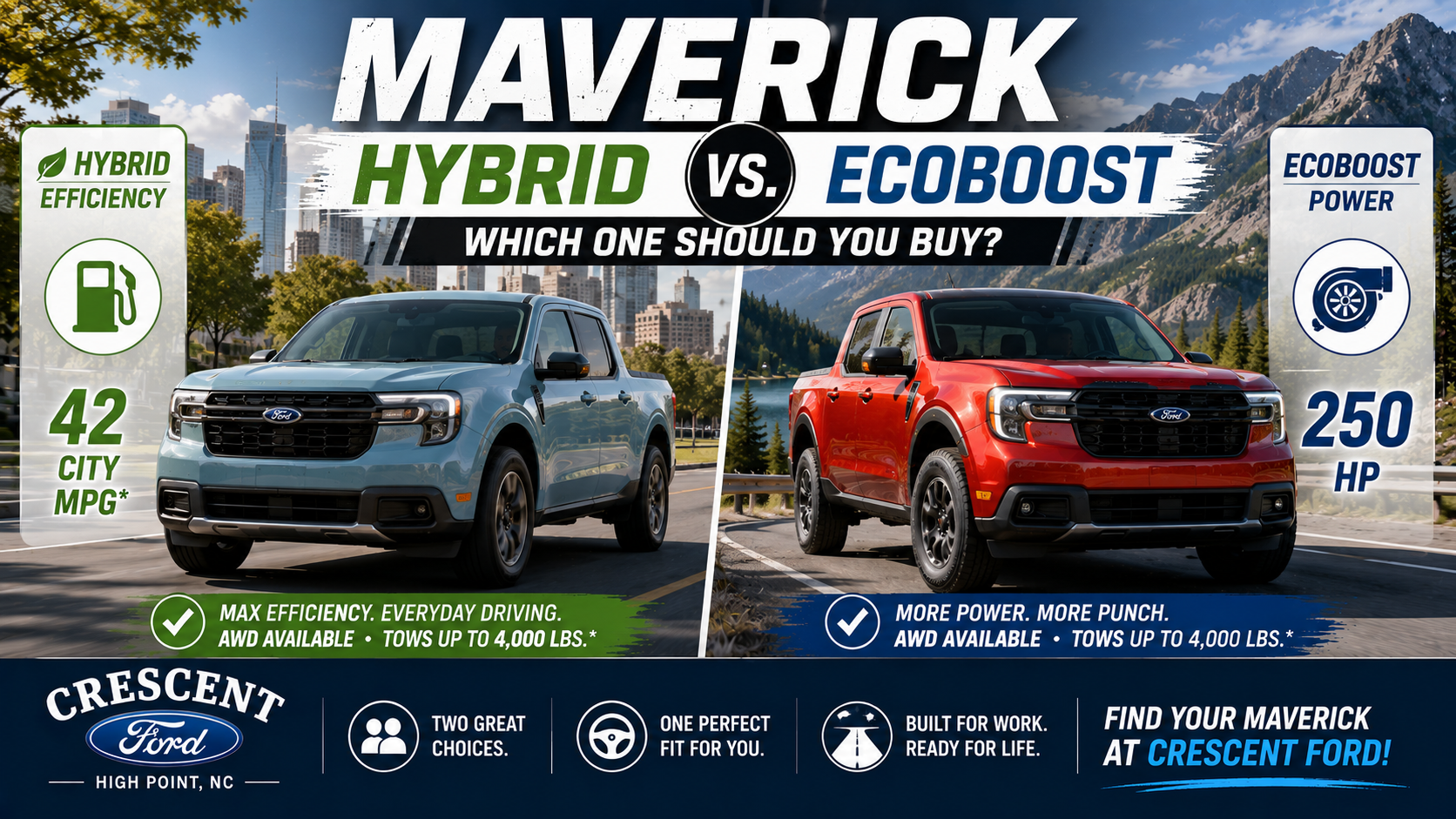
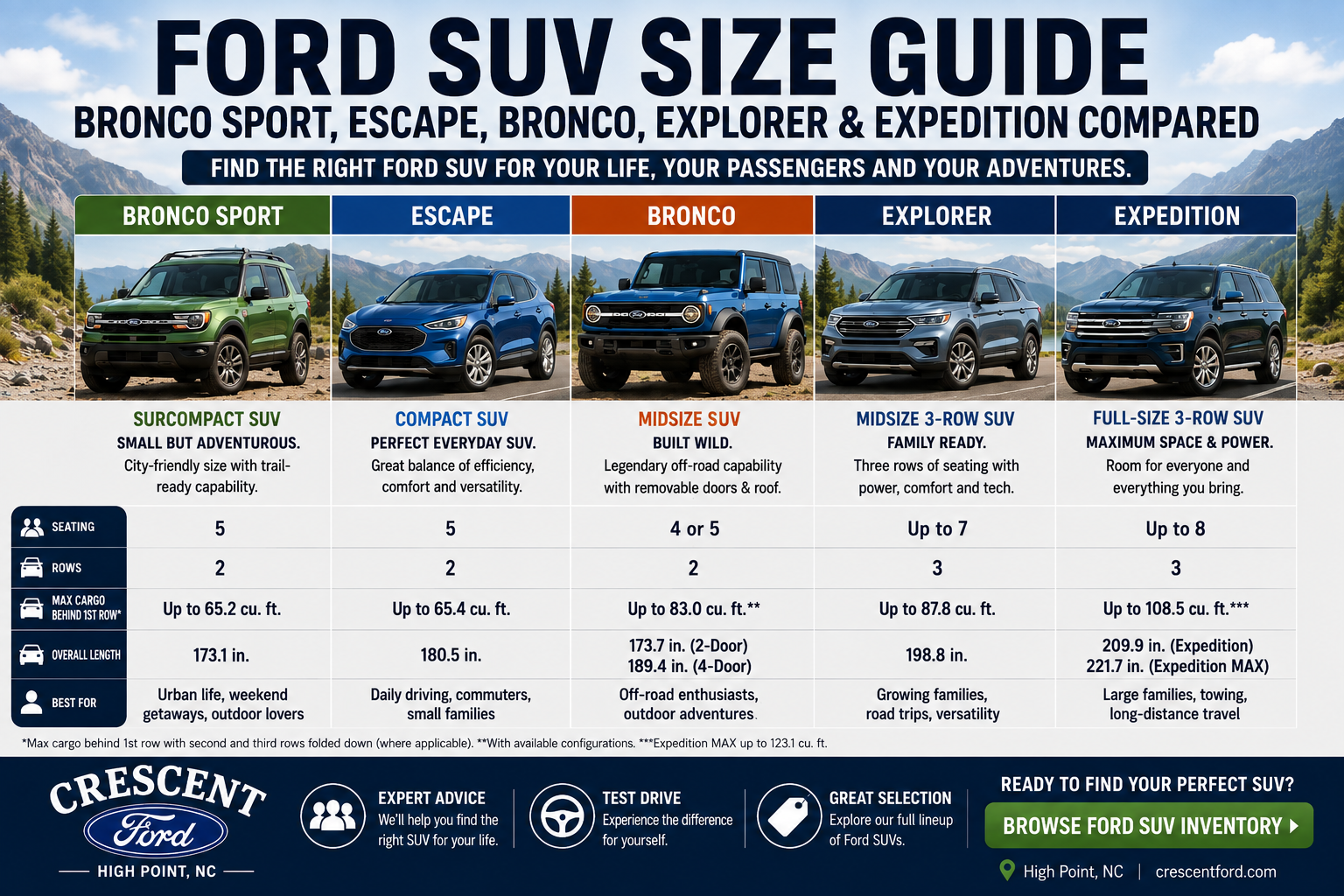
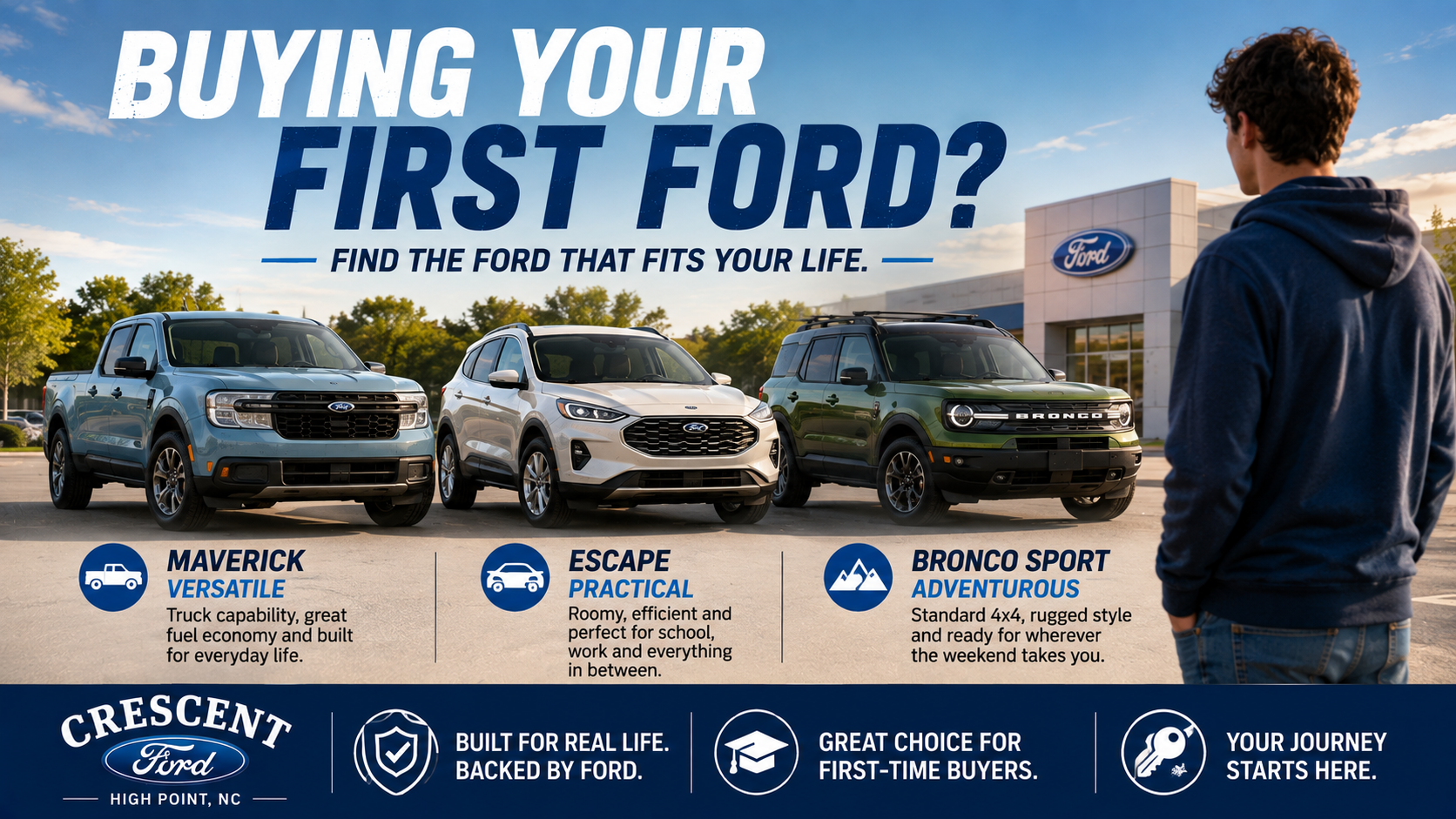
What Is the Best Ford for a First-Time Buyer? Buying your first vehicle is exciting. It's also one of those moments where approximately 47 different people suddenly have an opinion about what you should buy. Your parents say: "Get something practical." Your friend says: "Get the Bronco." Your budget says: "Everybody calm down." 😂 So what actually makes a good first vehicle? And if you want a Ford, which one should you buy? For many first-time buyers, we'd start by looking at three: Ford Maverick Ford Escape Ford Bronco Sport But there's another option that absolutely belongs in the conversation: a used Ford—or another quality used vehicle. The best first vehicle isn't necessarily the least expensive one, the coolest one or even the one with the best gas mileage. It's the vehicle that fits: your budget + your driving + your lifestyle without stretching you so far financially that owning it stops being fun. Let's figure out which one makes sense for you. Shop New & Used Vehicles at Crescent Ford What Makes a Good First Vehicle? Before choosing a model, let's define what we're looking for. For most first-time buyers, we'd prioritize: A payment that fits comfortably in the budget Reasonable insurance costs Good fuel economy Manageable maintenance expenses Practical passenger and cargo space Easy everyday drivability Useful technology Driver-assistance features A vehicle you'll still like a few years from now Notice what isn't at the top of the list? Maximum horsepower. Your first vehicle doesn't have to do everything. It needs to do your things well. That's a much better starting point. Best Ford for Most First-Time Buyers: Ford Maverick If we had to choose one Ford that deserves to be at the top of the first-time buyer's shopping list? Maverick. The Maverick is unusual because it combines several things that don't normally appear in the same vehicle. You get: five seats four doors a truck bed compact dimensions an available fuel-efficient hybrid powertrain. The 2026 Maverick's standard 2.5L full-hybrid powertrain is available with FWD or AWD depending on configuration. Ford rates the FWD Hybrid at an EPA-estimated: 42 MPG city 35 MPG highway 38 MPG combined Actual mileage varies. For someone commuting to: Work College School An apprenticeship Their first full-time job that kind of city fuel economy can be a major advantage. And unlike a traditional compact car, you've still got a truck bed. Moving into an apartment? Throw the furniture in the bed. Bought something at Lowe's? Bed. Mountain bikes? Bed. Dirty camping equipment? Also bed. That's what makes Maverick such an interesting first vehicle. Shop Ford Maverick Trucks Is a Ford Maverick Easy to Drive? One of Maverick's biggest advantages for a first-time buyer is that you get truck utility without jumping directly into a full-size pickup. The 2026 Maverick is approximately 199.8 inches long in most configurations. For comparison, it's significantly smaller than an F-150. That can make everyday tasks like: Parking Navigating parking decks Driving through town Maneuvering in tighter spaces feel more approachable for someone who doesn't need a full-size truck. You still sit in a truck. You still have a bed. You just aren't driving something enormous. Is the Maverick Hybrid Good for a First-Time Buyer? For many people? Absolutely. Especially if your first vehicle is also going to become your daily commuter. The Hybrid is particularly attractive if you: Drive frequently Spend a lot of time around town Want to reduce fuel consumption Don't need maximum performance Want truck utility without traditional truck fuel economy And no—you don't plug the Maverick Hybrid in. It's a full hybrid. Put gasoline in it and drive normally. The vehicle manages the hybrid system automatically. Ford Maverick Hybrid vs. EcoBoost: Which One Should You Buy? Best First Ford SUV: Ford Escape Maybe you don't want a truck. That's okay. Our next stop would be: Ford Escape. Escape is a compact SUV, which gives a first-time buyer a very useful balance of: Passenger room Cargo room Fuel economy Easy everyday driving Available AWD Multiple powertrain choices The 2026 Escape Active with the 1.5L EcoBoost and FWD is rated by Ford at an EPA-estimated: 27 MPG city 34 MPG highway 30 MPG combined Actual mileage varies. It also offers up to 65.4 cubic feet of maximum cargo space on EcoBoost models. That's a lot of versatility in a vehicle that doesn't feel enormous. Who Should Choose an Escape as Their First Vehicle? We'd point you toward Escape if you say: "I just want a comfortable SUV that does everything pretty well." That's Escape's strength. Commute? Yep. Road trip? Yep. Groceries? Obviously. Friends? Yep. Dog? Yep. Moving boxes? Fold the seats. Escape isn't trying to be a hardcore off-roader or a pickup truck. It's designed to be a practical everyday SUV. For a first-time buyer, that's a very good thing. Shop Ford Escape SUVs Best First Ford for an Active Lifestyle: Bronco Sport Then there's the buyer who says: "Okay, but I want something a little more fun." Hello, Bronco Sport. 😂 Bronco Sport gives you the practical size of a compact SUV but with more adventure-oriented personality. The 2026 Bronco Sport Big Bend comes standard with 4x4. Ford rates its 1.5L EcoBoost at an EPA-estimated: 25 MPG city 30 MPG highway 27 MPG combined Actual mileage varies. It also offers up to approximately 65.2 cubic feet of maximum cargo capacity with the rear seats folded on applicable 1.5L configurations. That's a very useful combination for someone who spends weekdays commuting and weekends doing things like: Hiking Camping Fishing Mountain trips Beach trips Outdoor recreation Bronco Sport vs. Bronco for a First-Time Buyer This distinction is important. Bronco Sport and Bronco are completely different vehicles. Bronco Sport is the smaller compact SUV. Bronco is the larger, purpose-built off-road 4x4 with removable doors and roof. For most first-time buyers? We'd start with Bronco Sport. It's smaller, more conventional for everyday driving and still gives you standard 4x4 capability. That doesn't mean a Bronco can't be someone's first vehicle. Of course it can. But if we're recommending a starting point based on practicality? Bronco Sport first. RELATED READING — Ford Bronco vs. Bronco Sport: Which One Should You Buy? Link to: Previously published Bronco vs. Bronco Sport article Maverick vs. Escape vs. Bronco Sport for a First-Time Buyer Let's make this easy. If You Want... Start With... Best city fuel economy of these three Maverick Hybrid A truck bed Maverick Traditional compact SUV Escape Maximum everyday versatility Escape Standard 4x4 Bronco Sport Outdoor/adventure personality Bronco Sport Compact truck utility Maverick Easy commuter Maverick Hybrid or Escape Weekend adventure vehicle Bronco Sport A little bit of everything Compare all three That's our shortlist. But don't stop there. Because there's another category first-time buyers should absolutely consider. Should a First-Time Buyer Buy New or Used? Used can make a LOT of sense. A first-time buyer doesn't automatically need a brand-new vehicle. A quality used vehicle may allow you to: Spend less overall Reduce the amount financed Get more features for the money Choose from more makes and models Find a vehicle that better fits your budget But new vehicles have advantages too. Depending on the vehicle and available programs, you may get: New-vehicle warranty coverage Latest technology Latest driver-assistance features Known ownership history Potential manufacturer financing offers So we don't think the question should be: "Is new or used better?" Ask: "Which gives me the best vehicle and financial situation for my budget?" RELATED READING — New vs. Used Cars in 2026: Which Should You Buy? Shop Used Cars, Trucks & SUVs Should Your First Car Be Cheap? It should be: AFFORDABLE FOR YOU. That's different. A $5,000 vehicle that immediately needs: $3,000 in repairs may not be cheaper to own than a more expensive vehicle in better condition. On the other hand, buying the most expensive vehicle a lender approves you for isn't necessarily a smart decision either. Your budget needs room for more than the payment. Remember: Vehicle payment Insurance Fuel Maintenance Registration/taxes Unexpected expenses = Actual cost of owning the vehicle. That's the number that matters. How Much Car Can a First-Time Buyer Afford? There isn't one payment or percentage that works for everyone. Your finances are individual. Someone living at home with very few expenses has a different budget from someone paying: Rent Utilities Student loans Childcare Credit cards Other household expenses Start with your real monthly budget. Then decide what vehicle expense fits comfortably inside it. We'd much rather see you buy a vehicle you can comfortably afford than stretch into something that makes every other part of your life harder. Don't Shop Only by Monthly Payment This is especially important for first-time buyers. A salesperson—or an online payment calculator—can make two very different vehicles appear to have similar payments simply by changing: loan term down payment or financing assumptions. So don't only ask: "What's my payment?" Ask: What's the selling price? How much am I financing? What's my interest rate? How long is the loan? What's my total cost? How much money am I putting down? Understanding the transaction matters. RELATED READING — What Does “Out-the-Door Price” Mean When Buying a Car in NC? How Much Should a First-Time Buyer Put Down? There isn't one required amount that's right for everyone. A larger down payment can: Reduce the amount financed Lower the monthly payment Reduce interest expense Help create a better equity position But draining your entire savings account just to put more money down may leave you without an emergency fund. That's not ideal either. You want balance. RELATED READING — How Much Should You Put Down on a Car? Can You Finance a Car With No Credit History? Potentially. Having no credit isn't necessarily the same thing as having bad credit. But lenders still need to evaluate the risk of making the loan. Depending on the situation, they may consider factors such as: Income Employment Credit history Debt Down payment Vehicle Loan amount Co-buyer/co-signer where applicable Every lender has its own requirements. That's why a first-time buyer shouldn't assume: "I've never financed anything, so nobody will approve me." You may have options. Explore Auto Financing Options Buying your first vehicle? Crescent Ford's finance team can help you explore available financing options based on your individual situation. Do First-Time Buyers Need a Co-Signer? Not necessarily. Some first-time buyers can qualify on their own. Others may benefit from an eligible co-buyer or co-signer. But don't assume you need Mom or Dad on the loan before you've even explored your options. And if someone does agree to co-sign? Understand what that means. A co-signer is taking legal responsibility for the debt too. That's not simply: "They helped me get approved." It's a real financial obligation. Should Parents Co-Sign Their Child's First Car? That's a family and financial decision. But both parties should understand exactly what they're agreeing to. Before signing, review: Amount financed Interest rate Loan term Monthly payment Total finance cost Who is responsible for payments What happens if payments are missed Don't treat co-signing like giving someone a character reference. You're signing a loan. Should a First-Time Buyer Get Pre-Approved? It can be useful. A pre-approval can give you a better understanding of: Potential budget Available rate Loan structure Amount financed You can also compare outside financing with financing available through the dealership. The important thing is understanding the numbers before making a decision. Does Your First Car Help Build Credit? An auto loan can contribute to your credit history when reported to the credit bureaus. But don't buy a vehicle just to build credit. That's an expensive way to accomplish something that can potentially be done with other credit products. Buy the vehicle because: you need or want the vehicle and make your payments as agreed. The credit history is a secondary benefit. What Should a First-Time Buyer Know About Insurance? This is one of the biggest things people forget. GET AN INSURANCE QUOTE BEFORE YOU BUY THE CAR. Seriously. Two vehicles with similar purchase prices can have very different insurance premiums. Insurance pricing can depend on many factors, including: Driver age Driving history Location Vehicle Coverage Deductible Insurance company Other rating factors If you're a younger driver in particular, insurance can materially change whether a vehicle fits your monthly budget. Before signing: Call your insurer. Give them the VIN if possible. Get the actual quote. Is a Mustang a Good First Car? We knew this question was coming. 😂 Can a Mustang be your first car? Absolutely. Would it be our default recommendation for every first-time buyer? No. A Mustang is a rear-wheel-drive sports car. That may mean different: Insurance costs Driving characteristics Practicality Passenger/cargo considerations than something like an Escape or Maverick. If you've always wanted a Mustang and it fits your: budget + insurance + driving needs then test drive one. But compare the total cost of ownership, not just the payment. Is an F-150 a Good First Vehicle? It can be. Especially if you genuinely need a full-size truck for: Work Towing Hauling Farm/property use Outdoor recreation But if your F-150 will spend 99% of its life carrying: one person + a backpack you may be buying more truck than you need. That's exactly why Maverick can be such an attractive first truck. You get useful truck capability in a smaller package. RELATED READING — Ford Maverick vs. Ranger vs. F-150: How Much Truck Do You Actually Need? What Safety Features Should a First-Time Buyer Look For? Don't just ask: "Is this car safe?" Look at the actual vehicle and equipment. Modern vehicles may offer driver-assistance technology such as: Automatic emergency braking Blind-spot monitoring Lane-keeping assistance Rearview cameras Cross-traffic alerts Adaptive cruise control Parking assistance 360-degree cameras Availability varies by vehicle and trim. For example, the 2026 Maverick offers available Ford Co-Pilot360 Assist 2.0 technology with features including Adaptive Cruise Control with Stop-and-Go, Lane Centering, Predictive Speed Assist and Intersection Assist. An available 360-Degree Camera can also provide additional visibility around the truck. Technology doesn't replace attentive driving. But when comparing vehicles, it's worth understanding what driver-assistance equipment each one actually has. Is a Bigger Vehicle Safer for a New Driver? Don't automatically choose a huge vehicle because: "Bigger means safer." Vehicle safety is much more complicated than size alone. A new driver also needs to be comfortable: Parking Turning Judging vehicle dimensions Changing lanes Maneuvering in traffic Seeing around the vehicle A vehicle that feels enormous and intimidating to the driver may not be the best fit. This is another reason the test drive matters. Should a First-Time Buyer Test Drive More Than One Vehicle? YES. Please do. Even if you think you already know what you want. Drive: Maverick. Then: Escape. Then: Bronco Sport. Or compare a new vehicle with a used option. You may discover that the vehicle you loved online doesn't feel right from the driver's seat. Or you may drive something you hadn't seriously considered and think: "Oh. This is it." That's exactly what the test drive is supposed to accomplish. Schedule a Test Drive Not sure whether a Maverick, Escape, Bronco Sport or used vehicle fits you best? Drive a few back-to-back and compare them in the real world. What Should You Check During Your First Test Drive? Don't just drive around the block and say: "Yep. It drives." 😂 Pay attention to: Visibility Seat comfort Steering feel Acceleration Braking Parking Backup camera Blind spots Controls Phone connectivity Rear-seat space Cargo space Road noise How confident you feel driving it If you're nervous driving the vehicle during the test drive, don't assume you'll magically love it after you buy it. Should You Bring Your Parents When Buying Your First Car? If their advice is useful to you? Absolutely. Bring: Mom Dad Spouse Sibling Friend Mechanically knowledgeable relative Whoever helps you make good decisions You don't have to prove adulthood by buying a car alone. Just remember: YOU are the person who has to drive it and potentially pay for it. Take advice. Then choose the vehicle that fits your life. What If a Parent Is Buying a First Car for a Teen? Now our priorities shift a little. We'd focus heavily on: Manageable size Driver confidence Insurance cost Reliability Driver-assistance equipment Fuel economy Maintenance Actual transportation needs And we'd strongly recommend that the teen drive the vehicle before you buy it. The parent's favorite vehicle isn't automatically the vehicle the new driver feels most comfortable operating. Should a College Student Buy a Maverick? Maverick makes a very strong case. Think about college life. You're moving: Mini fridge Boxes Bedding Furniture Sports equipment Random objects you somehow acquire during four years of college 😂 A truck bed is surprisingly useful. Then Monday morning arrives and you still have a compact vehicle that can commute efficiently. For a college student who wants utility without a full-size truck? Maverick deserves a test drive. Should a College Student Buy an Escape? Also a strong option. Escape may be better if you'd rather have: enclosed cargo space than a truck bed. Fold the rear seats and you've got substantial room for: Luggage Moving boxes Sporting equipment Groceries Road-trip gear Plus, everything stays inside the vehicle. That's useful for someone frequently traveling between campus and home. Should a First-Time Buyer Consider a Used Ford? Absolutely. You may find a used: Escape Maverick Bronco Sport Edge Explorer Ranger F-150 that gives you the equipment and capability you need at a price that fits your budget better than buying new. But don't shop used vehicles based on: price + mileage alone. Also consider: Condition Maintenance history Accident history Tires Mechanical condition Features Ownership cost RELATED READING — Buying a Used Car in High Point, NC: What to Check Before You Buy First-Time Buyer Mistake #1: Shopping Only by Payment A low payment isn't automatically a good deal. Understand: price + rate + term + down payment + total amount financed. All of it matters. First-Time Buyer Mistake #2: Forgetting Insurance We've already said it. We're saying it again. GET THE QUOTE BEFORE YOU BUY. Future-you will appreciate this. First-Time Buyer Mistake #3: Buying Too Much Vehicle You probably don't need: 7,000 pounds of towing because you might buy a jet ski someday. 😂 Buy for what you actually do. First-Time Buyer Mistake #4: Buying Too Little Vehicle The opposite happens too. If you: Have children Regularly carry passengers Need cargo space Tow Travel frequently Need AWD/4x4 for your lifestyle don't buy something that frustrates you every day just because it has a lower payment. First-Time Buyer Mistake #5: Spending Every Dollar on the Down Payment You still need money after you leave the dealership. Keep room in the budget for: Insurance Fuel Maintenance Emergencies Normal life A car shouldn't leave your checking account at: $4.17. First-Time Buyer Mistake #6: Not Understanding the Out-the-Door Price The advertised vehicle price and the final amount involved in the transaction aren't necessarily the same thing. In North Carolina, a vehicle purchase can involve: Vehicle selling price Highway-Use Tax Title/registration fees Dealer documentation fee Any products or services you voluntarily choose At Crescent Ford, our dealer documentation fee is $695. Before buying, understand the complete transaction. RELATED READING — What Does “Out-the-Door Price” Mean When Buying a Car in NC? First-Time Buyer Mistake #7: Being Afraid to Ask Questions Nobody is born knowing how auto financing works. You are allowed to ask: "What does that mean?" "Why is that number there?" "Can you explain this again?" "What happens if I put more down?" "What's the difference between these two vehicles?" If you're making a major purchase, you deserve to understand what you're signing. What Is the Best Ford for a Young Driver? We'd start with: FOR COMMUTING + MAXIMUM FUEL EFFICIENCY Maverick Hybrid FOR A TRADITIONAL SMALL SUV Escape FOR 4X4 + OUTDOOR LIFESTYLE Bronco Sport FOR THE MOST BUDGET FLEXIBILITY Used inventory That's not saying one is universally safest, cheapest or best. Those are simply strong starting points based on how the vehicles are designed. Insurance quotes, budget and the individual driver still matter. What Is the Best Ford for a First-Time Truck Buyer? Maverick. This may be the easiest recommendation in the article. If you need more capability? Then look at: Ranger and eventually: F-150. But don't start with the assumption that a "real truck" has to be full-size. If Maverick handles everything you actually need, its smaller dimensions and available hybrid efficiency can make it an excellent first truck. What Is the Best Ford for a First-Time SUV Buyer? We'd compare: Escape vs. Bronco Sport. Choose Escape if you prioritize: Everyday comfort Fuel economy Cargo flexibility Traditional crossover driving Choose Bronco Sport if you prioritize: Standard 4x4 Outdoor recreation Rugged styling Adventure-oriented capability Drive both. You'll probably know which personality fits you pretty quickly. First-Time Buyer Quick Decision Guide If This Sounds Like You... Start Here I commute every day Maverick Hybrid / Escape I want my first truck Maverick I want an SUV Escape I want standard 4x4 Bronco Sport I camp/hike constantly Bronco Sport I want maximum fuel efficiency Maverick Hybrid I need enclosed cargo space Escape / Bronco Sport I want a truck bed Maverick My budget is the biggest priority Used Inventory I'm not sure what I need Test drive several Buying Your First Vehicle in High Point, NC If you're buying your first vehicle around High Point, Greensboro, Thomasville, Trinity, Archdale, Kernersville or elsewhere in the Piedmont Triad, your real-world driving should influence the decision. Commuting around the Triad every day? Maverick Hybrid or Escape may make a lot of sense. Weekend trips toward Boone? Bronco Sport becomes interesting. Need a truck for work but don't tow anything enormous? Maverick. Trying to keep your purchase price down? Shop used. Your first vehicle doesn't need to impress everyone else. It needs to work for you. So, What Is the Best Ford for a First-Time Buyer? If we had to make a shortlist: BEST FIRST TRUCK Ford Maverick Compact size, five seats, a useful bed and an efficient available hybrid powertrain make it incredibly versatile. BEST FIRST SUV FOR EVERYDAY USE Ford Escape Comfortable, practical and versatile without being unnecessarily large. BEST FIRST SUV FOR ADVENTURE Ford Bronco Sport Compact dimensions, standard 4x4 and a more outdoor-focused personality. BEST VALUE OPTION A Quality Used Vehicle Especially when buying used allows you to stay comfortably within your total transportation budget. But here's the answer we care about most: The best first Ford is the one you can comfortably afford, confidently drive and realistically use. Not the one TikTok says you should buy. Not the one your friend wants. Not necessarily even the one your parents would choose. Yours. Ready to Find Your First Vehicle? Shop New Ford Vehicles Shop Used Cars, Trucks & SUVs Explore Auto Financing Schedule a Test Drive RELATED READING Ford Maverick Hybrid vs. EcoBoost: Which One Should You Buy? Is a Ford Maverick Big Enough for a Family? Ford Bronco vs. Bronco Sport: Which One Should You Buy? New vs. Used Cars in 2026: Which Should You Buy? Buying a Used Car in High Point, NC: What to Check Before You Buy How Much Should You Put Down on a Car? What Does “Out-the-Door Price” Mean When Buying a Car in NC? Frequently Asked Questions for First-Time Car Buyers What is the best Ford for a first-time buyer? For many first-time buyers, the Ford Maverick, Escape and Bronco Sport are strong places to start. Maverick offers compact-truck utility and an efficient hybrid option, Escape provides traditional compact-SUV versatility, and Bronco Sport provides standard 4x4 and an adventure-oriented design. Is a Ford Maverick a good first vehicle? Yes, Maverick can be an excellent first vehicle for someone who wants a truck. It seats five, has a usable pickup bed and is smaller than a traditional full-size pickup. The FWD 2026 Maverick Hybrid is rated at an EPA-estimated 42 MPG city, 35 highway and 38 combined. Actual mileage varies. Is a Ford Escape a good first car? Escape can be a strong first SUV because it combines passenger room, cargo space, available AWD and multiple powertrain choices in a compact package. Is Bronco Sport good for a first-time buyer? It can be, particularly for someone who wants a compact SUV with standard 4x4 and an outdoor-oriented design. Buyers should still compare insurance costs and total ownership expenses with other options. Should a first-time buyer buy new or used? Either can make sense. New vehicles can provide warranty coverage, newer technology and potentially manufacturer financing offers. Used vehicles may lower the purchase price or allow the buyer to get more features within the same budget. Compare the complete financial picture rather than assuming one is always better. Can a first-time buyer finance a car without credit? Potentially. Lender requirements vary, and approval can depend on income, employment, credit history, debt, down payment, vehicle and other factors. Having limited credit history doesn't automatically mean financing is impossible. Does a first-time buyer need a co-signer? Not always. Some first-time buyers may qualify independently, while others may benefit from an eligible co-buyer or co-signer. A co-signer assumes legal responsibility for the loan, so everyone involved should understand the obligation before signing. How much should a first-time buyer put down? There is no single amount that's right for every buyer. A larger down payment can reduce the amount financed and monthly payment, but buyers should generally avoid exhausting all available savings simply to increase the down payment. Should I get an insurance quote before buying my first car? Yes. Insurance premiums can vary significantly between drivers and vehicles. Getting a quote on the specific vehicle before purchasing can help you understand your true monthly transportation cost. Is a Mustang a good first car? A Mustang can be a first vehicle if it fits the driver's needs and budget, but buyers should consider insurance, rear-wheel-drive characteristics, passenger space, cargo needs and total ownership cost before choosing it over a more conventional first vehicle. Is an F-150 a good first truck? It can be if the buyer genuinely needs full-size truck capability. For buyers who don't need that much towing, hauling or interior space, the smaller Ford Maverick may be a more practical first truck. What should I test drive as a first-time buyer? Rather than testing only one vehicle, compare two or three that fit your budget. For Ford shoppers, Maverick, Escape and Bronco Sport provide three distinctly different experiences and are a useful starting point. What should I bring when buying my first car? Requirements vary by transaction, but buyers commonly need a valid driver's license, insurance information and documentation requested by the lender or dealership. If financing, ask what documents you'll need before arriving so you can be prepared. What is the biggest mistake first-time car buyers make? One of the biggest is focusing only on the monthly payment. Purchase price, interest rate, loan term, down payment, insurance, fuel, maintenance and the total amount financed all affect what the vehicle actually costs to own.