
Blog / Service & Maintenance

Blog

All Service & Maintenance Automotive Buying Guides High Point & Piedmont Triad Automotive Ford Model Research & Comparisons Trade-In & Financing Ford Ownership & Vehicle Tips
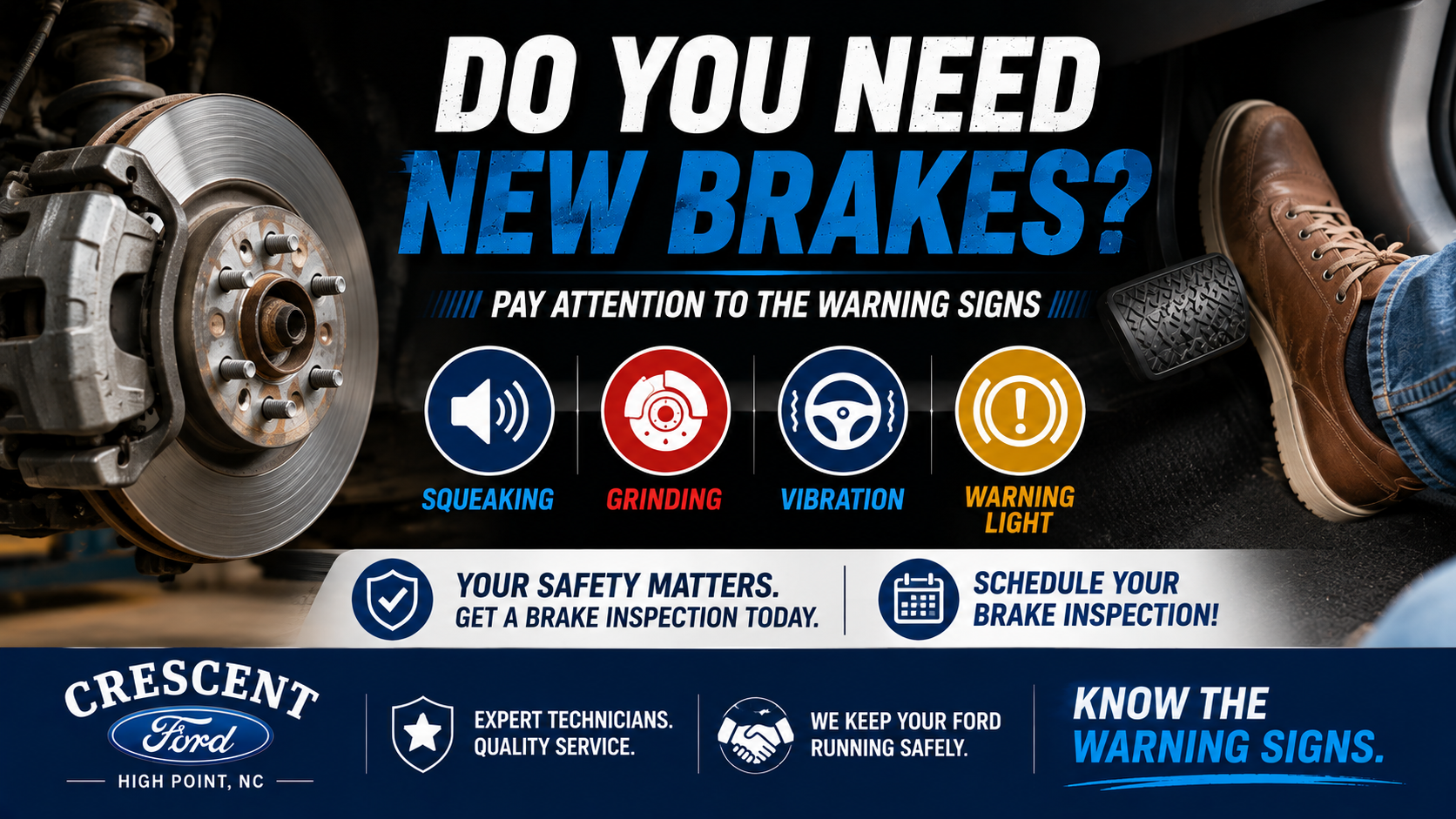
rake warning signs including squeaking, grinding, vibration and dashboard warning lights, with brake service available at Crescent Ford in High Point, NC

How Do You Know When You Need New Brakes? Warning Signs to Watch

How Do You Know When You Need New Brakes? You're backing out of the driveway and hear: SQUEEEEEAK. Or you press the brake pedal at a stoplight and feel: a little vibration. Or maybe your brakes just don't feel quite like they used to. And immediately you wonder: "Do I need new brakes?" Maybe. But here's the important part: Your braking system has several components, and not every brake symptom automatically means you need new brake pads. It could involve: Brake pads Rotors Brake fluid Calipers Sensors Another part of the braking system The symptom tells you: "Something needs attention." An inspection tells you: "Here's what's actually wrong." Let's go through the most common signs your brakes may need service—and which symptoms you shouldn't ignore. Schedule a Brake Inspection at Crescent Ford Hearing a new brake noise or noticing a change in how your vehicle stops? Schedule a brake inspection at Crescent Ford in High Point. What Are the Signs You May Need New Brakes? Some of the most common warning signs include: Squeaking or squealing Grinding Vibration while braking Longer stopping distance A brake pedal that feels different Pulling while braking A burning smell Brake warning lights Visible brake wear Some symptoms develop gradually. Others deserve much more immediate attention. Let's take them one at a time. Why Are My Brakes Squeaking? This is probably the brake question we hear most often. Squeaking brakes don't always mean your brakes are failing. Brake noise can have several causes. Depending on the vehicle and circumstances, you may hear temporary brake noise because of: Moisture Surface rust Dust or debris Temperature Brake-pad material Normal conditions after the vehicle has been sitting For example, if your vehicle sits outside overnight after rain, you may occasionally hear some noise during the first few stops. That may disappear as you drive. But if you're hearing: persistent or frequent squeaking every time you brake? That's worth having inspected. Ford includes loud or frequent squeaking among the signs that brakes may need service. Is It Safe to Drive With Squeaking Brakes? That depends on why they're squeaking. A brief occasional squeak isn't necessarily an emergency. But if the noise is: New Persistent Getting louder Accompanied by vibration Accompanied by reduced braking performance Accompanied by a warning light don't just turn the radio up and hope it goes away. 😂 Get the brakes checked. Brake noises are much easier to deal with when they're investigated before they become more serious. Why Are My Brakes Grinding? Grinding is much more concerning than a little squeaking. If you hear a harsh: GRINDING or metal-on-metal sound while braking, have the vehicle inspected promptly. One possible cause is severely worn brake-pad friction material. If brake components begin making metal-to-metal contact, you may no longer be dealing with: "I need brake pads." You may now be dealing with: "I need brake pads AND potentially additional brake components." Ford specifically warns that delaying replacement of worn brakes can result in rotor damage and additional repair expense. This is exactly why waiting for the brakes to become extremely noisy isn't a great maintenance strategy. Can Worn Brake Pads Damage the Rotors? Yes, they can. Brake pads are designed to provide friction against the rotor to slow the vehicle. As the friction material wears away, the pads eventually reach the end of their useful life. If they're allowed to wear too far, additional components can be damaged. That's one reason replacing worn pads before they become severely worn can potentially prevent a more expensive brake repair. Think of it like this: Brake maintenance = normal wear item. Ignoring brake maintenance = potentially more parts. Why Does My Steering Wheel Shake When I Brake? A steering wheel that shakes or vibrates while braking is another reason to have the braking system inspected. Drivers often describe it as: shaking pulsing shuddering or vibration. Ford lists continuous steering-wheel vibration or shuddering while braking as a brake-service warning sign. The exact cause can't be diagnosed from the sensation alone. The braking system, suspension, wheels, tires and other components can all affect what you feel through the steering wheel. So don't automatically assume: "I need rotors." Have the vehicle inspected. Why Does My Brake Pedal Pulse? A brake pedal that pulses under certain circumstances may be normal if the anti-lock braking system is actively operating during a hard stop or on a low-traction surface. That's different from a repetitive vibration or pulsation you feel during ordinary braking. If your pedal consistently pulses during normal stops, schedule an inspection. The key word is: consistent. Something happening once during an emergency stop isn't the same as something happening every morning at the same traffic light. Why Does My Brake Pedal Feel Soft or Spongy? A brake pedal that suddenly feels: soft spongy or significantly different from normal deserves attention. Ford specifically lists an unusually "squishy" brake pedal as a reason to schedule brake service. Changes in pedal feel can have multiple causes, and some can affect braking performance. If the pedal suddenly feels dramatically different or the vehicle isn't stopping normally, don't keep driving simply to see whether it improves. Safety comes first. Why Is My Brake Pedal Hard to Push? The opposite can also happen. If your brake pedal suddenly becomes unusually difficult to depress, that can indicate a braking-system problem as well. Ford also lists a brake pedal that becomes difficult to depress among its brake-service warning signs. Again: A noticeable change in brake-pedal feel should be inspected. You drive your vehicle every day. You know what the pedal normally feels like. If one morning you're thinking: "Whoa. That's different." Pay attention to that instinct. Why Does My Car Pull When I Brake? If your vehicle consistently pulls to one side during braking, schedule an inspection. Pulling can have multiple possible causes, including issues involving: Brakes Tires Alignment Suspension That's why trying to diagnose a vehicle based on one symptom can be misleading. If the pull happens specifically when braking, the braking system should be part of the inspection. Why Does It Take Longer for My Car to Stop? This is one of the symptoms we don't want you ignoring. If your vehicle's stopping performance has noticeably changed, have it inspected. You may notice: You're pressing the pedal farther than before. The vehicle doesn't seem to slow as quickly. You need more distance to stop. Those are not symptoms to postpone until your next convenient oil change. If the vehicle isn't braking normally or you don't believe it can be driven safely, don't drive it. Why Do My Brakes Smell Like They're Burning? A strong burning or acrid odor around the brakes can indicate excessive heat. Ford lists a burning odor among the warning signs that warrant brake inspection. This can happen under different circumstances, including prolonged or heavy braking. If you notice a strong burning smell after normal driving—or especially if it's accompanied by: Smoke Reduced braking performance Pulling An unusual pedal Excessive heat near a wheel stop somewhere safe and have the situation evaluated. Don't touch brake components or wheels to check whether they're hot. They can become extremely hot. Why Is My Brake Warning Light On? Your vehicle can have more than one brake-related warning indicator. A red brake-system warning light may have several possible causes. First, make sure the parking brake is fully released. Ford advises that if the brake warning remains illuminated after the parking brake is released, the braking system should be inspected promptly. A brake warning light does not automatically mean: "You need brake pads." That's why diagnosis matters. RELATED READING — Why Is My Check Engine Light On? What to Do Next Brake light isn't the only dashboard warning worth understanding. See what a check engine light may be trying to tell you. Is the ABS Light the Same as the Brake Warning Light? No. The ABS warning light relates to the vehicle's anti-lock braking system. If the ABS system detects a malfunction, the warning indicator can illuminate. That doesn't necessarily mean the vehicle has worn brake pads. And it doesn't mean you should ignore it. Your owner's manual contains vehicle-specific information about dashboard warnings, and an inspection can determine what's causing the light. How Long Do Brake Pads Last? There is no universal mileage at which every vehicle needs brake pads. That's important. You may see estimates online that say: "Replace your brakes every X miles." Real life is more complicated. Brake wear depends heavily on: Driving style Vehicle weight Traffic Terrain Towing Payload Brake material Road conditions How frequently you drive The specific vehicle Two people can own the same model and need brake service at very different mileages. That's why: inspection > guessing by odometer. Do City Drivers Wear Out Brakes Faster? They can. Think about the difference. Highway driving: Drive 50 miles. Brake a few times. Stop-and-go driving: Drive 50 miles. Brake. Accelerate. Brake. Accelerate. Brake. Repeat approximately 900 times because Greensboro traffic has decided today is the day. 😂 More frequent braking can mean more wear. So someone who drives primarily around town may have a very different brake-service experience from someone who spends most of their miles cruising on the interstate. Does Mountain Driving Wear Brakes Faster? It can. Long downhill grades can place significant heat and demand on the braking system. That's particularly relevant for drivers around the Piedmont Triad who frequently head toward: Boone Blowing Rock Asheville Blue Ridge Parkway Other mountain destinations Proper driving technique matters. Riding the brakes continuously down a long grade can generate substantial heat. Your owner's manual may provide guidance specific to your vehicle for driving on steep grades or when towing. Does Towing Wear Out Brakes Faster? Potentially, yes. More weight means the vehicle has more work to do when slowing down. That's one reason trucks and SUVs used for: Towing Hauling Work Heavy payloads may experience different brake wear from the same vehicle used only for light commuting. If your Ford regularly tows, brake inspections should be taken seriously. Do Electric Vehicles and Hybrids Need Brake Pads? Yes. Hybrid and electric vehicles still have physical braking systems. However, many use regenerative braking, which can reduce reliance on the friction brakes during certain types of deceleration. That can affect how brake components wear. But: regenerative braking does not eliminate the need for brake inspection and maintenance. The vehicle still has brakes. What Is the Difference Between Brake Pads and Rotors? Think of it this way: Brake Pads These contain friction material and press against the rotor when braking. Brake Rotors These are the discs the pads clamp against. Together, they create the friction needed to slow the vehicle. The pads are designed to wear. Rotors also experience wear and can require resurfacing or replacement depending on their condition, measurements and manufacturer specifications. That's why: "How much are brakes?" is difficult to answer without seeing the vehicle. Do you need pads? Pads and rotors? Something else? We need to inspect it first. Do You Always Need Rotors When Replacing Brake Pads? Not automatically. Whether rotors require replacement depends on their: Thickness Condition Wear Surface Manufacturer specifications Other factors This is one of those areas where an inspection and measurements matter. You don't want someone replacing parts you don't need. But you also don't want new pads installed against rotors that aren't suitable for continued service. Can I See Whether My Brake Pads Are Worn? Sometimes you can see part of the brake pad through the wheel. But accurately evaluating the braking system isn't always as simple as looking through the spokes. An inspection can evaluate: Pad thickness Rotor condition Brake hardware Fluid Hoses/lines Other visible components So if you're uncertain, don't rely solely on: "They looked okay to me." How Often Should I Have My Brakes Inspected? Rather than waiting until the brakes start making noise, have them inspected as part of routine vehicle maintenance. Ford recommends regular brake-system inspection as part of vehicle maintenance and specifically emphasizes having brakes checked before they're badly worn. Your exact maintenance needs depend on your vehicle, mileage and driving conditions. Check your owner's manual for vehicle-specific guidance. Can I Wait Until My Brakes Start Grinding? We wouldn't. Grinding can indicate that you've moved beyond ordinary friction-material wear into a situation where additional components may be affected. This is the difference between: preventive maintenance and repairing damage after something has been ignored. If your brakes are telling you something? Listen. They're one of the few parts of the vehicle we'd really prefer you not procrastinate on. How Much Does a Brake Job Cost? It depends on what the vehicle actually needs. Brake service can involve different combinations of: Pads Rotors Calipers Hardware Brake fluid Sensors Other components The vehicle itself matters too. Brake components for a: Ford Maverick aren't necessarily the same as those for an: F-250 Super Duty. That's why the first step isn't: "Give me a brake-job price." It's: "Tell me what my vehicle actually needs." View Current Ford Service Specials Before scheduling your brake service, check Crescent Ford's current service offers for available maintenance and repair specials. Should I Replace My Brakes Myself? Brake service is a safety-critical repair. Some experienced DIYers have the tools, knowledge and vehicle-specific service information to perform brake work correctly. But if you're unsure how to: Inspect components Measure wear Properly lift and support the vehicle Service electronic parking-brake systems Torque fasteners correctly Bleed hydraulic components when necessary Verify proper operation afterward this isn't the repair we'd recommend learning by trial and error. Modern vehicles may also require specific procedures or service modes when performing certain brake repairs. If you're not confident in the procedure, have the brakes professionally serviced. Why Get Brake Service at a Ford Dealer? For Ford vehicles, dealer service provides access to technicians familiar with Ford braking systems, vehicle-specific procedures and appropriate parts. Ford's Motorcraft brake pads are designed and tested to meet Ford engineering standards for factors including wear, noise, dust and vibration. That doesn't mean a dealership is the only place capable of performing brake service. But if you're driving a Ford and want technicians accustomed to servicing Ford vehicles, dealership service can make sense. Schedule Ford Brake Service in High Point What Happens During a Brake Inspection? The exact inspection depends on the vehicle and symptoms, but the goal is to determine: What's worn? What's damaged? What's still serviceable? What's causing the symptom? A technician may evaluate items such as: Brake-pad condition Rotor condition Calipers Brake fluid Brake hoses and lines Warning indicators Related components Then you can make a repair decision based on what the vehicle actually needs. What If My Car Needs More Than Just Brakes? This is where service and sales can naturally overlap. Suppose you come in expecting: brake pads. Then the inspection reveals: Brakes Tires Suspension work Another major repair High mileage Additional maintenance coming soon Now you're facing a larger question: "Is this vehicle still worth fixing?" That doesn't automatically mean you should trade it. Sometimes repairing the vehicle is absolutely the smarter financial decision. But if the repair list is becoming expensive and you've already been thinking about replacing the vehicle, it may make sense to compare: repair cost vs. current trade value before making the decision. Getting an appraisal doesn't obligate you to buy another vehicle. It simply gives you another number to consider. Is My Car Worth Fixing or Should I Trade It In? If your brake inspection uncovers several expensive repairs, here's how to decide whether fixing or replacing your vehicle makes more financial sense. Should I Trade My Car Instead of Replacing the Brakes? If the vehicle only needs normal brake maintenance? Probably not for that reason alone. Brakes are wear items. Eventually replacing brake pads doesn't mean your vehicle is becoming unreliable. But if brakes are one item on a growing repair list, that's different. For example: Brakes + tires + transmission issue + 180,000 miles deserves a different conversation from: "My otherwise-great vehicle needs brake pads." Look at the whole vehicle. RELATED READING — My Car Needs Expensive Repairs—Can I Trade It In As-Is? Brake Service in High Point, NC If you're hearing squeaking, grinding or another unusual brake noise around High Point, Greensboro, Thomasville, Trinity, Archdale, Kernersville or elsewhere in the Piedmont Triad, don't wait for the noise to become dramatically worse before having it checked. Sometimes the answer is straightforward: You need brake pads. Sometimes the brakes are fine and the noise has another explanation. And sometimes an inspection catches wear before it turns into a more expensive repair. That's the value of having the vehicle looked at. You don't need to diagnose it from the driver's seat. That's our job. So, How Do You Know When You Need New Brakes? Your vehicle may be telling you. Watch for: Squeaking or squealing Grinding Vibration when braking Changes in brake-pedal feel Reduced stopping performance Pulling while braking Burning odors Brake-system warning lights But remember: A symptom doesn't automatically tell you which part needs replacement. That's what the inspection is for. And with something as important as your brakes, we'd rather find out: "You're okay for now." than have you wait until a small maintenance item becomes a larger repair—or a safety issue. Hearing Something When You Brake? Schedule a Brake Inspection Looking for Current Maintenance Offers? View Service Specials Did Your Inspection Reveal Bigger Repairs? Value Your Trade RELATED READING Why Is My Check Engine Light On? What to Do Next Is My Car Worth Fixing or Should I Trade It In? My Car Needs Expensive Repairs—Can I Trade It In As-Is? Should I Fix My Car Before Trading It In? What Actually Affects Trade Value Frequently Asked Questions About Brake Replacement What are the first signs that I need new brakes? Persistent squeaking or squealing, grinding, vibration during braking, changes in pedal feel and reduced braking performance can all indicate that your braking system needs inspection. The symptom alone doesn't necessarily tell you which brake component needs replacement. Does squeaking mean I need new brake pads? Not always. Moisture, surface rust, temperature and other conditions can sometimes cause temporary brake noise. Persistent or frequent squeaking should be inspected, especially if it's accompanied by other braking symptoms. Is grinding worse than squeaking brakes? Generally, yes. Grinding can indicate a more serious condition and should be inspected promptly. Continuing to drive with severely worn brake components can potentially damage additional parts such as the rotors. How many miles do brake pads last? There isn't one replacement mileage that applies to every vehicle. Brake-pad life varies based on driving habits, traffic, terrain, vehicle weight, towing and other conditions. Regular inspection is more useful than relying solely on mileage. Why does my steering wheel shake when I brake? Brake-related vibration can have several possible causes. Because tires, wheels, suspension and braking components can all contribute to vibration, an inspection is the best way to identify the actual cause. Do I need rotors every time I replace brake pads? Not automatically. Rotor replacement depends on condition, wear, thickness and manufacturer specifications. The rotors should be evaluated when brake pads are serviced. Can I drive with my brake warning light on? First verify that the parking brake is fully released. Ford advises having the braking system inspected promptly if the brake warning remains illuminated. If braking performance is affected or you don't believe the vehicle can be driven safely, don't drive it. Why does my brake pedal feel spongy? A soft or spongy brake pedal can have multiple possible causes and should be inspected. A sudden or significant change in brake-pedal feel deserves prompt attention. Do hybrids still need brake replacements? Yes. Hybrid vehicles still use friction brakes even though regenerative braking can reduce their use under certain driving conditions. Their braking systems still require inspection and maintenance. Does towing wear brakes faster? Towing adds weight and can increase the demand placed on the braking system. Driving conditions, trailer weight, vehicle configuration and driving habits can all affect brake wear. Should I trade my car because it needs brakes? Normal brake replacement alone generally isn't a reason to replace an otherwise reliable vehicle. Brakes are wear items. If the vehicle needs brakes plus several other expensive repairs, however, comparing total repair cost with its current trade value may help you make a better decision. Where can I get Ford brake service in High Point, NC? Crescent Ford's service department in High Point can inspect your Ford's braking system, diagnose brake noises or warning lights and recommend service based on the vehicle's actual condition.
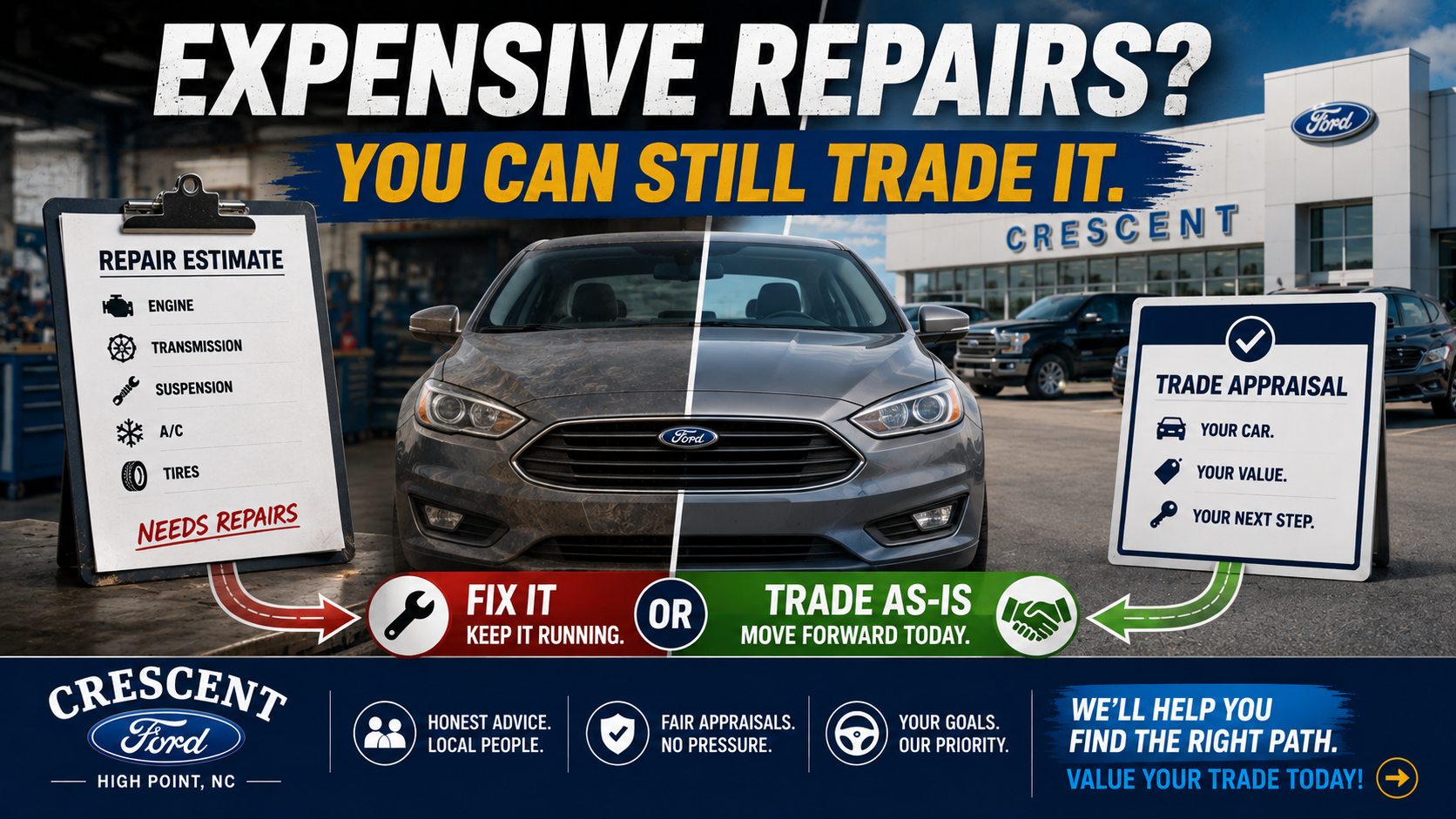
Car needing expensive repairs compared with trading it in as-is at Crescent Ford in High Point, NC

My Car Needs Expensive Repairs—Can I Trade It In As-Is?

My Car Needs Expensive Repairs—Can I Trade It In As-Is? Your car is in the shop. The service advisor gives you the news: Transmission: $5,000. Or maybe it's: Engine repair: $4,200. A/C + suspension + tires: $3,600. And suddenly you're thinking: "I don't even want to fix this thing anymore." Which leads to the next question: Can you trade in a car that needs expensive repairs? Yes. A vehicle does not have to be mechanically perfect before a dealership can appraise it. Cars with: Check engine lights Transmission problems Engine problems A/C failures Worn tires Body damage High mileage Suspension problems Electrical issues Other mechanical needs can potentially still be traded. The more important question is: Should you repair it first—or trade it exactly as it sits? And that's where you want to do a little math before spending thousands of dollars. Can I Really Trade In a Car That Needs Repairs? Yes. A trade appraisal is an evaluation of the vehicle in its current condition. That doesn't mean the mechanical problem won't matter. It absolutely can. If your vehicle needs a $5,000 transmission repair, a dealership isn't going to appraise it as though the transmission were perfect. But: Needs repair doesn't automatically mean: Has no trade value. The dealership will evaluate the entire vehicle, including things such as: Year Make Model Trim Mileage Equipment Vehicle history Cosmetic condition Mechanical condition Tires Local market demand Current wholesale/retail market Cost and extent of needed reconditioning Then the dealership can determine what the vehicle is worth as-is. Find Out What Your Car Is Worth As-Is Your vehicle doesn't have to be repaired before it can be evaluated. Start by finding out what it's worth in its current condition. Do I Have to Fix My Car Before Trading It In? No. And if the repair is expensive, we would generally recommend finding out the vehicle's as-is trade value before automatically approving the repair. Why? Because this: $4,000 repair does not necessarily equal: $4,000 increase in trade value. That's one of the most important concepts in this entire article. Imagine your vehicle is worth: $10,000 as-is. You spend: $4,000 repairing it. And afterward it's worth: $12,500. You improved the trade value by: $2,500 but spent: $4,000. If your only reason for completing the repair was to trade the vehicle immediately afterward, you spent more than you gained. That's why you want the appraisal before making the repair decision. Repairs Don't Necessarily Increase Trade Value Dollar-for-Dollar This is where consumers can understandably get confused. You might think: "If the dealership has to spend $3,000 fixing it, I'll lose $3,000 if I don't repair it myself." Not necessarily. A dealership evaluates reconditioning differently from a retail customer paying a repair bill. There are also other factors involved in determining what happens to a trade. Depending on the vehicle, condition and dealership, it might ultimately be: Reconditioned and retailed Sold wholesale Sent to auction Handled through another disposition channel So the dealership isn't simply looking at your retail repair estimate and subtracting it from an otherwise perfect-car value. The vehicle is appraised as a whole. That's another reason getting a real appraisal is more useful than trying to calculate the value yourself from a repair bill. Should I Get the Repair Estimate Before Trading the Car? If you already have one? Bring it. A repair estimate can provide useful information. But don't feel like you necessarily need to authorize thousands of dollars of diagnostic work solely to make your vehicle eligible for appraisal. If you know: "The transmission is slipping." tell us. If the check engine light is on? Tell us. If the A/C stopped working? Tell us. If another shop diagnosed a specific problem? Bring the paperwork. Being straightforward about what you know helps everyone understand the vehicle. Can I Trade In a Car With a Check Engine Light On? Potentially, yes. A check engine light does not automatically prevent a vehicle from being traded. But there's a huge range of problems that can trigger that light. It could be relatively minor. Or it could indicate a significant mechanical issue. That's why the light itself doesn't tell us how much the vehicle is worth. The underlying problem matters. If you haven't had the vehicle diagnosed yet and it otherwise runs normally, diagnosis may give you useful information before making a major financial decision. RELATED READING — Why Is My Check Engine Light On? What to Do Next Can I Trade In a Car With Transmission Problems? Potentially, yes. Transmission problems can significantly affect a vehicle's value because transmission repair or replacement can be expensive. But that doesn't mean: "Nobody will take it." Suppose you're facing a major transmission repair. Before spending several thousand dollars, you could compare: OPTION A Repair the transmission + keep the vehicle OPTION B Repair the transmission + trade the vehicle OPTION C Trade the vehicle as-is Those are three completely different financial decisions. If you already wanted to replace the vehicle, Option B deserves particular scrutiny. Why spend thousands repairing a vehicle you're immediately going to give up unless the numbers clearly justify it? Can I Trade In a Car With Engine Problems? Again: Potentially, yes. The severity matters. There's a big difference between: A sensor-related engine issue and An engine requiring major internal repair or replacement. The more significant the mechanical problem, the more likely it is to have a meaningful impact on trade value. But even a vehicle requiring major engine work may still have value. The correct question isn't: "Is my broken car worthless?" It's: "What is my vehicle worth in its current condition?" Can I Trade In a Car That Doesn't Run? This gets more complicated. A non-running vehicle can potentially still have value, but logistics and appraisal become more vehicle-specific. If the vehicle cannot safely be driven to the dealership, contact the dealership before arranging transportation. Explain: What the vehicle is Mileage What happened Whether it starts Whether it moves under its own power Where the vehicle is located What diagnosis you have, if any Then determine the best next step. Don't pay to tow a vehicle somewhere without first confirming how the appraisal will be handled. Can I Trade In a Car With Body Damage? Yes. Mechanical problems aren't the only condition issues dealerships evaluate. Trades can have: Dents Scratches Cracked bumpers Paint damage Hail damage Interior wear Stains Wheel damage Accident history Again, condition can affect value. But you generally don't need to make the vehicle cosmetically perfect before asking what it's worth. Sometimes inexpensive cleanup makes sense. Major bodywork solely for the purpose of trading? Get the appraisal first. What Actually Happens When a Dealership Appraises a Car That Needs Repairs? The appraiser is essentially trying to answer: "What is this specific vehicle worth to us today in this condition?" That means evaluating more than the broken component. For example: Imagine two vehicles both need a transmission. Vehicle A 2022 model 55,000 miles Clean interior Good tires Desirable trim Strong local demand Vehicle B 2014 model 185,000 miles Body damage Worn tires Multiple warning lights Poor interior condition Same type of mechanical failure. Very different vehicles. That's why there isn't a universal formula such as: Normal trade value – repair estimate = trade offer. The entire vehicle matters. How Much Does a Mechanical Problem Reduce Trade-In Value? There isn't a universal number. And anyone who gives you one without inspecting the vehicle is guessing. The impact depends on: What is wrong Severity of the problem Repair complexity Vehicle value Age Mileage Overall condition Market demand Whether other repairs are needed How the dealership expects to dispose of or recondition the vehicle A $3,000 repair on a desirable late-model vehicle is very different from a $3,000 repair on an older vehicle worth only a few thousand dollars when fully operational. Context matters. Should I Fix a $500 Repair Before Trading? Maybe. This is where the math can change. We're much more cautious about: $4,000 transmission repair than something inexpensive and obvious. Small repairs that improve the vehicle's operation or presentation can sometimes make sense. But even then: Don't assume. If you've already decided to trade soon, ask whether completing the repair is likely to improve the appraisal enough to justify spending the money. Should I Put New Tires on My Car Before Trading It? Usually, don't automatically install a full set of new tires solely because you're trading the vehicle. Worn tires can affect condition and value. But four brand-new retail-priced tires don't necessarily increase your trade value by exactly what you spent. If the vehicle needs tires and you're planning to keep driving it for safety reasons, that's a different decision. But if you're trading tomorrow? Get the appraisal first. RELATED READING — Should I Fix My Car Before Trading It In? What Actually Affects Trade Value What Repairs SHOULD I Make Before Trading? Think: cheap, simple and obvious before: expensive mechanical overhaul. For example, depending on the situation: Remove personal belongings Clean excessive trash Address simple inexpensive items Gather keys Gather maintenance records Bring accessories that belong with the vehicle You don't need to transform the car into showroom condition. You're trading a used vehicle. It's expected to be used. Should I Detail My Car Before Trading It In? You don't need to spend hundreds of dollars on professional detailing just to receive an appraisal. But: Clean is helpful. Remove: Trash Personal belongings Excessive clutter A basic wash and vacuum certainly won't hurt. The appraiser still needs to evaluate the actual vehicle beneath the dirt. But don't confuse: cleaning with reconditioning. A detail doesn't erase: Mechanical problems Accident history Significant body damage Worn tires Warning lights Clean the vehicle reasonably. Don't spend a fortune trying to disguise normal use. Should I Tell the Dealer What's Wrong With My Car? Yes. If you know about a significant problem, be straightforward about it. For example: "The transmission started slipping last week." "The A/C isn't working." "The check engine light came on and another shop diagnosed an EVAP leak." "It overheated and I've stopped driving it." That information is useful. The dealership is going to evaluate the vehicle anyway. Trying to hide a major known problem doesn't create a better transaction. A transparent appraisal is better for everyone. What If I Still Owe Money on the Car? You can potentially trade a vehicle that: needs repairs and still has a loan. Now we need another number: Your payoff amount. Compare: Trade Value vs. Loan Payoff If the trade value is higher than your payoff, you have positive equity. If your payoff is higher than the trade value, you have negative equity. For example: As-is trade value: $12,000 Loan payoff: $16,000 Negative equity: $4,000 That $4,000 doesn't disappear because you trade the vehicle. It still has to be addressed as part of the transaction. The CFPB specifically recommends finding both your payoff amount and potential trade value before deciding how to proceed with a vehicle that still has a loan. RELATED READING — Can You Trade In a Car You Still Owe Money On? Does a Big Repair Make Negative Equity Worse? It can indirectly create a difficult situation. Imagine: Vehicle value before major mechanical failure: $17,000 Loan payoff: $18,000 You were already slightly upside down. Then the transmission fails. Now the vehicle's as-is value may be lower while your loan payoff hasn't suddenly decreased. That can increase the gap between: what you owe and what the vehicle is worth. This is where we especially don't want you making the decision based only on frustration. Get the numbers. You may discover repairing and continuing to drive the vehicle is the better financial choice. Or there may still be a reasonable path to replacing it. But you need the actual appraisal and payoff to know. The FTC also cautions consumers that negative equity doesn't simply vanish when a vehicle is traded; if incorporated into a new loan, it increases the amount being financed and can increase total borrowing costs. Should I Repair the Car If I'm Upside Down? Maybe. This is where our earlier repair-vs.-trade article becomes extremely useful. If: The vehicle otherwise fits your needs The repair restores reliable transportation You have substantial negative equity The vehicle has otherwise been dependable repairing it and continuing to pay down the loan may make sense. But if: Repairs keep occurring Reliability is poor Several additional expensive repairs are coming The vehicle no longer meets your needs then you may still want to understand your replacement options. RELATED READING — Is My Car Worth Fixing or Should I Trade It In? Can I Trade In a Car I Can't Afford to Repair? Potentially, yes. And this is an important distinction. You don't necessarily need to come up with: $5,000 cash for repairs before you're allowed to find out what the vehicle is worth. You can ask for an appraisal in its current condition. Then you'll know whether trading provides a realistic alternative. That doesn't guarantee a replacement transaction will work. Your: Trade value Loan payoff Credit Down payment Replacement vehicle Financing terms all matter. But at least you'll have another option to evaluate. Does Trading As-Is Save Me the Hassle of Repairing It? Potentially, yes—and that's one of the biggest non-financial reasons people choose this route. A major repair may involve: Diagnosis Parts availability Repair appointments Transportation while the vehicle is down Rental costs Additional problems discovered during repair Time Sometimes a consumer decides: "Even if repairing might technically produce a little more value, I don't want to deal with it." Convenience has value too. Just make that choice after seeing the numbers. Is It Better to Sell a Broken Car Privately? You may be able to get more money selling a vehicle privately. But a vehicle with known mechanical problems can make private sale considerably more complicated. You'll need to deal with: Advertising Buyers Test drives Payment Title paperwork Disclosure of known issues Negotiation People who may not understand the extent of the repair A knowledgeable private buyer may be interested in a project or repairable vehicle. But convenience is one of the major advantages of trading. RELATED READING — Is It Better to Trade In or Sell Your Car Yourself? Is There a Tax Advantage to Trading a Car in North Carolina? Potentially, yes. North Carolina generally assesses a 3% Highway-Use Tax when a vehicle title is transferred rather than ordinary retail sales tax. For a dealership transaction involving a trade, the trade allowance can reduce the net amount used in calculating the Highway-Use Tax. Here's a simplified illustration: Replacement vehicle: $30,000 Trade allowance: $10,000 Difference: $20,000 The Highway-Use Tax calculation for the dealer transaction is generally based on that net difference, subject to applicable North Carolina rules. That means comparing: private-sale price vs. trade allowance shouldn't always be done dollar-for-dollar. There may also be convenience and transaction differences to consider. How Do I Know Whether to Repair or Trade As-Is? Here's the calculation we recommend. Step 1: Get the Repair Estimate Find out: What exactly is wrong? and What will it cost to repair? Step 2: Get an As-Is Appraisal Find out: What is the vehicle worth today without repairing it? Step 3: Determine Your Loan Payoff If you have a loan, get the actual payoff amount. Step 4: Ask What Else the Vehicle Needs Don't evaluate a $3,000 repair in isolation if another $4,000 of maintenance and repairs are approaching. Step 5: Compare Your Options Now evaluate: REPAIR + KEEP Repair cost Expected future repairs Remaining loan vs. TRADE AS-IS + REPLACE Trade equity/negative equity Replacement cost Financing Expected ownership costs Now you're making a decision with real information. Example: When Trading As-Is Might Make Sense Imagine: Vehicle value if mechanically sound: approximately $10,000 Current major repair estimate: $4,500 Mileage: 165,000 Other upcoming repairs: $1,500 Recent repair history: Frequent Vehicle no longer fits your needs: Yes You planned to replace it within a year anyway. Before spending: $4,500 we would absolutely want to know: What is the vehicle worth as-is? Maybe repairing it still wins. But this is exactly the situation where an appraisal should happen before the repair. Get an As-Is Trade Appraisal Example: When Repairing Might Make More Sense Now imagine: Vehicle value: $18,000 Repair estimate: $1,800 Mileage: 75,000 Other known repairs: None Repair history: Minimal Vehicle fits your needs: Yes Loan situation: Good You intended to keep it another four years. In that situation? We may tell you: Fix the car. Seriously. The existence of a trade-in department doesn't mean trading is automatically the best financial decision. If a reasonable repair restores an otherwise good vehicle that still fits your life, keeping it may make considerably more sense. Schedule Service at Crescent Ford If repairing your current vehicle makes more financial sense, our service team can help you keep it rolling. Example: When You Need More Information Vehicle value: Unknown Repair estimate: $3,500 Loan payoff: $14,000 Mileage: 110,000 Additional repairs: Unknown This isn't a repair decision yet. You're missing information. Before doing anything: Get the appraisal. Then compare your trade value with your payoff. That's the entire purpose of gathering numbers first. Can I Get My Car Appraised Before Deciding Whether to Repair It? Yes. And that's probably the most important takeaway from this article. Getting an appraisal doesn't mean: You have to trade the vehicle. It simply gives you another number. You can still decide: "Nope. I'm fixing it." That's perfectly fine. Now you know you made that decision after comparing both options. An appraisal is information. Not an obligation. What Should I Bring for a Trade-In Appraisal? If available, bring: Vehicle Keys/remotes Registration Loan/payoff information Repair estimate Maintenance records Information about known mechanical issues If the vehicle is financed, the exact documentation needed can depend on the lender and transaction. If you're unsure what to bring, contact the dealership before your visit. What If the Vehicle Is at Another Repair Shop? Call before moving it. If the vehicle is: safe and operable you may be able to bring it for appraisal normally. If it's: not safely drivable don't risk additional damage or your safety just to get it to a dealership. Explain where the vehicle is and what's wrong with it so you can determine the appropriate next step. Don't Make a $5,000 Repair Decision Without Knowing the Trade Value This is the central point. When you get an expensive repair estimate, your first instinct may be: "Well, I guess I have to fix it." Maybe. But if you've already been considering replacing the vehicle? Stop for a moment. You need two numbers: NUMBER 1 What will it cost to repair? NUMBER 2 What is it worth as-is? Then you can decide. That's much better than: Repair first. Ask questions later. Trading a Car That Needs Repairs in High Point, NC If your car needs expensive repairs in High Point, Greensboro, Winston-Salem, Thomasville, Trinity, Lexington, Kernersville or elsewhere around the Piedmont Triad, you don't necessarily have to repair it before exploring your trade options. At Crescent Ford, we can evaluate your vehicle in its current condition. Maybe the numbers show that trading it as-is makes sense. Maybe they show that repairing the vehicle and keeping it is clearly the smarter move. Either answer is useful. The important thing is that you don't spend thousands of dollars just because you assumed you had to repair the vehicle before anyone would take it. Find out what it's worth first. Then make the decision. FINAL CTA / INTERNAL LINKS Want to Know What It's Worth Right Now? Value Your Trade Want to Repair It Instead? Schedule Service at Crescent Ford Ready to Look at Replacement Options? Shop New Ford Vehicles Shop Used Cars, Trucks & SUVs RELATED READING Is My Car Worth Fixing or Should I Trade It In? Should I Fix My Car Before Trading It In? What Actually Affects Trade Value Can You Trade In a Car You Still Owe Money On? Is It Better to Trade In or Sell Your Car Yourself? Why Is My Check Engine Light On? What to Do Next Frequently Asked Questions About Trading a Car That Needs Repairs Can I trade in a car that needs major repairs? Yes. A vehicle does not necessarily need to be repaired before it can be appraised or traded. Mechanical condition will be considered when determining its value. Can I trade in a car with a bad transmission? Potentially, yes. A transmission problem can significantly affect trade value, but it doesn't automatically make the vehicle ineligible for trade. Before paying for a major transmission repair solely to trade the vehicle, consider getting an as-is appraisal. Can I trade in a car with engine problems? Potentially. The effect on value depends on the severity of the engine problem along with the vehicle's age, mileage, condition and market value. Can I trade in a car with the check engine light on? Yes, an illuminated check engine light does not automatically prevent a vehicle from being appraised. The underlying problem may affect its value. Can I trade in a car that doesn't run? A non-running vehicle may still have value, but appraisal and transportation logistics become more vehicle-specific. Contact the dealership before arranging transportation for a vehicle that cannot be safely driven. Should I repair my car before trading it in? Not automatically. Particularly with an expensive repair, consider getting the vehicle appraised as-is first. The amount you spend repairing the vehicle may not increase its trade value by the same amount. Will a dealer subtract the entire repair estimate from my trade value? There is no universal formula. Dealers evaluate the entire vehicle, including its condition, mileage, market demand, expected reconditioning and potential disposition. A retail repair estimate isn't necessarily deducted dollar-for-dollar from an otherwise perfect-condition value. Should I put new tires on my car before trading it? Not automatically. Worn tires can affect a vehicle's condition and value, but buying a new set immediately before trading doesn't guarantee an equal increase in trade value. Consider getting the appraisal first. Can I trade in a damaged car that I still owe money on? Potentially, yes. You'll need to compare the vehicle's current trade value with your loan payoff. If you owe more than the vehicle is worth, you have negative equity that must be addressed in the replacement transaction. Does negative equity disappear when I trade my car? No. If your loan payoff exceeds the vehicle's trade value, the difference still has to be addressed. If negative equity is incorporated into a new loan, it increases the amount financed and can increase borrowing costs. Is it better to repair a broken car or trade it? It depends on the repair cost, vehicle value, mileage, reliability, loan payoff, other upcoming repairs and replacement cost. Get both the repair estimate and as-is trade value before deciding. Can I get a trade appraisal without committing to buying another vehicle? Yes. An appraisal gives you information about the vehicle's current value. You can use that information when deciding whether repairing, keeping, selling or trading makes the most sense. Does trading a car reduce vehicle taxes in North Carolina? In a North Carolina dealer transaction, the trade allowance can reduce the net amount used to calculate the state's Highway-Use Tax, subject to applicable rules. North Carolina generally uses a 3% Highway-Use Tax on vehicle title transfers rather than ordinary retail sales tax. What should I do first if my car suddenly needs a $5,000 repair? Get a clear diagnosis and repair estimate. If you're considering replacing the vehicle, also determine its as-is trade value and, if financed, your current loan payoff. Those numbers let you compare repairing and keeping the vehicle with trading it in its current condition.

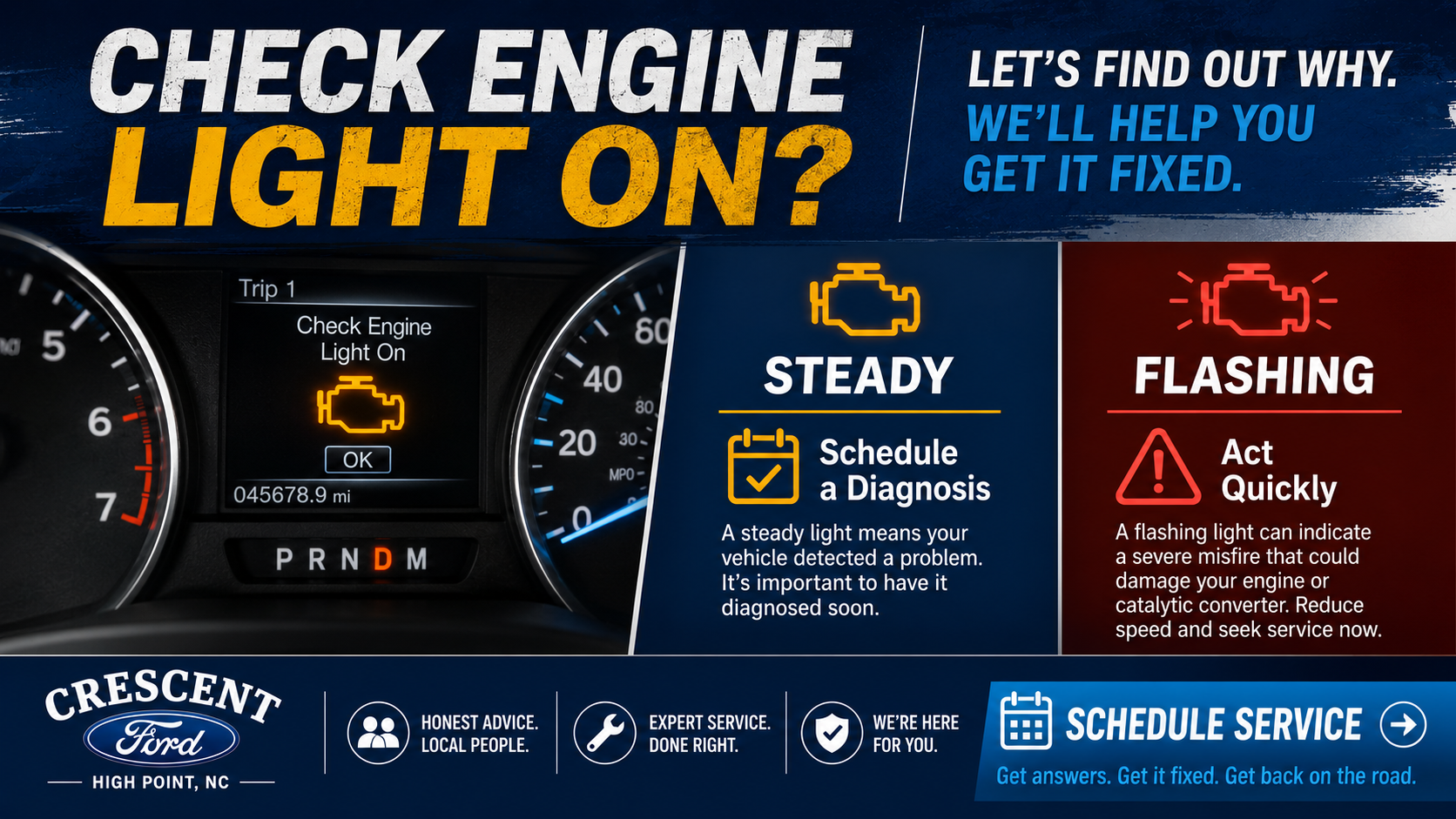
Check engine light guide explaining the difference between a steady and flashing warning light and when to schedule service at Crescent Ford

Why Is My Check Engine Light On? What to Do Next

Why Is My Check Engine Light On? What to Do Next You're driving along normally when suddenly you notice it: The check engine light. Great. Now what? Is your engine about to quit? Can you keep driving? Is this going to cost $50? Or $5,000? The frustrating answer is: The check engine light alone can't tell you. It can illuminate for something relatively simple, but it can also warn you about a problem that deserves immediate attention. That's because the check engine light isn't connected to just one component. It's part of your vehicle's on-board diagnostic system, commonly called OBD or OBD-II. The system continuously monitors aspects of engine operation and emissions-related systems. When it detects certain faults, it can store a diagnostic trouble code and turn on the check engine light—also called the Malfunction Indicator Light (MIL). So the light isn't the diagnosis. It's the warning that tells you a diagnosis is needed. The first thing to look at is very simple: Is the check engine light steady—or is it flashing? That distinction matters. Steady vs. Flashing Check Engine Light: What's the Difference? If you remember nothing else from this article, remember this section. A Steady Check Engine Light A check engine light that comes on and stays illuminated means your vehicle's diagnostic system has detected a fault. That doesn't automatically mean: "Stop the car immediately." Depending on the problem, the vehicle may seem completely normal. But it also doesn't mean: "Ignore it until something actually breaks." A steady light should be diagnosed because seemingly minor problems can sometimes affect: Fuel economy Emissions Engine performance Other components Long-term repair costs In other words: Don't panic—but don't ignore it. A Flashing Check Engine Light A flashing or blinking check engine light deserves much more urgency. A flashing malfunction indicator light can indicate a severe engine misfire. Continuing to operate the vehicle under those conditions can potentially damage emissions-control components, particularly the catalytic converter. If the check engine light begins flashing: Reduce your speed and load on the engine. Avoid hard acceleration. If the vehicle is running poorly, shaking, losing power, overheating or showing other serious symptoms, find a safe place to stop and arrange assistance rather than continuing to drive. Consult the owner's manual for vehicle-specific guidance. Flashing = don't treat it like a normal warning light. Schedule Check Engine Light Service If your check engine light is on, a proper diagnosis can identify what's triggering the warning before you start replacing parts. What Does the Check Engine Light Actually Monitor? Modern vehicles contain computers and sensors constantly monitoring vehicle operation. For model-year 1996 and newer light-duty cars and trucks, OBD-II monitors emissions-related systems and aspects of powertrain operation. When the system detects a problem that meets certain criteria, it can: Store a diagnostic trouble code and Illuminate the check engine light. That stored code gives a technician a starting point for diagnosis. But this is important: A trouble code doesn't always tell you which part to replace. It tells you what the vehicle's computer detected. There's a difference. What Are the Most Common Reasons a Check Engine Light Comes On? There are many possible causes, and the exact answer depends on the vehicle. But some broad categories appear frequently. 1. Loose or Faulty Fuel Cap / EVAP Leak Yes. Something as simple as a loose fuel cap can potentially trigger a check engine light on vehicles that use a conventional cap. Your vehicle's evaporative-emissions system is designed to contain fuel vapors. If the system detects a leak, it may illuminate the check engine light. A loose, damaged or improperly sealed fuel cap can be one possible cause. What Should You Do? If your vehicle has a traditional fuel cap and the check engine light appeared shortly after refueling, safely check whether the cap is installed correctly. If it was loose, secure it properly. Don't expect the light to necessarily disappear immediately. The vehicle may need to complete additional self-checks before determining that the problem is no longer present. And if the light remains on? Get it diagnosed. Don't assume the fuel cap was the problem simply because that's the easiest explanation. 2. Oxygen Sensor Problems Your vehicle uses oxygen sensors as part of managing engine operation and monitoring the exhaust system. If an oxygen sensor or its related circuit isn't operating as expected, the diagnostic system may store a fault code and illuminate the check engine light. A sensor problem can potentially affect: Fuel management Emissions Fuel economy Engine operation But again: A code involving an oxygen sensor doesn't automatically mean "replace the oxygen sensor." There may be another condition affecting the sensor's readings. That's why diagnosis matters. 3. Catalytic Converter Efficiency Problems The catalytic converter is part of the vehicle's emissions-control system. Your vehicle's computer can monitor whether the system appears to be functioning properly. If catalytic-converter efficiency falls outside expected parameters, the check engine light may illuminate. This is one reason you don't want to ignore a severe misfire. A continuing misfire can potentially damage the catalytic converter—and that can turn one problem into a more expensive one. 4. Engine Misfire An engine misfire means combustion isn't occurring properly in one or more cylinders. Possible causes can involve things such as: Spark plugs Ignition coils Fuel delivery Air/fuel mixture Mechanical engine problems Electrical faults Symptoms might include: Rough idle Shaking Hesitation Loss of power Poor acceleration But sometimes a misfire is detected before the driver notices much of anything. A severe misfire is also one of the conditions that can cause the check engine light to flash. 5. EVAP System Problems The fuel cap is only one piece of the evaporative-emissions system. A fault elsewhere in that system can also trigger the check engine light. Potential problems can involve: Hoses Valves Sensors Connections Leaks elsewhere in the system So if you've already checked the fuel cap and the light remains on, don't keep tightening it harder and hoping. 😂 There may be something else going on. 6. Air/Fuel or Fuel-Delivery Problems Your engine needs the correct balance of: air + fuel + spark to operate properly. Problems affecting fuel delivery or the information the computer uses to manage the air/fuel mixture can trigger diagnostic codes. Depending on the cause, you might also notice: Rough running Hard starting Hesitation Reduced fuel economy Lack of power Or you might notice nothing except the light. 7. Sensor or Electrical Problems Modern vehicles depend heavily on electronic sensors. A fault involving a sensor, wiring, connector or related circuit can sometimes trigger the check engine light even when the vehicle appears to drive normally. That's another reason visual inspection alone can't always identify the problem. The vehicle may look and feel perfectly fine while its diagnostic system has detected something outside the expected range. Can I Drive With the Check Engine Light On? It depends on: the light and what the vehicle is doing. If the Light Is Steady and the Vehicle Feels Normal You generally don't need to panic. But schedule a diagnosis rather than ignoring the light indefinitely. Pay attention to the vehicle. If additional symptoms develop, your situation may change. If the Light Is Flashing Treat the situation with greater urgency. Reduce engine load and seek service promptly. If the Vehicle Is Running Poorly Even with a steady light, symptoms matter. If you're experiencing: Severe shaking Major loss of power Overheating Smoke Unusual noises Strong fuel smell Multiple warning lights Other significant changes in vehicle operation don't rely on the fact that the check engine light happens to be steady. Find a safe place to stop and get appropriate assistance. How the vehicle is behaving matters just as much as the light itself. Can a Check Engine Light Turn Off by Itself? Yes. Sometimes the condition that triggered the light stops occurring. The OBD system can continue monitoring the vehicle, and after enough successful checks, the light may turn off. For example, a loose fuel cap that has been corrected may eventually result in the light going out after the system confirms the leak is no longer present. That doesn't mean the warning light was malfunctioning. It means the system detected a problem and later determined that the condition was no longer present. If the light repeatedly comes on and goes off, however, don't assume: "It fixed itself again." An intermittent problem may still need diagnosis. Why Is My Check Engine Light On but My Car Runs Fine? This is extremely common. The check engine light can detect certain faults before they create an obvious drivability problem. That's one of the benefits of on-board diagnostics. Your car doesn't have to: Shake Stall Overheat Make noise Lose power before the system recognizes that something isn't operating as expected. So: "It drives fine." doesn't mean: "Nothing is wrong." It means: "Whatever the computer detected hasn't necessarily created a symptom you can feel yet." What Does a Check Engine Light Diagnostic Code Mean? When a scan tool is connected to the vehicle's diagnostic port, it can retrieve stored Diagnostic Trouble Codes, commonly called DTCs. You might see codes formatted something like: P0XXX But here's where people sometimes get into trouble. They search the code online. Google says: "Oxygen sensor." They buy an oxygen sensor. They replace it. And... the light comes back. Why? Because the code may describe the system or condition where the problem was detected—not necessarily identify one guaranteed failed part. A proper diagnosis can involve: Reading stored codes Looking at live vehicle data Checking related components Inspecting wiring or connections Performing tests Following manufacturer diagnostic procedures The scan is the beginning. Diagnosis is what determines why the code is there. Is a Free Check Engine Light Scan the Same as a Diagnosis? Not necessarily. A code scan can be very useful. It tells you what codes are stored in the vehicle's computer. But retrieving: PXXXX isn't always the same as knowing: "This exact part has failed and replacing it will fix the vehicle." Think of it like this: A thermometer tells you: You have a fever. It doesn't necessarily tell you: why. Likewise, a trouble code gives the technician valuable information about what the computer detected. Further testing may be necessary to determine the actual cause. Should I Clear the Check Engine Light Myself? Clearing a code doesn't repair the problem that caused it. If the underlying condition remains, the light may simply return. Clearing diagnostic information can also erase useful data a technician may need when trying to determine what happened. And there's another issue particularly relevant in North Carolina: Emissions readiness monitors. After codes are cleared or the battery is disconnected, some OBD monitors may show as not ready until the vehicle completes the conditions necessary to run those self-tests again. That matters if you're approaching an emissions inspection. So don't treat: "How do I turn the light off?" as the same question as: "How do I fix the problem?" They're not. Will a Check Engine Light Make You Fail NC Inspection? For vehicles subject to North Carolina's OBD emissions inspection, an illuminated malfunction indicator light can matter. North Carolina currently requires emissions inspections in 19 counties, including several directly within Crescent Ford's market: Guilford Randolph Davidson Forsyth There are exemptions for certain vehicles, including qualifying newer low-mileage vehicles, vehicles 20 years old or older, diesels and registered farm vehicles. If your applicable vehicle's OBD system indicates an emissions-related failure, it may not pass the emissions portion of inspection until the issue is addressed. Schedule Service in High Point, NC Check engine light on before your NC inspection? Have the cause diagnosed before inspection day rather than simply clearing the code. My Inspection Is Due—Should I Just Clear the Check Engine Light? That's usually not a useful strategy. North Carolina's OBD emissions inspection doesn't only look at whether the dashboard light happens to be off at that exact moment. The inspection system communicates with the vehicle's OBD system. If too many required readiness monitors haven't completed their checks, the vehicle may not be ready for the emissions test. In other words: Clearing the light right before inspection isn't the same as repairing the vehicle. Address the cause instead. How Urgent Is a Check Engine Light? Here's a simple way to think about it. LEVEL 1 — Steady Light, Vehicle Running Normally Action: Schedule diagnosis. Don't ignore it for months, but you generally don't need to assume an immediate catastrophe. LEVEL 2 — Steady Light + Noticeable Symptoms Examples: Rough idle Hesitation Reduced power Poor acceleration Difficult starting Action: Have it evaluated promptly. The symptoms give the warning more context. LEVEL 3 — Flashing Check Engine Light Action: Reduce speed/load and seek service quickly. A severe misfire can potentially cause additional damage. LEVEL 4 — Serious Vehicle Symptoms Examples: Overheating Heavy smoke Severe loss of power Strong fuel odor Loud mechanical noise Vehicle barely running Action: Safely stop driving and arrange assistance. Don't keep driving simply because: "It's only the check engine light." What Should I Do When My Check Engine Light Comes On? Here's the practical checklist. 1. Look at the Light Is it: Steady? or Flashing? That's your first clue about urgency. 2. Pay Attention to the Vehicle Is it: Shaking? Losing power? Running hot? Making unusual noises? Smelling unusual? Driving differently? Symptoms matter. 3. Check the Fuel Cap if Applicable If your vehicle uses a traditional fuel cap, make sure it's properly installed—particularly if the light appeared shortly after refueling. 4. Don't Start Replacing Parts Based on a Guess Get the diagnostic codes read and the cause properly evaluated. 5. Schedule Service Especially if: The light remains on The light returns The vehicle has symptoms Your inspection is approaching The light is flashing Schedule a Check Engine Light Diagnosis How Much Does It Cost to Fix a Check Engine Light? There isn't one check-engine-light repair. That's the problem with trying to answer this question with a single number. The light could be related to something relatively simple. Or it could point toward a much more significant repair. The useful sequence is: Diagnose first. Then: Price the actual repair. Don't assume the worst before diagnosis. And don't assume the cheapest possibility either. What If the Check Engine Light Reveals an Expensive Repair? Now we enter the part of this topic that connects naturally with the other side of Crescent Ford. Suppose diagnosis reveals that your vehicle needs a substantial repair. The next question may become: "Is this car actually worth fixing?" That's a legitimate financial question. But don't jump there simply because the check engine light came on. First: Find out what's actually wrong. Then determine: Repair cost Current vehicle value Mileage Overall condition Repair history Other upcoming maintenance Loan payoff How long you intended to keep the vehicle If repairing makes sense? Repair it. If the repair changes the economics of keeping the vehicle? Now it may be worth finding out what the car is worth as-is. I s My Car Worth Fixing or Should I Trade It In? Find Out What Your Vehicle Is Worth Can I Trade In a Car With the Check Engine Light On? Potentially, yes. An illuminated check engine light doesn't automatically prevent a dealership from appraising the vehicle. But the underlying problem can affect its value. That's why we'd recommend: Diagnosis first if practical. If the problem turns out to be relatively minor, repairing it and keeping the vehicle may make perfect sense. If it turns out to be a major repair on a vehicle you were already considering replacing, an as-is appraisal can give you another piece of information. Should I Fix My Car Before Trading It In? What Actually Affects Trade Value Why You Shouldn't Ignore a Check Engine Light for Months There's a difference between: "I don't need to panic." and "I don't need to do anything." A steady check engine light may not represent an immediate emergency. But ignoring it can potentially: Allow a problem to worsen Affect fuel economy Increase emissions Lead to additional component damage Cause inspection problems Make future diagnosis more complicated if additional faults develop If the vehicle is trying to tell you something? Eventually, it's worth listening. What If the Check Engine Light Comes On Right After Service? Don't immediately assume the service caused it. The timing may be related. Or it may be coincidence. Contact the service department and explain: When the light appeared What work was performed Whether the vehicle has symptoms Whether the light is steady or flashing That gives the technician useful context. If something related to the previous work needs to be checked, they can determine that during diagnosis. What If My Check Engine Light Comes On After Getting Gas? First, if your vehicle has a conventional fuel cap: Check the cap. Make sure it's properly secured. A loose or missing fuel cap can allow the OBD system to detect an evaporative-emissions leak. If that's what triggered the light, it may take several trips before the vehicle completes the necessary self-checks and turns the light off. If the light stays on? Don't assume the cap is responsible. Schedule diagnosis. Why Is My Check Engine Light On in My Ford? The basic meaning is the same: Your Ford's onboard diagnostic system has detected a condition that caused the malfunction indicator light to illuminate. But the actual cause depends on: Model Model year Engine Stored diagnostic codes Vehicle symptoms Operating conditions An F-150 check engine light doesn't automatically mean the same thing as an Explorer check engine light. And two identical F-150s can illuminate the same warning for different underlying reasons. That's why the diagnostic process matters more than guessing based on model alone. Check Engine Light vs. Wrench Light on a Ford Ford owners may also see a wrench-shaped warning indicator. Don't automatically assume the wrench light and check engine light mean the same thing. Warning indicators can have different meanings depending on the vehicle and model year. Your owner's manual is the best source for understanding the exact warning displayed on your specific Ford. And yes—we're going to give the Ford wrench light its own article rather than trying to cram every dashboard warning into this one. That lets this article stay focused on the check engine light. Check Engine Light Service in High Point, NC If your check engine light is on around High Point, Greensboro, Winston-Salem, Thomasville, Trinity, Kernersville, Lexington or elsewhere in the Piedmont Triad, the most useful thing you can do is stop guessing. Maybe it's simple. Maybe it isn't. But: A warning light isn't a diagnosis. At Crescent Ford, our service team can retrieve diagnostic information and evaluate what's causing the warning. And if the diagnosis turns into a larger question about whether your vehicle is still worth repairing? We can help with that too. But the order matters: Diagnose first. Understand your options second. Make the financial decision third. Sometimes the best answer will be: Fix it and keep driving. That's a win. And sometimes a major repair on an older or already unreliable vehicle may make you decide it's time to move on. That's when knowing your trade value becomes useful. Either way, you make the decision based on information instead of the little yellow light staring at you from the dashboard. FINAL CTA / INTERNAL LINKS Check Engine Light On? Schedule Service at Crescent Ford Facing a Major Repair? Is My Car Worth Fixing or Should I Trade It In? Considering Replacing the Vehicle? Value Your Trade Shop New Ford Vehicles Shop Used Cars, Trucks & SUVs Frequently Asked Questions About Check Engine Lights What is the most common reason for a check engine light? There isn't one cause that applies to every vehicle. Possible causes range from evaporative-emissions leaks, including a loose fuel cap on applicable vehicles, to sensor faults, misfires, catalytic-converter efficiency issues and other engine or emissions-related problems. Diagnosis is necessary to determine the actual cause. Can I drive with a solid check engine light? If the light is steady and the vehicle is otherwise running normally, it doesn't necessarily mean you must immediately stop driving. However, the problem should be diagnosed rather than ignored. If the vehicle is running poorly or displaying other serious symptoms, seek assistance sooner. Can I drive with a flashing check engine light? A flashing check engine light can indicate a severe misfire capable of damaging emissions-control components. Reduce engine load and seek service promptly. If the vehicle is running very poorly or displaying other serious symptoms, safely stop driving and arrange assistance. Why is my check engine light on but nothing seems wrong? OBD systems can detect certain faults before they produce symptoms a driver can feel. The vehicle may appear to drive normally even though the computer has detected an emissions-related or engine-operating condition requiring attention. Can a loose gas cap cause a check engine light? Yes, on vehicles equipped with a conventional fuel cap, a loose, missing or improperly sealed cap can potentially create an evaporative-emissions leak that triggers the check engine light. How long does it take a check engine light to go off after tightening the gas cap? It may not turn off immediately. The vehicle's OBD system typically needs to complete additional monitoring before confirming that the condition is no longer present. If the light remains on, have the vehicle diagnosed rather than assuming the fuel cap is the cause. Will a check engine light go away by itself? It can. If the condition that triggered the warning no longer occurs, the vehicle's OBD system may eventually turn the light off after successful self-checks. A recurring light may indicate an intermittent problem and should be evaluated. Does a code scanner tell you exactly what's wrong? Not always. A scanner retrieves diagnostic trouble codes that indicate what the vehicle's computer detected. Additional testing may be necessary to determine the actual failed component or root cause. Is a free check engine light scan a diagnosis? Not necessarily. Retrieving a trouble code is useful, but diagnosis may require testing components, examining vehicle data, inspecting wiring and following manufacturer diagnostic procedures. Will my car fail NC inspection if the check engine light is on? For vehicles subject to North Carolina's OBD emissions inspection, an illuminated malfunction indicator light can cause an emissions inspection failure. Emissions inspections currently apply in 19 North Carolina counties, subject to vehicle exemptions. Does Guilford County require emissions inspections? Yes. Guilford County is currently one of North Carolina's 19 emissions-inspection counties. Randolph, Davidson and Forsyth are also on the current list. Can I clear my check engine light before inspection? Clearing codes doesn't repair the underlying problem and can reset OBD readiness monitors. If required monitors aren't ready when the vehicle is inspected, that can create an inspection issue. Repairing the cause is the better approach. Can I trade in a car with the check engine light on? Potentially, yes. A warning light doesn't automatically prevent a vehicle from being appraised, although the underlying mechanical problem can affect its value. If you're deciding between repairing and trading, knowing both the repair cost and the vehicle's as-is value can help. Should I replace my car because the check engine light came on? No. A check engine light alone isn't a reason to replace a vehicle. Diagnose the problem first. If the diagnosis reveals a major repair, then compare repair cost, vehicle value, reliability, mileage, loan payoff and replacement cost before deciding whether to repair or trade.

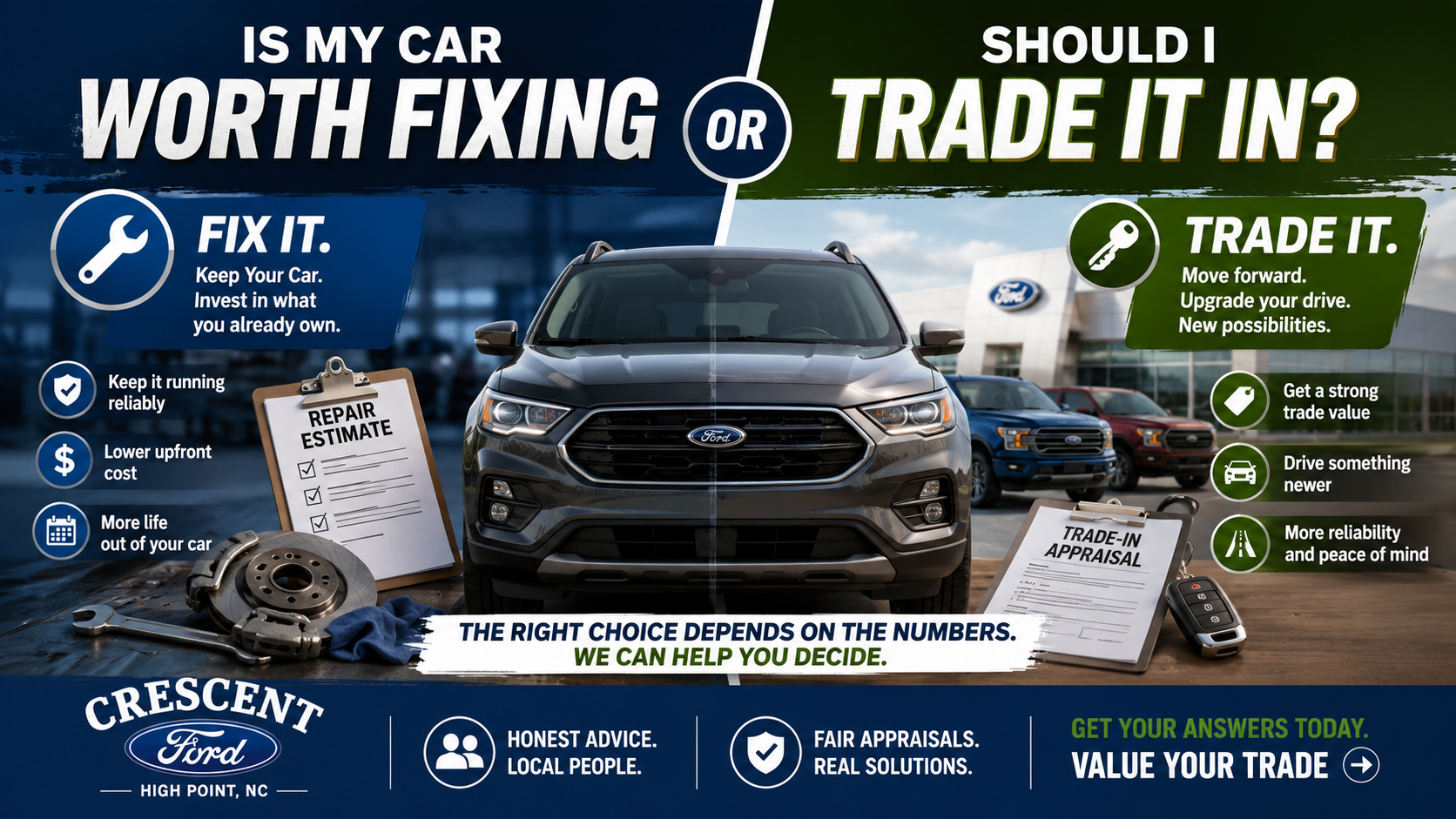
Repair or trade-in comparison showing factors like repair cost, reliability, trade value and future vehicle needs at Crescent Ford

Is My Car Worth Fixing or Should I Trade It In?

Is My Car Worth Fixing or Should I Trade It In? Your mechanic gives you the estimate. $2,800. And suddenly you're staring at your car thinking: "Is this thing even worth fixing?" It's one of the hardest decisions in vehicle ownership. Maybe your car is paid off. Maybe you still owe money on it. Maybe it has 70,000 miles. Maybe it has 170,000. And maybe this isn't even the first repair you've paid for this year. At some point, nearly every vehicle owner has to decide: Do I put more money into the car I already have—or is it time to move on? Unfortunately, there isn't a magic repair amount or mileage number that answers the question for everyone. A $3,000 repair on one vehicle could make perfect financial sense. The exact same repair on another vehicle might be a strong reason to consider replacing it. The better way to decide is to look at the repair cost in context: What is the vehicle worth today? What exactly needs to be repaired? What other repairs are likely coming? How reliable has the vehicle been? How much longer do you plan to keep it? Do you still owe money? What would replacing it actually cost? Let's work through it. First: Don't Compare the Repair Bill to $0 This is one of the easiest mistakes to make. Suppose your car needs a $2,500 repair. You might think: "$2,500 is ridiculous. I'm buying another car." But replacing your vehicle doesn't cost $0. The real comparison is: Cost to repair and continue owning your current vehicle vs. Cost to replace it with another vehicle If spending $2,500 gives you another two or three reliable years from a paid-off vehicle, repairing it could be considerably less expensive than taking on another vehicle purchase. On the other hand, if that $2,500 repair is simply the latest in a string of expensive problems? That's a different calculation. The repair estimate is only the starting point. Step 1: Find Out What Your Car Is Worth Right Now Before deciding whether to put thousands of dollars into a vehicle, find out what the vehicle is actually worth. Not what you paid for it. Not what you still owe. Not what a similar vehicle is advertised for online. What is your specific vehicle worth today, in its current condition? Suppose your vehicle is worth approximately: $18,000 and it needs a: $1,500 repair. That's very different from a vehicle worth: $4,000 that needs a: $3,500 repair. This doesn't mean you should automatically refuse any repair that approaches the vehicle's value. But the relationship between: Repair Cost ÷ Current Vehicle Value is useful information. Find Out What Your Vehicle Is Worth Before approving a major repair, knowing your vehicle's current trade value can give you important context for the decision. RELATED READING What Is My Car Worth in High Point, NC? How Trade-In Appraisals Actually Work Is There a Percentage Where a Car Isn't Worth Fixing? You'll sometimes hear rules such as: "Never spend more than 50% of the car's value on a repair." It's a useful warning sign. It isn't a universal rule. Imagine two cars worth $5,000. Vehicle A Needs a $2,500 repair. Otherwise it has been reliable, recently received new tires and brakes, has no other known major problems and is paid off. Vehicle B Needs the same $2,500 repair. But it also: Burns oil Needs tires Has an A/C problem Has a transmission starting to slip Has multiple warning lights Has already required several repairs this year Same value. Same repair bill. Completely different decision. That's why a percentage alone can't tell you whether a car is worth fixing. Step 2: Ask What the Repair Actually Accomplishes Not all $3,000 repairs are equal. This matters enormously. Ask: If I make this repair, what am I getting for the money? Are you fixing one isolated problem on an otherwise healthy vehicle? Or are you addressing one problem while several others remain? For example, replacing a failed component on an otherwise well-maintained vehicle may restore it to dependable transportation. But if the repair estimate includes one major problem and the technician is already warning you about several others? You need to consider the total upcoming cost, not just today's bill. Questions Worth Asking the Service Advisor Is this repair necessary now? Is the vehicle safe to drive without it? Is this normal wear or a major failure? Are there other problems you can already see? What maintenance is coming due soon? If I complete this repair, is there any obvious reason the vehicle shouldn't continue to be dependable? Which repairs are urgent and which can wait? Those answers give you much better information than simply seeing a dollar amount at the bottom of an estimate. Step 3: Look at Your Repair History One large repair doesn't necessarily mean your vehicle has become unreliable. But repeated repairs tell a different story. Look back over the last 12 to 24 months. Have you spent: $2,000 once? Or: $600 + $900 + $1,400 + $800 + now another $2,500? Those situations feel different because they are different. A vehicle that needs occasional maintenance and repair is normal. Every vehicle eventually needs things like: Tires Brakes Batteries Fluids Belts Filters Suspension components Routine maintenance Those expenses don't automatically mean the vehicle should be replaced. But when unpredictable mechanical failures become frequent, your annual cost of keeping the vehicle becomes more important than any individual repair. Maintenance Is Not the Same as a Breakdown This distinction matters. Imagine your vehicle needs: Four tires + brakes + scheduled maintenance. That's an expensive visit. But those are largely wear and maintenance items. A newer vehicle will eventually need them too. Now compare that with: Transmission failure + electrical problems + overheating + oil consumption. That's a different pattern. Don't trade a perfectly good vehicle simply because several maintenance items happened to come due around the same time. Ask whether you're paying for: normal ownership or declining reliability. Step 4: Consider the Vehicle's Mileage—but Don't Let Mileage Make the Decision Is 100,000 miles too many? No. Is 150,000? Not necessarily. Some vehicles reach high mileage while remaining dependable. Others become expensive to own much earlier. Mileage matters because it can influence: Vehicle value Wear Upcoming maintenance Warranty coverage Likelihood of age-related repairs But the odometer doesn't know whether you've maintained the vehicle. A well-maintained 130,000-mile vehicle can be a much better ownership proposition than a neglected 70,000-mile vehicle. So don't ask only: "How many miles are on it?" Ask: "How healthy is the vehicle at this mileage?" Step 5: Think About What May Need Repair Next This may be the most important question after receiving a major estimate. If you spend $3,000 today, are you likely to spend another $3,000 six months from now? Nobody can predict every future failure. But an inspection can sometimes identify obvious upcoming needs. Maybe the vehicle currently needs an engine repair, while the technician also notes: Tires near replacement Brake pads getting low Suspension wear Fluid leaks A/C concerns Battery nearing replacement Individually, none of those necessarily means you should trade. Together? They help show what the next year of ownership may look like. Step 6: Is Your Car Paid Off? A paid-off vehicle deserves special consideration. Why? Because: No car payment has value. Suppose your paid-off vehicle needs $2,400 in repairs. That's painful. But replacing it with a vehicle carrying a $500 monthly payment means: $6,000 per year in payments alone before considering insurance, taxes, interest or maintenance. If that $2,400 repair genuinely restores dependable transportation, fixing the paid-off vehicle may make excellent financial sense. This is why: "The repair costs more than one monthly payment!" isn't a useful comparison. Compare the repair with the total cost of replacement ownership. But Don't Let "It's Paid Off" Trap You Either There's another side to this. Sometimes people keep pouring money into an unreliable vehicle because: "At least I don't have a payment." But if you're spending thousands every year on unpredictable repairs, missing work because the car won't start and constantly wondering what's going to fail next? The absence of a monthly payment doesn't automatically make the vehicle inexpensive to own. Your actual ownership cost includes: repairs + maintenance + downtime + towing + transportation disruptions + depreciation along with the value of reliability to your household. A paid-off car isn't free if it's constantly broken. Step 7: Do You Still Owe Money on the Car? If the vehicle isn't paid off, there's another number you need: Your loan payoff. Your loan balance and vehicle value determine whether you have: Positive equity or Negative equity. For example: Vehicle trade value: $18,000 Loan payoff: $14,000 Approximate positive equity: $4,000 Now reverse it: Vehicle trade value: $14,000 Loan payoff: $18,000 Approximate negative equity: $4,000 That doesn't automatically mean you can or can't trade. But it absolutely belongs in the repair-vs.-replace calculation. Can You Trade In a Car You Still Owe Money On? Should You Repair a Car Before Trading It In? Not automatically. This is important. Suppose your car needs a $4,000 repair. You might assume: "I'll fix it first so it's worth more when I trade it." But spending $4,000 doesn't guarantee your trade value increases by $4,000. Before authorizing a major repair on a vehicle you're seriously considering trading, get it appraised as-is. Then you can compare: Trade value today vs. Potential value after repair – cost of repair Now you have numbers instead of assumptions. Should I Fix My Car Before Trading It In? What Actually Affects Trade Value Can You Trade In a Car That Needs Repairs? Yes. A vehicle does not have to be mechanically perfect to be appraised. Dealerships routinely evaluate vehicles with: Warning lights Cosmetic damage Worn tires Mechanical problems High mileage Accident history Maintenance needs The condition will affect the vehicle's value. But: needs repair doesn't automatically mean: can't be traded. That's another reason an appraisal can be useful before spending money. You may discover that trading the vehicle as-is makes more sense. Or the appraisal may confirm that repairing it and continuing to drive it is clearly the better choice. Either outcome is useful information. Step 8: Consider How Much Longer You Actually Want the Vehicle This part isn't purely financial. Suppose your car needs $2,000 in repairs. If you love the vehicle and planned to drive it another five years? That repair may be easy to justify. But what if you've already been thinking: "We really need a third row." or: "I need a truck now." or: "My commute changed and I want something more efficient." or: "We're constantly running out of cargo space." Now the repair isn't the only issue. Your vehicle may no longer fit your life. Putting several thousand dollars into a vehicle you already planned to replace in six months deserves more scrutiny than repairing one you genuinely want to keep. Step 9: Factor Reliability Into the Decision There's a financial value to reliability that's difficult to put on a spreadsheet. If your vehicle breaks down: How do you get to work? Who picks up the kids? Do you have another vehicle available? Can you work from home? Would you need a rental? Would a breakdown leave you stranded far from home? Two people can own the exact same unreliable car and rationally make different decisions. Someone with a second household vehicle and a five-mile commute may tolerate occasional repairs. Someone driving 70 miles per day with no backup transportation may place much greater value on predictable reliability. Your situation matters. Step 10: Compare Repair Cost With the REAL Cost of Replacing the Car If you're leaning toward trading, don't compare your repair bill with the advertised price of another vehicle. Compare the whole transaction. That includes: Vehicle selling price Trade value Current loan payoff Equity or negative equity Taxes and fees Financing Interest rate Insurance Expected maintenance Fuel costs You may discover that repairing is financially obvious. Or you may discover you're in a stronger position to replace the vehicle than you expected. What Does “Out-the-Door Price” Mean When Buying a Car in NC? A Simple Repair-or-Trade Formula Here's a practical way to think through the decision. KEEP & REPAIR Consider: Repair needed now Likely repairs/maintenance over the next 12 months Current operating costs Reliability risk Then ask: How much useful life do I realistically expect to get from that spending? TRADE & REPLACE Consider: Replacement vehicle price – Trade equity Taxes and fees Financing cost Insurance difference Then ask: What am I gaining from replacing the vehicle? Possibly: Better reliability Warranty coverage Better fuel economy More passenger space More capability Updated safety features Lower expected repair costs Now you're comparing two ownership paths—not simply: $3,000 repair vs. $0 repair. Example #1: Repairing Probably Makes Sense Imagine: Vehicle value: $12,000 Loan balance: $0 Repair: $1,800 Mileage: 105,000 Recent repair history: Minimal Tires: Good Brakes: Good Vehicle still fits your needs: Yes Expected ownership: 3+ more years In this situation, we'd seriously consider repairing it. Spending $1,800 on an otherwise dependable paid-off vehicle could be much less expensive than replacing it. Schedule Service at Crescent Ford If your vehicle still makes sense to keep, staying ahead of needed repairs and maintenance can help you get more useful life from it. Example #2: Trading Deserves Serious Consideration Now imagine: Vehicle value: $6,000 Loan balance: $0 Current repair: $3,500 Mileage: 175,000 Additional known needs: Tires, A/C repair and suspension work Repairs during the last year: $2,200 Vehicle still fits your needs: Not really Expected ownership if repaired: Uncertain Now the picture looks different. It doesn't mean repairing is objectively wrong. But before putting another $3,500 into the vehicle, we'd absolutely want to know: What can I trade it for as-is? See What Your Car Is Worth As-Is Example #3: The Repair Is Expensive—but Trading May Still Be Worse Here's the scenario people sometimes overlook. Vehicle value: $16,000 Loan payoff: $21,000 Repair: $2,500 Vehicle otherwise reliable: Yes You have approximately: $5,000 in negative equity. Trading may mean that negative equity has to be addressed as part of the next transaction. Suddenly, repairing the current vehicle and continuing to pay down the loan may deserve much more consideration. Again: Look at the whole financial picture. Don't make a $20,000 decision because you're angry about a $2,500 repair bill. What Repairs Might Make You Consider Trading? There's no repair that automatically means: Trade the car. But expensive failures naturally justify a broader conversation. Examples can include major: Engine repairs Transmission repairs Hybrid-system repairs Electrical problems Cooling-system failures A/C repairs Suspension repairs Multiple simultaneous mechanical issues The important factor isn't the name of the broken component. It's: repair cost + vehicle value + overall condition + future needs + your financial situation. What Repairs Usually Aren't a Reason to Trade a Car? Routine wear items alone generally shouldn't send you immediately to the sales department. Things like: Tires Brake pads Battery Oil change Filters Wiper blades Routine fluid service Scheduled maintenance are part of owning a vehicle. Yes, several can hit at once and produce an unpleasant bill. But replacing your vehicle doesn't eliminate maintenance forever. It resets the clock. What If You're Not Sure Whether the Repair Estimate Is Worth It? Ask questions. A good service conversation should help you understand: What needs attention now? What can wait? What is maintenance? What is repair? What else may be coming? You can also ask for the estimate to be explained line by line. The goal isn't simply to know: "It costs $3,200." You want to understand: "What does $3,200 accomplish?" That information is what helps you make a rational keep-or-replace decision. Should You Get a Second Opinion on an Expensive Car Repair? For a significant repair, getting another qualified opinion can be reasonable—particularly if the diagnosis is unclear or you're making a major financial decision based on it. Just make sure you're comparing the same diagnosis and scope of work. One estimate may include additional required parts, related repairs or different-quality components. The lowest number isn't automatically the same repair for less money. Understand what each estimate includes. Repair vs. Trade: Quick Decision Guide Ask Yourself Repair May Make More Sense Trading May Make More Sense How expensive is the repair relative to value? Small/moderate Very large Has the vehicle been reliable? Generally yes Repeated failures Are more repairs coming? Few known needs Several expensive needs Is it paid off? Strong reason to consider keeping Helpful, but not decisive Do you have negative equity? May favor keeping longer Depends on ability to address it Does the vehicle still fit your life? Yes No Do you want to keep it several more years? Yes No Is reliability becoming disruptive? No Yes Would replacing it improve something important? Not significantly Yes No single row decides it. Look at the pattern. The Question Isn't "Is My Car Old?" It's: "Does keeping this particular vehicle still make sense?" An older car that's: Paid off Dependable Properly maintained Affordable to insure Still useful can be an excellent vehicle to keep. A newer vehicle that: Has repeated mechanical problems No longer fits your family Costs a lot to operate Has become unreliable might deserve a different conversation. Age and mileage provide context. They don't make the decision for you. What If You're Emotionally Done With the Car? This is real too. Sometimes the spreadsheet says: "Repair it." And the owner says: "I never want to see this car again." 😂 That's allowed. Vehicle ownership isn't purely mathematical. If you've lost confidence in the vehicle and every new noise makes you wonder what's breaking next, reliability has value. Just understand the financial consequences before replacing it. Make an informed emotional decision—not an expensive impulse decision. The Best First Step: Get Two Numbers If you're stuck between repairing and trading, you need two pieces of information: Number 1: What will it realistically cost to repair the vehicle? Get a clear diagnosis and estimate. Number 2: What is the vehicle worth in its current condition? Get a current appraisal. Then compare. You don't need to repair the vehicle first. And getting an appraisal doesn't obligate you to trade it. Those two numbers give you the information you need to make a much better decision. Keeping your vehicle? Schedule Service Thinking about replacing it? Value Your Trade Is My Car Worth Fixing in High Point, NC? If you're facing a major vehicle repair in High Point, Greensboro, Winston-Salem, Thomasville, Trinity, Kernersville, Lexington or elsewhere in the Piedmont Triad, don't feel like you have to guess. Start with information. What needs to be repaired? What will it cost? What else does the vehicle need? What is the vehicle worth today? What do you owe? What would replacing it cost? Sometimes the answer will be: Fix the car. And if that's the financially sensible choice, that's the choice you should make. Other times, the numbers tell you that putting several thousand more dollars into the vehicle doesn't make much sense. Then it may be time to see what your current vehicle could put toward something newer. At Crescent Ford, both conversations can start in the same place. Our service team can help you understand your vehicle's repair and maintenance needs. And if you decide you're ready to move on, your vehicle can be appraised in its current condition so you can understand your options before spending money repairing a car you don't intend to keep. Repair it when repairing makes sense. Trade it when trading makes sense. The goal is simply to make the decision with the right information. FINAL CTA / INTERNAL LINKS Want to Keep Your Current Vehicle? Schedule Service at Crescent Ford Wondering What It's Worth As-Is? Value Your Trade Ready to See Your Replacement Options? Shop New Ford Vehicles Shop Used Cars, Trucks & SUVs RELATED READING What Is My Car Worth in High Point, NC? How Trade-In Appraisals Actually Work Should I Fix My Car Before Trading It In? What Actually Affects Trade Value Can You Trade In a Car You Still Owe Money On? Should You Buy New or Used in 2026? A Real-World Cost Comparison Frequently Asked Questions About Fixing or Trading a Car Is it worth repairing an old car? It can be. Age alone doesn't determine whether a vehicle is worth repairing. Consider the repair cost, current vehicle value, overall condition, repair history, upcoming maintenance and how much longer you expect to keep it. A paid-off older vehicle that has otherwise been reliable may still be financially sensible to repair. When is a car not worth fixing? There's no universal dollar amount or percentage. A vehicle deserves closer scrutiny when a major repair represents a large portion of its value, several other expensive problems are developing, reliability has become poor or the vehicle no longer fits your needs. Should I repair a paid-off car or buy another one? Don't underestimate the value of having no monthly payment. If a repair restores an otherwise reliable paid-off vehicle, repairing can be considerably less expensive than replacing it. But repeated expensive failures can eventually make a paid-off vehicle costly to own too. Is 100,000 miles too many to keep a car? Not automatically. Many vehicles can remain dependable well beyond 100,000 miles when properly maintained. Condition, maintenance history and reliability are more useful than treating 100,000 miles as an automatic replacement point. Should I trade my car because it needs a major repair? Not necessarily. First determine exactly what the repair accomplishes, whether other major repairs are likely and what the vehicle is worth in its current condition. Then compare the cost of keeping it with the full cost of replacing it. Can I trade in a car that needs repairs? Yes. A vehicle doesn't have to be in perfect condition to be appraised. Mechanical problems, warning lights, cosmetic damage and other issues may affect the trade value, but they don't necessarily prevent you from trading the vehicle. Should I fix my car before getting a trade-in appraisal? For a major repair, consider getting the vehicle appraised first. Spending thousands on a repair doesn't guarantee the trade value will increase by the same amount. Is it better to repair a car or have a car payment? It depends on the numbers. A one-time repair can be much less expensive than years of vehicle payments, interest and potentially higher insurance. But frequent repairs and poor reliability can change the calculation. Compare annual ownership costs rather than one repair bill with one monthly payment. Does negative equity mean I should repair my car instead of trading it? Not necessarily, but negative equity is an important consideration. If you owe more than the vehicle is worth, the remaining balance needs to be addressed in a replacement transaction. Depending on the repair, continuing to drive the current vehicle while paying down the loan may make financial sense. How do I know what my car is worth if it needs repairs? You can have the vehicle appraised in its current condition. The needed repairs will be considered as part of the appraisal, along with mileage, equipment, history, overall condition and current market demand. What should I do first if my car needs an expensive repair? Start by getting a clear diagnosis and repair estimate. Then find out what the vehicle is worth as-is. Those two numbers give you a much better foundation for deciding whether to repair, trade or replace the vehicle. Should I trade my car if repairs keep adding up? Repeated repairs deserve more attention than a single isolated problem. Look at how much you've spent over the last year or two, what additional work is expected and how dependable the vehicle has become. If repair costs and reliability problems are increasing, comparing your current trade value with replacement options can be worthwhile. Can Crescent Ford appraise a vehicle that isn't a Ford? Yes. You can have vehicles from other manufacturers appraised as well. You don't have to currently own a Ford to consider trading your vehicle at Crescent Ford.

Contact Us

Fill out this form below and we'll contact you shortly
*Required Fields