

Blog / Trade-In & Financing

My Car Needs Expensive Repairs—Can I Trade It In As-Is?

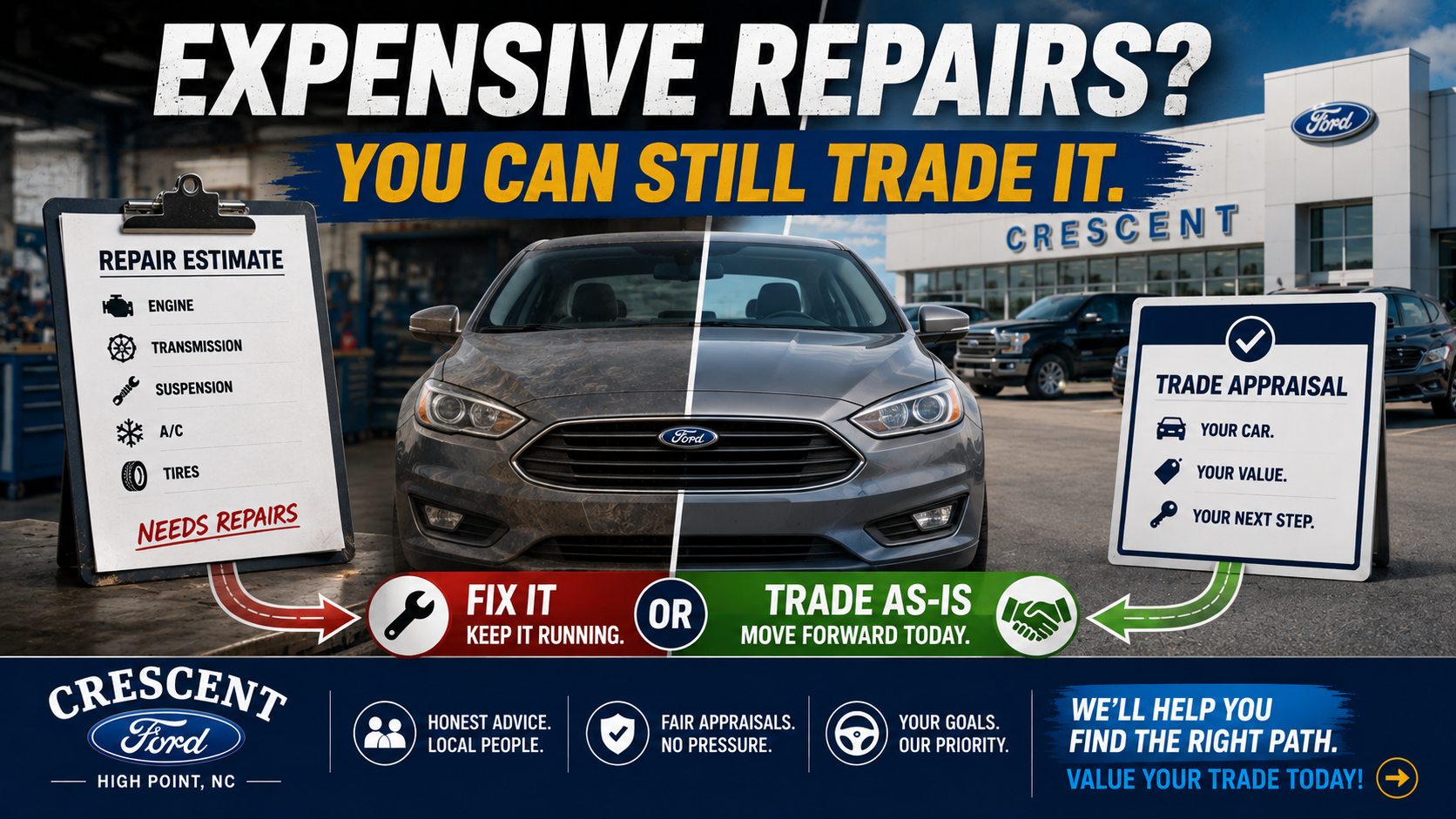
Car needing expensive repairs compared with trading it in as-is at Crescent Ford in High Point, NC

My Car Needs Expensive Repairs—Can I Trade It In As-Is?

Your car is in the shop.

The service advisor gives you the news:

Transmission: $5,000.

Or maybe it's:

Engine repair: $4,200.

A/C + suspension + tires: $3,600.

And suddenly you're thinking:

"I don't even want to fix this thing anymore."

Which leads to the next question:

Can you trade in a car that needs expensive repairs?

Yes.

A vehicle does not have to be mechanically perfect before a dealership can appraise it.

Cars with:

  • Check engine lights

  • Transmission problems

  • Engine problems

  • A/C failures

  • Worn tires

  • Body damage

  • High mileage

  • Suspension problems

  • Electrical issues

  • Other mechanical needs

can potentially still be traded.

The more important question is:

Should you repair it first—or trade it exactly as it sits?

And that's where you want to do a little math before spending thousands of dollars.


Can I Really Trade In a Car That Needs Repairs?

Yes.

A trade appraisal is an evaluation of the vehicle in its current condition.

That doesn't mean the mechanical problem won't matter.

It absolutely can.

If your vehicle needs a $5,000 transmission repair, a dealership isn't going to appraise it as though the transmission were perfect.

But:

Needs repair

doesn't automatically mean:

Has no trade value.

The dealership will evaluate the entire vehicle, including things such as:

  • Year

  • Make

  • Model

  • Trim

  • Mileage

  • Equipment

  • Vehicle history

  • Cosmetic condition

  • Mechanical condition

  • Tires

  • Local market demand

  • Current wholesale/retail market

  • Cost and extent of needed reconditioning

Then the dealership can determine what the vehicle is worth as-is.

Find Out What Your Car Is Worth As-Is

Your vehicle doesn't have to be repaired before it can be evaluated. Start by finding out what it's worth in its current condition.


Do I Have to Fix My Car Before Trading It In?

No.

And if the repair is expensive, we would generally recommend finding out the vehicle's as-is trade value before automatically approving the repair.

Why?

Because this:

$4,000 repair

does not necessarily equal:

$4,000 increase in trade value.

That's one of the most important concepts in this entire article.

Imagine your vehicle is worth:

$10,000 as-is.

You spend:

$4,000 repairing it.

And afterward it's worth:

$12,500.

You improved the trade value by:

$2,500

but spent:

$4,000.

If your only reason for completing the repair was to trade the vehicle immediately afterward, you spent more than you gained.

That's why you want the appraisal before making the repair decision.


Repairs Don't Necessarily Increase Trade Value Dollar-for-Dollar

This is where consumers can understandably get confused.

You might think:

"If the dealership has to spend $3,000 fixing it, I'll lose $3,000 if I don't repair it myself."

Not necessarily.

A dealership evaluates reconditioning differently from a retail customer paying a repair bill.

There are also other factors involved in determining what happens to a trade.

Depending on the vehicle, condition and dealership, it might ultimately be:

  • Reconditioned and retailed

  • Sold wholesale

  • Sent to auction

  • Handled through another disposition channel

So the dealership isn't simply looking at your retail repair estimate and subtracting it from an otherwise perfect-car value.

The vehicle is appraised as a whole.

That's another reason getting a real appraisal is more useful than trying to calculate the value yourself from a repair bill.


Should I Get the Repair Estimate Before Trading the Car?

If you already have one?

Bring it.

A repair estimate can provide useful information.

But don't feel like you necessarily need to authorize thousands of dollars of diagnostic work solely to make your vehicle eligible for appraisal.

If you know:

"The transmission is slipping."

tell us.

If the check engine light is on?

Tell us.

If the A/C stopped working?

Tell us.

If another shop diagnosed a specific problem?

Bring the paperwork.

Being straightforward about what you know helps everyone understand the vehicle.


Can I Trade In a Car With a Check Engine Light On?

Potentially, yes.

A check engine light does not automatically prevent a vehicle from being traded.

But there's a huge range of problems that can trigger that light.

It could be relatively minor.

Or it could indicate a significant mechanical issue.

That's why the light itself doesn't tell us how much the vehicle is worth.

The underlying problem matters.

If you haven't had the vehicle diagnosed yet and it otherwise runs normally, diagnosis may give you useful information before making a major financial decision.

RELATED READING — Why Is My Check Engine Light On? What to Do Next


Can I Trade In a Car With Transmission Problems?

Potentially, yes.

Transmission problems can significantly affect a vehicle's value because transmission repair or replacement can be expensive.

But that doesn't mean:

"Nobody will take it."

Suppose you're facing a major transmission repair.

Before spending several thousand dollars, you could compare:

OPTION A

Repair the transmission + keep the vehicle

OPTION B

Repair the transmission + trade the vehicle

OPTION C

Trade the vehicle as-is

Those are three completely different financial decisions.

If you already wanted to replace the vehicle, Option B deserves particular scrutiny.

Why spend thousands repairing a vehicle you're immediately going to give up unless the numbers clearly justify it?


Can I Trade In a Car With Engine Problems?

Again:

Potentially, yes.

The severity matters.

There's a big difference between:

A sensor-related engine issue

and

An engine requiring major internal repair or replacement.

The more significant the mechanical problem, the more likely it is to have a meaningful impact on trade value.

But even a vehicle requiring major engine work may still have value.

The correct question isn't:

"Is my broken car worthless?"

It's:

"What is my vehicle worth in its current condition?"


Can I Trade In a Car That Doesn't Run?

This gets more complicated.

A non-running vehicle can potentially still have value, but logistics and appraisal become more vehicle-specific.

If the vehicle cannot safely be driven to the dealership, contact the dealership before arranging transportation.

Explain:

  • What the vehicle is

  • Mileage

  • What happened

  • Whether it starts

  • Whether it moves under its own power

  • Where the vehicle is located

  • What diagnosis you have, if any

Then determine the best next step.

Don't pay to tow a vehicle somewhere without first confirming how the appraisal will be handled.


Can I Trade In a Car With Body Damage?

Yes.

Mechanical problems aren't the only condition issues dealerships evaluate.

Trades can have:

  • Dents

  • Scratches

  • Cracked bumpers

  • Paint damage

  • Hail damage

  • Interior wear

  • Stains

  • Wheel damage

  • Accident history

Again, condition can affect value.

But you generally don't need to make the vehicle cosmetically perfect before asking what it's worth.

Sometimes inexpensive cleanup makes sense.

Major bodywork solely for the purpose of trading?

Get the appraisal first.


What Actually Happens When a Dealership Appraises a Car That Needs Repairs?

The appraiser is essentially trying to answer:

"What is this specific vehicle worth to us today in this condition?"

That means evaluating more than the broken component.

For example:

Imagine two vehicles both need a transmission.

Vehicle A

2022 model

55,000 miles

Clean interior

Good tires

Desirable trim

Strong local demand

Vehicle B

2014 model

185,000 miles

Body damage

Worn tires

Multiple warning lights

Poor interior condition

Same type of mechanical failure.

Very different vehicles.

That's why there isn't a universal formula such as:

Normal trade value – repair estimate = trade offer.

The entire vehicle matters.


How Much Does a Mechanical Problem Reduce Trade-In Value?

There isn't a universal number.

And anyone who gives you one without inspecting the vehicle is guessing.

The impact depends on:

  • What is wrong

  • Severity of the problem

  • Repair complexity

  • Vehicle value

  • Age

  • Mileage

  • Overall condition

  • Market demand

  • Whether other repairs are needed

  • How the dealership expects to dispose of or recondition the vehicle

A $3,000 repair on a desirable late-model vehicle is very different from a $3,000 repair on an older vehicle worth only a few thousand dollars when fully operational.

Context matters.


Should I Fix a $500 Repair Before Trading?

Maybe.

This is where the math can change.

We're much more cautious about:

$4,000 transmission repair

than something inexpensive and obvious.

Small repairs that improve the vehicle's operation or presentation can sometimes make sense.

But even then:

Don't assume.

If you've already decided to trade soon, ask whether completing the repair is likely to improve the appraisal enough to justify spending the money.


Should I Put New Tires on My Car Before Trading It?

Usually, don't automatically install a full set of new tires solely because you're trading the vehicle.

Worn tires can affect condition and value.

But four brand-new retail-priced tires don't necessarily increase your trade value by exactly what you spent.

If the vehicle needs tires and you're planning to keep driving it for safety reasons, that's a different decision.

But if you're trading tomorrow?

Get the appraisal first.

RELATED READING — Should I Fix My Car Before Trading It In? What Actually Affects Trade Value


What Repairs SHOULD I Make Before Trading?

Think:

cheap, simple and obvious

before:

expensive mechanical overhaul.

For example, depending on the situation:

  • Remove personal belongings

  • Clean excessive trash

  • Address simple inexpensive items

  • Gather keys

  • Gather maintenance records

  • Bring accessories that belong with the vehicle

You don't need to transform the car into showroom condition.

You're trading a used vehicle.

It's expected to be used.


Should I Detail My Car Before Trading It In?

You don't need to spend hundreds of dollars on professional detailing just to receive an appraisal.

But:

Clean is helpful.

Remove:

  • Trash

  • Personal belongings

  • Excessive clutter

A basic wash and vacuum certainly won't hurt.

The appraiser still needs to evaluate the actual vehicle beneath the dirt.

But don't confuse:

cleaning

with

reconditioning.

A detail doesn't erase:

  • Mechanical problems

  • Accident history

  • Significant body damage

  • Worn tires

  • Warning lights

Clean the vehicle reasonably.

Don't spend a fortune trying to disguise normal use.


Should I Tell the Dealer What's Wrong With My Car?

Yes.

If you know about a significant problem, be straightforward about it.

For example:

"The transmission started slipping last week."

"The A/C isn't working."

"The check engine light came on and another shop diagnosed an EVAP leak."

"It overheated and I've stopped driving it."

That information is useful.

The dealership is going to evaluate the vehicle anyway.

Trying to hide a major known problem doesn't create a better transaction.

A transparent appraisal is better for everyone.


What If I Still Owe Money on the Car?

You can potentially trade a vehicle that:

needs repairs

and

still has a loan.

Now we need another number:

Your payoff amount.

Compare:

Trade Value

vs.

Loan Payoff

If the trade value is higher than your payoff, you have positive equity.

If your payoff is higher than the trade value, you have negative equity.

For example:

As-is trade value: $12,000

Loan payoff: $16,000

Negative equity: $4,000

That $4,000 doesn't disappear because you trade the vehicle.

It still has to be addressed as part of the transaction.

The CFPB specifically recommends finding both your payoff amount and potential trade value before deciding how to proceed with a vehicle that still has a loan.

RELATED READING — Can You Trade In a Car You Still Owe Money On?


Does a Big Repair Make Negative Equity Worse?

It can indirectly create a difficult situation.

Imagine:

Vehicle value before major mechanical failure: $17,000

Loan payoff: $18,000

You were already slightly upside down.

Then the transmission fails.

Now the vehicle's as-is value may be lower while your loan payoff hasn't suddenly decreased.

That can increase the gap between:

what you owe

and

what the vehicle is worth.

This is where we especially don't want you making the decision based only on frustration.

Get the numbers.

You may discover repairing and continuing to drive the vehicle is the better financial choice.

Or there may still be a reasonable path to replacing it.

But you need the actual appraisal and payoff to know.

The FTC also cautions consumers that negative equity doesn't simply vanish when a vehicle is traded; if incorporated into a new loan, it increases the amount being financed and can increase total borrowing costs.


Should I Repair the Car If I'm Upside Down?

Maybe.

This is where our earlier repair-vs.-trade article becomes extremely useful.

If:

  • The vehicle otherwise fits your needs

  • The repair restores reliable transportation

  • You have substantial negative equity

  • The vehicle has otherwise been dependable

repairing it and continuing to pay down the loan may make sense.

But if:

  • Repairs keep occurring

  • Reliability is poor

  • Several additional expensive repairs are coming

  • The vehicle no longer meets your needs

then you may still want to understand your replacement options.

RELATED READING — Is My Car Worth Fixing or Should I Trade It In?


Can I Trade In a Car I Can't Afford to Repair?

Potentially, yes.

And this is an important distinction.

You don't necessarily need to come up with:

$5,000 cash for repairs

before you're allowed to find out what the vehicle is worth.

You can ask for an appraisal in its current condition.

Then you'll know whether trading provides a realistic alternative.

That doesn't guarantee a replacement transaction will work.

Your:

  • Trade value

  • Loan payoff

  • Credit

  • Down payment

  • Replacement vehicle

  • Financing terms

all matter.

But at least you'll have another option to evaluate.


Does Trading As-Is Save Me the Hassle of Repairing It?

Potentially, yes—and that's one of the biggest non-financial reasons people choose this route.

A major repair may involve:

  • Diagnosis

  • Parts availability

  • Repair appointments

  • Transportation while the vehicle is down

  • Rental costs

  • Additional problems discovered during repair

  • Time

Sometimes a consumer decides:

"Even if repairing might technically produce a little more value, I don't want to deal with it."

Convenience has value too.

Just make that choice after seeing the numbers.


Is It Better to Sell a Broken Car Privately?

You may be able to get more money selling a vehicle privately.

But a vehicle with known mechanical problems can make private sale considerably more complicated.

You'll need to deal with:

  • Advertising

  • Buyers

  • Test drives

  • Payment

  • Title paperwork

  • Disclosure of known issues

  • Negotiation

  • People who may not understand the extent of the repair

A knowledgeable private buyer may be interested in a project or repairable vehicle.

But convenience is one of the major advantages of trading.

RELATED READING — Is It Better to Trade In or Sell Your Car Yourself?


Is There a Tax Advantage to Trading a Car in North Carolina?

Potentially, yes.

North Carolina generally assesses a 3% Highway-Use Tax when a vehicle title is transferred rather than ordinary retail sales tax.

For a dealership transaction involving a trade, the trade allowance can reduce the net amount used in calculating the Highway-Use Tax.

Here's a simplified illustration:

Replacement vehicle: $30,000

Trade allowance: $10,000

Difference: $20,000

The Highway-Use Tax calculation for the dealer transaction is generally based on that net difference, subject to applicable North Carolina rules.

That means comparing:

private-sale price

vs.

trade allowance

shouldn't always be done dollar-for-dollar.

There may also be convenience and transaction differences to consider.


How Do I Know Whether to Repair or Trade As-Is?

Here's the calculation we recommend.

Step 1: Get the Repair Estimate

Find out:

What exactly is wrong?

and

What will it cost to repair?

Step 2: Get an As-Is Appraisal

Find out:

What is the vehicle worth today without repairing it?

Step 3: Determine Your Loan Payoff

If you have a loan, get the actual payoff amount.

Step 4: Ask What Else the Vehicle Needs

Don't evaluate a $3,000 repair in isolation if another $4,000 of maintenance and repairs are approaching.

Step 5: Compare Your Options

Now evaluate:

REPAIR + KEEP

Repair cost


Expected future repairs


Remaining loan

vs.

TRADE AS-IS + REPLACE

Trade equity/negative equity


Replacement cost


Financing


Expected ownership costs

Now you're making a decision with real information.


Example: When Trading As-Is Might Make Sense

Imagine:

Vehicle value if mechanically sound: approximately $10,000

Current major repair estimate: $4,500

Mileage: 165,000

Other upcoming repairs: $1,500

Recent repair history: Frequent

Vehicle no longer fits your needs: Yes

You planned to replace it within a year anyway.

Before spending:

$4,500

we would absolutely want to know:

What is the vehicle worth as-is?

Maybe repairing it still wins.

But this is exactly the situation where an appraisal should happen before the repair.

Get an As-Is Trade Appraisal


Example: When Repairing Might Make More Sense

Now imagine:

Vehicle value: $18,000

Repair estimate: $1,800

Mileage: 75,000

Other known repairs: None

Repair history: Minimal

Vehicle fits your needs: Yes

Loan situation: Good

You intended to keep it another four years.

In that situation?

We may tell you:

Fix the car.

Seriously.

The existence of a trade-in department doesn't mean trading is automatically the best financial decision.

If a reasonable repair restores an otherwise good vehicle that still fits your life, keeping it may make considerably more sense.

Schedule Service at Crescent Ford

If repairing your current vehicle makes more financial sense, our service team can help you keep it rolling.


Example: When You Need More Information

Vehicle value: Unknown

Repair estimate: $3,500

Loan payoff: $14,000

Mileage: 110,000

Additional repairs: Unknown

This isn't a repair decision yet.

You're missing information.

Before doing anything:

Get the appraisal.

Then compare your trade value with your payoff.

That's the entire purpose of gathering numbers first.


Can I Get My Car Appraised Before Deciding Whether to Repair It?

Yes.

And that's probably the most important takeaway from this article.

Getting an appraisal doesn't mean:

You have to trade the vehicle.

It simply gives you another number.

You can still decide:

"Nope. I'm fixing it."

That's perfectly fine.

Now you know you made that decision after comparing both options.

An appraisal is information.

Not an obligation.


What Should I Bring for a Trade-In Appraisal?

If available, bring:

  • Vehicle

  • Keys/remotes

  • Registration

  • Loan/payoff information

  • Repair estimate

  • Maintenance records

  • Information about known mechanical issues

If the vehicle is financed, the exact documentation needed can depend on the lender and transaction.

If you're unsure what to bring, contact the dealership before your visit.


What If the Vehicle Is at Another Repair Shop?

Call before moving it.

If the vehicle is:

safe and operable

you may be able to bring it for appraisal normally.

If it's:

not safely drivable

don't risk additional damage or your safety just to get it to a dealership.

Explain where the vehicle is and what's wrong with it so you can determine the appropriate next step.


Don't Make a $5,000 Repair Decision Without Knowing the Trade Value

This is the central point.

When you get an expensive repair estimate, your first instinct may be:

"Well, I guess I have to fix it."

Maybe.

But if you've already been considering replacing the vehicle?

Stop for a moment.

You need two numbers:

NUMBER 1

What will it cost to repair?

NUMBER 2

What is it worth as-is?

Then you can decide.

That's much better than:

Repair first. Ask questions later.


Trading a Car That Needs Repairs in High Point, NC

If your car needs expensive repairs in High Point, Greensboro, Winston-Salem, Thomasville, Trinity, Lexington, Kernersville or elsewhere around the Piedmont Triad, you don't necessarily have to repair it before exploring your trade options.

At Crescent Ford, we can evaluate your vehicle in its current condition.

Maybe the numbers show that trading it as-is makes sense.

Maybe they show that repairing the vehicle and keeping it is clearly the smarter move.

Either answer is useful.

The important thing is that you don't spend thousands of dollars just because you assumed you had to repair the vehicle before anyone would take it.

Find out what it's worth first.

Then make the decision.


FINAL CTA / INTERNAL LINKS

Want to Know What It's Worth Right Now?

Value Your Trade

Want to Repair It Instead?

Schedule Service at Crescent Ford

Ready to Look at Replacement Options?

Shop New Ford Vehicles

Shop Used Cars, Trucks & SUVs

RELATED READING

Is My Car Worth Fixing or Should I Trade It In? 

Should I Fix My Car Before Trading It In? What Actually Affects Trade Value 

Can You Trade In a Car You Still Owe Money On? 

Is It Better to Trade In or Sell Your Car Yourself? 

Why Is My Check Engine Light On? What to Do Next 


Frequently Asked Questions About Trading a Car That Needs Repairs

Can I trade in a car that needs major repairs?

Yes. A vehicle does not necessarily need to be repaired before it can be appraised or traded. Mechanical condition will be considered when determining its value.

Can I trade in a car with a bad transmission?

Potentially, yes. A transmission problem can significantly affect trade value, but it doesn't automatically make the vehicle ineligible for trade. Before paying for a major transmission repair solely to trade the vehicle, consider getting an as-is appraisal.

Can I trade in a car with engine problems?

Potentially. The effect on value depends on the severity of the engine problem along with the vehicle's age, mileage, condition and market value.

Can I trade in a car with the check engine light on?

Yes, an illuminated check engine light does not automatically prevent a vehicle from being appraised. The underlying problem may affect its value.

Can I trade in a car that doesn't run?

A non-running vehicle may still have value, but appraisal and transportation logistics become more vehicle-specific. Contact the dealership before arranging transportation for a vehicle that cannot be safely driven.

Should I repair my car before trading it in?

Not automatically. Particularly with an expensive repair, consider getting the vehicle appraised as-is first. The amount you spend repairing the vehicle may not increase its trade value by the same amount.

Will a dealer subtract the entire repair estimate from my trade value?

There is no universal formula. Dealers evaluate the entire vehicle, including its condition, mileage, market demand, expected reconditioning and potential disposition. A retail repair estimate isn't necessarily deducted dollar-for-dollar from an otherwise perfect-condition value.

Should I put new tires on my car before trading it?

Not automatically. Worn tires can affect a vehicle's condition and value, but buying a new set immediately before trading doesn't guarantee an equal increase in trade value. Consider getting the appraisal first.

Can I trade in a damaged car that I still owe money on?

Potentially, yes. You'll need to compare the vehicle's current trade value with your loan payoff. If you owe more than the vehicle is worth, you have negative equity that must be addressed in the replacement transaction.

Does negative equity disappear when I trade my car?

No. If your loan payoff exceeds the vehicle's trade value, the difference still has to be addressed. If negative equity is incorporated into a new loan, it increases the amount financed and can increase borrowing costs.

Is it better to repair a broken car or trade it?

It depends on the repair cost, vehicle value, mileage, reliability, loan payoff, other upcoming repairs and replacement cost. Get both the repair estimate and as-is trade value before deciding.

Can I get a trade appraisal without committing to buying another vehicle?

Yes. An appraisal gives you information about the vehicle's current value. You can use that information when deciding whether repairing, keeping, selling or trading makes the most sense.

Does trading a car reduce vehicle taxes in North Carolina?

In a North Carolina dealer transaction, the trade allowance can reduce the net amount used to calculate the state's Highway-Use Tax, subject to applicable rules. North Carolina generally uses a 3% Highway-Use Tax on vehicle title transfers rather than ordinary retail sales tax.

What should I do first if my car suddenly needs a $5,000 repair?

Get a clear diagnosis and repair estimate. If you're considering replacing the vehicle, also determine its as-is trade value and, if financed, your current loan payoff. Those numbers let you compare repairing and keeping the vehicle with trading it in its current condition.
Posted in:

Related Posts

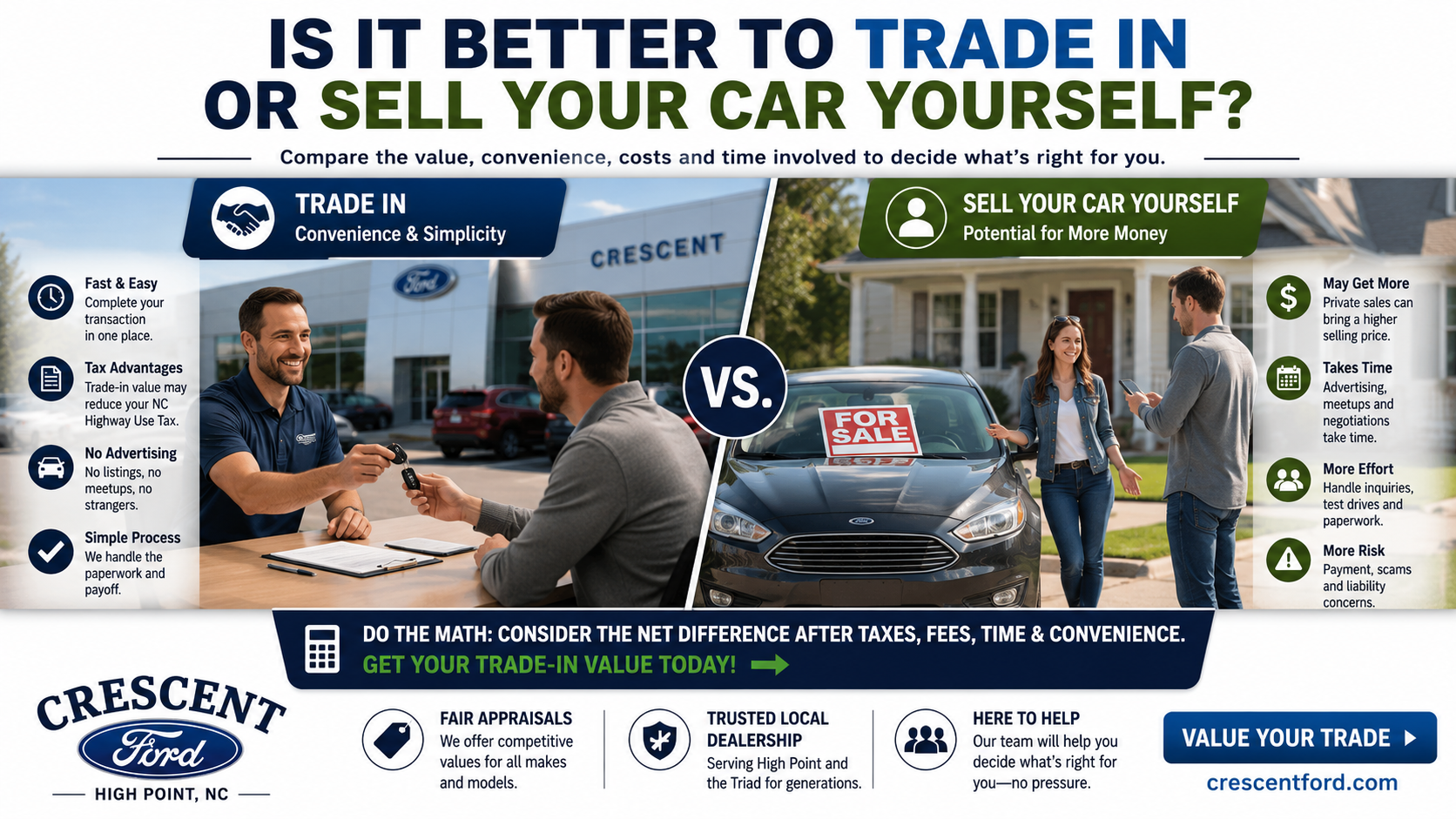
Trade-in vs. selling your car yourself comparison showing convenience, potential value, time, taxes and transaction effort

Is It Better to Trade In or Sell Your Car Yourself?

Is It Better to Trade In or Sell Your Car Yourself? You've decided it's probably time for another vehicle. Now there's one more decision to make: What should you do with the car you already own? You essentially have two common options: Trade it in to a dealership. or Sell it yourself. If you search online, you'll probably find some version of: "Always sell privately! You'll get more money!" Sometimes that's true. But it doesn't necessarily mean you'll be better off selling privately. A private sale may produce a higher selling price, while a trade-in can offer advantages in convenience, transaction simplicity and—when you're buying another vehicle in North Carolina—the way a qualifying trade allowance affects Highway Use Tax. The right question isn't simply: "Which gives me the highest number?" It's: "Which option leaves me with the best overall outcome?" Here's how to figure that out. Find Out What Your Vehicle Is Worth Before deciding whether to trade or sell privately, start by finding out what your vehicle may actually be worth as a trade. Trade-In vs. Private Sale: What's the Difference? Let's start with the basics. Trading In Your Car You take your vehicle to a dealership, it is appraised, and you receive a trade-in offer. If you accept the offer while purchasing another vehicle, the trade value can generally be applied directly to the transaction. Selling Your Car Privately You become the seller. That means you determine an asking price, advertise the vehicle, communicate with prospective buyers, arrange meetings and test drives, negotiate the sale, handle payment and complete the required ownership-transfer process. In exchange for doing that work yourself, you may be able to sell the vehicle for more than its trade-in value. So why wouldn't everyone sell privately? Because that higher selling price isn't the only thing that matters. Will You Get More Money Selling Your Car Yourself? Potentially. A private buyer is purchasing the vehicle for their own use. A dealership acquiring a trade has additional considerations before that vehicle ultimately reaches another owner. Depending on the vehicle, that can include: Inspection Maintenance Mechanical repairs Tires or brakes Cosmetic reconditioning Detailing Transportation Inventory expenses Market risk That's one reason trade-in value and retail value aren't the same thing. So yes, there can be a gap between what a dealership offers for a trade and what someone might be willing to pay in a private transaction. But don't stop the comparison there. Suppose you could: Trade your vehicle for $20,000 or Sell it privately for $22,000. It looks like selling privately automatically puts you $2,000 ahead. Maybe it does. But before deciding, you need to look at the rest of the transaction. The Most Important Number Is the Net Difference This is the part people sometimes miss. Don't compare: Trade offer vs. Private asking price. Compare: What you actually receive from each option after considering the entire transaction. Your private asking price isn't necessarily what someone will pay. And your trade value can potentially affect the Highway Use Tax calculation when you're purchasing another vehicle in North Carolina. So the comparison needs a little more math. How Does a Trade-In Affect Vehicle Taxes in North Carolina? North Carolina generally imposes a Highway Use Tax when a vehicle title is transferred rather than the conventional retail sales tax shoppers may be accustomed to with other purchases. For a qualifying dealer transaction involving a trade-in, the trade allowance generally reduces the net retail value used to calculate Highway Use Tax. Let's use a simplified hypothetical example. Suppose you're buying a: $40,000 vehicle and receiving: $20,000 for your trade. The applicable Highway Use Tax calculation may be based on the remaining $20,000 net retail value, subject to North Carolina's rules and the specifics of the transaction. If instead you sell your old vehicle privately and then purchase the $40,000 vehicle without a trade allowance, you don't have that same trade allowance reducing the taxable amount of the dealer purchase. That means the private sale needs to beat the trade offer by enough to account for any difference in the transaction—not merely by $1. The exact tax treatment depends on the transaction, so always compare the actual numbers for your specific purchase. What Does “Out-the-Door Price” Mean When Buying a Car in NC? A Better Way to Compare Trade-In vs. Private Sale Let's create a hypothetical example. Imagine your vehicle receives a: $20,000 trade offer and you believe you can sell it privately for: $22,000. At first: Private sale advantage = $2,000 But now evaluate: What would the actual private-sale price be after negotiation? How does the trade allowance affect your new-vehicle transaction? Will you spend money preparing the vehicle for sale? Will you need to advertise it? How much time will the process take? Are you comfortable handling test drives and payment? Do you still have a loan on the vehicle? Do you need your current vehicle until the replacement is ready? After answering those questions, maybe selling privately is still clearly better. If so? Sell it privately. There's nothing wrong with that. But you might discover the actual financial advantage is much smaller than the difference between the two headline numbers. That's why we'd calculate before deciding. The Biggest Advantage of Trading In: Convenience Trading a vehicle is relatively straightforward. You bring the vehicle in. It gets appraised. You review the offer. If you accept it, the trade becomes part of your vehicle-purchase transaction. You're not spending the next two weeks answering: "Is this still available?" You're not coordinating schedules with strangers. You're not meeting someone for a test drive. You're not negotiating with multiple prospective buyers. You're not trying to determine whether a payment method is legitimate. And you're not trying to coordinate selling one vehicle at exactly the right time to purchase another. For some people, that convenience is worth a lot. For others? They'd happily do the extra work for another $1,500. Neither person is wrong. What Does Selling Your Car Yourself Actually Involve? Private selling isn't necessarily difficult. But it is a process. You'll generally need to: Determine the Vehicle's Value Research comparable vehicles and establish a realistic asking price. Prepare the Vehicle You may want to clean it, remove personal belongings and address minor issues. Photograph It Good photos matter when you're competing with hundreds of other online listings. Create the Listing You'll need an accurate description including mileage, equipment and condition. Respond to Buyers Some will be serious. Some won't. Arrange Meetings You'll need a safe location and a time that works for both parties. Handle Test Drives That introduces questions about driver's licenses, insurance and personal safety. Negotiate Your asking price isn't necessarily your selling price. Handle Payment You'll need to make sure funds are legitimate before releasing the vehicle. Complete the Ownership Transfer The title and other transaction requirements need to be handled correctly. None of this means: "Don't sell privately." It simply means: Your time has value too. What About Safety When Selling a Car Privately? This deserves consideration. Selling privately means interacting with people you don't know while also advertising an asset potentially worth thousands—or tens of thousands—of dollars. Take sensible precautions. That can include: Meeting in a safe, public location Avoiding unnecessary disclosure of personal information Verifying a driver's license before allowing a test drive Understanding your insurance situation Being cautious with payment methods Confirming funds before transferring ownership Being alert for scams or unusual requests If something about a prospective buyer or transaction feels questionable, don't proceed simply because you want the vehicle sold. The convenience of trading also means transferring much of this process to the dealership. Is Trading Better If You Still Owe Money on Your Car? It can certainly be easier. If your vehicle still has a loan, you don't currently have completely unencumbered ownership of the vehicle. There is a lien that needs to be addressed as part of the sale. When trading to a dealership, the dealership can generally obtain the payoff information and incorporate it into the transaction. The basic math is: Trade Value – Loan Payoff = Equity For example: Trade value: $25,000 Loan payoff: $19,000 Approximate positive equity: $6,000 That equity can generally be applied toward your next vehicle. If the numbers are reversed: Trade value: $19,000 Loan payoff: $25,000 You have approximately $6,000 in negative equity. That situation requires a different conversation about how the remaining balance will be handled. Selling privately while a lien exists isn't necessarily impossible, but you'll need to coordinate payoff and title requirements with your lender and buyer. For many people, that's another reason trading is simpler. Can You Trade In a Car You Still Owe Money On? What If You Own the Car Outright? This simplifies either option. If there's no lien, you don't need to coordinate a lender payoff. That can make private selling more attractive because there's one less complication. But the same basic comparison still applies: Potential additional money vs. Time + effort + transaction complexity. Should You Fix Your Car Before Selling It Privately? This is where selling privately and trading can differ. A private buyer may be more sensitive to things like: Cosmetic appearance Warning lights Worn tires Interior condition Minor mechanical issues You may decide certain repairs make the vehicle easier to sell or justify a better asking price. But be careful about spending $2,000 to theoretically increase the selling price by $1,000. Do the math first. If you're considering trading instead, we'd recommend getting the vehicle appraised before making expensive repairs. You may find that the repair won't increase the trade value enough to justify your cost. Should I Fix My Car Before Trading It In? What Actually Affects Trade Value Should You Detail Your Car Before Trading or Selling? Clean it? Yes. Spend hundreds of dollars having it professionally detailed? Not necessarily. For a trade, remove your belongings, take out the trash, vacuum if necessary and give the vehicle a basic wash. A professional appraiser can distinguish dirt from actual vehicle condition. For a private sale, presentation may matter somewhat more because you're trying to attract an individual buyer from photos and a listing. Even then, don't assume every dollar you spend preparing the vehicle comes back to you in the selling price. Which Option Is Faster? Usually: Trading. If you're already buying another vehicle, the appraisal and purchase can potentially happen as part of the same transaction. A private sale could happen the first day you list it. Or the vehicle could sit for weeks. It depends on: Price Condition Mileage Vehicle type Local demand Season How aggressively you market it If you have plenty of time, this may not matter. If you need another vehicle immediately, it might matter a lot. What If You Need Your Current Car Until You Buy the Next One? This is an underrated advantage of trading. Suppose you sell your car privately today. Great. Now how are you getting to work tomorrow? If you already have another vehicle available, no problem. But if you need the proceeds from your current car to purchase your replacement, coordinating the timing can become tricky. Trading allows the outgoing vehicle and incoming vehicle to change hands as part of the same transaction. You drive in with one. You drive home with the other. For many shoppers, that's a significant practical advantage. Is It Easier to Trade If You're Buying a New Car? It can make the transaction simpler because you're handling: Purchase + trade + payoff + financing in one place. But don't let convenience prevent you from understanding the individual numbers. You should still know: What am I paying for the vehicle? What am I receiving for my trade? What do I owe on the trade? What are my taxes and fees? How much am I financing? That way, you can evaluate the entire deal instead of focusing only on: "They gave me $25,000 for my trade!" A huge trade number isn't impressive if another part of the transaction changed to compensate for it. Look at the whole deal. Can You Get a Trade-In Appraisal Without Buying a Car? Getting an appraisal before you've selected your next vehicle can be extremely useful. Why? Because now you know what you're working with. Maybe you thought you had: $2,000 in equity. The appraisal shows you have: $8,000. That could change your next-vehicle budget considerably. Or perhaps you discover you're upside down. Now you can evaluate your financing options before falling in love with a particular vehicle. Knowledge first. Shopping second. See What Your Car Is Worth RELATED READING What Is My Car Worth in High Point, NC? How Trade-In Appraisals Actually Work When Selling Your Car Yourself Probably Makes More Sense Let's give private selling its fair argument. Selling privately may make more sense when: Maximizing the selling price is your highest priority There's a substantial difference between private-sale value and trade value You own the vehicle outright You aren't in a hurry You're comfortable advertising and negotiating You're comfortable handling payment and paperwork You don't need to coordinate the sale with an immediate replacement purchase The additional net proceeds justify the time involved If you can realistically put substantially more money in your pocket and you're comfortable doing the work? Private sale can absolutely be the right answer. When Trading Your Car Probably Makes More Sense Trading may make more sense when: You're purchasing another vehicle immediately You value convenience You still have a loan You don't want to advertise the vehicle You don't want strangers test-driving your car You don't want to handle payment from a private buyer Timing the sale and replacement would be difficult The net financial difference between trading and selling is relatively small The trade allowance provides a meaningful advantage in your North Carolina purchase transaction The important word there is: net. Not asking price. Not trade offer. Net difference. What If the Dealer Trade Offer Seems Too Low? Ask how the vehicle was valued. And get another opinion if you want one. There's nothing wrong with comparing offers. Vehicle values aren't determined by a secret number hidden somewhere on the internet. They're influenced by: Mileage Condition Equipment History Current market demand Comparable vehicles Reconditioning needs Wholesale market conditions An offer from six months ago also isn't necessarily representative of what the vehicle is worth today. If you're making a trade-vs.-sell decision, use current numbers. Don't Compare Trade Value With Online Retail Listings This causes a lot of confusion. You search your vehicle online. You see one advertised for: $29,995. Then you receive a: $24,000 trade offer. And naturally think: "They're making $6,000 on my car!" Not necessarily. The advertised vehicle may: Have different mileage Be a different trim Have different equipment Have a different history Be in different condition Have received reconditioning Ultimately sell for a different price The dealership also incurs costs and assumes the risk of owning that inventory until it sells. Retail asking price is useful information. It just isn't the same thing as trade value. Should You Get Multiple Trade-In Offers? You certainly can. If the difference between trading and selling privately is driving your decision, having more than one real appraisal gives you better information. But compare the offers carefully. Make sure you're looking at: Actual offer Offer expiration Vehicle-condition requirements Whether anything changes if you don't purchase from that company The complete purchase transaction if you're also buying The goal isn't to find the biggest number printed on a screen. It's to determine what actually leaves you in the strongest financial position. Trade-In vs. Selling Privately: Quick Comparison Consideration Trade-In Private Sale Potential selling price Usually lower Potentially higher Convenience High Lower Advertising required No Yes Handling inquiries No Yes Test drives with buyers No Usually Negotiating with private buyers No Yes Existing loan Dealer can coordinate payoff Requires additional coordination Timing replacement vehicle Simple May require planning NC purchase tax consideration Trade allowance may reduce taxable amount No trade allowance on replacement purchase Transaction time Usually faster Varies Paperwork burden Lower Higher Best for Convenience and streamlined replacement Maximizing potential sale proceeds So, Is It Better to Trade In or Sell Your Car Yourself? There isn't one answer for everyone. If your only priority is obtaining the highest possible selling price, private sale may have the advantage. But that's not the same as saying private sale always leaves you financially better off. Calculate: Expected private selling price minus Trade offer Then consider: North Carolina Highway Use Tax impact Preparation expenses Time Convenience Loan payoff Transaction risk Replacement-vehicle timing Now ask: "Is the remaining difference worth it to me?" Maybe the answer is absolutely yes. Sell it yourself. Maybe you're doing all that work to come out only slightly ahead. Trade it. The important thing is making the decision with real numbers instead of assuming one option is automatically better. Trading Your Car in High Point, NC If you're considering replacing your vehicle in High Point, Greensboro, Winston-Salem, Kernersville, Thomasville, Lexington, Trinity or elsewhere around the Piedmont Triad, you don't have to decide between trading and selling privately based on guesswork. Start with an appraisal. Once you know what your vehicle is actually worth as a trade, you have something concrete to compare against the private-sale option. At Crescent Ford, we can appraise Ford vehicles and other makes and models. And getting an appraisal doesn't mean you have to buy something. Maybe the number confirms: "Yep. I'm selling this myself." That's fine. Or maybe you realize the difference isn't enough to make dealing with a private sale worthwhile. Now you know. Find Out What Your Vehicle Is Worth Get a current trade-in estimate first, then compare it with what you realistically expect to net from a private sale. Ready to See What Your Trade Could Put You Into? If trading makes sense, the next question becomes: What's next? Maybe you're moving from a sedan into an SUV. Maybe your family has outgrown your current vehicle. Maybe you're downsizing. Maybe you're finally replacing the truck you've had for 12 years. Once you understand your equity, you can start shopping with a much clearer idea of your budget. Value Your Trade Shop New Ford Vehicles Shop Used Cars, Trucks & SUVs Explore Financing Options Frequently Asked Questions About Trading vs. Selling a Car Do you get more money trading in or selling privately? A private sale may produce a higher selling price because you're selling directly to the next owner. However, compare the actual net difference rather than selling price alone. If you're purchasing another vehicle, factors such as trade-related tax treatment, preparation expenses, time and convenience can affect which option is better overall. Is trading in a car easier than selling it yourself? Generally, yes. Trading eliminates the need to advertise the vehicle, respond to private buyers, arrange test drives and coordinate a separate sale before or after purchasing your replacement vehicle. Does trading in a car reduce taxes in North Carolina? For qualifying dealer transactions, a trade-in allowance generally reduces the net retail value used to calculate North Carolina's Highway Use Tax. The exact treatment depends on the transaction, so compare actual purchase figures before deciding. Can I sell a car privately if I still owe money on it? Potentially, but the lien and loan payoff need to be resolved as part of the transaction. Contact your lender for its specific payoff and title-transfer procedures. Trading can simplify this because a dealership can generally coordinate the payoff as part of the transaction. Should I pay off my car before trading it in? Not necessarily. Vehicles with outstanding loans are commonly traded. The dealership can compare your payoff with the vehicle's appraised value to determine whether you have positive or negative equity. Should I repair my car before trading it? Not automatically. Get an appraisal before spending significant money on repairs. The repair may cost more than the amount it adds to your trade value. Do I need to detail my car before trading it? No. Removing personal belongings, cleaning out trash and doing a basic cleaning is generally enough. An expensive professional detail isn't necessary simply to have the vehicle appraised. Can I get my car appraised without buying another vehicle? Yes. Knowing your current vehicle's value can help you decide whether to trade, sell privately, keep the vehicle or begin shopping for a replacement. Can I trade in a vehicle that isn't a Ford at Crescent Ford? Yes. Your trade doesn't have to be a Ford. Vehicles from other manufacturers can be appraised as well. Should I get more than one trade-in offer? You can. Multiple current appraisals can give you additional context when evaluating your vehicle's value. Compare the actual terms of each offer and, if you're purchasing another vehicle, the complete transaction. How do I decide whether the extra money from a private sale is worth it? Estimate what you realistically expect the vehicle to sell for—not simply your asking price—and compare that with your trade offer. Then account for the financial effect of the trade on your replacement purchase, any selling expenses, your time, loan payoff requirements and the effort involved. The remaining difference is what you're effectively being compensated for handling the private sale yourself.

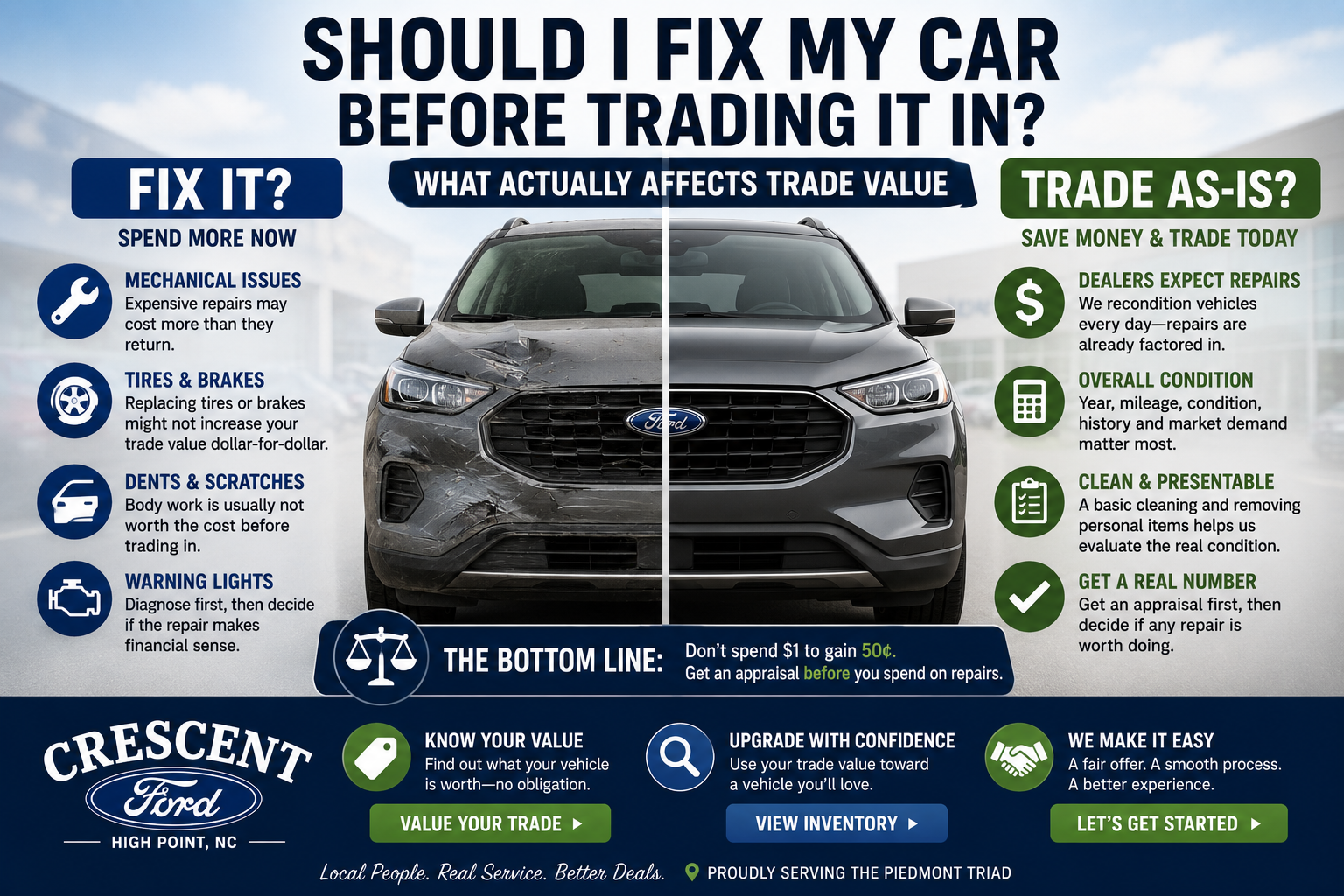
Should I fix my car before trading it in? Comparison of repairs versus trading as-is and what actually affects trade-in value

Should I Fix My Car Before Trading It In? What Affects Trade Value

Should I Fix My Car Before Trading It In? What Actually Affects Trade Value Your check-engine light is on. There's a scratch down the passenger door. The tires are getting close to needing replacement. And you've already decided you're probably trading the car. So now you're wondering: Should I fix all of this before I take it to the dealership? Usually, the answer isn't: "Fix everything." It's: "Figure out whether the repair will actually return what you're about to spend." That's an important distinction. Spending $2,000 repairing your vehicle doesn't automatically increase its trade-in value by $2,000. Sometimes fixing something before an appraisal makes sense. Sometimes cleaning the vehicle and replacing a $20 part is worthwhile. And sometimes the smartest financial decision is to leave the vehicle exactly as it is and let the dealership account for the repair when determining its value. Here's how to tell the difference. Do You Have to Fix Your Car Before Trading It In? No. You can trade in a vehicle that has: Mechanical problems Warning lights Dents Scratches Worn tires Interior damage Accident history High mileage Cosmetic wear A vehicle does not have to be in perfect condition to be traded. The condition will generally affect what it's worth, but that's very different from saying you need to repair everything before bringing it in. In fact, if you're planning to trade soon, making expensive repairs solely to increase the appraisal can sometimes cost you more than they return. Before authorizing a major repair, it may make sense to get the vehicle appraised first. Find Out What Your Vehicle Is Worth Before spending money on repairs, get an estimate of your vehicle's current trade value. You may find that trading it as-is makes more financial sense. The Most Important Rule: Don't Spend $1 to Gain 50 Cents This is the basic math behind deciding whether to repair a trade-in. Imagine your vehicle needs $1,500 worth of bodywork. You might naturally assume: "If I fix it, my car will be worth $1,500 more." Not necessarily. A dealership doesn't evaluate your vehicle by taking a perfect-condition value and subtracting exactly what a retail repair shop would charge you. Dealers consider what the vehicle is worth in its current condition, what it may cost to recondition, how desirable that vehicle is in the current market and what they reasonably expect to do with it. A dealership may also be able to complete certain repairs differently or at a different cost than you can as a retail customer. So if you spend $1,500 repairing something that only changes the appraisal by $800? You're $700 behind. That's why we'd rather have you get an appraisal before making a major repair solely for trade-in purposes. What Actually Determines Your Car's Trade-In Value? The dent you're worried about may not even be the biggest factor affecting your vehicle's value. An appraisal considers the vehicle as a whole. Some of the biggest factors include: Year, Make and Model This establishes the basic vehicle we're evaluating. A three-year-old F-150 is naturally being evaluated in a different market than a ten-year-old compact sedan. Mileage Mileage matters because it gives buyers and dealers an indication of how much use a vehicle has experienced. But there's no magic number where your car suddenly becomes worthless. A well-maintained higher-mileage vehicle can still have significant value. Likewise, unusually low mileage doesn't automatically erase condition issues or accident history. Mileage is one part of the appraisal. Overall Condition This includes much more than whether the car looks shiny. An appraiser may consider: Exterior condition Interior condition Tires Mechanical operation Warning lights Glass Wheels Upholstery Odors Evidence of previous damage General wear The question isn't: "Is this vehicle perfect?" It's: "What condition is this vehicle in relative to its age and mileage?" A six-year-old vehicle isn't expected to look like it rolled off the showroom floor yesterday. Vehicle History Accident and damage history can affect market value. So can how the vehicle was repaired. A professionally repaired minor incident isn't necessarily treated the same as significant structural damage. And trying to repair visible damage immediately before trading the vehicle doesn't erase the underlying vehicle history. Equipment and Configuration Two vehicles from the same model year can have very different values. Things such as: Trim level Engine Drivetrain Factory options Cab configuration Bed length Seating configuration Popular equipment can all affect desirability. This is especially noticeable with trucks and SUVs. Current Market Demand This one surprises some shoppers. Your car's value isn't determined in isolation. It's also influenced by: What people are currently willing to pay for vehicles like yours. Supply and demand matter. A particular model, configuration or price point that's selling quickly may be worth more than another vehicle with similar age and mileage that has less market demand. This is also why an online trade estimate from several months ago isn't necessarily your vehicle's value today. RELATED READING What Is My Car Worth in High Point, NC? How Trade-In Appraisals Actually Work Which Repairs Should You Consider Before Trading In? Let's get practical. Some inexpensive fixes can make sense. The key word is: Inexpensive. Replace Burned-Out Bulbs If you have a simple burned-out exterior bulb that's inexpensive and easy to replace, taking care of it can make sense. There's little reason to present a vehicle with an obvious small issue when fixing it costs very little. But if what appears to be a burned-out light is actually an expensive LED assembly or electrical problem? Different story. Get the cost before automatically repairing it. Replace Missing Inexpensive Items Is a floor mat missing? Did a cheap plastic trim piece fall off? Is there an inexpensive replacement part that takes five minutes to install? Those can be reasonable fixes. But again: Don't turn preparing your trade into a restoration project. Remove Your Stuff This one is free. Empty: Door pockets Center console Glove box Cargo area Truck bed Seat-back pockets Take out the collection of water bottles, receipts, kid toys, work equipment and whatever has been living under the passenger seat since 2023. You're not changing the vehicle's mechanical value. You're simply making it easier to evaluate. Give It a Basic Cleaning Yes, clean your vehicle. No, you probably don't need a $300 professional detail solely because you're trading it. Vacuum it. Throw away trash. Wipe down obvious dirt. Wash the exterior if it's filthy. That's enough in most cases. Don't try to make the vehicle look "new." Make it look cared for. There's a difference. Should You Detail Your Car Before Trading It In? A basic cleanup? Yes. An expensive professional detail? Usually not necessary solely for the appraisal. If your interior is unusually dirty, stained or full of pet hair, a more thorough cleaning could make sense. But don't assume every dollar spent detailing will come back in the appraisal. A dealer is evaluating the underlying vehicle. We know the difference between: a clean used car and a used car that was professionally detailed yesterday. A detail doesn't erase: Mechanical issues Accident history Worn tires High mileage Body damage Warning lights Clean it enough that its actual condition is easy to see. Then stop. Should You Fix Dents Before Trading In? Usually, we'd get the appraisal first. Small door dings and minor dents are common on used vehicles. If you already have access to inexpensive paintless dent repair and the damage is minor, you could ask what it would cost. But don't automatically schedule hundreds or thousands of dollars of bodywork because you're afraid a dent will destroy your trade value. Get two numbers: What will the repair cost me? and What is the vehicle worth as-is? Then make the decision. Should You Fix Scratches Before Trading In? It depends on the scratch. Light surface scratch? A simple polish or touch-up may help its appearance. Deep scratch through the paint? Don't automatically pay for body and paint work. Multiple panels scratched or damaged? Definitely get an appraisal before spending significant money. And please don't try to disguise major damage with a bottle of touch-up paint five minutes before arriving. It usually looks worse. Should You Replace the Tires Before Trading In? This is one of the biggest areas where shoppers can spend a lot of money right before trading. A set of tires can easily become a significant expense. And while worn tires absolutely can affect an appraisal, that doesn't automatically mean you should replace all four yourself. Suppose your vehicle needs tires. You spend $1,000 replacing them. Will the trade value increase by exactly $1,000? Don't assume it will. If you're trading the vehicle soon, get it appraised with the current tires first. Then you'll have actual information to work with. One exception: If a tire is unsafe to drive on, safety comes first. That's no longer simply a trade-value question. Should You Replace a Cracked Windshield Before Trading In? Again: Get the cost first. A windshield issue can affect the appraisal because the vehicle may need to be repaired before resale. But whether you should handle it yourself depends on: Size and location of the damage Whether repair is possible Replacement cost Insurance coverage Vehicle technology that may require calibration How soon you're trading Modern windshields can be more complicated than they appear because vehicles may have cameras or driver-assistance equipment associated with the windshield area. Don't assume it's a cheap piece of glass. Should You Fix a Check-Engine Light Before Trading In? This is where we'd separate: diagnosing from repairing. If your check-engine light is on and you have no idea why, knowing the cause can be useful. A loose or faulty component and a major mechanical problem are very different situations. But once you know the repair cost, you still have to ask: Does fixing this make financial sense if I'm trading the vehicle? If the repair is inexpensive? Maybe. If you receive a $4,000 repair estimate and were already planning to replace the vehicle? Get a trade appraisal before authorizing the work. Important: Don't clear warning codes simply to make the dashboard light disappear before the appraisal. The goal should be understanding the vehicle's condition — not hiding it. Should You Fix the Air Conditioning Before Trading In? North Carolina in August makes a broken air conditioner pretty noticeable. And yes, a non-functioning A/C system can affect value. But A/C repairs can range from relatively minor to very expensive. Before approving a major repair, compare: Repair cost against the vehicle's as-is trade value. If you're keeping the car for another year, repairing the A/C may be worthwhile because you'll benefit from using it. If you're trading it tomorrow? That's a different calculation. What About Mechanical Repairs? This is where we'd be especially cautious about spending money solely to improve trade value. Examples include: Transmission repairs Engine repairs Suspension work Major electrical repairs A/C system repairs Four-wheel-drive system repairs Significant oil or coolant leaks These issues can absolutely reduce a vehicle's value. But that doesn't mean paying retail for every repair is automatically your best option. Get the vehicle appraised as-is first. Then compare. What If My Car Needs Several Repairs? This is actually one of the situations where trading can make the most sense. Suppose your car needs: $1,200 in tires $1,500 in suspension work $800 in A/C repairs and you're approaching another major service interval. You could spend thousands getting everything caught up. But if you were already planning to replace the vehicle within six months? Ask yourself: Am I repairing this car because I want to keep it, or am I repairing it because I think I have to before trading it? Those are completely different decisions. Before writing checks to three repair shops, find out what someone will actually give you for the vehicle today. Will a Dealership Take a Car That Needs Major Repairs? Potentially, yes. A vehicle doesn't necessarily have to be retail-ready for a dealership to take it as a trade. Dealers handle vehicles differently depending on: Condition Age Mileage Marketability Reconditioning needs Some trades may eventually be offered for retail sale. Others may not. You don't need to transform your vehicle into something you'd expect to see on a used-car lot before bringing it in. That's the dealership's decision after it owns the vehicle. Should I Repair Accident Damage Before Trading My Car? Be particularly careful here. If your vehicle has accident damage, repairing it doesn't necessarily restore its value to what the same vehicle with no accident history would be worth. The history and the physical condition are separate considerations. If the repair is being handled through an active insurance claim, that's another situation entirely. But if you're thinking about paying thousands out of pocket solely because you plan to trade? Get an appraisal first. You want to know whether the difference in trade value justifies the repair expense. Does a Previous Accident Ruin Your Trade-In Value? Not necessarily. Accident history can affect value, but the amount depends on the circumstances. Consider: Severity Type of damage Quality of repair Structural involvement Vehicle age Mileage Current condition Market demand A minor accident years ago on an older vehicle isn't necessarily treated the same as recent major structural damage on a nearly new vehicle. This is why generic online advice such as: "An accident lowers your car by exactly X%" isn't particularly useful. Your actual vehicle needs to be evaluated. Does Regular Maintenance Increase Trade-In Value? Maintenance matters, but think of it more as protecting value than creating value. Changing your oil regularly doesn't suddenly add thousands of dollars to the appraisal. But poor maintenance can absolutely create problems that reduce value. If you have maintenance records, they're worth bringing. They can help document how the vehicle has been cared for. But don't schedule a giant list of routine maintenance immediately before trading solely because you think every dollar will be added to the appraisal. Should I Get an Oil Change Before Trading In? If the vehicle is due and you're still driving it? Sure. If you're trading it tomorrow and wondering whether a fresh oil change will significantly increase the offer? Probably not. A $70 oil change doesn't automatically create $70 in additional trade value. If the vehicle needs basic maintenance for safe continued operation, that's different. But don't confuse: maintaining a vehicle with preparing a vehicle for appraisal. Does Having Two Keys Increase Trade-In Value? Bring both keys if you have them. Modern vehicle keys and key fobs can be expensive to replace. Having all original keys, remotes and relevant accessories makes the vehicle more complete. The same applies to things such as: Owner's manuals Removable cargo accessories Factory equipment Wheel-lock keys Headphones/remotes for entertainment systems Charging equipment for EVs or plug-in hybrids Don't buy a second key solely because you're trading. But if you already have it? Bring it. Should I Remove Aftermarket Modifications Before Trading? This depends heavily on the modification. You may love: Oversized wheels Suspension modifications Custom exhaust Performance tuning Aftermarket lighting Audio upgrades Cosmetic accessories The next buyer may not. Aftermarket modifications don't automatically increase trade value by what you paid for them. In some cases, they may reduce the number of potential buyers for the vehicle. If you still have the original factory parts and the modification is easily reversible, ask whether returning the vehicle to stock makes sense. But don't spend a fortune undoing modifications without first getting an appraisal. Does a Clean Car Get a Better Trade-In Offer? Potentially — but not because we're fooled by Armor All. A reasonably clean vehicle allows the appraiser to evaluate the condition more easily. It can also indicate that the vehicle has been cared for. But we're still going to see: the scratch the dent the worn tire and the warning light. So yes: Clean it. But don't spend all weekend with a toothbrush cleaning the air vents because you're convinced it'll add $500. It won't. What Should You Do Before Getting Your Car Appraised? Here's the preparation we'd actually recommend. 1. Remove personal belongings. Empty the vehicle. 2. Give it a reasonable cleaning. Vacuum, wipe it down and wash it if needed. 3. Find both keys. Bring them if you have them. 4. Gather maintenance records. Especially if you've kept good documentation. 5. Know your payoff if you still have a loan. You don't need to pay the vehicle off before trading it. 6. Don't make expensive repairs yet. Get the appraisal first. 7. Be honest about known issues. It makes the process much easier. That's it. You don't need to prepare your car for the Pebble Beach Concours d'Elegance. You're trading it. Get Your Trade-In Value What If You Still Owe Money on a Car That Needs Repairs? You can potentially trade it. The fact that your vehicle: has a loan and needs repairs doesn't automatically prevent you from trading. Those are separate parts of the transaction. The dealership evaluates the vehicle's trade value. Then your current lender provides a payoff amount. If the vehicle is worth more than the payoff, you have positive equity. If the payoff is higher than the trade value, you have negative equity. The repair issue may affect the vehicle's value, but it doesn't change how equity fundamentally works. RELATED READING Can You Trade In a Car You Still Owe Money On? Should You Repair Your Car or Trade It? This is actually a bigger question than: "Will fixing this increase my trade value?" Maybe your vehicle needs a $2,500 repair. If the repair gives you another three reliable years with a vehicle you like and that's otherwise paid for? Repairing it could make perfect sense. But if: You've already outgrown the vehicle. You don't trust it anymore. Repairs are becoming frequent. You were planning to replace it soon anyway. Your needs have changed. then putting thousands into it immediately before trading may not make sense. The right decision isn't based solely on what the repair costs. It's based on: What does keeping the vehicle cost me? versus What does replacing it cost me? How to Decide Whether a Repair Is Worth Doing Before a Trade Here's a simple process. Step 1: Get the repair estimate. Find out what the issue actually costs to fix. Step 2: Get the vehicle appraised as-is. Now you know what the vehicle is worth without spending the money. Step 3: Ask whether repairing it would materially change the appraisal. Don't guess. Ask. Step 4: Compare the numbers. Suppose: Current trade value: $12,000 Repair cost: $2,000 Estimated value after repair: $13,000 Spending $2,000 to potentially gain $1,000 doesn't make much financial sense. But suppose: Repair cost: $200 and the issue materially affects the vehicle's usability or marketability. That could be a very different calculation. Use the numbers, not emotion. Don't Confuse Trade Value With What You Owe This is another common mistake. Suppose you owe: $20,000 on your vehicle. That doesn't mean it's worth $20,000. And spending $2,000 repairing it doesn't automatically mean it becomes worth $22,000. Your loan balance and your vehicle's market value are independent. This is why knowing both numbers before deciding what to do is so important. What If an Online Trade Tool Doesn't Know My Car Needs Repairs? An online valuation is a starting point. Your final appraisal requires evaluating the actual vehicle. That's where condition becomes much more specific. Two vehicles can have: Same year Same model Same trim Same mileage and still receive different appraisals because one needs substantially more reconditioning than the other. Use the online estimate to start the conversation. Then let the actual vehicle tell the rest of the story. Value Your Trade Online Should You Fix Your Car Before Selling It Privately? This can be different from trading. A private buyer generally expects a vehicle they can immediately use and may be less comfortable buying something with an obvious mechanical problem. That means certain repairs can have more value when you're trying to sell directly to another consumer. But private selling also means handling: Advertising Messages Test drives Negotiation Payment Paperwork Potential no-shows Trading is usually simpler. So when comparing private-sale value with trade value, don't compare only the two dollar amounts. Consider the cost, repairs, time and effort required to actually achieve the private-sale price. Should You Get Multiple Trade-In Appraisals? You can. But make sure you're comparing actual offers based on the vehicle's real condition. An online estimate generated without someone inspecting your car isn't necessarily the same thing as an appraisal after the vehicle has been evaluated. And make sure you're comparing the whole transaction if you're simultaneously buying another vehicle. A dealership giving you $1,000 more for your trade isn't necessarily giving you a $1,000 better overall deal if another part of the transaction costs more. RELATED READING What Does “Out-the-Door Price” Mean When Buying a Car in NC? When Should You Definitely NOT Repair Your Car Before Trading It? We'd be very cautious about making an expensive repair solely for trade value when: You're trading immediately. The repair costs thousands. You're assuming you'll recover 100% of the cost. You haven't gotten an appraisal yet. The vehicle has several other significant issues. You're trying to erase an accident history that will still exist. You're replacing tires solely because you think you'll get every dollar back. You're repairing something the dealership may handle more economically. There's a very easy way to avoid guessing: Appraise first. Repair second — if the numbers actually justify it. When Might Fixing Something Before Trading Make Sense? Consider taking care of an issue when: The repair is inexpensive. The fix is simple. It materially improves usability. It removes an obvious problem. You're still going to drive the vehicle for a while. Safety requires the repair. You know the repair meaningfully improves the vehicle's value relative to its cost. The key isn't whether the vehicle has a problem. The key is: What's the return on fixing it? Trading a Car That Needs Repairs in High Point, NC If you're in High Point, Greensboro, Winston-Salem, Kernersville, Thomasville, Lexington, Trinity or elsewhere around the Piedmont Triad and you're thinking about replacing a vehicle that needs work, you don't need to fix everything before finding out what it's worth. Bring it as-is. Let us evaluate it. Then you'll have a real number to work with. Maybe fixing the vehicle makes sense. Maybe trading it makes more sense. And maybe the difference isn't nearly as large as you expected. You won't know until you have the appraisal. Find Out What Your Car Is Worth at Crescent Ford Shop New Ford Vehicles Shop Used Vehicles Explore Financing Options Frequently Asked Questions About Fixing a Car Before Trading It In Should I fix my car before trading it in? Not necessarily. Small, inexpensive repairs may make sense, but expensive repairs don't automatically increase your trade value by the amount you spend. Consider getting an appraisal in the vehicle's current condition before making major repairs solely for trade-in purposes. Can I trade in a car that needs repairs? Yes. Dealerships can evaluate vehicles with mechanical, cosmetic and other condition issues. The needed repairs may affect the appraisal, but the vehicle doesn't have to be perfect to be traded. Should I fix a check-engine light before trading my car? Consider diagnosing the issue first so you understand what you're dealing with. If the repair is expensive and you're already planning to trade, get an appraisal before authorizing the work. Don't clear codes simply to hide a known problem. Should I replace my tires before trading in my car? Not automatically. Worn tires can affect value, but a new set may cost more than the increase you'd receive in trade value. Get the vehicle appraised with its current tires before replacing them solely for a trade. Should I detail my car before trading it in? A basic cleaning is worthwhile. Remove trash and personal belongings, vacuum the interior and wash the vehicle if needed. An expensive professional detail usually isn't necessary solely for a trade appraisal. Should I fix dents and scratches before trading my car? Minor cosmetic issues don't always justify professional bodywork before a trade. Get a repair estimate and an as-is appraisal before spending significant money. Will a cracked windshield lower my trade-in value? It can. The effect depends on the damage and replacement requirements. Modern vehicles may also require camera or driver-assistance-system calibration after windshield replacement, so get an accurate repair estimate before deciding. Does a previous accident affect trade-in value? It can. The impact depends on factors such as severity, repair quality, structural damage, vehicle age, mileage and current market demand. Repairing cosmetic damage doesn't necessarily erase the effect of accident history. Does high mileage lower trade-in value? Mileage is one factor used in an appraisal. Higher mileage can affect value, but age, condition, equipment, history and current market demand also matter. Do maintenance records help trade-in value? They can help document that a vehicle has been properly maintained. Maintenance is generally better viewed as protecting the vehicle's condition and value over time rather than creating a dollar-for-dollar increase at appraisal. Should I change the oil before trading in my car? If it's due and you're continuing to drive the vehicle, normal maintenance makes sense. But a fresh oil change immediately before an appraisal generally shouldn't be expected to increase the trade offer dollar-for-dollar. Should I bring both keys when trading in my car? Yes, if you have them. Modern replacement keys can be expensive, so bring all keys, remotes and original equipment that belongs with the vehicle. Is it better to repair my car or trade it in? That depends on the repair cost, current vehicle value, how long you plan to keep it and the cost of replacing it. If you're already planning to replace the vehicle soon, get an as-is appraisal before spending thousands on repairs. Can I trade in a car with a loan and mechanical problems? Potentially, yes. The dealership determines the vehicle's value based partly on its condition, while your lender provides the payoff. The difference between those two numbers determines whether you have positive or negative equity. What's the easiest way to know whether a repair is worth doing before trading? Get the repair estimate and an as-is trade appraisal. Then compare how much the repair costs with how much it is reasonably expected to change the vehicle's value. That takes the guesswork out of the decision.

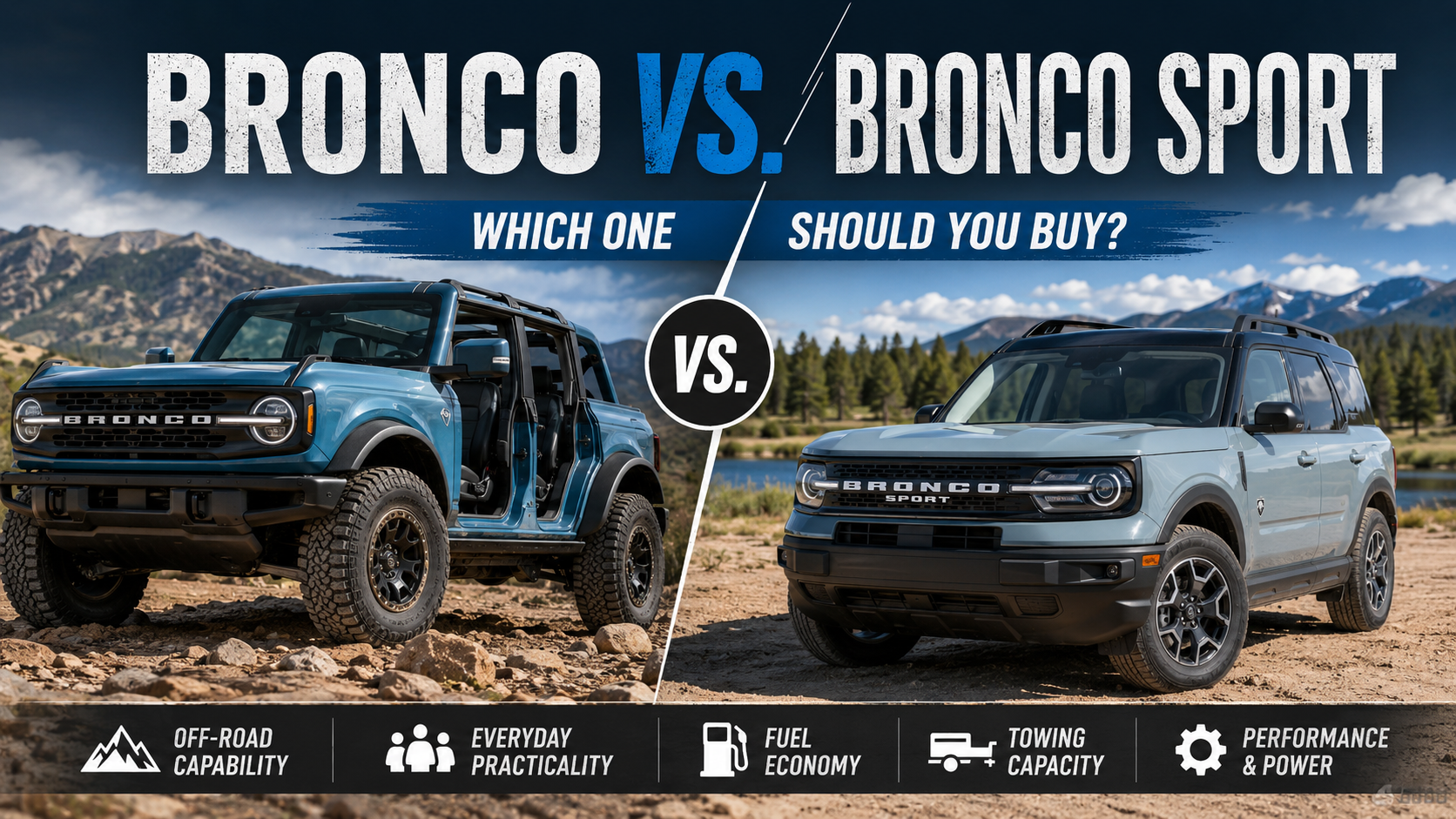
2026 Ford Bronco and Ford Bronco Sport comparison

2026 Ford Bronco vs. Bronco Sport: Which Should You Buy?

2026 Ford Bronco vs. Bronco Sport: Which One Should You Buy? The Ford Bronco and Ford Bronco Sport share a name, unmistakable Bronco styling and an adventurous personality. But if you're trying to decide which one belongs in your driveway, there's an important distinction to understand: The Bronco and Bronco Sport aren't simply two sizes of the same SUV. The 2026 Ford Bronco is the more rugged, highly configurable choice, built for drivers who want serious off-road capability, available 2-door or 4-door configurations, removable doors and roof options, stronger available engines and greater towing capability. The 2026 Ford Bronco Sport is the smaller, more everyday-friendly SUV. It's easier to maneuver, more fuel-efficient with its standard engine and still comes standard with 4x4. It's a particularly appealing option for shoppers who want Bronco-inspired capability and styling without needing everything the larger Bronco offers. So, which should you buy? Choose the Bronco if serious off-roading, open-air driving, greater towing capability and maximum customization are priorities. Choose the Bronco Sport if you want a practical five-passenger SUV that's easy to live with every day while still being ready for weekends away from the pavement. For many buyers, the decision becomes surprisingly easy once you stop comparing badges and start comparing how you'll actually use the vehicle. Bronco vs. Bronco Sport at a Glance Feature 2026 Ford Bronco 2026 Ford Bronco Sport Seating Up to 5 5 Door Configurations 2-door or 4-door, depending on model 4-door Drive System 4x4 4x4 Engine Options 2.3L EcoBoost, 2.7L EcoBoost V6, 3.0L EcoBoost V6 1.5L EcoBoost or 2.0L EcoBoost Maximum Horsepower Up to 418 hp Up to 250 hp Transmission 7-speed manual or 10-speed automatic, depending on configuration 8-speed automatic Maximum Towing Up to 4,500 lbs. on Raptor; most models up to 3,500 lbs. Up to 2,700 lbs. when properly equipped Removable Doors/Roof Yes No Best Fit Off-roading, customization, towing, open-air adventure Commuting, families, daily driving, light off-road adventures Specifications vary by trim, configuration and equipment. Always verify the specifications of the individual vehicle you're considering. Compare New Ford Bronco and Bronco Sport SUVs What's the Biggest Difference Between the Ford Bronco and Bronco Sport? Think of the Bronco as an off-road vehicle that can comfortably handle everyday life and the Bronco Sport as an everyday compact SUV that's surprisingly capable when the pavement ends. That's an oversimplification, but it's a useful starting point. The Bronco's design gives buyers considerably more opportunity to configure the vehicle around adventure. Depending on the model, you can choose 2-door or 4-door configurations, manual or automatic transmissions, different engines and increasingly serious off-road equipment. Then there's one of the Bronco's signature features: the doors and roof can come off. The Bronco Sport doesn't offer the same open-air configuration, but that's not necessarily a disadvantage. Plenty of shoppers love the Bronco look but don't actually plan to remove doors, tackle difficult trails or use all of the larger Bronco's capability. For them, the Bronco Sport can make considerably more sense. It's compact, practical and standard with 4x4 while providing the type of versatility that works for commuting during the week and loading up for a weekend in the mountains. Which One Is Better for Everyday Driving? For the average commute around High Point, Greensboro or Winston-Salem, we'd give the Bronco Sport the advantage for everyday practicality. The 2026 Bronco Sport is approximately 173 inches long depending on configuration. For comparison, a four-door Bronco is roughly 189 inches long in several popular configurations. That difference matters when you're pulling into a tight parking spot, navigating a crowded shopping center or simply fitting another vehicle in the driveway. The Bronco Sport also pairs its compact dimensions with useful passenger and cargo space. With the standard 1.5L EcoBoost configuration, it provides up to 32.5 cubic feet of cargo space behind the second row and up to 65.2 cubic feet behind the first row. If your SUV spends considerably more time carrying groceries, backpacks, strollers and luggage than climbing rocks, that's worth considering. None of this means the larger Bronco is difficult to drive every day. Far from it. A four-door Bronco can make a perfectly usable daily driver. You're simply accepting some additional size and capability in exchange for everything that makes the Bronco unique. Our pick for daily driving: Bronco Sport If your typical week consists of commuting, school drop-offs, errands and highway driving with occasional outdoor adventures mixed in, start your comparison with the Bronco Sport. Shop New Ford Bronco Sport SUVs Which Is Better Off-Road: Bronco or Bronco Sport? Here's where the Bronco earns its reputation. Both SUVs come standard with 4x4 for 2026, but the Bronco offers substantially more capability for shoppers who intend to use it. The 2026 Bronco lineup offers up to seven G.O.A.T. Modes — Ford's "Goes Over Any Type of Terrain" drive modes — depending on model. Available off-road equipment can include features such as electronic-locking axles, specialized HOSS suspension systems, steel bash plates and the Sasquatch Package. The Badlands trim is particularly interesting for buyers looking for serious trail capability without moving all the way to a Bronco Raptor. The Bronco Sport shouldn't be dismissed, though. Ford has pushed its smaller SUV beyond the typical compact crossover formula. Bronco Sport models come standard with 4x4, and the Badlands receives a 2.0L EcoBoost engine and Advanced 4x4 with a twin-clutch rear drive unit. Available off-road packages can take Bronco Sport capability even further. The practical question is how far off-road you actually intend to go. If "off-road" means gravel roads, muddy campsites, mountain trips, snow, fishing spots and occasional trails, a properly equipped Bronco Sport may provide all the capability you need. If you're specifically shopping for something to tackle difficult trails, rocks, deeper water crossings or more demanding terrain, the Bronco deserves the advantage. Our pick for serious off-roading: Bronco For buyers who genuinely intend to use their SUV's off-road hardware, the larger Bronco provides more capability and more ways to configure the vehicle around that purpose. Bronco vs. Bronco Sport Engine Options There's another significant difference under the hood. 2026 Ford Bronco Sport Engines The Bronco Sport offers two EcoBoost engine choices depending on trim. The 1.5L EcoBoost produces up to 180 horsepower and 200 lb.-ft. of torque and is used in Big Bend, Heritage and Outer Banks models. The 2.0L EcoBoost in the Badlands produces up to 250 horsepower and 280 lb.-ft. of torque. Both use an 8-speed automatic transmission. 2026 Ford Bronco Engines The Bronco gives buyers considerably more powertrain choice. The 2.3L EcoBoost four-cylinder produces up to 300 horsepower and 325 lb.-ft. of torque. An available 2.7L EcoBoost V6 increases output to up to 330 horsepower and 415 lb.-ft. of torque. At the top of the range, the Bronco Raptor's 3.0L EcoBoost V6 produces up to 418 horsepower. Depending on the Bronco model and configuration, buyers can also choose between a 7-speed manual and 10-speed automatic transmission. Do you actually need the extra Bronco power? That's the better question. For commuting and normal family use, the Bronco Sport's 1.5L engine may be perfectly appropriate. Buyers wanting more performance and off-road capability can move into the Bronco Sport Badlands and its 2.0L. If stronger acceleration, greater towing capability or serious off-road performance matters, the Bronco's available powertrains become much more compelling. See Available Ford Bronco SUVs in High Point Which Gets Better Gas Mileage? This is one area where the Bronco Sport has a clear advantage. The 2026 Bronco Sport with the 1.5L EcoBoost is EPA-estimated at 25 mpg city, 30 mpg highway and 27 mpg combined. The more powerful 2.0L Bronco Sport is EPA-estimated at 21 mpg city, 27 mpg highway and 23 mpg combined. Actual mileage varies, of course, and equipment such as off-road packages can affect the ratings. The larger Bronco prioritizes capability, power and off-road performance rather than maximizing fuel economy. If you're driving from High Point to Greensboro five days a week and heading to the mountains occasionally, fuel economy may deserve considerably more weight in your decision than maximum trail capability. Our pick for fuel-conscious buyers: Bronco Sport The 1.5L Bronco Sport is the more logical starting point if reducing fuel consumption during everyday driving is high on your priority list. Which Has More Cargo Space? This comparison is more interesting than simply saying "the bigger SUV has more room." A Bronco Sport with the 1.5L engine provides up to 32.5 cubic feet behind the second row and 65.2 cubic feet behind the first row. Bronco cargo capacity varies substantially depending on whether you choose a 2-door or 4-door configuration and the type of roof. A 2-door Bronco provides about 20.6 cubic feet behind the rear seats, while 4-door versions can provide considerably more. Depending on roof and configuration, maximum cargo capacity on a 4-door Bronco can exceed 70 cubic feet. For families, we'd pay particular attention to the configuration rather than simply the Bronco name. A 2-door Bronco might be the vehicle you love, but climbing into the rear seats and working around its cargo area is very different from loading children and all their gear into a Bronco Sport or four-door Bronco. If car seats, sports equipment, groceries and family trips are part of your normal routine, compare the vehicles in person with those needs in mind. Sometimes the spec sheet doesn't answer that question nearly as well as opening the doors and cargo area yourself. Bronco vs. Bronco Sport for Families For many families, we'd start with the Bronco Sport or a four-door Bronco. The Bronco Sport seats five and gives you four conventional passenger doors in every configuration. Its smaller exterior dimensions can make it particularly convenient for daily family duty. The four-door Bronco offers more of the Bronco experience without the compromises a 2-door configuration can create for regular rear-seat access. Parents should also think beyond passenger capacity. Ask yourself: How often are adults sitting in the second row? Are you installing rear-facing or forward-facing car seats? Do you regularly carry a stroller? How much luggage goes with you on vacation? Do your children bring sports equipment? Will this be your primary family vehicle or a second vehicle? There's no universal winner because two families of four can use their SUVs completely differently. Our pick for most everyday family use: Bronco Sport Our pick for families wanting more Bronco capability: Four-door Bronco Not sure which Ford SUV fits your family? Browse our new Ford SUV inventory Which One Can Tow More? If towing is part of the plan, the Bronco has the advantage. Most properly equipped 2026 Bronco models can tow up to 3,500 pounds, while Bronco Raptor can tow up to 4,500 pounds. The Bronco Sport can tow up to 2,200 pounds with applicable 1.5L models and the required Class II Trailer Tow Package. The Bronco Sport Badlands can tow up to 2,700 pounds with its Class II Trailer Tow Package. Those numbers shouldn't be treated as universal ratings for every Bronco or Bronco Sport on a dealer's lot. Towing capacity depends on the specific vehicle, equipment, passengers, cargo and configuration. If towing is important to your purchase, verify the capability of the specific VIN you're considering rather than assuming every vehicle with the same model name has the same rating. For a small utility trailer or similar lighter towing needs, Bronco Sport may be enough. For buyers who know they'll need more capacity, Bronco is the better place to start. Our pick for towing: Bronco What About Bronco Sport Badlands vs. Bronco? This may actually be the most interesting comparison in the lineup. A shopper considering a Bronco Sport Badlands is clearly interested in more capability than the average compact SUV provides. But does that mean it's time to move to a Bronco? Not necessarily. The Bronco Sport Badlands gives you the more powerful 2.0L EcoBoost, Advanced 4x4 with a twin-clutch rear drive unit and additional capability while retaining the Bronco Sport's compact dimensions and everyday practicality. That can be an excellent combination for someone who wants to explore trails and spend weekends outdoors but still wants a compact SUV Monday through Friday. Move toward the Bronco when you start prioritizing things such as removable doors and roof, more extreme off-road capability, greater available ground clearance, more powerful engine choices, manual-transmission availability or greater towing capability. In other words: Don't buy capability solely because it's available. Buy the capability you're actually going to use. That usually leads to a better vehicle — and a better use of your budget. Is the Bronco Sport Just a Smaller Bronco? No. They share styling cues, branding and an adventure-focused philosophy, but they're designed for different jobs. That's important because "Bronco Sport" can make it sound as though it's simply a trim or smaller version of the Bronco. It isn't. The Bronco is built around serious off-road capability and configurability. The Bronco Sport takes many of the ideas shoppers like about Bronco — rugged styling, standard 4x4 and outdoor versatility — and packages them into a compact SUV that's easier to use as an everyday vehicle. Neither approach is inherently better. The question is which one better matches your life. Should You Buy a Bronco or Bronco Sport? Here's the simplest way we'd break it down. Buy the Ford Bronco if: You want the doors and roof to come off. Serious off-roading is part of your plans. You want more available horsepower. You need greater towing capability. You want a manual-transmission option. You like having extensive off-road packages and configurations to choose from. The Bronco experience itself is part of why you're buying the vehicle. Buy the Ford Bronco Sport if: This will primarily be your everyday SUV. Fuel economy matters more than maximum capability. You prefer a smaller vehicle that's easier to maneuver and park. You want standard 4x4 without moving into a larger SUV. You need room for five but don't need a large vehicle. Your adventures typically involve camping, mountain roads, beaches, gravel roads or moderate trails rather than extreme off-roading. You like Bronco styling but don't need removable doors or a removable roof. And if you're still somewhere in the middle? Drive both. This is one comparison where 20 minutes behind the wheel can tell you more than another hour of online research. Compare Bronco and Bronco Sport Inventory at Crescent Ford Don't Forget to Compare the Cost of the Whole Purchase Choosing the right model is only part of the equation. Before deciding between Bronco and Bronco Sport, consider what you're trading, how much you want to put down and what monthly payment fits comfortably into your budget. If you currently own a vehicle, knowing its approximate trade value can make the comparison much easier. For example, you may discover that the equity in your current vehicle puts a Bronco configuration you prefer within reach. Or you may decide you'd rather keep more room in your monthly budget and choose a well-equipped Bronco Sport. Either way, it's better to make that decision with actual numbers instead of guessing. Find Out What Your Trade Is Worth Explore Auto Financing Options Compare the Ford Bronco and Bronco Sport in High Point, NC The Bronco vs. Bronco Sport decision doesn't have to come down to which vehicle has the biggest numbers on a spec sheet. It comes down to what you need your SUV to do. For drivers around High Point and the Piedmont Triad who want a practical daily vehicle with standard 4x4 and plenty of versatility for weekend adventures, the Bronco Sport is an excellent place to start. If you're looking for more power, serious off-road capability, greater towing potential or the unique experience of taking the doors and roof off your SUV, the Bronco is worth the step up. At Crescent Ford in High Point, you can compare available Bronco and Bronco Sport models side by side instead of trying to make the entire decision online. Sit in both. Check the back seat. Open the cargo areas. Drive them. The right choice usually becomes pretty obvious once you do. Shop New Ford Bronco & Bronco Sport Inventory Value Your Trade Frequently Asked Questions About the Ford Bronco vs. Bronco Sport Is the Bronco Sport smaller than the Bronco? Yes, particularly compared with a four-door Bronco. The 2026 Bronco Sport is approximately 173 inches long depending on engine, while many four-door Bronco configurations are approximately 189 inches long. Interestingly, a 2-door Bronco is similar to the Bronco Sport in overall length, although the vehicles have very different designs and proportions. Do the Ford Bronco and Bronco Sport both have 4x4? Yes. The 2026 Bronco and Bronco Sport both come with 4x4, although the specific systems and available off-road hardware differ by model and trim. Can you take the doors off a Bronco Sport? No. Removable doors and roof options are features of the larger Ford Bronco. The Bronco Sport uses conventional fixed doors and roof. Which gets better gas mileage, Bronco or Bronco Sport? The Bronco Sport generally has the advantage for fuel economy. The 2026 Bronco Sport with the 1.5L EcoBoost is EPA-estimated at 25 mpg city, 30 mpg highway and 27 mpg combined. Actual mileage varies. Which can tow more, Bronco or Bronco Sport? The Bronco. Most properly equipped 2026 Bronco models can tow up to 3,500 pounds, while Bronco Raptor can tow up to 4,500 pounds. The 2026 Bronco Sport can tow up to 2,700 pounds when properly equipped, depending on model. Is the Bronco Sport good for off-roading? Yes, particularly when properly equipped. Every 2026 Bronco Sport comes with 4x4, and models such as the Badlands add substantially more off-road capability. Drivers planning more difficult or technical off-roading should also consider the larger Bronco. Is the Bronco Sport better for commuting? For many drivers, yes. Its smaller dimensions and strong fuel-economy ratings with the 1.5L EcoBoost make the Bronco Sport particularly well suited to everyday commuting while still providing standard 4x4 and SUV versatility. Should I test drive the Bronco and Bronco Sport before deciding? Absolutely. Specifications can help narrow the choice, but seating position, ride, visibility, cargo access and overall size feel very different in person. Driving both back-to-back is one of the easiest ways to decide which one fits you better. Schedule a Bronco or Bronco Sport test drive