

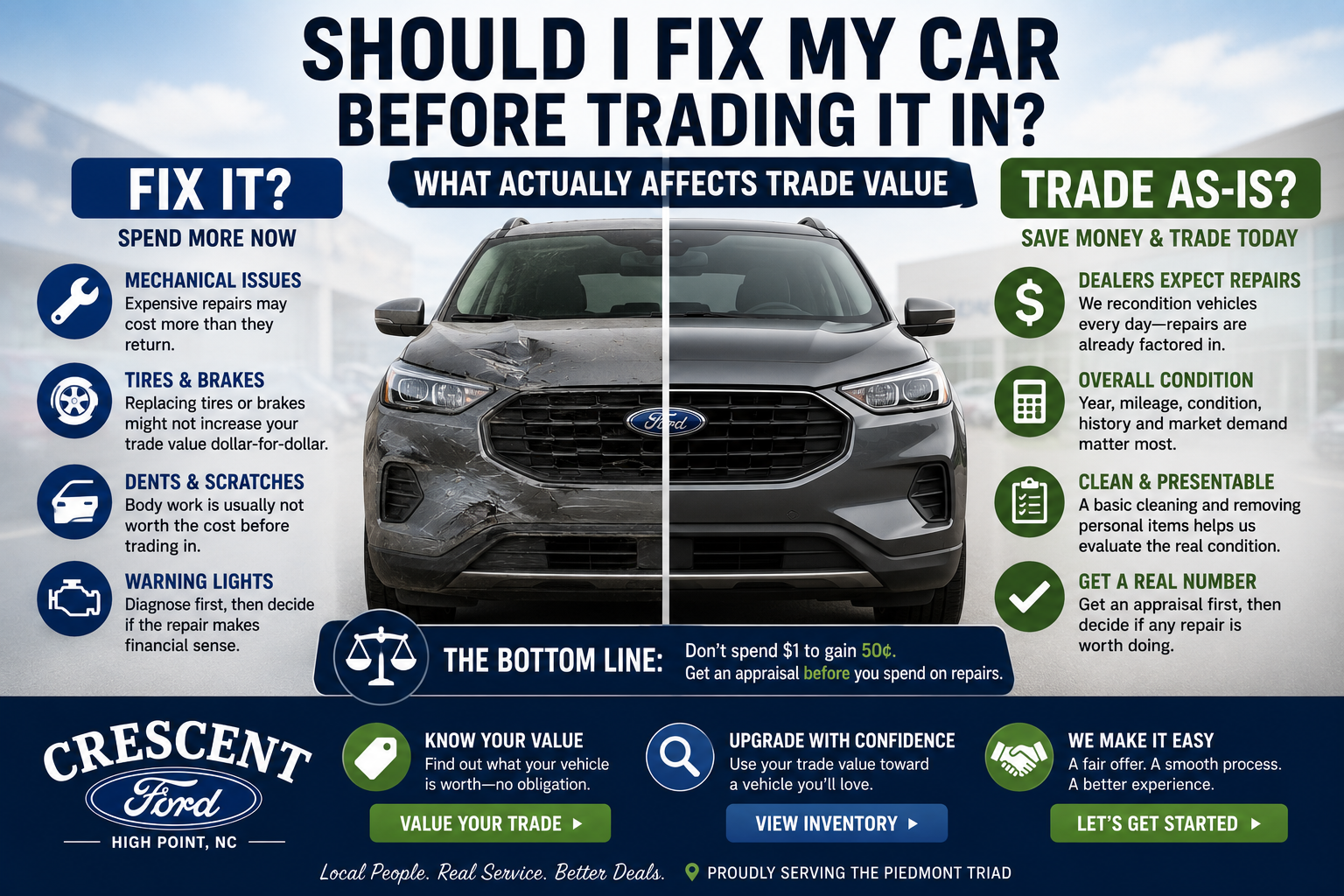
Should I Fix My Car Before Trading It In? What Actually Affects Trade Value
Your check-engine light is on.
There's a scratch down the passenger door.
The tires are getting close to needing replacement.
And you've already decided you're probably trading the car.
So now you're wondering:
Should I fix all of this before I take it to the dealership?
Usually, the answer isn't:
"Fix everything."
It's:
"Figure out whether the repair will actually return what you're about to spend."
That's an important distinction.
Spending $2,000 repairing your vehicle doesn't automatically increase its trade-in value by $2,000.
Sometimes fixing something before an appraisal makes sense.
Sometimes cleaning the vehicle and replacing a $20 part is worthwhile.
And sometimes the smartest financial decision is to leave the vehicle exactly as it is and let the dealership account for the repair when determining its value.
Here's how to tell the difference.
Do You Have to Fix Your Car Before Trading It In?
No.
You can trade in a vehicle that has:
Mechanical problems
Warning lights
Dents
Scratches
Worn tires
Interior damage
Accident history
High mileage
Cosmetic wear
A vehicle does not have to be in perfect condition to be traded.
The condition will generally affect what it's worth, but that's very different from saying you need to repair everything before bringing it in.
In fact, if you're planning to trade soon, making expensive repairs solely to increase the appraisal can sometimes cost you more than they return.
Before authorizing a major repair, it may make sense to get the vehicle appraised first.
Find Out What Your Vehicle Is Worth
Before spending money on repairs, get an estimate of your vehicle's current trade value. You may find that trading it as-is makes more financial sense.
The Most Important Rule: Don't Spend $1 to Gain 50 Cents
This is the basic math behind deciding whether to repair a trade-in.
Imagine your vehicle needs $1,500 worth of bodywork.
You might naturally assume:
"If I fix it, my car will be worth $1,500 more."
Not necessarily.
A dealership doesn't evaluate your vehicle by taking a perfect-condition value and subtracting exactly what a retail repair shop would charge you.
Dealers consider what the vehicle is worth in its current condition, what it may cost to recondition, how desirable that vehicle is in the current market and what they reasonably expect to do with it.
A dealership may also be able to complete certain repairs differently or at a different cost than you can as a retail customer.
So if you spend $1,500 repairing something that only changes the appraisal by $800?
You're $700 behind.
That's why we'd rather have you get an appraisal before making a major repair solely for trade-in purposes.
What Actually Determines Your Car's Trade-In Value?
The dent you're worried about may not even be the biggest factor affecting your vehicle's value.
An appraisal considers the vehicle as a whole.
Some of the biggest factors include:
Year, Make and Model
This establishes the basic vehicle we're evaluating.
A three-year-old F-150 is naturally being evaluated in a different market than a ten-year-old compact sedan.
Mileage
Mileage matters because it gives buyers and dealers an indication of how much use a vehicle has experienced.
But there's no magic number where your car suddenly becomes worthless.
A well-maintained higher-mileage vehicle can still have significant value.
Likewise, unusually low mileage doesn't automatically erase condition issues or accident history.
Mileage is one part of the appraisal.
Overall Condition
This includes much more than whether the car looks shiny.
An appraiser may consider:
Exterior condition
Interior condition
Tires
Mechanical operation
Warning lights
Glass
Wheels
Upholstery
Odors
Evidence of previous damage
General wear
The question isn't:
"Is this vehicle perfect?"
It's:
"What condition is this vehicle in relative to its age and mileage?"
A six-year-old vehicle isn't expected to look like it rolled off the showroom floor yesterday.
Vehicle History
Accident and damage history can affect market value.
So can how the vehicle was repaired.
A professionally repaired minor incident isn't necessarily treated the same as significant structural damage.
And trying to repair visible damage immediately before trading the vehicle doesn't erase the underlying vehicle history.
Equipment and Configuration
Two vehicles from the same model year can have very different values.
Things such as:
Trim level
Engine
Drivetrain
Factory options
Cab configuration
Bed length
Seating configuration
Popular equipment
can all affect desirability.
This is especially noticeable with trucks and SUVs.
Current Market Demand
This one surprises some shoppers.
Your car's value isn't determined in isolation.
It's also influenced by:
What people are currently willing to pay for vehicles like yours.
Supply and demand matter.
A particular model, configuration or price point that's selling quickly may be worth more than another vehicle with similar age and mileage that has less market demand.
This is also why an online trade estimate from several months ago isn't necessarily your vehicle's value today.
RELATED READING
What Is My Car Worth in High Point, NC? How Trade-In Appraisals Actually Work
Which Repairs Should You Consider Before Trading In?
Let's get practical.
Some inexpensive fixes can make sense.
The key word is:
Inexpensive.
Replace Burned-Out Bulbs
If you have a simple burned-out exterior bulb that's inexpensive and easy to replace, taking care of it can make sense.
There's little reason to present a vehicle with an obvious small issue when fixing it costs very little.
But if what appears to be a burned-out light is actually an expensive LED assembly or electrical problem?
Different story.
Get the cost before automatically repairing it.
Replace Missing Inexpensive Items
Is a floor mat missing?
Did a cheap plastic trim piece fall off?
Is there an inexpensive replacement part that takes five minutes to install?
Those can be reasonable fixes.
But again:
Don't turn preparing your trade into a restoration project.
Remove Your Stuff
This one is free.
Empty:
Door pockets
Center console
Glove box
Cargo area
Truck bed
Seat-back pockets
Take out the collection of water bottles, receipts, kid toys, work equipment and whatever has been living under the passenger seat since 2023.
You're not changing the vehicle's mechanical value.
You're simply making it easier to evaluate.
Give It a Basic Cleaning
Yes, clean your vehicle.
No, you probably don't need a $300 professional detail solely because you're trading it.
Vacuum it.
Throw away trash.
Wipe down obvious dirt.
Wash the exterior if it's filthy.
That's enough in most cases.
Don't try to make the vehicle look "new."
Make it look cared for.
There's a difference.
Should You Detail Your Car Before Trading It In?
A basic cleanup?
Yes.
An expensive professional detail?
Usually not necessary solely for the appraisal.
If your interior is unusually dirty, stained or full of pet hair, a more thorough cleaning could make sense.
But don't assume every dollar spent detailing will come back in the appraisal.
A dealer is evaluating the underlying vehicle.
We know the difference between:
a clean used car
and
a used car that was professionally detailed yesterday.
A detail doesn't erase:
Mechanical issues
Accident history
Worn tires
High mileage
Body damage
Warning lights
Clean it enough that its actual condition is easy to see.
Then stop.
Should You Fix Dents Before Trading In?
Usually, we'd get the appraisal first.
Small door dings and minor dents are common on used vehicles.
If you already have access to inexpensive paintless dent repair and the damage is minor, you could ask what it would cost.
But don't automatically schedule hundreds or thousands of dollars of bodywork because you're afraid a dent will destroy your trade value.
Get two numbers:
What will the repair cost me?
and
What is the vehicle worth as-is?
Then make the decision.
Should You Fix Scratches Before Trading In?
It depends on the scratch.
Light surface scratch?
A simple polish or touch-up may help its appearance.
Deep scratch through the paint?
Don't automatically pay for body and paint work.
Multiple panels scratched or damaged?
Definitely get an appraisal before spending significant money.
And please don't try to disguise major damage with a bottle of touch-up paint five minutes before arriving.
It usually looks worse.
Should You Replace the Tires Before Trading In?
This is one of the biggest areas where shoppers can spend a lot of money right before trading.
A set of tires can easily become a significant expense.
And while worn tires absolutely can affect an appraisal, that doesn't automatically mean you should replace all four yourself.
Suppose your vehicle needs tires.
You spend $1,000 replacing them.
Will the trade value increase by exactly $1,000?
Don't assume it will.
If you're trading the vehicle soon, get it appraised with the current tires first.
Then you'll have actual information to work with.
One exception:
If a tire is unsafe to drive on, safety comes first.
That's no longer simply a trade-value question.
Should You Replace a Cracked Windshield Before Trading In?
Again:
Get the cost first.
A windshield issue can affect the appraisal because the vehicle may need to be repaired before resale.
But whether you should handle it yourself depends on:
Size and location of the damage
Whether repair is possible
Replacement cost
Insurance coverage
Vehicle technology that may require calibration
How soon you're trading
Modern windshields can be more complicated than they appear because vehicles may have cameras or driver-assistance equipment associated with the windshield area.
Don't assume it's a cheap piece of glass.
Should You Fix a Check-Engine Light Before Trading In?
This is where we'd separate:
diagnosing
from
repairing.
If your check-engine light is on and you have no idea why, knowing the cause can be useful.
A loose or faulty component and a major mechanical problem are very different situations.
But once you know the repair cost, you still have to ask:
Does fixing this make financial sense if I'm trading the vehicle?
If the repair is inexpensive?
Maybe.
If you receive a $4,000 repair estimate and were already planning to replace the vehicle?
Get a trade appraisal before authorizing the work.
Important:
Don't clear warning codes simply to make the dashboard light disappear before the appraisal.
The goal should be understanding the vehicle's condition — not hiding it.
Should You Fix the Air Conditioning Before Trading In?
North Carolina in August makes a broken air conditioner pretty noticeable.
And yes, a non-functioning A/C system can affect value.
But A/C repairs can range from relatively minor to very expensive.
Before approving a major repair, compare:
Repair cost
against
the vehicle's as-is trade value.
If you're keeping the car for another year, repairing the A/C may be worthwhile because you'll benefit from using it.
If you're trading it tomorrow?
That's a different calculation.
What About Mechanical Repairs?
This is where we'd be especially cautious about spending money solely to improve trade value.
Examples include:
Transmission repairs
Engine repairs
Suspension work
Major electrical repairs
A/C system repairs
Four-wheel-drive system repairs
Significant oil or coolant leaks
These issues can absolutely reduce a vehicle's value.
But that doesn't mean paying retail for every repair is automatically your best option.
Get the vehicle appraised as-is first.
Then compare.
What If My Car Needs Several Repairs?
This is actually one of the situations where trading can make the most sense.
Suppose your car needs:
$1,200 in tires
$1,500 in suspension work
$800 in A/C repairs
and you're approaching another major service interval.
You could spend thousands getting everything caught up.
But if you were already planning to replace the vehicle within six months?
Ask yourself:
Am I repairing this car because I want to keep it, or am I repairing it because I think I have to before trading it?
Those are completely different decisions.
Before writing checks to three repair shops, find out what someone will actually give you for the vehicle today.
Will a Dealership Take a Car That Needs Major Repairs?
Potentially, yes.
A vehicle doesn't necessarily have to be retail-ready for a dealership to take it as a trade.
Dealers handle vehicles differently depending on:
Condition
Age
Mileage
Marketability
Reconditioning needs
Some trades may eventually be offered for retail sale.
Others may not.
You don't need to transform your vehicle into something you'd expect to see on a used-car lot before bringing it in.
That's the dealership's decision after it owns the vehicle.
Should I Repair Accident Damage Before Trading My Car?
Be particularly careful here.
If your vehicle has accident damage, repairing it doesn't necessarily restore its value to what the same vehicle with no accident history would be worth.
The history and the physical condition are separate considerations.
If the repair is being handled through an active insurance claim, that's another situation entirely.
But if you're thinking about paying thousands out of pocket solely because you plan to trade?
Get an appraisal first.
You want to know whether the difference in trade value justifies the repair expense.
Does a Previous Accident Ruin Your Trade-In Value?
Not necessarily.
Accident history can affect value, but the amount depends on the circumstances.
Consider:
Severity
Type of damage
Quality of repair
Structural involvement
Vehicle age
Mileage
Current condition
Market demand
A minor accident years ago on an older vehicle isn't necessarily treated the same as recent major structural damage on a nearly new vehicle.
This is why generic online advice such as:
"An accident lowers your car by exactly X%"
isn't particularly useful.
Your actual vehicle needs to be evaluated.
Does Regular Maintenance Increase Trade-In Value?
Maintenance matters, but think of it more as protecting value than creating value.
Changing your oil regularly doesn't suddenly add thousands of dollars to the appraisal.
But poor maintenance can absolutely create problems that reduce value.
If you have maintenance records, they're worth bringing.
They can help document how the vehicle has been cared for.
But don't schedule a giant list of routine maintenance immediately before trading solely because you think every dollar will be added to the appraisal.
Should I Get an Oil Change Before Trading In?
If the vehicle is due and you're still driving it?
Sure.
If you're trading it tomorrow and wondering whether a fresh oil change will significantly increase the offer?
Probably not.
A $70 oil change doesn't automatically create $70 in additional trade value.
If the vehicle needs basic maintenance for safe continued operation, that's different.
But don't confuse:
maintaining a vehicle
with
preparing a vehicle for appraisal.
Does Having Two Keys Increase Trade-In Value?
Bring both keys if you have them.
Modern vehicle keys and key fobs can be expensive to replace.
Having all original keys, remotes and relevant accessories makes the vehicle more complete.
The same applies to things such as:
Owner's manuals
Removable cargo accessories
Factory equipment
Wheel-lock keys
Headphones/remotes for entertainment systems
Charging equipment for EVs or plug-in hybrids
Don't buy a second key solely because you're trading.
But if you already have it?
Bring it.
Should I Remove Aftermarket Modifications Before Trading?
This depends heavily on the modification.
You may love:
Oversized wheels
Suspension modifications
Custom exhaust
Performance tuning
Aftermarket lighting
Audio upgrades
Cosmetic accessories
The next buyer may not.
Aftermarket modifications don't automatically increase trade value by what you paid for them.
In some cases, they may reduce the number of potential buyers for the vehicle.
If you still have the original factory parts and the modification is easily reversible, ask whether returning the vehicle to stock makes sense.
But don't spend a fortune undoing modifications without first getting an appraisal.
Does a Clean Car Get a Better Trade-In Offer?
Potentially — but not because we're fooled by Armor All.
A reasonably clean vehicle allows the appraiser to evaluate the condition more easily.
It can also indicate that the vehicle has been cared for.
But we're still going to see:
the scratch
the dent
the worn tire
and
the warning light.
So yes:
Clean it.
But don't spend all weekend with a toothbrush cleaning the air vents because you're convinced it'll add $500.
It won't.
What Should You Do Before Getting Your Car Appraised?
Here's the preparation we'd actually recommend.
1. Remove personal belongings.
Empty the vehicle.
2. Give it a reasonable cleaning.
Vacuum, wipe it down and wash it if needed.
3. Find both keys.
Bring them if you have them.
4. Gather maintenance records.
Especially if you've kept good documentation.
5. Know your payoff if you still have a loan.
You don't need to pay the vehicle off before trading it.
6. Don't make expensive repairs yet.
Get the appraisal first.
7. Be honest about known issues.
It makes the process much easier.
That's it.
You don't need to prepare your car for the Pebble Beach Concours d'Elegance.
You're trading it.
Get Your Trade-In Value
What If You Still Owe Money on a Car That Needs Repairs?
You can potentially trade it.
The fact that your vehicle:
has a loan
and
needs repairs
doesn't automatically prevent you from trading.
Those are separate parts of the transaction.
The dealership evaluates the vehicle's trade value.
Then your current lender provides a payoff amount.
If the vehicle is worth more than the payoff, you have positive equity.
If the payoff is higher than the trade value, you have negative equity.
The repair issue may affect the vehicle's value, but it doesn't change how equity fundamentally works.
RELATED READING
Can You Trade In a Car You Still Owe Money On?
Should You Repair Your Car or Trade It?
This is actually a bigger question than:
"Will fixing this increase my trade value?"
Maybe your vehicle needs a $2,500 repair.
If the repair gives you another three reliable years with a vehicle you like and that's otherwise paid for?
Repairing it could make perfect sense.
But if:
You've already outgrown the vehicle.
You don't trust it anymore.
Repairs are becoming frequent.
You were planning to replace it soon anyway.
Your needs have changed.
then putting thousands into it immediately before trading may not make sense.
The right decision isn't based solely on what the repair costs.
It's based on:
What does keeping the vehicle cost me?
versus
What does replacing it cost me?
How to Decide Whether a Repair Is Worth Doing Before a Trade
Here's a simple process.
Step 1: Get the repair estimate.
Find out what the issue actually costs to fix.
Step 2: Get the vehicle appraised as-is.
Now you know what the vehicle is worth without spending the money.
Step 3: Ask whether repairing it would materially change the appraisal.
Don't guess.
Ask.
Step 4: Compare the numbers.
Suppose:
Current trade value: $12,000
Repair cost: $2,000
Estimated value after repair: $13,000
Spending $2,000 to potentially gain $1,000 doesn't make much financial sense.
But suppose:
Repair cost: $200
and the issue materially affects the vehicle's usability or marketability.
That could be a very different calculation.
Use the numbers, not emotion.
Don't Confuse Trade Value With What You Owe
This is another common mistake.
Suppose you owe:
$20,000
on your vehicle.
That doesn't mean it's worth $20,000.
And spending $2,000 repairing it doesn't automatically mean it becomes worth $22,000.
Your loan balance and your vehicle's market value are independent.
This is why knowing both numbers before deciding what to do is so important.
What If an Online Trade Tool Doesn't Know My Car Needs Repairs?
An online valuation is a starting point.
Your final appraisal requires evaluating the actual vehicle.
That's where condition becomes much more specific.
Two vehicles can have:
Same year
Same model
Same trim
Same mileage
and still receive different appraisals because one needs substantially more reconditioning than the other.
Use the online estimate to start the conversation.
Then let the actual vehicle tell the rest of the story.
Should You Fix Your Car Before Selling It Privately?
This can be different from trading.
A private buyer generally expects a vehicle they can immediately use and may be less comfortable buying something with an obvious mechanical problem.
That means certain repairs can have more value when you're trying to sell directly to another consumer.
But private selling also means handling:
Advertising
Messages
Test drives
Negotiation
Payment
Paperwork
Potential no-shows
Trading is usually simpler.
So when comparing private-sale value with trade value, don't compare only the two dollar amounts.
Consider the cost, repairs, time and effort required to actually achieve the private-sale price.
Should You Get Multiple Trade-In Appraisals?
You can.
But make sure you're comparing actual offers based on the vehicle's real condition.
An online estimate generated without someone inspecting your car isn't necessarily the same thing as an appraisal after the vehicle has been evaluated.
And make sure you're comparing the whole transaction if you're simultaneously buying another vehicle.
A dealership giving you $1,000 more for your trade isn't necessarily giving you a $1,000 better overall deal if another part of the transaction costs more.
RELATED READING
What Does “Out-the-Door Price” Mean When Buying a Car in NC?
When Should You Definitely NOT Repair Your Car Before Trading It?
We'd be very cautious about making an expensive repair solely for trade value when:
You're trading immediately.
The repair costs thousands.
You're assuming you'll recover 100% of the cost.
You haven't gotten an appraisal yet.
The vehicle has several other significant issues.
You're trying to erase an accident history that will still exist.
You're replacing tires solely because you think you'll get every dollar back.
You're repairing something the dealership may handle more economically.
There's a very easy way to avoid guessing:
Appraise first. Repair second — if the numbers actually justify it.
When Might Fixing Something Before Trading Make Sense?
Consider taking care of an issue when:
The repair is inexpensive.
The fix is simple.
It materially improves usability.
It removes an obvious problem.
You're still going to drive the vehicle for a while.
Safety requires the repair.
You know the repair meaningfully improves the vehicle's value relative to its cost.
The key isn't whether the vehicle has a problem.
The key is:
What's the return on fixing it?
Trading a Car That Needs Repairs in High Point, NC
If you're in High Point, Greensboro, Winston-Salem, Kernersville, Thomasville, Lexington, Trinity or elsewhere around the Piedmont Triad and you're thinking about replacing a vehicle that needs work, you don't need to fix everything before finding out what it's worth.
Bring it as-is.
Let us evaluate it.
Then you'll have a real number to work with.
Maybe fixing the vehicle makes sense.
Maybe trading it makes more sense.
And maybe the difference isn't nearly as large as you expected.
You won't know until you have the appraisal.
Find Out What Your Car Is Worth at Crescent Ford
Frequently Asked Questions About Fixing a Car Before Trading It In
Should I fix my car before trading it in?
Not necessarily. Small, inexpensive repairs may make sense, but expensive repairs don't automatically increase your trade value by the amount you spend. Consider getting an appraisal in the vehicle's current condition before making major repairs solely for trade-in purposes.
Can I trade in a car that needs repairs?
Yes. Dealerships can evaluate vehicles with mechanical, cosmetic and other condition issues. The needed repairs may affect the appraisal, but the vehicle doesn't have to be perfect to be traded.
Should I fix a check-engine light before trading my car?
Consider diagnosing the issue first so you understand what you're dealing with. If the repair is expensive and you're already planning to trade, get an appraisal before authorizing the work. Don't clear codes simply to hide a known problem.
Should I replace my tires before trading in my car?
Not automatically. Worn tires can affect value, but a new set may cost more than the increase you'd receive in trade value. Get the vehicle appraised with its current tires before replacing them solely for a trade.
Should I detail my car before trading it in?
A basic cleaning is worthwhile. Remove trash and personal belongings, vacuum the interior and wash the vehicle if needed. An expensive professional detail usually isn't necessary solely for a trade appraisal.
Should I fix dents and scratches before trading my car?
Minor cosmetic issues don't always justify professional bodywork before a trade. Get a repair estimate and an as-is appraisal before spending significant money.
Will a cracked windshield lower my trade-in value?
It can. The effect depends on the damage and replacement requirements. Modern vehicles may also require camera or driver-assistance-system calibration after windshield replacement, so get an accurate repair estimate before deciding.
Does a previous accident affect trade-in value?
It can. The impact depends on factors such as severity, repair quality, structural damage, vehicle age, mileage and current market demand. Repairing cosmetic damage doesn't necessarily erase the effect of accident history.
Does high mileage lower trade-in value?
Mileage is one factor used in an appraisal. Higher mileage can affect value, but age, condition, equipment, history and current market demand also matter.
Do maintenance records help trade-in value?
They can help document that a vehicle has been properly maintained. Maintenance is generally better viewed as protecting the vehicle's condition and value over time rather than creating a dollar-for-dollar increase at appraisal.
Should I change the oil before trading in my car?
If it's due and you're continuing to drive the vehicle, normal maintenance makes sense. But a fresh oil change immediately before an appraisal generally shouldn't be expected to increase the trade offer dollar-for-dollar.
Should I bring both keys when trading in my car?
Yes, if you have them. Modern replacement keys can be expensive, so bring all keys, remotes and original equipment that belongs with the vehicle.
Is it better to repair my car or trade it in?
That depends on the repair cost, current vehicle value, how long you plan to keep it and the cost of replacing it. If you're already planning to replace the vehicle soon, get an as-is appraisal before spending thousands on repairs.
Can I trade in a car with a loan and mechanical problems?
Potentially, yes. The dealership determines the vehicle's value based partly on its condition, while your lender provides the payoff. The difference between those two numbers determines whether you have positive or negative equity.
What's the easiest way to know whether a repair is worth doing before trading?
Get the repair estimate and an as-is trade appraisal. Then compare how much the repair costs with how much it is reasonably expected to change the vehicle's value. That takes the guesswork out of the decision.