

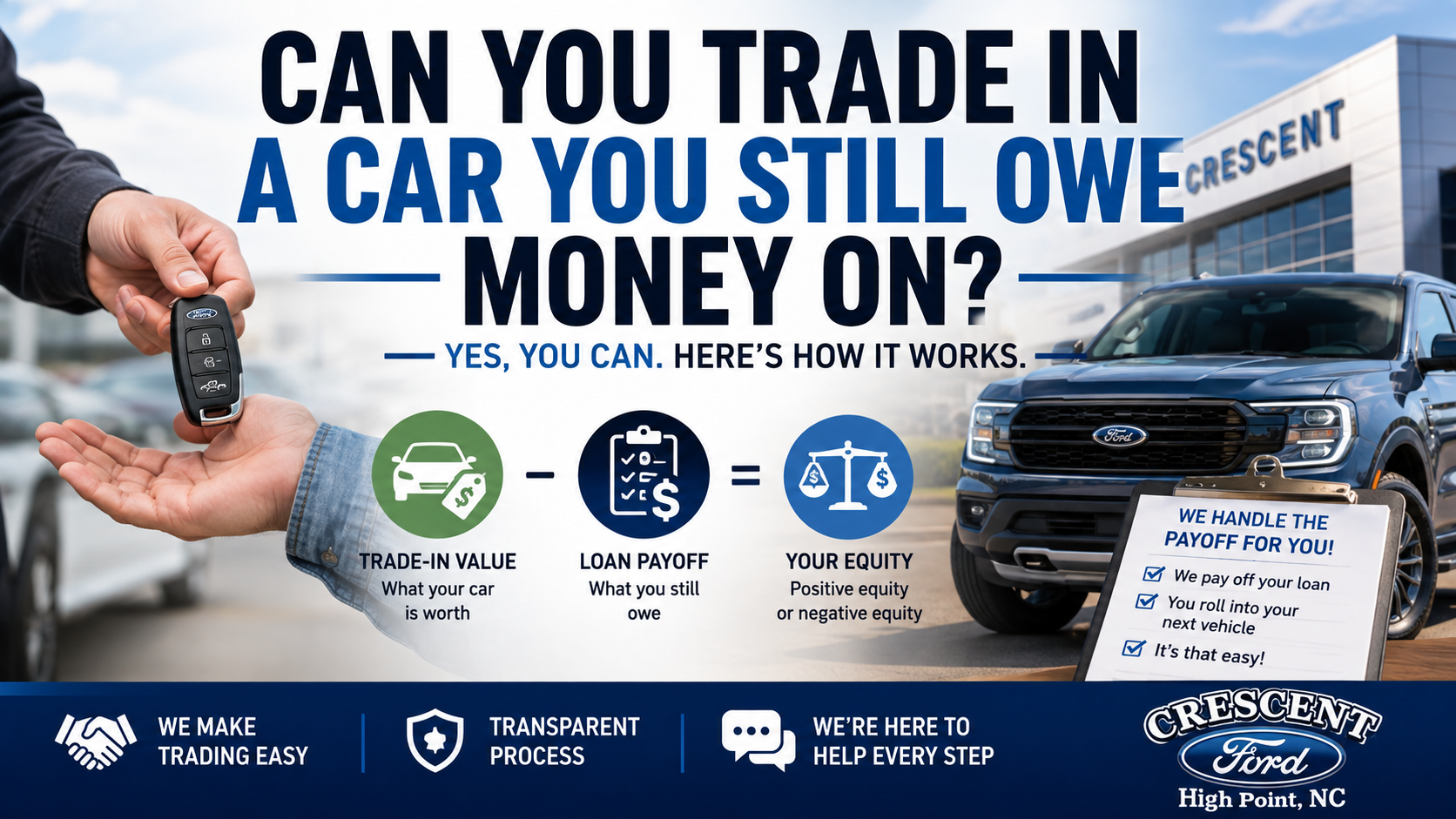
Can You Trade In a Car You Still Owe Money On?
Yes. You can trade in a car even if you haven't finished paying off the loan.
In fact, it's extremely common for drivers to trade vehicles that still have an outstanding loan balance.
The important question isn't really whether you still owe money.
It's this:
Is your vehicle worth more or less than what you currently owe?
If your vehicle is worth more than your loan payoff, you have positive equity. That equity can generally be applied toward your next vehicle.
If your vehicle is worth less than your payoff, you have negative equity, sometimes called being "upside down" on your loan. You may still be able to trade, but you'll need to account for the difference.
Here's how the process works and what you should know before deciding whether trading your financed vehicle makes sense.
Find Out What Your Current Vehicle Is Worth
How Do You Trade In a Car That Isn't Paid Off?
The process is actually pretty straightforward.
When you trade a financed vehicle, there are two numbers that matter:
1. Your vehicle's trade-in value
This is what the dealership determines your vehicle is worth based on its year, make, model, mileage, equipment, condition, history and current market demand.
2. Your loan payoff amount
This is the amount required to completely satisfy your existing auto loan.
Then you compare the two.
The basic formula is:
Trade-In Value − Loan Payoff = Your Equity
For example:
That difference determines what happens next.
What Is a Loan Payoff?
Your payoff amount isn't necessarily the same number you see as the current balance when you log into your lender's website or app.
A payoff quote is the amount necessary to completely satisfy the loan by a particular date.
It can account for interest that accrues through the payoff date and potentially other amounts associated with the loan.
That's why you don't want to estimate your equity using a loan balance from an old statement.
You want a current payoff amount.
When you're actually trading the vehicle, the dealership can typically work with the lender to obtain the necessary payoff information and pay off the existing lien as part of the transaction.
Until your lender confirms that your previous loan has been satisfied, continue following your existing loan obligations.
What Happens If My Car Is Worth More Than I Owe?
This is the easiest scenario.
You have positive equity.
Let's say:
Your trade is worth: $24,000
Your loan payoff is: $18,000
Subtract the payoff from the trade value:
$24,000 − $18,000 = $6,000 positive equity
That $6,000 represents value you have in the vehicle after satisfying the old loan.
If you're trading toward another vehicle, that equity can generally be applied toward the transaction.
Positive equity can reduce how much you need to finance
Imagine you're purchasing a $35,000 vehicle.
Your $6,000 of positive trade equity can reduce the amount that needs to be covered by your cash and/or financing, before considering applicable taxes, fees and other parts of the transaction.
That's one reason knowing your equity position before you start seriously shopping can be helpful.
You may have more buying power in your current vehicle than you realized.
See What Your Trade Could Be Worth
What If My Car Is Worth Exactly What I Owe?
Then you're essentially at break-even.
For example:
Trade value: $20,000
Payoff: $20,000
Your vehicle's value satisfies the old loan, but there's no remaining positive equity to apply toward the next purchase.
That isn't necessarily a bad position.
It simply means your current vehicle isn't contributing additional equity toward your next one.
You can evaluate the next purchase based on your budget, financing and whether changing vehicles makes sense for you.
What If I Owe More Than My Car Is Worth?
This is called negative equity.
You may also hear it described as being:
Upside down
Underwater
Buried in a vehicle
They all refer to essentially the same situation:
Your loan payoff is higher than your vehicle's current value.
Suppose:
Your trade is worth: $20,000
Your payoff is: $25,000
That leaves:
$5,000 in negative equity.
Trading the vehicle doesn't make that $5,000 disappear.
The remaining balance still has to be accounted for as part of the transaction.
Can You Trade In a Car With Negative Equity?
Yes, it may be possible to trade a vehicle with negative equity.
But this is where we want shoppers to slow down and look at the complete transaction.
There are generally a few ways negative equity can be handled.
Option 1: Pay the difference
If you have $5,000 of negative equity, you could potentially contribute enough cash to cover that difference.
That keeps the old debt from being added to the financing of your next vehicle.
Whether that's the best use of your cash is a personal financial decision, but mathematically it's the cleanest solution.
Option 2: Include the negative equity in new financing
Depending on the new vehicle, your credit, the amount of negative equity and lender approval, it may be possible to include some or all of the remaining balance in the financing for your next vehicle.
This is commonly referred to as "rolling negative equity" into the new loan.
But there's something important to understand:
The debt isn't erased. It's moved.
Suppose you're buying a $35,000 vehicle and have $5,000 in negative equity.
If that entire $5,000 were included in the new financing, you're effectively adding that previous debt to the amount being financed on the replacement vehicle, along with other applicable costs.
That can mean:
A larger loan
A higher monthly payment
More interest paid over time
A greater chance of starting the next loan with negative equity
Approval is also not automatic. Lenders have guidelines regarding how much they're willing to finance relative to a vehicle's value.
Option 3: Wait and pay down your current loan
Sometimes the best trade is not trading yet.
If your current vehicle still meets your needs and you're significantly upside down, continuing to make payments can reduce the loan balance.
You may eventually reach a point where the gap between your payoff and vehicle value is smaller — or where you have positive equity.
That can put you in a stronger position for the next purchase.
Option 4: Make an additional principal payment
If you're close to breaking even and have available cash, you might choose to pay down the existing loan before trading.
Check with your lender regarding how additional payments are applied and whether your loan has any relevant terms you should understand.
How Do I Know If I'm Upside Down on My Car?
You need two reasonably accurate numbers.
Step 1: Find out what your vehicle is worth
You can start with an online trade-in estimate.
For a more complete picture, have the actual vehicle appraised.
Mileage, condition, equipment, vehicle history and current market demand can all affect its value.
Related reading: What Is My Car Worth in High Point, NC? How Trade-In Appraisals Actually Work
Step 2: Get your current loan payoff
Contact your lender or check whether a payoff quote is available through your online account.
Step 3: Subtract
If:
Trade Value > Payoff
You have positive equity.
If:
Trade Value = Payoff
You're approximately break-even.
If:
Trade Value < Payoff
You have negative equity.
Don't assume you're upside down just because you still have several years of payments left.
And don't assume you have equity simply because you've owned the vehicle for several years.
Get the numbers.
Start With Your Trade-In Value
Why Do People End Up With Negative Equity?
Negative equity isn't unusual.
Vehicles depreciate, while auto loans are paid down according to a separate schedule.
Those two numbers don't always move at the same speed.
Several situations can contribute to negative equity.
A small down payment
If you financed most or all of a vehicle purchase, you may have started with relatively little equity.
A longer loan term
Longer loan terms can lower the monthly payment, but they can also mean the principal balance declines more slowly.
Trading vehicles frequently
If you replace vehicles before building much equity — particularly if negative equity was included in a previous loan — the problem can carry into the next transaction.
High mileage or vehicle condition
Mileage, accidents, mechanical issues and condition can affect the vehicle's market value.
Changes in the used-car market
Vehicle values don't remain fixed.
The market value of a particular model can rise or fall based on supply, demand and broader market conditions.
That's why knowing what you paid three years ago doesn't tell you what the vehicle is worth today.
How Much Negative Equity Is Too Much to Trade?
There isn't one dollar amount that applies to everyone.
Having $2,000 in negative equity on one transaction can be very different from having $2,000 on another.
The bigger questions are:
What vehicle are you purchasing?
How much negative equity do you have?
How much cash are you putting down?
What is the new vehicle worth?
What amount will need to be financed?
What loan terms are available?
Does the lender approve the transaction?
Does the resulting payment fit comfortably into your budget?
Instead of asking:
"Can I get approved?"
we'd encourage you to also ask:
"Does this transaction make financial sense for me?"
Those aren't always the same question.
A dealership finance department can show you what may be possible.
You still get to decide whether it's the right move.
Explore Auto Financing Options
Can a Dealer Pay Off My Current Car Loan?
When you trade a financed vehicle through a dealership, the existing loan is generally handled as part of the transaction.
The dealer obtains the appropriate payoff information and sends payment to the lienholder.
If you have positive equity, the difference is accounted for in your transaction.
If you have negative equity, that difference also has to be addressed.
This can make trading considerably simpler than trying to privately sell a vehicle with an active lien, because you're not personally coordinating the purchase, lien payoff and title process with a private buyer.
But you should still review your paperwork.
Make sure you understand:
Your agreed trade value
Your old loan payoff
Your positive or negative equity
The selling price of the next vehicle
Amount financed
APR
Loan term
Monthly payment
Applicable taxes and fees
Don't focus only on the payment.
Understanding how the transaction gets to that payment gives you a much clearer picture.
Does Trading In a Financed Car Hurt Your Credit?
Simply having a loan on your trade doesn't inherently damage your credit.
If you finance your next vehicle, however, the lender will generally review your credit as part of the new credit application.
Your existing auto loan also remains your responsibility until it has actually been paid off.
After a trade, keep an eye on the old account and continue following your lender's payment requirements until the payoff is completed and reflected by the lender.
Can I Trade In My Car If I Just Bought It?
Potentially, yes.
There's no general rule requiring you to finish paying off a car before you're allowed to trade it.
The bigger issue is usually equity.
Vehicles can depreciate faster than the loan balance declines, particularly early in ownership.
If you recently bought a vehicle and financed a large portion of the purchase, you may discover that you owe considerably more than its current trade value.
That doesn't necessarily make trading impossible.
It does mean you should understand exactly how much negative equity you're dealing with before proceeding.
Should I Trade My Car If I'm Upside Down?
Sometimes there are legitimate reasons to consider it.
Maybe:
Your family has outgrown the vehicle.
You need a truck for work.
Your commute has changed.
You need different capabilities.
The vehicle no longer works for your lifestyle.
You're facing reliability concerns or other circumstances that make replacing it important.
But if the only reason is:
"I'm tired of my current car,"
and you're substantially upside down, waiting deserves serious consideration.
Rolling negative equity from one vehicle to another repeatedly can make it increasingly difficult to reach a positive-equity position.
There's nothing wrong with wanting a different vehicle.
Just know what that decision actually costs.
Can a Rebate or Discount Get Rid of Negative Equity?
This is an area where terminology can become misleading.
A manufacturer incentive, dealer discount or other savings may improve the overall numbers on a transaction.
But it doesn't literally change what you owe on your old vehicle.
If you owe $25,000 and your vehicle is worth $20,000, you still entered the transaction with a $5,000 equity deficit.
What matters is how all of the numbers work together and what amount ultimately needs to be financed.
Also remember that incentives change frequently and can depend on the vehicle, program, buyer qualifications and financing method.
Don't choose a replacement vehicle solely because someone tells you a large rebate will "wipe out" your negative equity.
Ask to see the complete numbers.
Should I Put Money Down If I Have Negative Equity?
Cash down can potentially reduce the amount you need to finance.
For example, if you have $4,000 in negative equity and contribute $4,000 in cash, you've effectively offset that difference before considering the rest of the transaction.
But whether you should use your cash that way depends on your finances.
You may need to preserve emergency savings or have other financial priorities.
The useful question is:
How does this amount of cash change my new loan and payment?
Have the numbers calculated both ways.
Then you can make an informed decision.
What Should I Bring When Trading a Car With a Loan?
When you're ready to trade, it helps to have:
Your driver's license
Current vehicle registration
Lender information
Loan account information if requested
All keys and key fobs
Any relevant vehicle records you want considered
You generally won't have a clear title in hand when a lender still has a lien on the vehicle, so don't assume that prevents you from starting the trade process.
Requirements can vary depending on ownership, lender and individual circumstances, so confirm what documentation you'll need for your particular transaction.
Can I Trade a Vehicle Financed Through a Different Bank or Credit Union?
Generally, yes.
Your vehicle doesn't have to be financed through the dealership or manufacturer you're buying your next vehicle from.
The payoff process can involve banks, credit unions and other auto lenders.
If you're considering trading, having your lender information available can make obtaining an accurate payoff easier.
Can I Trade In My Car Without Buying Another One?
A trade-in technically involves exchanging your current vehicle as part of another purchase.
If you simply want to get rid of your current vehicle without replacing it, you're looking to sell the vehicle rather than trade it.
An outstanding loan still has to be satisfied before ownership can be transferred free of the lien.
If you're deciding between selling and trading, compare the actual numbers rather than assuming one approach is always better.
What Should I Do Before Shopping for My Next Car?
If you're trading a financed vehicle, we'd do things in this order.
1. Get your trade value
Find out approximately what your vehicle is worth.
2. Get your payoff
Use a current payoff amount rather than guessing from the balance on an old statement.
3. Calculate your equity
Now you know whether you're positive, even or negative.
4. Establish your budget
If you have positive equity, determine how much you want to apply toward the next purchase.
If you're upside down, decide whether you're comfortable paying some of the difference or potentially financing it if approved.
5. Then shop for the replacement vehicle
This gives you a much more useful budget.
Instead of saying:
"I need my payment to be $500."
you can look at the entire transaction and understand how your trade, payoff, financing and replacement vehicle interact.
Browse Used Cars, Trucks & SUVs
Trading In a Financed Car in High Point, NC
If you live around High Point, Greensboro, Thomasville, Trinity, Kernersville, Winston-Salem or elsewhere in the Piedmont Triad, you don't have to wait until your final loan payment to find out whether changing vehicles makes sense.
Start with two numbers:
What is your vehicle worth?
and
What is your payoff?
From there, the picture becomes much clearer.
At Crescent Ford in High Point, we can appraise your current vehicle and help you understand how its value compares with the amount you still owe.
If you have equity, we'll show you how it affects the transaction.
If you're upside down, we'll show you the numbers there too.
And if the numbers don't make sense yet, knowing that is valuable information as well.
The goal isn't simply to find out whether you can trade your vehicle. It's to understand what happens financially if you do.
Find Out What Your Vehicle Is Worth
Talk With Our Finance Team About Your Options
Frequently Asked Questions About Trading In a Car With a Loan
Can you trade in a car that isn't paid off?
Yes. You can generally trade a vehicle while you still have an outstanding auto loan. The dealership obtains the loan payoff and accounts for it as part of the transaction.
What happens to my old car loan when I trade?
The existing loan must be paid off. When you trade through a dealership, the dealership typically obtains the payoff information and sends the required payment to your lender as part of completing the transaction.
What happens if my trade is worth more than I owe?
The difference is positive equity. For example, if your vehicle is worth $20,000 and your payoff is $15,000, you have $5,000 in positive equity that can generally be applied toward your next purchase.
What happens if I owe more than my car is worth?
You have negative equity. The difference must still be accounted for. You might pay it with cash or, subject to lender approval and the specifics of the transaction, some or all may potentially be included in new financing.
Can a dealership roll my negative equity into another car loan?
It may be possible, depending on lender approval, the amount of negative equity, your credit and the vehicle you're purchasing. Doing so increases the amount financed because the old debt doesn't disappear.
How do I find out how much equity I have in my car?
Subtract your current loan payoff from your vehicle's current trade-in value. A positive result means you have positive equity; a negative result means you're upside down.
Is my payoff amount the same as my loan balance?
Not necessarily. A payoff quote reflects the amount required to fully satisfy the loan by a specified date and can differ from the balance displayed on a statement or account screen.
Should I trade in a car with negative equity?
It depends on why you're replacing the vehicle, the size of the equity deficit and how the new transaction affects your finances. If replacing the vehicle isn't necessary, waiting and reducing your existing loan balance may put you in a better financial position.
Can I trade a car I just financed?
Potentially. However, trading soon after purchase can make negative equity more likely because the vehicle's market value may be lower than the remaining loan payoff.
Do I need to pay off my car before bringing it to the dealership?
No. You can have the vehicle appraised while it still has a loan. If you decide to trade, the existing lien and payoff are addressed as part of the transaction.
Related reading: What Is My Car Worth in High Point, NC? How Trade-In Appraisals Actually Work