
Ford F-150 Trim Levels Explained: XL vs. STX vs. XLT vs. Lariat vs. Tremor vs. Platinum
You've decided you want an F-150.
Great.
Now Ford gives you another decision:
Which F-150?
Because an F-150 XL and an F-150 Platinum may share the same basic truck underneath, but they're designed for very different buyers.
And then there's everything in between.
XL.
STX.
XLT.
Lariat.
Tremor.
Platinum.
One shopper wants a straightforward work truck.
Another wants a truck that looks great without paying for luxury features.
Someone else wants heated seats, upgraded technology and a truck comfortable enough for a 45-minute commute every morning.
And another shopper couldn't care less about any of that because they're heading off-road.
That's why we don't think there's a single:
"Best F-150 trim."
There's a best F-150 trim for what you actually want your truck to do.
Let's find yours.
Shop Ford F-150 Trucks at Crescent Ford
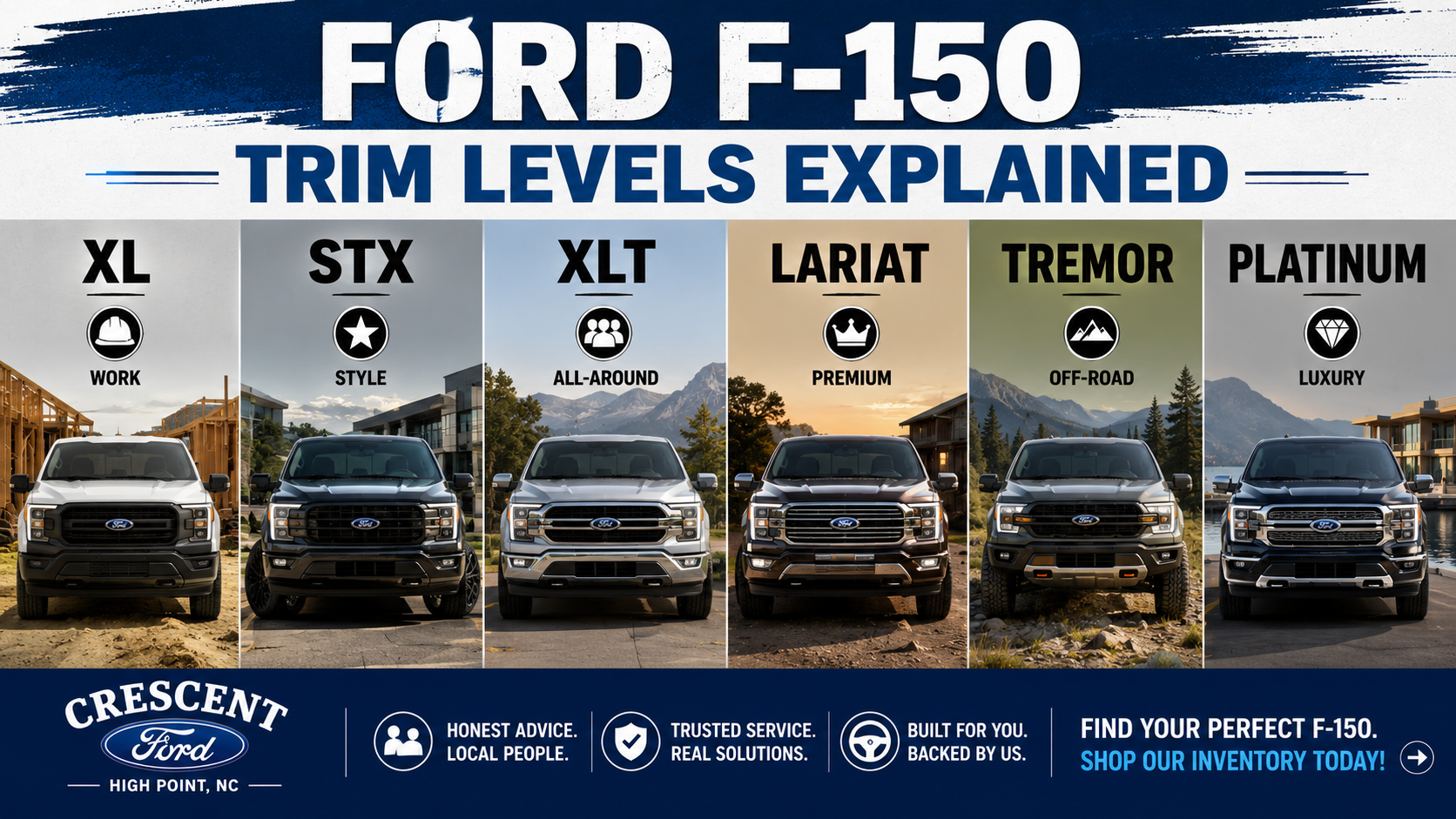
2026 Ford F-150 Trim Levels at a Glance
Here's the easiest way to understand the six trims we're comparing:
That's the short version.
But there's an important thing to understand before comparing them:
Moving up the F-150 lineup doesn't necessarily mean getting "more truck."
Sometimes you're getting:
More comfort
More technology
Different styling
Additional convenience
More premium materials
And sometimes you're moving into a trim designed for an entirely different purpose.
That's especially true with Tremor.
So don't assume the highest trim is automatically the best truck for you.
Ford F-150 XL: The Essential Truck
The XL is where the F-150 lineup begins.
But don't mistake:
"base trim"
for:
"not a real F-150."
The XL is fundamentally designed to do truck things without requiring you to pay for a long list of luxury features you may not care about.
That's exactly why it remains attractive to:
Contractors
Businesses
Fleet buyers
Farmers
Property owners
Work-truck shoppers
Value-conscious personal buyers
Why Buy an F-150 XL?
Because maybe you don't need your truck to feel like a luxury SUV.
You need it to:
haul
tow
carry equipment
get dirty
and
go to work.
In that situation, paying more simply to move into a higher trim may not accomplish anything important for you.
XL also gives shoppers access to different cab, bed and drivetrain configurations, making it particularly relevant for buyers who care more about how the truck is configured than how fancy the interior is.
Who Should Buy the XL?
Someone who says:
"Give me the F-150 capability I need and let me choose the options that actually matter."
That's an XL shopper.
Shop F-150 XL Trucks
Ford F-150 STX: When Style Matters
STX is where the F-150 starts becoming particularly interesting for personal-use buyers who don't necessarily want to jump into the more feature-heavy trims.
Think of STX as:
"I want my truck to look good."
It gives the F-150 a more distinctive appearance while maintaining a more accessible position in the lineup.
For many shoppers, that's exactly the balance they're looking for.
Who Is the STX Best For?
Someone who says:
"I don't need every luxury feature. I just don't want my truck to look or feel like a basic work truck."
STX can be especially attractive for:
First-time truck buyers
Daily drivers
Younger truck shoppers
Buyers who prioritize exterior styling
Someone moving from an SUV or car into their first pickup
Shoppers who want capability without moving far up the trim ladder
And there's an important update for 2026:
The 3.5L PowerBoost Full Hybrid V6 is now available on STX, giving shoppers another powertrain choice that previously required moving elsewhere in the lineup.
STX vs. XL
This is mostly a question of priorities.
Choose XL if you're primarily focused on function and configuration.
Choose STX if you want more visual personality in a truck that can still handle everyday work.
Neither is automatically better.
STX simply spends more of its attention on the things many personal-use buyers notice every day.
Shop F-150 STX Trucks
Ford F-150 XLT: The Sweet Spot for a Lot of Buyers
If someone walks into Crescent Ford and says:
"I want a nice F-150, but I don't need a luxury truck,"
XLT is one of the first places we'd look.
Why?
Because XLT sits right in the middle of what a huge number of truck buyers actually want:
Capability + comfort + useful technology + lots of configuration choices.
It's a truck that can:
go to work Monday morning
and
take the family out Saturday afternoon
without feeling particularly compromised in either role.
What Makes XLT Different?
As you move from STX to XLT, the conversation becomes less about appearance alone and more about everyday equipment and flexibility.
For 2026, Zone Lighting is standard on XLT and above.
Ford also offers multiple engine choices and appearance packages on XLT, so shoppers can configure the truck toward work, towing, appearance or everyday use.
BlueCruise-equipped hands-free highway driving is also available on properly equipped XLT configurations.
That gives XLT a surprisingly broad range.
Who Should Buy the XLT?
Someone who says:
"This is my truck, but it's also my everyday vehicle."
That's important.
If your F-150 is going to be:
Your commuter
Your family vehicle
Your weekend project truck
Your road-trip vehicle
Your towing vehicle
then features you might not care about in a dedicated work truck suddenly become much more valuable.
STX vs. XLT
This will probably be one of the most common decisions for F-150 shoppers.
Choose STX if:
You care about styling and want to keep the truck relatively straightforward.
Choose XLT if:
You want more available comfort, technology and configuration flexibility.
The right answer often comes down to this:
How much time are you going to spend inside the truck?
If the answer is:
"A lot."
XLT deserves a serious look.
Shop F-150 XLT Trucks
Ford F-150 Lariat: Where the F-150 Starts Feeling Premium
Lariat is where the character of the truck changes again.
Now we're not simply talking about:
"a nicer work truck."
We're moving into:
premium everyday vehicle that happens to be a very capable pickup.
That's an important distinction.
For someone who spends an hour or more in their truck every day, comfort isn't frivolous.
It's something you experience constantly.
What Does Lariat Add to the Experience?
This is where shoppers start looking for things such as:
More premium seating
Additional power adjustments
Heated and ventilated front seats
Upgraded interior materials
More convenience technology
Additional driver-assistance availability
Premium appearance
Greater everyday comfort
For 2026, Ford also made power-adjustable pedals with memory available within Lariat equipment groups, and a Head-Up Display is available on certain configurations.
But the reason to buy a Lariat isn't because one individual feature appears on a checklist.
It's because the overall experience becomes more premium.
Who Should Buy the Lariat?
Someone who says:
"I use my truck for everything, and I want it to be comfortable."
Think:
Long commuters
Business owners
Frequent travelers
People who tow regularly
Buyers coming from premium SUVs
Anyone whose truck doubles as their primary family vehicle
XLT vs. Lariat
This is where we'd ask:
Which features will you actually appreciate every day?
If you don't care about the additional comfort and premium touches?
Buy the XLT.
Seriously.
Don't pay for features because someone told you Lariat is "better."
But if you sit in the Lariat and immediately think:
"Yep. This is where I want to spend my commute."
Then the upgrade may be worth every penny to you.
Shop F-150 Lariat Trucks
Ford F-150 Tremor: The F-150 for Going Off the Pavement
Tremor is different.
It isn't simply:
"the trim above Lariat."
In fact, thinking of Tremor as part of a straight:
XL → STX → XLT → Lariat → Tremor → Platinum
ladder misses the point.
Tremor is a purpose-driven branch of the F-150 family.
It's designed for buyers who want greater off-road capability directly from Ford.
What Makes Tremor Different?
Tremor is built around a more rugged mission.
That means the things you're paying for are more focused on:
Off-road capability
Terrain management
Trail use
Ground clearance
Rugged suspension tuning
Off-road hardware
Distinctive Tremor styling
For 2026, the 3.5L EcoBoost V6 is standard on Tremor, while the 5.0L V8 is available.
That's going to make the engine decision particularly interesting for Tremor shoppers.
Who Should Buy the Tremor?
Someone who actually says things like:
"Where does that trail go?"
😂
More seriously, Tremor makes sense for:
Outdoor enthusiasts
Hunters
Campers
Property owners
People regularly traveling on rough terrain
Buyers who simply want more factory off-road capability
Lariat vs. Tremor
Don't ask:
"Which one is better?"
Ask:
"Where am I driving?"
If most of your miles happen on pavement and comfort is your priority:
Lariat.
If off-road capability is genuinely important:
Tremor.
That makes this comparison much easier.
Tremor vs. Raptor
Tremor is not simply a less expensive Raptor.
They occupy different positions in the F-150 lineup.
Tremor is designed to add meaningful off-road capability while remaining very much an everyday F-150.
Raptor pushes much further toward high-performance off-road driving.
For many buyers who want an off-road-capable truck they can comfortably use every day, Tremor may actually be the more logical choice.
Shop F-150 Tremor Trucks
Ford F-150 Platinum: Luxury Meets Capability
Now we reach the shopper who says:
"I want a truck. But I want a REALLY nice truck."
That's Platinum territory.
Platinum isn't trying to disguise the fact that it's a pickup.
It's taking F-150 capability and wrapping it in a more luxurious ownership experience.
Ford describes the current Platinum as combining luxury and capability, with features such as leather-trimmed seating, available multicontour front seats, heated and ventilated front seating, available premium B&O audio and available BlueCruise.
Who Should Buy the Platinum?
Someone who wants:
F-150 capability
without giving up:
premium comfort.
That's especially attractive for:
Executives
Business owners
Long-distance drivers
Luxury SUV owners moving into a truck
Buyers who tow but want a premium cabin
Someone who simply likes having a very well-equipped vehicle
Lariat vs. Platinum
This is an interesting comparison because Lariat is already a very nice truck.
So the question becomes:
How premium do you want to go?
Lariat gives you a significant jump in comfort and equipment without going all the way to the top of the mainstream lineup.
Platinum adds a more upscale design, additional premium appointments and a stronger luxury emphasis.
If you're primarily interested in capability and comfort?
Lariat may be plenty.
If the luxury experience itself matters?
Platinum starts making more sense.
Wait—What About F-150 King Ranch?
Yes, King Ranch still exists.
For 2026, Ford's complete F-150 model lineup includes:
XL
STX
XLT
Lariat
King Ranch
Platinum
Tremor
Raptor
King Ranch occupies the premium end of the lineup alongside Platinum but brings its own distinctive Southwestern-inspired styling and interior personality.
So if you're shopping Platinum because you want a luxury truck, sit in a King Ranch too.
You may immediately prefer one interior personality over the other.
That's exactly why both exist.
And What About F-150 Raptor?
Raptor deserves its own conversation.
While Tremor adds substantial off-road capability to the traditional F-150 formula, Raptor is designed around a much more extreme performance mission.
If your question is:
"Which normal F-150 trim should I buy?"
Raptor probably isn't the answer.
If your question is:
"Which F-150 was engineered specifically for serious high-performance off-road driving?"
Now we're having a Raptor conversation.
For this guide, we're concentrating primarily on the F-150 trims most mainstream truck buyers are likely to cross-shop.
XL vs. STX: Which Should You Buy?
Choose XL if:
Value matters most
It's primarily a work truck
You want maximum configuration flexibility
You don't care much about appearance upgrades
You'd rather spend money on capability than styling
Choose STX if:
Styling matters
It's primarily a personal truck
You want something sportier-looking
You want useful capability without jumping into a higher trim
PowerBoost availability interests you
Our shorthand:
XL = Work first.
STX = Style + value.
STX vs. XLT: Is XLT Worth the Upgrade?
For many buyers:
Yes.
But not everyone.
XLT starts making sense when the truck becomes a major part of your everyday life.
If you're commuting in it, road-tripping in it and carrying your family in it, additional convenience and technology can become worth the upgrade.
But if you love the STX appearance and don't care about the extra equipment?
Save your money.
Our shorthand:
STX = Give me the look.
XLT = Give me the all-around truck.
XLT vs. Lariat: Which Is the Better Daily Driver?
Both can be excellent daily drivers.
The difference is how much comfort matters to you.
XLT gives you a very versatile F-150.
Lariat moves noticeably toward a premium experience.
If you drive:
10 minutes to work?
Maybe you don't care.
If you drive:
45 minutes each way?
Heated and ventilated seating, additional power adjustments and premium cabin features may suddenly matter a lot more.
Our shorthand:
XLT = Everything I need.
Lariat = More of what I want.
Lariat vs. Tremor: Comfort or Off-Road Capability?
This one's easy.
Mostly pavement?
Lariat.
Regularly leaving pavement?
Tremor.
Want Tremor because it looks cool even though you'll never take it off-road?
That's allowed too.
We're not the truck police.
😂
Just understand what you're paying for.
Lariat vs. Platinum: Is Platinum Worth It?
That's almost entirely a personal-value question.
Both can be extremely capable trucks.
The difference is whether Platinum's additional luxury appointments and styling matter enough to you.
There's no spreadsheet that can answer that.
Sit in both.
Drive both.
Then decide whether you experience enough difference to justify moving up.
Which F-150 Trim Is Best for Towing?
Here's where we need to separate:
trim
from
configuration.
Don't choose an F-150 for towing based only on the badge on the fender.
Towing capacity can depend on:
Engine
Cab
Bed
Drivetrain
Axle ratio
Equipment
Trailer package
Payload
Specific vehicle configuration
A properly configured XLT could be a better match for your trailer than a more expensive Platinum configured differently.
If towing is your priority, start with:
What are you towing?
Then configure the truck.
Don't start with:
"What's the fanciest trim?"
RELATED READING — Ford F-150 Engines Explained: Which Engine Is Right for You?
Which F-150 Trim Is Best for Work?
Start with:
XL
and
XLT.
XL makes excellent sense when function and value dominate the decision.
XLT makes sense when the truck has to work during the day but also needs to serve as comfortable personal transportation.
For someone spending all day driving between jobsites?
That extra comfort may be worth moving up.
Which F-150 Trim Is Best for a Family?
We'd start with a SuperCrew configuration.
Then we'd look at:
XLT
or
Lariat
depending on your desired comfort level.
Platinum can obviously work beautifully as a family truck too, but you don't need to go that high in the lineup simply to get a comfortable family-friendly F-150.
If your truck is going to replace an SUV as the household's primary vehicle, don't evaluate only the driver's seat.
Put the family in it.
Check the rear-seat space.
Bring the car seats.
Drive it like you actually plan to use it.
Which F-150 Trim Is Best for Commuting?
For many buyers:
XLT or Lariat.
XLT provides an excellent balance.
Lariat becomes particularly attractive for longer commutes where premium comfort features are something you'll appreciate twice every workday.
Platinum takes that even further for buyers who want a genuinely luxury-oriented truck.
Which F-150 Trim Is Best for Off-Road Driving?
Among the six trims we're concentrating on here:
Tremor.
That's exactly what it's designed to do.
If you're looking for an even more specialized high-performance off-road F-150, then it's time to look at Raptor.
Which F-150 Trim Gives You the Best Value?
There is no objective answer.
Because:
Value = getting the features YOU care about without paying for the ones you don't.
For a contractor?
XL could be an incredible value.
For someone who wants a stylish personal truck?
STX.
For a family using an F-150 as its primary vehicle?
XLT might hit the sweet spot.
For someone commuting an hour a day?
Lariat's additional comfort could be worth every penny.
Value isn't:
"Which truck is cheapest?"
It's:
"Which truck gives me the most useful equipment for my money?"
Don't Choose Your F-150 Trim Before Choosing Your Engine
These decisions overlap.
Not every engine is available with every configuration.
And the engine can completely change how the truck fits your needs.
The 2026 F-150 powertrain family includes choices such as:
2.7L EcoBoost V6
5.0L V8
3.5L EcoBoost V6
3.5L PowerBoost Full Hybrid V6
with availability depending on trim and configuration.
So if you already know:
"I absolutely want the V8."
or
"I want PowerBoost."
tell your salesperson that first.
That can immediately narrow your trim choices.
RELATED READING — Ford F-150 Engines Explained: Which Engine Is Right for You?
Don't Forget Cab and Bed Configuration Either
This is another reason F-150 shopping is different from choosing a typical SUV.
You're not simply picking:
trim + color.
You're potentially choosing:
Trim
Engine
Cab
Bed
2WD/4WD
Packages
Options
That means two F-150 XLTs parked beside each other can be very different trucks.
If you need a particular bed length, cab configuration or drivetrain, tell us that before falling in love with a trim.
Which F-150 Trim Should You Buy?
Here's our simplest recommendation.
Buy the XL if:
You need a truck to work.
Capability and value matter more than luxury.
Buy the STX if:
You want style without going far up the trim ladder.
You want a truck that looks sharp and handles everyday truck duty without paying for premium equipment you don't need.
Buy the XLT if:
You want the all-around F-150.
Work.
Family.
Commute.
Weekend projects.
Road trips.
Towing.
XLT can be configured to handle a little bit of everything.
Buy the Lariat if:
Your truck is your primary vehicle and comfort matters.
This is where the F-150 starts feeling significantly more premium.
Buy the Tremor if:
You actually want off-road capability.
It's the specialized choice in this group rather than simply another step up the luxury ladder.
Buy the Platinum if:
You want your truck to feel luxurious.
You still need F-150 capability.
You just don't want to sacrifice premium comfort to get it.
The Best Way to Choose an F-150 Trim
Don't try to solve the entire decision from a feature chart.
Narrow it down to two trims.
Then drive them back-to-back.
For example:
STX vs. XLT
or
XLT vs. Lariat
or
Lariat vs. Platinum
Sit in both.
Drive both.
Use the technology.
Check the seats.
Look at the bed.
Put your family in the back.
And then ask:
"Do I actually notice enough difference to pay for the upgrade?"
If yes?
Move up.
If no?
Don't.
That's one of the easiest ways to avoid paying for equipment you'll never appreciate.
Schedule an F-150 Test Drive
Compare your top two F-150 trims back-to-back and see which features actually matter once you're behind the wheel.
Shopping for a Ford F-150 in High Point, NC?
If you're shopping for an F-150 around High Point, Greensboro, Winston-Salem, Kernersville, Thomasville, Lexington, Trinity or elsewhere in the Piedmont Triad, don't worry about memorizing every option code before you visit.
Start with three questions:
1. What do you need the truck to do?
2. Which features matter to you every day?
3. What do you absolutely NOT want to pay extra for?
Those answers usually narrow the lineup quickly.
At Crescent Ford, we can compare available F-150s side-by-side and help you work backward from your actual needs rather than simply pushing you toward the highest trim.
Maybe XL is exactly what you need.
Maybe STX gives you the look you want.
Maybe XLT is your sweet spot.
Maybe you spend enough time behind the wheel to appreciate Lariat.
Maybe you're heading off-road and Tremor makes perfect sense.
Or maybe you've decided:
"If I'm buying a truck, I'm buying a REALLY nice truck."
We know where the Platinum is.
The goal isn't to buy the most F-150.
It's to buy the right F-150.
FINAL CTA / INTERNAL LINKS
Ready to Compare F-150 Trims?
RELATED READING
Ford F-150 Engines Explained: Which Engine Is Right for You?
Ford Maverick vs. Ranger vs. F-150: How Much Truck Do You Actually Need?
Ford F-150 vs. F-250: When Do You Actually Need a Super Duty?
Frequently Asked Questions About Ford F-150 Trim Levels
What are the 2026 Ford F-150 trim levels?
The 2026 Ford F-150 lineup includes XL, STX, XLT, Lariat, King Ranch, Platinum, Tremor and Raptor. Each targets a different balance of work capability, styling, comfort, luxury or off-road performance.
What is the difference between F-150 XL and STX?
XL is primarily focused on essential truck capability, value and configuration flexibility. STX adds a stronger styling emphasis and can be appealing to personal-use buyers who want a more distinctive truck without moving far up the lineup.
What is the difference between F-150 STX and XLT?
STX emphasizes style and value, while XLT offers greater available comfort, technology and configuration flexibility. XLT is often attractive to buyers using their F-150 as both a truck and an everyday family or commuting vehicle.
Is the F-150 XLT worth it over the STX?
It depends on which features matter to you. If you spend significant time in the truck and value additional convenience and technology, XLT may be worth the upgrade. If you primarily want STX styling and don't need the extra equipment, STX may be the better value.
Is F-150 Lariat better than XLT?
Lariat is positioned above XLT and provides a more premium ownership experience with additional comfort, technology and interior appointments. That doesn't make it the better choice for everyone. XLT may offer everything a particular shopper actually needs.
Is the F-150 Tremor above the Lariat?
It's better to think of Tremor as a specialized off-road branch of the F-150 lineup rather than simply the next luxury level above Lariat. Tremor prioritizes rugged capability, while Lariat focuses more heavily on premium everyday comfort.
What engine comes in the 2026 F-150 Tremor?
For 2026, the 3.5L EcoBoost V6 is standard on Tremor, and the 5.0L V8 is available.
Can you get a hybrid F-150 STX?
Yes. For 2026, Ford made the 3.5L PowerBoost Full Hybrid V6 available on the STX.
Which F-150 trim is best for everyday driving?
XLT is a strong starting point for many everyday drivers because it balances capability, comfort and available technology. Lariat may be worth considering for shoppers who want a more premium daily-driving experience.
Which F-150 trim is best for work?
XL is the natural starting point for dedicated work use because of its focus on capability and value. XLT can be attractive when the truck also serves as a daily personal vehicle.
Which F-150 trim is best for off-roading?
Tremor is specifically designed for greater off-road capability within the trims compared in this guide. Raptor takes the F-150's off-road performance mission considerably further.
Which is better, F-150 Lariat or Platinum?
Neither is universally better. Lariat provides premium comfort and technology while Platinum takes the luxury experience further. The better choice depends on how much you value Platinum's additional premium appointments.
Is King Ranch higher than Lariat?
King Ranch sits in the premium portion of the F-150 lineup above Lariat and offers distinctive Southwestern-inspired luxury styling. Shoppers considering Platinum may also want to compare King Ranch because the two have different design personalities.
Should I choose my F-150 engine or trim first?
If you have a specific engine requirement—such as wanting the 5.0L V8 or PowerBoost hybrid—start there because engine availability varies by trim and configuration. Otherwise, narrowing down how you'll use the truck and which features matter most can help identify both the appropriate trim and powertrain.
Should I test drive different F-150 trims before buying?
Yes. Comparing two trims back-to-back is one of the best ways to determine whether an upgrade is worthwhile for you. Features that look important on a specification sheet may matter less in person, while seating, technology or convenience features you overlooked may become important once you drive the truck.