
Is It Better to Trade In or Sell Your Car Yourself?
You've decided it's probably time for another vehicle.
Now there's one more decision to make:
What should you do with the car you already own?
You essentially have two common options:
Trade it in to a dealership.
or
Sell it yourself.
If you search online, you'll probably find some version of:
"Always sell privately! You'll get more money!"
Sometimes that's true.
But it doesn't necessarily mean you'll be better off selling privately.
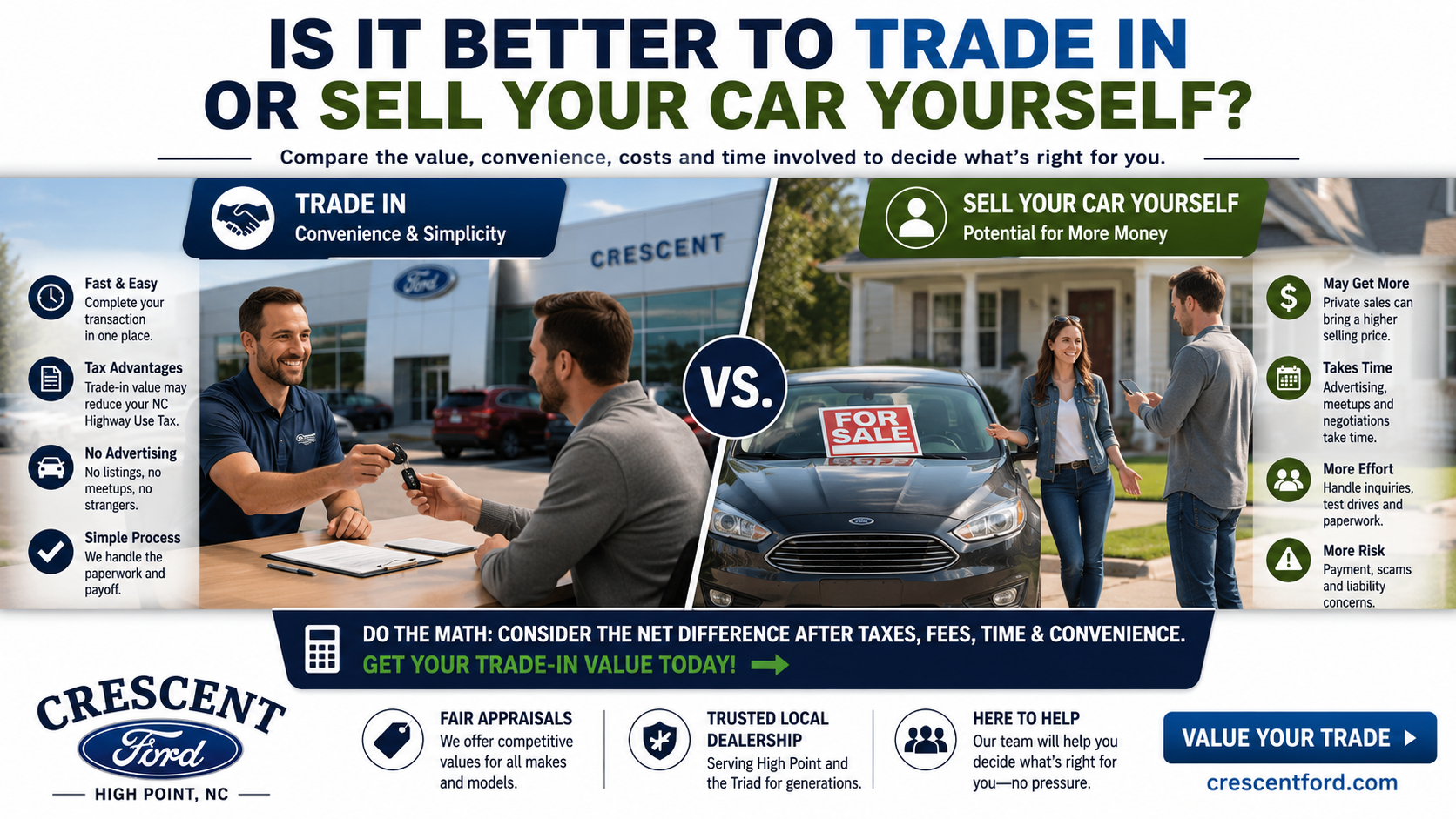
A private sale may produce a higher selling price, while a trade-in can offer advantages in convenience, transaction simplicity and—when you're buying another vehicle in North Carolina—the way a qualifying trade allowance affects Highway Use Tax.
The right question isn't simply:
"Which gives me the highest number?"
It's:
"Which option leaves me with the best overall outcome?"
Here's how to figure that out.
Find Out What Your Vehicle Is Worth
Before deciding whether to trade or sell privately, start by finding out what your vehicle may actually be worth as a trade.
Trade-In vs. Private Sale: What's the Difference?
Let's start with the basics.
Trading In Your Car
You take your vehicle to a dealership, it is appraised, and you receive a trade-in offer.
If you accept the offer while purchasing another vehicle, the trade value can generally be applied directly to the transaction.
Selling Your Car Privately
You become the seller.
That means you determine an asking price, advertise the vehicle, communicate with prospective buyers, arrange meetings and test drives, negotiate the sale, handle payment and complete the required ownership-transfer process.
In exchange for doing that work yourself, you may be able to sell the vehicle for more than its trade-in value.
So why wouldn't everyone sell privately?
Because that higher selling price isn't the only thing that matters.
Will You Get More Money Selling Your Car Yourself?
Potentially.
A private buyer is purchasing the vehicle for their own use.
A dealership acquiring a trade has additional considerations before that vehicle ultimately reaches another owner. Depending on the vehicle, that can include:
Inspection
Maintenance
Mechanical repairs
Tires or brakes
Cosmetic reconditioning
Detailing
Transportation
Inventory expenses
Market risk
That's one reason trade-in value and retail value aren't the same thing.
So yes, there can be a gap between what a dealership offers for a trade and what someone might be willing to pay in a private transaction.
But don't stop the comparison there.
Suppose you could:
Trade your vehicle for $20,000
or
Sell it privately for $22,000.
It looks like selling privately automatically puts you $2,000 ahead.
Maybe it does.
But before deciding, you need to look at the rest of the transaction.
The Most Important Number Is the Net Difference
This is the part people sometimes miss.
Don't compare:
Trade offer
vs.
Private asking price.
Compare:
What you actually receive from each option after considering the entire transaction.
Your private asking price isn't necessarily what someone will pay.
And your trade value can potentially affect the Highway Use Tax calculation when you're purchasing another vehicle in North Carolina.
So the comparison needs a little more math.
How Does a Trade-In Affect Vehicle Taxes in North Carolina?
North Carolina generally imposes a Highway Use Tax when a vehicle title is transferred rather than the conventional retail sales tax shoppers may be accustomed to with other purchases.
For a qualifying dealer transaction involving a trade-in, the trade allowance generally reduces the net retail value used to calculate Highway Use Tax.
Let's use a simplified hypothetical example.
Suppose you're buying a:
$40,000 vehicle
and receiving:
$20,000 for your trade.
The applicable Highway Use Tax calculation may be based on the remaining $20,000 net retail value, subject to North Carolina's rules and the specifics of the transaction.
If instead you sell your old vehicle privately and then purchase the $40,000 vehicle without a trade allowance, you don't have that same trade allowance reducing the taxable amount of the dealer purchase.
That means the private sale needs to beat the trade offer by enough to account for any difference in the transaction—not merely by $1.
The exact tax treatment depends on the transaction, so always compare the actual numbers for your specific purchase.
What Does “Out-the-Door Price” Mean When Buying a Car in NC?
A Better Way to Compare Trade-In vs. Private Sale
Let's create a hypothetical example.
Imagine your vehicle receives a:
$20,000 trade offer
and you believe you can sell it privately for:
$22,000.
At first:
Private sale advantage = $2,000
But now evaluate:
What would the actual private-sale price be after negotiation?
How does the trade allowance affect your new-vehicle transaction?
Will you spend money preparing the vehicle for sale?
Will you need to advertise it?
How much time will the process take?
Are you comfortable handling test drives and payment?
Do you still have a loan on the vehicle?
Do you need your current vehicle until the replacement is ready?
After answering those questions, maybe selling privately is still clearly better.
If so?
Sell it privately.
There's nothing wrong with that.
But you might discover the actual financial advantage is much smaller than the difference between the two headline numbers.
That's why we'd calculate before deciding.
The Biggest Advantage of Trading In: Convenience
Trading a vehicle is relatively straightforward.
You bring the vehicle in.
It gets appraised.
You review the offer.
If you accept it, the trade becomes part of your vehicle-purchase transaction.
You're not spending the next two weeks answering:
"Is this still available?"
You're not coordinating schedules with strangers.
You're not meeting someone for a test drive.
You're not negotiating with multiple prospective buyers.
You're not trying to determine whether a payment method is legitimate.
And you're not trying to coordinate selling one vehicle at exactly the right time to purchase another.
For some people, that convenience is worth a lot.
For others?
They'd happily do the extra work for another $1,500.
Neither person is wrong.
What Does Selling Your Car Yourself Actually Involve?
Private selling isn't necessarily difficult.
But it is a process.
You'll generally need to:
Determine the Vehicle's Value
Research comparable vehicles and establish a realistic asking price.
Prepare the Vehicle
You may want to clean it, remove personal belongings and address minor issues.
Photograph It
Good photos matter when you're competing with hundreds of other online listings.
Create the Listing
You'll need an accurate description including mileage, equipment and condition.
Respond to Buyers
Some will be serious.
Some won't.
Arrange Meetings
You'll need a safe location and a time that works for both parties.
Handle Test Drives
That introduces questions about driver's licenses, insurance and personal safety.
Negotiate
Your asking price isn't necessarily your selling price.
Handle Payment
You'll need to make sure funds are legitimate before releasing the vehicle.
Complete the Ownership Transfer
The title and other transaction requirements need to be handled correctly.
None of this means:
"Don't sell privately."
It simply means:
Your time has value too.
What About Safety When Selling a Car Privately?
This deserves consideration.
Selling privately means interacting with people you don't know while also advertising an asset potentially worth thousands—or tens of thousands—of dollars.
Take sensible precautions.
That can include:
Meeting in a safe, public location
Avoiding unnecessary disclosure of personal information
Verifying a driver's license before allowing a test drive
Understanding your insurance situation
Being cautious with payment methods
Confirming funds before transferring ownership
Being alert for scams or unusual requests
If something about a prospective buyer or transaction feels questionable, don't proceed simply because you want the vehicle sold.
The convenience of trading also means transferring much of this process to the dealership.
Is Trading Better If You Still Owe Money on Your Car?
It can certainly be easier.
If your vehicle still has a loan, you don't currently have completely unencumbered ownership of the vehicle.
There is a lien that needs to be addressed as part of the sale.
When trading to a dealership, the dealership can generally obtain the payoff information and incorporate it into the transaction.
The basic math is:
Trade Value – Loan Payoff = Equity
For example:
Trade value: $25,000
Loan payoff: $19,000
Approximate positive equity: $6,000
That equity can generally be applied toward your next vehicle.
If the numbers are reversed:
Trade value: $19,000
Loan payoff: $25,000
You have approximately $6,000 in negative equity.
That situation requires a different conversation about how the remaining balance will be handled.
Selling privately while a lien exists isn't necessarily impossible, but you'll need to coordinate payoff and title requirements with your lender and buyer.
For many people, that's another reason trading is simpler.
Can You Trade In a Car You Still Owe Money On?
What If You Own the Car Outright?
This simplifies either option.
If there's no lien, you don't need to coordinate a lender payoff.
That can make private selling more attractive because there's one less complication.
But the same basic comparison still applies:
Potential additional money
vs.
Time + effort + transaction complexity.
Should You Fix Your Car Before Selling It Privately?
This is where selling privately and trading can differ.
A private buyer may be more sensitive to things like:
Cosmetic appearance
Warning lights
Worn tires
Interior condition
Minor mechanical issues
You may decide certain repairs make the vehicle easier to sell or justify a better asking price.
But be careful about spending $2,000 to theoretically increase the selling price by $1,000.
Do the math first.
If you're considering trading instead, we'd recommend getting the vehicle appraised before making expensive repairs.
You may find that the repair won't increase the trade value enough to justify your cost.
Should I Fix My Car Before Trading It In? What Actually Affects Trade Value
Should You Detail Your Car Before Trading or Selling?
Clean it?
Yes.
Spend hundreds of dollars having it professionally detailed?
Not necessarily.
For a trade, remove your belongings, take out the trash, vacuum if necessary and give the vehicle a basic wash.
A professional appraiser can distinguish dirt from actual vehicle condition.
For a private sale, presentation may matter somewhat more because you're trying to attract an individual buyer from photos and a listing.
Even then, don't assume every dollar you spend preparing the vehicle comes back to you in the selling price.
Which Option Is Faster?
Usually:
Trading.
If you're already buying another vehicle, the appraisal and purchase can potentially happen as part of the same transaction.
A private sale could happen the first day you list it.
Or the vehicle could sit for weeks.
It depends on:
Price
Condition
Mileage
Vehicle type
Local demand
Season
How aggressively you market it
If you have plenty of time, this may not matter.
If you need another vehicle immediately, it might matter a lot.
What If You Need Your Current Car Until You Buy the Next One?
This is an underrated advantage of trading.
Suppose you sell your car privately today.
Great.
Now how are you getting to work tomorrow?
If you already have another vehicle available, no problem.
But if you need the proceeds from your current car to purchase your replacement, coordinating the timing can become tricky.
Trading allows the outgoing vehicle and incoming vehicle to change hands as part of the same transaction.
You drive in with one.
You drive home with the other.
For many shoppers, that's a significant practical advantage.
Is It Easier to Trade If You're Buying a New Car?
It can make the transaction simpler because you're handling:
Purchase + trade + payoff + financing
in one place.
But don't let convenience prevent you from understanding the individual numbers.
You should still know:
What am I paying for the vehicle?
What am I receiving for my trade?
What do I owe on the trade?
What are my taxes and fees?
How much am I financing?
That way, you can evaluate the entire deal instead of focusing only on:
"They gave me $25,000 for my trade!"
A huge trade number isn't impressive if another part of the transaction changed to compensate for it.
Look at the whole deal.
Can You Get a Trade-In Appraisal Without Buying a Car?
Getting an appraisal before you've selected your next vehicle can be extremely useful.
Why?
Because now you know what you're working with.
Maybe you thought you had:
$2,000 in equity.
The appraisal shows you have:
$8,000.
That could change your next-vehicle budget considerably.
Or perhaps you discover you're upside down.
Now you can evaluate your financing options before falling in love with a particular vehicle.
Knowledge first.
Shopping second.
See What Your Car Is Worth
RELATED READING
What Is My Car Worth in High Point, NC? How Trade-In Appraisals Actually Work
When Selling Your Car Yourself Probably Makes More Sense
Let's give private selling its fair argument.
Selling privately may make more sense when:
Maximizing the selling price is your highest priority
There's a substantial difference between private-sale value and trade value
You own the vehicle outright
You aren't in a hurry
You're comfortable advertising and negotiating
You're comfortable handling payment and paperwork
You don't need to coordinate the sale with an immediate replacement purchase
The additional net proceeds justify the time involved
If you can realistically put substantially more money in your pocket and you're comfortable doing the work?
Private sale can absolutely be the right answer.
When Trading Your Car Probably Makes More Sense
Trading may make more sense when:
You're purchasing another vehicle immediately
You value convenience
You still have a loan
You don't want to advertise the vehicle
You don't want strangers test-driving your car
You don't want to handle payment from a private buyer
Timing the sale and replacement would be difficult
The net financial difference between trading and selling is relatively small
The trade allowance provides a meaningful advantage in your North Carolina purchase transaction
The important word there is:
net.
Not asking price.
Not trade offer.
Net difference.
What If the Dealer Trade Offer Seems Too Low?
Ask how the vehicle was valued.
And get another opinion if you want one.
There's nothing wrong with comparing offers.
Vehicle values aren't determined by a secret number hidden somewhere on the internet.
They're influenced by:
Mileage
Condition
Equipment
History
Current market demand
Comparable vehicles
Reconditioning needs
Wholesale market conditions
An offer from six months ago also isn't necessarily representative of what the vehicle is worth today.
If you're making a trade-vs.-sell decision, use current numbers.
Don't Compare Trade Value With Online Retail Listings
This causes a lot of confusion.
You search your vehicle online.
You see one advertised for:
$29,995.
Then you receive a:
$24,000 trade offer.
And naturally think:
"They're making $6,000 on my car!"
Not necessarily.
The advertised vehicle may:
Have different mileage
Be a different trim
Have different equipment
Have a different history
Be in different condition
Have received reconditioning
Ultimately sell for a different price
The dealership also incurs costs and assumes the risk of owning that inventory until it sells.
Retail asking price is useful information.
It just isn't the same thing as trade value.
Should You Get Multiple Trade-In Offers?
You certainly can.
If the difference between trading and selling privately is driving your decision, having more than one real appraisal gives you better information.
But compare the offers carefully.
Make sure you're looking at:
Actual offer
Offer expiration
Vehicle-condition requirements
Whether anything changes if you don't purchase from that company
The complete purchase transaction if you're also buying
The goal isn't to find the biggest number printed on a screen.
It's to determine what actually leaves you in the strongest financial position.
Trade-In vs. Selling Privately: Quick Comparison
So, Is It Better to Trade In or Sell Your Car Yourself?
There isn't one answer for everyone.
If your only priority is obtaining the highest possible selling price, private sale may have the advantage.
But that's not the same as saying private sale always leaves you financially better off.
Calculate:
Expected private selling price
minus
Trade offer
Then consider:
North Carolina Highway Use Tax impact
Preparation expenses
Time
Convenience
Loan payoff
Transaction risk
Replacement-vehicle timing
Now ask:
"Is the remaining difference worth it to me?"
Maybe the answer is absolutely yes.
Sell it yourself.
Maybe you're doing all that work to come out only slightly ahead.
Trade it.
The important thing is making the decision with real numbers instead of assuming one option is automatically better.
Trading Your Car in High Point, NC
If you're considering replacing your vehicle in High Point, Greensboro, Winston-Salem, Kernersville, Thomasville, Lexington, Trinity or elsewhere around the Piedmont Triad, you don't have to decide between trading and selling privately based on guesswork.
Start with an appraisal.
Once you know what your vehicle is actually worth as a trade, you have something concrete to compare against the private-sale option.
At Crescent Ford, we can appraise Ford vehicles and other makes and models.
And getting an appraisal doesn't mean you have to buy something.
Maybe the number confirms:
"Yep. I'm selling this myself."
That's fine.
Or maybe you realize the difference isn't enough to make dealing with a private sale worthwhile.
Now you know.
Find Out What Your Vehicle Is Worth
Get a current trade-in estimate first, then compare it with what you realistically expect to net from a private sale.
Ready to See What Your Trade Could Put You Into?
If trading makes sense, the next question becomes:
What's next?
Maybe you're moving from a sedan into an SUV.
Maybe your family has outgrown your current vehicle.
Maybe you're downsizing.
Maybe you're finally replacing the truck you've had for 12 years.
Once you understand your equity, you can start shopping with a much clearer idea of your budget.
Value Your Trade
Frequently Asked Questions About Trading vs. Selling a Car
Do you get more money trading in or selling privately?
A private sale may produce a higher selling price because you're selling directly to the next owner. However, compare the actual net difference rather than selling price alone. If you're purchasing another vehicle, factors such as trade-related tax treatment, preparation expenses, time and convenience can affect which option is better overall.
Is trading in a car easier than selling it yourself?
Generally, yes. Trading eliminates the need to advertise the vehicle, respond to private buyers, arrange test drives and coordinate a separate sale before or after purchasing your replacement vehicle.
Does trading in a car reduce taxes in North Carolina?
For qualifying dealer transactions, a trade-in allowance generally reduces the net retail value used to calculate North Carolina's Highway Use Tax. The exact treatment depends on the transaction, so compare actual purchase figures before deciding.
Can I sell a car privately if I still owe money on it?
Potentially, but the lien and loan payoff need to be resolved as part of the transaction. Contact your lender for its specific payoff and title-transfer procedures. Trading can simplify this because a dealership can generally coordinate the payoff as part of the transaction.
Should I pay off my car before trading it in?
Not necessarily. Vehicles with outstanding loans are commonly traded. The dealership can compare your payoff with the vehicle's appraised value to determine whether you have positive or negative equity.
Should I repair my car before trading it?
Not automatically. Get an appraisal before spending significant money on repairs. The repair may cost more than the amount it adds to your trade value.
Do I need to detail my car before trading it?
No. Removing personal belongings, cleaning out trash and doing a basic cleaning is generally enough. An expensive professional detail isn't necessary simply to have the vehicle appraised.
Can I get my car appraised without buying another vehicle?
Yes. Knowing your current vehicle's value can help you decide whether to trade, sell privately, keep the vehicle or begin shopping for a replacement.
Can I trade in a vehicle that isn't a Ford at Crescent Ford?
Yes. Your trade doesn't have to be a Ford. Vehicles from other manufacturers can be appraised as well.
Should I get more than one trade-in offer?
You can. Multiple current appraisals can give you additional context when evaluating your vehicle's value. Compare the actual terms of each offer and, if you're purchasing another vehicle, the complete transaction.
How do I decide whether the extra money from a private sale is worth it?
Estimate what you realistically expect the vehicle to sell for—not simply your asking price—and compare that with your trade offer. Then account for the financial effect of the trade on your replacement purchase, any selling expenses, your time, loan payoff requirements and the effort involved. The remaining difference is what you're effectively being compensated for handling the private sale yourself.