

Blog / Automotive Buying Guides

What Does “Out-the-Door Price” Mean When Buying a Car in North Carolina?

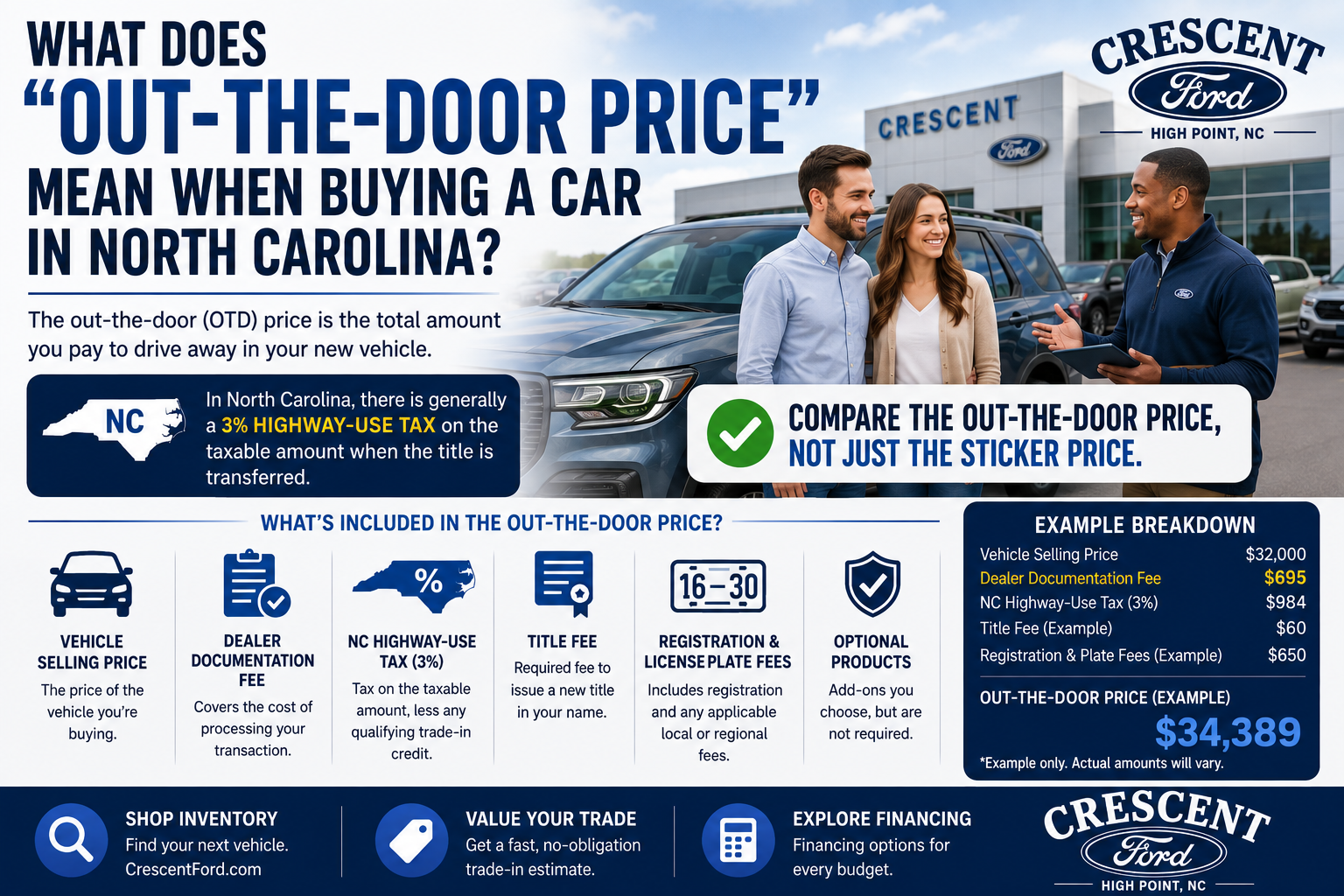
Out-the-door car price in North Carolina explained, including vehicle price, dealer fee, highway-use tax, title and registration fees at Crescent Ford

What Does “Out-the-Door Price” Mean When Buying a Car in North Carolina?

You find a vehicle advertised for $32,000.

You like it. It fits your budget. You're ready to buy.

But then you get to the numbers and the total isn't $32,000.

So what happened?

Usually, the answer is that the advertised vehicle price and the out-the-door price aren't the same thing.

If you're shopping for a new or used car in North Carolina, understanding that difference can make comparing vehicles — and dealerships — much easier.

An out-the-door price gives you a much more complete picture of what it actually costs to purchase the vehicle.

And if you're comparing two offers, that's usually the number you want to compare.


What Is an Out-the-Door Price?

The out-the-door price, often shortened to OTD price, is the total amount associated with purchasing the vehicle after applicable taxes and required fees are included.

In simple terms:

It's the number at the bottom of the purchase agreement before accounting for how you're paying for it.

Depending on the transaction, an out-the-door price can include:

  • Vehicle selling price

  • Factory-installed or dealer-installed equipment included in the transaction

  • Dealer documentation or administrative fee

  • North Carolina highway-use tax

  • Title fee

  • Registration or license plate fees

  • Applicable local or regional fees

  • Optional products you choose to purchase

Trade-ins, rebates and other transaction-specific credits can also affect the final numbers.

That's why two vehicles with the same advertised price don't necessarily have the same out-the-door price.

Shop New Ford Vehicles at Crescent Ford

Browse Used Cars, Trucks & SUVs


Is the Advertised Price the Same as the Out-the-Door Price?

Usually, no.

The advertised price generally refers to the price of the vehicle itself under the terms stated in the advertisement.

The out-the-door price accounts for the additional amounts necessary to complete the purchase.

Think about it like this:

Advertised Price

What does the vehicle cost?

Out-the-Door Price

What does the entire transaction cost before financing?

That distinction matters.

Suppose you're comparing:

Vehicle A: $29,500

and

Vehicle B: $29,900

At first glance, Vehicle A looks $400 cheaper.

But if the dealerships have different dealer fees or the transactions contain different additions, Vehicle B could potentially have the lower final price.

That's why shoppers should avoid comparing vehicles based solely on one number in an advertisement.


What Is Included in an Out-the-Door Car Price in North Carolina?

Let's break down the pieces you're most likely to encounter.

1. The Vehicle Selling Price

This is the agreed-upon price of the vehicle.

For a new Ford, the selling price may reflect applicable dealer discounts or manufacturer incentives for which the transaction qualifies.

For a used vehicle, it's the agreed selling price of that particular vehicle.

This is the number most shoppers naturally focus on first.

But it isn't the only number.


2. North Carolina Highway-Use Tax

This is one of the most important differences for NC shoppers to understand.

North Carolina generally does not handle a vehicle purchase by simply applying the state's ordinary retail sales tax.

Instead, North Carolina generally collects a highway-use tax when a vehicle title is transferred.

For vehicles purchased from a motor vehicle dealer, the highway-use tax is generally 3% of the taxable purchase amount under North Carolina rules, and qualifying trade-in credit can reduce the amount on which the tax is calculated.

That last part is important.

Your trade-in can affect the taxable amount.

We'll look at that more closely below.


Is North Carolina's Highway-Use Tax the Same as Sales Tax?

Not technically.

People commonly say:

"What's the sales tax on a car in NC?"

But North Carolina generally imposes a highway-use tax instead of ordinary sales tax when a vehicle's title is transferred.

For most shoppers, the practical concern is still the same:

How much tax will I owe as part of the transaction?

But if you're researching the rules online or reviewing your paperwork, highway-use tax is the terminology you'll see from NCDMV.


3. Dealer Documentation or Administrative Fee

A dealership may charge a documentation or administrative fee associated with processing the transaction.

This is separate from the vehicle's selling price.

When you're comparing dealerships, this is one of the reasons an out-the-door comparison is so useful.

Imagine:

Dealership A

Lower vehicle price + higher dealer fee

Dealership B

Slightly higher vehicle price + lower dealer fee

Which is cheaper?

You can't tell until you look at the complete numbers.

Crescent Ford transparency note

At Crescent Ford, the dealer documentation fee is disclosed as part of the transaction rather than something you should discover after you've already decided to purchase.


4. North Carolina Title Fee

When ownership of a vehicle changes, a new title generally needs to be issued.

North Carolina charges a title fee as part of that process.

These DMV amounts can change over time, so rather than relying on an old article for an exact figure, it's smart to verify the current fee when you're actually purchasing.

That way you're working with today's number rather than a fee quoted online several years ago.


5. Registration and License Plate Fees

You'll also generally encounter registration-related costs.

The exact amount can vary depending on factors such as:

  • Vehicle type

  • Registration type

  • Whether you're transferring an existing plate

  • Where the vehicle is registered

  • Applicable local or regional fees

This is another reason an actual buyer's order is more useful than trying to estimate every transaction from a generic online calculator.


6. Optional Products

This category needs an important word:

Optional.

Depending on the dealership and transaction, you may be offered products such as:

  • Vehicle service contracts

  • GAP coverage

  • Maintenance products

  • Appearance or protection products

  • Other optional coverage

If you choose to purchase an optional product, it affects your final transaction amount.

But you should understand what you're buying.

Ask:

What is it?

How much does it cost?

Is it optional?

What does it cover?

Don't judge the entire transaction only by the monthly payment after products have been added.

Look at the actual purchase figures.


Does Financing Change the Out-the-Door Price?

This is an important distinction.

Your financing structure and your out-the-door purchase price are related, but they aren't the same thing.

Suppose the out-the-door amount is $35,000.

You could:

  • Pay $35,000 in cash

  • Finance $35,000

  • Put $5,000 down and finance $30,000

  • Apply $7,000 of trade equity and finance $28,000

The purchase amount hasn't necessarily changed.

The way you're paying for it has.

Your loan then introduces additional considerations such as:

  • APR

  • Loan term

  • Monthly payment

  • Finance charge

  • Total of payments

This is why you shouldn't evaluate a vehicle purchase solely from:

"What's my payment?"

Two buyers can purchase the same vehicle for the same out-the-door price and have very different monthly payments.


Does a Trade-In Change Your Out-the-Door Price in North Carolina?

A trade-in can have a significant impact on the transaction.

Let's use a simplified hypothetical example.

Suppose the applicable taxable purchase amount before trade credit is:

$40,000

and you receive:

$15,000 in qualifying trade-in credit.

In a simplified example:

$40,000 - $15,000 = $25,000

The applicable highway-use tax would generally be calculated using the taxable amount determined under North Carolina rules rather than simply taxing the entire $40,000 without regard to the trade.

That's a real financial benefit of trading a vehicle in North Carolina.

However, your exact transaction can contain other taxable amounts, fees and adjustments, so don't use this simplified example as your final purchase calculation.

Find Out What Your Vehicle Is Worth

Related Reading

What Is My Car Worth in High Point, NC? How Trade-In Appraisals Actually Work


What If You Still Owe Money on Your Trade?

You can potentially trade a vehicle even if you still have a loan.

The dealership determines the vehicle's trade value and obtains the payoff amount on your current loan.

Then we compare the two.

Positive Equity

Suppose:

Trade value: $22,000

Loan payoff: $16,000

You have approximately:

$6,000 in positive equity.

That equity can generally be applied toward the next transaction.

Negative Equity

Now suppose:

Trade value: $22,000

Loan payoff: $26,000

You're approximately:

$4,000 upside down.

Depending on lender approval and the structure of the transaction, some or all of that negative equity may potentially be included in the new financing.

But here's something important:

Your payoff doesn't determine the vehicle's trade value.

Those are separate numbers.


Does a Down Payment Reduce the Out-the-Door Price?

Usually, think of a down payment as changing how much of the transaction you're financing, not magically making the vehicle itself cheaper.

For example:

Out-the-door amount: $40,000

Cash down: $5,000

That may leave approximately:

$35,000 to be financed

before considering any other transaction-specific adjustments.

The $5,000 didn't necessarily turn a $40,000 purchase into a $35,000 purchase.

You simply paid $5,000 of it upfront.

That's an important distinction when comparing offers.


What Does "$0 Down" Mean?

Usually, it refers to how the transaction is being financed — not that taxes and fees disappeared.

If a qualified buyer finances a transaction with no cash down, the applicable amounts may simply be included in the amount financed, subject to lender approval and financing terms.

So:

$0 down does not mean $0 taxes and fees.

It means you're not necessarily bringing a cash down payment.

That's why you should look at both:

Out-the-door price

and

Amount financed.


What's the Difference Between MSRP and Out-the-Door Price?

These numbers answer completely different questions.

MSRP

The Manufacturer's Suggested Retail Price is the manufacturer's suggested price for a new vehicle based on its configuration and equipment.

Selling Price

The amount the dealership and buyer agree upon for the vehicle before applicable transaction items.

Out-the-Door Price

The more complete purchase amount after applicable taxes and required fees are considered.

Amount Financed

The portion of the transaction being financed after applicable down payments, trade equity and other adjustments.

Monthly Payment

The periodic payment resulting from the amount financed, APR and loan term.

Understanding those five numbers makes car shopping dramatically easier.


What's the Difference Between Out-the-Door Price and Amount Financed?

This is one of the most common points of confusion.

Imagine:

Out-the-door amount: $38,000

You have:

$5,000 trade equity

and put:

$3,000 cash down.

You aren't necessarily financing $38,000.

Those contributions can reduce what needs to be borrowed.

Conversely, negative equity from a previous loan could potentially increase the amount you're financing beyond the new vehicle's purchase figures.

That's why:

OTD price does not always equal amount financed.


Should You Negotiate the Out-the-Door Price?

The out-the-door number is certainly a useful number to discuss because it forces everyone to look at the whole transaction.

Instead of asking only:

"Can you take $500 off the car?"

you can ask:

"What is my total out-the-door amount?"

That gives you a much clearer picture.

But don't ignore the individual line items.

You still want to understand:

  • Vehicle selling price

  • Dealer fee

  • Tax

  • DMV fees

  • Trade allowance

  • Trade payoff

  • Optional products

  • Rebates or discounts

A transparent deal isn't simply one where you know the final number.

It's one where you understand how the final number was calculated.


Why the Lowest Advertised Price Isn't Always the Cheapest Deal

This is probably the biggest reason shoppers should understand OTD pricing.

Imagine you find two similar vehicles online.

Dealer A

Advertised price:

$31,000

Dealer B

Advertised price:

$31,600

Easy decision, right?

Not necessarily.

What if Dealer A's advertised price requires:

  • A rebate you don't qualify for

  • A trade-in

  • Financing through a particular lender

  • Additional products

  • Other conditions

while Dealer B's price has fewer qualifications?

The only way to know which transaction is actually better is to compare the complete terms.

Don't compare advertisements.

Compare deals.

That doesn't mean advertised pricing isn't useful.

It absolutely is.

It's where shopping starts.

But the out-the-door number tells you much more about where the shopping ends.


What Should You Ask a Dealership Before You Visit?

If you're shopping remotely or comparing several vehicles around the Piedmont Triad, ask for enough information to understand the transaction.

Useful questions include:

What is the selling price?

What rebates or incentives are included?

Do I qualify for those incentives?

What is the dealer documentation fee?

Are there any required dealer-installed products?

What are the estimated taxes and DMV fees for my registration situation?

What is the estimated out-the-door amount?

If you have a trade:

Is the trade value included in that figure?

If you're financing:

Does this price require dealer financing or a particular lender?

Those questions can save a lot of confusion.


Can a Dealership Give You an Exact Out-the-Door Price Online?

Often, yes — once it has enough information.

But an accurate North Carolina out-the-door calculation can depend on information the dealership may not have from an anonymous website visitor.

For example:

  • Where will the vehicle be registered?

  • Are you transferring a plate?

  • Do you have a trade?

  • What is the trade worth?

  • Is there a payoff?

  • Which incentives do you qualify for?

  • Are you adding optional products?

So if an online number is labeled an estimate, don't automatically assume someone is hiding something.

Sometimes the dealership simply doesn't have enough information yet to calculate the final transaction precisely.

The solution is easy:

Ask for a buyer's order or complete purchase breakdown based on your actual situation.


What Is a Buyer's Order?

A buyer's order is one of the most useful documents in the entire purchase process.

It lays out the transaction.

Depending on the deal, you'll see items such as:

  • Vehicle information

  • Selling price

  • Trade allowance

  • Payoff

  • Tax

  • Dealer fee

  • Title and registration fees

  • Optional products

  • Total

This lets you see where the out-the-door number actually came from.

If something doesn't make sense:

Ask.

A dealership should be able to explain the line item.


How Do You Compare Out-the-Door Quotes From Two Dealers?

Put them next to each other.

Seriously.

Don't compare:

Dealer A's payment

to

Dealer B's selling price.

Don't compare:

Dealer A's OTD price

to

Dealer B's MSRP.

Compare equivalent numbers.

A simple table works:

Item

Dealer A

Dealer B

Vehicle selling price


Dealer fee


Tax


DMV/title/registration


Required additions


Optional products


Trade allowance


Trade payoff


Out-the-door amount


Then make sure both quotes are based on the same assumptions.

This can reveal very quickly why one deal looks cheaper.


What About Rebates and Ford Incentives?

Manufacturer incentives can affect your purchase price, but eligibility matters.

A Ford offer might depend on factors such as:

  • Vehicle or model

  • Purchase vs. lease

  • Financing program

  • Customer eligibility

  • Location

  • Program dates

And incentives change.

That's why we aren't going to tell you in this article that every buyer gets a particular rebate.

Instead:

Look at the programs available on the exact vehicle when you're ready to purchase.

View Current Ford Specials


Does 0% Financing Change the Out-the-Door Price?

Not necessarily.

A promotional APR primarily changes the cost of financing, not automatically the vehicle's underlying out-the-door amount.

But manufacturer programs can sometimes require shoppers to choose between promotional financing and other incentives.

So when comparing offers, don't ask only:

"What's the APR?"

Ask:

"What is my total purchase price under each option?"

and

"What will I pay over the life of the loan?"

A lower APR can be extremely valuable.

A larger rebate can also be valuable.

The better option depends on the actual numbers.


What About Property Tax in North Carolina?

North Carolina vehicles are also subject to property tax.

Vehicle property taxes are generally connected to registration, and the exact amount depends on where the vehicle is registered and the applicable local tax rate.

This is another reason shoppers should avoid assuming that a generic "NC car tax calculator" will reproduce their exact transaction.

Registration location matters.


A Simple Example of an Out-the-Door Price

Let's build a hypothetical transaction.

Vehicle selling price: $35,000

Dealer/document fee: Example amount

Applicable NC highway-use tax: Calculated under current NC rules

Title/registration fees: Applicable DMV amount

The total of those applicable transaction amounts gives you your out-the-door figure.

Then suppose you have:

$5,000 positive trade equity

and

$2,000 cash down.

Those amounts may reduce how much you need to finance.

Notice the order:

First question:

What does the vehicle transaction cost?

Second question:

How are we paying for it?

Keeping those two questions separate makes financing much easier to understand.


What Should Not Surprise You at the Dealership?

This is where transparency matters most.

By the time you're ready to sign, you should understand:

  • What you're paying for the vehicle

  • The dealer fee

  • Applicable taxes

  • DMV, title and registration charges

  • Your trade value

  • Your payoff

  • Any optional products you've selected

  • Your amount financed

  • Your APR

  • Your loan term

  • Your payment

If a number changes:

Ask why.

There may be a completely legitimate reason.

Maybe the payoff changed.

Maybe registration information changed.

Maybe an incentive wasn't applicable.

Maybe you selected an optional product.

The point isn't that numbers can never change.

The point is that you should understand why they changed.


How Crescent Ford Approaches Pricing

Car buying gets unnecessarily frustrating when shoppers feel like they're trying to uncover the "real" price.

Our goal is to make the numbers understandable.

If you're shopping with Crescent Ford, ask us for the breakdown.

We can explain:

Vehicle price

Trade

Payoff

Taxes

Fees

Financing

and how those pieces create the final transaction.

You shouldn't need an accounting degree to understand your car deal.

Contact Crescent Ford About a Vehicle


Shopping for a Car in High Point, NC?

If you're comparing a new Ford or used vehicle in High Point, Greensboro, Winston-Salem, Kernersville, Thomasville, Lexington, Trinity or elsewhere in the Piedmont Triad, start by comparing the complete transaction — not just the largest number in an advertisement.

A good shopping process looks like this:

Find the right vehicle.

Confirm the selling price.

Find out what your trade is worth.

Review taxes and fees.

Determine the out-the-door amount.

Compare financing options.

Choose the deal that makes sense for you.

That's a much better process than beginning and ending with:

"What's my monthly payment?"

Shop New Ford Vehicles at Crescent Ford

Shop Used Vehicles

Value Your Trade

Explore Financing Options


Frequently Asked Questions About Out-the-Door Car Prices in North Carolina

What does out-the-door price mean when buying a car?

The out-the-door price is the more complete cost of purchasing the vehicle after applicable taxes and required transaction fees are included. It helps shoppers understand what the purchase costs beyond the advertised vehicle price.

Does out-the-door price include tax in North Carolina?

Yes. An out-the-door quote should account for applicable taxes. North Carolina generally imposes a highway-use tax rather than ordinary sales tax when a motor vehicle title is transferred.

What is the highway-use tax on a car in North Carolina?

For a vehicle purchased from a dealer, North Carolina generally imposes a 3% highway-use tax based on the taxable purchase amount under state rules. Qualifying trade-in credit can reduce the amount on which the tax is calculated.

Does NC charge sales tax when you buy a car?

North Carolina generally collects a highway-use tax instead of the state's ordinary retail sales tax when a motor vehicle title is transferred.

Does trading in a car reduce taxes in North Carolina?

For qualifying dealer transactions, trade-in credit can reduce the amount subject to North Carolina highway-use tax.

Does a down payment lower the out-the-door price?

A cash down payment generally changes how much of the transaction you need to finance rather than changing the vehicle's underlying selling price. That's why it's useful to look separately at the out-the-door amount and amount financed.

Is the dealer documentation fee included in the out-the-door price?

It should be accounted for when determining the complete amount associated with the purchase. The dealer fee is separate from the vehicle selling price.

Are title and registration fees included in an out-the-door quote?

An out-the-door quote should account for applicable title and registration costs. Exact fees can vary depending on the vehicle and registration circumstances.

Is MSRP the same as out-the-door price?

No. MSRP is the manufacturer's suggested retail price for a new vehicle. The out-the-door amount accounts for the actual transaction, including applicable taxes and fees.

Is out-the-door price the same as amount financed?

Not necessarily. A down payment or positive trade equity can reduce the amount you finance. Negative equity can potentially increase it. The out-the-door price and amount financed therefore answer different questions.

Should I ask for the out-the-door price before going to a dealership?

It's a useful number to request when comparing vehicles. To provide an accurate figure, however, the dealership may need information such as where you'll register the vehicle, whether you have a trade and which incentives apply to you.

Can Crescent Ford give me an out-the-door quote?

Yes. Once the necessary information about the vehicle and transaction is available, Crescent Ford can provide a purchase breakdown so you can see the vehicle price, applicable taxes, fees, trade information and other transaction-specific amounts before deciding how you want to finance the purchase.
Posted in:

Related Posts

How much should you put down on a car guide explaining down payments, monthly payments and vehicle financing at Crescent Ford

How Much Should You Put Down on a Car? A Practical Guide

How Much Should You Put Down on a Car? You've found a car you like. You've figured out roughly what you want your monthly payment to be. Then comes another question: How much money should you actually put down? You've probably heard plenty of rules. "Always put 20% down." "Ten percent is enough." "Never put money down on a car." "Put down as much as possible." The problem? None of those rules works for every buyer. There are good reasons to make a larger down payment. There are also situations where putting thousands of dollars down may not be the best use of your cash. And if you have a trade-in with equity, you may already have a down payment without writing a check at all. So instead of giving you an arbitrary percentage, let's look at what a down payment actually does — and how to decide what makes sense for your car purchase. Explore Auto Financing Options How Much Should You Put Down on a Car? The Quick Answer There isn't a universal amount that every buyer should put down. You'll often see 10% to 20% used as a general guideline, with some financial experts recommending even more. But that's a guideline — not a requirement. The better goal is to put down enough to: Keep the amount you're financing manageable Get a monthly payment that fits comfortably in your budget Reduce the amount of interest you'll pay Establish some equity in the vehicle Meet any lender requirements Avoid draining savings you may need for emergencies For one shopper, that could be $5,000. For another, it might be $1,000. Someone with substantial trade equity may not need to bring any additional cash at all. And some buyers may qualify to purchase a vehicle with little or no money down. The important question isn't: "What's the normal down payment?" It's: "What does putting more or less down do to this particular deal?" What Is a Down Payment on a Car? A down payment is money or equity applied toward the vehicle purchase upfront rather than financed as part of your auto loan. Suppose your amount to be financed before a down payment is $35,000. If you put $5,000 down, you'd reduce that amount to approximately $30,000, assuming everything else remains the same. That's important because you're now borrowing less money. And when you borrow less money, several other things can change. What Does a Bigger Down Payment Actually Do? A larger down payment can provide several benefits. 1. It reduces the amount you finance This is the most obvious one. If you put $5,000 down, that's $5,000 you don't have to borrow. 2. It can lower your monthly payment Borrowing less generally means a lower monthly payment when the APR and loan term stay the same. 3. It can reduce the interest you pay Interest is charged on the money you borrow. Reduce the amount borrowed, and you can reduce the total interest expense over the life of the loan. 4. It can improve your equity position Vehicles depreciate. Starting with more money down can help create a cushion between what the vehicle is worth and what you owe. 5. It may help with financing approval Depending on your credit profile, vehicle and lender, a lender may require a certain amount of money down. A down payment can reduce the lender's risk because you're financing a smaller portion of the transaction. But that doesn't mean: More down is always better. We'll get to that. How Does a Down Payment Affect Your Car Payment? Let's use a simple hypothetical example. Suppose you're financing a vehicle at $35,000 before any down payment. We'll use an example 7% APR for 60 months purely to demonstrate the math. Your actual APR will depend on your credit, lender, vehicle, loan term and available financing programs. Down Payment Approx. Amount Financed Approx. Monthly Payment $0 $35,000 $693 $2,500 $32,500 $644 $5,000 $30,000 $594 $7,500 $27,500 $545 $10,000 $25,000 $495 Hypothetical example only. Excludes taxes, fees, optional products and other transaction-specific amounts. That's a useful way to think about a down payment. In this example, every additional $2,500 down reduces the payment by roughly $50 per month. But here's where we want you to think beyond the payment. Would you rather have: $5,000 in your savings account and a payment around $693? or $0 of that $5,000 in savings and a payment around $594? There isn't enough information to answer that question yet. That's exactly the point. Your emergency savings, income stability, other debt and overall financial situation matter too. Is 10% a Good Down Payment on a Car? Ten percent can be a reasonable starting point for many shoppers, but don't treat it as a magic number. On a $30,000 vehicle, 10% would be: $3,000. On a $50,000 vehicle: $5,000. On a $70,000 truck: $7,000. The percentage may be the same, but those are very different amounts of cash. Before deciding that you "need" to put 10% down, look at what that money actually accomplishes. Ask: How much does it lower my payment? How much interest does it save? Does the lender require it? How much cash will I have left afterward? Do I already have trade equity? Would some of that cash be better used to pay down higher-interest debt? A percentage is a starting point—not a financial strategy. Should You Put 20% Down on a Car? Putting 20% down can put you in a strong equity position and substantially reduce the amount you're financing. But again, don't blindly follow the rule. Imagine you're buying a $45,000 vehicle. Twenty percent is: $9,000. If you have $40,000 sitting in savings and no high-interest debt, putting $9,000 down may be perfectly comfortable. If you have $10,000 total in savings? Putting $9,000 into a depreciating asset and leaving yourself with $1,000 for emergencies is a completely different decision. That's why we prefer: "How much can I comfortably put down?" over: "What percentage am I supposed to put down?" Can You Buy a Car With No Money Down? Potentially, yes. Some buyers may qualify for financing with $0 cash down, depending on factors such as: Credit Income Vehicle Amount financed Loan-to-value Lender requirements Trade equity Current financing programs But qualifying for $0 down and deciding that $0 down is your best financial choice are two different things. If you finance more of the purchase, you'll generally have: A larger loan A higher monthly payment More interest expense Less initial equity That doesn't make a zero-down purchase inherently bad. Keeping your cash might be valuable for other reasons. It simply means you should understand the tradeoff. Talk With Our Finance Team When Does $0 Down Make Sense? There are situations where keeping your cash can be reasonable. You have a very favorable interest rate If you're financing at a particularly low promotional APR, you may decide that keeping cash available is more valuable than using it to reduce a low-cost loan. Manufacturer financing programs change regularly, so this decision should be based on the actual offer available when you're shopping. You need to preserve an emergency fund Buying a car shouldn't leave you unable to handle an unexpected home repair, medical bill or other emergency. You already have substantial trade equity This is a big one. You might say: "I'm not putting any money down." But if your trade has $7,000 of positive equity and you apply that toward the transaction, you effectively have $7,000 reducing what you need to finance. No additional cash may be necessary. The payment already fits comfortably If your payment, loan term and total financing cost are reasonable without cash down, you may decide that keeping your savings is more important. When Should You Consider Putting More Money Down? There are also situations where we'd strongly consider a larger down payment. Your monthly payment is too high If the payment doesn't fit comfortably into your budget, a larger down payment can reduce it. But there's an important warning here: Don't use a huge down payment to make an unaffordable vehicle look affordable. If you have to empty your savings just to make the monthly payment work, you may simply be shopping for too much vehicle. Your lender requires it Depending on the transaction and credit profile, the lender may require money down for approval. You want to reduce total interest If you're borrowing at a higher APR, reducing the principal can become increasingly valuable. You want a stronger equity position A larger down payment can help reduce the chance that you'll owe significantly more than the vehicle is worth, particularly early in the loan. You're financing for a longer term If you're considering a longer loan, starting with more equity deserves additional consideration because you'll be paying down principal more slowly. Can Your Trade-In Be Your Down Payment? Absolutely. This is one of the most important things for shoppers to understand. Suppose your current vehicle is worth: $20,000 and your loan payoff is: $13,000. You have approximately: $7,000 in positive equity. If you trade the vehicle and apply that equity toward your next purchase, that $7,000 reduces the amount that otherwise needs to be financed. You may not need to bring additional cash. Find Out What Your Vehicle Is Worth Related Reading What Is My Car Worth in High Point, NC? How Trade-In Appraisals Actually Work Can You Trade In a Car You Still Owe Money On? What If You Have Negative Equity? Now we have the opposite situation. Suppose your vehicle is worth: $20,000 but you still owe: $24,000. You're approximately $4,000 upside down, or $4,000 in negative equity. That doesn't necessarily prevent you from trading. Depending on lender approval and the overall transaction, some or all of that negative equity may potentially be included in the new loan. But this is a situation where bringing money down can become particularly valuable. If you bring $4,000, for example, you could potentially offset that negative-equity amount rather than carrying it forward into your next loan. The specifics depend on the transaction and lender approval, but the principle is simple: Money down can help prevent old debt from becoming new debt. That's something worth discussing with the finance team before choosing your next vehicle. Should You Put Your Entire Trade Value Down? Not necessarily. If you own your trade outright, you have choices. Suppose your vehicle is worth $15,000 and you owe nothing. You could apply all $15,000 toward your next vehicle. But depending on the transaction, you may also want to discuss whether there are other options for how your equity is handled. The important thing is knowing what the vehicle is worth first. Your trade is part of your financial picture. Don't treat it as an afterthought. Should You Use Your Savings for a Car Down Payment? This is where we'd be cautious. Having $10,000 in a savings account doesn't automatically mean you should put $10,000 down. Before taking money from savings, consider: Your emergency fund Upcoming expenses Other debts The APR on those debts Job/income stability The auto-loan APR How much the additional down payment actually saves you Here's an extreme example: Suppose you have $10,000 in cash. You also have $5,000 in high-interest credit-card debt. Putting the entire $10,000 down on a relatively low-interest auto loan while continuing to carry expensive credit-card debt may not be the most efficient use of your money. This is where the "put as much down as possible" advice falls apart. Your car loan doesn't exist in isolation from the rest of your finances. Does a Bigger Down Payment Lower Your Interest Rate? Not automatically. A larger down payment reduces the amount you're borrowing, but your APR is determined by factors that can include: Credit history Credit score Loan term Vehicle Lender Amount financed Loan-to-value Current programs A larger down payment may help make a transaction more attractive to a lender or help meet lending requirements, but don't assume putting another $2,000 down automatically lowers your APR. Ask. Compare the actual financing scenarios. Does a Down Payment Help You Get Approved? It can. From a lender's perspective, financing $25,000 on a particular vehicle can present a different risk than financing $35,000 on that same vehicle. A down payment can reduce the loan-to-value ratio and the amount the lender is being asked to finance. For some borrowers, that may help create a financeable structure. But there's no universal amount that guarantees approval. Credit history, income, debt obligations, vehicle and lender guidelines still matter. What If You Have Bad Credit? If your credit is challenged, you may encounter lenders that require money down as part of the approval. In that situation, the question changes from: "How much do I want to put down?" to: "What financing structures are actually available to me?" That doesn't mean you should automatically agree to the first option presented. Look at: APR Amount financed Down payment Monthly payment Loan term Total of payments You want an affordable vehicle and an understandable loan. How Do I Get a Car Loan With Bad Credit? Is It Better to Put Money Down or Choose a Shorter Loan? This is a great question because both can reduce financing costs. Let's say you have enough income to handle a higher monthly payment. You might compare: Option A: Larger down payment + 72-month loan with Option B: Smaller down payment + 60-month loan Which is better? You can't tell from those descriptions alone. You need the actual: APR Amount financed Monthly payment Total interest Total of payments A shorter term generally means a higher monthly payment but can reduce the amount of interest paid. A larger down payment reduces the principal from the beginning. Sometimes the best answer is a combination of both. Explore Your Auto Financing Options Don't Choose Your Down Payment Based Only on the Monthly Payment This deserves its own section. Suppose you tell a salesperson: "I need to be at $500 per month." There are several ways the math could potentially get there. You could: Put more money down Choose a less expensive vehicle Extend the loan term Qualify for a lower APR Apply trade equity Use some combination of those factors Those aren't financially equivalent. Putting $8,000 down to reach $500 per month isn't the same thing as putting $2,000 down and reaching $500 because you qualified for a lower rate. And neither is the same as reaching $500 by extending the loan substantially. That's why we'd encourage shoppers to look at: Vehicle price + trade value + down payment + APR + term + payment + total financed rather than focusing on the payment alone. New vs. Used: Should Your Down Payment Be Different? You may see traditional rules recommending a larger percentage down on a new vehicle than a used vehicle. There's some logic behind that. A new vehicle begins its depreciation cycle when you purchase it, so putting more down can help establish an equity cushion. A used vehicle has already experienced some depreciation. But once again, we'd rather compare the actual transaction. A nearly new used vehicle with a high APR may benefit from a larger down payment. A brand-new vehicle with an attractive manufacturer APR may make keeping more cash appealing. There isn't a universal percentage that accounts for those differences. Related Reading Should You Buy New or Used in 2026? A Real-World Cost Comparison What About Taxes and Fees? This is another reason your down-payment calculation shouldn't begin and end with the vehicle's advertised price. The amount you're actually financing can include more than the vehicle price. Depending on the transaction, you'll also need to account for applicable: Taxes Registration Title fees Dealer documentation fees Optional products you choose to purchase Negative equity, if applicable That's why understanding the out-the-door price is useful before deciding how much cash to put down. Related Reading What Is the Out-the-Door Price of a Car? A Better Way to Decide How Much to Put Down Instead of starting with a percentage, try this process. Step 1: Determine what you can comfortably afford Figure out a comfortable vehicle budget before worrying about how to structure the loan. Step 2: Find out what your trade is worth You may already have thousands of dollars in equity available. Step 3: Find out your payoff Trade value minus payoff tells you whether you have positive or negative equity. Step 4: Look at your financing options Find out the actual APR and terms available to you. Step 5: Run several down-payment scenarios Ask to see the difference between: $0 down $2,500 down $5,000 down or whatever amounts are realistic for you. Step 6: Look at both payment AND total cost Don't stop when you see a monthly payment you like. Step 7: Protect your cash reserves Ask yourself what you'd have left after making the down payment. Step 8: Choose the balance that makes sense The goal isn't to put the most money down. It's to create a vehicle purchase that works comfortably within your finances. How Much Should You Put Down on a $30,000 Car? Let's make this practical. On a $30,000 vehicle: 5% = $1,500 10% = $3,000 15% = $4,500 20% = $6,000 That doesn't mean $6,000 is automatically the "correct" answer. If $3,000 creates a comfortable payment and allows you to maintain healthy savings, that may be more appropriate. If you have $6,000 in trade equity already, you may not need additional cash. If the lender requires $4,000 for the transaction, then your situation is different again. How Much Should You Put Down on a $40,000 Car? On $40,000: 5% = $2,000 10% = $4,000 15% = $6,000 20% = $8,000 Again, run the loan both ways. Seeing how much an additional $2,000 changes the payment and total interest makes the decision much easier than following an arbitrary rule. How Much Should You Put Down on a $50,000 Car? On $50,000: 5% = $2,500 10% = $5,000 15% = $7,500 20% = $10,000 This is where percentages can start representing substantial amounts of cash. Twenty percent sounds simple until it means moving $10,000 out of your savings account. Make sure the financial benefit justifies what you're giving up in liquidity. How Much Should You Put Down on a $60,000 Truck or SUV? On $60,000: 5% = $3,000 10% = $6,000 15% = $9,000 20% = $12,000 For higher-priced trucks and SUVs, trade equity can become especially important. If your current truck is worth $30,000 and you owe $20,000, that $10,000 in equity may do much of the work without requiring you to bring another large amount of cash. Value Your Trade Before You Shop Should You Put Money Down on a 0% APR Car Loan? This is one of the situations where the answer becomes especially interesting. If you qualify for a genuine 0% APR offer, you're not paying interest on the financed amount under the terms of that loan. That removes one of the major financial reasons for making a larger down payment: reducing interest expense. You may still choose to put money down to: Lower the payment Reduce the amount financed Create additional equity Meet program or lender requirements But if no down payment is required, you may prefer to keep more cash available. There is no universal answer. Also remember that manufacturer 0% APR programs are generally available only on certain vehicles, terms and for qualified buyers when offered. They may sometimes be an alternative to other incentives. Compare the complete offers before choosing. Should You Put Money Down on a Lease? A lease is different from financing a purchase. Generally, we'd be cautious about making a large capitalized cost reduction simply to lower a lease payment. Why? Because you're putting a substantial amount of cash upfront into a vehicle you don't own. Lease structures, requirements and protections can vary, so if you're considering leasing, ask the finance team to show you: Amount due at signing Any required fees Payment with minimal upfront cash Payment with additional cash down Then compare them before deciding. Don't put several thousand dollars down simply because the lower advertised monthly payment looks attractive. What Is the Best Down Payment on a Car? The best down payment isn't necessarily 10%. It isn't necessarily 20%. And it definitely isn't: "As much as you possibly can." A good down payment is one that helps create an affordable loan without putting the rest of your finances under unnecessary pressure. Ideally, after the transaction: Your payment fits comfortably. You understand your APR and loan term. You haven't emptied your savings. You have a reasonable equity position. You understand what your trade contributed. You know the total amount you're financing. You're comfortable with the total cost. If that happens with 20% down, great. If it happens with 10%, that's fine too. If you have enough trade equity that you don't need additional cash, that's worth considering. And if you're approved with $0 down, compare that option against putting money down before deciding. There is no prize for putting the most money down. The goal is to structure the purchase intelligently. Calculate Your Down Payment at Crescent Ford in High Point, NC If you're shopping for a new Ford or used vehicle around High Point, Greensboro, Winston-Salem, Kernersville, Thomasville, Lexington, Trinity or the surrounding Piedmont Triad, you don't have to decide on a down payment before you know the rest of the numbers. Start with the vehicle. Find out what your trade is worth. See what financing options are available. Then compare different amounts down. At Crescent Ford, our finance team can show you how changing the down payment affects the amount financed and monthly payment so you can make the decision based on actual numbers rather than an internet rule. Explore Financing at Crescent Ford Value Your Trade Shop New Ford Vehicles Shop Used Cars, Trucks & SUVs Frequently Asked Questions About Car Down Payments How much should I put down on a car? There isn't one required amount for every buyer. While 10% to 20% is commonly discussed as a guideline, the appropriate down payment depends on the vehicle, financing terms, trade equity, lender requirements and your personal finances. Is $2,000 a good down payment on a car? It can be. The more useful question is how $2,000 affects your specific loan. Compare the payment, amount financed and total interest with and without the $2,000 down. Is $5,000 a good down payment on a car? Depending on the vehicle's price, $5,000 can substantially reduce the amount financed. However, make sure making that down payment doesn't leave you without adequate savings for emergencies or other expenses. Is 10% enough for a car down payment? Ten percent is a commonly used guideline, but it isn't a universal requirement. Some buyers may benefit from putting more down, while others may qualify with less or no additional cash down. Is 20% down on a car too much? Not necessarily. A 20% down payment can reduce your loan balance, monthly payment and interest expense while improving your equity position. However, putting 20% down may not make sense if doing so would significantly deplete your savings. Can I buy a car with no money down? Some buyers can qualify for a vehicle loan without a cash down payment. Approval depends on the borrower, lender, vehicle and overall transaction. Keep in mind that financing more generally means a larger loan and higher monthly payment. Does my trade-in count as a down payment? Positive trade equity can be applied toward your next vehicle and reduce the amount that needs to be financed. For example, if your vehicle is worth $20,000 and you owe $13,000, you have approximately $7,000 in positive equity that could potentially be applied to the transaction. Should I put more money down if I have bad credit? A lender may require money down depending on your credit profile and the transaction. Putting more down reduces the amount being financed and may help create a structure a lender will approve, but it doesn't guarantee approval or a particular interest rate. Does putting more money down lower my car payment? Generally, yes. If the interest rate and loan term remain the same, reducing the amount financed with a larger down payment will lower the monthly payment. Does putting more money down lower the interest rate? Not automatically. Your APR depends on factors such as credit history, lender, vehicle, loan term and current financing programs. A larger down payment can reduce how much you borrow even if the APR stays the same. Should I use my entire savings for a car down payment? Generally, you should consider your emergency fund and other financial obligations before using a large portion of your savings for a vehicle. A lower car payment may not be worth leaving yourself without adequate cash reserves. Should I put money down if I have trade equity? You may not need to. Positive equity in your trade can already reduce the amount you need to finance. Compare the transaction using your trade equity before deciding whether adding cash provides enough additional benefit. Can Crescent Ford show me different down-payment options? Yes. Rather than choosing an amount based solely on a percentage, you can compare financing scenarios with different down payments to see how each affects the amount financed and monthly payment. Use the actual financing terms available to you when deciding.

2026 Ford F-150 engine options comparison showing EcoBoost, V8, PowerBoost Hybrid and Raptor engines at Crescent Ford

2026 Ford F-150 Engines Explained: Which Engine Is Best for You?

2026 Ford F-150 Engines Explained: Which Engine Is Right for You? Shopping for a Ford F-150 is relatively easy until you get to one particular question: Which engine should you get? For 2026, the Ford F-150 offers an unusually broad powertrain lineup. You can choose a twin-turbo V6, a traditional V8, a full-hybrid powertrain or — if you're shopping the Raptor lineup — engines designed primarily around high-performance off-road driving. And here's where F-150 shopping gets interesting: The biggest engine isn't automatically the best engine for you. The 5.0L V8 isn't the F-150's maximum-towing engine. The hybrid isn't simply an "MPG version" of the F-150. And plenty of truck owners who never tow anywhere near 10,000 pounds may be perfectly happy with the 2.7L EcoBoost. The right engine depends on what you actually expect your truck to do. Let's break down the 2026 F-150 engine lineup without assuming everyone needs the most powerful truck on the lot. Shop New Ford F-150 Trucks at Crescent Ford 2026 Ford F-150 Engines at a Glance Engine Horsepower Torque Max. Available Towing Best For 2.7L EcoBoost V6 325 hp 400 lb.-ft. 8,400 lbs. Daily driving + lighter truck duty 5.0L Ti-VCT V8 400 hp 410 lb.-ft. 12,800 lbs. V8 buyers, work and towing 3.5L EcoBoost V6 382 hp 500 lb.-ft. 13,500 lbs. Maximum F-150 towing 3.5L PowerBoost Full Hybrid V6 420 hp 570 lb.-ft. 11,600 lbs. Power, towing + onboard electricity High-Output 3.5L EcoBoost V6 450 hp 510 lb.-ft. 8,200 lbs. F-150 Raptor performance 5.2L Supercharged V8 720 hp 640 lb.-ft. 8,700 lbs. Raptor R extreme performance Ratings shown are Ford's maximum available figures for the 2026 F-150 lineup. Maximum towing and payload require specific configurations and equipment and vary based on cab, bed, drivetrain, axle ratio, equipment, passengers, accessories and cargo. Always verify the ratings of the specific truck you're considering. If you want the short version: 2.7L EcoBoost: The practical choice for many everyday F-150 owners. 5.0L V8: The traditional V8 choice with serious capability. 3.5L EcoBoost: The choice when maximum F-150 towing is the priority. 3.5L PowerBoost Hybrid: The technology-and-torque choice, especially if Pro Power Onboard matters. High-Output 3.5L EcoBoost: The Raptor engine. 5.2L Supercharged V8: The Raptor R engine — and an entirely different conversation. But those numbers don't tell the whole story. 2.7L EcoBoost V6: Do You Really Need More Engine? Let's start with the engine that can be easiest to overlook. The 2026 F-150's 2.7L EcoBoost V6 produces 325 horsepower and 400 lb.-ft. of torque. A properly configured truck can tow up to 8,400 pounds and offers maximum available payload of up to 1,775 pounds. Read those numbers again. Because "smallest F-150 engine" can make the 2.7L sound much less capable than it actually is. For someone whose F-150 is primarily a daily driver that also handles homeowner projects, recreational equipment, occasional towing and normal truck duty, the 2.7L deserves serious consideration. Who should consider the 2.7L EcoBoost? The 2.7L may be a great fit if: Your F-150 will be your daily driver. You rarely tow heavy trailers. You tow a smaller boat, utility trailer or other lighter load. You want strong low-end torque without stepping into a larger engine. You haul typical homeowner and recreational loads. You simply don't need the maximum capability available from an F-150. There's sometimes a tendency in truck shopping to buy capability for the one thing you might someday do rather than the things you actually do every week. If your biggest towing job is a 3,500-pound trailer a handful of times per year, you probably don't need to shop exclusively around a 13,500-pound maximum tow rating. The case for the 2.7L is simple: It may already be more engine than you need. That isn't a criticism. It's one of the reasons it's such an interesting F-150 engine. 5.0L Ti-VCT V8: The Traditional F-150 Choice For some truck buyers, there's still only one answer. V8. The 2026 F-150's 5.0L Ti-VCT V8 produces 400 horsepower and 410 lb.-ft. of torque. When properly configured, Ford rates it for up to 12,800 pounds of maximum available towing. That gives the V8 substantially more towing capability than the 2.7L EcoBoost while maintaining the naturally aspirated V8 layout many longtime truck owners prefer. Why choose the 5.0L V8? Some buyers simply prefer: Naturally aspirated power V8 sound and character Strong towing and hauling capability A familiar traditional truck powertrain The way a V8 delivers its power And there's nothing wrong with preference being part of the decision. A vehicle isn't a spreadsheet. If you've driven V8 trucks for 20 years and that's what you enjoy owning, the 5.0L gives you that option without sacrificing serious capability. But here's an important surprise: The V8 is not the maximum-towing F-150 engine. That distinction belongs to the 3.5L EcoBoost. So if your primary argument for buying the V8 is: "I need the biggest engine because I tow." keep reading. See Available Ford F-150 Trucks 3.5L EcoBoost V6: The F-150 Towing Champion If maximum towing capability is the priority, this is the engine you need to pay attention to. The 3.5L EcoBoost V6 produces 382 horsepower and 500 lb.-ft. of torque for 2026. More importantly, a properly configured F-150 with the 3.5L EcoBoost can tow up to: 13,500 pounds. That's the highest maximum available tow rating in the 2026 F-150 lineup. Not the V8. Not the hybrid. The 3.5L EcoBoost. Why is the 3.5L EcoBoost so good for towing? Torque matters tremendously when you're asking a truck to move a heavy trailer. The 3.5L EcoBoost produces 500 lb.-ft. of torque, considerably more than the 410 lb.-ft. from the 5.0L V8. Its turbocharged design also allows it to produce substantial torque at lower engine speeds. For buyers pulling campers, boats, equipment trailers or other substantial loads, that's a major reason to consider the 3.5L. Who should consider the 3.5L EcoBoost? We'd put it high on the list if: Towing is one of the main reasons you're buying an F-150. You tow regularly rather than occasionally. Your trailer is on the heavier end of half-ton capability. You want substantial torque. Maximum available F-150 towing matters to you. You want serious capability without moving into a Super Duty. But there's an important caveat. Buying a 3.5L EcoBoost does NOT automatically give you 13,500 pounds of towing capacity. That maximum requires a particular F-150 configuration and equipment. Cab. Bed. Drivetrain. Axle ratio. Tow equipment. Passengers. Cargo. Accessories. They all matter. If you're shopping specifically because you need to tow a 10,000-pound camper, don't walk onto a lot and say: "Just show me anything with the 3.5." Tell us what you're towing. Then we can help identify which 3.5L-equipped F-150 configurations actually meet your needs. 3.5L PowerBoost Full Hybrid V6: The F-150 Hybrid Is About More Than MPG The PowerBoost is probably the most misunderstood F-150 engine. Some shoppers hear "hybrid" and immediately assume: That's the fuel-economy engine. Efficiency is part of the PowerBoost story, but that description dramatically undersells what Ford has built. The 2026 3.5L PowerBoost Full Hybrid V6 produces 420 horsepower and 570 lb.-ft. of torque. That's more torque than the regular 3.5L EcoBoost. A properly configured PowerBoost F-150 can tow up to 11,600 pounds. So this isn't an F-150 that sacrifices truck capability in order to become a hybrid. It's a seriously capable powertrain that combines gasoline and electric power. Why would you choose PowerBoost? For many buyers, the most interesting feature isn't under the hood. It's in the bed. Pro Power Onboard PowerBoost-equipped F-150s include Pro Power Onboard capability designed to provide usable electrical power from the truck. Depending on configuration and equipment, that can be valuable for: Power tools Jobsite equipment Camping Tailgating Outdoor events Powering devices away from a traditional outlet For contractors and people who regularly work from their truck, that can be much more than a novelty. For campers, it can completely change how the truck is used away from home. Who should consider the PowerBoost? PowerBoost deserves a serious look if: You want substantial torque. You tow but don't require the F-150's absolute maximum rating. You want hybrid technology. Pro Power Onboard would be useful for work. You camp or spend significant time outdoors. You like the idea of your truck functioning as a mobile power source. You want one of the most technologically interesting F-150 powertrains. PowerBoost vs. 3.5L EcoBoost This is a much more interesting comparison than "hybrid vs. gas." Choose the 3.5L EcoBoost if maximum towing is the primary objective. Choose the PowerBoost if you value its combination of torque, towing capability, hybrid operation and onboard power. Neither is universally better. They solve slightly different problems. Compare 2026 F-150 Engine Options What About the F-150 Raptor Engines? Now we're moving away from conventional F-150 shopping. The Raptor engines exist for a different reason. These trucks are engineered around high-performance off-road capability rather than maximizing towing or payload. That distinction is important because someone looking only at horsepower might assume a Raptor should tow more than every other F-150. It doesn't. High-Output 3.5L EcoBoost V6 The standard 2026 F-150 Raptor uses a High-Output 3.5L EcoBoost V6 producing: 450 horsepower and 510 lb.-ft. of torque. Maximum available towing is 8,200 pounds. That number is lower than the regular 3.5L EcoBoost because Raptor's engineering priorities are different. You're buying suspension travel, off-road performance and high-speed capability over rough terrain — not a maximum-tow configuration. 5.2L Supercharged V8: Raptor R Then there's the Raptor R. Its 5.2L supercharged V8 produces: 720 horsepower and 640 lb.-ft. of torque. Maximum available towing is 8,700 pounds. Again: 720 horsepower does not mean maximum towing. That's an excellent example of why horsepower alone shouldn't determine which F-150 engine you buy. The Raptor R is about performance. The 3.5L EcoBoost is about maximum conventional F-150 towing. Completely different missions. F-150 EcoBoost vs. V8: Which Is Better? This is probably the debate we hear most often. And there isn't one winner. Choose EcoBoost if: You value high torque from a turbocharged engine, and particularly if maximum towing leads you toward the 3.5L. Choose the 5.0L V8 if: You prefer a naturally aspirated V8, want its particular driving character and still need substantial truck capability. That's really the answer. You don't need to join an internet team. The EcoBoost engines don't make the V8 obsolete. The V8 doesn't automatically make the EcoBoost engines inferior because it has two more cylinders. Drive them. A 5.0L and a 3.5L EcoBoost feel different. You may strongly prefer one. 2.7L EcoBoost vs. 3.5L EcoBoost: Which Should You Buy? This decision is largely about how much capability you need. 2.7L EcoBoost 325 hp / 400 lb.-ft. Up to 8,400 lbs. towing For many daily drivers and lighter-duty truck owners, that's plenty. 3.5L EcoBoost 382 hp / 500 lb.-ft. Up to 13,500 lbs. towing If towing is a major part of your truck's job, the 3.5L provides considerably more available capability. Our recommendation: Don't pay for capability simply because the larger number looks better. But don't undersize the truck if you already know what you're going to tow. If you're planning to buy a camper next year, figure out what camper you're considering before selecting the engine. 3.5L EcoBoost vs. 5.0L V8 This is where personal preference and intended use intersect. The 5.0L gives you: 400 hp / 410 lb.-ft. The 3.5L EcoBoost gives you: 382 hp / 500 lb.-ft. So the V8 actually produces slightly more horsepower. The EcoBoost produces considerably more torque. And the properly configured 3.5L EcoBoost carries the higher maximum available tow rating. For heavy towing: We'd lean 3.5L EcoBoost. For someone who simply wants a V8 F-150: Get the 5.0L. That may sound overly simple, but truck buyers sometimes talk themselves out of the engine they actually want because another specification is slightly higher. If both engines comfortably exceed your real capability requirements, preference is allowed to matter. PowerBoost vs. 5.0L V8 These two engines appeal to very different buyers. The PowerBoost produces significantly more torque: PowerBoost: 570 lb.-ft. 5.0L V8: 410 lb.-ft. But choosing between them isn't simply about output. PowerBoost brings hybrid technology and Pro Power Onboard into the equation. The 5.0L gives you the traditional V8 experience. We'd lean PowerBoost if: Onboard electrical power is valuable. You want the hybrid powertrain. High torque is important. Your truck serves multiple work/recreation roles. We'd lean 5.0L if: You specifically want a naturally aspirated V8. You don't particularly value the hybrid system or onboard-power advantages. You want substantial towing capability in a traditional powertrain. Which F-150 Engine Is Best for Towing? If you're chasing the maximum number: 3.5L EcoBoost V6. Ford rates a properly equipped 2026 F-150 with this engine for up to 13,500 pounds of maximum available towing. But this is where we need to make an important distinction: "Best towing engine" and "best engine for my trailer" are not the same question. Suppose your loaded trailer weighs 5,000 pounds. You don't automatically need 13,500 pounds of maximum towing capability. The 2.7L EcoBoost may potentially provide all the capability you need in an appropriate configuration. On the other hand, if your trailer approaches the limits of a particular F-150 configuration, we'd want to look much more carefully at: Loaded trailer weight Tongue weight Truck payload Passengers Cargo Hitch equipment GCWR Axle ratio Specific truck configuration Never select a tow vehicle solely from the maximum number advertised for an engine. Bring your trailer information when you shop If you're buying an F-150 specifically to tow a camper, boat or equipment trailer, bring the specifications with you. Even better, know its expected loaded weight rather than simply the manufacturer's dry weight. Then we're solving an actual problem rather than guessing. Which F-150 Engine Is Best for Daily Driving? For someone who wants an F-150 because they love having a truck but isn't regularly towing heavy trailers, we'd start with the: 2.7L EcoBoost. Its 325 horsepower and 400 lb.-ft. of torque already give it substantial capability. That doesn't mean it's automatically the right answer. If you want a V8, buy the V8. If you want PowerBoost technology, look at the hybrid. But don't dismiss the 2.7 simply because it's the smaller engine. For a High Point driver commuting around the Piedmont Triad during the week and using the bed for home projects, outdoor gear and normal truck duties on weekends, the 2.7 can make a very compelling case. Which F-150 Engine Is Best for Contractors? This one depends heavily on the job. If your truck is towing equipment regularly, the 3.5L EcoBoost's capability may make it the obvious choice. If you value a traditional V8 work truck, the 5.0L remains compelling. But we'd give the PowerBoost special attention for one reason: Pro Power Onboard. Being able to use the truck as a source of electrical power can potentially be extremely useful on a jobsite. The best contractor engine isn't necessarily the one with the largest towing number. It's the one that makes the truck most useful during your actual workday. Which F-150 Engine Is Best for Camping? Again, PowerBoost deserves attention. Not because you necessarily need hybrid technology to reach the campsite. Because onboard electrical power at the campsite can be incredibly useful. If you're also towing a larger camper, however, compare its loaded specifications against the PowerBoost's towing ratings and the ratings of the individual truck. If your trailer requires more capability, the 3.5L EcoBoost may be the better fit. This is a perfect example of why engine choice needs to follow how you use the truck, not the other way around. Which F-150 Engine Gets the Best Gas Mileage? This sounds like it should have a one-line answer. It doesn't. EPA fuel-economy ratings can vary with engine, drivetrain, configuration and equipment, and your real-world results will also depend heavily on how you drive and whether you're towing. PowerBoost adds hybrid operation. The 2.7L EcoBoost provides strong capability from the smallest-displacement conventional F-150 engine. But don't choose an engine based only on an MPG number if your truck regularly performs demanding work. Likewise, don't buy more engine than you'll use and then be surprised that your everyday ownership costs reflect that choice. For a shopper prioritizing fuel costs, we'd compare the EPA ratings of the specific F-150 configurations you're actually considering rather than applying one MPG figure to an entire engine family. Don't Forget Payload Towing gets most of the attention. Payload can be just as important. Ford's maximum available payload ratings for the 2026 engines include: 2.7L EcoBoost: up to 1,775 lbs. 3.5L EcoBoost: up to 2,440 lbs. 3.5L PowerBoost: up to approximately 1,740 lbs. 5.0L V8: up to approximately 2,235 lbs. Again, these are maximum available ratings, not the payload capacity of every truck with that engine. Your actual F-150 has a payload rating specific to its configuration. And payload includes more than what you throw in the bed. Passengers count. Cargo counts. Accessories count. Trailer tongue weight counts. That's why someone towing a camper with four passengers and a bed full of vacation gear needs to think about more than the trailer's weight. Check the specific truck. Which F-150 Engine Should You Buy? Here's where we'd start. Mostly commuting, errands and homeowner truck duty Start with: 2.7L EcoBoost Don't assume you need more until your actual use says otherwise. You specifically want a V8 Start with: 5.0L Ti-VCT V8 No need to overcomplicate it. Heavy towing is your priority Start with: 3.5L EcoBoost It's the engine behind the F-150's maximum available 13,500-pound tow rating. You want hybrid technology and onboard power Start with: 3.5L PowerBoost Especially compelling for work, camping and anyone who sees real value in Pro Power Onboard. You want high-performance off-road capability Start with: F-150 Raptor / High-Output 3.5L EcoBoost Raptor is built for a different mission than a conventional F-150. You want the wildest F-150 Ford makes Raptor R / 5.2L Supercharged V8 At 720 horsepower, we're no longer pretending this is simply about getting mulch home from the garden center. What If You're Still Not Sure? Drive them. Seriously. If you're deciding between a 2.7L EcoBoost, 3.5L EcoBoost and 5.0L V8, a back-to-back test drive can tell you things an engine chart can't. Pay attention to: Acceleration Throttle response Engine sound How the transmission behaves How the truck feels around town How each configuration fits your budget Then consider what you'll actually ask the truck to do. If towing is part of the equation, tell us what you're towing. If you just want a V8 because you love V8 trucks, tell us that too. There isn't a prize for buying the F-150 engine with the largest number. There's value in buying the engine that fits you. Compare Ford F-150 Trucks in High Point What If You're Not Sure You Need an F-150? There's another question worth asking. Maybe the engine decision feels complicated because you don't actually need a full-size truck. A Ford Ranger can tow substantially more than many people expect. A Maverick can handle everyday homeowner and recreational truck duties while being considerably smaller. If you're still deciding how much truck you need, we've already built a guide specifically for that: RELATED READING Ford Maverick vs. Ranger vs. F-150: How Much Truck Do You Actually Need? If that article confirms the F-150 is right for you, come back here and choose the engine. That's a much more logical shopping process than starting with horsepower. Trading Your Current Truck? If your current vehicle will be part of the transaction, knowing what it's worth can help narrow down which F-150 configuration fits your budget. Find Out What Your Current Vehicle Is Worth Related Reading What Is My Car Worth in High Point, NC? How Trade-In Appraisals Actually Work Can You Trade In a Car You Still Owe Money On? Compare 2026 Ford F-150 Engines at Crescent Ford in High Point, NC The 2026 F-150 engine lineup gives you something that's becoming increasingly rare: actual choices. You don't have to buy the same powertrain as every other F-150 owner. The 2.7L EcoBoost can be an excellent everyday truck engine. The 5.0L V8 keeps traditional V8 power in the lineup. The 3.5L EcoBoost delivers the F-150's greatest maximum towing capability. The PowerBoost combines serious torque with hybrid technology and onboard electrical power. And the Raptor engines take F-150 performance in an entirely different direction. For truck shoppers around High Point, Greensboro, Winston-Salem, Thomasville, Trinity, Kernersville, Lexington and the surrounding Piedmont Triad, our recommendation is simple: Don't start by asking which F-150 engine is best. Start by asking: What does my F-150 need to do? Once you know that, choosing the engine gets much easier. At Crescent Ford in High Point, you can compare available F-150 configurations, look at the actual towing and payload information for the trucks you're considering and drive different powertrains before deciding. Because the best F-150 engine isn't necessarily the biggest one. It's the one that fits the job — and the way you actually drive. Shop New Ford F-150 Trucks at Crescent Ford Value Your Trade Explore Financing Options Frequently Asked Questions About 2026 Ford F-150 Engines What engines are available in the 2026 Ford F-150? The 2026 F-150 lineup offers six engines: a 2.7L EcoBoost V6, 5.0L Ti-VCT V8, 3.5L EcoBoost V6, 3.5L PowerBoost Full Hybrid V6, High-Output 3.5L EcoBoost V6 for Raptor and a 5.2L Supercharged V8 for Raptor R. Which 2026 F-150 engine can tow the most? The 3.5L EcoBoost V6 provides the highest maximum available towing capacity in the 2026 F-150 lineup at up to 13,500 pounds when properly configured. Is the 5.0L V8 or 3.5L EcoBoost better for towing? The 3.5L EcoBoost has the higher maximum available tow rating: up to 13,500 pounds compared with up to 12,800 pounds for the 5.0L V8. Actual towing capacity varies by truck configuration. Is the 2.7L EcoBoost enough for an F-150? For many drivers, yes. It produces 325 horsepower and 400 lb.-ft. of torque and can tow up to 8,400 pounds when properly configured. Drivers who don't regularly tow heavy trailers may find it provides more than enough capability. How much horsepower does the 5.0L F-150 have? Ford rates the 2026 F-150's 5.0L Ti-VCT V8 at 400 horsepower and 410 lb.-ft. of torque. Is the F-150 PowerBoost a hybrid? Yes. The 3.5L PowerBoost is a full-hybrid V6 powertrain combining gasoline and electric power. For 2026 it produces 420 horsepower and up to 570 lb.-ft. of torque according to Ford's towing guide. Can the F-150 hybrid tow? Yes. A properly configured 2026 F-150 PowerBoost can tow up to 11,600 pounds. Which F-150 has 720 horsepower? The 2026 F-150 Raptor R uses a 5.2L supercharged V8 producing 720 horsepower and 640 lb.-ft. of torque. Does the F-150 V8 tow more than the EcoBoost? Not the 3.5L EcoBoost. The properly configured 3.5L EcoBoost has a maximum available tow rating of 13,500 pounds, while the 5.0L V8 reaches up to 12,800 pounds. Which F-150 engine is best for everyday driving? There isn't one answer for every driver, but the 2.7L EcoBoost is a strong starting point for shoppers primarily using an F-150 for commuting, household projects and lighter-duty towing. It provides 325 horsepower, 400 lb.-ft. of torque and substantial available towing capability without requiring shoppers to move into one of the larger powertrains. Should I get the 2.7L or 3.5L EcoBoost? If your truck is primarily a daily driver with occasional lighter towing, start by considering the 2.7L. If frequent or heavier towing is a priority, the 3.5L EcoBoost provides substantially greater torque and maximum available towing capability. Do I need the 3.5L EcoBoost to tow a camper? Not necessarily. It depends on the camper's loaded weight, tongue weight, the truck's configuration, passengers and cargo. Some campers may fit within the capability of a properly equipped 2.7L, 5.0L or PowerBoost F-150. Always match the trailer to the ratings of the specific truck rather than relying only on an engine's maximum advertised tow rating. Should I test drive an F-150 before choosing an engine? Yes. If you’re deciding between F-150 engines, a test drive can help you compare differences that specifications alone don’t show, including acceleration, throttle response, engine sound and overall driving feel. If possible, drive F-150s with the engines you’re considering back-to-back. And if towing is important, let us know what you plan to tow so we can help you compare the capabilities of the specific trucks you’re considering. Schedule an F-150 Test Drive

2026 Ford Explorer vs. Ford Expedition comparison for families, showing seating, cargo space and towing capability

2026 Ford Explorer vs. Expedition: Which SUV Is Right for Your Family?

2026 Ford Explorer vs. Expedition: Which 3-Row SUV Fits Your Family? If your family needs three rows of seats, Ford gives you two very different ways to get them: the 2026 Ford Explorer and 2026 Ford Expedition. At first, the decision might seem simple. Explorer is the smaller one. Expedition is the bigger one. But bigger isn't automatically better — especially when you're talking about the vehicle you'll use for school drop-offs, grocery runs, commuting, vacations, sports practices and everything else family life throws at it. The better question is: How much SUV does your family actually need? For many families, the Explorer hits the sweet spot. It offers three rows, seating for up to seven, plenty of cargo flexibility and up to 5,000 pounds of towing capacity without moving into a full-size SUV. The Expedition is for families who genuinely need more: more passenger capacity, more room, significantly more towing capability and the option of an extended-length Expedition MAX. Here's how to decide which one makes more sense in your driveway. 2026 Explorer vs. Expedition at a Glance Feature 2026 Ford Explorer 2026 Ford Expedition SUV Class Midsize 3-row SUV Full-size 3-row SUV Maximum Seating Up to 7 Up to 8 Maximum Cargo Volume Up to 85.8 cu. ft. More overall cargo capacity; MAX adds additional space Maximum Towing 5,000 lbs. Up to 9,600 lbs. Standard Engine 2.3L EcoBoost I-4 3.5L EcoBoost V6 Available Performance Engine 3.0L EcoBoost V6 High-Output 3.5L EcoBoost V6 RWD Available Available 4WD Available Available Extended-Length Version No Expedition MAX Best Fit Most families needing 3 rows Larger families, heavy towing and maximum space Specifications vary by trim and configuration. Maximum towing ratings require proper equipment and can be affected by passengers, cargo and accessories. Verify specifications for the individual vehicle you're considering. The quick answer Choose the Explorer if you need three rows but still want something manageable for everyday driving, parking and commuting. Choose the Expedition if you regularly use the third row, need seating for up to eight, carry a lot of people and cargo at the same time, or tow something that exceeds Explorer capability. And if you're somewhere in between, that's exactly where this comparison gets interesting. Compare New Ford SUVs at Crescent Ford How Much Bigger Is the Ford Expedition Than the Explorer? This is one of the biggest differences you'll notice before you even get behind the wheel. The Explorer is a midsize SUV. The Expedition is a full-size SUV. The 2026 Explorer measures approximately 198.7 inches long, giving families three-row capability without the overall footprint of a full-size vehicle. The Expedition is larger in virtually every meaningful dimension. And then there's the Expedition MAX, which stretches the vehicle even farther to create additional cargo room. That extra size can be fantastic when you need it. It can also be more vehicle than some families need Monday through Friday. Think about where you drive most If your typical day involves: School drop-off Daycare Grocery-store parking lots Commuting Downtown parking Tight garages Running errands around High Point or Greensboro the Explorer's smaller dimensions can be a real advantage. If your typical vehicle load looks more like: two adults + three or four kids + luggage + sports equipment + a cooler + a dog, the Expedition's additional size starts looking less like a luxury and more like a necessity. Our pick for everyday maneuverability: Explorer Our pick for maximum space: Expedition Which Has More Passenger Room? Both are three-row SUVs, but don't let that make you think they provide the same passenger experience. The Explorer can seat up to seven depending on configuration. That's plenty for many families. The Expedition can seat up to eight depending on configuration, and its full-size dimensions provide considerably more room for families who regularly fill all three rows. The key word is regularly. If your third row is mostly for: "My kids occasionally bring a friend." that's very different from: "We have six people in this vehicle every single day." If the third row is occasional seating, Explorer may be all the SUV you need. If the third row is an everyday part of family life, we'd spend much more time looking at Expedition. Which Third Row Is Better for Adults? This deserves its own section because "three rows" doesn't always mean "three equally usable rows." The Explorer provides a legitimate third row and can absolutely work for families. But if you routinely expect adults or older teenagers to sit all the way in the back, the Expedition's larger dimensions become increasingly valuable. This is something we'd strongly recommend testing in person. Don't just sit in the driver's seat during your test drive. Get out. Move the second row. Climb into the third row. Then ask yourself: Would I want to sit here for three hours on the way to the beach? If the answer matters to your family, third-row comfort deserves much more weight than horsepower or wheel size. Shop New Ford Explorer SUVs Explorer vs. Expedition for Car Seats If you have babies or younger children, the seating-capacity number only tells part of the story. Car seats change everything. A vehicle might technically seat seven people, but your real question could be: Can I fit a rear-facing seat, a booster, two adults and all of our stuff without everyone climbing over each other? Think about: Rear-facing car-seat clearance Access to the third row Captain's chairs vs. bench seating Where you'll install each child's seat Whether older children need to pass between the second-row seats How often you'll remove or reinstall seats For families with one or two younger children, Explorer can make a lot of sense. For larger families using multiple car seats while also needing the third row, Expedition's additional interior room deserves serious consideration. One test-drive tip for parents Bring your car seat with you. Seriously. Install it in the vehicle you're considering. Move the front seat into your normal driving position. Put the stroller in the cargo area. Open and close everything. A salesperson won't think it's strange. It's much better to discover how your family actually fits before the vehicle is sitting in your driveway. Which Has More Cargo Space? The Expedition wins overall cargo capacity, particularly when you move into the Expedition MAX. But there's another question that's more useful for families: How much cargo space is left when you're actually using all three rows? That's where three-row SUVs can surprise shoppers. Folding the third row makes impressive maximum cargo numbers possible. But if you've got children sitting back there, those seats can't also be folded down for luggage. The 2026 Explorer provides 16.3 cubic feet of cargo space behind its third row and up to 85.8 cubic feet with the rear seating folded, depending on configuration. That's useful flexibility for most day-to-day family tasks. But if you regularly need: all three rows + everyone's luggage, Expedition starts making a stronger case. And if that describes every family vacation, Expedition MAX deserves a look. Explorer makes sense when: You occasionally use the third row and can fold seats when you need maximum cargo space. Expedition makes sense when: You need passengers and substantial cargo space simultaneously. Expedition MAX makes sense when: Your family looks at a regular Expedition and says: "Where are we putting everything else?" Explorer vs. Expedition for Strollers and Family Gear This isn't the glamorous part of SUV shopping, but it might be one of the most important. Babies come with an unbelievable amount of equipment. Stroller. Diaper bag. Portable crib. Groceries. Maybe sports equipment for an older child. Then someone decides you're going away for the weekend. Maximum cargo volume doesn't tell you how easy those things are to load around your normal seating arrangement. For a smaller family, Explorer's cargo area may be completely adequate. For larger families — particularly those using the third row full-time — the Expedition's extra room can make everyday life noticeably easier. Again, bring the stuff. You don't need to bring your entire house to Crescent Ford. But if your stroller is a major part of your daily routine, putting it into both SUVs will answer the question faster than reading another five comparison articles. Which Is Easier to Drive Every Day? Explorer. For most people, there's not much debate here. That doesn't mean Expedition is difficult to drive. Modern full-size SUVs have cameras, driver-assistance technology and features designed to make maneuvering easier. But physics still exists. The Expedition is larger. The Explorer's approximately 199-inch length makes it more manageable in parking lots, garages and everyday traffic. That's especially important if you're moving into a three-row SUV from something like an Escape, Bronco Sport or another compact crossover. The Explorer gives you substantially more family capability without making the transition all the way to a full-size vehicle. Our pick for High Point/Triad commuting: Explorer If you're regularly driving between High Point, Greensboro, Winston-Salem and the surrounding Triad, Explorer provides a compelling combination of passenger capacity and everyday usability. Which Is Better for Road Trips? This one depends entirely on how many people are going. Family of four? Explorer may be the better road-trip vehicle. You'll have plenty of passenger room and can fold some of the rear seating to create additional luggage space. Family of five? Still very much an Explorer conversation, depending on how you pack and how frequently you use the third row. Six, seven or eight people? Now we're leaning increasingly toward Expedition. Once you're using all three rows and need luggage space at the same time, the additional size becomes extremely valuable. Large family + luggage + long-distance travel? Look closely at Expedition MAX. There's a reason Ford offers the extended version. Sometimes "more SUV" is exactly what a family needs. Explorer vs. Expedition Engines The two SUVs take different approaches to performance. 2026 Ford Explorer Most Explorer models use a 2.3L EcoBoost four-cylinder producing up to 300 horsepower. Select models offer a 3.0L twin-turbocharged EcoBoost V6 producing substantially more power. That gives Explorer shoppers the ability to prioritize practical everyday performance or move into a more performance-oriented configuration. 2026 Ford Expedition The Expedition uses a 3.5L EcoBoost V6. The standard version produces up to 400 horsepower and 480 lb.-ft. of torque. An available High-Output version increases that to up to 440 horsepower and 510 lb.-ft. of torque. That additional output makes sense when you consider the Expedition's size and towing mission. But don't choose between these SUVs solely based on horsepower. If you're never towing a large trailer and mostly commuting with two kids, having more horsepower doesn't automatically make Expedition the better family vehicle. Which Can Tow More: Explorer or Expedition? This is one of the clearest victories for Expedition. 2026 Explorer maximum towing: 5,000 pounds Ford equips every 2026 Explorer with a Class III Trailer Tow Package, and the maximum trailer rating is 5,000 pounds when properly equipped. That's enough capability for a variety of recreational towing needs. 2026 Expedition maximum towing: 9,600 pounds A properly equipped standard-wheelbase Expedition 4x4 can tow up to 9,600 pounds in eligible configurations. Expedition MAX can tow up to 9,000 pounds when properly equipped. That's a major difference. If your family owns — or plans to buy — a larger camper, boat or trailer, Expedition may be the obvious choice. See Available Ford Expedition SUVs Do You Actually Need Expedition Towing Capacity? This is where we'd caution against shopping entirely from maximum numbers. If your trailer weighs 3,000 pounds loaded, you don't automatically need a vehicle capable of towing 9,600 pounds. Explorer may handle your needs perfectly well when properly configured. On the other hand, if you're shopping for a large camper and expect to carry the entire family, luggage and gear while towing, that's a much different scenario. Remember: Passengers and cargo matter when towing. Don't simply look up the trailer's advertised dry weight and compare it with a vehicle's maximum towing number. If towing will be an important part of your family's SUV use, bring the trailer specifications with you when you shop. We can help you evaluate them against the specifications of the actual vehicle you're considering. Explorer vs. Expedition for Fuel Economy Generally, Explorer is the more fuel-conscious choice. That's not surprising. It's smaller and lighter and offers a 2.3L EcoBoost four-cylinder as its primary engine. Expedition is a full-size SUV powered by a 3.5L EcoBoost V6 and designed to provide substantially greater towing and hauling capability. Rather than fixating on a single MPG number here — ratings can vary by trim, drivetrain and configuration — think about your actual use. If you drive 15,000 miles per year and tow twice, Explorer's everyday efficiency may matter much more than Expedition's additional capability. If you're regularly towing a large camper with six people aboard, the Expedition's greater fuel use may simply be part of having the capability you actually need. Which Is Better for a Family of Four? For most families of four, we'd start with Explorer. You get three-row flexibility without needing to drive a full-size SUV every day. That third row can handle friends, grandparents or additional passengers when needed. When it isn't needed, fold it down and use the space for cargo. That's an extremely useful combination. We'd move toward Expedition if the family regularly: Tows heavier trailers Carries a lot of equipment Takes long trips with significant luggage Wants substantially more passenger room Simply prefers the size and driving position of a full-size SUV But having two children doesn't automatically mean you need the largest three-row SUV available. Which Is Better for a Family of Five? This is where we'd drive both. Explorer can absolutely work for a family of five. But your children's ages matter. Three teenagers have different space requirements than three young children. Three children in car seats create another set of requirements entirely. Then consider how often you travel. If you're frequently loading five people, luggage, sports equipment and everything else into the vehicle, Expedition's additional space may become much more valuable. For normal commuting and occasional travel, Explorer may still be the sweet spot. Which Is Better for a Family of Six or More? This is where Expedition starts to pull ahead. The Explorer can seat up to seven depending on configuration, so the question isn't simply whether everyone technically has a seat. It's whether everyone and everything fit comfortably. A family of six using Explorer's third row every day may find that cargo space and passenger access matter more than they expected. Expedition gives you more breathing room. And the availability of eight-passenger configurations matters for larger households. If you regularly carry six or more people, we'd put Expedition very high on the test-drive list. Do You Need an Expedition MAX? Not everyone does. The standard Expedition is already a very large and capable SUV. The MAX exists for families who need to solve a specific problem: carrying lots of passengers and lots of cargo at the same time. Think: Large families Frequent road trips Sports equipment Vacation luggage Camping gear Large strollers Families who rarely have the luxury of folding the third row If your family regularly fills a standard three-row SUV to the roof, MAX can be incredibly useful. If you usually have four passengers and occasionally use the third row, it may simply be more vehicle than you need. Explorer Tremor vs. Expedition Tremor For 2026, both families can also shop a Tremor if outdoor capability matters. But these aren't identical vehicles with different dimensions. The Explorer Tremor gives families a more adventure-focused version of the midsize Explorer, including Intelligent 4WD and equipment aimed at getting farther away from pavement. Expedition Tremor applies that idea to a full-size SUV with considerably more overall capability. Which makes more sense? The same rule applies. If you want an adventure-ready family SUV but don't need full-size dimensions or heavy towing, start with Explorer Tremor. If you're hauling a larger family, substantial gear and potentially a heavier trailer into your adventures, Expedition Tremor becomes much more compelling. Which Is the Better Value? We wouldn't answer this by simply comparing starting prices. Value depends on whether you're paying for capability you'll actually use. An Explorer can be a better value for a family that needs three rows but doesn't need full-size towing and cargo capacity. An Expedition can be a better value for a family that would otherwise constantly struggle with space or towing limits. Buying the less expensive vehicle isn't a bargain if it doesn't do what you need. Buying the larger vehicle isn't necessarily a better value if you're paying for space and capability you never use. The goal is to find the point where: your needs + your budget + the vehicle's capability actually match. Should You Buy an Explorer or Expedition? Here's our simplest recommendation. Buy the 2026 Ford Explorer if: You need three rows but don't want a full-size SUV. Your family typically has four or five people. The third row is used occasionally or moderately. Everyday maneuverability matters. You commute frequently. Up to 5,000 pounds of towing meets your needs. You want flexible family space without going huge. Buy the 2026 Ford Expedition if: You regularly carry six or more people. Adults or teenagers frequently use the third row. You need more passenger and cargo room simultaneously. You tow a heavier boat, camper or trailer. You want seating for up to eight. Full-size SUV space is a priority. Your family simply needs more room. Consider Expedition MAX if: You read the Expedition list and thought: "Yes, but we also bring a ridiculous amount of stuff." That's exactly the problem MAX is designed to solve. The Best Way to Decide? Bring Your Family We're serious. A three-row SUV is one of the worst vehicles to choose based entirely on specifications. Bring the kids. Bring the car seats. If the stroller is always in your vehicle, bring the stroller. Have everyone climb in. Put someone in the third row. Move the seats. Open the cargo area. Then drive both SUVs. You may discover that Explorer has much more room than you expected. Or you may get everyone into Explorer, look at the cargo area and immediately realize why Expedition exists. Either result is useful. Compare Explorer & Expedition Inventory in High Point What About Your Current Vehicle? If you're trading your current vehicle toward an Explorer or Expedition, knowing its value can make this decision easier. A larger SUV may look outside your planned budget until you know how much equity you have in your trade. Or your trade value may confirm that Explorer is the more comfortable financial choice. Either way, don't guess. Find Out What Your Current Vehicle Is Worth Related reading: What Is My Car Worth in High Point, NC? How Trade-In Appraisals Actually Work Related reading: Can You Trade In a Car You Still Owe Money On? Compare the 2026 Ford Explorer and Expedition in High Point, NC The Explorer and Expedition aren't really competing to be the same SUV. They solve different family problems. Explorer gives most families the space and flexibility of three rows without requiring them to drive a full-size SUV every day. Expedition gives larger families and heavier towers the room and capability Explorer simply isn't designed to provide. For families around High Point, Greensboro, Winston-Salem and the Piedmont Triad, the right answer comes down to how many people you regularly carry, how much stuff goes with them and whether towing is part of your family's plans. At Crescent Ford in High Point, you can compare available Explorer and Expedition models in person. And don't worry about showing up with car seats, kids and a stroller. For this particular comparison, that's probably the best test-drive equipment you can bring. Shop New Ford SUVs at Crescent Ford Shop Ford Explorer Shop Ford Expedition Value Your Trade Frequently Asked Questions: Ford Explorer vs. Expedition Is the Ford Expedition bigger than the Explorer? Yes. The Expedition is a full-size three-row SUV, while the Explorer is a midsize three-row SUV. Expedition provides more overall passenger and cargo room, while Explorer's smaller dimensions make it easier to maneuver for everyday driving. How many people can the 2026 Ford Explorer seat? The 2026 Ford Explorer can seat up to seven people depending on configuration. How many people can the 2026 Ford Expedition seat? The 2026 Ford Expedition can seat up to eight people depending on seating configuration. Which has more cargo space, Explorer or Expedition? The Expedition provides more cargo capacity overall, and the extended-length Expedition MAX adds even more room. The Explorer offers up to 85.8 cubic feet of maximum cargo volume depending on configuration. How much can a 2026 Ford Explorer tow? Every 2026 Explorer comes with a Class III Trailer Tow Package and can tow up to 5,000 pounds when properly equipped. How much can a 2026 Ford Expedition tow? A properly equipped 2026 Expedition can tow up to 9,600 pounds in eligible configurations. Expedition MAX can tow up to 9,000 pounds when properly equipped. Which is better for a family of four: Explorer or Expedition? For many families of four, Explorer provides an excellent balance of three-row seating, cargo flexibility and manageable dimensions. Expedition becomes more attractive if you need substantially more cargo space or towing capability. Which is better for a large family? Expedition generally makes more sense for families who regularly carry six or more passengers because of its greater interior room and available eight-passenger seating. Is Expedition MAX worth it? Expedition MAX can be particularly useful for larger families who need all three seating rows and substantial cargo space at the same time. If you rarely fill the third row, the additional size may be unnecessary. Should I test drive Explorer and Expedition back-to-back? Yes. The difference in overall size, seating space and driving feel is significant enough that a back-to-back comparison can be more useful than specifications alone. If you're shopping for a family vehicle, bring the car seats or other equipment you regularly carry. Schedule a test drive for an Expedition and Explorer