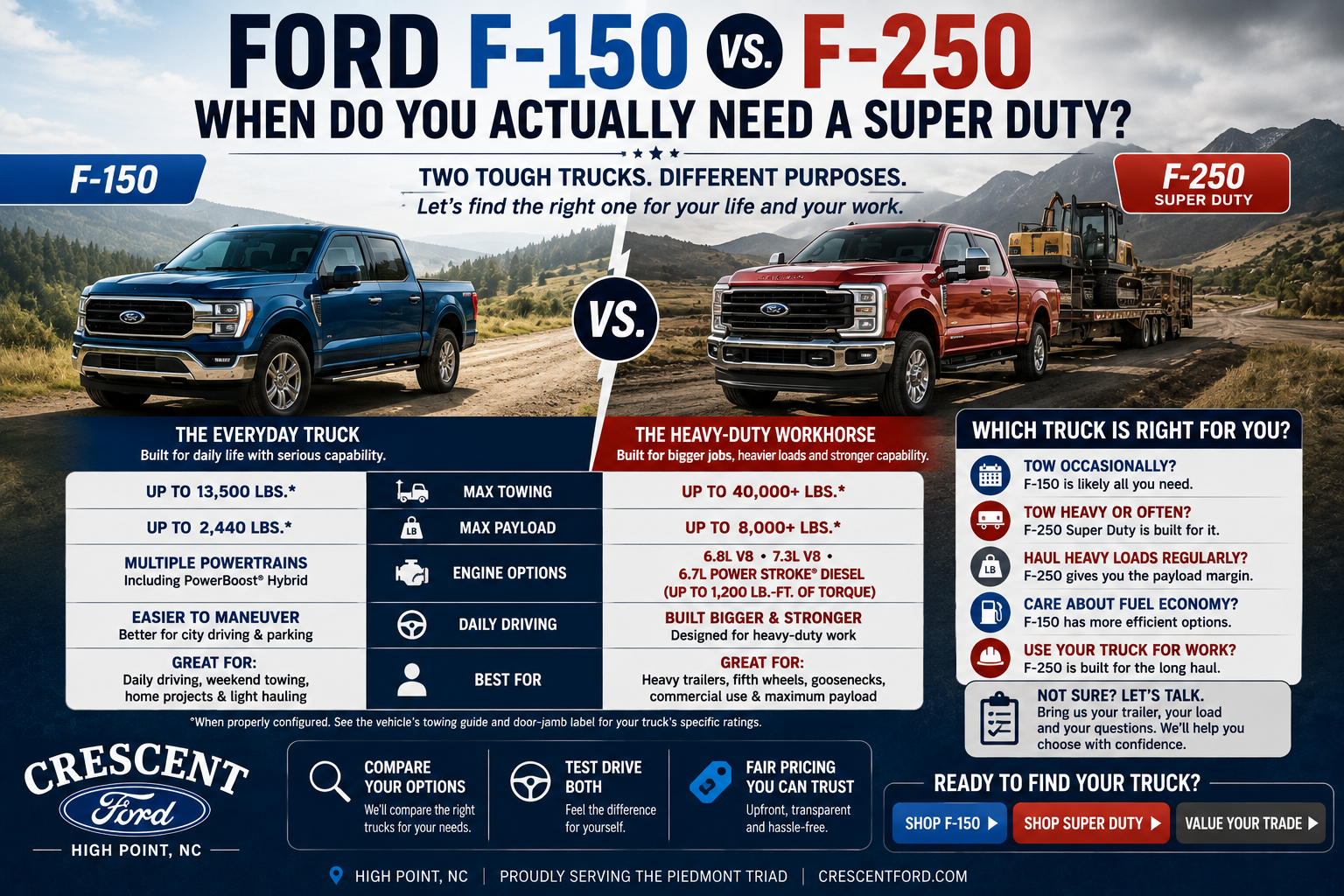
Ford F-150 vs. F-250: When Do You Actually Need a Super Duty?
You need a truck.
Maybe you tow a camper.
Maybe you've got a boat.
Maybe you own a business.
Maybe you're hauling equipment every week.
And at some point while shopping Ford trucks, you arrive at the inevitable question:
Do I need an F-250 — or is an F-150 enough truck?
Here's the mistake we'd avoid:
Buying an F-250 simply because it's "more truck."
More capability isn't automatically better if you don't need it.
An F-150 is easier to live with for many everyday truck owners and offers substantial towing and hauling capability when properly configured.
An F-250 Super Duty is built for heavier work.
So the real question isn't:
Which truck is better?
It's:
What are you actually asking the truck to do?
Let's figure that out.
Ford F-150 vs. F-250: What's the Basic Difference?
The Ford F-150 is a full-size light-duty pickup.
The F-250 belongs to Ford's Super Duty family of heavy-duty pickups.
That's the most important distinction.
They're both Ford trucks.
They can both tow.
They can both haul.
They can both be configured as extremely comfortable crew-cab daily drivers.
But they're engineered around different levels of work.
Think of it this way:
F-150
Everyday truck that can do serious work.
F-250 Super Duty
Heavy-duty work truck that can also be an everyday vehicle.
For a lot of buyers, that distinction tells us where to start.
Shop Ford F-150 Trucks at Crescent Ford
F-150 vs. F-250 at a Glance
Notice we said:
Start with.
Not:
Automatically buy.
The actual truck needs to be matched to the actual load.
When Is an F-150 Enough Truck?
Probably more often than some shoppers expect.
The modern F-150 can be configured for substantial towing and hauling capability.
So if your truck life consists primarily of:
Driving to work
Home improvement projects
Hauling furniture
Landscaping supplies
Bikes
ATVs
Occasional trailers
A moderate-size boat
A properly matched travel trailer
Weekend projects
you may not need to move into Super Duty territory.
That's particularly true if the truck will spend significantly more time not towing than towing.
If you tow your camper six weekends a year but commute in the truck 250 days a year, everyday drivability deserves a place in the decision.
When Should You Start Looking at an F-250?
We'd start moving the conversation toward Super Duty when the work becomes:
heavier
more frequent
or
closer to the F-150's limits.
For example:
Large travel trailers
Fifth-wheel trailers
Gooseneck trailers
Heavy equipment
Construction trailers
Large enclosed trailers
Heavy bed loads
Commercial towing
Regular towing through mountainous terrain
Loads that push an F-150's payload limits
There's another reason, too:
Margin.
Just because a properly configured F-150 can handle a particular trailer doesn't automatically mean that's the truck we'd recommend if you're going to tow that trailer every week.
Sometimes stepping up gives you more appropriate capacity for the job you're actually doing.
Don't Choose Between F-150 and F-250 Based on Trailer Weight Alone
This may be the most important part of this entire article.
A shopper comes in and says:
"My camper weighs 8,000 pounds. Can an F-150 tow it?"
We can't responsibly answer that from one number.
We need to know more.
Things such as:
Loaded trailer weight
Tongue weight
Passengers
Cargo in the truck
Hitch equipment
Truck configuration
Engine
Cab
Bed
Drivetrain
Axle ratio
Payload rating
Gross Vehicle Weight Rating
Gross Combined Weight Rating
all matter.
The advertised maximum towing number is not your truck's universal towing number.
That's true for F-150.
And it's true for F-250.
You need to evaluate the specific truck you're considering.
Payload May Decide F-150 vs. F-250 Before Towing Capacity Does
This catches a lot of truck shoppers by surprise.
They focus entirely on:
"How much can it tow?"
But sometimes the limiting factor isn't the trailer rating.
It's payload.
Payload includes weight carried by the truck.
That can include:
Driver
Passengers
Cargo
Tools
Equipment
Accessories
Hitch-related weight
Trailer tongue or pin weight applied to the truck
Imagine you're towing a camper.
You've got:
Two adults
Three kids
Coolers
Camping gear
A bed full of stuff
and
the trailer's tongue weight.
All of that matters.
This is one reason a truck that appears capable based solely on a headline tow rating may not be the right configuration once you look at the entire setup.
How Do You Know Your Truck's Actual Payload?
Look at the specific truck, not just a website comparison chart.
Payload varies by configuration.
Options add weight.
Cab configuration matters.
Drivetrain matters.
Engine choice matters.
Equipment matters.
So two F-150s sitting next to each other can have different payload ratings.
The same is true for two F-250s.
When you're shopping for a truck specifically to tow or haul, tell us what you're carrying.
We can help you look at the ratings for the actual truck rather than relying on a theoretical maximum.
F-150 vs. F-250 for Towing a Travel Trailer
This is probably one of the most common reasons people cross-shop these trucks.
And there's no single travel-trailer weight where everyone should suddenly switch from F-150 to F-250.
Why?
Because travel trailers aren't loaded identically.
Trucks aren't configured identically.
And families don't pack identically.
A lighter camper with a carefully matched F-150 can make perfect sense.
As trailer size, tongue weight, passengers and cargo increase, F-250 starts becoming more compelling.
Our advice:
Shop using the trailer's realistic loaded weight — not just its empty or "dry" weight.
The camper may leave the manufacturer at one weight.
Then you add:
Propane
Batteries
Water
Food
Clothing
Chairs
Grills
Bikes
Camping gear
The truck needs to handle the way you actually travel.
Do You Need an F-250 for a Fifth-Wheel Camper?
This is where we'd start looking seriously at Super Duty.
Fifth-wheel trailers transfer significant pin weight into the truck.
That makes payload capacity extremely important.
Ford Super Duty also offers configurations specifically designed around fifth-wheel and gooseneck towing.
If you're shopping for a fifth-wheel camper, we'd recommend choosing the truck and trailer as a system rather than buying either one independently.
Don't buy the camper and then ask:
"Can my truck handle this?"
And don't buy the truck without knowing what you're planning to tow.
Match them from the beginning.
What About a Gooseneck Trailer?
Similar story.
If you're regularly towing:
Equipment trailers
Horse trailers
Agricultural trailers
Commercial loads
with a gooseneck setup, you're firmly in the territory where Super Duty deserves serious consideration.
That doesn't automatically mean every buyer needs an F-350.
But this is the type of work the Super Duty family is designed to handle.
F-150 vs. F-250 Engines: A Very Different Approach
The engine lineups help illustrate the difference between these trucks.
The F-150 offers several powertrain choices designed to cover everything from everyday driving to towing, performance and hybrid use.
Depending on configuration, the F-150 lineup offers EcoBoost engines, a 5.0L V8 and the PowerBoost Full Hybrid V6, among other performance-oriented configurations.
Super Duty takes a different approach.
For 2026, Ford offers engines including:
6.8L Gas V8
405 horsepower
445 lb.-ft. of torque
7.3L Gas V8
430 horsepower
485 lb.-ft. of torque
6.7L Power Stroke V8 Turbo Diesel
475 horsepower
1,050 lb.-ft. of torque
High-Output 6.7L Power Stroke V8 Turbo Diesel
500 horsepower
1,200 lb.-ft. of torque
Look at those torque numbers.
That's what tells you what Super Duty is really about.
Work.
Do You Need the Diesel F-250?
Not automatically.
This is another place where shoppers sometimes jump straight to:
"If I'm buying an F-250, I should get the diesel."
Maybe.
But don't assume that.
Ford offers powerful gas engines in the Super Duty lineup for a reason.
A gas F-250 may make plenty of sense if:
You need Super Duty payload/capability.
Your towing isn't extremely heavy.
You don't accumulate huge towing mileage.
You prefer a gas powertrain.
The gas truck meets all your actual ratings.
The Power Stroke becomes particularly compelling for buyers who want substantial torque and regularly perform heavy towing.
Buy the engine for the job.
Not the badge.
F-150 vs. F-250 for Daily Driving
Here's where F-150 has an important advantage for many people.
The F-150 is generally the easier truck to live with when most of your driving isn't heavy-duty work.
Think:
Parking garages
Grocery stores
School pickup
Restaurants
Commuting
Downtown areas
An F-250 is larger and heavier because it is designed to do more demanding work.
That's useful when you need it.
It's unnecessary when you don't.
If 95% of your truck's life will be commuting around High Point and Greensboro and 5% will be towing a relatively modest trailer, we'd start with F-150 and see whether a properly configured truck handles your needs.
Is an F-250 Harder to Park?
It can certainly require more attention.
Exact dimensions vary by cab and bed configuration, but Super Duty is a substantial truck.
If your daily routine involves:
Tight parking decks
Downtown parking
Small garages
School pickup lines
Crowded shopping centers
drive the exact configuration you're considering in those types of environments.
A Crew Cab Super Duty with a long bed may be fantastic with a trailer attached.
That doesn't mean you'll love navigating it through a cramped parking lot every afternoon.
Is an F-250 More Comfortable Than an F-150?
Don't assume that "bigger truck" automatically means "more comfortable truck."
Both F-150 and Super Duty can be configured with extremely nice interiors.
The bigger difference is what they're engineered to carry.
A heavy-duty truck's suspension and chassis are designed around heavy-duty work.
How a particular truck feels unloaded versus loaded can therefore be different.
If you're buying an F-250 primarily as a personal vehicle, test-drive it unloaded.
That's how you'll spend most of your time.
F-150 vs. F-250 for Contractors
Now the decision becomes more interesting.
Suppose you're a contractor and your truck carries:
Tools
Toolboxes
Equipment
Materials
Crew members
Trailer tongue weight
every day.
Payload can add up surprisingly quickly.
An F-150 may still be appropriate depending on the load.
But if you're routinely loading the truck heavily or towing equipment, F-250 can provide capacity better suited to commercial work.
Don't estimate your equipment weight.
Know it.
The difference between:
"I carry some tools"
and
"My truck carries 1,200 pounds of tools and equipment every day"
is enormous.
F-150 vs. F-250 for Landscaping
Again, look at the actual job.
If you're a homeowner hauling mulch several times per year?
F-150.
If you're operating a landscaping business with equipment in the bed and a loaded trailer behind you five days per week?
Start comparing Super Duty.
Frequency matters.
A truck that handles an occasional heavy task isn't necessarily the truck we'd choose for that same task every day.
F-150 vs. F-250 for a Boat
Boat weights vary tremendously.
A smaller fishing boat and a large offshore boat aren't remotely the same towing job.
You need to account for:
Boat
Trailer
Fuel
Batteries
Gear
Coolers
Equipment
Then look at the truck's specific towing and payload ratings.
For many recreational boats, a properly configured F-150 may be plenty.
As the boat and trailer get heavier, Super Duty becomes increasingly worth considering.
F-150 vs. F-250 for a Horse Trailer
This is another situation where we'd pay particularly close attention to loaded weight.
The trailer itself is only part of the equation.
Then you add:
horses
tack
feed
water
equipment
and other cargo.
For larger horse trailers—particularly gooseneck configurations—Super Duty may be the more appropriate starting point.
Again:
Bring us the trailer information.
That's more useful than telling us:
"It's a horse trailer."
What If the F-150 Can Technically Tow My Trailer?
This is where we'd ask another question:
How often are you towing it?
Suppose you've verified that a particular F-150 configuration is properly rated for your loaded trailer and total setup.
Great.
Now:
Tow it three weekends per year?
F-150 may make perfect sense.
Tow it three days per week?
You may still want to compare F-250.
There's a difference between:
having enough rated capability
and
choosing the truck best suited to repeated heavy use.
That doesn't mean you automatically need to move up.
It means frequency belongs in the conversation.
Don't Buy an F-250 Just for the Power Stroke
We understand the appeal.
The Power Stroke is a serious engine.
The available High-Output 6.7L Power Stroke produces 1,200 lb.-ft. of torque.
That's an incredible number.
But if you don't tow anything heavier than a utility trailer twice a year?
You probably don't need to build your entire vehicle purchase around that capability.
There are plenty of reasons someone may simply want a diesel Super Duty.
That's fine.
Just distinguish:
want
from
need.
This article is about the second one.
Don't Buy an F-150 Just Because It's Cheaper
The opposite mistake is worse.
If your trailer and load genuinely require Super Duty capability, don't try to make the F-150 work simply because you'd prefer the smaller truck or lower purchase price.
Truck ratings aren't suggestions.
If your actual use exceeds the capabilities of the F-150 configuration you're considering, move up.
The right truck is the one properly rated for the work.
Does F-250 Automatically Have More Payload Than Every F-150?
Don't make comparisons based solely on the badge.
Payload is vehicle-specific.
Configuration matters tremendously.
A heavily optioned crew-cab truck can have a different payload rating than a more basic configuration.
That's why we're going to keep repeating this:
Check the actual truck.
Not:
"an F-150."
Not:
"an F-250."
The truck with the VIN you're considering.
How Much Towing Capacity Do You Actually Need?
Don't shop for the biggest number you can afford.
Start with your load.
Step 1: Determine realistic loaded trailer weight.
Not just dry weight.
Step 2: Determine tongue or pin weight.
This matters for payload.
Step 3: Account for passengers.
Yes, people count.
Step 4: Account for cargo.
Everything you're carrying in the truck matters.
Step 5: Look at the actual truck's ratings.
Now compare configurations.
This is a much safer and smarter shopping process than saying:
"Give me whichever truck tows the most."
Should You Leave Extra Towing Capacity?
It's generally smart not to shop by trying to make every number land exactly on the truck's maximum rating.
Real life changes.
You add cargo.
You add passengers.
You buy equipment.
Your camping setup gets heavier.
Your next trailer may be larger.
But there's also no universal rule that says every shopper must buy a truck with twice the capacity they actually need.
The goal is:
appropriate capability with reasonable room for the way you'll actually use the truck.
What If You Plan to Buy a Bigger Camper Later?
Tell us.
This can absolutely change the recommendation.
If your current camper fits comfortably within an F-150's capabilities but you're planning to move into a substantially larger fifth wheel in two years, buying the truck only for today's trailer may mean buying twice.
On the other hand, don't buy an F-250 today for a hypothetical trailer you may never purchase.
Be realistic about the plan.
F-150 vs. F-250: What About Fuel Economy?
If fuel cost is important and you don't need Super Duty capability, that's another reason to look carefully at F-150.
The F-150 offers powertrains designed around a wider mix of everyday driving needs, including the available PowerBoost hybrid.
Super Duty is designed around heavy-duty capability.
Fuel economy shouldn't override the truck's ability to safely perform the job.
But if both trucks can comfortably handle your actual needs, operating cost becomes a legitimate factor in deciding which one makes more sense.
RELATED READING
Ford F-150 Engines Explained: Which Engine Is Right for You?
What About F-150 vs. F-250 Price?
Don't compare only the sticker prices.
Compare the trucks you would actually buy.
Maybe you're considering a heavily equipped F-150.
Maybe the F-250 you're considering has a diesel engine.
Maybe one has four-wheel drive and the other doesn't.
Maybe the trims are completely different.
Then factor in:
Purchase price
Financing
Insurance
Fuel
Maintenance
Tires
Registration
How long you plan to keep it
And most importantly:
Whether you're paying for capability you'll actually use.
RELATED READING
What Does “Out-the-Door Price” Mean When Buying a Car in NC?
Should You Buy a Used F-250 Instead of a New F-150?
Sometimes this comparison comes up when budgets overlap.
A used F-250 may offer more heavy-duty capability for a similar purchase price to a newer F-150.
But don't compare only price and tow ratings.
Consider:
Mileage
Previous use
Maintenance history
Engine
Equipment
Condition
Warranty
Tires
How you'll use the truck
A used diesel Super Duty that spent its life towing commercially is a very different purchase from a lightly used personal truck.
Buy the vehicle, not just the specification sheet.
Shop Used Ford Trucks at Crescent Ford
What About Your Trade?
If you're moving from an F-150 into an F-250 because your towing needs have increased, your current truck's equity can make a significant difference in the transaction.
Before deciding what the next truck needs to cost:
Find out what your current truck is worth.
Find Out What Your Truck Is Worth
RELATED READING
What Is My Car Worth in High Point, NC? How Trade-In Appraisals Actually Work
If you still have a loan:
Can You Trade In a Car You Still Owe Money On?
The Simplest Way to Decide Between F-150 and F-250
Ask yourself these questions.
1. What is the heaviest thing I'll actually tow?
Get the real loaded weight.
2. What's the tongue or pin weight?
Don't overlook payload.
3. How much weight will be in the truck?
People, tools, cargo and equipment count.
4. How often will I tow?
Twice a year and five days per week are very different use cases.
5. Will I tow a fifth wheel or gooseneck?
That can push the conversation toward Super Duty quickly.
6. Is the truck primarily a daily driver?
If yes, F-150's everyday advantages deserve more weight.
7. Do I genuinely need diesel torque?
If not, don't assume diesel is automatically the right choice.
8. Are my needs likely to change soon?
Consider the trailer or workload you realistically expect during the time you'll own the truck.
Once you answer those questions, the decision usually becomes much clearer.
When We'd Recommend an F-150
We'd start with F-150 if you tell us:
"This is my daily driver."
"I tow occasionally."
"I need a truck bed but don't haul extremely heavy loads."
"I have a boat or camper that fits comfortably within the ratings of the configuration I'm considering."
"I want substantial truck capability without moving into a heavy-duty truck."
For an enormous number of truck owners, F-150 is the right answer.
And buying more truck won't necessarily make ownership better.
When We'd Recommend an F-250 Super Duty
We'd start moving toward F-250 when you tell us:
"I tow heavy trailers regularly."
"Payload is becoming an issue."
"I'm buying a fifth wheel."
"I'm towing a gooseneck."
"I carry substantial tools or equipment every day."
"My business depends on this truck."
"I want the Power Stroke because my workload actually benefits from diesel torque."
"I'm near the limits of the F-150 configuration I'd otherwise buy."
That's what Super Duty is for.
Browse Ford F-250 Super Duty Trucks
Should You Test Drive an F-150 and F-250 Back-to-Back?
Yes.
Especially if your towing needs could realistically be handled by either.
Drive the F-150.
Then immediately drive the F-250.
Pay attention to:
Ride
Steering
Visibility
Turning
Braking feel
Seating position
Parking
Acceleration
Overall size
If the truck is going to be your daily driver, don't evaluate it only for the ten days per year your camper is attached.
Evaluate the other 355 days, too.
And if you're buying specifically for towing, bring us the specifications for the trailer.
That information is more useful than almost anything else you can tell us.
Schedule an F-150 vs. F-250 Test Drive
Drive an F-150 and Super Duty back-to-back and let us help compare the specific truck ratings with what you plan to tow or haul.
F-150 vs. F-250: When Do You Actually Need the Super Duty?
Here's the simplest answer.
Choose the Ford F-150 when:
You want a truck that's easy to live with every day.
Your towing and payload requirements comfortably fit the specific F-150 configuration.
You tow occasionally rather than constantly.
You don't need fifth-wheel or gooseneck capability.
You want more powertrain choices geared toward everyday use.
For most personal-use truck buyers, we'd start here.
Choose the Ford F-250 Super Duty when:
Your trailer is getting heavier.
Your payload requirements are substantial.
You're towing frequently.
You're moving into fifth-wheel or gooseneck territory.
Your truck is an essential work tool.
You need heavy-duty capability or diesel torque.
Or the numbers show you're simply asking too much of an F-150.
That's when moving to Super Duty makes sense.
Compare Ford F-150 and F-250 Trucks in High Point, NC
The goal isn't to sell you the biggest truck.
It's to put you in enough truck.
If an F-150 comfortably handles everything you need it to do, that's probably the better choice.
If your towing, payload or workload genuinely requires Super Duty capability, don't try to squeeze the job into a light-duty truck.
And if you're somewhere in the middle?
That's exactly when you should compare them in person.
For truck shoppers in High Point, Greensboro, Winston-Salem, Kernersville, Thomasville, Lexington, Trinity and throughout the Piedmont Triad, Crescent Ford can help you compare the actual trucks you're considering.
Bring us:
Your trailer weight.
Your camper information.
Your equipment.
Your typical passenger/cargo load.
Then we can look at the ratings on the specific trucks.
Because when it comes to towing:
The badge on the tailgate isn't enough information.
Shop Ford F-150 Trucks at Crescent Ford
Frequently Asked Questions About Ford F-150 vs. F-250
What is the main difference between an F-150 and F-250?
The F-150 is Ford's full-size light-duty pickup, while the F-250 is part of the heavy-duty Super Duty lineup. The F-250 is engineered for higher levels of towing, payload and sustained heavy-duty work.
Do I need an F-250 to tow a camper?
Not necessarily. Many travel trailers can be appropriately matched with certain F-150 configurations. The decision depends on the trailer's actual loaded weight, tongue weight, passengers, cargo and the ratings of the specific truck. Larger trailers and fifth wheels can make an F-250 or another Super Duty more appropriate.
Is an F-250 better for towing than an F-150?
The F-250 is designed for heavier-duty towing, but that doesn't mean it is necessary for every trailer. A properly configured F-150 can provide substantial towing capability. Match the specific truck to the actual trailer rather than choosing based only on model name.
Can an F-150 tow a travel trailer?
Yes, depending on the F-150 configuration and the trailer. Use realistic loaded trailer weight rather than only the trailer's dry weight, and account for tongue weight, passengers and cargo when evaluating the truck.
Do I need an F-250 for a fifth wheel?
An F-250 may be appropriate for certain fifth-wheel trailers, but fifth-wheel towing requires careful attention to pin weight, payload and the specific truck's ratings. Depending on the trailer, an F-350 may also need to be considered.
Is payload or towing capacity more important?
Both matter. In some towing situations, payload becomes the limiting factor before the maximum trailer rating does because passengers, cargo and trailer tongue or pin weight all place weight on the truck.
Does every F-250 have more payload than every F-150?
Payload varies by configuration, so don't make a purchase based solely on the model badge. Check the ratings of the specific vehicle you're considering.
Is an F-250 a good daily driver?
It can be, especially for someone who also needs its heavy-duty capability. However, shoppers who don't need that capability may find an F-150 easier to maneuver and better suited to everyday use. A back-to-back test drive is worthwhile.
Does the F-250 have a diesel engine?
Ford offers the 6.7L Power Stroke V8 Turbo Diesel and a High-Output version in the 2026 Super Duty lineup, along with 6.8L and 7.3L gas V8 engines.
How much torque does the 2026 F-250 diesel have?
Ford rates the 2026 6.7L Power Stroke V8 Turbo Diesel at 1,050 lb.-ft. of torque and the available High-Output version at 1,200 lb.-ft. of torque.
Do I need a diesel F-250 for towing?
Not necessarily. Ford's gas Super Duty engines may provide sufficient capability depending on your trailer and usage. Diesel becomes particularly compelling for shoppers who regularly perform heavier towing and can benefit from its substantial torque.
Is an F-250 better for contractors?
It can be when tools, materials, passengers and trailers create substantial payload or towing requirements. Contractors with lighter loads may still be well served by an appropriately configured F-150.
Should I buy an F-250 if my trailer is close to my F-150's limits?
It's worth comparing. You need to consider all applicable ratings—not just maximum trailer weight—and your real passenger and cargo load. If your normal use puts the F-150 configuration near its limits, an appropriately configured Super Duty may be a better fit.
How do I know exactly how much a Ford truck can tow?
Use the specifications for the specific truck configuration and follow Ford's towing guidance. Engine, drivetrain, cab, wheelbase, axle ratio, equipment and other factors can affect ratings. Don't assume a headline maximum applies to every F-150 or F-250.
Should I test drive an F-150 and F-250 before deciding?
Yes. If both trucks can properly handle your intended workload, a back-to-back test drive can help you evaluate the differences in ride, maneuverability, size and everyday usability.