2026 Ford Maverick vs. Ranger vs. F-150: How Much Truck Do You Actually Need?
If you've decided you want a Ford truck, choosing between the Maverick, Ranger and F-150 might seem simple:
Small. Medium. Large.
But that's not really the best way to choose.
The better question is:
How much truck do you actually need?
Buying more truck than you'll use can mean living with a larger vehicle every day when a smaller truck would have handled everything you needed. Buy too little truck, though, and you may discover that the camper, boat, trailer or workload you had in mind exceeds what your truck was designed to handle.
For 2026, Ford gives shoppers three very different answers.
The Ford Maverick is the compact choice, combining a genuinely useful pickup bed with easy everyday driving and an available hybrid powertrain.
The Ford Ranger moves into midsize-truck territory with considerably more towing capability, a larger bed and available 4x4.
And the Ford F-150 is the full-size choice, offering the most configurations, powertrain choices and capability of the three.
Here's how to figure out which one actually fits your life.
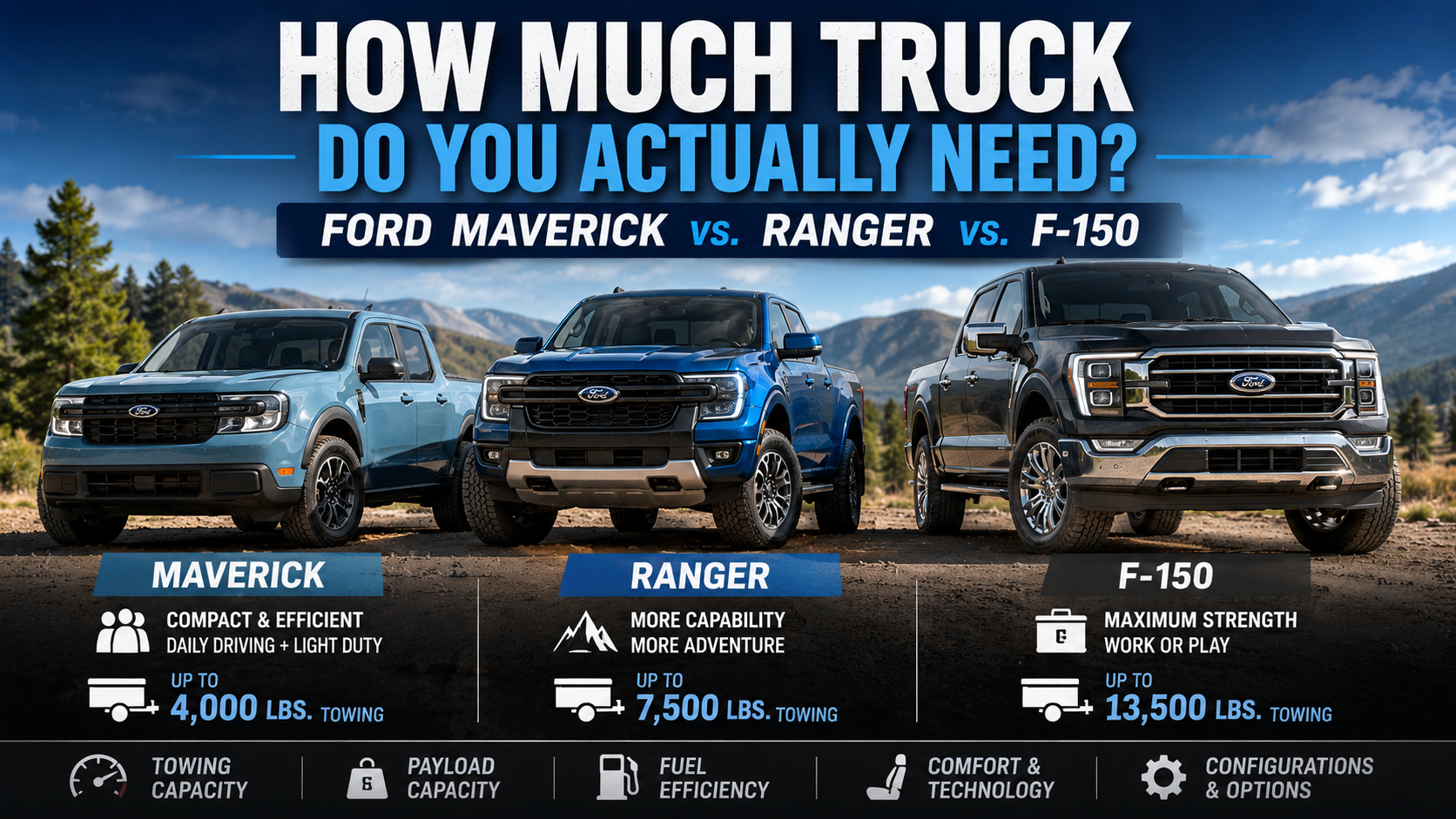
Maverick vs. Ranger vs. F-150 at a Glance
Maximum ratings require specific configurations and equipment. Payload and towing capacity vary by vehicle, equipment, passengers and cargo. Always verify the ratings of the specific truck you intend to purchase.
The short answer
Choose the Maverick if you want a truck primarily for everyday transportation but regularly need a bed for home projects, outdoor gear or lighter-duty hauling.
Choose the Ranger if you need legitimate towing and off-road capability but don't necessarily want to drive a full-size truck every day.
Choose the F-150 if towing, payload, bed/cab choices, powertrain options or maximum versatility are priorities.
If you're already leaning toward one, start by seeing what's actually available.
Compare New Ford Trucks at Crescent Ford
When Does a Ford Maverick Make the Most Sense?
The Maverick makes an interesting argument:
Do you really need a traditional full-size pickup to do the things you want a truck to do?
For plenty of drivers, the answer is no.
Maybe you're commuting between High Point and Greensboro during the week, but on Saturday you're hauling mulch, taking bicycles to a trail, buying lumber for a home project or loading camping gear.
That's exactly where a compact pickup starts making sense.
The Maverick gives you four doors, seating for five and a useful pickup bed without the dimensions of a full-size truck.
For 2026, the Maverick also continues to offer something neither the Ranger nor most conventional pickups can match: a standard hybrid powertrain with impressive fuel efficiency.
The 2026 Maverick Hybrid FWD is EPA-estimated at up to 42 mpg city.
That's an unusual number for a pickup.
Who should buy a Maverick?
The Maverick deserves serious consideration if:
Your truck will also be your daily commuter.
You don't regularly tow heavy trailers.
You want something easy to maneuver and park.
You haul DIY supplies, landscaping materials, bikes or outdoor equipment.
Fuel economy matters.
You want four doors and useful passenger space.
You like having a pickup bed but don't need a full-size bed.
You're moving from a car or compact SUV and want additional utility.
The Maverick isn't pretending to be an F-150.
That's actually part of its appeal.
You're getting the utility you need without paying for — or driving around with — capability you may never use.
How Much Can the Ford Maverick Tow?
A properly equipped 2026 Maverick can tow up to 4,000 pounds with the available 4K Tow Package and an eligible powertrain/drivetrain configuration.
Without that package, the maximum loaded trailer weight is generally 2,000 pounds.
That distinction is extremely important.
Seeing “Maverick can tow 4,000 pounds” online does not mean every Maverick sitting on a dealer lot is rated to tow 4,000 pounds.
If towing is part of your purchase decision, make that known while you're shopping so you can verify the equipment and rating of the specific vehicle.
Is 4,000 pounds enough?
Potentially.
It depends entirely on what you're towing.
A small utility trailer, lightweight boat or certain smaller recreational trailers may fit within the capabilities of a properly equipped Maverick.
But don't choose a truck based solely on your trailer's advertised “dry weight.”
Trailer cargo, fluids, equipment, passengers and cargo in the truck all matter when determining whether a particular truck-and-trailer combination is appropriate.
If your towing needs are approaching the Maverick's upper limits regularly, we'd start looking at the Ranger.
When Is the Ford Ranger the Better Choice?
The Ranger occupies what may be the sweet spot of the Ford truck lineup.
It's considerably more capable than the Maverick but doesn't require you to move all the way into a full-size F-150.
For many buyers, that's exactly the point.
A properly equipped 2026 Ranger can tow up to 7,500 pounds.
That creates a big jump from Maverick capability and opens the door to heavier trailers and more demanding recreational or work uses.
The Ranger also provides a 59.6-inch bed and, depending on trim and configuration, can offer maximum available payload exceeding 1,700 pounds.
Who should buy a Ranger?
Consider Ranger if:
You tow more than a Maverick comfortably accommodates.
You want a midsize truck rather than a full-size pickup.
Off-road capability is important.
You regularly haul equipment or supplies.
You want a traditional body-on-frame pickup.
You need more capability but don't need F-150-level towing.
You're looking for a truck that can serve both work and recreation.
This is where we'd encourage shoppers to be particularly realistic about their needs.
If you tow a 5,000-pound trailer, there's no reason to try to make a Maverick work.
But there's also no rule saying that automatically means you need an F-150.
The Ranger may give you exactly the middle ground you're looking for.
See Available Ford Ranger Trucks
What Engines Are Available in the Ranger?
The 2026 Ranger offers multiple EcoBoost powertrains depending on trim.
The standard 2.3L EcoBoost provides a strong balance of everyday performance and capability.
An available 2.7L EcoBoost V6 gives shoppers another step up in performance while retaining the Ranger's midsize dimensions.
At the performance end of the lineup, Ranger Raptor uses a 3.0L EcoBoost V6.
But here's an important point:
Don't assume the most powerful Ranger automatically has the highest towing capacity.
The Ranger Raptor is engineered around high-performance off-road capability and has a maximum loaded trailer rating of 5,510 pounds for 2026.
Properly equipped Rangers with the 2.3L or 2.7L EcoBoost can reach the 7,500-pound maximum.
This is a good example of why truck shopping requires looking beyond horsepower.
Choose the configuration designed for the job you're actually going to do.
When Should You Step Up to the Ford F-150?
This is where the question changes.
Instead of asking whether you need a truck, you're asking how much work you expect that truck to do.
The F-150 provides substantially more choice than Maverick or Ranger.
Different cab configurations.
Different bed lengths.
Multiple engines.
Available hybrid power.
Serious towing capability.
Greater maximum payload.
And configurations ranging from work-focused pickups to premium family trucks and high-performance off-road models.
A properly configured 2026 F-150 can tow up to 13,500 pounds and offers maximum available payload of up to 2,440 pounds.
Those are maximum figures, not ratings for every F-150.
But they illustrate just how much capability becomes available when you step into Ford's full-size truck.
Who should buy an F-150?
The F-150 should probably be your starting point if:
You regularly tow heavier trailers.
You need more bed or cab configurations.
Your truck is an important work tool.
You regularly carry heavier payloads.
You want a V8 option.
You want an available full-hybrid powertrain in a full-size truck.
You want available onboard power for tools, equipment or recreation.
You need a truck that can comfortably transition between work, family duty and towing.
You simply prefer the space and feel of a full-size pickup.
For some buyers, F-150 capability isn't optional.
For others, it's simply what they prefer.
There's nothing wrong with buying more capability because you want it. The point is to understand what you're paying for and what you're getting.
Browse New Ford F-150 Inventory
Maverick vs. Ranger vs. F-150 for Towing
Towing is one of the easiest ways to narrow this comparison.
Up to 4,000 pounds: Start with Maverick
If your towing needs are relatively light and you want the everyday benefits of a compact truck, a properly equipped Maverick with the 4K Tow Package may be enough.
Up to 7,500 pounds: Look closely at Ranger
Ranger dramatically expands your towing possibilities while keeping midsize dimensions.
Heavier towing: F-150
The F-150 provides substantially greater available towing capacity, topping out at 13,500 pounds when properly configured.
But don't buy your tow vehicle by looking only at the maximum number.
Your actual truck needs to be configured correctly for your trailer.
Payload matters too.
Passengers matter.
Cargo matters.
Trailer tongue weight matters.
Equipment matters.
If towing is a major reason you're buying a truck, bring the specifications for your trailer when you shop. We can help you compare those requirements against the ratings of the actual trucks you're considering.
One towing rule worth remembering
Don't buy exactly enough truck on paper if you know you'll regularly operate near its limits.
A little breathing room can make much more sense than choosing solely because a trailer technically falls below a published maximum.
What About Payload?
Towing gets most of the attention, but payload is equally important for many truck owners.
Payload is the weight the truck itself is carrying.
That includes more than whatever you throw into the bed.
It can include:
Passengers
Cargo
Tools
Accessories
Gear
Trailer tongue weight
That's why two people towing the same trailer can have different truck requirements.
Imagine one driver towing with just one passenger and an almost empty bed.
Now imagine another towing the same trailer with four passengers, coolers, luggage and equipment in the truck.
The trailer hasn't changed.
The load on the truck has.
The F-150 offers the highest maximum available payload of these three trucks, followed by Ranger, while Maverick is designed around lighter-duty use.
Most importantly, check the payload label on the specific truck you're considering.
Maximum advertised payload ratings represent particular configurations and shouldn't be assumed to apply to every vehicle.
Which Ford Truck Is Easiest to Drive Every Day?
Maverick wins for most commuters.
If you're going to work, picking up kids, running errands and squeezing into parking spaces most of the week, Maverick's compact size is a major advantage.
It feels less like you're making a compromise just to own a pickup.
Ranger is the middle ground.
It gives you more of the traditional truck experience without the overall footprint of an F-150.
That's attractive for someone who wants legitimate truck capability but still spends plenty of time driving through town.
F-150 gives you the most space.
If you're comfortable driving a full-size truck, the F-150 can be an excellent everyday vehicle — particularly when passenger room matters.
The tradeoff is obvious.
It's a larger vehicle.
Whether that's a benefit or inconvenience depends entirely on how you use it.
If you're driving around High Point most days but regularly heading toward Greensboro, Winston-Salem or elsewhere in the Triad, we'd weigh your normal commute just as heavily as what you plan to do on occasional weekends.
You're going to experience the truck's size every day.
Which Ford Truck Is Best for Families?
This one is less obvious than you might expect.
All three can work for family use, but they appeal to different families.
Maverick
A strong choice for smaller families who want four doors, five seats and truck utility without full-size dimensions.
It can make particular sense if this vehicle replaces a compact crossover.
Ranger
A good middle ground for families that spend a lot of time outdoors, tow recreational equipment or want more traditional truck capability.
F-150
The strongest choice when rear-seat space, long trips and maximum versatility are priorities.
A SuperCrew F-150 can function as both a serious truck and a spacious family vehicle.
If you're bringing car seats into the equation, don't make the decision from measurements alone.
Bring the car seat.
Install it.
Sit in front of it.
Try the doors.
Look at where you'll put the stroller, diaper bag, sports equipment or luggage.
A spec sheet can tell you how large a truck is.
It can't tell you whether your family's stuff works in it.
Which Has the Most Useful Truck Bed?
Again, “biggest” and “most useful” aren't always the same thing.
Maverick: Clever everyday utility
Maverick's FLEXBED system is designed to make a relatively small bed more useful.
For DIY projects, bikes, landscaping supplies and normal homeowner tasks, it can be surprisingly practical.
Ranger: More traditional midsize capability
The Ranger's approximately five-foot bed gives you more cargo volume while keeping the truck relatively manageable.
Its 48.2 inches of width between the wheel wells is also worth noting for shoppers who regularly haul larger items.
F-150: More choices
F-150 gives you the greatest range of cab and bed configurations.
That's valuable for contractors, business owners and anyone who needs the truck to fit a particular job rather than simply occasional weekend use.
Ask yourself what you're actually putting in the bed.
If the answer is usually:
mulch, bicycles, furniture, camping gear and Home Depot runs,
you may not need the biggest bed available.
If the answer is:
tools and materials five days a week,
that's a very different conversation.
What If I Want a Hybrid Ford Truck?
Then you have two interesting options.
Maverick Hybrid
This is the fuel-economy-focused option.
The 2026 Maverick's standard hybrid powertrain delivers an EPA-estimated 42 mpg city with front-wheel drive.
For someone who wants pickup utility without giving up efficient commuting, that's a compelling combination.
F-150 PowerBoost
The F-150's available 3.5L PowerBoost Full Hybrid V6 takes a very different approach.
Rather than focusing primarily on maximizing fuel economy, it combines hybrid technology with full-size-truck performance.
For 2026, it produces 420 horsepower and 578 lb.-ft. of torque and can tow up to 11,600 pounds when properly equipped.
Available Pro Power Onboard also allows the truck to provide electrical power for tools, equipment and other devices.
So don't think of these as equivalent hybrid trucks in two sizes.
The Maverick Hybrid is largely about efficiency plus utility.
The F-150 PowerBoost is about capability plus electrified power.
Maverick vs. Ranger vs. F-150 for Homeowners
If you're buying a truck primarily because owning a house has taught you that everything eventually requires a trip for lumber, mulch, appliances or landscaping supplies, don't automatically jump to F-150.
A Maverick may handle the majority of what the average homeowner needs.
If you're renovating frequently, towing equipment or handling larger projects, Ranger starts making more sense.
If you're hauling heavy materials regularly, towing substantial trailers or using the truck as part of a business, F-150 becomes much easier to justify.
This is the theme throughout this comparison:
Buy for your normal use, then make sure you have enough capability for the demanding things you reasonably expect to do.
Don't buy solely around something you might do once every five years.
Maverick vs. Ranger vs. F-150 for Outdoor Recreation
Here's another useful way to decide.
Camping, biking, kayaking and light towing
Maverick
You get a bed for dirty gear without giving up the everyday benefits of a compact vehicle.
Boats, campers, trails and more serious off-road use
Ranger
The additional towing capability and available 4x4/off-road equipment make the Ranger a strong recreational truck.
Larger campers, boats and heavier equipment
F-150
When the toys get bigger, the truck usually needs to get bigger too.
Before purchasing around a camper or boat, get its actual weight specifications and understand how you'll load it.
“I'm planning to buy a camper later” is useful information when you're truck shopping.
Which Ford Truck Should You Buy?
Here's our simplest recommendation.
Buy a Ford Maverick if...
You want a truck sometimes and an easy-to-live-with daily vehicle all the time.
It's particularly compelling for commuters, homeowners, small families and people moving into their first pickup.
Buy a Ford Ranger if...
You genuinely need more capability than Maverick provides but don't have a reason to move into a full-size truck.
Ranger is the Goldilocks option in this comparison: substantially more truck without being the biggest truck.
Buy a Ford F-150 if...
You know you'll use the extra capability, need the additional configurations and space, tow heavier trailers or simply want a full-size pickup.
F-150 gives you far more ways to build a truck around a specific job.
Still can't decide?
That's when we'd stop comparing numbers and drive them.
A Maverick, Ranger and F-150 feel noticeably different from behind the wheel.
Park them.
Sit in the back seat.
Open the beds.
Look at the window stickers.
Then think about what you'll actually do with the truck during the other 360 days of the year when you aren't taking that one big trip.
Compare Ford Maverick, Ranger & F-150 Trucks in High Point
Don't Forget Your Current Vehicle
If you're trading a vehicle toward your next truck, knowing what it's worth can help determine which of these options fits your budget.
Start with your trade value before deciding that a Ranger or F-150 is out of reach — or assuming you need to stretch your budget to get more truck.
The important number isn't simply the price of the new truck.
It's the whole transaction.
Find Out What Your Current Vehicle Is Worth
Related reading: What Is My Car Worth in High Point, NC? How Trade-In Appraisals Actually Work
Compare Ford Trucks at Crescent Ford in High Point, NC
There's no universal “best” truck among the Maverick, Ranger and F-150.
That's exactly why Ford builds all three.
For many Piedmont Triad drivers, the Maverick provides all the truck utility they need while remaining an excellent everyday vehicle.
For buyers who need more towing and traditional pickup capability without full-size dimensions, Ranger fills an important gap.
And when the job requires greater towing, payload, passenger space or configuration choices, it's hard to ignore what the F-150 brings to the table.
The goal isn't to buy the biggest truck.
It's to buy enough truck.
At Crescent Ford in High Point, you can compare available Maverick, Ranger and F-150 models and see the differences for yourself.
Because sometimes the easiest way to answer “How much truck do I need?” is to put all three next to each other.
Shop New Ford Trucks at Crescent Ford
Shop Ford Maverick
Shop Ford Ranger
Shop Ford F-150
Value Your Trade
Frequently Asked Questions: Ford Maverick vs. Ranger vs. F-150
Is the Ford Maverick smaller than the Ranger?
Yes. The Maverick is Ford's compact pickup, while Ranger is a midsize truck and F-150 is a full-size pickup. The smaller Maverick can be easier to maneuver and park for everyday use.
How much can a 2026 Ford Maverick tow?
A properly equipped 2026 Ford Maverick can tow up to 4,000 pounds with the available 4K Tow Package and an eligible configuration. Other configurations are rated for up to 2,000 pounds.
How much can a 2026 Ford Ranger tow?
A properly equipped 2026 Ford Ranger can tow up to 7,500 pounds with the available Trailer Tow Package. Ranger Raptor has a lower maximum tow rating because it is configured around high-performance off-road capability.
How much can a 2026 Ford F-150 tow?
A properly configured 2026 Ford F-150 can tow up to 13,500 pounds. Actual capacity varies significantly by engine, drivetrain, cab, wheelbase and equipment.
Is the Maverick a good truck for homeowners?
For many homeowners, yes. The Maverick provides a pickup bed for landscaping materials, home-improvement supplies, bicycles, furniture and other everyday cargo without requiring a full-size truck.
Should I buy a Ranger or F-150?
Choose Ranger if you want substantial towing and truck capability in a midsize package. Consider F-150 if you need heavier towing, more cab and bed choices, greater maximum payload or the versatility of a full-size pickup.
Which Ford truck gets the best gas mileage?
The Maverick Hybrid is the fuel-economy standout among these three trucks. The 2026 Maverick Hybrid FWD is EPA-estimated at up to 42 mpg city. Actual mileage varies.
Does the Ranger tow more than the Maverick?
Yes. A properly equipped Ranger can tow up to 7,500 pounds compared with up to 4,000 pounds for a properly equipped Maverick.
Do I need an F-150 to tow a camper?
Not necessarily. It depends on the camper's weight, tongue weight, cargo, passengers and the configuration of the truck. Some trailers may fall within properly equipped Maverick or Ranger ratings, while larger campers may require F-150 capability. Always evaluate the complete towing setup rather than trailer dry weight alone.
Which is better for a daily driver: Maverick, Ranger or F-150?
For drivers who prioritize maneuverability and fuel economy, Maverick is generally the strongest everyday choice. Ranger provides a middle ground between daily usability and greater truck capability, while F-150 provides more space and capability in a larger full-size package.