Blog / Ford Model Research & Comparisons

Blog

All Ford Model Research & Comparisons Automotive Buying Guides High Point & Piedmont Triad Automotive Trade-In & Financing Ford Ownership & Vehicle Tips Service & Maintenance
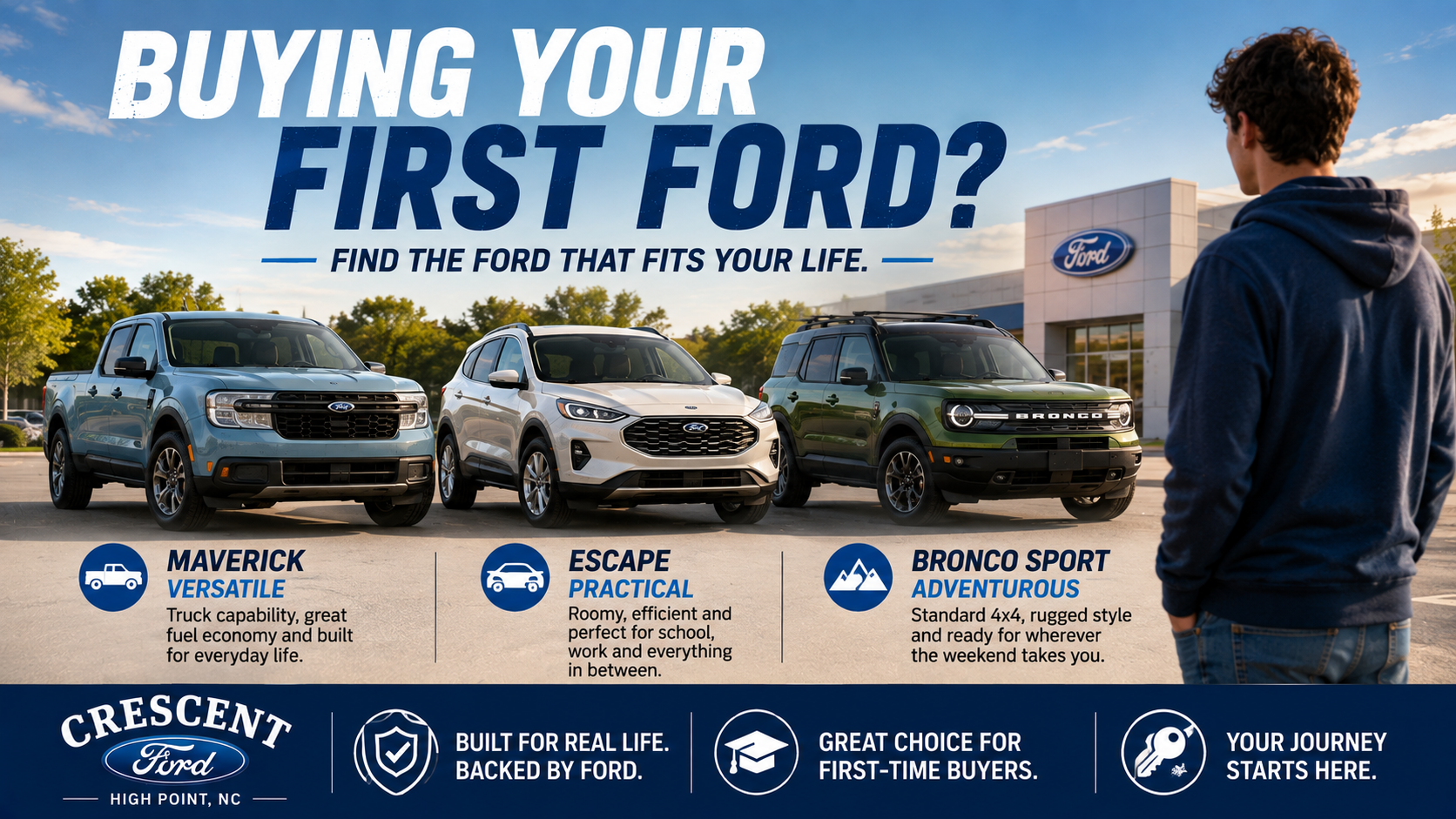
Ford Maverick, Escape and Bronco Sport compared as practical vehicle options for first-time buyers at Crescent Ford in High Point, NC

What Is the Best Ford for a First-Time Buyer?

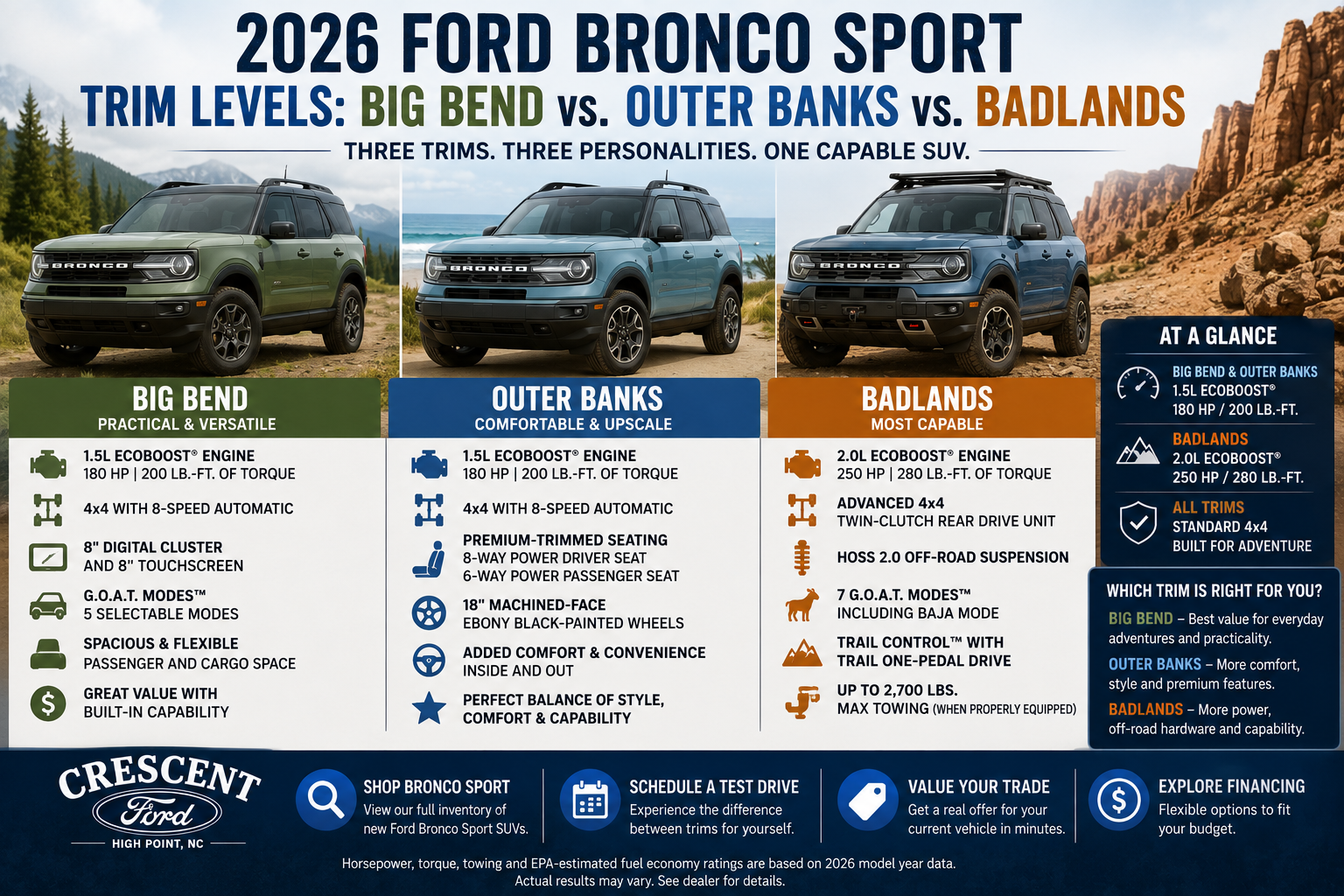
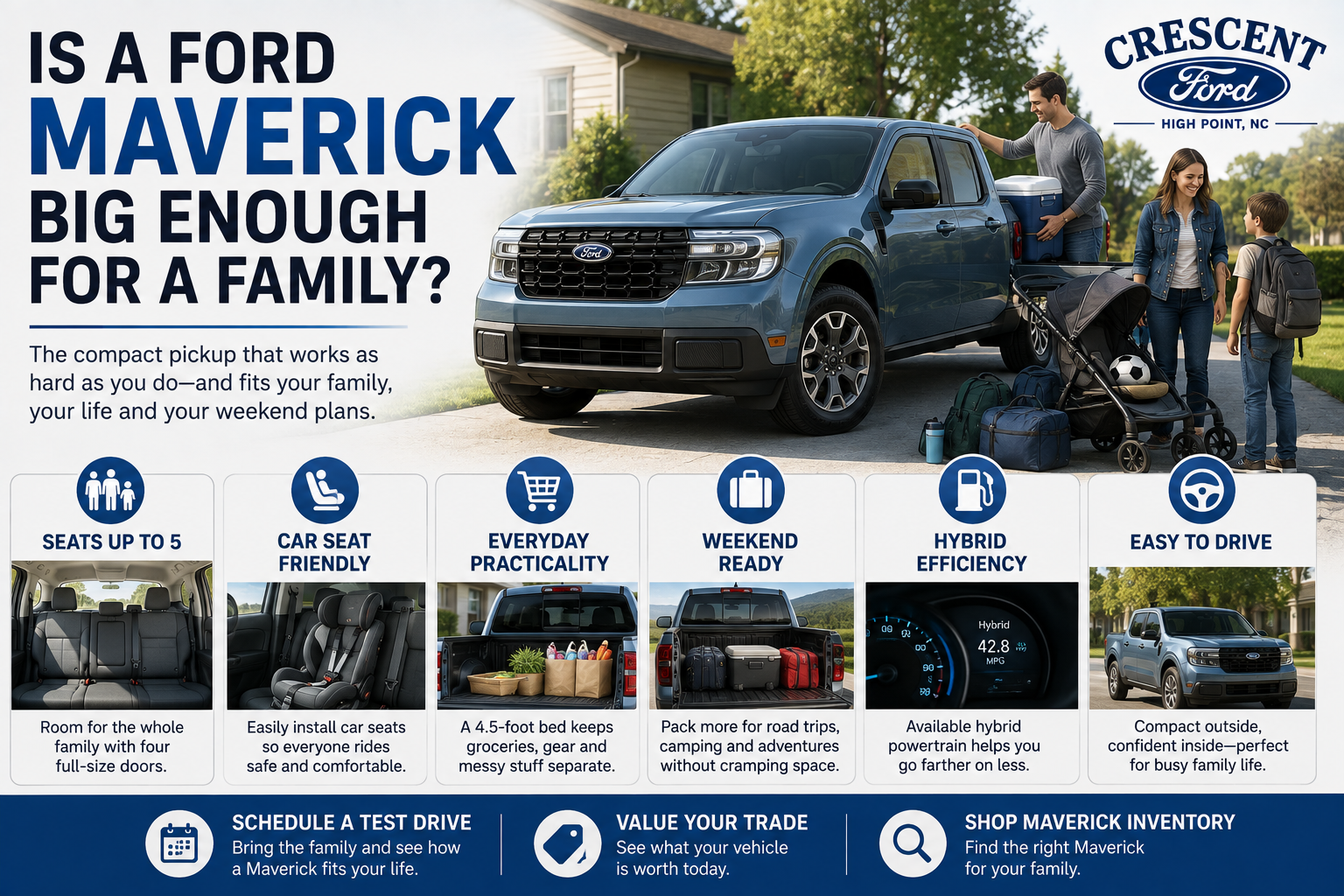
What Is the Best Ford for a First-Time Buyer? Buying your first vehicle is exciting. It's also one of those moments where approximately 47 different people suddenly have an opinion about what you should buy. Your parents say: "Get something practical." Your friend says: "Get the Bronco." Your budget says: "Everybody calm down." 😂 So what actually makes a good first vehicle? And if you want a Ford, which one should you buy? For many first-time buyers, we'd start by looking at three: Ford Maverick Ford Escape Ford Bronco Sport But there's another option that absolutely belongs in the conversation: a used Ford—or another quality used vehicle. The best first vehicle isn't necessarily the least expensive one, the coolest one or even the one with the best gas mileage. It's the vehicle that fits: your budget + your driving + your lifestyle without stretching you so far financially that owning it stops being fun. Let's figure out which one makes sense for you. Shop New & Used Vehicles at Crescent Ford What Makes a Good First Vehicle? Before choosing a model, let's define what we're looking for. For most first-time buyers, we'd prioritize: A payment that fits comfortably in the budget Reasonable insurance costs Good fuel economy Manageable maintenance expenses Practical passenger and cargo space Easy everyday drivability Useful technology Driver-assistance features A vehicle you'll still like a few years from now Notice what isn't at the top of the list? Maximum horsepower. Your first vehicle doesn't have to do everything. It needs to do your things well. That's a much better starting point. Best Ford for Most First-Time Buyers: Ford Maverick If we had to choose one Ford that deserves to be at the top of the first-time buyer's shopping list? Maverick. The Maverick is unusual because it combines several things that don't normally appear in the same vehicle. You get: five seats four doors a truck bed compact dimensions an available fuel-efficient hybrid powertrain. The 2026 Maverick's standard 2.5L full-hybrid powertrain is available with FWD or AWD depending on configuration. Ford rates the FWD Hybrid at an EPA-estimated: 42 MPG city 35 MPG highway 38 MPG combined Actual mileage varies. For someone commuting to: Work College School An apprenticeship Their first full-time job that kind of city fuel economy can be a major advantage. And unlike a traditional compact car, you've still got a truck bed. Moving into an apartment? Throw the furniture in the bed. Bought something at Lowe's? Bed. Mountain bikes? Bed. Dirty camping equipment? Also bed. That's what makes Maverick such an interesting first vehicle. Shop Ford Maverick Trucks Is a Ford Maverick Easy to Drive? One of Maverick's biggest advantages for a first-time buyer is that you get truck utility without jumping directly into a full-size pickup. The 2026 Maverick is approximately 199.8 inches long in most configurations. For comparison, it's significantly smaller than an F-150. That can make everyday tasks like: Parking Navigating parking decks Driving through town Maneuvering in tighter spaces feel more approachable for someone who doesn't need a full-size truck. You still sit in a truck. You still have a bed. You just aren't driving something enormous. Is the Maverick Hybrid Good for a First-Time Buyer? For many people? Absolutely. Especially if your first vehicle is also going to become your daily commuter. The Hybrid is particularly attractive if you: Drive frequently Spend a lot of time around town Want to reduce fuel consumption Don't need maximum performance Want truck utility without traditional truck fuel economy And no—you don't plug the Maverick Hybrid in. It's a full hybrid. Put gasoline in it and drive normally. The vehicle manages the hybrid system automatically. Ford Maverick Hybrid vs. EcoBoost: Which One Should You Buy? Best First Ford SUV: Ford Escape Maybe you don't want a truck. That's okay. Our next stop would be: Ford Escape. Escape is a compact SUV, which gives a first-time buyer a very useful balance of: Passenger room Cargo room Fuel economy Easy everyday driving Available AWD Multiple powertrain choices The 2026 Escape Active with the 1.5L EcoBoost and FWD is rated by Ford at an EPA-estimated: 27 MPG city 34 MPG highway 30 MPG combined Actual mileage varies. It also offers up to 65.4 cubic feet of maximum cargo space on EcoBoost models. That's a lot of versatility in a vehicle that doesn't feel enormous. Who Should Choose an Escape as Their First Vehicle? We'd point you toward Escape if you say: "I just want a comfortable SUV that does everything pretty well." That's Escape's strength. Commute? Yep. Road trip? Yep. Groceries? Obviously. Friends? Yep. Dog? Yep. Moving boxes? Fold the seats. Escape isn't trying to be a hardcore off-roader or a pickup truck. It's designed to be a practical everyday SUV. For a first-time buyer, that's a very good thing. Shop Ford Escape SUVs Best First Ford for an Active Lifestyle: Bronco Sport Then there's the buyer who says: "Okay, but I want something a little more fun." Hello, Bronco Sport. 😂 Bronco Sport gives you the practical size of a compact SUV but with more adventure-oriented personality. The 2026 Bronco Sport Big Bend comes standard with 4x4. Ford rates its 1.5L EcoBoost at an EPA-estimated: 25 MPG city 30 MPG highway 27 MPG combined Actual mileage varies. It also offers up to approximately 65.2 cubic feet of maximum cargo capacity with the rear seats folded on applicable 1.5L configurations. That's a very useful combination for someone who spends weekdays commuting and weekends doing things like: Hiking Camping Fishing Mountain trips Beach trips Outdoor recreation Bronco Sport vs. Bronco for a First-Time Buyer This distinction is important. Bronco Sport and Bronco are completely different vehicles. Bronco Sport is the smaller compact SUV. Bronco is the larger, purpose-built off-road 4x4 with removable doors and roof. For most first-time buyers? We'd start with Bronco Sport. It's smaller, more conventional for everyday driving and still gives you standard 4x4 capability. That doesn't mean a Bronco can't be someone's first vehicle. Of course it can. But if we're recommending a starting point based on practicality? Bronco Sport first. RELATED READING — Ford Bronco vs. Bronco Sport: Which One Should You Buy? Link to: Previously published Bronco vs. Bronco Sport article Maverick vs. Escape vs. Bronco Sport for a First-Time Buyer Let's make this easy. If You Want... Start With... Best city fuel economy of these three Maverick Hybrid A truck bed Maverick Traditional compact SUV Escape Maximum everyday versatility Escape Standard 4x4 Bronco Sport Outdoor/adventure personality Bronco Sport Compact truck utility Maverick Easy commuter Maverick Hybrid or Escape Weekend adventure vehicle Bronco Sport A little bit of everything Compare all three That's our shortlist. But don't stop there. Because there's another category first-time buyers should absolutely consider. Should a First-Time Buyer Buy New or Used? Used can make a LOT of sense. A first-time buyer doesn't automatically need a brand-new vehicle. A quality used vehicle may allow you to: Spend less overall Reduce the amount financed Get more features for the money Choose from more makes and models Find a vehicle that better fits your budget But new vehicles have advantages too. Depending on the vehicle and available programs, you may get: New-vehicle warranty coverage Latest technology Latest driver-assistance features Known ownership history Potential manufacturer financing offers So we don't think the question should be: "Is new or used better?" Ask: "Which gives me the best vehicle and financial situation for my budget?" RELATED READING — New vs. Used Cars in 2026: Which Should You Buy? Shop Used Cars, Trucks & SUVs Should Your First Car Be Cheap? It should be: AFFORDABLE FOR YOU. That's different. A $5,000 vehicle that immediately needs: $3,000 in repairs may not be cheaper to own than a more expensive vehicle in better condition. On the other hand, buying the most expensive vehicle a lender approves you for isn't necessarily a smart decision either. Your budget needs room for more than the payment. Remember: Vehicle payment Insurance Fuel Maintenance Registration/taxes Unexpected expenses = Actual cost of owning the vehicle. That's the number that matters. How Much Car Can a First-Time Buyer Afford? There isn't one payment or percentage that works for everyone. Your finances are individual. Someone living at home with very few expenses has a different budget from someone paying: Rent Utilities Student loans Childcare Credit cards Other household expenses Start with your real monthly budget. Then decide what vehicle expense fits comfortably inside it. We'd much rather see you buy a vehicle you can comfortably afford than stretch into something that makes every other part of your life harder. Don't Shop Only by Monthly Payment This is especially important for first-time buyers. A salesperson—or an online payment calculator—can make two very different vehicles appear to have similar payments simply by changing: loan term down payment or financing assumptions. So don't only ask: "What's my payment?" Ask: What's the selling price? How much am I financing? What's my interest rate? How long is the loan? What's my total cost? How much money am I putting down? Understanding the transaction matters. RELATED READING — What Does “Out-the-Door Price” Mean When Buying a Car in NC? How Much Should a First-Time Buyer Put Down? There isn't one required amount that's right for everyone. A larger down payment can: Reduce the amount financed Lower the monthly payment Reduce interest expense Help create a better equity position But draining your entire savings account just to put more money down may leave you without an emergency fund. That's not ideal either. You want balance. RELATED READING — How Much Should You Put Down on a Car? Can You Finance a Car With No Credit History? Potentially. Having no credit isn't necessarily the same thing as having bad credit. But lenders still need to evaluate the risk of making the loan. Depending on the situation, they may consider factors such as: Income Employment Credit history Debt Down payment Vehicle Loan amount Co-buyer/co-signer where applicable Every lender has its own requirements. That's why a first-time buyer shouldn't assume: "I've never financed anything, so nobody will approve me." You may have options. Explore Auto Financing Options Buying your first vehicle? Crescent Ford's finance team can help you explore available financing options based on your individual situation. Do First-Time Buyers Need a Co-Signer? Not necessarily. Some first-time buyers can qualify on their own. Others may benefit from an eligible co-buyer or co-signer. But don't assume you need Mom or Dad on the loan before you've even explored your options. And if someone does agree to co-sign? Understand what that means. A co-signer is taking legal responsibility for the debt too. That's not simply: "They helped me get approved." It's a real financial obligation. Should Parents Co-Sign Their Child's First Car? That's a family and financial decision. But both parties should understand exactly what they're agreeing to. Before signing, review: Amount financed Interest rate Loan term Monthly payment Total finance cost Who is responsible for payments What happens if payments are missed Don't treat co-signing like giving someone a character reference. You're signing a loan. Should a First-Time Buyer Get Pre-Approved? It can be useful. A pre-approval can give you a better understanding of: Potential budget Available rate Loan structure Amount financed You can also compare outside financing with financing available through the dealership. The important thing is understanding the numbers before making a decision. Does Your First Car Help Build Credit? An auto loan can contribute to your credit history when reported to the credit bureaus. But don't buy a vehicle just to build credit. That's an expensive way to accomplish something that can potentially be done with other credit products. Buy the vehicle because: you need or want the vehicle and make your payments as agreed. The credit history is a secondary benefit. What Should a First-Time Buyer Know About Insurance? This is one of the biggest things people forget. GET AN INSURANCE QUOTE BEFORE YOU BUY THE CAR. Seriously. Two vehicles with similar purchase prices can have very different insurance premiums. Insurance pricing can depend on many factors, including: Driver age Driving history Location Vehicle Coverage Deductible Insurance company Other rating factors If you're a younger driver in particular, insurance can materially change whether a vehicle fits your monthly budget. Before signing: Call your insurer. Give them the VIN if possible. Get the actual quote. Is a Mustang a Good First Car? We knew this question was coming. 😂 Can a Mustang be your first car? Absolutely. Would it be our default recommendation for every first-time buyer? No. A Mustang is a rear-wheel-drive sports car. That may mean different: Insurance costs Driving characteristics Practicality Passenger/cargo considerations than something like an Escape or Maverick. If you've always wanted a Mustang and it fits your: budget + insurance + driving needs then test drive one. But compare the total cost of ownership, not just the payment. Is an F-150 a Good First Vehicle? It can be. Especially if you genuinely need a full-size truck for: Work Towing Hauling Farm/property use Outdoor recreation But if your F-150 will spend 99% of its life carrying: one person + a backpack you may be buying more truck than you need. That's exactly why Maverick can be such an attractive first truck. You get useful truck capability in a smaller package. RELATED READING — Ford Maverick vs. Ranger vs. F-150: How Much Truck Do You Actually Need? What Safety Features Should a First-Time Buyer Look For? Don't just ask: "Is this car safe?" Look at the actual vehicle and equipment. Modern vehicles may offer driver-assistance technology such as: Automatic emergency braking Blind-spot monitoring Lane-keeping assistance Rearview cameras Cross-traffic alerts Adaptive cruise control Parking assistance 360-degree cameras Availability varies by vehicle and trim. For example, the 2026 Maverick offers available Ford Co-Pilot360 Assist 2.0 technology with features including Adaptive Cruise Control with Stop-and-Go, Lane Centering, Predictive Speed Assist and Intersection Assist. An available 360-Degree Camera can also provide additional visibility around the truck. Technology doesn't replace attentive driving. But when comparing vehicles, it's worth understanding what driver-assistance equipment each one actually has. Is a Bigger Vehicle Safer for a New Driver? Don't automatically choose a huge vehicle because: "Bigger means safer." Vehicle safety is much more complicated than size alone. A new driver also needs to be comfortable: Parking Turning Judging vehicle dimensions Changing lanes Maneuvering in traffic Seeing around the vehicle A vehicle that feels enormous and intimidating to the driver may not be the best fit. This is another reason the test drive matters. Should a First-Time Buyer Test Drive More Than One Vehicle? YES. Please do. Even if you think you already know what you want. Drive: Maverick. Then: Escape. Then: Bronco Sport. Or compare a new vehicle with a used option. You may discover that the vehicle you loved online doesn't feel right from the driver's seat. Or you may drive something you hadn't seriously considered and think: "Oh. This is it." That's exactly what the test drive is supposed to accomplish. Schedule a Test Drive Not sure whether a Maverick, Escape, Bronco Sport or used vehicle fits you best? Drive a few back-to-back and compare them in the real world. What Should You Check During Your First Test Drive? Don't just drive around the block and say: "Yep. It drives." 😂 Pay attention to: Visibility Seat comfort Steering feel Acceleration Braking Parking Backup camera Blind spots Controls Phone connectivity Rear-seat space Cargo space Road noise How confident you feel driving it If you're nervous driving the vehicle during the test drive, don't assume you'll magically love it after you buy it. Should You Bring Your Parents When Buying Your First Car? If their advice is useful to you? Absolutely. Bring: Mom Dad Spouse Sibling Friend Mechanically knowledgeable relative Whoever helps you make good decisions You don't have to prove adulthood by buying a car alone. Just remember: YOU are the person who has to drive it and potentially pay for it. Take advice. Then choose the vehicle that fits your life. What If a Parent Is Buying a First Car for a Teen? Now our priorities shift a little. We'd focus heavily on: Manageable size Driver confidence Insurance cost Reliability Driver-assistance equipment Fuel economy Maintenance Actual transportation needs And we'd strongly recommend that the teen drive the vehicle before you buy it. The parent's favorite vehicle isn't automatically the vehicle the new driver feels most comfortable operating. Should a College Student Buy a Maverick? Maverick makes a very strong case. Think about college life. You're moving: Mini fridge Boxes Bedding Furniture Sports equipment Random objects you somehow acquire during four years of college 😂 A truck bed is surprisingly useful. Then Monday morning arrives and you still have a compact vehicle that can commute efficiently. For a college student who wants utility without a full-size truck? Maverick deserves a test drive. Should a College Student Buy an Escape? Also a strong option. Escape may be better if you'd rather have: enclosed cargo space than a truck bed. Fold the rear seats and you've got substantial room for: Luggage Moving boxes Sporting equipment Groceries Road-trip gear Plus, everything stays inside the vehicle. That's useful for someone frequently traveling between campus and home. Should a First-Time Buyer Consider a Used Ford? Absolutely. You may find a used: Escape Maverick Bronco Sport Edge Explorer Ranger F-150 that gives you the equipment and capability you need at a price that fits your budget better than buying new. But don't shop used vehicles based on: price + mileage alone. Also consider: Condition Maintenance history Accident history Tires Mechanical condition Features Ownership cost RELATED READING — Buying a Used Car in High Point, NC: What to Check Before You Buy First-Time Buyer Mistake #1: Shopping Only by Payment A low payment isn't automatically a good deal. Understand: price + rate + term + down payment + total amount financed. All of it matters. First-Time Buyer Mistake #2: Forgetting Insurance We've already said it. We're saying it again. GET THE QUOTE BEFORE YOU BUY. Future-you will appreciate this. First-Time Buyer Mistake #3: Buying Too Much Vehicle You probably don't need: 7,000 pounds of towing because you might buy a jet ski someday. 😂 Buy for what you actually do. First-Time Buyer Mistake #4: Buying Too Little Vehicle The opposite happens too. If you: Have children Regularly carry passengers Need cargo space Tow Travel frequently Need AWD/4x4 for your lifestyle don't buy something that frustrates you every day just because it has a lower payment. First-Time Buyer Mistake #5: Spending Every Dollar on the Down Payment You still need money after you leave the dealership. Keep room in the budget for: Insurance Fuel Maintenance Emergencies Normal life A car shouldn't leave your checking account at: $4.17. First-Time Buyer Mistake #6: Not Understanding the Out-the-Door Price The advertised vehicle price and the final amount involved in the transaction aren't necessarily the same thing. In North Carolina, a vehicle purchase can involve: Vehicle selling price Highway-Use Tax Title/registration fees Dealer documentation fee Any products or services you voluntarily choose At Crescent Ford, our dealer documentation fee is $695. Before buying, understand the complete transaction. RELATED READING — What Does “Out-the-Door Price” Mean When Buying a Car in NC? First-Time Buyer Mistake #7: Being Afraid to Ask Questions Nobody is born knowing how auto financing works. You are allowed to ask: "What does that mean?" "Why is that number there?" "Can you explain this again?" "What happens if I put more down?" "What's the difference between these two vehicles?" If you're making a major purchase, you deserve to understand what you're signing. What Is the Best Ford for a Young Driver? We'd start with: FOR COMMUTING + MAXIMUM FUEL EFFICIENCY Maverick Hybrid FOR A TRADITIONAL SMALL SUV Escape FOR 4X4 + OUTDOOR LIFESTYLE Bronco Sport FOR THE MOST BUDGET FLEXIBILITY Used inventory That's not saying one is universally safest, cheapest or best. Those are simply strong starting points based on how the vehicles are designed. Insurance quotes, budget and the individual driver still matter. What Is the Best Ford for a First-Time Truck Buyer? Maverick. This may be the easiest recommendation in the article. If you need more capability? Then look at: Ranger and eventually: F-150. But don't start with the assumption that a "real truck" has to be full-size. If Maverick handles everything you actually need, its smaller dimensions and available hybrid efficiency can make it an excellent first truck. What Is the Best Ford for a First-Time SUV Buyer? We'd compare: Escape vs. Bronco Sport. Choose Escape if you prioritize: Everyday comfort Fuel economy Cargo flexibility Traditional crossover driving Choose Bronco Sport if you prioritize: Standard 4x4 Outdoor recreation Rugged styling Adventure-oriented capability Drive both. You'll probably know which personality fits you pretty quickly. First-Time Buyer Quick Decision Guide If This Sounds Like You... Start Here I commute every day Maverick Hybrid / Escape I want my first truck Maverick I want an SUV Escape I want standard 4x4 Bronco Sport I camp/hike constantly Bronco Sport I want maximum fuel efficiency Maverick Hybrid I need enclosed cargo space Escape / Bronco Sport I want a truck bed Maverick My budget is the biggest priority Used Inventory I'm not sure what I need Test drive several Buying Your First Vehicle in High Point, NC If you're buying your first vehicle around High Point, Greensboro, Thomasville, Trinity, Archdale, Kernersville or elsewhere in the Piedmont Triad, your real-world driving should influence the decision. Commuting around the Triad every day? Maverick Hybrid or Escape may make a lot of sense. Weekend trips toward Boone? Bronco Sport becomes interesting. Need a truck for work but don't tow anything enormous? Maverick. Trying to keep your purchase price down? Shop used. Your first vehicle doesn't need to impress everyone else. It needs to work for you. So, What Is the Best Ford for a First-Time Buyer? If we had to make a shortlist: BEST FIRST TRUCK Ford Maverick Compact size, five seats, a useful bed and an efficient available hybrid powertrain make it incredibly versatile. BEST FIRST SUV FOR EVERYDAY USE Ford Escape Comfortable, practical and versatile without being unnecessarily large. BEST FIRST SUV FOR ADVENTURE Ford Bronco Sport Compact dimensions, standard 4x4 and a more outdoor-focused personality. BEST VALUE OPTION A Quality Used Vehicle Especially when buying used allows you to stay comfortably within your total transportation budget. But here's the answer we care about most: The best first Ford is the one you can comfortably afford, confidently drive and realistically use. Not the one TikTok says you should buy. Not the one your friend wants. Not necessarily even the one your parents would choose. Yours. Ready to Find Your First Vehicle? Shop New Ford Vehicles Shop Used Cars, Trucks & SUVs Explore Auto Financing Schedule a Test Drive RELATED READING Ford Maverick Hybrid vs. EcoBoost: Which One Should You Buy? Is a Ford Maverick Big Enough for a Family? Ford Bronco vs. Bronco Sport: Which One Should You Buy? New vs. Used Cars in 2026: Which Should You Buy? Buying a Used Car in High Point, NC: What to Check Before You Buy How Much Should You Put Down on a Car? What Does “Out-the-Door Price” Mean When Buying a Car in NC? Frequently Asked Questions for First-Time Car Buyers What is the best Ford for a first-time buyer? For many first-time buyers, the Ford Maverick, Escape and Bronco Sport are strong places to start. Maverick offers compact-truck utility and an efficient hybrid option, Escape provides traditional compact-SUV versatility, and Bronco Sport provides standard 4x4 and an adventure-oriented design. Is a Ford Maverick a good first vehicle? Yes, Maverick can be an excellent first vehicle for someone who wants a truck. It seats five, has a usable pickup bed and is smaller than a traditional full-size pickup. The FWD 2026 Maverick Hybrid is rated at an EPA-estimated 42 MPG city, 35 highway and 38 combined. Actual mileage varies. Is a Ford Escape a good first car? Escape can be a strong first SUV because it combines passenger room, cargo space, available AWD and multiple powertrain choices in a compact package. Is Bronco Sport good for a first-time buyer? It can be, particularly for someone who wants a compact SUV with standard 4x4 and an outdoor-oriented design. Buyers should still compare insurance costs and total ownership expenses with other options. Should a first-time buyer buy new or used? Either can make sense. New vehicles can provide warranty coverage, newer technology and potentially manufacturer financing offers. Used vehicles may lower the purchase price or allow the buyer to get more features within the same budget. Compare the complete financial picture rather than assuming one is always better. Can a first-time buyer finance a car without credit? Potentially. Lender requirements vary, and approval can depend on income, employment, credit history, debt, down payment, vehicle and other factors. Having limited credit history doesn't automatically mean financing is impossible. Does a first-time buyer need a co-signer? Not always. Some first-time buyers may qualify independently, while others may benefit from an eligible co-buyer or co-signer. A co-signer assumes legal responsibility for the loan, so everyone involved should understand the obligation before signing. How much should a first-time buyer put down? There is no single amount that's right for every buyer. A larger down payment can reduce the amount financed and monthly payment, but buyers should generally avoid exhausting all available savings simply to increase the down payment. Should I get an insurance quote before buying my first car? Yes. Insurance premiums can vary significantly between drivers and vehicles. Getting a quote on the specific vehicle before purchasing can help you understand your true monthly transportation cost. Is a Mustang a good first car? A Mustang can be a first vehicle if it fits the driver's needs and budget, but buyers should consider insurance, rear-wheel-drive characteristics, passenger space, cargo needs and total ownership cost before choosing it over a more conventional first vehicle. Is an F-150 a good first truck? It can be if the buyer genuinely needs full-size truck capability. For buyers who don't need that much towing, hauling or interior space, the smaller Ford Maverick may be a more practical first truck. What should I test drive as a first-time buyer? Rather than testing only one vehicle, compare two or three that fit your budget. For Ford shoppers, Maverick, Escape and Bronco Sport provide three distinctly different experiences and are a useful starting point. What should I bring when buying my first car? Requirements vary by transaction, but buyers commonly need a valid driver's license, insurance information and documentation requested by the lender or dealership. If financing, ask what documents you'll need before arriving so you can be prepared. What is the biggest mistake first-time car buyers make? One of the biggest is focusing only on the monthly payment. Purchase price, interest rate, loan term, down payment, insurance, fuel, maintenance and the total amount financed all affect what the vehicle actually costs to own.
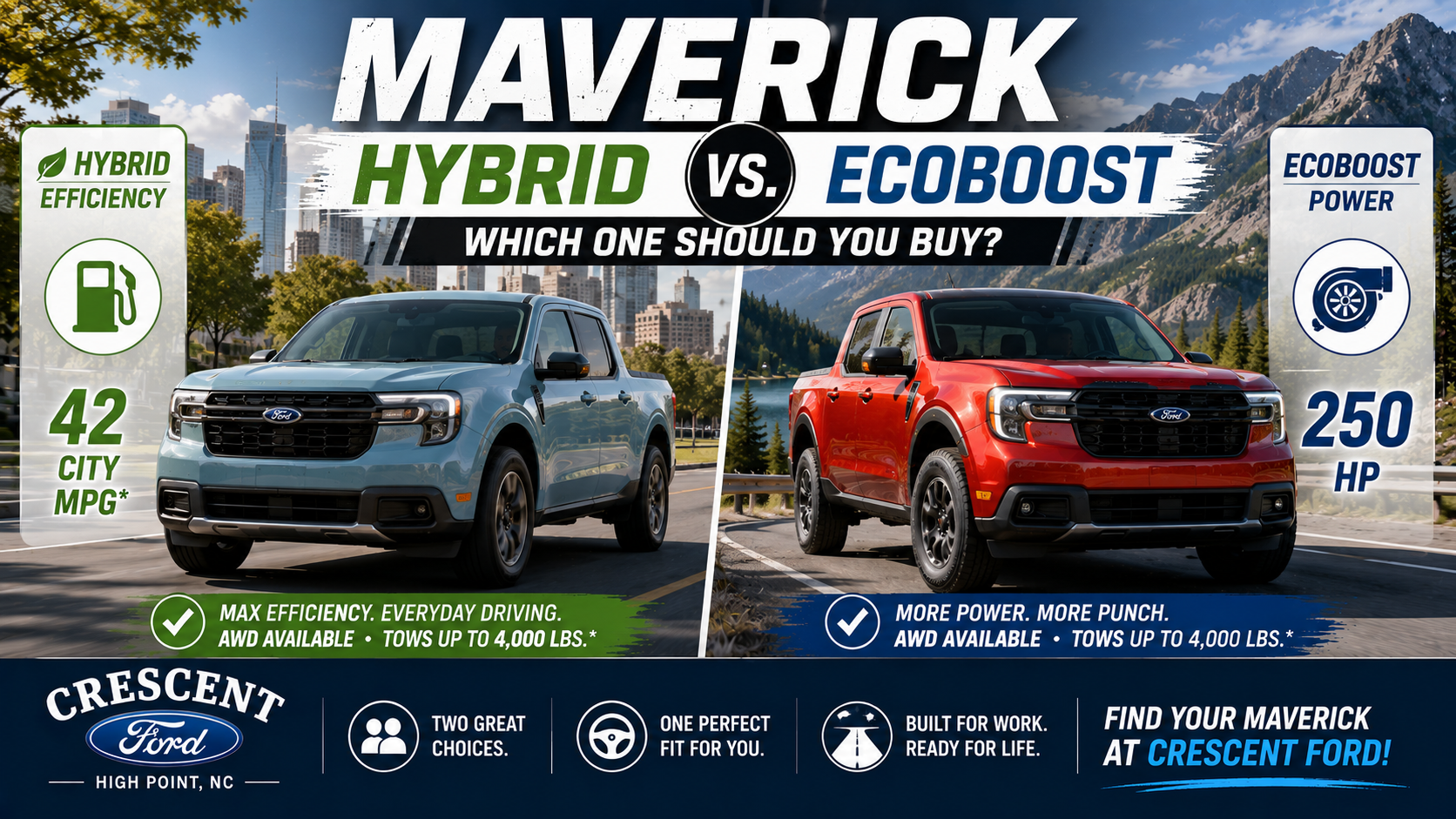
Ford Maverick Hybrid vs. EcoBoost comparison showing Hybrid efficiency, EcoBoost power, available AWD, towing capability, and Crescent Ford branding

2026 Ford Maverick Hybrid vs. EcoBoost: Which Should You Buy?

Ford Maverick Hybrid vs. EcoBoost: Which One Should You Buy? You've decided you want a Ford Maverick. Good choice. Now you have another decision: HYBRID or ECOBOOST? And this decision isn't quite as simple as it used to be. A few years ago, shoppers could almost reduce the Maverick powertrain decision to: "Want maximum fuel economy? Buy the Hybrid." "Want AWD and more capability? Buy the EcoBoost." Not anymore. The 2026 Ford Maverick Hybrid is available with all-wheel drive. And when properly equipped, an AWD Hybrid Maverick can tow up to 4,000 pounds. That means the Hybrid has moved considerably closer to EcoBoost territory when it comes to capability. But the EcoBoost still has a major advantage: POWER. So the question isn't really: "Which Maverick engine is better?" It's: "Which Maverick engine fits the way I'm actually going to use my truck?" Let's figure it out. Shop Ford Maverick Trucks at Crescent Ford 2026 Maverick Hybrid vs. EcoBoost at a Glance Here's the simplest comparison: MAVERICK HYBRID MAVERICK ECOBOOST Engine 2.5L Full Hybrid 2.0L Turbocharged EcoBoost Horsepower 184 combined hp 250 hp Torque Hybrid system 280 lb-ft Transmission Power-Split Electronic CVT 8-speed automatic on applicable models FWD Available Available on applicable trims AWD Available Available Advanced 4WD No Available on Tremor/Lobo Standard Towing Up to 2,000 lbs. Up to 2,000 lbs. Maximum Towing Up to 4,000 lbs. when properly equipped Up to 4,000 lbs. when properly equipped Best For MPG, commuting, everyday truck use Power, acceleration, rugged use Already see the problem? The Hybrid isn't simply the "economy Maverick" anymore. It can be surprisingly capable. So let's go deeper. Maverick Hybrid: The Fuel-Economy Champion If your Maverick is going to spend most of its life doing: Commuting School pickup Errands City driving Weekend projects Normal everyday truck duty the Hybrid deserves serious consideration. The 2026 Maverick uses a 2.5L full-hybrid powertrain producing 184 combined horsepower. On the front-wheel-drive configuration, Ford lists an EPA-estimated: 42 MPG city 35 MPG highway 38 MPG combined Actual mileage will vary, of course. But for a pickup truck? Those are numbers that immediately get people's attention. And notice where the Hybrid performs especially well: CITY DRIVING. That's exactly where hybrid systems can shine. How Does the Maverick Hybrid Work? You do NOT plug it in. That's one of the most common questions we hear about hybrids. The Maverick Hybrid is a full hybrid, not a plug-in hybrid. It combines: a gasoline engine an electric motor a hybrid battery. The vehicle manages those systems automatically. Depending on driving conditions, it may use the gasoline engine, electric power or a combination of both. Regenerative braking also helps recover energy during deceleration. From the driver's perspective? You mostly just: GET IN AND DRIVE. There's no nightly charging routine. There's no charger you need to install at home. There's no need to decide when to use gasoline versus electricity. The truck handles that for you. Do You Have to Charge a Ford Maverick Hybrid? No. You put gasoline in it just like a conventional vehicle. The hybrid system manages its battery automatically. This makes the Maverick particularly appealing to someone who likes the idea of improved fuel economy but isn't ready—or doesn't have the ability—to plug in an electric vehicle. Apartment? No problem. No garage? No problem. Don't want to think about charging? Also no problem. Maverick EcoBoost: The Power Choice Now let's talk about the 2.0L EcoBoost. The 2026 Maverick EcoBoost produces: 250 horsepower and 280 lb-ft of torque. That's a substantial increase in horsepower compared with the Hybrid. And you'll notice it. Especially when: Accelerating Merging Passing Climbing grades Carrying or towing heavier loads If the Hybrid's personality is: "EFFICIENT EVERYDAY TRUCK" the EcoBoost's personality is: "SMALL TRUCK WITH SOME PUNCH." Shop Ford Maverick Trucks Is the Maverick EcoBoost Fast? "Fast" is relative. This isn't a Mustang. 😂 But the EcoBoost Maverick can feel surprisingly quick for a compact pickup. The combination of: 250 hp 280 lb-ft of torque in a relatively compact truck gives it noticeably stronger acceleration than you might expect simply by looking at it. For someone coming out of a larger naturally aspirated truck or SUV, the Maverick EcoBoost may feel much more responsive than its size suggests. If acceleration and passing power matter to you? Drive the EcoBoost. Which Gets Better Gas Mileage: Maverick Hybrid or EcoBoost? Hybrid. That's the easy one. The Hybrid's entire powertrain is designed around combining gasoline and electric power to improve efficiency. Ford currently lists the FWD 2026 Maverick Hybrid at an EPA-estimated: 42 MPG city 35 MPG highway 38 MPG combined Actual mileage varies based on driving habits, weather, terrain, vehicle configuration and other factors. The EcoBoost trades some fuel efficiency for: more horsepower and more torque. So this part of the decision comes down to: WHAT DO YOU VALUE MORE? Fuel economy? Hybrid. Performance? EcoBoost. How Much Can You Save on Gas With the Maverick Hybrid? This depends entirely on: How much you drive Where you drive Fuel prices What you're comparing it against But here's the important part: Don't only think about annual mileage. Think about WHERE those miles happen. Hybrid systems can be particularly attractive for drivers doing lots of: Stop-and-go traffic City streets Short trips Commuting School runs Urban/suburban driving If most of your driving is steady highway cruising, the fuel-economy difference may be less dramatic than it is for someone driving around High Point and Greensboro all day. That's why your driving pattern matters. Can You Get AWD on the Maverick Hybrid? YES. This is one of the most important things to know about the current Maverick. The Hybrid is no longer limited to front-wheel drive. The 2026 Maverick Hybrid is available with AWD. That means shoppers no longer necessarily have to choose: FUEL ECONOMY or ALL-WHEEL DRIVE. You can potentially have both. That makes the Hybrid much more compelling for drivers who want additional traction for: Rain Winter weather Gravel roads Mountain trips General all-weather confidence Is Maverick Hybrid AWD the Same as Maverick Tremor? No. This distinction matters. Available AWD on a Maverick Hybrid gives you additional driven-wheel traction. Maverick Tremor is a purpose-built off-road-oriented model using the EcoBoost engine and Advanced 4WD. Tremor includes specialized equipment such as: Advanced 4WD with Twin Clutch Rear Drive Unit Off-road-tuned suspension Trail Control Trail 1-Pedal Drive Additional off-road equipment So: HYBRID AWD = additional everyday traction. TREMOR = specialized off-road capability. Don't confuse the two. Can the Maverick Hybrid Tow 4,000 Pounds? Yes — when properly configured. This is probably the biggest misconception left over from earlier Maverick model years. The standard Maverick towing capacity is: UP TO 2,000 LBS. But properly equipped AWD Hybrid configurations with the available 4K Tow Package can tow: UP TO 4,000 LBS. That's the same maximum trailer-weight figure available on properly equipped EcoBoost Mavericks with the 4K Tow Package. That's a BIG deal for Hybrid shoppers. IMPORTANT NOTE Maximum towing varies based on vehicle configuration, passengers, cargo, accessories and other factors. Always verify the capability of the specific truck you're considering before towing. What's Included in the Maverick 4K Tow Package? Ford's 2026 towing information lists equipment including: Class III hitch receiver 4-pin/7-pin connector Trailer brake controller Upgraded cooling fan Powertrain-specific cooling upgrades Hybrid models receive an auxiliary automatic transmission oil cooler as part of the package, while EcoBoost models receive a higher-capacity radiator. If your trailer exceeds 2,000 pounds, this isn't an area where you want to guess. Make sure the specific Maverick you're buying has the equipment necessary for what you intend to tow. Hybrid vs. EcoBoost for Towing Here's where our recommendation gets more nuanced. If you occasionally tow: A small camper Utility trailer Small boat Other appropriately sized trailer a properly equipped Hybrid AWD Maverick may handle your needs while still giving you the benefits of the hybrid powertrain during everyday driving. But if towing is a frequent part of your life? We would still test the EcoBoost. Why? POWER. The EcoBoost gives you: 250 horsepower and 280 lb-ft of torque. Maximum tow ratings tell you what the vehicle is rated to tow. They don't tell you whether two different engines will FEEL identical doing it. If you're towing regularly through: Hills Mountains Highway merges Longer distances the EcoBoost's additional power may matter to you. RELATED READING — Ford Maverick vs. Ranger vs. F-150: How Much Truck Do You Actually Need? Maverick Hybrid vs. EcoBoost for Commuting HYBRID. For most commuters, this is where we'd start. Especially around the Piedmont Triad. Think about a typical commute involving: High Point. Greensboro. Winston-Salem. Thomasville. Kernersville. I-85. Business 85. US-311. City traffic. Stoplights. Daily errands. That is exactly the type of mixed driving where a hybrid pickup can make a lot of sense. You're getting: truck bed five-passenger seating compact dimensions excellent city fuel economy. That's a pretty compelling daily-driver combination. RELATED READING — Best Ford Vehicles for Commuting Around the Piedmont Triad Maverick Hybrid vs. EcoBoost for Highway Driving This one is closer. Hybrid still offers good fuel economy. But if your commute consists almost entirely of: High-speed interstate driving Long highway trips Frequent passing Little stop-and-go traffic the EcoBoost becomes more appealing. Its additional horsepower and torque can make highway acceleration and passing feel more effortless. This is one of those situations where we'd recommend: DRIVE BOTH. Maverick Hybrid vs. EcoBoost for City Driving Hybrid. Easy. The hybrid system is particularly well suited to stop-and-go driving. If your Maverick spends most of its time: Running errands Driving through High Point Sitting at traffic lights Making short trips Navigating suburban streets the Hybrid is extremely difficult to ignore. Maverick Hybrid vs. EcoBoost for Mountain Driving Now we're leaning toward: ECOBOOST. Not because the Hybrid can't drive in the mountains. Of course it can. But if your weekends regularly involve: Boone Blowing Rock The Blue Ridge Parkway Mountain grades Loaded highway travel the EcoBoost's additional horsepower and torque may make it more satisfying. Especially if you're towing at the same time. That doesn't automatically mean you need EcoBoost. It means this is one of the use cases where the extra power becomes more relevant. Maverick Hybrid vs. EcoBoost for Snow This is no longer simply: EcoBoost wins because AWD. Both powertrains can now be paired with AWD on applicable configurations. So the better question is: What tires are on the truck? AWD can help with traction. But tires remain critically important in winter conditions. For normal Piedmont Triad winter driving and occasional mountain travel, a properly equipped Hybrid AWD Maverick may be perfectly suitable. If your winter travel overlaps with rugged/off-road use? Then EcoBoost configurations such as Tremor become more relevant. Maverick Hybrid vs. EcoBoost for Off-Road Driving EcoBoost. This is where the lineup makes the decision for us. The Maverick Tremor uses the 2.0L EcoBoost engine and Advanced 4WD. So if your definition of truck ownership includes: Trails Rough terrain Camping access roads Mud Uneven surfaces Legitimate off-road use look at the EcoBoost-powered Tremor. If you just want AWD for weather and everyday traction? Hybrid AWD may be all you need. Maverick Hybrid vs. EcoBoost for a Family Either. And this is important: Choosing Hybrid vs. EcoBoost doesn't fundamentally change what makes the Maverick family-friendly. You still get: Four doors Five seats A usable truck bed Compact exterior dimensions The ability to carry family stuff without putting all of it inside the cabin For a family using Maverick primarily as an everyday vehicle? We'd lean Hybrid. For a family frequently: Towing Camping Traveling through the mountains Prioritizing performance EcoBoost deserves a closer look. RELATED READING — Is a Ford Maverick Big Enough for a Family? Which Maverick Engine Is Better for Short Trips? Hybrid. This is another strong use case. If your typical drive is: 5 miles to work. 3 miles to school. 2 miles to the grocery store. Then back home. You aren't necessarily taking advantage of the strengths of a powerful turbocharged gasoline engine very often. The Hybrid's efficiency-focused design fits that type of driving extremely well. Which Maverick Engine Is Better for Long Trips? This depends on what you're doing when you arrive. Long highway road trip? Either. Long trip while towing? EcoBoost deserves serious consideration. Long trip with mostly city driving once you reach the destination? Hybrid becomes attractive again. Long trip behind an RV? Now Hybrid has a unique advantage we'll get to next. Can You Flat Tow a Maverick Behind an RV? Here's a big advantage for certain shoppers: The 2026 Maverick with the 2.5L Hybrid can be flat-towed with all four wheels down when properly configured and following Ford's requirements. That makes the Hybrid especially interesting for RV owners. If you're specifically buying a Maverick to tow behind a motorhome? Tell your salesperson that immediately. This is not something you want to assume based on the fact that another Maverick looks identical. Powertrain matters. Is the Maverick Hybrid Reliable? This is one of those questions where we'd be careful about making sweeping promises about either powertrain. Modern hybrid and turbocharged gasoline systems are both sophisticated. And reliability depends on more than engine type. It can be affected by: Maintenance Driving habits Operating conditions Manufacturing variation Long-term ownership Instead of choosing solely because someone online says: "Hybrids last forever." or "Turbos don't last." look at: How you use the truck Manufacturer warranty coverage Maintenance requirements Which powertrain actually fits your needs Don't let internet mythology choose your truck. Does the Maverick Hybrid Cost More to Maintain? Not necessarily. A hybrid has components a conventional gasoline vehicle doesn't have. But it also uses regenerative braking and operates differently from a conventional powertrain. The EcoBoost has its own components and maintenance considerations. Rather than assuming one is automatically cheaper to maintain forever, follow Ford's recommended maintenance schedule for the specific vehicle. If long-term ownership cost is your biggest concern, fuel consumption may ultimately create a larger everyday difference than routine maintenance. Does the Maverick Hybrid Battery Need to Be Replaced? Hybrid batteries are designed as long-term vehicle components. That doesn't mean no battery can ever fail. But you shouldn't think of the high-voltage hybrid battery like: a phone battery or a normal 12-volt battery that you're expected to replace every few years. If you're considering a Maverick Hybrid specifically because you plan to keep it for a long time, ask us about the applicable hybrid-component warranty coverage on the specific vehicle you're considering. Which Maverick Feels More Like a Traditional Truck? EcoBoost. Mostly because of how the powertrain delivers its performance. The 2.0L turbocharged engine paired with a conventional automatic transmission will feel more familiar to someone coming from another gasoline truck. The Hybrid's power-split electronic continuously variable transmission operates differently. That isn't necessarily better or worse. It's different. Some people love the smooth hybrid experience. Others prefer the feel of the EcoBoost. TEST DRIVE BOTH. Which Maverick Is Quieter? Driving conditions matter. Hybrid vehicles can be particularly quiet at lower speeds when the gasoline engine isn't doing all the work. But engine operation changes depending on: Speed Acceleration Battery state Temperature Other conditions During harder acceleration, you'll hear the gasoline engine. If cabin sound matters to you, don't try to decide from YouTube. Drive them. Is the EcoBoost Worth Giving Up Hybrid MPG? For some buyers: ABSOLUTELY. For others: NOT EVEN CLOSE. 😂 That's why both exist. Imagine you drive: 20,000 miles per year mostly commuting, rarely tow, and never go off-road. Hybrid makes an extremely strong case. Now imagine: 8,000 miles per year frequent mountain trips, tow a camper, love acceleration, and want Tremor. The fuel-economy advantage of Hybrid may matter far less to you than EcoBoost's additional performance. Your mileage matters. But your USE matters more. Do I Need EcoBoost Just Because I Want AWD? No. And if you've read old Maverick comparisons online, this is worth repeating: YOU CAN GET AWD WITH THE HYBRID. That single change dramatically affects the Hybrid vs. EcoBoost decision. You no longer have to automatically move to EcoBoost just because you want additional traction. Do I Need EcoBoost Just Because I Want to Tow? Not necessarily. Properly equipped Hybrid AWD Mavericks can tow up to 4,000 pounds with the available 4K Tow Package. So your decision should be based on: Trailer weight How frequently you tow Where you tow Passenger/cargo load How much you value additional engine performance If towing is important, let us help verify the specific truck's configuration rather than simply looking at the engine badge. When Should You Definitely Consider EcoBoost? Start with EcoBoost if you say: "I want the most horsepower." "I care about acceleration." "I tow regularly." "I drive through the mountains frequently." "I want a Maverick Tremor." "I plan to do legitimate off-road driving." "I just prefer a traditional turbo gasoline powertrain." Those are strong EcoBoost use cases. When Should You Definitely Consider Hybrid? Start with Hybrid if you say: "Fuel economy is one of my biggest priorities." "I commute every day." "I drive a lot of city miles." "I rarely tow." "I want a truck but don't want traditional truck fuel economy." "I want AWD but still prioritize efficiency." "I want to flat tow my Maverick behind an RV." Those are strong Hybrid use cases. Maverick Hybrid vs. EcoBoost: Quick Decision Guide If Your Priority Is... Start With... Best fuel economy HYBRID City driving HYBRID Daily commuting HYBRID Short trips HYBRID AWD + efficiency HYBRID AWD Flat towing behind an RV HYBRID Maximum horsepower ECOBOOST Stronger acceleration ECOBOOST Frequent towing ECOBOOST Mountain driving ECOBOOST Serious off-road use ECOBOOST Maverick Tremor ECOBOOST Family use EITHER Occasional towing up to 4,000 lbs. COMPARE BOTH The Biggest Mistake When Choosing a Maverick Engine Buying based entirely on one specification. For example: "Hybrid gets better MPG, so Hybrid." Maybe. But what if you tow every weekend? Or: "EcoBoost has more horsepower, so EcoBoost." Okay. But what if you drive 25,000 city miles every year and never use the additional performance? A vehicle isn't a collection of specifications. It's something you're going to use every day. Choose the powertrain based on YOUR day. Should You Test Drive Maverick Hybrid and EcoBoost Back-to-Back? YES. This comparison absolutely deserves a back-to-back drive. Drive the Hybrid first. Then the EcoBoost. Or vice versa. Pay attention to: Acceleration Engine sound Transmission feel Low-speed driving Highway merging Ride Visibility Overall personality You may know within five minutes. One of them may simply feel more natural to you. Schedule a Maverick Test Drive Drive the Maverick Hybrid and EcoBoost back-to-back at Crescent Ford and decide whether fuel efficiency or additional power matters more to you. Which Maverick Should You Buy in High Point, NC? Living around High Point and the Piedmont Triad creates a pretty strong argument for both. If your week looks like: High Point → Greensboro → High Point or Thomasville → High Point or Kernersville → Winston-Salem plus errands and school pickup? MAVERICK HYBRID. That's an extremely compelling use case. But if your weekends look like: High Point → Boone camper attached, mountain grades, outdoor recreation, and maybe some off-pavement driving? Now we're looking much harder at: MAVERICK ECOBOOST. And if your life is: commuting Monday through Friday occasional towing on Saturday? That's where we'd compare a Hybrid AWD with the 4K Tow Package against an EcoBoost. The answer may surprise you. So, Maverick Hybrid or EcoBoost? Let's make it simple. BUY THE MAVERICK HYBRID IF: Fuel economy matters most. You drive a lot. You spend significant time in city/suburban traffic. You want a highly efficient commuter with a truck bed. You want AWD but still prioritize efficiency. You only tow occasionally. You need flat-tow capability behind an RV. BUY THE MAVERICK ECOBOOST IF: Power matters more than maximum MPG. You want 250 horsepower and 280 lb-ft of torque. You tow frequently. You regularly drive through hilly or mountainous terrain. You want stronger acceleration. You want Tremor or more serious off-road capability. You simply prefer the way the EcoBoost drives. COMPARE BOTH IF: You want AWD. You tow up to 4,000 pounds occasionally. You need one vehicle for commuting AND weekend projects. You want efficiency but aren't sure you're willing to give up EcoBoost performance. That's where the test drive matters. The Good News: There Really Isn't a Bad Choice The Maverick Hybrid and EcoBoost are designed for different priorities. The Hybrid says: "How efficiently can we make a genuinely useful little truck?" The EcoBoost says: "How much performance can we fit into a genuinely useful little truck?" And for 2026, the line between them has gotten much smaller. Hybrid can have AWD. Hybrid can tow up to 4,000 pounds when properly equipped. EcoBoost still gives you considerably more horsepower. So don't let an outdated comparison make the decision for you. Decide what you actually need. Then drive both. Ready to Compare Maverick Hybrid vs. EcoBoost? Shop Ford Maverick Trucks Schedule a Maverick Test Drive Value Your Trade Explore Financing Options RELATED READING Is a Ford Maverick Big Enough for a Family? Ford Maverick vs. Ranger vs. F-150: How Much Truck Do You Actually Need? Best Ford Vehicles for Commuting Around the Piedmont Triad Frequently Asked Questions About Maverick Hybrid vs. EcoBoost What is the difference between the Maverick Hybrid and EcoBoost? The 2026 Maverick Hybrid uses a 2.5L full-hybrid powertrain producing 184 combined horsepower and prioritizes fuel efficiency. The 2.0L EcoBoost is a turbocharged gasoline engine producing 250 horsepower and 280 lb-ft of torque, giving it a significant performance advantage. Which gets better gas mileage, Maverick Hybrid or EcoBoost? The Hybrid. Ford lists the 2026 front-wheel-drive Maverick Hybrid at an EPA-estimated 42 MPG city, 35 highway and 38 combined. Actual mileage varies. Does the Ford Maverick Hybrid need to be plugged in? No. Maverick is a full hybrid, not a plug-in hybrid. The vehicle manages the hybrid battery automatically and is fueled with gasoline like a conventional vehicle. Can you get AWD on a Ford Maverick Hybrid? Yes. The 2026 Maverick Hybrid is available with all-wheel drive. Can the Maverick Hybrid tow 4,000 pounds? A properly equipped AWD Maverick Hybrid with the available 4K Tow Package can have a maximum tow rating of up to 4,000 pounds. Actual capacity depends on the specific vehicle configuration, passengers, cargo and accessories. Can the Maverick EcoBoost tow 4,000 pounds? Yes. Properly equipped EcoBoost AWD Mavericks with the available 4K Tow Package can tow up to 4,000 pounds. Which Maverick has more horsepower? The EcoBoost. Ford rates the 2.0L EcoBoost at 250 horsepower, compared with 184 combined horsepower for the 2.5L Hybrid. Which Maverick is better for commuting? For many commuters, the Hybrid is the stronger starting point because of its fuel efficiency, particularly in city and stop-and-go driving. Which Maverick is better for towing? Both can reach a maximum 4,000-pound tow rating when properly configured. However, the EcoBoost provides considerably more horsepower and may appeal more to shoppers who tow frequently or through hilly terrain. Which Maverick is better for off-roading? EcoBoost. The off-road-focused Maverick Tremor uses the 2.0L EcoBoost engine and Advanced 4WD along with specialized off-road equipment. Can you flat tow a Maverick behind an RV? Ford says 2026 Mavericks equipped with the 2.5L Hybrid can be flat-towed with all four wheels down when properly configured and following Ford's requirements. Is the Maverick Hybrid good for a family? Yes. The Maverick's four-door, five-passenger layout and truck bed can make it practical for smaller families. Powertrain choice depends more on driving habits and capability needs than passenger space. Should I buy Maverick Hybrid or EcoBoost? Choose the Hybrid if fuel economy, commuting and everyday efficiency are your priorities. Choose EcoBoost if you value additional horsepower, acceleration, frequent towing or off-road capability. If you want AWD or occasional 4,000-pound towing, compare both because those features are no longer exclusive to EcoBoost. Should I test drive both Maverick engines? Yes. The Hybrid and EcoBoost have noticeably different powertrain characteristics. Driving them back-to-back is the easiest way to determine whether you prefer the Hybrid's efficiency-focused driving experience or the EcoBoost's additional performance.

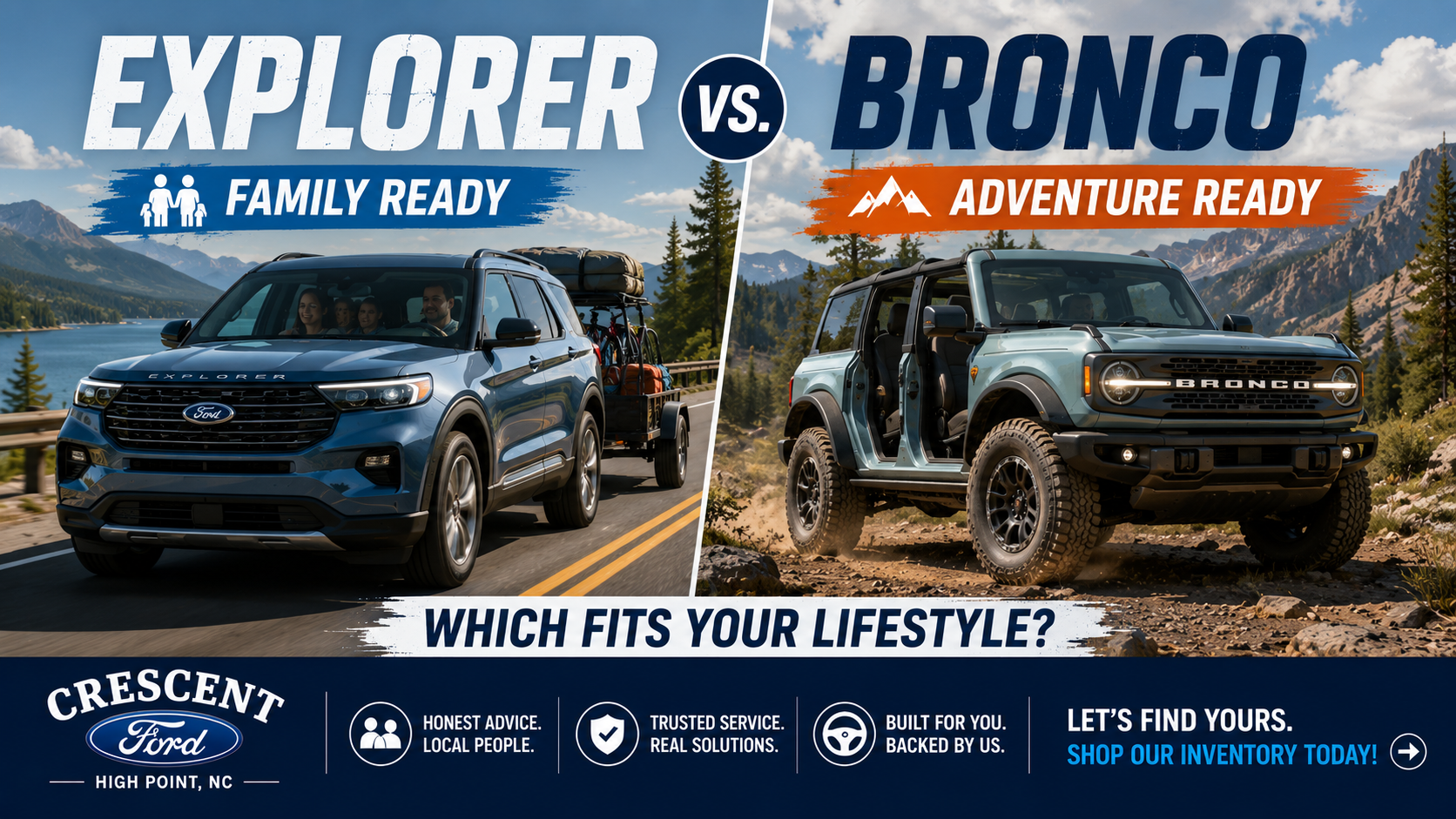
Ford Explorer vs. Bronco comparison showing the family-ready Explorer and adventure-ready Bronco for different lifestyles at Crescent Ford

2026 Ford Explorer vs. Bronco: Which SUV Fits Your Lifestyle?

Ford Explorer vs. Bronco: Which SUV Fits Your Lifestyle? You're shopping for a Ford SUV. You want something larger than a compact crossover. You want capability. You want space. And you've narrowed the list to two vehicles: Ford Explorer and Ford Bronco. At first, that sounds like a normal SUV comparison. Then you look a little closer. Explorer has three rows. Bronco has removable doors. Explorer can seat up to seven. Bronco can tackle terrain most family SUVs were never designed to see. Explorer is built around everyday family versatility. Bronco is built around adventure. So despite both wearing Ford badges and occupying a similar general part of the SUV market, these two vehicles answer very different questions. The easiest way to decide isn't: "Which SUV is better?" It's: "What do I actually need my SUV to do?" Let's figure that out. Shop Ford SUVs at Crescent Ford Ford Explorer vs. Bronco at a Glance Here's the simplest way to understand the difference: Ford Explorer Ford Bronco Primary Mission Family versatility Off-road adventure Rows 3 2 Maximum Seating 7 5 Doors 4 2 or 4 Drivetrain RWD or available Intelligent 4WD depending on model 4x4 Removable Doors No Yes Removable Roof No Yes Maximum Cargo Space Up to 85.8 cu. ft. depending on model Varies significantly by 2-door/4-door configuration Maximum Towing Up to 5,000 lbs. when properly equipped Varies by model/configuration Best For Families, commuting, road trips Off-roading, outdoor recreation, adventure If you need a third row? This comparison may already be over. Explorer. If removable doors, serious 4x4 hardware and trail capability are high on your priority list? Bronco. But for everyone in the middle, there's more worth considering. Ford Explorer: The Family-Focused Choice Explorer is Ford's midsize three-row SUV. And that third row is the biggest fundamental difference between these vehicles. The 2026 Explorer can seat six or seven people, depending on seating configuration. That immediately gives Explorer an advantage for: Larger families Families with multiple children Car pools Grandparents Kids bringing friends Road trips Anyone who regularly carries more than five people Explorer also provides up to approximately 85.8 cubic feet of maximum cargo capacity, depending on model and configuration. That combination of: three rows + flexible cargo space is what makes Explorer fundamentally a family SUV. Who Should Buy an Explorer? Someone who says: "I need my SUV to make everyday life easier." Think: School. Work. Groceries. Sports practice. Road trips. Vacation. Dinner with the grandparents. Home improvement runs. Explorer is designed to handle a little bit of everything without being particularly specialized in only one direction. Shop Ford Explorer SUVs RELATED READING Ford Explorer Trim Levels Explained: Which Explorer Should You Buy? Ford Bronco: The Adventure-Focused Choice Bronco takes a completely different approach. This isn't simply: "Ford's other midsize SUV." Bronco is a purpose-built 4x4. Ford designed it around things like: Trail driving Off-road capability Ground clearance Terrain management Outdoor recreation Removable doors Removable roof Customization Even the basic Bronco comes with standard 4x4 and removable doors and roof. That's a very different vehicle philosophy from Explorer. Who Should Buy a Bronco? Someone who says: "I don't just want my SUV to get me to the adventure. I want the SUV to be part of the adventure." That's Bronco. Camping. Trails. Beach trips. Mountain weekends. Outdoor recreation. Doors off. Roof off. Bronco is designed to make driving itself part of the experience. Shop Ford Bronco SUVs RELATED READING Ford Bronco vs. Bronco Sport: Which One Should You Buy? Explorer vs. Bronco: Which Is Better for a Family? For most families? Explorer. Not because Bronco can't work for a family. A four-door Bronco absolutely can. But Explorer was specifically designed around family practicality. You get: three rows instead of two. You can seat: up to seven instead of five. And the interior is designed around everyday passenger flexibility. That matters when your life includes: Car seats School bags Sports equipment Friends Grandparents Luggage Strollers If you have two children and never need more than five seats, though? Now Bronco becomes much more realistic. Especially if your family spends a lot of time outdoors. Can a Family of Four Use a Ford Bronco? Absolutely. A four-door Bronco can make a very fun family vehicle. A family of four still has room for: two adults + two kids without needing the third row Explorer provides. And if your weekends frequently involve: Camping Hiking Fishing Mountains Beach driving where permitted Outdoor recreation Bronco may actually fit your family's personality better. The question becomes: Do you need maximum family practicality? or Do you want enough family practicality plus much more adventure capability? That's where Explorer and Bronco separate. Explorer vs. Bronco With Car Seats If car seats are part of your life, don't make this decision from a specification table. Bring the car seats. Seriously. Install them. A rear-facing seat can require significant front-to-back space. Multiple car seats can change how useful the second row feels. And Explorer's third row can provide additional flexibility as your family grows. For example, if you have: two kids in car seats + an older child Explorer's three-row layout may be considerably easier to live with. If you have: one or two children and don't need additional passenger capacity? A four-door Bronco may work perfectly well. RELATED READING — Is a Ford Maverick Big Enough for a Family? Which Has More Passenger Space: Explorer or Bronco? This isn't really about inches. It's about layout. Explorer has three rows. Bronco has two. Explorer can accommodate up to seven passengers depending on configuration. Four-door Bronco seats up to five. Two-door Bronco seats four. So if your definition of passenger space is: "How many people can I bring?" Explorer wins easily. But if you only need four or five seats? Now you should compare how each vehicle actually feels to your family. Sit in the back. Bring the kids. Adjust the front seats where you'd normally drive. That's much more useful than comparing one isolated measurement. Which Has More Cargo Space: Explorer or Bronco? Explorer offers up to approximately 85.8 cubic feet of maximum cargo capacity on certain 2026 models. Bronco cargo capacity varies substantially depending on whether you choose a two-door or four-door model and how the vehicle is configured. But here's the more useful question: What are you carrying? Explorer's cargo area is built around family versatility. Think: Groceries Luggage Strollers Sports gear Home-improvement purchases Family road-trip cargo Bronco's cargo space may be more likely to carry: Camping equipment Coolers Hiking gear Recovery gear Outdoor equipment Muddy stuff you'd rather not put in your nice family crossover 😂 Same concept: cargo but very different lifestyles. Explorer vs. Bronco for Road Trips This one's interesting. For a conventional family road trip? Explorer gets our vote. Especially with more than four passengers. Explorer's three-row layout, passenger-focused interior and cargo flexibility make it naturally suited to long highway trips. But imagine your road trip looks like: High Point → Boone → cabin → trail → campsite. Now Bronco becomes a lot more interesting. The destination matters. Explorer Road Trip The SUV gets you comfortably to the adventure. Bronco Road Trip The SUV may BE part of the adventure. That's probably the cleanest explanation of these two vehicles. Explorer vs. Bronco for Commuting For most commuters? Explorer. It's designed more around conventional everyday road use. But that doesn't mean Bronco can't be a daily driver. Plenty of Bronco owners commute in them every day. The difference is what you're prioritizing. If your driving consists mostly of: Highway City streets School pickup Interstate commuting Explorer's mission aligns more naturally with your daily life. If you're willing to prioritize Bronco's personality and capability because that's what you really want? Buy the Bronco. Not every vehicle decision needs to be made by spreadsheet. RELATED READING — Best Ford Vehicles for Commuting Around the Piedmont Triad Explorer vs. Bronco for Off-Road Driving Bronco. Next question. 😂 This is exactly what Bronco was built to do. Standard 4x4. Available Sasquatch Package. Available locking differentials depending on configuration. Off-road suspension systems. Terrain-focused drive modes. Ground clearance. Trail technology. Bronco isn't simply an SUV that happens to be capable off pavement. Off-road performance is fundamental to its identity. But What About the 2026 Explorer Tremor? Now things get interesting. For 2026, Ford added Explorer Tremor. That gives Explorer shoppers a more adventure-oriented option without requiring them to leave the three-row SUV format. Explorer Tremor adds off-road-focused equipment and standard Intelligent 4WD while preserving Explorer's family-friendly layout. So if you're thinking: "I need three rows, but we also camp, explore forest roads and spend weekends outdoors," Explorer Tremor deserves a serious look. But don't confuse: Explorer Tremor with Bronco. Bronco still provides a fundamentally different level of off-road specialization, including removable doors and roof and an architecture built around trail capability. Explorer Tremor = Family SUV with additional off-road capability. Bronco = Off-road SUV that can also handle family duty. That's a very important distinction. Explorer vs. Bronco for Snow and Bad Weather Both can be configured for additional traction and capability. Explorer offers available Intelligent 4WD depending on model and powertrain. Bronco comes with 4x4. But don't forget: Tires matter enormously. Having 4WD doesn't magically overcome inappropriate tires or poor driving decisions. For most Piedmont Triad drivers dealing with: Rain Occasional snow Wet roads Winter trips toward Boone or the mountains either vehicle can be a capable choice when appropriately equipped. If you're specifically prioritizing rugged terrain beyond normal winter-road driving? Bronco begins pulling away. Explorer vs. Bronco for Towing Here's a category where Explorer may surprise people. The 2026 Explorer can tow up to 5,000 pounds when properly equipped. Mainstream Bronco configurations such as the Base and Outer Banks list maximum towing of 3,500 pounds when properly equipped. So don't assume: "Bronco looks tougher, therefore Bronco tows more." That's not how vehicle capability works. If towing is important, start with: What are you towing? Boat? Utility trailer? Small camper? Then look at the specific vehicle configuration. Never choose a tow vehicle based solely on model name or appearance. Explorer vs. Bronco for Camping Now we're going to annoy everyone by saying: It depends. 😂 Choose Explorer for Camping If: Camping means: Family + luggage + tent + coolers + highway drive to the campground. Explorer's passenger and cargo versatility can be extremely useful. Choose Bronco for Camping If: Camping means: Let's see how far down that trail the campsite is. Bronco. Easy. The more rugged your version of camping becomes, the stronger Bronco's case gets. Explorer vs. Bronco for Beach Trips Same idea. If you're driving the family to: Myrtle Beach with luggage, beach chairs, coolers and kids? Explorer may be the more practical road-trip vehicle. If your destination includes legal beach-driving areas where appropriate vehicle access is permitted? Now Bronco's 4x4 capability becomes much more relevant. Just remember that off-road and beach driving require appropriate preparation, knowledge of the terrain and compliance with local rules. Explorer vs. Bronco for Dogs Dog owners can make a good case for either. Explorer provides substantial interior flexibility and cargo space. Bronco offers a more rugged, outdoor-focused environment depending on configuration. But this is another: Bring your stuff decision. If you use: Large dog crate Barrier Travel kennel Ramp bring measurements—or better yet, bring the equipment. A cargo-volume number doesn't tell you whether your specific crate fits through the opening. Which Is Easier to Get In and Out Of? Generally, Explorer's family-oriented design will feel more conventional for everyday entry and exit. Bronco—especially more aggressively equipped off-road configurations—can have a taller step-in height. That matters for: Small children Older family members Anyone with limited mobility Loading kids repeatedly throughout the day Don't underestimate this. If Grandma rides with you every weekend, have Grandma get in the Bronco before you buy it. She gets a vote. 😂 Explorer vs. Bronco: Which Has the Better Interior? That's completely subjective because they're intentionally different. Explorer's interior is geared toward: comfort + passengers + everyday technology. Bronco's interior emphasizes: ruggedness + utility + adventure. Depending on trim, either can become very nicely equipped. For example, Bronco Outer Banks can be configured with more premium touches such as available leather-trimmed seating, while Explorer Platinum moves strongly toward a luxury-oriented family SUV experience. So don't ask: "Which interior is nicer?" Ask: "Which interior feels right for how I'm going to use it?" Explorer vs. Bronco: Which Is More Fun? Bronco. We're comfortable saying it. 😂 Removable doors. Removable roof. Trail capability. That is inherently fun. But here's the catch: Fun isn't everyone's #1 vehicle requirement. Loading three kids, a stroller and groceries without playing automotive Tetris can also bring a surprising amount of joy. Explorer wins a different kind of fun. Which Is More Practical? Explorer. That's what it's designed to be. Three rows. More passenger capacity. Family-oriented cargo flexibility. Conventional everyday driving. But practicality isn't automatically the same as: better. A minivan would probably be more practical than a Bronco too. Someone shopping for a Bronco probably doesn't care. And that's okay. Which Is Better for a Family of Four? This is where the comparison gets genuinely difficult. Because either could be excellent. Choose Explorer if: You want extra passenger capacity. You regularly bring friends or relatives. Cargo flexibility matters. You want a more conventional family SUV. Road trips are important. Choose Bronco if: Five seats are enough. Your family spends significant time outdoors. You value 4x4/off-road capability. You love the removable-door/roof experience. You simply WANT a Bronco. That last one matters. Sometimes both vehicles meet your practical needs. Then you're allowed to buy the one you like more. Which Is Better for a Family of Five? We'd lean: Explorer. A four-door Bronco can seat five. But Explorer gives five people the ability to spread across three rows. That's especially useful as children get older. Five people technically fitting inside a vehicle isn't the same as five people wanting to spend six hours inside it. For regular family-of-five duty, we'd test Explorer first. Which Is Better for Six or Seven People? Explorer. Bronco isn't a three-row SUV. If you regularly need seating for more than five, Explorer wins this comparison automatically. If Explorer isn't large enough for your passenger/cargo needs, the next comparison probably isn't Bronco. It's: Explorer vs. Expedition. RELATED READING — 2026 Ford Explorer vs. Expedition: Which 3-Row SUV Fits Your Family? Do You Need a Bronco or Just Want a Bronco? This is an important question. And we're not asking it to talk you out of one. You may never: Rock crawl Cross a stream Drive a difficult trail Need a locking differential and still absolutely love owning a Bronco. Vehicles aren't appliances. Sometimes we buy them because they make us happy. The key is simply understanding the trade-off. If Bronco gives you everything you need and you love it? Great. If you're sacrificing passenger space you genuinely need every day because the Bronco looks cool? Now we should probably have a longer conversation. Do You Need an Explorer or Just Think You Need Three Rows? Same question in reverse. If you're a family of four and the third row will be folded for 360 days per year? Maybe you don't need Explorer. Perhaps Bronco—or even a smaller Ford SUV—would fit your life better. Don't buy seats you'll never use simply because: "What if someday we need them?" Buy for your real life most of the time. Explorer vs. Bronco: Quick Decision Guide If Your Priority Is... Our Starting Point Three rows Explorer 6–7 passengers Explorer Family road trips Explorer Maximum everyday practicality Explorer Up to 5,000-lb. towing when properly equipped Explorer Traditional commuting Explorer Off-road capability Bronco Standard 4x4 Bronco Removable doors Bronco Removable roof Bronco Trail driving Bronco Open-air experience Bronco Family + light adventure/off-pavement use Explorer Tremor deserves a look Family of four + serious outdoor lifestyle Compare both What If You Want Something Between Explorer and Bronco? This is where Ford's SUV lineup gets interesting. Maybe Explorer feels bigger than you need. Maybe Bronco is more off-road-focused than you need. You still have: Bronco Sport and Escape in the Ford SUV lineup. And if Explorer isn't large enough? There's: Expedition. That's why we'd recommend thinking about Ford SUVs as a spectrum rather than trying to force yourself into one model. RELATED READING — Ford SUV Size Guide: Bronco Sport, Escape, Bronco, Explorer & Expedition Compared Should You Test Drive Explorer and Bronco Back-to-Back? Absolutely. This is one comparison where a back-to-back drive can settle things very quickly. Drive Explorer. Then drive Bronco. Pay attention to: Seating position Ride Visibility Entry/exit Rear-seat space Cargo access Road noise Maneuverability Technology Overall feel One may immediately feel more natural. And if you're shopping for your family? Bring them. Don't let Dad pick the family SUV by himself and then discover everyone hates the back seat. We see you, Dad. 😂 Schedule an Explorer vs. Bronco Test Drive Compare the Explorer and Bronco back-to-back at Crescent Ford and see which SUV fits your real-world passenger, cargo and driving needs. Ford Explorer vs. Bronco in High Point, NC Living around High Point and the Piedmont Triad makes this comparison particularly interesting. Your normal week might involve: I-85 Business 85 High Point Greensboro Winston-Salem and normal suburban driving. Then the weekend comes. Within a relatively short drive, you can be heading toward: Boone Blowing Rock the Blue Ridge Mountains campgrounds trails and outdoor recreation. That's why both SUVs make sense here. The question is which part of your life should your vehicle prioritize. Explorer: Everyday life first. Adventure when needed. Bronco: Adventure first. Everyday life still possible. That's the comparison. So, Should You Buy the Ford Explorer or Bronco? Let's make it simple. Buy the Explorer if: You need three rows. You regularly carry more than five people. Family practicality is your priority. You take long road trips. You want up to 5,000 pounds of towing capability when properly equipped. You want a more conventional everyday SUV. You want adventure capability but still need family versatility—especially if you're considering Explorer Tremor. Buy the Bronco if: You don't need a third row. Off-road capability genuinely matters. You want standard 4x4. You love outdoor recreation. You want removable doors. You want a removable roof. You want the vehicle itself to be part of the adventure. Or... you've always wanted a Bronco. That's a perfectly valid reason too. The Best SUV Is the One That Fits Your Actual Life It's easy to get lost comparing: horsepower cargo volume screens ground clearance towing capacity and hundreds of individual features. But Explorer vs. Bronco is actually simpler than that. Ask yourself: What will I do with this SUV 80% of the time? If the answer is: Carry people, commute, run errands and take family trips start with Explorer. If the answer is: Commute during the week so I can get outside and explore on the weekend start with Bronco. And if your answer is: Honestly...both. Drive them back-to-back. That's exactly what test drives are for. FINAL CTA / INTERNAL LINKS Ready to Compare Them? Shop Ford Explorer SUVs Shop Ford Bronco SUVs Schedule a Test Drive Value Your Trade Explore Financing Options RELATED READING Ford Explorer Trim Levels Explained: Which Explorer Should You Buy? Ford Bronco vs. Bronco Sport: Which One Should You Buy? 2026 Ford Explorer vs. Expedition: Which 3-Row SUV Fits Your Family? Ford SUV Size Guide: Bronco Sport, Escape, Bronco, Explorer & Expedition Compared Best Ford Vehicles for Commuting Around the Piedmont Triad Frequently Asked Questions About Ford Explorer vs. Bronco Is the Ford Explorer bigger than the Bronco? It depends on which Bronco configuration you're comparing because Bronco is offered in both two-door and four-door versions. More importantly, Explorer and Bronco use their size differently. Explorer is a three-row family SUV, while Bronco is a two-row off-road-focused 4x4. Does the Ford Bronco have a third row? No. Ford Bronco is a two-row SUV. Two-door Bronco models seat four, while four-door models can seat five. How many people does the Ford Explorer seat? The 2026 Ford Explorer seats six or seven depending on model and seating configuration. Second-row captain's chairs or a bench seat determine the available passenger capacity. Is the Bronco or Explorer better for families? Explorer is generally the more practical family choice because it offers three rows and seating for up to seven. A four-door Bronco can still work well for a family of four or five, particularly for families prioritizing outdoor recreation and off-road capability. Is the Explorer or Bronco better for off-roading? Bronco. It is purpose-built around off-road capability and comes standard with 4x4, removable doors and roof, with additional off-road hardware available depending on configuration. The 2026 Explorer Tremor adds meaningful adventure capability while retaining Explorer's three-row family layout. Is the Explorer Tremor like a Bronco? Not exactly. Explorer Tremor is an adventure-oriented version of a three-row family SUV. Bronco is fundamentally designed as an off-road 4x4 with removable doors and roof. The Tremor bridges some of the gap, but the two vehicles still have different missions. Which tows more, Ford Explorer or Bronco? The 2026 Explorer can tow up to 5,000 pounds when properly equipped. Mainstream Bronco configurations such as Base and Outer Banks list maximum towing of 3,500 pounds when properly equipped. Always verify the rating of the specific configuration you're considering. Does the Bronco come standard with 4WD? Yes. The 2026 Ford Bronco is a 4x4 vehicle. Explorer uses rear-wheel drive as standard on several models with Intelligent 4WD available, while some Explorer configurations such as Tremor include 4WD. Which is better for commuting, Explorer or Bronco? Explorer's family-focused design makes it a natural choice for conventional commuting and everyday road use. Bronco can certainly be daily-driven, but shoppers are generally choosing it because they also value its off-road capability, rugged design and open-air experience. Is the Bronco good for a family of four? A four-door Bronco can work very well for a family of four. Whether it's better than Explorer depends on whether you value Explorer's additional passenger and cargo flexibility or Bronco's adventure-oriented capability more. Is Explorer better for a family of five? Explorer deserves serious consideration for a family of five because its third row allows passengers to spread across multiple rows. A four-door Bronco can seat five, but it doesn't offer the same three-row flexibility. Can you remove the doors and roof on a Ford Bronco? Yes. Removable doors and roof are core features of the current Ford Bronco. That open-air capability is one of the most significant differences between Bronco and Explorer. Should I buy an Explorer or Bronco? Choose Explorer if three-row seating, family versatility, road-trip comfort and everyday practicality are your priorities. Choose Bronco if you don't need a third row and place greater value on 4x4 capability, off-road driving, removable doors and roof, and outdoor adventure. Should I test drive Explorer and Bronco before deciding? Yes. Because the two vehicles have such different personalities, a back-to-back test drive can be especially useful. Compare ride, seating position, rear-seat space, entry and exit, cargo access and how each SUV feels during the kind of driving you do most often.

Ford F-150 trim levels comparison featuring XL, STX, XLT, Lariat, Tremor and Platinum trucks at Crescent Ford in High Point, NC

2026 Ford F-150 Trim Levels Explained: XL vs. STX vs. XLT vs. Lariat vs. Tremor vs. Platinum

Ford F-150 Trim Levels Explained: XL vs. STX vs. XLT vs. Lariat vs. Tremor vs. Platinum You've decided you want an F-150. Great. Now Ford gives you another decision: Which F-150? Because an F-150 XL and an F-150 Platinum may share the same basic truck underneath, but they're designed for very different buyers. And then there's everything in between. XL. STX. XLT. Lariat. Tremor. Platinum. One shopper wants a straightforward work truck. Another wants a truck that looks great without paying for luxury features. Someone else wants heated seats, upgraded technology and a truck comfortable enough for a 45-minute commute every morning. And another shopper couldn't care less about any of that because they're heading off-road. That's why we don't think there's a single: "Best F-150 trim." There's a best F-150 trim for what you actually want your truck to do. Let's find yours. Shop Ford F-150 Trucks at Crescent Ford 2026 Ford F-150 Trim Levels at a Glance Here's the easiest way to understand the six trims we're comparing: F-150 Trim Think of It As Best For XL The essential F-150 Work, fleets, value-focused buyers STX Style without the luxury jump Buyers wanting a sharper-looking everyday truck XLT The all-around F-150 Daily driving, work and family use Lariat Premium everyday truck Comfort, technology and capability Tremor Off-road F-150 Trails, outdoor recreation and rugged use Platinum Luxury F-150 Premium comfort without giving up truck capability That's the short version. But there's an important thing to understand before comparing them: Moving up the F-150 lineup doesn't necessarily mean getting "more truck." Sometimes you're getting: More comfort More technology Different styling Additional convenience More premium materials And sometimes you're moving into a trim designed for an entirely different purpose. That's especially true with Tremor. So don't assume the highest trim is automatically the best truck for you. Ford F-150 XL: The Essential Truck The XL is where the F-150 lineup begins. But don't mistake: "base trim" for: "not a real F-150." The XL is fundamentally designed to do truck things without requiring you to pay for a long list of luxury features you may not care about. That's exactly why it remains attractive to: Contractors Businesses Fleet buyers Farmers Property owners Work-truck shoppers Value-conscious personal buyers Why Buy an F-150 XL? Because maybe you don't need your truck to feel like a luxury SUV. You need it to: haul tow carry equipment get dirty and go to work. In that situation, paying more simply to move into a higher trim may not accomplish anything important for you. XL also gives shoppers access to different cab, bed and drivetrain configurations, making it particularly relevant for buyers who care more about how the truck is configured than how fancy the interior is. Who Should Buy the XL? Someone who says: "Give me the F-150 capability I need and let me choose the options that actually matter." That's an XL shopper. Shop F-150 XL Trucks Ford F-150 STX: When Style Matters STX is where the F-150 starts becoming particularly interesting for personal-use buyers who don't necessarily want to jump into the more feature-heavy trims. Think of STX as: "I want my truck to look good." It gives the F-150 a more distinctive appearance while maintaining a more accessible position in the lineup. For many shoppers, that's exactly the balance they're looking for. Who Is the STX Best For? Someone who says: "I don't need every luxury feature. I just don't want my truck to look or feel like a basic work truck." STX can be especially attractive for: First-time truck buyers Daily drivers Younger truck shoppers Buyers who prioritize exterior styling Someone moving from an SUV or car into their first pickup Shoppers who want capability without moving far up the trim ladder And there's an important update for 2026: The 3.5L PowerBoost Full Hybrid V6 is now available on STX, giving shoppers another powertrain choice that previously required moving elsewhere in the lineup. STX vs. XL This is mostly a question of priorities. Choose XL if you're primarily focused on function and configuration. Choose STX if you want more visual personality in a truck that can still handle everyday work. Neither is automatically better. STX simply spends more of its attention on the things many personal-use buyers notice every day. Shop F-150 STX Trucks Ford F-150 XLT: The Sweet Spot for a Lot of Buyers If someone walks into Crescent Ford and says: "I want a nice F-150, but I don't need a luxury truck," XLT is one of the first places we'd look. Why? Because XLT sits right in the middle of what a huge number of truck buyers actually want: Capability + comfort + useful technology + lots of configuration choices. It's a truck that can: go to work Monday morning and take the family out Saturday afternoon without feeling particularly compromised in either role. What Makes XLT Different? As you move from STX to XLT, the conversation becomes less about appearance alone and more about everyday equipment and flexibility. For 2026, Zone Lighting is standard on XLT and above. Ford also offers multiple engine choices and appearance packages on XLT, so shoppers can configure the truck toward work, towing, appearance or everyday use. BlueCruise-equipped hands-free highway driving is also available on properly equipped XLT configurations. That gives XLT a surprisingly broad range. Who Should Buy the XLT? Someone who says: "This is my truck, but it's also my everyday vehicle." That's important. If your F-150 is going to be: Your commuter Your family vehicle Your weekend project truck Your road-trip vehicle Your towing vehicle then features you might not care about in a dedicated work truck suddenly become much more valuable. STX vs. XLT This will probably be one of the most common decisions for F-150 shoppers. Choose STX if: You care about styling and want to keep the truck relatively straightforward. Choose XLT if: You want more available comfort, technology and configuration flexibility. The right answer often comes down to this: How much time are you going to spend inside the truck? If the answer is: "A lot." XLT deserves a serious look. Shop F-150 XLT Trucks Ford F-150 Lariat: Where the F-150 Starts Feeling Premium Lariat is where the character of the truck changes again. Now we're not simply talking about: "a nicer work truck." We're moving into: premium everyday vehicle that happens to be a very capable pickup. That's an important distinction. For someone who spends an hour or more in their truck every day, comfort isn't frivolous. It's something you experience constantly. What Does Lariat Add to the Experience? This is where shoppers start looking for things such as: More premium seating Additional power adjustments Heated and ventilated front seats Upgraded interior materials More convenience technology Additional driver-assistance availability Premium appearance Greater everyday comfort For 2026, Ford also made power-adjustable pedals with memory available within Lariat equipment groups, and a Head-Up Display is available on certain configurations. But the reason to buy a Lariat isn't because one individual feature appears on a checklist. It's because the overall experience becomes more premium. Who Should Buy the Lariat? Someone who says: "I use my truck for everything, and I want it to be comfortable." Think: Long commuters Business owners Frequent travelers People who tow regularly Buyers coming from premium SUVs Anyone whose truck doubles as their primary family vehicle XLT vs. Lariat This is where we'd ask: Which features will you actually appreciate every day? If you don't care about the additional comfort and premium touches? Buy the XLT. Seriously. Don't pay for features because someone told you Lariat is "better." But if you sit in the Lariat and immediately think: "Yep. This is where I want to spend my commute." Then the upgrade may be worth every penny to you. Shop F-150 Lariat Trucks Ford F-150 Tremor: The F-150 for Going Off the Pavement Tremor is different. It isn't simply: "the trim above Lariat." In fact, thinking of Tremor as part of a straight: XL → STX → XLT → Lariat → Tremor → Platinum ladder misses the point. Tremor is a purpose-driven branch of the F-150 family. It's designed for buyers who want greater off-road capability directly from Ford. What Makes Tremor Different? Tremor is built around a more rugged mission. That means the things you're paying for are more focused on: Off-road capability Terrain management Trail use Ground clearance Rugged suspension tuning Off-road hardware Distinctive Tremor styling For 2026, the 3.5L EcoBoost V6 is standard on Tremor, while the 5.0L V8 is available. That's going to make the engine decision particularly interesting for Tremor shoppers. Who Should Buy the Tremor? Someone who actually says things like: "Where does that trail go?" 😂 More seriously, Tremor makes sense for: Outdoor enthusiasts Hunters Campers Property owners People regularly traveling on rough terrain Buyers who simply want more factory off-road capability Lariat vs. Tremor Don't ask: "Which one is better?" Ask: "Where am I driving?" If most of your miles happen on pavement and comfort is your priority: Lariat. If off-road capability is genuinely important: Tremor. That makes this comparison much easier. Tremor vs. Raptor Tremor is not simply a less expensive Raptor. They occupy different positions in the F-150 lineup. Tremor is designed to add meaningful off-road capability while remaining very much an everyday F-150. Raptor pushes much further toward high-performance off-road driving. For many buyers who want an off-road-capable truck they can comfortably use every day, Tremor may actually be the more logical choice. Shop F-150 Tremor Trucks Ford F-150 Platinum: Luxury Meets Capability Now we reach the shopper who says: "I want a truck. But I want a REALLY nice truck." That's Platinum territory. Platinum isn't trying to disguise the fact that it's a pickup. It's taking F-150 capability and wrapping it in a more luxurious ownership experience. Ford describes the current Platinum as combining luxury and capability, with features such as leather-trimmed seating, available multicontour front seats, heated and ventilated front seating, available premium B&O audio and available BlueCruise. Who Should Buy the Platinum? Someone who wants: F-150 capability without giving up: premium comfort. That's especially attractive for: Executives Business owners Long-distance drivers Luxury SUV owners moving into a truck Buyers who tow but want a premium cabin Someone who simply likes having a very well-equipped vehicle Lariat vs. Platinum This is an interesting comparison because Lariat is already a very nice truck. So the question becomes: How premium do you want to go? Lariat gives you a significant jump in comfort and equipment without going all the way to the top of the mainstream lineup. Platinum adds a more upscale design, additional premium appointments and a stronger luxury emphasis. If you're primarily interested in capability and comfort? Lariat may be plenty. If the luxury experience itself matters? Platinum starts making more sense. Shop F-150 Platinum Trucks Wait—What About F-150 King Ranch? Yes, King Ranch still exists. For 2026, Ford's complete F-150 model lineup includes: XL STX XLT Lariat King Ranch Platinum Tremor Raptor King Ranch occupies the premium end of the lineup alongside Platinum but brings its own distinctive Southwestern-inspired styling and interior personality. So if you're shopping Platinum because you want a luxury truck, sit in a King Ranch too. You may immediately prefer one interior personality over the other. That's exactly why both exist. And What About F-150 Raptor? Raptor deserves its own conversation. While Tremor adds substantial off-road capability to the traditional F-150 formula, Raptor is designed around a much more extreme performance mission. If your question is: "Which normal F-150 trim should I buy?" Raptor probably isn't the answer. If your question is: "Which F-150 was engineered specifically for serious high-performance off-road driving?" Now we're having a Raptor conversation. For this guide, we're concentrating primarily on the F-150 trims most mainstream truck buyers are likely to cross-shop. XL vs. STX: Which Should You Buy? Choose XL if: Value matters most It's primarily a work truck You want maximum configuration flexibility You don't care much about appearance upgrades You'd rather spend money on capability than styling Choose STX if: Styling matters It's primarily a personal truck You want something sportier-looking You want useful capability without jumping into a higher trim PowerBoost availability interests you Our shorthand: XL = Work first. STX = Style + value. STX vs. XLT: Is XLT Worth the Upgrade? For many buyers: Yes. But not everyone. XLT starts making sense when the truck becomes a major part of your everyday life. If you're commuting in it, road-tripping in it and carrying your family in it, additional convenience and technology can become worth the upgrade. But if you love the STX appearance and don't care about the extra equipment? Save your money. Our shorthand: STX = Give me the look. XLT = Give me the all-around truck. XLT vs. Lariat: Which Is the Better Daily Driver? Both can be excellent daily drivers. The difference is how much comfort matters to you. XLT gives you a very versatile F-150. Lariat moves noticeably toward a premium experience. If you drive: 10 minutes to work? Maybe you don't care. If you drive: 45 minutes each way? Heated and ventilated seating, additional power adjustments and premium cabin features may suddenly matter a lot more. Our shorthand: XLT = Everything I need. Lariat = More of what I want. Lariat vs. Tremor: Comfort or Off-Road Capability? This one's easy. Mostly pavement? Lariat. Regularly leaving pavement? Tremor. Want Tremor because it looks cool even though you'll never take it off-road? That's allowed too. We're not the truck police. 😂 Just understand what you're paying for. Lariat vs. Platinum: Is Platinum Worth It? That's almost entirely a personal-value question. Both can be extremely capable trucks. The difference is whether Platinum's additional luxury appointments and styling matter enough to you. There's no spreadsheet that can answer that. Sit in both. Drive both. Then decide whether you experience enough difference to justify moving up. Which F-150 Trim Is Best for Towing? Here's where we need to separate: trim from configuration. Don't choose an F-150 for towing based only on the badge on the fender. Towing capacity can depend on: Engine Cab Bed Drivetrain Axle ratio Equipment Trailer package Payload Specific vehicle configuration A properly configured XLT could be a better match for your trailer than a more expensive Platinum configured differently. If towing is your priority, start with: What are you towing? Then configure the truck. Don't start with: "What's the fanciest trim?" RELATED READING — Ford F-150 Engines Explained: Which Engine Is Right for You? Which F-150 Trim Is Best for Work? Start with: XL and XLT. XL makes excellent sense when function and value dominate the decision. XLT makes sense when the truck has to work during the day but also needs to serve as comfortable personal transportation. For someone spending all day driving between jobsites? That extra comfort may be worth moving up. Which F-150 Trim Is Best for a Family? We'd start with a SuperCrew configuration. Then we'd look at: XLT or Lariat depending on your desired comfort level. Platinum can obviously work beautifully as a family truck too, but you don't need to go that high in the lineup simply to get a comfortable family-friendly F-150. If your truck is going to replace an SUV as the household's primary vehicle, don't evaluate only the driver's seat. Put the family in it. Check the rear-seat space. Bring the car seats. Drive it like you actually plan to use it. Which F-150 Trim Is Best for Commuting? For many buyers: XLT or Lariat. XLT provides an excellent balance. Lariat becomes particularly attractive for longer commutes where premium comfort features are something you'll appreciate twice every workday. Platinum takes that even further for buyers who want a genuinely luxury-oriented truck. Which F-150 Trim Is Best for Off-Road Driving? Among the six trims we're concentrating on here: Tremor. That's exactly what it's designed to do. If you're looking for an even more specialized high-performance off-road F-150, then it's time to look at Raptor. Which F-150 Trim Gives You the Best Value? There is no objective answer. Because: Value = getting the features YOU care about without paying for the ones you don't. For a contractor? XL could be an incredible value. For someone who wants a stylish personal truck? STX. For a family using an F-150 as its primary vehicle? XLT might hit the sweet spot. For someone commuting an hour a day? Lariat's additional comfort could be worth every penny. Value isn't: "Which truck is cheapest?" It's: "Which truck gives me the most useful equipment for my money?" Don't Choose Your F-150 Trim Before Choosing Your Engine These decisions overlap. Not every engine is available with every configuration. And the engine can completely change how the truck fits your needs. The 2026 F-150 powertrain family includes choices such as: 2.7L EcoBoost V6 5.0L V8 3.5L EcoBoost V6 3.5L PowerBoost Full Hybrid V6 with availability depending on trim and configuration. So if you already know: "I absolutely want the V8." or "I want PowerBoost." tell your salesperson that first. That can immediately narrow your trim choices. RELATED READING — Ford F-150 Engines Explained: Which Engine Is Right for You? Don't Forget Cab and Bed Configuration Either This is another reason F-150 shopping is different from choosing a typical SUV. You're not simply picking: trim + color. You're potentially choosing: Trim Engine Cab Bed 2WD/4WD Packages Options That means two F-150 XLTs parked beside each other can be very different trucks. If you need a particular bed length, cab configuration or drivetrain, tell us that before falling in love with a trim. Which F-150 Trim Should You Buy? Here's our simplest recommendation. Buy the XL if: You need a truck to work. Capability and value matter more than luxury. Buy the STX if: You want style without going far up the trim ladder. You want a truck that looks sharp and handles everyday truck duty without paying for premium equipment you don't need. Buy the XLT if: You want the all-around F-150. Work. Family. Commute. Weekend projects. Road trips. Towing. XLT can be configured to handle a little bit of everything. Buy the Lariat if: Your truck is your primary vehicle and comfort matters. This is where the F-150 starts feeling significantly more premium. Buy the Tremor if: You actually want off-road capability. It's the specialized choice in this group rather than simply another step up the luxury ladder. Buy the Platinum if: You want your truck to feel luxurious. You still need F-150 capability. You just don't want to sacrifice premium comfort to get it. The Best Way to Choose an F-150 Trim Don't try to solve the entire decision from a feature chart. Narrow it down to two trims. Then drive them back-to-back. For example: STX vs. XLT or XLT vs. Lariat or Lariat vs. Platinum Sit in both. Drive both. Use the technology. Check the seats. Look at the bed. Put your family in the back. And then ask: "Do I actually notice enough difference to pay for the upgrade?" If yes? Move up. If no? Don't. That's one of the easiest ways to avoid paying for equipment you'll never appreciate. Schedule an F-150 Test Drive Compare your top two F-150 trims back-to-back and see which features actually matter once you're behind the wheel. Shopping for a Ford F-150 in High Point, NC? If you're shopping for an F-150 around High Point, Greensboro, Winston-Salem, Kernersville, Thomasville, Lexington, Trinity or elsewhere in the Piedmont Triad, don't worry about memorizing every option code before you visit. Start with three questions: 1. What do you need the truck to do? 2. Which features matter to you every day? 3. What do you absolutely NOT want to pay extra for? Those answers usually narrow the lineup quickly. At Crescent Ford, we can compare available F-150s side-by-side and help you work backward from your actual needs rather than simply pushing you toward the highest trim. Maybe XL is exactly what you need. Maybe STX gives you the look you want. Maybe XLT is your sweet spot. Maybe you spend enough time behind the wheel to appreciate Lariat. Maybe you're heading off-road and Tremor makes perfect sense. Or maybe you've decided: "If I'm buying a truck, I'm buying a REALLY nice truck." We know where the Platinum is. The goal isn't to buy the most F-150. It's to buy the right F-150. FINAL CTA / INTERNAL LINKS Ready to Compare F-150 Trims? Shop Ford F-150 Trucks Schedule an F-150 Test Drive Value Your Trade Explore Financing Options RELATED READING Ford F-150 Engines Explained: Which Engine Is Right for You? Ford Maverick vs. Ranger vs. F-150: How Much Truck Do You Actually Need? Ford F-150 vs. F-250: When Do You Actually Need a Super Duty? Frequently Asked Questions About Ford F-150 Trim Levels What are the 2026 Ford F-150 trim levels? The 2026 Ford F-150 lineup includes XL, STX, XLT, Lariat, King Ranch, Platinum, Tremor and Raptor. Each targets a different balance of work capability, styling, comfort, luxury or off-road performance. What is the difference between F-150 XL and STX? XL is primarily focused on essential truck capability, value and configuration flexibility. STX adds a stronger styling emphasis and can be appealing to personal-use buyers who want a more distinctive truck without moving far up the lineup. What is the difference between F-150 STX and XLT? STX emphasizes style and value, while XLT offers greater available comfort, technology and configuration flexibility. XLT is often attractive to buyers using their F-150 as both a truck and an everyday family or commuting vehicle. Is the F-150 XLT worth it over the STX? It depends on which features matter to you. If you spend significant time in the truck and value additional convenience and technology, XLT may be worth the upgrade. If you primarily want STX styling and don't need the extra equipment, STX may be the better value. Is F-150 Lariat better than XLT? Lariat is positioned above XLT and provides a more premium ownership experience with additional comfort, technology and interior appointments. That doesn't make it the better choice for everyone. XLT may offer everything a particular shopper actually needs. Is the F-150 Tremor above the Lariat? It's better to think of Tremor as a specialized off-road branch of the F-150 lineup rather than simply the next luxury level above Lariat. Tremor prioritizes rugged capability, while Lariat focuses more heavily on premium everyday comfort. What engine comes in the 2026 F-150 Tremor? For 2026, the 3.5L EcoBoost V6 is standard on Tremor, and the 5.0L V8 is available. Can you get a hybrid F-150 STX? Yes. For 2026, Ford made the 3.5L PowerBoost Full Hybrid V6 available on the STX. Which F-150 trim is best for everyday driving? XLT is a strong starting point for many everyday drivers because it balances capability, comfort and available technology. Lariat may be worth considering for shoppers who want a more premium daily-driving experience. Which F-150 trim is best for work? XL is the natural starting point for dedicated work use because of its focus on capability and value. XLT can be attractive when the truck also serves as a daily personal vehicle. Which F-150 trim is best for off-roading? Tremor is specifically designed for greater off-road capability within the trims compared in this guide. Raptor takes the F-150's off-road performance mission considerably further. Which is better, F-150 Lariat or Platinum? Neither is universally better. Lariat provides premium comfort and technology while Platinum takes the luxury experience further. The better choice depends on how much you value Platinum's additional premium appointments. Is King Ranch higher than Lariat? King Ranch sits in the premium portion of the F-150 lineup above Lariat and offers distinctive Southwestern-inspired luxury styling. Shoppers considering Platinum may also want to compare King Ranch because the two have different design personalities. Should I choose my F-150 engine or trim first? If you have a specific engine requirement—such as wanting the 5.0L V8 or PowerBoost hybrid—start there because engine availability varies by trim and configuration. Otherwise, narrowing down how you'll use the truck and which features matter most can help identify both the appropriate trim and powertrain. Should I test drive different F-150 trims before buying? Yes. Comparing two trims back-to-back is one of the best ways to determine whether an upgrade is worthwhile for you. Features that look important on a specification sheet may matter less in person, while seating, technology or convenience features you overlooked may become important once you drive the truck.

Ford SUV size comparison featuring Bronco Sport, Escape, Bronco, Explorer and Expedition with seating, cargo space and overall size

Ford SUV Size Guide: Bronco Sport, Escape, Bronco, Explorer & Expedition

Ford SUV Size Guide: Bronco Sport, Escape, Bronco, Explorer & Expedition Compared You know you want an SUV. You've narrowed it down to Ford. And then you look at the lineup: Bronco Sport. Escape. Bronco. Explorer. Expedition. Now you have another decision to make. How much SUV do you actually need? At first glance, it seems simple enough. Bronco Sport and Escape are smaller. Explorer is bigger. Expedition is the biggest. But size alone doesn't tell the whole story. Bronco Sport and Escape are similar in overall footprint, yet they're designed for different shoppers. Bronco is larger and more rugged—but it isn't a three-row family SUV. Explorer gives you three rows without going all the way to a full-size SUV. And Expedition gives larger families significantly more passenger and cargo capability, with an available MAX version for shoppers who need even more room. So rather than asking: "Which Ford SUV is best?" A better question is: "Which Ford SUV is the right size for my life?" Let's compare them. Shop New Ford SUVs at Crescent Ford Ford SUVs From Smallest to Largest If we're looking primarily at overall vehicle size, here's the easiest way to think about Ford's SUV lineup: Ford SUV General Size Rows Seating Bronco Sport Compact 2 5 Escape Compact 2 5 Bronco Midsize / Off-Road SUV 2 4 or 5 Explorer Midsize 3-Row SUV 3 Up to 7 Expedition Full-Size 3-Row SUV 3 Up to 8 Expedition MAX Extended Full-Size SUV 3 Up to 8 That's the simple version. But there's a lot more to choosing between them than moving from smallest to biggest. For example: A family of four doesn't automatically need an Explorer. Someone without kids might have a very good reason to buy an Expedition. And a Bronco isn't simply a larger Bronco Sport. Let's break them down individually. Ford Bronco Sport: Small SUV With an Adventurous Side The Bronco Sport is one of the easiest Ford SUVs to live with around town. It seats five and offers a useful amount of cargo room in a compact footprint, making it manageable for: Daily commuting Parking Grocery runs School pickup Weekend trips But Bronco Sport separates itself from a conventional compact crossover with its more adventure-focused personality and standard 4x4. Who Is Bronco Sport Best For? We'd put it high on the list for someone who says: "I want something small enough for everyday life, but I want more capability and personality than a typical small SUV." Think: Commuting Monday through Friday. Then: Camping, hiking, mountain trips or outdoor adventures on Saturday. That combination is Bronco Sport's sweet spot. Shop Ford Bronco Sport SUVs RELATED READING Ford Bronco Sport Trim Levels: Big Bend vs. Outer Banks vs. Badlands Ford Escape: Compact SUV Built Around Everyday Versatility Escape and Bronco Sport are natural vehicles to cross-shop because both fit into the compact SUV conversation. But they approach the job differently. Escape leans more toward: Daily driving Comfort Efficiency Family practicality while Bronco Sport leans more toward: 4x4 capability Rugged styling Outdoor use That's why we wouldn't choose between them based on which one is technically a little longer or shorter. We'd choose based on how you're going to use it. Who Is Escape Best For? Someone who says: "I want a manageable SUV with useful cargo space, good everyday road manners and powertrain choices geared toward daily driving." Escape makes a lot of sense for: Commuters Couples Small families Empty nesters Drivers downsizing from a larger SUV Shoppers who want SUV practicality without three rows Escape vs. Bronco Sport This is one of the most useful comparisons in Ford's SUV lineup. Choose Escape if your priorities lean toward everyday driving and efficiency. Choose Bronco Sport if your priorities lean toward 4x4 capability and outdoor lifestyle. Neither is universally better. They're solving slightly different problems. Shop Ford Escape SUVs Is Bronco Sport Smaller Than Escape? They're both compact SUVs, and the difference in footprint isn't enormous. That means this decision shouldn't come down to: "Which one is the small Ford SUV?" They're both small Ford SUVs. Instead, sit in them. Open the cargo areas. Drive them. Think about what you carry. And decide which personality better fits your life. For someone commuting around the Piedmont Triad every day, Escape may be the more natural choice. For someone doing the same commute but heading toward the Blue Ridge Mountains with camping gear every other weekend, Bronco Sport might make more sense. Ford Bronco: More Than Just a Bigger Bronco Sport This is probably the most important misconception to clear up. Bronco and Bronco Sport aren't simply two sizes of the same SUV. Bronco is built around significantly more serious off-road capability. It's available in both two-door and four-door configurations, which also means its dimensions, cargo capacity and passenger capacity can vary. Two-door Bronco models seat four, while four-door configurations can seat five. Bronco Is About Configuration A two-door Bronco and a four-door Bronco are very different vehicles from a space perspective. If you're shopping primarily for everyday family use, we'd strongly recommend physically comparing the two. Who Should Buy the Ford Bronco? Bronco starts making sense when the vehicle itself is part of the adventure. Think: Off-road driving Trails Beach trips Camping Outdoor recreation Removable doors Removable roof options Genuine 4x4 capability You can absolutely commute in a Bronco. Plenty of people do. But Bronco isn't trying to be the most conventional family crossover in Ford's lineup. That's part of the appeal. Bronco vs. Explorer This comparison gets interesting because both are larger than Ford's compact SUVs. But they're built for completely different priorities. Bronco: Adventure first. Explorer: Family versatility first. Need three rows? Explorer. Want serious off-road capability and removable doors and roof? Bronco. That decision is much easier than comparing dimensions. Shop Ford Bronco SUVs RELATED READING Ford Bronco vs. Bronco Sport: Which One Should You Buy? Ford Explorer: Where the Third Row Begins Explorer represents a major change in the lineup. Now we're moving from two rows to three. That's important for families who regularly carry more than five people—or simply want the flexibility of extra seating. Explorer can accommodate up to seven passengers depending on configuration. And that's why it makes sense for families who need more space but don't necessarily want to move into a full-size SUV. Who Is Explorer Best For? Someone who says: "I need three rows, but I don't need an Expedition." That's Explorer territory. It's particularly appealing for: Growing families Families with multiple children Car-seat households Road trips Sports families People who occasionally carry grandparents or friends Drivers who want more passenger flexibility Shop Ford Explorer SUVs RELATED READING Ford Explorer Trim Levels Explained: Which Explorer Should You Buy? Do You Need Three Rows? This is one of the first questions we'd ask when helping someone choose a Ford SUV. If your answer is: "Never." You can probably focus on Bronco Sport, Escape or Bronco. If your answer is: "Occasionally." Explorer becomes interesting. If your answer is: "Constantly—and all three rows will actually have people in them." Now we'd compare Explorer and Expedition more carefully. Because there's a difference between: having a third row and living with a third row every day. Explorer vs. Expedition: How Much Family SUV Do You Need? This is one of the most important Ford SUV comparisons for families. Explorer gives you three-row versatility in a midsize package. Expedition gives you full-size SUV space. And that difference becomes particularly noticeable when you're trying to carry: people AND luggage at the same time. That's the key. You might be able to fit the family into either SUV. But what happens when everyone brings a suitcase? Or you add: Stroller Pack-and-play Sports equipment Cooler Beach chairs Groceries That's where cargo space behind the third row becomes extremely important. RELATED READING 2026 Ford Explorer vs. Expedition: Which 3-Row SUV Fits Your Family? Ford Expedition: When You Need Full-Size Space Expedition is Ford's full-size SUV. And unlike the smaller SUVs in this guide, it's designed for households that may genuinely use substantial passenger space, cargo capacity and towing capability. The Expedition offers seating for up to eight, depending on configuration. That's a very different amount of vehicle from a compact SUV. And you feel it. Who Is Expedition Best For? Someone who says: "We actually need the room." For example: Larger families Three-row seating used regularly Families carrying substantial cargo Road-trip households Boat owners Camper owners People needing greater towing capability Drivers who simply prefer a full-size SUV Expedition isn't something we'd recommend simply because: "Bigger is better." If you don't need the space or capability, Explorer may be easier to live with. But when you do need it? That's exactly why Expedition exists. Shop Ford Expedition SUVs And Then There's Expedition MAX Think a regular Expedition is big? Ford offers another step: Expedition MAX. MAX adds additional overall length and cargo capacity, with the difference becoming particularly useful when all three rows are occupied. Expedition MAX Is Especially Worth Considering If: You regularly travel with six, seven or eight people and their stuff. That's the difference. If the third row is folded most of the time, standard Expedition already provides substantial cargo room. If every seat is occupied and you're packing for vacation? MAX starts making a lot more sense. Which Ford SUV Has the Most Cargo Space? Among the SUVs we're comparing here: Expedition MAX wins. But don't immediately conclude: "I need the SUV with the most cargo space." Ask: How often will I actually use it? Someone carrying a laptop and groceries doesn't need an Expedition MAX. Someone taking six people to the beach for a week might feel very differently. Buy space you'll actually use. Which Ford SUV Is Best for a Family of Four? This is where the answer becomes: Almost any of them. A family of four could realistically fit in: Bronco Sport Escape Four-door Bronco Explorer Expedition So passenger count alone doesn't solve it. Instead, ask: Two young children and normal daily driving? Look closely at Escape or Bronco Sport. Two kids plus lots of sports gear? Explorer may become appealing. Two kids plus frequent grandparents or friends? Explorer. Two kids plus serious outdoor adventures? Bronco Sport or Bronco, depending on the capability you want. Two kids plus a large camper or boat? Expedition may deserve a look. Your lifestyle determines the size—not just the number of people. Which Ford SUV Is Best for a Family of Five? Now the differences start becoming more important. Technically, a five-passenger SUV may fit five people. But: Can everyone sit comfortably? That's a different question. If your family of five includes three small children and multiple car seats, bring the seats with you. Seriously. Put them in the vehicle. If your family includes three teenagers? Sit all three in the back. This is where Explorer's third row can make daily life considerably easier. Instead of fitting five people into two rows, you can spread them across three. Sometimes the most important SUV measurement isn't cargo volume. It's: "Mom, he's touching me." Which Ford SUV Is Best for a Family of Six or More? Now we'd primarily focus on: Explorer and Expedition. Explorer can work well depending on your seating configuration and cargo needs. But if six or more people will regularly travel together—especially on longer trips—Expedition deserves a serious comparison. The question becomes: How much cargo do we carry with everyone aboard? That's where the larger SUV's advantage can become much more obvious. Which Ford SUV Is Easiest to Park? If maneuverability is a major priority, we'd start with: Bronco Sport or Escape. That's one of the benefits of a compact SUV. If your normal life includes: Tight parking decks Downtown areas Small garages Crowded shopping centers Parallel parking don't automatically buy a larger SUV simply because you like having extra room. You're going to maneuver the vehicle every day. Make sure you're comfortable with its footprint. Which Ford SUV Is Best for Commuting? For many commuters, we'd begin with: Escape or Bronco Sport. Escape if your priorities lean toward everyday road use and efficiency. Bronco Sport if you want compact dimensions but more adventure-oriented capability. If you need three rows after work, Explorer may still be the better overall vehicle. RELATED READING Best Ford Vehicles for Commuting Around the Piedmont Triad Which Ford SUV Is Best for Road Trips? This depends heavily on the number of passengers. Two people? Any of them. Family of four? Escape, Bronco Sport, Bronco or Explorer could all work depending on luggage. Five or more? Explorer becomes increasingly attractive. Six to eight people plus luggage? Expedition—and possibly Expedition MAX. Again, don't evaluate only seating capacity. People need somewhere to put their stuff. Which Ford SUV Is Best for Car Seats? Don't answer this question from an online specification table. Bring your car seats. Car-seat fit depends on: Seat type Car-seat model Rear-facing vs. forward-facing Driver/passenger height Number of seats installed Seating configuration A rear-facing seat can consume a surprising amount of front-to-back space. Three car seats across one row can also be very different from using multiple rows. If car seats are part of your daily life, they should be part of your test drive. Which Ford SUV Is Best for a Stroller? Same advice. Bring it. Cargo measurements are useful for comparing vehicles. But your stroller doesn't care what the brochure says. Open the liftgate. Put it inside. Can you still fit groceries? Can you fit luggage beside it? Do you have to remove the wheels? These real-world tests can tell you more than staring at cubic-foot measurements for an hour. Bronco Sport vs. Escape: Which Feels Bigger? They're close enough in overall class that we'd strongly recommend comparing them in person. Cargo shape matters. Seat position matters. Roofline matters. Visibility matters. What feels spacious to one person may not feel spacious to another. This is one of those comparisons where: Sit in both. is much more useful than: One measurement is a couple of inches larger. Bronco vs. Explorer: Which Is Bigger? A four-door Bronco and Explorer can look like logical size competitors on paper, but that's not the best way to choose between them. Their missions are different. Bronco is a two-row 4x4 built around off-road capability and open-air experiences. Explorer is a three-row SUV designed around passenger versatility and everyday family use. So ask: Do I need a third row? If yes: Explorer. Do I want Bronco's off-road and open-air character? If yes: Bronco. That's the comparison that actually matters. Explorer vs. Expedition: Which Is Easier to Live With? For many families: Explorer. It's the smaller of the two. If Explorer provides enough seating and cargo room for your normal life, there's no requirement to move up. But if your normal life means: three rows full + luggage + gear + towing Expedition starts earning its extra size. Don't choose based on the biggest day you can imagine once every three years. Choose based on what your household does regularly. Do You Really Need a Third Row? Maybe not. This is worth thinking about because plenty of people shop for a three-row SUV "just in case." If you use the third row twice a year? A smaller SUV may make more sense. If you use it every week? Different story. The best SUV isn't the one that can handle every hypothetical situation. It's the one that handles your actual life well. Should You Buy More SUV Than You Need Because Your Family May Grow? Think realistically about how long you'll own the vehicle. If you're planning for a larger family and intend to keep the SUV for six years, future seating needs absolutely belong in the decision. Likewise, if your kids are getting older and moving out, you may be heading in the opposite direction. Don't only shop for: today. But don't buy a giant SUV for a hypothetical future that may never happen either. What About Towing? Size and towing aren't the same thing, but they often overlap. If towing is part of your SUV decision, don't choose solely by model. You need to consider: Trailer weight Loaded trailer weight Passengers Cargo Vehicle configuration Towing equipment Specific vehicle ratings Expedition offers substantially more towing capability than Ford's compact SUVs. But if you never tow? That capability shouldn't be the reason you buy one. Always check the towing ratings for the specific vehicle and configuration you're considering rather than assuming every version of a model has the same capacity. What About Fuel Economy? Generally speaking, moving into a larger, heavier vehicle can mean higher fuel consumption. But don't shop based only on vehicle size. Powertrain matters too. Your driving matters. Annual mileage matters. If you drive 20,000 miles per year, fuel economy may deserve significant weight in the decision. If you drive 5,000? Maybe cargo space matters more. Look at the current EPA estimates for the specific powertrain and configuration you're considering rather than assuming every version of a model gets the same mileage. Which Ford SUV Should You Buy? Here's the simplest version. Choose Bronco Sport if: You want a compact SUV that's easy to live with but still feels adventurous. You want standard 4x4. You spend weekends outdoors. You don't need three rows. Choose Escape if: You want a practical compact SUV. Daily driving and efficiency matter. You want useful cargo versatility. You don't need serious off-road capability. You don't need three rows. Choose Bronco if: Off-road capability matters. You want removable-door and roof experiences. You want a true 4x4. You don't need a third row. The vehicle is part of your adventure—not just transportation to it. Choose Explorer if: You need three rows. You have a growing family. You want more passenger flexibility. You need more space but don't necessarily need a full-size SUV. Choose Expedition if: You regularly use all three rows. You need significant passenger and cargo space. You have a larger family. You tow. Or Explorer simply isn't enough SUV for your household. Choose Expedition MAX if: You need Expedition passenger space and even more cargo room, especially when the third row is occupied. The Best Way to Compare Ford SUV Sizes You can do a lot of research online. But eventually? Bring your stuff. Bring: Car seats Stroller Golf clubs Sports bags Work equipment Dog crate Whatever actually needs to fit. Then compare vehicles back-to-back. Sit in the second row. Sit in the third row. Fold the seats. Open the cargo area. Park them. Drive them. A specification table can tell you that one SUV has more cargo volume. Your stroller can tell you whether that difference actually matters. Schedule a Ford SUV Test Drive Not sure which Ford SUV is the right size? Compare your top choices back-to-back and bring the car seats, stroller or gear you use every day. Finding the Right Ford SUV in High Point, NC If you're shopping for an SUV around High Point, Greensboro, Winston-Salem, Kernersville, Thomasville, Lexington, Trinity or elsewhere in the Piedmont Triad, don't automatically buy the largest vehicle your budget allows. Buy the one that fits. Maybe that's a Bronco Sport. Maybe it's an Escape. Maybe your family needs an Explorer. Maybe you fill every seat and still need room for luggage, which puts Expedition or Expedition MAX at the top of the list. And maybe you don't need family space at all—you want to take the doors off and head toward the mountains. Then Bronco is calling your name. The right Ford SUV isn't determined by which one is biggest. It's determined by which one gives you enough space, capability and flexibility for the way you actually live. Shop Ford SUVs at Crescent Ford Shop Bronco Sport Shop Escape Shop Bronco Shop Explorer Shop Expedition Schedule a Test Drive Value Your Trade Explore Financing Options Frequently Asked Questions About Ford SUV Sizes What is the smallest Ford SUV? The Bronco Sport and Escape are Ford's compact SUV choices in this comparison. Although they're similar in general size class, Bronco Sport emphasizes standard 4x4 capability and an adventurous character, while Escape is more focused on everyday road use and efficiency. What is the largest Ford SUV? The Expedition MAX is the largest Ford SUV in this comparison. It extends the Expedition's body to provide additional cargo room, particularly behind the third row. Which Ford SUVs have three rows? The Ford Explorer and Ford Expedition offer three-row seating. Depending on configuration, Explorer can seat up to seven while Expedition can seat up to eight. Is the Bronco Sport or Escape bigger? They're both compact SUVs and close enough in overall footprint that we'd recommend choosing based on interior fit, cargo needs, powertrain preferences and intended use rather than size alone. Is the Ford Bronco bigger than the Bronco Sport? Generally, a four-door Bronco is substantially larger than Bronco Sport, although Bronco is also available in a shorter two-door configuration. More importantly, they're designed for different purposes. Bronco offers more serious off-road capability and removable doors and roof, while Bronco Sport is a compact five-passenger SUV. Does the Ford Bronco have three rows? No. Bronco is a two-row SUV. Two-door models seat four, while four-door configurations can seat five. Is the Explorer or Expedition better for a family? It depends on family size and cargo needs. Explorer provides three-row versatility without moving into a full-size SUV. Expedition is better suited to shoppers who regularly need more passenger, cargo or towing capability. Is Expedition MAX bigger than Expedition? Yes. Expedition MAX has a longer body and provides additional cargo capacity, with the difference becoming especially useful when passengers are occupying the third row. Which Ford SUV has the most cargo space? Expedition MAX provides the most cargo space among the SUVs compared here. Which Ford SUV is best for five people? That depends on how much space those five passengers need. Bronco Sport, Escape and four-door Bronco can seat five, while Explorer and Expedition allow passengers to spread across three rows. Which Ford SUV is best for six people? Start with Explorer and Expedition because they offer three-row seating. If you regularly carry six people plus substantial luggage or gear, Expedition may be worth the step up. Which Ford SUV is best for commuting? Escape and Bronco Sport are natural starting points for many commuters because of their compact size. Explorer may make more sense if you also need three-row family space outside your commute. Should I get an Explorer or Expedition? Choose Explorer if you need three rows but want a more manageable midsize SUV. Consider Expedition if you regularly fill all three rows, need substantially more cargo room, tow heavier loads or otherwise need full-size SUV capability. Should I bring my car seats when test-driving an SUV? Absolutely. Installing your actual car seats is one of the best ways to determine whether an SUV works for your family, particularly if you use multiple seats or a rear-facing seat.

Ford F-150 vs. F-250 Super Duty comparison showing which Ford truck is best for everyday driving, towing, hauling and heavy-duty work

Ford F-150 vs. F-250: When Do You Actually Need a Super Duty?

Ford F-150 vs. F-250: When Do You Actually Need a Super Duty? You need a truck. Maybe you tow a camper. Maybe you've got a boat. Maybe you own a business. Maybe you're hauling equipment every week. And at some point while shopping Ford trucks, you arrive at the inevitable question: Do I need an F-250 — or is an F-150 enough truck? Here's the mistake we'd avoid: Buying an F-250 simply because it's "more truck." More capability isn't automatically better if you don't need it. An F-150 is easier to live with for many everyday truck owners and offers substantial towing and hauling capability when properly configured. An F-250 Super Duty is built for heavier work. So the real question isn't: Which truck is better? It's: What are you actually asking the truck to do? Let's figure that out. Ford F-150 vs. F-250: What's the Basic Difference? The Ford F-150 is a full-size light-duty pickup. The F-250 belongs to Ford's Super Duty family of heavy-duty pickups. That's the most important distinction. They're both Ford trucks. They can both tow. They can both haul. They can both be configured as extremely comfortable crew-cab daily drivers. But they're engineered around different levels of work. Think of it this way: F-150 Everyday truck that can do serious work. F-250 Super Duty Heavy-duty work truck that can also be an everyday vehicle. For a lot of buyers, that distinction tells us where to start. Shop Ford F-150 Trucks at Crescent Ford Shop Ford Super Duty Trucks F-150 vs. F-250 at a Glance If You Prioritize... Start With Everyday driving F-150 Occasional towing F-150 Light-to-moderate hauling F-150 Fuel economy F-150 Easier parking/maneuverability F-150 Heavy trailers F-250 Higher payload requirements F-250 Fifth-wheel/gooseneck towing F-250 Diesel torque F-250 Regular heavy-duty commercial use F-250 Notice we said: Start with. Not: Automatically buy. The actual truck needs to be matched to the actual load. When Is an F-150 Enough Truck? Probably more often than some shoppers expect. The modern F-150 can be configured for substantial towing and hauling capability. So if your truck life consists primarily of: Driving to work Home improvement projects Hauling furniture Landscaping supplies Bikes ATVs Occasional trailers A moderate-size boat A properly matched travel trailer Weekend projects you may not need to move into Super Duty territory. That's particularly true if the truck will spend significantly more time not towing than towing. If you tow your camper six weekends a year but commute in the truck 250 days a year, everyday drivability deserves a place in the decision. When Should You Start Looking at an F-250? We'd start moving the conversation toward Super Duty when the work becomes: heavier more frequent or closer to the F-150's limits. For example: Large travel trailers Fifth-wheel trailers Gooseneck trailers Heavy equipment Construction trailers Large enclosed trailers Heavy bed loads Commercial towing Regular towing through mountainous terrain Loads that push an F-150's payload limits There's another reason, too: Margin. Just because a properly configured F-150 can handle a particular trailer doesn't automatically mean that's the truck we'd recommend if you're going to tow that trailer every week. Sometimes stepping up gives you more appropriate capacity for the job you're actually doing. Don't Choose Between F-150 and F-250 Based on Trailer Weight Alone This may be the most important part of this entire article. A shopper comes in and says: "My camper weighs 8,000 pounds. Can an F-150 tow it?" We can't responsibly answer that from one number. We need to know more. Things such as: Loaded trailer weight Tongue weight Passengers Cargo in the truck Hitch equipment Truck configuration Engine Cab Bed Drivetrain Axle ratio Payload rating Gross Vehicle Weight Rating Gross Combined Weight Rating all matter. The advertised maximum towing number is not your truck's universal towing number. That's true for F-150. And it's true for F-250. You need to evaluate the specific truck you're considering. Payload May Decide F-150 vs. F-250 Before Towing Capacity Does This catches a lot of truck shoppers by surprise. They focus entirely on: "How much can it tow?" But sometimes the limiting factor isn't the trailer rating. It's payload. Payload includes weight carried by the truck. That can include: Driver Passengers Cargo Tools Equipment Accessories Hitch-related weight Trailer tongue or pin weight applied to the truck Imagine you're towing a camper. You've got: Two adults Three kids Coolers Camping gear A bed full of stuff and the trailer's tongue weight. All of that matters. This is one reason a truck that appears capable based solely on a headline tow rating may not be the right configuration once you look at the entire setup. How Do You Know Your Truck's Actual Payload? Look at the specific truck, not just a website comparison chart. Payload varies by configuration. Options add weight. Cab configuration matters. Drivetrain matters. Engine choice matters. Equipment matters. So two F-150s sitting next to each other can have different payload ratings. The same is true for two F-250s. When you're shopping for a truck specifically to tow or haul, tell us what you're carrying. We can help you look at the ratings for the actual truck rather than relying on a theoretical maximum. F-150 vs. F-250 for Towing a Travel Trailer This is probably one of the most common reasons people cross-shop these trucks. And there's no single travel-trailer weight where everyone should suddenly switch from F-150 to F-250. Why? Because travel trailers aren't loaded identically. Trucks aren't configured identically. And families don't pack identically. A lighter camper with a carefully matched F-150 can make perfect sense. As trailer size, tongue weight, passengers and cargo increase, F-250 starts becoming more compelling. Our advice: Shop using the trailer's realistic loaded weight — not just its empty or "dry" weight. The camper may leave the manufacturer at one weight. Then you add: Propane Batteries Water Food Clothing Chairs Grills Bikes Camping gear The truck needs to handle the way you actually travel. Do You Need an F-250 for a Fifth-Wheel Camper? This is where we'd start looking seriously at Super Duty. Fifth-wheel trailers transfer significant pin weight into the truck. That makes payload capacity extremely important. Ford Super Duty also offers configurations specifically designed around fifth-wheel and gooseneck towing. If you're shopping for a fifth-wheel camper, we'd recommend choosing the truck and trailer as a system rather than buying either one independently. Don't buy the camper and then ask: "Can my truck handle this?" And don't buy the truck without knowing what you're planning to tow. Match them from the beginning. What About a Gooseneck Trailer? Similar story. If you're regularly towing: Equipment trailers Horse trailers Agricultural trailers Commercial loads with a gooseneck setup, you're firmly in the territory where Super Duty deserves serious consideration. That doesn't automatically mean every buyer needs an F-350. But this is the type of work the Super Duty family is designed to handle. F-150 vs. F-250 Engines: A Very Different Approach The engine lineups help illustrate the difference between these trucks. The F-150 offers several powertrain choices designed to cover everything from everyday driving to towing, performance and hybrid use. Depending on configuration, the F-150 lineup offers EcoBoost engines, a 5.0L V8 and the PowerBoost Full Hybrid V6, among other performance-oriented configurations. Super Duty takes a different approach. For 2026, Ford offers engines including: 6.8L Gas V8 405 horsepower 445 lb.-ft. of torque 7.3L Gas V8 430 horsepower 485 lb.-ft. of torque 6.7L Power Stroke V8 Turbo Diesel 475 horsepower 1,050 lb.-ft. of torque High-Output 6.7L Power Stroke V8 Turbo Diesel 500 horsepower 1,200 lb.-ft. of torque Look at those torque numbers. That's what tells you what Super Duty is really about. Work. Do You Need the Diesel F-250? Not automatically. This is another place where shoppers sometimes jump straight to: "If I'm buying an F-250, I should get the diesel." Maybe. But don't assume that. Ford offers powerful gas engines in the Super Duty lineup for a reason. A gas F-250 may make plenty of sense if: You need Super Duty payload/capability. Your towing isn't extremely heavy. You don't accumulate huge towing mileage. You prefer a gas powertrain. The gas truck meets all your actual ratings. The Power Stroke becomes particularly compelling for buyers who want substantial torque and regularly perform heavy towing. Buy the engine for the job. Not the badge. F-150 vs. F-250 for Daily Driving Here's where F-150 has an important advantage for many people. The F-150 is generally the easier truck to live with when most of your driving isn't heavy-duty work. Think: Parking garages Grocery stores School pickup Restaurants Commuting Downtown areas An F-250 is larger and heavier because it is designed to do more demanding work. That's useful when you need it. It's unnecessary when you don't. If 95% of your truck's life will be commuting around High Point and Greensboro and 5% will be towing a relatively modest trailer, we'd start with F-150 and see whether a properly configured truck handles your needs. Is an F-250 Harder to Park? It can certainly require more attention. Exact dimensions vary by cab and bed configuration, but Super Duty is a substantial truck. If your daily routine involves: Tight parking decks Downtown parking Small garages School pickup lines Crowded shopping centers drive the exact configuration you're considering in those types of environments. A Crew Cab Super Duty with a long bed may be fantastic with a trailer attached. That doesn't mean you'll love navigating it through a cramped parking lot every afternoon. Is an F-250 More Comfortable Than an F-150? Don't assume that "bigger truck" automatically means "more comfortable truck." Both F-150 and Super Duty can be configured with extremely nice interiors. The bigger difference is what they're engineered to carry. A heavy-duty truck's suspension and chassis are designed around heavy-duty work. How a particular truck feels unloaded versus loaded can therefore be different. If you're buying an F-250 primarily as a personal vehicle, test-drive it unloaded. That's how you'll spend most of your time. F-150 vs. F-250 for Contractors Now the decision becomes more interesting. Suppose you're a contractor and your truck carries: Tools Toolboxes Equipment Materials Crew members Trailer tongue weight every day. Payload can add up surprisingly quickly. An F-150 may still be appropriate depending on the load. But if you're routinely loading the truck heavily or towing equipment, F-250 can provide capacity better suited to commercial work. Don't estimate your equipment weight. Know it. The difference between: "I carry some tools" and "My truck carries 1,200 pounds of tools and equipment every day" is enormous. F-150 vs. F-250 for Landscaping Again, look at the actual job. If you're a homeowner hauling mulch several times per year? F-150. If you're operating a landscaping business with equipment in the bed and a loaded trailer behind you five days per week? Start comparing Super Duty. Frequency matters. A truck that handles an occasional heavy task isn't necessarily the truck we'd choose for that same task every day. F-150 vs. F-250 for a Boat Boat weights vary tremendously. A smaller fishing boat and a large offshore boat aren't remotely the same towing job. You need to account for: Boat Trailer Fuel Batteries Gear Coolers Equipment Then look at the truck's specific towing and payload ratings. For many recreational boats, a properly configured F-150 may be plenty. As the boat and trailer get heavier, Super Duty becomes increasingly worth considering. F-150 vs. F-250 for a Horse Trailer This is another situation where we'd pay particularly close attention to loaded weight. The trailer itself is only part of the equation. Then you add: horses tack feed water equipment and other cargo. For larger horse trailers—particularly gooseneck configurations—Super Duty may be the more appropriate starting point. Again: Bring us the trailer information. That's more useful than telling us: "It's a horse trailer." What If the F-150 Can Technically Tow My Trailer? This is where we'd ask another question: How often are you towing it? Suppose you've verified that a particular F-150 configuration is properly rated for your loaded trailer and total setup. Great. Now: Tow it three weekends per year? F-150 may make perfect sense. Tow it three days per week? You may still want to compare F-250. There's a difference between: having enough rated capability and choosing the truck best suited to repeated heavy use. That doesn't mean you automatically need to move up. It means frequency belongs in the conversation. Don't Buy an F-250 Just for the Power Stroke We understand the appeal. The Power Stroke is a serious engine. The available High-Output 6.7L Power Stroke produces 1,200 lb.-ft. of torque. That's an incredible number. But if you don't tow anything heavier than a utility trailer twice a year? You probably don't need to build your entire vehicle purchase around that capability. There are plenty of reasons someone may simply want a diesel Super Duty. That's fine. Just distinguish: want from need. This article is about the second one. Don't Buy an F-150 Just Because It's Cheaper The opposite mistake is worse. If your trailer and load genuinely require Super Duty capability, don't try to make the F-150 work simply because you'd prefer the smaller truck or lower purchase price. Truck ratings aren't suggestions. If your actual use exceeds the capabilities of the F-150 configuration you're considering, move up. The right truck is the one properly rated for the work. Does F-250 Automatically Have More Payload Than Every F-150? Don't make comparisons based solely on the badge. Payload is vehicle-specific. Configuration matters tremendously. A heavily optioned crew-cab truck can have a different payload rating than a more basic configuration. That's why we're going to keep repeating this: Check the actual truck. Not: "an F-150." Not: "an F-250." The truck with the VIN you're considering. How Much Towing Capacity Do You Actually Need? Don't shop for the biggest number you can afford. Start with your load. Step 1: Determine realistic loaded trailer weight. Not just dry weight. Step 2: Determine tongue or pin weight. This matters for payload. Step 3: Account for passengers. Yes, people count. Step 4: Account for cargo. Everything you're carrying in the truck matters. Step 5: Look at the actual truck's ratings. Now compare configurations. This is a much safer and smarter shopping process than saying: "Give me whichever truck tows the most." Should You Leave Extra Towing Capacity? It's generally smart not to shop by trying to make every number land exactly on the truck's maximum rating. Real life changes. You add cargo. You add passengers. You buy equipment. Your camping setup gets heavier. Your next trailer may be larger. But there's also no universal rule that says every shopper must buy a truck with twice the capacity they actually need. The goal is: appropriate capability with reasonable room for the way you'll actually use the truck. What If You Plan to Buy a Bigger Camper Later? Tell us. This can absolutely change the recommendation. If your current camper fits comfortably within an F-150's capabilities but you're planning to move into a substantially larger fifth wheel in two years, buying the truck only for today's trailer may mean buying twice. On the other hand, don't buy an F-250 today for a hypothetical trailer you may never purchase. Be realistic about the plan. F-150 vs. F-250: What About Fuel Economy? If fuel cost is important and you don't need Super Duty capability, that's another reason to look carefully at F-150. The F-150 offers powertrains designed around a wider mix of everyday driving needs, including the available PowerBoost hybrid. Super Duty is designed around heavy-duty capability. Fuel economy shouldn't override the truck's ability to safely perform the job. But if both trucks can comfortably handle your actual needs, operating cost becomes a legitimate factor in deciding which one makes more sense. RELATED READING Ford F-150 Engines Explained: Which Engine Is Right for You? What About F-150 vs. F-250 Price? Don't compare only the sticker prices. Compare the trucks you would actually buy. Maybe you're considering a heavily equipped F-150. Maybe the F-250 you're considering has a diesel engine. Maybe one has four-wheel drive and the other doesn't. Maybe the trims are completely different. Then factor in: Purchase price Financing Insurance Fuel Maintenance Tires Registration How long you plan to keep it And most importantly: Whether you're paying for capability you'll actually use. RELATED READING What Does “Out-the-Door Price” Mean When Buying a Car in NC? Should You Buy a Used F-250 Instead of a New F-150? Sometimes this comparison comes up when budgets overlap. A used F-250 may offer more heavy-duty capability for a similar purchase price to a newer F-150. But don't compare only price and tow ratings. Consider: Mileage Previous use Maintenance history Engine Equipment Condition Warranty Tires How you'll use the truck A used diesel Super Duty that spent its life towing commercially is a very different purchase from a lightly used personal truck. Buy the vehicle, not just the specification sheet. Shop Used Ford Trucks at Crescent Ford What About Your Trade? If you're moving from an F-150 into an F-250 because your towing needs have increased, your current truck's equity can make a significant difference in the transaction. Before deciding what the next truck needs to cost: Find out what your current truck is worth. Find Out What Your Truck Is Worth RELATED READING What Is My Car Worth in High Point, NC? How Trade-In Appraisals Actually Work If you still have a loan: Can You Trade In a Car You Still Owe Money On? The Simplest Way to Decide Between F-150 and F-250 Ask yourself these questions. 1. What is the heaviest thing I'll actually tow? Get the real loaded weight. 2. What's the tongue or pin weight? Don't overlook payload. 3. How much weight will be in the truck? People, tools, cargo and equipment count. 4. How often will I tow? Twice a year and five days per week are very different use cases. 5. Will I tow a fifth wheel or gooseneck? That can push the conversation toward Super Duty quickly. 6. Is the truck primarily a daily driver? If yes, F-150's everyday advantages deserve more weight. 7. Do I genuinely need diesel torque? If not, don't assume diesel is automatically the right choice. 8. Are my needs likely to change soon? Consider the trailer or workload you realistically expect during the time you'll own the truck. Once you answer those questions, the decision usually becomes much clearer. When We'd Recommend an F-150 We'd start with F-150 if you tell us: "This is my daily driver." "I tow occasionally." "I need a truck bed but don't haul extremely heavy loads." "I have a boat or camper that fits comfortably within the ratings of the configuration I'm considering." "I want substantial truck capability without moving into a heavy-duty truck." For an enormous number of truck owners, F-150 is the right answer. And buying more truck won't necessarily make ownership better. Browse Ford F-150 Inventory When We'd Recommend an F-250 Super Duty We'd start moving toward F-250 when you tell us: "I tow heavy trailers regularly." "Payload is becoming an issue." "I'm buying a fifth wheel." "I'm towing a gooseneck." "I carry substantial tools or equipment every day." "My business depends on this truck." "I want the Power Stroke because my workload actually benefits from diesel torque." "I'm near the limits of the F-150 configuration I'd otherwise buy." That's what Super Duty is for. Browse Ford F-250 Super Duty Trucks Should You Test Drive an F-150 and F-250 Back-to-Back? Yes. Especially if your towing needs could realistically be handled by either. Drive the F-150. Then immediately drive the F-250. Pay attention to: Ride Steering Visibility Turning Braking feel Seating position Parking Acceleration Overall size If the truck is going to be your daily driver, don't evaluate it only for the ten days per year your camper is attached. Evaluate the other 355 days, too. And if you're buying specifically for towing, bring us the specifications for the trailer. That information is more useful than almost anything else you can tell us. Schedule an F-150 vs. F-250 Test Drive Drive an F-150 and Super Duty back-to-back and let us help compare the specific truck ratings with what you plan to tow or haul. F-150 vs. F-250: When Do You Actually Need the Super Duty? Here's the simplest answer. Choose the Ford F-150 when: You want a truck that's easy to live with every day. Your towing and payload requirements comfortably fit the specific F-150 configuration. You tow occasionally rather than constantly. You don't need fifth-wheel or gooseneck capability. You want more powertrain choices geared toward everyday use. For most personal-use truck buyers, we'd start here. Choose the Ford F-250 Super Duty when: Your trailer is getting heavier. Your payload requirements are substantial. You're towing frequently. You're moving into fifth-wheel or gooseneck territory. Your truck is an essential work tool. You need heavy-duty capability or diesel torque. Or the numbers show you're simply asking too much of an F-150. That's when moving to Super Duty makes sense. Compare Ford F-150 and F-250 Trucks in High Point, NC The goal isn't to sell you the biggest truck. It's to put you in enough truck. If an F-150 comfortably handles everything you need it to do, that's probably the better choice. If your towing, payload or workload genuinely requires Super Duty capability, don't try to squeeze the job into a light-duty truck. And if you're somewhere in the middle? That's exactly when you should compare them in person. For truck shoppers in High Point, Greensboro, Winston-Salem, Kernersville, Thomasville, Lexington, Trinity and throughout the Piedmont Triad, Crescent Ford can help you compare the actual trucks you're considering. Bring us: Your trailer weight. Your camper information. Your equipment. Your typical passenger/cargo load. Then we can look at the ratings on the specific trucks. Because when it comes to towing: The badge on the tailgate isn't enough information. Shop Ford F-150 Trucks at Crescent Ford Shop Ford Super Duty Trucks Schedule a Test Drive Value Your Trade Explore Financing Options Frequently Asked Questions About Ford F-150 vs. F-250 What is the main difference between an F-150 and F-250? The F-150 is Ford's full-size light-duty pickup, while the F-250 is part of the heavy-duty Super Duty lineup. The F-250 is engineered for higher levels of towing, payload and sustained heavy-duty work. Do I need an F-250 to tow a camper? Not necessarily. Many travel trailers can be appropriately matched with certain F-150 configurations. The decision depends on the trailer's actual loaded weight, tongue weight, passengers, cargo and the ratings of the specific truck. Larger trailers and fifth wheels can make an F-250 or another Super Duty more appropriate. Is an F-250 better for towing than an F-150? The F-250 is designed for heavier-duty towing, but that doesn't mean it is necessary for every trailer. A properly configured F-150 can provide substantial towing capability. Match the specific truck to the actual trailer rather than choosing based only on model name. Can an F-150 tow a travel trailer? Yes, depending on the F-150 configuration and the trailer. Use realistic loaded trailer weight rather than only the trailer's dry weight, and account for tongue weight, passengers and cargo when evaluating the truck. Do I need an F-250 for a fifth wheel? An F-250 may be appropriate for certain fifth-wheel trailers, but fifth-wheel towing requires careful attention to pin weight, payload and the specific truck's ratings. Depending on the trailer, an F-350 may also need to be considered. Is payload or towing capacity more important? Both matter. In some towing situations, payload becomes the limiting factor before the maximum trailer rating does because passengers, cargo and trailer tongue or pin weight all place weight on the truck. Does every F-250 have more payload than every F-150? Payload varies by configuration, so don't make a purchase based solely on the model badge. Check the ratings of the specific vehicle you're considering. Is an F-250 a good daily driver? It can be, especially for someone who also needs its heavy-duty capability. However, shoppers who don't need that capability may find an F-150 easier to maneuver and better suited to everyday use. A back-to-back test drive is worthwhile. Does the F-250 have a diesel engine? Ford offers the 6.7L Power Stroke V8 Turbo Diesel and a High-Output version in the 2026 Super Duty lineup, along with 6.8L and 7.3L gas V8 engines. How much torque does the 2026 F-250 diesel have? Ford rates the 2026 6.7L Power Stroke V8 Turbo Diesel at 1,050 lb.-ft. of torque and the available High-Output version at 1,200 lb.-ft. of torque. Do I need a diesel F-250 for towing? Not necessarily. Ford's gas Super Duty engines may provide sufficient capability depending on your trailer and usage. Diesel becomes particularly compelling for shoppers who regularly perform heavier towing and can benefit from its substantial torque. Is an F-250 better for contractors? It can be when tools, materials, passengers and trailers create substantial payload or towing requirements. Contractors with lighter loads may still be well served by an appropriately configured F-150. Should I buy an F-250 if my trailer is close to my F-150's limits? It's worth comparing. You need to consider all applicable ratings—not just maximum trailer weight—and your real passenger and cargo load. If your normal use puts the F-150 configuration near its limits, an appropriately configured Super Duty may be a better fit. How do I know exactly how much a Ford truck can tow? Use the specifications for the specific truck configuration and follow Ford's towing guidance. Engine, drivetrain, cab, wheelbase, axle ratio, equipment and other factors can affect ratings. Don't assume a headline maximum applies to every F-150 or F-250. Should I test drive an F-150 and F-250 before deciding? Yes. If both trucks can properly handle your intended workload, a back-to-back test drive can help you evaluate the differences in ride, maneuverability, size and everyday usability.

2026 Ford Bronco Sport trim comparison showing Big Bend, Outer Banks and Badlands features at Crescent Ford in High Point, NC

2026 Ford Bronco Sport Trim Levels: Big Bend vs. Outer Banks vs. Badlands

2026 Ford Bronco Sport Trim Levels: Big Bend vs. Outer Banks vs. Badlands You've decided you like the Ford Bronco Sport. Now comes the harder question: Which Bronco Sport should you buy? For most shoppers, the decision eventually comes down to three names: Big Bend Outer Banks or Badlands They may share the same basic Bronco Sport shape, but they're designed for different buyers. Big Bend gives you the essentials and plenty of everyday capability. Outer Banks moves the Bronco Sport toward comfort and upscale features. Badlands changes the equation more dramatically with a larger engine and significantly more off-road hardware. So rather than asking: "Which Bronco Sport trim is best?" there's a better question: "Which Bronco Sport trim is best for the way I'll actually use it?" Let's figure that out. Shop New Ford Bronco Sport SUVs at Crescent Ford 2026 Bronco Sport Big Bend vs. Outer Banks vs. Badlands at a Glance Trim Personality Engine Drivetrain Best For Big Bend Practical & versatile 1.5L EcoBoost 4x4 Value and everyday use Outer Banks Comfortable & upscale 1.5L EcoBoost 4x4 Comfort, style and daily driving Badlands Most capable 2.0L EcoBoost Advanced 4x4 Performance and off-road use The quick answer Buy Big Bend if: You want a Bronco Sport because it's practical, adventurous and easy to live with, but you don't need a long list of premium features. Buy Outer Banks if: You want the same basic 1.5L EcoBoost powertrain but care more about interior comfort, appearance and convenience. Buy Badlands if: You actually want more capability and performance—not simply more features. That's the simple version. Now let's look at where your money actually goes when you move between trims. 2026 Bronco Sport Big Bend: The Practical Choice Let's start with the Bronco Sport we'd use as the baseline. Big Bend. The Big Bend isn't simply the Bronco Sport you settle for because you don't want to spend more. For a lot of shoppers, it may be all the Bronco Sport they actually need. The 2026 Big Bend uses Ford's 1.5L EcoBoost three-cylinder engine, producing 180 horsepower and 200 lb.-ft. of torque. It's paired with an eight-speed automatic transmission and standard 4x4. That last part is important. You aren't buying a stripped-down front-wheel-drive crossover just because you're choosing the lower trim. Every 2026 Bronco Sport comes with 4x4. That gives Big Bend a strong starting point for someone who wants an everyday compact SUV that can also handle dirt roads, campsites, poor weather and weekend adventures. Who should buy Bronco Sport Big Bend? Big Bend makes a lot of sense if your typical week looks like: Commuting School drop-off Grocery shopping Driving around High Point or Greensboro Weekend trips Occasional dirt or gravel roads Camping Hiking trips Beach weekends Mountain getaways In other words: Normal life with occasional adventure. You don't need the most expensive trim to drive a Bronco Sport to Boone for the weekend. And you don't need Badlands simply because you occasionally leave pavement. What Does the Big Bend Give You? The Big Bend establishes the core Bronco Sport formula: Compact SUV size Five-passenger seating Standard 4x4 1.5L EcoBoost Eight-speed automatic transmission Bronco-inspired styling Flexible cargo space For 2026, Ford also equips Big Bend with a standard 8-inch cluster display. And if you want additional equipment, Big Bend can be configured with packages rather than forcing you automatically into the next trim. That's important because sometimes the smartest purchase isn't: "Move up a trim." It's: "Add the package containing the features I actually want." Is Bronco Sport Big Bend Enough? For many people? Yes. Ask yourself why you're buying a Bronco Sport. If the answer is: "I like the styling, I want standard 4x4, I need a practical small SUV and I want something that can handle my weekend activities," Big Bend deserves a serious look. Where we'd start considering Outer Banks is when your wish list begins including more comfort and premium interior features. Where we'd start considering Badlands is when you say: "I want more power and I actually care about off-road capability." Those are two very different reasons to spend more money. 2026 Bronco Sport Outer Banks: The Comfort Choice Outer Banks is for the shopper who likes what the Big Bend does but wants the Bronco Sport to feel a little more upscale. The important thing to understand is this: Moving from Big Bend to Outer Banks isn't primarily an engine upgrade. Both use the 1.5L EcoBoost. Both have standard 4x4. Both use an eight-speed automatic. So if you're looking at an Outer Banks because you assume you're getting substantially more horsepower than Big Bend: You're not. You're primarily paying for equipment, comfort and styling. And for the right shopper, that's absolutely worth it. What Makes the Bronco Sport Outer Banks Different? Outer Banks moves the Bronco Sport toward a more premium everyday experience. For 2026, Ford equips it with 18-inch machined-face Ebony Black-painted aluminum wheels as standard equipment. Inside, Outer Banks gets premium-trimmed seating and power-adjustable front seats, including an 8-way power driver's seat and 6-way power passenger seat. Those are the kinds of differences you may appreciate far more frequently than an additional off-road feature. If you're driving the vehicle every day, seat comfort and convenience matter. A lot. Who Should Buy Bronco Sport Outer Banks? Consider Outer Banks if: You want a nicer interior. Power-adjustable seating matters to you. You prefer its wheel and exterior treatment. You spend a lot of time commuting. You want more comfort but don't need Badlands capability. You like Bronco Sport styling but aren't primarily buying it for serious off-roading. The 1.5L EcoBoost already gives you enough performance. This is probably the trim we'd recommend looking at if someone told us: "I love the Bronco Sport, but this will mostly be my everyday SUV." Outer Banks leans into the part of ownership you'll experience every single day. Big Bend vs. Outer Banks: Is Outer Banks Worth It? This may be the most common Bronco Sport trim decision. And the answer comes down to a surprisingly simple question: Do you care about the extra comfort? Because mechanically, Big Bend and Outer Banks have a lot in common. Both use: 1.5L EcoBoost 180 horsepower 200 lb.-ft. of torque 8-speed automatic 4x4 So don't move to Outer Banks expecting the vehicle suddenly to become dramatically quicker. Instead, compare the seats. Compare the interior. Compare the wheels. Compare the convenience features. Then ask: Would I appreciate these things every day? If yes, Outer Banks may easily justify the move. If you're looking at the extra features and thinking: "That's nice, but I don't really care..." Save the money and buy the Big Bend. That's not settling. That's buying the trim that fits you. Compare Available Bronco Sport Models 2026 Bronco Sport Badlands: The Capability Choice Now we get to the trim where the Bronco Sport actually changes significantly underneath. Badlands isn't simply a better-equipped Outer Banks. It's a different kind of Bronco Sport. This is where Ford upgrades: The engine The 4x4 system The suspension The drive modes and The off-road hardware If you're wondering why Badlands costs more, this is where the answer becomes much easier to see. What Engine Is in the 2026 Bronco Sport Badlands? Badlands uses a 2.0L EcoBoost four-cylinder engine producing: 250 horsepower and 280 lb.-ft. of torque. Compare that with the 1.5L EcoBoost in Big Bend and Outer Banks: 180 horsepower and 200 lb.-ft. of torque. That's a substantial difference. And unlike moving from Big Bend to Outer Banks, this isn't simply about nicer seats or appearance. Badlands should feel different when you drive it. Badlands Gets Advanced 4x4 This is another major distinction. Big Bend and Outer Banks have standard 4x4. Badlands uses Ford's Advanced 4x4 system with a twin-clutch rear drive unit. That system is part of what makes Badlands the more serious off-road Bronco Sport. Badlands also includes a differential-locking capability through its Terrain Management System. For someone primarily commuting around the Piedmont Triad, you may never need the difference. For someone intentionally seeking trails and rough terrain? Now we're talking. Badlands Gets HOSS 2.0 Off-Road Suspension Badlands also upgrades to Ford's HOSS 2.0 Off-Road Suspension. HOSS stands for: High-Performance Off-Road Stability Suspension. Again, this helps illustrate the difference between Badlands and Outer Banks. Outer Banks asks: How can we make Bronco Sport nicer to live with? Badlands asks: How can we make Bronco Sport more capable when the pavement ends? That's why comparing these trims solely by feature count misses the point. They're designed around different priorities. How Many G.O.A.T. Modes Does Bronco Sport Badlands Have? Badlands gets seven G.O.A.T. Modes through its Terrain Management System. Those modes include settings designed for different surfaces and driving conditions, including dedicated off-road modes. Badlands also gets Trail Control with Trail One-Pedal Drive. If you actually plan to explore trails, these are meaningful upgrades. If your idea of "off-road" is the gravel parking lot at your kid's soccer field? Probably not. And there's nothing wrong with that. It just means you may be better served by Big Bend or Outer Banks. Who Should Buy Bronco Sport Badlands? Consider Badlands if: You want the 2.0L EcoBoost. You care about stronger acceleration. You regularly drive off pavement. You want Advanced 4x4. You want the twin-clutch rear drive unit. You want HOSS 2.0 off-road suspension. You use your SUV for outdoor recreation. You want the most capable conventional Bronco Sport trim. You need more available towing capability. But there's another type of Badlands shopper: Someone who simply likes the stronger engine. You don't have to be climbing rocks every weekend to appreciate an additional 70 horsepower and 80 lb.-ft. of torque. If performance matters to you, drive the Badlands. You may decide the engine alone makes it worthwhile. Outer Banks vs. Badlands: Which Should You Buy? This comparison is much easier when you stop thinking of Badlands as simply "the higher trim." Instead: Outer Banks = Comfort Badlands = Capability That's the fundamental difference. Choose Outer Banks if you spend most of your time on pavement and care more about interior comfort and everyday convenience. Choose Badlands if you want the larger engine, Advanced 4x4 and more serious off-road hardware. But there's one important complication. What About the Sasquatch Package? This is where the Bronco Sport lineup gets interesting. For 2026, the Sasquatch Package is available on Outer Banks and Badlands. That means Outer Banks shoppers who want more off-road capability don't necessarily have to jump directly to Badlands. And Badlands shoppers can push the vehicle even farther toward the off-road end of the spectrum. So the real shopping decision can sometimes become: Outer Banks vs. Outer Banks Sasquatch vs. Badlands vs. Badlands Sasquatch That's why we'd recommend comparing the actual window stickers rather than assuming every vehicle with the same trim badge has identical capability. Does the Sasquatch Package Give Outer Banks the Badlands Engine? No. And this is important. An Outer Banks with the Sasquatch package still uses the 1.5L EcoBoost engine. If you specifically want the: 250-hp 2.0L EcoBoost you want the Badlands. Sasquatch can significantly change the capability and appearance of Outer Banks, but it doesn't turn it into a Badlands mechanically in every respect. Big Bend vs. Badlands: Is Badlands Worth the Jump? This is less subtle than Big Bend vs. Outer Banks. You're moving from: 1.5L EcoBoost → 2.0L EcoBoost 180 hp → 250 hp 200 lb.-ft. → 280 lb.-ft. 4x4 → Advanced 4x4 and adding more specialized off-road hardware. So yes: Badlands gives you substantially more capability. But that's not the same as saying everyone should pay for it. If you drive 15,000 miles per year and 14,950 of those miles are pavement, ask yourself whether you'd rather have: Badlands capability or Outer Banks comfort or simply a lower-cost Big Bend. There isn't one correct answer. Which Bronco Sport Gets the Best Fuel Economy? This is one area where the smaller engine has an advantage. Ford currently lists the 1.5L EcoBoost Bronco Sport at an EPA-estimated: 25 MPG city 30 MPG highway 27 MPG combined The 2.0L EcoBoost Badlands is listed at: 21 MPG city 27 MPG highway 23 MPG combined. Actual mileage will vary. So the Badlands gives you considerably more horsepower and capability, but there is a tradeoff at the fuel pump. That's worth considering if the vehicle will primarily be a daily commuter. Which Bronco Sport Can Tow the Most? The Badlands also has an advantage here. When properly equipped with the available Class II Trailer Tow Package, Ford lists maximum trailer ratings of: Big Bend / Outer Banks with 1.5L EcoBoost Up to 2,200 pounds Badlands with 2.0L EcoBoost Up to 2,700 pounds Actual towing capability depends on vehicle configuration, passengers, cargo and trailer setup. If towing is an important part of your purchase, don't choose based solely on the maximum number. Bring the specifications for what you actually intend to tow. Which Bronco Sport Is Best for a Daily Driver? We'd compare: Big Bend and Outer Banks first. Big Bend is the value-oriented choice. Outer Banks is the comfort-oriented choice. Both use the same 1.5L EcoBoost powertrain. If you commute between High Point, Greensboro, Winston-Salem or elsewhere around the Piedmont Triad every day, think about the features you'll interact with constantly. Seats. Interior materials. Driver-assistance technology. Climate comfort. Infotainment. Those things may matter much more over several years of ownership than an off-road feature you rarely use. Which Bronco Sport Is Best for Snow and Bad Weather? All 2026 Bronco Sport trims come with 4x4, so you don't need to buy Badlands solely because you're worried about rain or occasional winter weather. Tires also matter tremendously. Badlands adds more advanced capability, but that doesn't automatically make it necessary for someone whose primary concern is everyday poor-weather driving. For many North Carolina drivers, Big Bend or Outer Banks may provide exactly the type of confidence they're looking for without moving into the more specialized Badlands. Which Bronco Sport Is Best for Camping? Now we're getting into Bronco Sport territory. Any of these three can make a great camping vehicle. Big Bend Great for someone who camps but doesn't necessarily tackle difficult trails getting there. Outer Banks Good for someone who wants camping capability but values comfort during the drive. Badlands Our pick if reaching the campsite regularly involves rough terrain. And remember: Going camping doesn't automatically mean you need Badlands. If your campsite has a paved entrance and your biggest challenge is loading a cooler, Big Bend can handle the job just fine. Which Bronco Sport Is Best for Trips to the Mountains? For most trips from the Piedmont Triad toward Boone, Blowing Rock, Asheville or the Blue Ridge Parkway, you don't automatically need Badlands. Those are normal paved-road trips. Big Bend and Outer Banks already give you standard 4x4. Badlands becomes more compelling if your mountain trips regularly involve: Forest roads Rough access roads Trailheads Remote campsites Significant off-pavement driving Buy for what you actually do once you get there. Not simply because the destination has mountains. Which Bronco Sport Is Best for a Family? Any of the three can work well for a small family because the basic passenger layout doesn't fundamentally change with the trim. The better question is: What does your family value? Big Bend Good for families prioritizing value and practicality. Outer Banks Good for families that want additional everyday comfort. Badlands Good for active families that genuinely use the vehicle for outdoor adventures. If your family spends weekends hiking, camping, kayaking or exploring mountain roads, Badlands may make sense. If your biggest adventure is navigating the Target parking lot on Saturday afternoon? Outer Banks may make you happier every day. Which Bronco Sport Trim Is the Best Value? For most shoppers, we'd start with Big Bend. Not because it's automatically the cheapest Bronco Sport you can configure. Because it gives you the core things that make Bronco Sport appealing: 4x4 SUV practicality Bronco styling Compact dimensions Useful cargo space and everyday drivability. Then ask: What am I missing? If the answer is comfort features: Look at Outer Banks. If the answer is power or off-road capability: Look at Badlands. That's a much better way to trim-shop than simply working your way up the price ladder. Which Bronco Sport Trim Would We Recommend? If you walked into Crescent Ford and told us nothing else about yourself, we'd probably start you in a Big Bend. Then we'd ask questions. "I drive a lot and want something nicer inside." Let's look at Outer Banks. "I want more power." Drive the Badlands. "I camp, hike and spend a lot of time on rough roads." Let's compare Badlands and the available off-road packages. "I just love how the Outer Banks looks." Then don't overcomplicate it. Look at the Outer Banks. The point isn't to convince you to buy the highest trim. It's to find the least expensive configuration that gives you the things you'll actually miss if you don't have them. Should You Test Drive Big Bend and Badlands Back-to-Back? Absolutely. Especially if you're trying to decide whether Badlands is worth the additional cost. The difference between the 1.5L and 2.0L EcoBoost engines is something you can actually feel. Likewise, if you're deciding between Big Bend and Outer Banks, spend time inside both vehicles. Adjust the seats. Look at the materials. Try the technology. Then ask yourself: Would I appreciate the Outer Banks upgrades every day? That's much easier to answer from the driver's seat than from a specification chart. Schedule a Bronco Sport Test Drive Compare Bronco Sport trims back-to-back and see which features actually matter to you. Bronco Sport or Full-Size Bronco? Sometimes trim shopping reveals that you're actually asking the wrong question. You may start by comparing: Bronco Sport Big Bend vs. Badlands and eventually realize what you really want is the larger Ford Bronco. These are two different vehicles built for different needs. The Bronco Sport is a compact SUV that's easier to live with in everyday driving. The Bronco takes the concept significantly farther toward traditional SUV and serious off-road capability. Fortunately, we've already built a guide specifically for that decision. RELATED READING Ford Bronco vs. Bronco Sport: Which One Should You Buy? If you're unsure whether you're choosing the wrong Bronco entirely, read that comparison before deciding on a Bronco Sport trim. Trading Your Current Vehicle for a Bronco Sport? Your trade value may affect which trim comfortably fits your budget. Maybe you planned on Big Bend and discover you have enough positive equity to comfortably consider Outer Banks. Or maybe the smarter move is keeping the purchase price lower. Either way, get the trade number first. Find Out What Your Vehicle Is Worth RELATED READING What Is My Car Worth in High Point, NC? How Trade-In Appraisals Actually Work If you still owe money: Can You Trade In a Car You Still Owe Money On? Don't Shop Bronco Sport Trims by Monthly Payment Alone It's easy to look at Big Bend, Outer Banks and Badlands and ask: "What's the payment difference?" But payment depends on much more than trim. It can change based on: Selling price Down payment Trade equity APR Loan term Incentives Amount financed First decide which vehicle actually fits your needs. Then decide how to structure the purchase. RELATED READING How Much Should You Put Down on a Car? And when you're comparing actual purchase figures: What Does “Out-the-Door Price” Mean When Buying a Car in NC? Big Bend vs. Outer Banks vs. Badlands: Which Bronco Sport Should You Buy? Here's our final breakdown. Buy the Bronco Sport Big Bend if: You want the core Bronco Sport experience. You want standard 4x4. You want the 1.5L EcoBoost. You prioritize value. You like outdoor activities but don't need serious off-road hardware. For most shoppers, we'd start here. Buy the Bronco Sport Outer Banks if: You want more comfort. You want a more premium interior. You like the upgraded exterior appearance. You want power-adjustable seating. You're primarily using the Bronco Sport as an everyday vehicle. You don't need the Badlands engine. For primarily on-road use, this may be the sweet spot. Buy the Bronco Sport Badlands if: You want the 250-horsepower 2.0L EcoBoost. You want Advanced 4x4. You want HOSS 2.0 off-road suspension. You regularly drive off pavement. You want greater available towing capability. Or you simply want the Bronco Sport with substantially more performance. If capability is the priority, this is the one. Compare Ford Bronco Sport Trims at Crescent Ford in High Point, NC The best Bronco Sport isn't automatically the Badlands. And the smartest purchase isn't automatically the Big Bend. It depends on what matters to you. Start with Big Bend. Then ask yourself: Do I want more comfort? Look at Outer Banks. Do I want more performance and capability? Look at Badlands. For shoppers around High Point, Greensboro, Winston-Salem, Kernersville, Thomasville, Lexington, Trinity and the surrounding Piedmont Triad, we'd recommend comparing your top two trims in person. Look at the actual window stickers. Sit in both. Drive both. And don't pay for capability you won't use—or skip features you'll wish you had every morning. The right Bronco Sport isn't the one with the longest equipment list. It's the one that fits your life. Shop New Ford Bronco Sport SUVs at Crescent Ford Schedule a Test Drive Value Your Trade Explore Financing Options Frequently Asked Questions About Ford Bronco Sport Trim Levels What are the 2026 Ford Bronco Sport trim levels? The 2026 Bronco Sport lineup includes Big Bend, Heritage, Outer Banks and Badlands. This guide focuses on Big Bend, Outer Banks and Badlands because they represent three clear steps in everyday value, premium comfort and off-road capability. What is the difference between Bronco Sport Big Bend and Outer Banks? Both use a 1.5L EcoBoost engine producing 180 horsepower and 200 lb.-ft. of torque and both have standard 4x4. Outer Banks focuses more heavily on comfort and premium equipment, including premium-trimmed seating and power-adjustable front seats. Does Bronco Sport Outer Banks have a bigger engine than Big Bend? No. Both the 2026 Big Bend and Outer Banks use the 1.5L EcoBoost three-cylinder engine. What engine is in the Bronco Sport Badlands? The 2026 Bronco Sport Badlands uses a 2.0L EcoBoost four-cylinder producing 250 horsepower and 280 lb.-ft. of torque. Is Bronco Sport Badlands faster than Outer Banks? Badlands has substantially more engine output. Its 2.0L EcoBoost produces 250 horsepower compared with 180 horsepower from the 1.5L EcoBoost in Outer Banks. Does every 2026 Bronco Sport have 4x4? Yes. The 2026 Bronco Sport lineup comes with 4x4. Badlands upgrades to Advanced 4x4 with a twin-clutch rear drive unit. Which Bronco Sport is best for everyday driving? Big Bend and Outer Banks are both strong everyday choices. Big Bend emphasizes value, while Outer Banks adds more comfort and premium equipment. Shoppers who spend most of their time on pavement may prefer either of these over paying for Badlands' specialized capability. Which Bronco Sport is best for off-roading? Badlands is the most off-road-focused of these three trims. It adds Advanced 4x4, a twin-clutch rear drive unit, HOSS 2.0 off-road suspension and seven G.O.A.T. Modes. Is Bronco Sport Badlands worth it? It can be if you value the 250-horsepower 2.0L EcoBoost, stronger off-road capability or greater available towing capacity. If you primarily commute and don't need the additional capability, Big Bend or Outer Banks may provide better value for your needs. Can you get Sasquatch on Bronco Sport Outer Banks? Yes. Ford offers a Sasquatch Outer Banks Package for the 2026 Bronco Sport. It adds off-road-oriented equipment while retaining the Outer Banks' 1.5L EcoBoost engine. Does the Outer Banks Sasquatch get the 2.0L engine? No. The 2026 Outer Banks uses the 1.5L EcoBoost even when equipped with its Sasquatch package. The 2.0L EcoBoost is standard on Badlands. Which Bronco Sport can tow the most? When properly equipped, Ford rates the 2.0L EcoBoost Badlands for up to 2,700 pounds of maximum trailer weight. Big Bend and Outer Banks with the 1.5L EcoBoost can tow up to 2,200 pounds when properly equipped. Which Bronco Sport gets better gas mileage, Outer Banks or Badlands? The 1.5L EcoBoost used by Outer Banks carries higher EPA-estimated fuel economy than the 2.0L EcoBoost Badlands. Ford lists the 1.5L at an EPA-estimated 25 city/30 highway/27 combined MPG versus 21 city/27 highway/23 combined for the 2.0L. Actual mileage varies. Should I test drive different Bronco Sport trims? Yes, particularly if you're considering Badlands. The engine and capability differences are substantial enough that a back-to-back drive can help you decide whether they're worth the upgrade. If you're comparing Big Bend and Outer Banks, spend extra time evaluating the seating, interior and convenience features you'll use every day.

Ford Maverick family truck showing seating for five, car-seat space and everyday family practicality at Crescent Ford

Is a Ford Maverick Big Enough for a Family? A Practical Guide

Is a Ford Maverick Big Enough for a Family? The Ford Maverick looks like it could be the perfect family vehicle. It's easier to maneuver than a full-size pickup. You get a real truck bed. There's seating for five. And you can choose a hybrid powertrain if fuel economy matters to you. Then you open the back door and start wondering: Is a Ford Maverick actually big enough for my family? That's a much better question than simply asking whether the Maverick has five seats. Because there's a big difference between fitting five seat belts into a vehicle and comfortably living with that vehicle every day. Can you install car seats? Where does the stroller go? What happens when you buy groceries and it's raining? Can you take it on vacation? Will teenagers fit in the back? And if you're expecting another child, are you going to wish you'd bought something bigger two years from now? Let's look at what living with a Ford Maverick as a family vehicle is actually like. Shop New Ford Maverick Trucks at Crescent Ford The Short Answer: Is a Ford Maverick Good for a Family? Yes — for the right family. The Maverick can make an excellent family vehicle for a family of three or four, particularly if you like the utility of having a pickup bed but don't need the size or capability of a larger truck. A family of five can fit, too, but this is where we'd recommend spending some time inside one before deciding. Three people across the rear seat is very different from two. And three teenagers are very different from three small children. The Maverick makes the most sense for families that want: Seating for up to five Four full-size doors A useful pickup bed A smaller exterior footprint Easy everyday drivability Available hybrid efficiency Truck utility without stepping into a larger Ranger or F-150 Where we'd hesitate is a family that regularly needs: Three bulky car seats across the rear Lots of enclosed cargo space Three-row seating Significant rear-seat room for older/taller children Heavy towing capability Room for five people plus substantial vacation luggage inside the cabin The Maverick can absolutely be a family truck. The bigger question is: What does your family bring with them? How Many People Does the Ford Maverick Seat? The Ford Maverick is a five-passenger SuperCrew pickup. That means you get: Two front seats and A three-person rear bench There isn't a smaller extended-cab Maverick with tiny rear doors. Every Maverick gives you four full-size doors and a proper rear seating area. That's one of the reasons it can work so well as a family truck. If you're coming from a compact sedan or crossover, the Maverick doesn't require you to give up a usable back seat just because you want a pickup. But let's talk about the reality of that back seat. Is the Ford Maverick Big Enough for a Family of Four? This is probably the Maverick's sweet spot. Two adults + two kids gives you a very practical seating arrangement. Each child can have an outboard rear position, and you aren't asking anyone to occupy the middle seat during every trip. For a family of four, the Maverick can give you something that's difficult to find elsewhere: A relatively compact everyday vehicle with a completely separate cargo area. That's especially useful if your weekends involve things you don't necessarily want inside an SUV. Think: Muddy soccer gear Bikes Gardening supplies Beach equipment Camping gear Home-improvement materials Coolers Wet outdoor equipment Instead of putting all of that behind the second row, you have a truck bed. For an active family, that's a legitimate advantage. Is the Ford Maverick Big Enough for a Family of Five? This answer is more complicated. Technically? Yes. Practically? You need to try it. A family with two adults and three children can use a Maverick, but comfort will depend heavily on: The children's ages Their sizes Whether anyone uses a car seat or booster How often all five people ride together How long your typical trips are Three younger children may have different space requirements than three teenagers. Likewise, putting three people across the rear seat for a 15-minute trip around High Point is different from putting them there for a six-hour family vacation. Our recommendation for a family of five: Bring everybody to the test drive. Seriously. Don't sit in the driver's seat for ten minutes and decide the Maverick has enough room. Put everyone where they actually sit. Bring the booster seats. Bring the car seats. Adjust the driver's seat to the position you actually use. Then close the doors. That's going to tell you far more than an interior-dimensions chart. Can You Put Car Seats in a Ford Maverick? Yes, families can use child restraints in the Maverick, but the important question isn't simply whether a car seat can be installed. It's whether your particular combination of car seats, passengers and front-seat positions works comfortably. Car seats vary enormously. An infant seat with a base can take up very different space than a forward-facing convertible seat. A narrow booster is different from a wide convertible seat. And a rear-facing seat generally creates a different front-to-back space requirement than a forward-facing one. One car seat For most families, this is the easiest Maverick setup. You still retain much of the rear seating area. Two car seats This is where the Maverick can make a lot of sense for a family of four. Each child can occupy an outboard position. Three car seats This is where we would not make promises from an article. Whether three specific child restraints fit safely across a particular rear seat depends on the seats themselves, their installation requirements and the vehicle. If three-across seating is essential to your family, bring the actual child restraints you're going to use and verify that they can be properly installed according to both the Maverick owner's manual and the child-seat manufacturers' instructions. Don't buy a vehicle because someone on the internet said: "Yeah, three car seats fit." Your seats may be completely different from theirs. Should You Bring Your Car Seat to a Maverick Test Drive? Absolutely. This is one of the easiest ways to prevent buyer's remorse. If you have an infant seat, bring it. If you have a rear-facing convertible seat, bring it. If you have two boosters, bring them. Install them the way you'll actually use them and then sit in the front seat. You want to know: Can the front passenger sit comfortably? Can your child get in and out easily? Can you reach the buckles? Does your stroller fit where you plan to carry it? Can you live with this setup every day? Those questions matter much more than whether the brochure says five passengers. Schedule a Ford Maverick Test Drive Bring your car seats, stroller or whatever your family uses every day. We'd rather help you make sure it fits before you buy. What About Rear-Facing Car Seats? Rear-facing seats deserve special attention because they can consume a surprising amount of front-to-back space. A rear-facing seat installed behind a tall driver can create a very different situation than one installed behind a shorter passenger. That's why we'd test the exact configuration. If Mom usually drives and Dad is 6'3", don't test the car seat with Dad driving if Mom will actually be behind the wheel most of the time. Set the truck up like your real life. If you're expecting a baby, this matters even more. A truck that feels spacious with an empty rear bench can feel completely different once an infant carrier is installed. What About Strollers? Here's where owning a pickup becomes interesting. You have a 4.5-foot FLEXBED behind the passenger compartment. That gives you plenty of flexibility for things like a stroller, wagon or other bulky family gear. But there's an obvious difference between a truck bed and an SUV cargo area: The truck bed is outside. That can be an advantage or disadvantage depending on what you're carrying. A muddy stroller? Fantastic. A load of beach chairs covered in sand? Put them in the bed. A week's worth of groceries during a thunderstorm? Now you may wish you had enclosed cargo space. A bed cover changes the equation Families planning to use a Maverick as their primary vehicle may want to consider an appropriate tonneau cover or other cargo solution. Covered bed storage can make the Maverick much more SUV-like when you need to carry: Groceries Luggage Strollers Sports bags Christmas presents Everyday family cargo while still preserving the ability to use the bed for dirty or oversized items when needed. Can You Fit Groceries in a Ford Maverick? Of course. But this question reveals one of the biggest lifestyle differences between a Maverick and an SUV. In an Explorer or Escape, you open the liftgate and put your groceries inside. In a Maverick, your primary cargo area is the bed. For a normal grocery run, that isn't necessarily a problem. But you'll want to think about: Weather Keeping bags from sliding around Keeping purchases secure Separating fragile groceries from other bed cargo A bed organizer, storage system or tonneau cover can make a major difference if the Maverick is going to handle family grocery duty every week. Is the Maverick Good for School Drop-Off? This is one area where the Maverick's compact dimensions can be a real family advantage. A full-size truck gives you considerably more interior and capability. It also gives you considerably more truck to maneuver. If your daily routine involves: School pickup lines Daycare Grocery-store parking lots Downtown parking Tight garages Commuting the Maverick's smaller footprint can be refreshing. You're getting the utility of a pickup without necessarily feeling like you're piloting a large truck through every parking lot. For families who want a truck but don't really want a big truck, that's a big part of the Maverick's appeal. Is a Ford Maverick Good for Teenagers? This is where we'd start thinking about how long you plan to keep the truck. Small children become big children remarkably quickly. A Maverick that feels enormous when your kids are 3 and 6 may feel very different when they're 13 and 16. That doesn't mean teenagers can't ride in the back. They can. But if you have multiple tall teenagers who regularly ride with you, we'd compare the Maverick directly with a Ranger and F-150 before deciding. Think five years ahead If you're financing a vehicle for five or six years, don't shop only for the family you have today. Ask: How old will my kids be when this loan is paid off? That's one of the most useful questions a family can ask while vehicle shopping. Is the Maverick Good for a Family Road Trip? It can be. But the answer depends heavily on family size. Family of three Very workable. You have plenty of flexibility for passengers and can use the bed for luggage. Family of four Still a strong use case, particularly with an effective covered-bed cargo setup. Family of five This is where we'd test carefully. Five people plus several hours on the highway plus everyone's luggage is a very different space test from five people driving to dinner. If family road trips are a major part of your life, don't just test-drive the Maverick around the block. Have everyone sit in it for a while. Look at where the luggage will go. Think about what happens when someone wants a backpack, blanket, snacks and electronics within reach. The Maverick may still work. But this is where an Explorer, Ranger or F-150 may begin making a stronger case depending on your priorities. Where Does Family Luggage Go in a Maverick? Mostly in the bed. And that's actually one of Maverick's strengths. Instead of trying to fit suitcases behind a rear seat, you have a 4.5-foot pickup bed designed to carry cargo. The FLEXBED system is designed to make that space adaptable for different uses. For family travel, we'd think about: Weather-resistant luggage A tonneau cover Properly securing cargo Keeping frequently needed items inside the cab That last point matters. If your toddler suddenly needs the bag containing their favorite stuffed animal while you're on I-40, you probably don't want that bag buried under four suitcases in the truck bed. Pack accordingly. Maverick vs. SUV for a Family This is probably the real decision for many shoppers. You're not necessarily deciding between a Maverick and another truck. You may be deciding between: Maverick vs. Escape or Maverick vs. Explorer. Maverick advantages Open pickup bed Better for dirty or bulky cargo Truck styling Useful for home projects Available hybrid powertrain Compact exterior dimensions Can tow when appropriately equipped SUV advantages Enclosed cargo space Easier access to luggage from the passenger compartment Better protection from weather without adding a bed cover Explorer offers a third row Cargo and passengers share one climate-controlled space Neither layout is better. They're useful in different ways. Ask yourself this: Would you rather have: a separate pickup bed or a large enclosed cargo area? That answer may tell you whether you're really a Maverick family or an SUV family. Is a Maverick Big Enough for a Baby? For many families, yes. In fact, a Maverick can be particularly appealing to new parents who want a truck but don't want to move into a full-size pickup. But don't test it empty. Bring: Infant seat Stroller Diaper bag Any other bulky gear you use regularly Then see how it all works together. The infant seat might fit beautifully. The stroller might fit beautifully. The question is whether the entire system fits your life. Is a Maverick Big Enough for Two Kids? This is arguably one of its strongest family configurations. Two adults up front. Two kids in the outboard rear seats. Bed for everything else. For families that spend weekends at ball fields, parks, campsites, home-improvement stores or outdoor activities, the ability to throw messy equipment in the bed can be genuinely useful. And during the week, you still have a compact truck that's easy to drive around High Point, Greensboro and the rest of the Triad. Is a Maverick Big Enough for Three Kids? Potentially. But this is the point where we'd stop answering from a computer screen and start testing the truck. Three kids means someone occupies the center rear position. If car seats or boosters are involved, you also have to make sure the particular combination can be properly installed and used. If the kids are older, shoulder room and comfort become more important. Our recommendation: If you're a family of five, compare the Maverick against something larger before you buy. Not because the Maverick can't work. Because you want to know what you're giving up in exchange for its smaller size. Maverick vs. Ranger for a Family This is an interesting comparison. The Maverick is the smaller truck. The Ranger gives you a step up in truck capability and size. But bigger isn't automatically better for family use. If you're mostly commuting, carrying kids and occasionally using the bed, the Maverick's compact dimensions may actually be an advantage. If you need greater towing capability, more traditional truck capability or simply prefer a midsize pickup, Ranger becomes more attractive. The right answer depends on whether you're buying: a family vehicle that happens to be a truck or a truck that also needs to carry your family. Those sound similar. They're not. Maverick vs. F-150 for a Family If rear-seat room and truck capability are priorities, the F-150 deserves a look. A properly configured F-150 can offer considerably more towing capability than the Maverick, and a SuperCrew F-150 provides the kind of rear-seat space that can make family duty much easier. The tradeoff? It's a much larger vehicle. For someone who rarely tows, lives in suburban neighborhoods and mostly needs a bed for weekend projects, buying an F-150 solely for the larger back seat may be more truck than they actually want to drive every day. Fortunately, we've already built a guide specifically around this decision. RELATED READING Ford Maverick vs. Ranger vs. F-150: How Much Truck Do You Actually Need? That article is the perfect next step if you're realizing the question isn't whether the Maverick is good — it's whether you need more truck. Can a Ford Maverick Tow a Family Camper? Potentially, but this is where you need actual numbers. For 2026, Ford rates the Maverick for 2,000 pounds of towing in its base configurations, with up to 4,000 pounds available when properly equipped with the 4K Tow Package. That can work for some small campers and recreational trailers. It absolutely does not mean every camper under 4,000 pounds should automatically be connected to any Maverick. You need to consider: Loaded trailer weight Cargo Passengers Vehicle configuration Equipment Tongue weight GCWR Ford specifically notes that maximum towing varies based on cargo, vehicle configuration, accessories and number of passengers. And that last item is especially important in an article about families. The people and gear coming with you matter. If camping is a major reason you're buying a truck, bring the specifications for the camper you're considering when you shop. Does the Maverick Have Enough Bed Space for a Family? The Maverick uses a 4.5-foot FLEXBED, which gives families a surprisingly useful cargo area without making the truck enormous. Crescent Ford's existing Maverick model page also highlights its five-passenger interior and 4.5-foot bed. Is it an F-150 bed? No. That's not the point. For family use, think about the things that are awkward to put inside a crossover: Bikes Scooters Sports gear Gardening supplies Bags of mulch Beach chairs Coolers Camping equipment Dirty shoes Wet umbrellas Small furniture Home-improvement supplies The Maverick gives you somewhere to put those things other than next to your children. That's a pretty underrated family feature. What About the Maverick Hybrid for a Family? This is where the Maverick becomes particularly interesting for someone who wants truck utility but spends most of the week doing normal family driving. Think about the typical family routine: School. Work. Grocery store. Practice. Daycare. Dinner. Home. Repeat. You may love having a truck bed on Saturday without wanting traditional full-size-truck operating costs Monday through Friday. That's exactly the kind of use case that makes the Maverick Hybrid worth considering. If you're comparing hybrid and EcoBoost Mavericks, we'd look at your entire use case rather than simply choosing whichever has the better fuel-economy number. Ask: How much do I drive? Do I tow? What drivetrain do I want? What equipment matters? How will I use the truck on weekends? Then choose the powertrain around your actual life. Browse Available Ford Maverick Trucks What Families Might Outgrow a Maverick? This is the part of the article where we're going to tell you not to buy a Maverick if it doesn't fit. Because finding that out before you buy is much better than discovering it six months later. We'd seriously compare something larger if: You have three children in bulky child restraints Don't assume they'll fit comfortably across the rear bench. Test it. You regularly carry five people Occasional five-passenger duty and everyday five-passenger duty are different things. Your children are already tall teenagers Rear-seat comfort may matter more than compact exterior dimensions. You need three rows Then Maverick simply isn't the right category of vehicle. Look at Explorer or Expedition. You tow something substantial The Maverick's available 4,000-pound maximum towing capability may not be enough for your needs. You want all of your cargo enclosed An SUV may fit your lifestyle better. You expect your family needs to change soon If baby number three is coming and you keep vehicles for eight years, shop for the family you'll have — not just the one sitting at the kitchen table today. What Families Are a Great Fit for a Maverick? On the other hand, Maverick can be a fantastic fit if: You're a family of three or four This is where the seating arrangement becomes particularly practical. You want a truck without driving a huge vehicle One of Maverick's biggest advantages. You're active outdoors The bed gives you a separate place for gear. You own a home Mulch, plants, tools, lumber and weekend projects suddenly become much easier. You commute every day You're not necessarily committing to full-size-truck dimensions just because you want a pickup. You want the option of a hybrid This can make the Maverick especially compelling as a vehicle doing double duty between family transportation and truck utility. You don't need extreme towing capability If your lifestyle doesn't require Ranger or F-150 capability, you don't have to buy it simply because those trucks are bigger. The Best Way to Know If a Maverick Fits Your Family Here's our recommendation: Don't come to the dealership alone. Bring the family. And bring the stuff. If you have a baby: Bring the car seat and stroller. If you have toddlers: Bring their seats. If you have teenagers: Bring the teenagers. If you're buying the Maverick because you mountain bike: Let's look at how you're going to carry the bikes. If you're buying it to tow: Bring the trailer specifications. We're not trying to determine whether a Maverick is big enough for some theoretical family. We're trying to determine whether it's big enough for yours. Schedule a Maverick Test Drive Bring the family, car seats and stroller. We'll help you see how a Maverick fits your real life before you decide. What If the Maverick Isn't Big Enough? That's useful information. It doesn't mean you've wasted your time. It means you've narrowed down what you actually need. If you love the idea of a truck but want to move up in size or capability, compare: Ford Ranger and Ford F-150. If you've realized you'd rather have enclosed family cargo space, compare: Ford Escape or Ford Explorer. And if three-row space is becoming the priority, we've already built another guide that can help: RELATED READING 2026 Ford Explorer vs. Expedition: Which 3-Row SUV Fits Your Family? That's exactly how vehicle shopping should work. You don't have to force yourself into the vehicle you originally planned to buy. You just need to find the one that solves the most problems for your family. Trading Your Current Family Vehicle for a Maverick? Before deciding what Maverick fits your budget, find out what your current vehicle is worth. If you have positive equity, that can significantly change the amount you need to finance. Find Out What Your Vehicle Is Worth Related Reading What Is My Car Worth in High Point, NC? How Trade-In Appraisals Actually Work Link to: Previously published trade-value article If you still owe money: Can You Trade In a Car You Still Owe Money On? And if you're deciding how much cash to bring: How Much Should You Put Down on a Car? Is a Ford Maverick Big Enough for Your Family? For plenty of families, yes. Especially families of three or four that want something that's easy to drive every day but much more useful on weekends than a typical sedan or small crossover. The Maverick gives you five-passenger seating and a 4.5-foot truck bed in a package that's deliberately smaller than traditional pickups. But we'd be more cautious for a family of five, families using multiple bulky car seats, or anyone who regularly needs substantial enclosed cargo space. And that's okay. The Maverick doesn't need to be the perfect family vehicle for everyone. It just needs to be the right one for you. For families around High Point, Greensboro, Winston-Salem, Kernersville, Thomasville, Lexington, Trinity and the surrounding Piedmont Triad, the best way to answer the question is surprisingly simple: Load one up. Put the kids in it. Install the car seat. Put the stroller where you think it'll go. Sit in the back. Open the bed. Drive it. If everything fits and you enjoy driving it, you've got your answer. And if it doesn't? We'll help you compare the next size up. Shop New Ford Maverick Trucks at Crescent Ford Schedule a Maverick Test Drive Value Your Trade Explore Financing Options Frequently Asked Questions About the Ford Maverick for Families Is a Ford Maverick a good family vehicle? Yes, the Maverick can be a practical family vehicle, particularly for families of three or four that want four full-size doors, seating for up to five and the utility of a pickup bed without moving into a larger truck. Is a Ford Maverick big enough for a family of four? For many families, yes. Two adults and two children can use the two outboard rear seating positions while retaining the bed for strollers, sports equipment, groceries and other family cargo. Is a Ford Maverick big enough for a family of five? It can be, but we'd recommend having all five family members sit in the Maverick before buying. Three people will need to share the rear bench, and comfort depends on their size, age and whether child restraints are being used. Can you fit car seats in a Ford Maverick? The Maverick can accommodate child restraints, but fit depends on the particular car seat and installation position. Families should follow both the Maverick owner's manual and child-restraint manufacturer's instructions. If multiple car seats are required, bring the actual seats when you test drive the truck. Can you fit three car seats in a Ford Maverick? Don't assume that any three child seats will fit safely across the Maverick's rear bench. Child restraints vary substantially in width and installation requirements. If you need three-across seating, test your exact seats and verify that each can be properly installed according to the vehicle and child-restraint instructions. Can a stroller fit in a Ford Maverick? The Maverick's 4.5-foot FLEXBED gives families a useful place to carry a stroller or wagon. If the truck will be your primary family vehicle, consider how you'll protect everyday cargo from weather and whether a bed cover or cargo-management solution makes sense. Is the Ford Maverick good for road trips? It can be, particularly for families of three or four. The pickup bed provides useful luggage space, although families may want covered storage for weather protection. Families of five should evaluate rear-seat comfort before planning frequent long-distance trips. Is the Maverick good for teenagers? Teenagers can ride in the Maverick's rear seat, but families with several taller teens should compare it with larger trucks before buying. If you plan to keep the vehicle for many years, consider how much your children may grow during your ownership period. Is the Maverick or an SUV better for a family? It depends on how you use cargo space. Maverick gives you a separate pickup bed that's excellent for dirty, wet or bulky gear. An SUV gives you enclosed, climate-controlled cargo space that's easier to access from the passenger compartment. Families should decide which layout better matches everyday life. Is a Maverick or F-150 better for a family? Maverick is easier to maneuver and may provide all the truck utility a smaller family needs. An F-150 SuperCrew provides considerably more truck capability and passenger space but is also a substantially larger vehicle. Your family size, towing needs and daily driving should determine which makes more sense. How much can a 2026 Ford Maverick tow? Ford rates the 2026 Maverick for 2,000 pounds of base towing capacity, with up to 4,000 pounds available when properly equipped with the 4K Tow Package. Actual capability varies based on vehicle configuration, cargo, accessories and passengers. Should I bring my car seats when I test drive a Ford Maverick? Yes. Bringing your actual car seats is one of the best ways to determine whether the Maverick works for your family. Install them according to the appropriate instructions, adjust the front seats to your normal positions and make sure everyone can ride comfortably. Should the whole family test drive the Maverick? Ideally, yes. If the Maverick will be your primary family vehicle, have the people who will regularly ride in it come along. Schedule a Maverick test drive, bring the car seats or stroller if applicable, and test the truck the way you'll actually use it.

2026 Ford Explorer trim levels comparison including Active, ST-Line, Tremor, ST and Platinum at Crescent Ford in High Point, NC

2026 Ford Explorer Trim Levels Explained: Which Should You Buy?

2026 Ford Explorer Trim Levels Explained: Which Explorer Should You Buy? So you've decided the Ford Explorer is probably the right SUV for your family. Great. Now you have another decision to make: Which Explorer should you buy? For 2026, Ford gives Explorer shoppers several distinctly different choices: Explorer Active 100A Explorer Active Explorer ST-Line Explorer Tremor Explorer ST Explorer Platinum And choosing between them isn't simply a matter of working your way up the price ladder. The ST-Line looks sportier without requiring you to move into the high-performance ST. The ST gives you the 3.0L EcoBoost V6 and significantly more performance. The Platinum prioritizes comfort and upscale features. And the new Tremor takes Explorer in a completely different direction with standard 4WD and equipment designed for greater capability away from pavement. In other words: The most expensive Explorer isn't automatically the best Explorer for you. Let's figure out which trim actually fits the way you'll use it. Shop New Ford Explorer SUVs at Crescent Ford 2026 Ford Explorer Trim Levels at a Glance Explorer Personality Engine Drivetrain Best For Active 100A Essential Explorer 2.3L EcoBoost RWD or 4WD Value-focused shoppers Active Comfort-focused 2.3L EcoBoost RWD or 4WD Everyday family use ST-Line Sporty appearance 2.3L EcoBoost RWD or 4WD Style + technology Tremor Adventure/off-road 2.3L EcoBoost; 3.0L available 4WD Outdoor/adventure families ST High performance 3.0L EcoBoost V6 RWD or 4WD Performance-focused shoppers Platinum Luxury-focused 2.3L EcoBoost RWD or 4WD Premium comfort Features and options can vary by equipment group and configuration. Always verify the window sticker and equipment on the individual Explorer you're considering. The quick answer Active 100A: Choose it if your priority is getting into a new Explorer while keeping things simple. Active: Our starting point for many traditional family-SUV shoppers. ST-Line: Choose it if you love the sporty Explorer look but don't need the ST's V6 performance. Tremor: Choose it if 4WD and greater off-pavement capability genuinely fit your lifestyle. ST: Choose it if you want the Explorer that is genuinely fun to drive. Platinum: Choose it if comfort and premium features matter more than maximum performance. Now let's look at why. 2026 Ford Explorer Active 100A: The Essential Explorer The Active 100A is new for 2026 and becomes the entry point into the Explorer lineup. Think of this as the Explorer for someone who says: "I want the space and capability of an Explorer, but I don't need every convenience feature." It uses the same 2.3L EcoBoost four-cylinder engine found in several other Explorer trims and is available with rear-wheel drive or Intelligent 4WD. Where Ford saves money is primarily in equipment. Compared with the regular Active, the 100A simplifies some convenience features. For example, Ford's order guide shows a manual liftgate rather than the Active's power liftgate, simplified front-seat adjustments and other equipment differences. That creates an interesting option for shoppers who care more about: Three-row capability Explorer size Core technology Engine performance Available 4WD Purchase price than having every comfort feature. Who should buy the Explorer Active 100A? Consider it if: You're shopping primarily around budget. You want a new Explorer rather than a smaller SUV. You don't mind a manual liftgate. You don't need premium interior features. You want the 2.3L EcoBoost powertrain. You'd rather spend money on the vehicle size you need than convenience features you don't. Who should move up to Active? If you're already thinking: "Wait — I definitely want the power liftgate." Keep reading. The regular Active may be the better fit. 2026 Ford Explorer Active: The Family Sweet Spot For a lot of Explorer shoppers, Active is where we'd start the comparison. It keeps the 2.3L EcoBoost powertrain but adds comfort and convenience features that can matter during everyday family use. And that's really what Active is about. Not showing off. Not pretending you're headed rock crawling. Not chasing maximum horsepower. Just making life with a three-row SUV easier. Why Explorer Active makes sense If your typical week consists of: School drop-offs Work Grocery runs Sports practice Family errands Weekend trips Occasional third-row passengers you may not need to move much farther up the lineup. That's important because trim shopping can easily become: "For just a little more, I can get..." Then you repeat that sentence four times and suddenly you're looking at a completely different SUV. Instead, ask: What features will I actually use? If Active already checks the boxes, that's a very good reason to stop there. Who should buy Explorer Active? We'd put it high on the list for: Families Daily commuters Buyers prioritizing value and comfort Shoppers who don't need performance styling Buyers who want available 4WD Anyone looking for a well-rounded Explorer Our take Active is probably the Explorer trim most shoppers should use as their baseline. Drive it first. Then decide whether something on ST-Line, Tremor, ST or Platinum gives you enough additional value to move up. See Available Ford Explorer SUVs 2026 Ford Explorer ST-Line: Sporty Without Going Full ST This is one of the easiest Explorer trims to misunderstand. The ST-Line is not an Explorer ST with a smaller badge. It gives you much of the sporty appearance associated with the ST while retaining the 2.3L EcoBoost powertrain. That's exactly why it exists. Some shoppers love the appearance of the ST but don't necessarily need — or want to pay for — the 3.0L EcoBoost V6. That's the ST-Line shopper. What makes the ST-Line different? Visually, ST-Line takes the Explorer in a much sportier direction. For 2026, Ford equips it with 20-inch Ebony-painted machined aluminum wheels as standard equipment. The overall theme is more aggressive than Active without requiring you to jump all the way to the performance-focused ST. Who should buy Explorer ST-Line? Consider ST-Line if: Exterior styling matters to you. You like blacked-out/sport-inspired details. You want a more aggressive-looking Explorer. The 2.3L EcoBoost already provides the performance you need. You want more technology and available equipment. You like the ST aesthetic but don't need the ST engine. This is an important distinction. ST-Line = sporty appearance ST = sporty appearance + serious performance If you're choosing primarily with your eyes, ST-Line can make a lot of sense. If you're choosing with your right foot? You probably want to drive the ST. 2026 Ford Explorer Tremor: The Adventure Explorer This is the biggest addition to the 2026 Explorer lineup. Explorer Tremor is new for 2026. And unlike ST-Line, which primarily changes the Explorer's personality through appearance and equipment, Tremor is about capability. The Tremor comes standard with Intelligent 4WD rather than offering rear-wheel drive as an alternative. Ford also gives it 18-inch Ebony Black-painted wheels with all-terrain tires, helping distinguish it from the more street-focused Explorer trims. What engine does the Explorer Tremor have? Here's where Tremor gets particularly interesting. The standard engine is the 2.3L EcoBoost. But the 3.0L EcoBoost V6 is available. That means you can configure Tremor in two very different ways. 2.3L Tremor Makes sense if you want the Tremor's capability and styling without needing the more powerful V6. 3.0L Tremor This is for someone who wants the more adventure-focused Explorer and considerably more power. Ford pairs the 3.0L Tremor with its Tremor Ultimate Package, which brings additional premium equipment into the mix. Who should buy Explorer Tremor? We'd consider Tremor if: You regularly drive on gravel, dirt or rougher roads. Camping is part of your lifestyle. You spend weekends in the mountains. Standard 4WD matters. You want all-terrain tires from the factory. You want an Explorer that looks and feels more adventure-focused. You like the idea of pairing Tremor capability with the available 3.0L EcoBoost. For drivers in the Piedmont Triad who regularly head toward Boone, Blowing Rock, the Blue Ridge or campsites around North Carolina, Tremor gives Explorer shoppers an option they didn't previously have. But be realistic. If your Explorer will spend 99.9% of its life on pavement between High Point and Greensboro, you don't need Tremor. You may still want it. That's different. Explorer Tremor vs. ST-Line These two trims may appeal to shoppers who want something more visually interesting than Active. But they have very different personalities. Choose ST-Line if: You want a sporty-looking Explorer primarily for pavement. Choose Tremor if: You want an adventure-oriented Explorer with standard 4WD and all-terrain equipment. Think: ST-Line = street Tremor = trail That's oversimplified, but it's a useful starting point. 2026 Ford Explorer ST: The Performance Choice Now we get to the Explorer that actually backs up its sporty appearance with a different engine. The 2026 Explorer ST uses a 3.0L EcoBoost V6 producing up to 385 horsepower and 415 lb.-ft. of torque. That's a substantial jump from the 2.3L EcoBoost used by Active and ST-Line. Ford also gives the ST a sport-tuned suspension, 21-inch Magnetite-painted aluminum wheels and other performance-oriented equipment. This isn't simply an appearance package. The ST drives differently. Who should buy Explorer ST? Consider the ST if: You genuinely enjoy driving. Acceleration matters to you. You want the 3.0L EcoBoost V6. You want a sport-tuned suspension. You want three rows without giving up performance. You'd actually appreciate the difference every time you drive it. And that last point matters. If you're never going to care how quickly your family SUV accelerates, you probably don't need the ST. If you get into an ST, accelerate onto the highway and immediately grin? Different story. This is one trim you absolutely should test drive. The reason to pay for an ST isn't simply a list of features. It's how the SUV feels. Schedule a Ford Explorer Test Drive Explorer ST-Line vs. Explorer ST: What's the Difference? This may be the most important trim comparison in the entire lineup. The names are similar. The vehicles aren't. Explorer ST-Line 2.3L EcoBoost Sport-inspired appearance 20-inch standard wheels Designed for shoppers who want the ST look without the ST powertrain Explorer ST 3.0L EcoBoost V6 Up to 385 horsepower Up to 415 lb.-ft. of torque Sport-tuned suspension 21-inch standard wheels Designed for shoppers who actually want increased performance Which should you buy? If you love the look: ST-Line. If you love the performance: ST. If you're unsure whether the ST is worth the additional money, drive both back-to-back. You'll know pretty quickly whether the performance difference matters to you. 2026 Ford Explorer Platinum: The Luxury Choice Platinum takes the Explorer in another direction entirely. Instead of asking: "How can we make Explorer sportier?" Platinum asks: "How can we make Explorer more comfortable and premium?" For 2026, Platinum uses the 2.3L EcoBoost engine. That's worth pointing out because shoppers familiar with previous Explorer model years may remember the availability of the 3.0L EcoBoost on Platinum. For 2026, Ford deleted the 3.0L engine option from Platinum. If you want the V6, you're now looking primarily toward ST or an appropriately equipped Tremor. If you want premium comfort, Platinum remains the luxury-focused Explorer. What makes Platinum different? Ford equips Platinum with upscale design and comfort features, including standard 20-inch Luster Nickel-painted aluminum wheels, with 21-inch wheels available. BlueCruise equipment is also part of the Platinum story, with Ford offering hands-free highway-driving capability under applicable activation plans. The emphasis is less: "Look how aggressive my SUV is." and more: "This is a very comfortable place to spend two hours." Who should buy Explorer Platinum? Consider Platinum if: Interior comfort is a major priority. You want a more upscale Explorer. Premium appointments matter more than performance. You spend significant time commuting or traveling. You're interested in available BlueCruise. You don't need the ST's V6. Platinum vs. ST This is almost entirely about personality. ST: performance. Platinum: luxury. Neither is inherently better. They're built for different buyers. Explorer Active vs. ST-Line: Is ST-Line Worth It? For a lot of shoppers, this is where the decision will happen. Both use the 2.3L EcoBoost. Both can perform the basic family-SUV job extremely well. So why spend more for ST-Line? Mostly because you want what ST-Line adds. If you prefer its appearance and equipment, that's legitimate value. If you're indifferent to styling? Active may give you everything you actually need. This is where we'd encourage shoppers not to get caught in trim creep. If the ST-Line makes you turn around and look at your Explorer after parking it, that matters. If Active looks perfectly good to you? Keep the money. Explorer Active vs. Platinum: How Much Luxury Do You Need? These trims represent two very different approaches to essentially the same family mission. Active says: Give me the features I need. Platinum says: I'm spending a lot of time in this SUV. Make it nice. Both use the 2.3L EcoBoost for 2026. So moving from Active to Platinum isn't primarily about needing more engine. It's about how much you value comfort, appearance, convenience and premium equipment. For someone driving 8,000 miles per year mostly around town, Active may make perfect sense. For someone driving 25,000 miles per year and spending hours every week behind the wheel? Those comfort upgrades may feel much more valuable. Explorer ST vs. Tremor: Performance or Adventure? This may be the most fun comparison in the lineup. Both can be equipped with the 3.0L EcoBoost V6, but they're designed around different priorities. Explorer ST Built around on-road performance. Sport-tuned suspension. 21-inch wheels. Available RWD or 4WD. Explorer Tremor Built around greater off-pavement capability. Standard Intelligent 4WD. 18-inch wheels. All-terrain tires. Available 3.0L EcoBoost. Which one should you buy? Ask where you'll actually drive. If your idea of fun is a curvy paved road: ST. If your idea of fun is the dirt road at the end of it: Tremor. Which 2026 Explorer Trim Is Best for Families? For most families, we'd start with: Explorer Active. Why? Because it gives you the core Explorer experience without requiring you to pay for a specific personality you may not need. Then ask what Active is missing. Need sportier styling? Move to ST-Line. Spend a lot of time camping or on rougher roads? Look at Tremor. Want considerably more performance? Drive the ST. Want more premium comfort? Look at Platinum. That's a much better way to trim-shop than automatically asking: "What's the highest trim?" Which Explorer Trim Is Best for a Daily Commute? We'd compare: Active, ST-Line and Platinum. Active gives you the practical value play. ST-Line adds a sportier look. Platinum emphasizes comfort. If your commute regularly takes you between High Point, Greensboro, Winston-Salem or elsewhere around the Triad, we'd pay particular attention to the features you'll interact with every single day. Seat comfort. Driver-assistance technology. Audio. Interior materials. Wheel/tire configuration. Those things may matter more over 15,000 miles than an off-road feature you'll use twice. Which Explorer Trim Is Best for Road Trips? This one isn't necessarily about trim. All Explorer models give you the basic three-row SUV format. Instead, we'd look at what makes your road trips better. Active Great if you simply need a comfortable family vehicle. ST-Line Good if you want additional style and technology. Platinum Our first look if long-distance comfort is the priority. ST For the parent who wants the road trip to be fun after everyone else falls asleep. Tremor For the family whose road trip destination isn't always at the end of a paved road. Which Explorer Trim Is Best for Snow and Bad Weather? Don't choose solely from the trim badge. Look at the drivetrain and tires. Intelligent 4WD is available on several Explorer trims. Tremor includes 4WD as standard equipment and comes with all-terrain tires, making it particularly interesting for shoppers who prioritize traction and more rugged use. But an Active, ST-Line, ST or Platinum equipped with 4WD may make much more sense for someone who primarily wants additional confidence during poor weather without Tremor's adventure-focused equipment. Which Explorer Has the Most Horsepower? For conventional 2026 Explorer trims, the Explorer ST is the straightforward performance choice. Its 3.0L EcoBoost V6 produces up to: 385 horsepower and 415 lb.-ft. of torque. The 3.0L EcoBoost is also available on Tremor, giving shoppers another route to V6 Explorer power. If horsepower is a major reason you're choosing your trim, don't assume Platinum is the answer simply because it's positioned as a premium model. For 2026: Luxury = Platinum Performance = ST That's an important distinction. Which Explorer Trim Is the Best Value? If we're talking about value rather than lowest price, we'd start with Active. Why? Because it provides the features many families actually want without forcing you into styling, performance, off-road or luxury upgrades you may not use. But value is personal. For someone who desperately wants an ST, buying an Active and wishing every day that they'd bought the V6 isn't great value. For someone who spends 25,000 miles a year commuting, Platinum's comfort features may provide value every single day. For an outdoors-focused family, Tremor's standard 4WD and capability may be worth far more than premium interior trim. The best value is: the least expensive Explorer that gives you the things you'll genuinely miss if you don't have them. What Features Should You Actually Pay For? This is the question we'd ask before choosing any trim. Make three lists. Must Have Features you genuinely won't buy the vehicle without. Examples: 4WD Particular seating configuration Heated seats BlueCruise capability Power liftgate Specific engine Nice to Have Features you'd enjoy but could live without. Don't Care Features that sound impressive but won't change your ownership experience. Then shop the trim that checks your Must Have list without paying unnecessarily for everything on someone else's list. That's how you avoid spending thousands of dollars moving up trims for one feature you wanted. Don't Forget Packages and Options Here's another reason trim comparisons aren't always straightforward: Two Explorers with the same trim badge may not have identical equipment. Ford offers packages and standalone options that can substantially change an Explorer's features. For example, 2026 brings an available panoramic fixed glass roof with power shade across the Explorer lineup, while trims such as Tremor have their own convenience and Ultimate packages. BlueCruise availability also varies by trim, equipment and activation choice. So once you've decided: "I think I want an ST-Line" don't stop there. Compare the actual window stickers. You may find one ST-Line has exactly what you want while another doesn't. The VIN matters more than the badge when you're comparing specific vehicles. Browse Available 2026 Ford Explorers Do All 2026 Ford Explorers Have Three Rows? Yes, Explorer remains a three-row SUV. Depending on seating configuration, the 2026 Explorer can accommodate up to seven passengers. One noteworthy 2026 change is that Ford now makes a second-row bench seat available on the ST, giving performance-focused shoppers another seating option. That's useful for families who previously might have liked the ST but needed a different seating arrangement. Can a 2026 Ford Explorer Tow? Yes. Ford rates the 2026 Explorer for up to 5,000 pounds of maximum towing capacity when properly equipped. The Class III Trailer Tow Package is standard across the Explorer lineup. But remember: The maximum number doesn't mean every towing situation is automatically appropriate. Trailer weight, passengers, cargo and the specific vehicle configuration still matter. If you're buying an Explorer to tow a boat or camper, bring the trailer information with you when you shop. We'll help you look at the actual Explorer you're considering rather than relying solely on a maximum number from a brochure. Explorer or Expedition? Sometimes trim shopping reveals a bigger question. Suppose you're looking at Explorer Platinum because you need more family space. Or you're loading an Explorer with seven passengers and realizing you won't have as much cargo room behind the third row as you'd like. You may not need a different Explorer trim. You may need an Expedition. We've already built a full comparison for exactly that question. RELATED READING 2026 Ford Explorer vs. Expedition: Which 3-Row SUV Fits Your Family? That guide compares the two SUVs based on passenger space, cargo, towing and everyday family use. What If You Need Something Smaller Than an Explorer? The opposite can happen too. Maybe you're shopping Explorer because you want an SUV, but: You rarely carry more than four people. You don't need three rows. You primarily commute. A smaller footprint would be easier every day. In that case, don't pay for space you don't need. A smaller Ford SUV may make more sense. The goal isn't to sell yourself the biggest SUV your budget allows. It's to find the vehicle you'll actually enjoy living with. Trading Your Current Vehicle for an Explorer? Your trade can also affect which Explorer trim comfortably fits your budget. You may assume ST or Platinum is out of reach until you discover you have substantial positive equity. Or you may decide Active is the smarter choice once you know the full transaction. Start by finding out what your current vehicle is worth. Find Out What Your Vehicle Is Worth Related Reading What Is My Car Worth in High Point, NC? How Trade-In Appraisals Actually Work If you still have a loan: Can You Trade In a Car You Still Owe Money On? How Much Should You Put Down on an Explorer? Once you've chosen a trim, the next question may be how to structure the purchase. There's no universal percentage that every Explorer buyer should put down. Trade equity, APR, loan term, cash reserves and your desired payment all matter. We just built a full guide to help with that decision. RELATED READING How Much Should You Put Down on a Car? That article walks through how different down payments affect the amount financed, payment, interest and equity. Should You Test Drive Different Explorer Trims? Yes — especially if you're deciding between trims with different personalities. Reading a feature list can tell you that ST has a sport-tuned suspension and a 3.0L EcoBoost. It can't tell you whether you care about the difference. Likewise, you may discover: Active already gives you everything you need. ST-Line's appearance is worth the upgrade to you. Tremor's ride and equipment fit your lifestyle. ST's additional performance completely changes your decision. Platinum's comfort makes it the obvious choice. If possible, drive your top two trims back-to-back. That's particularly useful for: Active vs. ST-Line ST-Line vs. ST ST vs. Tremor ST vs. Platinum Schedule a Ford Explorer Test Drive Which 2026 Ford Explorer Should You Buy? Here's our final breakdown. Buy Explorer Active 100A if: You want the essential Explorer experience at the lowest point of entry and don't mind giving up some convenience equipment. Buy Explorer Active if: You want a comfortable, well-rounded family Explorer without paying for a specialized personality. This is where we'd start most shoppers. Buy Explorer ST-Line if: You want the sporty Explorer appearance but don't need the ST's 3.0L V6. Buy Explorer Tremor if: Your family genuinely spends time away from pavement, you want standard 4WD and all-terrain equipment, or you simply love the adventure-oriented Explorer. Buy Explorer ST if: You want your three-row family SUV to be legitimately quick and fun to drive. Buy Explorer Platinum if: You care more about premium comfort and an upscale driving experience than maximum performance. Compare 2026 Ford Explorer Trims at Crescent Ford in High Point, NC Choosing an Explorer trim doesn't need to be complicated. Start with Active. Then ask yourself what you want that Active doesn't give you. Want the sporty look? ST-Line. Want to head farther off pavement? Tremor. Want the V6 and on-road performance? ST. Want the premium experience? Platinum. Want to keep the price as low as possible while still getting an Explorer? Active 100A. For Explorer shoppers around High Point, Greensboro, Winston-Salem, Kernersville, Thomasville, Lexington, Trinity and the surrounding Piedmont Triad, comparing the actual vehicles in person is the easiest way to determine whether moving up a trim is worth it. At Crescent Ford, you can compare available Explorer trims, check the equipment on individual vehicles and test drive your top choices. Because the best Explorer isn't necessarily the one with the longest feature list. It's the one that gives your family the features you'll actually use. Shop New Ford Explorer SUVs at Crescent Ford Schedule a Test Drive Value Your Trade Explore Financing Options Frequently Asked Questions About 2026 Ford Explorer Trim Levels What are the 2026 Ford Explorer trim levels? The 2026 Explorer lineup includes Active 100A, Active, ST-Line, Tremor, ST and Platinum. Active 100A and Tremor are new additions for the 2026 model year. What is the difference between Explorer Active 100A and Active? Active 100A is a simplified entry configuration designed to provide the essential Explorer experience at a lower point of entry. The regular Active adds convenience equipment, including a power liftgate and additional comfort features. Compare individual window stickers because equipment can vary. What is the difference between Explorer ST-Line and ST? The ST-Line uses the 2.3L EcoBoost engine and emphasizes sporty styling. The ST uses a 3.0L EcoBoost V6 producing up to 385 horsepower and 415 lb.-ft. of torque and adds performance-oriented equipment including a sport-tuned suspension. Is the 2026 Explorer Tremor new? Yes. Tremor joins the Explorer lineup for 2026 and comes standard with Intelligent 4WD, 18-inch wheels and all-terrain tires. A 3.0L EcoBoost V6 is also available. Does the Explorer Tremor have a V6? It can. The 2.3L EcoBoost is standard on the 2026 Explorer Tremor, while the 3.0L EcoBoost V6 is available. Which 2026 Explorer has a V6? The Explorer ST comes standard with the 3.0L EcoBoost V6. The 3.0L EcoBoost is also available on Tremor. Platinum no longer offers the 3.0L EcoBoost for the 2026 model year. Which Explorer trim is best for a family? For many families, Active is a strong starting point because it balances everyday comfort, three-row practicality and available 4WD without requiring shoppers to pay for specialized performance, off-road or luxury equipment. Which Explorer trim is the most luxurious? Platinum is the luxury-focused trim in the 2026 Explorer lineup, emphasizing premium comfort and upscale features rather than the performance focus of ST. Which Explorer trim is the fastest? The ST is the performance-focused Explorer, using a 3.0L EcoBoost V6 producing up to 385 horsepower and 415 lb.-ft. of torque along with a sport-tuned suspension. Is Explorer ST-Line the same as Explorer ST? No. Although they share sporty styling themes, ST-Line uses the 2.3L EcoBoost engine while ST gets the more powerful 3.0L EcoBoost V6 and performance-oriented suspension. Is Explorer Tremor or ST better? It depends on how you drive. ST is designed around on-road performance, while Tremor emphasizes off-pavement capability with standard Intelligent 4WD and all-terrain tires. Tremor can also be equipped with the 3.0L EcoBoost V6. Does the 2026 Explorer Platinum have the 3.0L V6? No. Ford's 2026 Explorer order guide shows the 3.0L EcoBoost option deleted from the Platinum trim for the 2026 model year. Platinum uses the 2.3L EcoBoost engine. Does the 2026 Ford Explorer have 4WD? Intelligent 4WD is available on Active 100A, Active, ST-Line, ST and Platinum. Tremor comes with Intelligent 4WD as standard equipment. How many people does the 2026 Ford Explorer seat? The 2026 Explorer offers three-row seating for up to seven people depending on configuration. Ford also added second-row bench-seat availability to the ST for 2026. How much can a 2026 Ford Explorer tow? The 2026 Ford Explorer can tow up to 5,000 pounds when properly equipped. Actual capability depends on the vehicle configuration, passengers, cargo and trailer. Should I test drive different Explorer trims before buying? Yes. A back-to-back test drive is particularly useful when comparing trims such as Active vs. ST-Line or ST-Line vs. ST because differences in styling, equipment and performance may matter more in person than they do on a specification sheet. Schedule a Ford Explorer Test Drive to compare the trims you're considering.

How much should you put down on a car guide explaining down payments, monthly payments and vehicle financing at Crescent Ford

How Much Should You Put Down on a Car? A Practical Guide

How Much Should You Put Down on a Car? You've found a car you like. You've figured out roughly what you want your monthly payment to be. Then comes another question: How much money should you actually put down? You've probably heard plenty of rules. "Always put 20% down." "Ten percent is enough." "Never put money down on a car." "Put down as much as possible." The problem? None of those rules works for every buyer. There are good reasons to make a larger down payment. There are also situations where putting thousands of dollars down may not be the best use of your cash. And if you have a trade-in with equity, you may already have a down payment without writing a check at all. So instead of giving you an arbitrary percentage, let's look at what a down payment actually does — and how to decide what makes sense for your car purchase. Explore Auto Financing Options How Much Should You Put Down on a Car? The Quick Answer There isn't a universal amount that every buyer should put down. You'll often see 10% to 20% used as a general guideline, with some financial experts recommending even more. But that's a guideline — not a requirement. The better goal is to put down enough to: Keep the amount you're financing manageable Get a monthly payment that fits comfortably in your budget Reduce the amount of interest you'll pay Establish some equity in the vehicle Meet any lender requirements Avoid draining savings you may need for emergencies For one shopper, that could be $5,000. For another, it might be $1,000. Someone with substantial trade equity may not need to bring any additional cash at all. And some buyers may qualify to purchase a vehicle with little or no money down. The important question isn't: "What's the normal down payment?" It's: "What does putting more or less down do to this particular deal?" What Is a Down Payment on a Car? A down payment is money or equity applied toward the vehicle purchase upfront rather than financed as part of your auto loan. Suppose your amount to be financed before a down payment is $35,000. If you put $5,000 down, you'd reduce that amount to approximately $30,000, assuming everything else remains the same. That's important because you're now borrowing less money. And when you borrow less money, several other things can change. What Does a Bigger Down Payment Actually Do? A larger down payment can provide several benefits. 1. It reduces the amount you finance This is the most obvious one. If you put $5,000 down, that's $5,000 you don't have to borrow. 2. It can lower your monthly payment Borrowing less generally means a lower monthly payment when the APR and loan term stay the same. 3. It can reduce the interest you pay Interest is charged on the money you borrow. Reduce the amount borrowed, and you can reduce the total interest expense over the life of the loan. 4. It can improve your equity position Vehicles depreciate. Starting with more money down can help create a cushion between what the vehicle is worth and what you owe. 5. It may help with financing approval Depending on your credit profile, vehicle and lender, a lender may require a certain amount of money down. A down payment can reduce the lender's risk because you're financing a smaller portion of the transaction. But that doesn't mean: More down is always better. We'll get to that. How Does a Down Payment Affect Your Car Payment? Let's use a simple hypothetical example. Suppose you're financing a vehicle at $35,000 before any down payment. We'll use an example 7% APR for 60 months purely to demonstrate the math. Your actual APR will depend on your credit, lender, vehicle, loan term and available financing programs. Down Payment Approx. Amount Financed Approx. Monthly Payment $0 $35,000 $693 $2,500 $32,500 $644 $5,000 $30,000 $594 $7,500 $27,500 $545 $10,000 $25,000 $495 Hypothetical example only. Excludes taxes, fees, optional products and other transaction-specific amounts. That's a useful way to think about a down payment. In this example, every additional $2,500 down reduces the payment by roughly $50 per month. But here's where we want you to think beyond the payment. Would you rather have: $5,000 in your savings account and a payment around $693? or $0 of that $5,000 in savings and a payment around $594? There isn't enough information to answer that question yet. That's exactly the point. Your emergency savings, income stability, other debt and overall financial situation matter too. Is 10% a Good Down Payment on a Car? Ten percent can be a reasonable starting point for many shoppers, but don't treat it as a magic number. On a $30,000 vehicle, 10% would be: $3,000. On a $50,000 vehicle: $5,000. On a $70,000 truck: $7,000. The percentage may be the same, but those are very different amounts of cash. Before deciding that you "need" to put 10% down, look at what that money actually accomplishes. Ask: How much does it lower my payment? How much interest does it save? Does the lender require it? How much cash will I have left afterward? Do I already have trade equity? Would some of that cash be better used to pay down higher-interest debt? A percentage is a starting point—not a financial strategy. Should You Put 20% Down on a Car? Putting 20% down can put you in a strong equity position and substantially reduce the amount you're financing. But again, don't blindly follow the rule. Imagine you're buying a $45,000 vehicle. Twenty percent is: $9,000. If you have $40,000 sitting in savings and no high-interest debt, putting $9,000 down may be perfectly comfortable. If you have $10,000 total in savings? Putting $9,000 into a depreciating asset and leaving yourself with $1,000 for emergencies is a completely different decision. That's why we prefer: "How much can I comfortably put down?" over: "What percentage am I supposed to put down?" Can You Buy a Car With No Money Down? Potentially, yes. Some buyers may qualify for financing with $0 cash down, depending on factors such as: Credit Income Vehicle Amount financed Loan-to-value Lender requirements Trade equity Current financing programs But qualifying for $0 down and deciding that $0 down is your best financial choice are two different things. If you finance more of the purchase, you'll generally have: A larger loan A higher monthly payment More interest expense Less initial equity That doesn't make a zero-down purchase inherently bad. Keeping your cash might be valuable for other reasons. It simply means you should understand the tradeoff. Talk With Our Finance Team When Does $0 Down Make Sense? There are situations where keeping your cash can be reasonable. You have a very favorable interest rate If you're financing at a particularly low promotional APR, you may decide that keeping cash available is more valuable than using it to reduce a low-cost loan. Manufacturer financing programs change regularly, so this decision should be based on the actual offer available when you're shopping. You need to preserve an emergency fund Buying a car shouldn't leave you unable to handle an unexpected home repair, medical bill or other emergency. You already have substantial trade equity This is a big one. You might say: "I'm not putting any money down." But if your trade has $7,000 of positive equity and you apply that toward the transaction, you effectively have $7,000 reducing what you need to finance. No additional cash may be necessary. The payment already fits comfortably If your payment, loan term and total financing cost are reasonable without cash down, you may decide that keeping your savings is more important. When Should You Consider Putting More Money Down? There are also situations where we'd strongly consider a larger down payment. Your monthly payment is too high If the payment doesn't fit comfortably into your budget, a larger down payment can reduce it. But there's an important warning here: Don't use a huge down payment to make an unaffordable vehicle look affordable. If you have to empty your savings just to make the monthly payment work, you may simply be shopping for too much vehicle. Your lender requires it Depending on the transaction and credit profile, the lender may require money down for approval. You want to reduce total interest If you're borrowing at a higher APR, reducing the principal can become increasingly valuable. You want a stronger equity position A larger down payment can help reduce the chance that you'll owe significantly more than the vehicle is worth, particularly early in the loan. You're financing for a longer term If you're considering a longer loan, starting with more equity deserves additional consideration because you'll be paying down principal more slowly. Can Your Trade-In Be Your Down Payment? Absolutely. This is one of the most important things for shoppers to understand. Suppose your current vehicle is worth: $20,000 and your loan payoff is: $13,000. You have approximately: $7,000 in positive equity. If you trade the vehicle and apply that equity toward your next purchase, that $7,000 reduces the amount that otherwise needs to be financed. You may not need to bring additional cash. Find Out What Your Vehicle Is Worth Related Reading What Is My Car Worth in High Point, NC? How Trade-In Appraisals Actually Work Can You Trade In a Car You Still Owe Money On? What If You Have Negative Equity? Now we have the opposite situation. Suppose your vehicle is worth: $20,000 but you still owe: $24,000. You're approximately $4,000 upside down, or $4,000 in negative equity. That doesn't necessarily prevent you from trading. Depending on lender approval and the overall transaction, some or all of that negative equity may potentially be included in the new loan. But this is a situation where bringing money down can become particularly valuable. If you bring $4,000, for example, you could potentially offset that negative-equity amount rather than carrying it forward into your next loan. The specifics depend on the transaction and lender approval, but the principle is simple: Money down can help prevent old debt from becoming new debt. That's something worth discussing with the finance team before choosing your next vehicle. Should You Put Your Entire Trade Value Down? Not necessarily. If you own your trade outright, you have choices. Suppose your vehicle is worth $15,000 and you owe nothing. You could apply all $15,000 toward your next vehicle. But depending on the transaction, you may also want to discuss whether there are other options for how your equity is handled. The important thing is knowing what the vehicle is worth first. Your trade is part of your financial picture. Don't treat it as an afterthought. Should You Use Your Savings for a Car Down Payment? This is where we'd be cautious. Having $10,000 in a savings account doesn't automatically mean you should put $10,000 down. Before taking money from savings, consider: Your emergency fund Upcoming expenses Other debts The APR on those debts Job/income stability The auto-loan APR How much the additional down payment actually saves you Here's an extreme example: Suppose you have $10,000 in cash. You also have $5,000 in high-interest credit-card debt. Putting the entire $10,000 down on a relatively low-interest auto loan while continuing to carry expensive credit-card debt may not be the most efficient use of your money. This is where the "put as much down as possible" advice falls apart. Your car loan doesn't exist in isolation from the rest of your finances. Does a Bigger Down Payment Lower Your Interest Rate? Not automatically. A larger down payment reduces the amount you're borrowing, but your APR is determined by factors that can include: Credit history Credit score Loan term Vehicle Lender Amount financed Loan-to-value Current programs A larger down payment may help make a transaction more attractive to a lender or help meet lending requirements, but don't assume putting another $2,000 down automatically lowers your APR. Ask. Compare the actual financing scenarios. Does a Down Payment Help You Get Approved? It can. From a lender's perspective, financing $25,000 on a particular vehicle can present a different risk than financing $35,000 on that same vehicle. A down payment can reduce the loan-to-value ratio and the amount the lender is being asked to finance. For some borrowers, that may help create a financeable structure. But there's no universal amount that guarantees approval. Credit history, income, debt obligations, vehicle and lender guidelines still matter. What If You Have Bad Credit? If your credit is challenged, you may encounter lenders that require money down as part of the approval. In that situation, the question changes from: "How much do I want to put down?" to: "What financing structures are actually available to me?" That doesn't mean you should automatically agree to the first option presented. Look at: APR Amount financed Down payment Monthly payment Loan term Total of payments You want an affordable vehicle and an understandable loan. How Do I Get a Car Loan With Bad Credit? Is It Better to Put Money Down or Choose a Shorter Loan? This is a great question because both can reduce financing costs. Let's say you have enough income to handle a higher monthly payment. You might compare: Option A: Larger down payment + 72-month loan with Option B: Smaller down payment + 60-month loan Which is better? You can't tell from those descriptions alone. You need the actual: APR Amount financed Monthly payment Total interest Total of payments A shorter term generally means a higher monthly payment but can reduce the amount of interest paid. A larger down payment reduces the principal from the beginning. Sometimes the best answer is a combination of both. Explore Your Auto Financing Options Don't Choose Your Down Payment Based Only on the Monthly Payment This deserves its own section. Suppose you tell a salesperson: "I need to be at $500 per month." There are several ways the math could potentially get there. You could: Put more money down Choose a less expensive vehicle Extend the loan term Qualify for a lower APR Apply trade equity Use some combination of those factors Those aren't financially equivalent. Putting $8,000 down to reach $500 per month isn't the same thing as putting $2,000 down and reaching $500 because you qualified for a lower rate. And neither is the same as reaching $500 by extending the loan substantially. That's why we'd encourage shoppers to look at: Vehicle price + trade value + down payment + APR + term + payment + total financed rather than focusing on the payment alone. New vs. Used: Should Your Down Payment Be Different? You may see traditional rules recommending a larger percentage down on a new vehicle than a used vehicle. There's some logic behind that. A new vehicle begins its depreciation cycle when you purchase it, so putting more down can help establish an equity cushion. A used vehicle has already experienced some depreciation. But once again, we'd rather compare the actual transaction. A nearly new used vehicle with a high APR may benefit from a larger down payment. A brand-new vehicle with an attractive manufacturer APR may make keeping more cash appealing. There isn't a universal percentage that accounts for those differences. Related Reading Should You Buy New or Used in 2026? A Real-World Cost Comparison What About Taxes and Fees? This is another reason your down-payment calculation shouldn't begin and end with the vehicle's advertised price. The amount you're actually financing can include more than the vehicle price. Depending on the transaction, you'll also need to account for applicable: Taxes Registration Title fees Dealer documentation fees Optional products you choose to purchase Negative equity, if applicable That's why understanding the out-the-door price is useful before deciding how much cash to put down. Related Reading What Is the Out-the-Door Price of a Car? A Better Way to Decide How Much to Put Down Instead of starting with a percentage, try this process. Step 1: Determine what you can comfortably afford Figure out a comfortable vehicle budget before worrying about how to structure the loan. Step 2: Find out what your trade is worth You may already have thousands of dollars in equity available. Step 3: Find out your payoff Trade value minus payoff tells you whether you have positive or negative equity. Step 4: Look at your financing options Find out the actual APR and terms available to you. Step 5: Run several down-payment scenarios Ask to see the difference between: $0 down $2,500 down $5,000 down or whatever amounts are realistic for you. Step 6: Look at both payment AND total cost Don't stop when you see a monthly payment you like. Step 7: Protect your cash reserves Ask yourself what you'd have left after making the down payment. Step 8: Choose the balance that makes sense The goal isn't to put the most money down. It's to create a vehicle purchase that works comfortably within your finances. How Much Should You Put Down on a $30,000 Car? Let's make this practical. On a $30,000 vehicle: 5% = $1,500 10% = $3,000 15% = $4,500 20% = $6,000 That doesn't mean $6,000 is automatically the "correct" answer. If $3,000 creates a comfortable payment and allows you to maintain healthy savings, that may be more appropriate. If you have $6,000 in trade equity already, you may not need additional cash. If the lender requires $4,000 for the transaction, then your situation is different again. How Much Should You Put Down on a $40,000 Car? On $40,000: 5% = $2,000 10% = $4,000 15% = $6,000 20% = $8,000 Again, run the loan both ways. Seeing how much an additional $2,000 changes the payment and total interest makes the decision much easier than following an arbitrary rule. How Much Should You Put Down on a $50,000 Car? On $50,000: 5% = $2,500 10% = $5,000 15% = $7,500 20% = $10,000 This is where percentages can start representing substantial amounts of cash. Twenty percent sounds simple until it means moving $10,000 out of your savings account. Make sure the financial benefit justifies what you're giving up in liquidity. How Much Should You Put Down on a $60,000 Truck or SUV? On $60,000: 5% = $3,000 10% = $6,000 15% = $9,000 20% = $12,000 For higher-priced trucks and SUVs, trade equity can become especially important. If your current truck is worth $30,000 and you owe $20,000, that $10,000 in equity may do much of the work without requiring you to bring another large amount of cash. Value Your Trade Before You Shop Should You Put Money Down on a 0% APR Car Loan? This is one of the situations where the answer becomes especially interesting. If you qualify for a genuine 0% APR offer, you're not paying interest on the financed amount under the terms of that loan. That removes one of the major financial reasons for making a larger down payment: reducing interest expense. You may still choose to put money down to: Lower the payment Reduce the amount financed Create additional equity Meet program or lender requirements But if no down payment is required, you may prefer to keep more cash available. There is no universal answer. Also remember that manufacturer 0% APR programs are generally available only on certain vehicles, terms and for qualified buyers when offered. They may sometimes be an alternative to other incentives. Compare the complete offers before choosing. Should You Put Money Down on a Lease? A lease is different from financing a purchase. Generally, we'd be cautious about making a large capitalized cost reduction simply to lower a lease payment. Why? Because you're putting a substantial amount of cash upfront into a vehicle you don't own. Lease structures, requirements and protections can vary, so if you're considering leasing, ask the finance team to show you: Amount due at signing Any required fees Payment with minimal upfront cash Payment with additional cash down Then compare them before deciding. Don't put several thousand dollars down simply because the lower advertised monthly payment looks attractive. What Is the Best Down Payment on a Car? The best down payment isn't necessarily 10%. It isn't necessarily 20%. And it definitely isn't: "As much as you possibly can." A good down payment is one that helps create an affordable loan without putting the rest of your finances under unnecessary pressure. Ideally, after the transaction: Your payment fits comfortably. You understand your APR and loan term. You haven't emptied your savings. You have a reasonable equity position. You understand what your trade contributed. You know the total amount you're financing. You're comfortable with the total cost. If that happens with 20% down, great. If it happens with 10%, that's fine too. If you have enough trade equity that you don't need additional cash, that's worth considering. And if you're approved with $0 down, compare that option against putting money down before deciding. There is no prize for putting the most money down. The goal is to structure the purchase intelligently. Calculate Your Down Payment at Crescent Ford in High Point, NC If you're shopping for a new Ford or used vehicle around High Point, Greensboro, Winston-Salem, Kernersville, Thomasville, Lexington, Trinity or the surrounding Piedmont Triad, you don't have to decide on a down payment before you know the rest of the numbers. Start with the vehicle. Find out what your trade is worth. See what financing options are available. Then compare different amounts down. At Crescent Ford, our finance team can show you how changing the down payment affects the amount financed and monthly payment so you can make the decision based on actual numbers rather than an internet rule. Explore Financing at Crescent Ford Value Your Trade Shop New Ford Vehicles Shop Used Cars, Trucks & SUVs Frequently Asked Questions About Car Down Payments How much should I put down on a car? There isn't one required amount for every buyer. While 10% to 20% is commonly discussed as a guideline, the appropriate down payment depends on the vehicle, financing terms, trade equity, lender requirements and your personal finances. Is $2,000 a good down payment on a car? It can be. The more useful question is how $2,000 affects your specific loan. Compare the payment, amount financed and total interest with and without the $2,000 down. Is $5,000 a good down payment on a car? Depending on the vehicle's price, $5,000 can substantially reduce the amount financed. However, make sure making that down payment doesn't leave you without adequate savings for emergencies or other expenses. Is 10% enough for a car down payment? Ten percent is a commonly used guideline, but it isn't a universal requirement. Some buyers may benefit from putting more down, while others may qualify with less or no additional cash down. Is 20% down on a car too much? Not necessarily. A 20% down payment can reduce your loan balance, monthly payment and interest expense while improving your equity position. However, putting 20% down may not make sense if doing so would significantly deplete your savings. Can I buy a car with no money down? Some buyers can qualify for a vehicle loan without a cash down payment. Approval depends on the borrower, lender, vehicle and overall transaction. Keep in mind that financing more generally means a larger loan and higher monthly payment. Does my trade-in count as a down payment? Positive trade equity can be applied toward your next vehicle and reduce the amount that needs to be financed. For example, if your vehicle is worth $20,000 and you owe $13,000, you have approximately $7,000 in positive equity that could potentially be applied to the transaction. Should I put more money down if I have bad credit? A lender may require money down depending on your credit profile and the transaction. Putting more down reduces the amount being financed and may help create a structure a lender will approve, but it doesn't guarantee approval or a particular interest rate. Does putting more money down lower my car payment? Generally, yes. If the interest rate and loan term remain the same, reducing the amount financed with a larger down payment will lower the monthly payment. Does putting more money down lower the interest rate? Not automatically. Your APR depends on factors such as credit history, lender, vehicle, loan term and current financing programs. A larger down payment can reduce how much you borrow even if the APR stays the same. Should I use my entire savings for a car down payment? Generally, you should consider your emergency fund and other financial obligations before using a large portion of your savings for a vehicle. A lower car payment may not be worth leaving yourself without adequate cash reserves. Should I put money down if I have trade equity? You may not need to. Positive equity in your trade can already reduce the amount you need to finance. Compare the transaction using your trade equity before deciding whether adding cash provides enough additional benefit. Can Crescent Ford show me different down-payment options? Yes. Rather than choosing an amount based solely on a percentage, you can compare financing scenarios with different down payments to see how each affects the amount financed and monthly payment. Use the actual financing terms available to you when deciding.

2026 Ford F-150 engine options comparison showing EcoBoost, V8, PowerBoost Hybrid and Raptor engines at Crescent Ford

2026 Ford F-150 Engines Explained: Which Engine Is Best for You?

2026 Ford F-150 Engines Explained: Which Engine Is Right for You? Shopping for a Ford F-150 is relatively easy until you get to one particular question: Which engine should you get? For 2026, the Ford F-150 offers an unusually broad powertrain lineup. You can choose a twin-turbo V6, a traditional V8, a full-hybrid powertrain or — if you're shopping the Raptor lineup — engines designed primarily around high-performance off-road driving. And here's where F-150 shopping gets interesting: The biggest engine isn't automatically the best engine for you. The 5.0L V8 isn't the F-150's maximum-towing engine. The hybrid isn't simply an "MPG version" of the F-150. And plenty of truck owners who never tow anywhere near 10,000 pounds may be perfectly happy with the 2.7L EcoBoost. The right engine depends on what you actually expect your truck to do. Let's break down the 2026 F-150 engine lineup without assuming everyone needs the most powerful truck on the lot. Shop New Ford F-150 Trucks at Crescent Ford 2026 Ford F-150 Engines at a Glance Engine Horsepower Torque Max. Available Towing Best For 2.7L EcoBoost V6 325 hp 400 lb.-ft. 8,400 lbs. Daily driving + lighter truck duty 5.0L Ti-VCT V8 400 hp 410 lb.-ft. 12,800 lbs. V8 buyers, work and towing 3.5L EcoBoost V6 382 hp 500 lb.-ft. 13,500 lbs. Maximum F-150 towing 3.5L PowerBoost Full Hybrid V6 420 hp 570 lb.-ft. 11,600 lbs. Power, towing + onboard electricity High-Output 3.5L EcoBoost V6 450 hp 510 lb.-ft. 8,200 lbs. F-150 Raptor performance 5.2L Supercharged V8 720 hp 640 lb.-ft. 8,700 lbs. Raptor R extreme performance Ratings shown are Ford's maximum available figures for the 2026 F-150 lineup. Maximum towing and payload require specific configurations and equipment and vary based on cab, bed, drivetrain, axle ratio, equipment, passengers, accessories and cargo. Always verify the ratings of the specific truck you're considering. If you want the short version: 2.7L EcoBoost: The practical choice for many everyday F-150 owners. 5.0L V8: The traditional V8 choice with serious capability. 3.5L EcoBoost: The choice when maximum F-150 towing is the priority. 3.5L PowerBoost Hybrid: The technology-and-torque choice, especially if Pro Power Onboard matters. High-Output 3.5L EcoBoost: The Raptor engine. 5.2L Supercharged V8: The Raptor R engine — and an entirely different conversation. But those numbers don't tell the whole story. 2.7L EcoBoost V6: Do You Really Need More Engine? Let's start with the engine that can be easiest to overlook. The 2026 F-150's 2.7L EcoBoost V6 produces 325 horsepower and 400 lb.-ft. of torque. A properly configured truck can tow up to 8,400 pounds and offers maximum available payload of up to 1,775 pounds. Read those numbers again. Because "smallest F-150 engine" can make the 2.7L sound much less capable than it actually is. For someone whose F-150 is primarily a daily driver that also handles homeowner projects, recreational equipment, occasional towing and normal truck duty, the 2.7L deserves serious consideration. Who should consider the 2.7L EcoBoost? The 2.7L may be a great fit if: Your F-150 will be your daily driver. You rarely tow heavy trailers. You tow a smaller boat, utility trailer or other lighter load. You want strong low-end torque without stepping into a larger engine. You haul typical homeowner and recreational loads. You simply don't need the maximum capability available from an F-150. There's sometimes a tendency in truck shopping to buy capability for the one thing you might someday do rather than the things you actually do every week. If your biggest towing job is a 3,500-pound trailer a handful of times per year, you probably don't need to shop exclusively around a 13,500-pound maximum tow rating. The case for the 2.7L is simple: It may already be more engine than you need. That isn't a criticism. It's one of the reasons it's such an interesting F-150 engine. 5.0L Ti-VCT V8: The Traditional F-150 Choice For some truck buyers, there's still only one answer. V8. The 2026 F-150's 5.0L Ti-VCT V8 produces 400 horsepower and 410 lb.-ft. of torque. When properly configured, Ford rates it for up to 12,800 pounds of maximum available towing. That gives the V8 substantially more towing capability than the 2.7L EcoBoost while maintaining the naturally aspirated V8 layout many longtime truck owners prefer. Why choose the 5.0L V8? Some buyers simply prefer: Naturally aspirated power V8 sound and character Strong towing and hauling capability A familiar traditional truck powertrain The way a V8 delivers its power And there's nothing wrong with preference being part of the decision. A vehicle isn't a spreadsheet. If you've driven V8 trucks for 20 years and that's what you enjoy owning, the 5.0L gives you that option without sacrificing serious capability. But here's an important surprise: The V8 is not the maximum-towing F-150 engine. That distinction belongs to the 3.5L EcoBoost. So if your primary argument for buying the V8 is: "I need the biggest engine because I tow." keep reading. See Available Ford F-150 Trucks 3.5L EcoBoost V6: The F-150 Towing Champion If maximum towing capability is the priority, this is the engine you need to pay attention to. The 3.5L EcoBoost V6 produces 382 horsepower and 500 lb.-ft. of torque for 2026. More importantly, a properly configured F-150 with the 3.5L EcoBoost can tow up to: 13,500 pounds. That's the highest maximum available tow rating in the 2026 F-150 lineup. Not the V8. Not the hybrid. The 3.5L EcoBoost. Why is the 3.5L EcoBoost so good for towing? Torque matters tremendously when you're asking a truck to move a heavy trailer. The 3.5L EcoBoost produces 500 lb.-ft. of torque, considerably more than the 410 lb.-ft. from the 5.0L V8. Its turbocharged design also allows it to produce substantial torque at lower engine speeds. For buyers pulling campers, boats, equipment trailers or other substantial loads, that's a major reason to consider the 3.5L. Who should consider the 3.5L EcoBoost? We'd put it high on the list if: Towing is one of the main reasons you're buying an F-150. You tow regularly rather than occasionally. Your trailer is on the heavier end of half-ton capability. You want substantial torque. Maximum available F-150 towing matters to you. You want serious capability without moving into a Super Duty. But there's an important caveat. Buying a 3.5L EcoBoost does NOT automatically give you 13,500 pounds of towing capacity. That maximum requires a particular F-150 configuration and equipment. Cab. Bed. Drivetrain. Axle ratio. Tow equipment. Passengers. Cargo. Accessories. They all matter. If you're shopping specifically because you need to tow a 10,000-pound camper, don't walk onto a lot and say: "Just show me anything with the 3.5." Tell us what you're towing. Then we can help identify which 3.5L-equipped F-150 configurations actually meet your needs. 3.5L PowerBoost Full Hybrid V6: The F-150 Hybrid Is About More Than MPG The PowerBoost is probably the most misunderstood F-150 engine. Some shoppers hear "hybrid" and immediately assume: That's the fuel-economy engine. Efficiency is part of the PowerBoost story, but that description dramatically undersells what Ford has built. The 2026 3.5L PowerBoost Full Hybrid V6 produces 420 horsepower and 570 lb.-ft. of torque. That's more torque than the regular 3.5L EcoBoost. A properly configured PowerBoost F-150 can tow up to 11,600 pounds. So this isn't an F-150 that sacrifices truck capability in order to become a hybrid. It's a seriously capable powertrain that combines gasoline and electric power. Why would you choose PowerBoost? For many buyers, the most interesting feature isn't under the hood. It's in the bed. Pro Power Onboard PowerBoost-equipped F-150s include Pro Power Onboard capability designed to provide usable electrical power from the truck. Depending on configuration and equipment, that can be valuable for: Power tools Jobsite equipment Camping Tailgating Outdoor events Powering devices away from a traditional outlet For contractors and people who regularly work from their truck, that can be much more than a novelty. For campers, it can completely change how the truck is used away from home. Who should consider the PowerBoost? PowerBoost deserves a serious look if: You want substantial torque. You tow but don't require the F-150's absolute maximum rating. You want hybrid technology. Pro Power Onboard would be useful for work. You camp or spend significant time outdoors. You like the idea of your truck functioning as a mobile power source. You want one of the most technologically interesting F-150 powertrains. PowerBoost vs. 3.5L EcoBoost This is a much more interesting comparison than "hybrid vs. gas." Choose the 3.5L EcoBoost if maximum towing is the primary objective. Choose the PowerBoost if you value its combination of torque, towing capability, hybrid operation and onboard power. Neither is universally better. They solve slightly different problems. Compare 2026 F-150 Engine Options What About the F-150 Raptor Engines? Now we're moving away from conventional F-150 shopping. The Raptor engines exist for a different reason. These trucks are engineered around high-performance off-road capability rather than maximizing towing or payload. That distinction is important because someone looking only at horsepower might assume a Raptor should tow more than every other F-150. It doesn't. High-Output 3.5L EcoBoost V6 The standard 2026 F-150 Raptor uses a High-Output 3.5L EcoBoost V6 producing: 450 horsepower and 510 lb.-ft. of torque. Maximum available towing is 8,200 pounds. That number is lower than the regular 3.5L EcoBoost because Raptor's engineering priorities are different. You're buying suspension travel, off-road performance and high-speed capability over rough terrain — not a maximum-tow configuration. 5.2L Supercharged V8: Raptor R Then there's the Raptor R. Its 5.2L supercharged V8 produces: 720 horsepower and 640 lb.-ft. of torque. Maximum available towing is 8,700 pounds. Again: 720 horsepower does not mean maximum towing. That's an excellent example of why horsepower alone shouldn't determine which F-150 engine you buy. The Raptor R is about performance. The 3.5L EcoBoost is about maximum conventional F-150 towing. Completely different missions. F-150 EcoBoost vs. V8: Which Is Better? This is probably the debate we hear most often. And there isn't one winner. Choose EcoBoost if: You value high torque from a turbocharged engine, and particularly if maximum towing leads you toward the 3.5L. Choose the 5.0L V8 if: You prefer a naturally aspirated V8, want its particular driving character and still need substantial truck capability. That's really the answer. You don't need to join an internet team. The EcoBoost engines don't make the V8 obsolete. The V8 doesn't automatically make the EcoBoost engines inferior because it has two more cylinders. Drive them. A 5.0L and a 3.5L EcoBoost feel different. You may strongly prefer one. 2.7L EcoBoost vs. 3.5L EcoBoost: Which Should You Buy? This decision is largely about how much capability you need. 2.7L EcoBoost 325 hp / 400 lb.-ft. Up to 8,400 lbs. towing For many daily drivers and lighter-duty truck owners, that's plenty. 3.5L EcoBoost 382 hp / 500 lb.-ft. Up to 13,500 lbs. towing If towing is a major part of your truck's job, the 3.5L provides considerably more available capability. Our recommendation: Don't pay for capability simply because the larger number looks better. But don't undersize the truck if you already know what you're going to tow. If you're planning to buy a camper next year, figure out what camper you're considering before selecting the engine. 3.5L EcoBoost vs. 5.0L V8 This is where personal preference and intended use intersect. The 5.0L gives you: 400 hp / 410 lb.-ft. The 3.5L EcoBoost gives you: 382 hp / 500 lb.-ft. So the V8 actually produces slightly more horsepower. The EcoBoost produces considerably more torque. And the properly configured 3.5L EcoBoost carries the higher maximum available tow rating. For heavy towing: We'd lean 3.5L EcoBoost. For someone who simply wants a V8 F-150: Get the 5.0L. That may sound overly simple, but truck buyers sometimes talk themselves out of the engine they actually want because another specification is slightly higher. If both engines comfortably exceed your real capability requirements, preference is allowed to matter. PowerBoost vs. 5.0L V8 These two engines appeal to very different buyers. The PowerBoost produces significantly more torque: PowerBoost: 570 lb.-ft. 5.0L V8: 410 lb.-ft. But choosing between them isn't simply about output. PowerBoost brings hybrid technology and Pro Power Onboard into the equation. The 5.0L gives you the traditional V8 experience. We'd lean PowerBoost if: Onboard electrical power is valuable. You want the hybrid powertrain. High torque is important. Your truck serves multiple work/recreation roles. We'd lean 5.0L if: You specifically want a naturally aspirated V8. You don't particularly value the hybrid system or onboard-power advantages. You want substantial towing capability in a traditional powertrain. Which F-150 Engine Is Best for Towing? If you're chasing the maximum number: 3.5L EcoBoost V6. Ford rates a properly equipped 2026 F-150 with this engine for up to 13,500 pounds of maximum available towing. But this is where we need to make an important distinction: "Best towing engine" and "best engine for my trailer" are not the same question. Suppose your loaded trailer weighs 5,000 pounds. You don't automatically need 13,500 pounds of maximum towing capability. The 2.7L EcoBoost may potentially provide all the capability you need in an appropriate configuration. On the other hand, if your trailer approaches the limits of a particular F-150 configuration, we'd want to look much more carefully at: Loaded trailer weight Tongue weight Truck payload Passengers Cargo Hitch equipment GCWR Axle ratio Specific truck configuration Never select a tow vehicle solely from the maximum number advertised for an engine. Bring your trailer information when you shop If you're buying an F-150 specifically to tow a camper, boat or equipment trailer, bring the specifications with you. Even better, know its expected loaded weight rather than simply the manufacturer's dry weight. Then we're solving an actual problem rather than guessing. Which F-150 Engine Is Best for Daily Driving? For someone who wants an F-150 because they love having a truck but isn't regularly towing heavy trailers, we'd start with the: 2.7L EcoBoost. Its 325 horsepower and 400 lb.-ft. of torque already give it substantial capability. That doesn't mean it's automatically the right answer. If you want a V8, buy the V8. If you want PowerBoost technology, look at the hybrid. But don't dismiss the 2.7 simply because it's the smaller engine. For a High Point driver commuting around the Piedmont Triad during the week and using the bed for home projects, outdoor gear and normal truck duties on weekends, the 2.7 can make a very compelling case. Which F-150 Engine Is Best for Contractors? This one depends heavily on the job. If your truck is towing equipment regularly, the 3.5L EcoBoost's capability may make it the obvious choice. If you value a traditional V8 work truck, the 5.0L remains compelling. But we'd give the PowerBoost special attention for one reason: Pro Power Onboard. Being able to use the truck as a source of electrical power can potentially be extremely useful on a jobsite. The best contractor engine isn't necessarily the one with the largest towing number. It's the one that makes the truck most useful during your actual workday. Which F-150 Engine Is Best for Camping? Again, PowerBoost deserves attention. Not because you necessarily need hybrid technology to reach the campsite. Because onboard electrical power at the campsite can be incredibly useful. If you're also towing a larger camper, however, compare its loaded specifications against the PowerBoost's towing ratings and the ratings of the individual truck. If your trailer requires more capability, the 3.5L EcoBoost may be the better fit. This is a perfect example of why engine choice needs to follow how you use the truck, not the other way around. Which F-150 Engine Gets the Best Gas Mileage? This sounds like it should have a one-line answer. It doesn't. EPA fuel-economy ratings can vary with engine, drivetrain, configuration and equipment, and your real-world results will also depend heavily on how you drive and whether you're towing. PowerBoost adds hybrid operation. The 2.7L EcoBoost provides strong capability from the smallest-displacement conventional F-150 engine. But don't choose an engine based only on an MPG number if your truck regularly performs demanding work. Likewise, don't buy more engine than you'll use and then be surprised that your everyday ownership costs reflect that choice. For a shopper prioritizing fuel costs, we'd compare the EPA ratings of the specific F-150 configurations you're actually considering rather than applying one MPG figure to an entire engine family. Don't Forget Payload Towing gets most of the attention. Payload can be just as important. Ford's maximum available payload ratings for the 2026 engines include: 2.7L EcoBoost: up to 1,775 lbs. 3.5L EcoBoost: up to 2,440 lbs. 3.5L PowerBoost: up to approximately 1,740 lbs. 5.0L V8: up to approximately 2,235 lbs. Again, these are maximum available ratings, not the payload capacity of every truck with that engine. Your actual F-150 has a payload rating specific to its configuration. And payload includes more than what you throw in the bed. Passengers count. Cargo counts. Accessories count. Trailer tongue weight counts. That's why someone towing a camper with four passengers and a bed full of vacation gear needs to think about more than the trailer's weight. Check the specific truck. Which F-150 Engine Should You Buy? Here's where we'd start. Mostly commuting, errands and homeowner truck duty Start with: 2.7L EcoBoost Don't assume you need more until your actual use says otherwise. You specifically want a V8 Start with: 5.0L Ti-VCT V8 No need to overcomplicate it. Heavy towing is your priority Start with: 3.5L EcoBoost It's the engine behind the F-150's maximum available 13,500-pound tow rating. You want hybrid technology and onboard power Start with: 3.5L PowerBoost Especially compelling for work, camping and anyone who sees real value in Pro Power Onboard. You want high-performance off-road capability Start with: F-150 Raptor / High-Output 3.5L EcoBoost Raptor is built for a different mission than a conventional F-150. You want the wildest F-150 Ford makes Raptor R / 5.2L Supercharged V8 At 720 horsepower, we're no longer pretending this is simply about getting mulch home from the garden center. What If You're Still Not Sure? Drive them. Seriously. If you're deciding between a 2.7L EcoBoost, 3.5L EcoBoost and 5.0L V8, a back-to-back test drive can tell you things an engine chart can't. Pay attention to: Acceleration Throttle response Engine sound How the transmission behaves How the truck feels around town How each configuration fits your budget Then consider what you'll actually ask the truck to do. If towing is part of the equation, tell us what you're towing. If you just want a V8 because you love V8 trucks, tell us that too. There isn't a prize for buying the F-150 engine with the largest number. There's value in buying the engine that fits you. Compare Ford F-150 Trucks in High Point What If You're Not Sure You Need an F-150? There's another question worth asking. Maybe the engine decision feels complicated because you don't actually need a full-size truck. A Ford Ranger can tow substantially more than many people expect. A Maverick can handle everyday homeowner and recreational truck duties while being considerably smaller. If you're still deciding how much truck you need, we've already built a guide specifically for that: RELATED READING Ford Maverick vs. Ranger vs. F-150: How Much Truck Do You Actually Need? If that article confirms the F-150 is right for you, come back here and choose the engine. That's a much more logical shopping process than starting with horsepower. Trading Your Current Truck? If your current vehicle will be part of the transaction, knowing what it's worth can help narrow down which F-150 configuration fits your budget. Find Out What Your Current Vehicle Is Worth Related Reading What Is My Car Worth in High Point, NC? How Trade-In Appraisals Actually Work Can You Trade In a Car You Still Owe Money On? Compare 2026 Ford F-150 Engines at Crescent Ford in High Point, NC The 2026 F-150 engine lineup gives you something that's becoming increasingly rare: actual choices. You don't have to buy the same powertrain as every other F-150 owner. The 2.7L EcoBoost can be an excellent everyday truck engine. The 5.0L V8 keeps traditional V8 power in the lineup. The 3.5L EcoBoost delivers the F-150's greatest maximum towing capability. The PowerBoost combines serious torque with hybrid technology and onboard electrical power. And the Raptor engines take F-150 performance in an entirely different direction. For truck shoppers around High Point, Greensboro, Winston-Salem, Thomasville, Trinity, Kernersville, Lexington and the surrounding Piedmont Triad, our recommendation is simple: Don't start by asking which F-150 engine is best. Start by asking: What does my F-150 need to do? Once you know that, choosing the engine gets much easier. At Crescent Ford in High Point, you can compare available F-150 configurations, look at the actual towing and payload information for the trucks you're considering and drive different powertrains before deciding. Because the best F-150 engine isn't necessarily the biggest one. It's the one that fits the job — and the way you actually drive. Shop New Ford F-150 Trucks at Crescent Ford Value Your Trade Explore Financing Options Frequently Asked Questions About 2026 Ford F-150 Engines What engines are available in the 2026 Ford F-150? The 2026 F-150 lineup offers six engines: a 2.7L EcoBoost V6, 5.0L Ti-VCT V8, 3.5L EcoBoost V6, 3.5L PowerBoost Full Hybrid V6, High-Output 3.5L EcoBoost V6 for Raptor and a 5.2L Supercharged V8 for Raptor R. Which 2026 F-150 engine can tow the most? The 3.5L EcoBoost V6 provides the highest maximum available towing capacity in the 2026 F-150 lineup at up to 13,500 pounds when properly configured. Is the 5.0L V8 or 3.5L EcoBoost better for towing? The 3.5L EcoBoost has the higher maximum available tow rating: up to 13,500 pounds compared with up to 12,800 pounds for the 5.0L V8. Actual towing capacity varies by truck configuration. Is the 2.7L EcoBoost enough for an F-150? For many drivers, yes. It produces 325 horsepower and 400 lb.-ft. of torque and can tow up to 8,400 pounds when properly configured. Drivers who don't regularly tow heavy trailers may find it provides more than enough capability. How much horsepower does the 5.0L F-150 have? Ford rates the 2026 F-150's 5.0L Ti-VCT V8 at 400 horsepower and 410 lb.-ft. of torque. Is the F-150 PowerBoost a hybrid? Yes. The 3.5L PowerBoost is a full-hybrid V6 powertrain combining gasoline and electric power. For 2026 it produces 420 horsepower and up to 570 lb.-ft. of torque according to Ford's towing guide. Can the F-150 hybrid tow? Yes. A properly configured 2026 F-150 PowerBoost can tow up to 11,600 pounds. Which F-150 has 720 horsepower? The 2026 F-150 Raptor R uses a 5.2L supercharged V8 producing 720 horsepower and 640 lb.-ft. of torque. Does the F-150 V8 tow more than the EcoBoost? Not the 3.5L EcoBoost. The properly configured 3.5L EcoBoost has a maximum available tow rating of 13,500 pounds, while the 5.0L V8 reaches up to 12,800 pounds. Which F-150 engine is best for everyday driving? There isn't one answer for every driver, but the 2.7L EcoBoost is a strong starting point for shoppers primarily using an F-150 for commuting, household projects and lighter-duty towing. It provides 325 horsepower, 400 lb.-ft. of torque and substantial available towing capability without requiring shoppers to move into one of the larger powertrains. Should I get the 2.7L or 3.5L EcoBoost? If your truck is primarily a daily driver with occasional lighter towing, start by considering the 2.7L. If frequent or heavier towing is a priority, the 3.5L EcoBoost provides substantially greater torque and maximum available towing capability. Do I need the 3.5L EcoBoost to tow a camper? Not necessarily. It depends on the camper's loaded weight, tongue weight, the truck's configuration, passengers and cargo. Some campers may fit within the capability of a properly equipped 2.7L, 5.0L or PowerBoost F-150. Always match the trailer to the ratings of the specific truck rather than relying only on an engine's maximum advertised tow rating. Should I test drive an F-150 before choosing an engine? Yes. If you’re deciding between F-150 engines, a test drive can help you compare differences that specifications alone don’t show, including acceleration, throttle response, engine sound and overall driving feel. If possible, drive F-150s with the engines you’re considering back-to-back. And if towing is important, let us know what you plan to tow so we can help you compare the capabilities of the specific trucks you’re considering. Schedule an F-150 Test Drive

2026 Ford Explorer vs. Ford Expedition comparison for families, showing seating, cargo space and towing capability

2026 Ford Explorer vs. Expedition: Which SUV Is Right for Your Family?

2026 Ford Explorer vs. Expedition: Which 3-Row SUV Fits Your Family? If your family needs three rows of seats, Ford gives you two very different ways to get them: the 2026 Ford Explorer and 2026 Ford Expedition. At first, the decision might seem simple. Explorer is the smaller one. Expedition is the bigger one. But bigger isn't automatically better — especially when you're talking about the vehicle you'll use for school drop-offs, grocery runs, commuting, vacations, sports practices and everything else family life throws at it. The better question is: How much SUV does your family actually need? For many families, the Explorer hits the sweet spot. It offers three rows, seating for up to seven, plenty of cargo flexibility and up to 5,000 pounds of towing capacity without moving into a full-size SUV. The Expedition is for families who genuinely need more: more passenger capacity, more room, significantly more towing capability and the option of an extended-length Expedition MAX. Here's how to decide which one makes more sense in your driveway. 2026 Explorer vs. Expedition at a Glance Feature 2026 Ford Explorer 2026 Ford Expedition SUV Class Midsize 3-row SUV Full-size 3-row SUV Maximum Seating Up to 7 Up to 8 Maximum Cargo Volume Up to 85.8 cu. ft. More overall cargo capacity; MAX adds additional space Maximum Towing 5,000 lbs. Up to 9,600 lbs. Standard Engine 2.3L EcoBoost I-4 3.5L EcoBoost V6 Available Performance Engine 3.0L EcoBoost V6 High-Output 3.5L EcoBoost V6 RWD Available Available 4WD Available Available Extended-Length Version No Expedition MAX Best Fit Most families needing 3 rows Larger families, heavy towing and maximum space Specifications vary by trim and configuration. Maximum towing ratings require proper equipment and can be affected by passengers, cargo and accessories. Verify specifications for the individual vehicle you're considering. The quick answer Choose the Explorer if you need three rows but still want something manageable for everyday driving, parking and commuting. Choose the Expedition if you regularly use the third row, need seating for up to eight, carry a lot of people and cargo at the same time, or tow something that exceeds Explorer capability. And if you're somewhere in between, that's exactly where this comparison gets interesting. Compare New Ford SUVs at Crescent Ford How Much Bigger Is the Ford Expedition Than the Explorer? This is one of the biggest differences you'll notice before you even get behind the wheel. The Explorer is a midsize SUV. The Expedition is a full-size SUV. The 2026 Explorer measures approximately 198.7 inches long, giving families three-row capability without the overall footprint of a full-size vehicle. The Expedition is larger in virtually every meaningful dimension. And then there's the Expedition MAX, which stretches the vehicle even farther to create additional cargo room. That extra size can be fantastic when you need it. It can also be more vehicle than some families need Monday through Friday. Think about where you drive most If your typical day involves: School drop-off Daycare Grocery-store parking lots Commuting Downtown parking Tight garages Running errands around High Point or Greensboro the Explorer's smaller dimensions can be a real advantage. If your typical vehicle load looks more like: two adults + three or four kids + luggage + sports equipment + a cooler + a dog, the Expedition's additional size starts looking less like a luxury and more like a necessity. Our pick for everyday maneuverability: Explorer Our pick for maximum space: Expedition Which Has More Passenger Room? Both are three-row SUVs, but don't let that make you think they provide the same passenger experience. The Explorer can seat up to seven depending on configuration. That's plenty for many families. The Expedition can seat up to eight depending on configuration, and its full-size dimensions provide considerably more room for families who regularly fill all three rows. The key word is regularly. If your third row is mostly for: "My kids occasionally bring a friend." that's very different from: "We have six people in this vehicle every single day." If the third row is occasional seating, Explorer may be all the SUV you need. If the third row is an everyday part of family life, we'd spend much more time looking at Expedition. Which Third Row Is Better for Adults? This deserves its own section because "three rows" doesn't always mean "three equally usable rows." The Explorer provides a legitimate third row and can absolutely work for families. But if you routinely expect adults or older teenagers to sit all the way in the back, the Expedition's larger dimensions become increasingly valuable. This is something we'd strongly recommend testing in person. Don't just sit in the driver's seat during your test drive. Get out. Move the second row. Climb into the third row. Then ask yourself: Would I want to sit here for three hours on the way to the beach? If the answer matters to your family, third-row comfort deserves much more weight than horsepower or wheel size. Shop New Ford Explorer SUVs Explorer vs. Expedition for Car Seats If you have babies or younger children, the seating-capacity number only tells part of the story. Car seats change everything. A vehicle might technically seat seven people, but your real question could be: Can I fit a rear-facing seat, a booster, two adults and all of our stuff without everyone climbing over each other? Think about: Rear-facing car-seat clearance Access to the third row Captain's chairs vs. bench seating Where you'll install each child's seat Whether older children need to pass between the second-row seats How often you'll remove or reinstall seats For families with one or two younger children, Explorer can make a lot of sense. For larger families using multiple car seats while also needing the third row, Expedition's additional interior room deserves serious consideration. One test-drive tip for parents Bring your car seat with you. Seriously. Install it in the vehicle you're considering. Move the front seat into your normal driving position. Put the stroller in the cargo area. Open and close everything. A salesperson won't think it's strange. It's much better to discover how your family actually fits before the vehicle is sitting in your driveway. Which Has More Cargo Space? The Expedition wins overall cargo capacity, particularly when you move into the Expedition MAX. But there's another question that's more useful for families: How much cargo space is left when you're actually using all three rows? That's where three-row SUVs can surprise shoppers. Folding the third row makes impressive maximum cargo numbers possible. But if you've got children sitting back there, those seats can't also be folded down for luggage. The 2026 Explorer provides 16.3 cubic feet of cargo space behind its third row and up to 85.8 cubic feet with the rear seating folded, depending on configuration. That's useful flexibility for most day-to-day family tasks. But if you regularly need: all three rows + everyone's luggage, Expedition starts making a stronger case. And if that describes every family vacation, Expedition MAX deserves a look. Explorer makes sense when: You occasionally use the third row and can fold seats when you need maximum cargo space. Expedition makes sense when: You need passengers and substantial cargo space simultaneously. Expedition MAX makes sense when: Your family looks at a regular Expedition and says: "Where are we putting everything else?" Explorer vs. Expedition for Strollers and Family Gear This isn't the glamorous part of SUV shopping, but it might be one of the most important. Babies come with an unbelievable amount of equipment. Stroller. Diaper bag. Portable crib. Groceries. Maybe sports equipment for an older child. Then someone decides you're going away for the weekend. Maximum cargo volume doesn't tell you how easy those things are to load around your normal seating arrangement. For a smaller family, Explorer's cargo area may be completely adequate. For larger families — particularly those using the third row full-time — the Expedition's extra room can make everyday life noticeably easier. Again, bring the stuff. You don't need to bring your entire house to Crescent Ford. But if your stroller is a major part of your daily routine, putting it into both SUVs will answer the question faster than reading another five comparison articles. Which Is Easier to Drive Every Day? Explorer. For most people, there's not much debate here. That doesn't mean Expedition is difficult to drive. Modern full-size SUVs have cameras, driver-assistance technology and features designed to make maneuvering easier. But physics still exists. The Expedition is larger. The Explorer's approximately 199-inch length makes it more manageable in parking lots, garages and everyday traffic. That's especially important if you're moving into a three-row SUV from something like an Escape, Bronco Sport or another compact crossover. The Explorer gives you substantially more family capability without making the transition all the way to a full-size vehicle. Our pick for High Point/Triad commuting: Explorer If you're regularly driving between High Point, Greensboro, Winston-Salem and the surrounding Triad, Explorer provides a compelling combination of passenger capacity and everyday usability. Which Is Better for Road Trips? This one depends entirely on how many people are going. Family of four? Explorer may be the better road-trip vehicle. You'll have plenty of passenger room and can fold some of the rear seating to create additional luggage space. Family of five? Still very much an Explorer conversation, depending on how you pack and how frequently you use the third row. Six, seven or eight people? Now we're leaning increasingly toward Expedition. Once you're using all three rows and need luggage space at the same time, the additional size becomes extremely valuable. Large family + luggage + long-distance travel? Look closely at Expedition MAX. There's a reason Ford offers the extended version. Sometimes "more SUV" is exactly what a family needs. Explorer vs. Expedition Engines The two SUVs take different approaches to performance. 2026 Ford Explorer Most Explorer models use a 2.3L EcoBoost four-cylinder producing up to 300 horsepower. Select models offer a 3.0L twin-turbocharged EcoBoost V6 producing substantially more power. That gives Explorer shoppers the ability to prioritize practical everyday performance or move into a more performance-oriented configuration. 2026 Ford Expedition The Expedition uses a 3.5L EcoBoost V6. The standard version produces up to 400 horsepower and 480 lb.-ft. of torque. An available High-Output version increases that to up to 440 horsepower and 510 lb.-ft. of torque. That additional output makes sense when you consider the Expedition's size and towing mission. But don't choose between these SUVs solely based on horsepower. If you're never towing a large trailer and mostly commuting with two kids, having more horsepower doesn't automatically make Expedition the better family vehicle. Which Can Tow More: Explorer or Expedition? This is one of the clearest victories for Expedition. 2026 Explorer maximum towing: 5,000 pounds Ford equips every 2026 Explorer with a Class III Trailer Tow Package, and the maximum trailer rating is 5,000 pounds when properly equipped. That's enough capability for a variety of recreational towing needs. 2026 Expedition maximum towing: 9,600 pounds A properly equipped standard-wheelbase Expedition 4x4 can tow up to 9,600 pounds in eligible configurations. Expedition MAX can tow up to 9,000 pounds when properly equipped. That's a major difference. If your family owns — or plans to buy — a larger camper, boat or trailer, Expedition may be the obvious choice. See Available Ford Expedition SUVs Do You Actually Need Expedition Towing Capacity? This is where we'd caution against shopping entirely from maximum numbers. If your trailer weighs 3,000 pounds loaded, you don't automatically need a vehicle capable of towing 9,600 pounds. Explorer may handle your needs perfectly well when properly configured. On the other hand, if you're shopping for a large camper and expect to carry the entire family, luggage and gear while towing, that's a much different scenario. Remember: Passengers and cargo matter when towing. Don't simply look up the trailer's advertised dry weight and compare it with a vehicle's maximum towing number. If towing will be an important part of your family's SUV use, bring the trailer specifications with you when you shop. We can help you evaluate them against the specifications of the actual vehicle you're considering. Explorer vs. Expedition for Fuel Economy Generally, Explorer is the more fuel-conscious choice. That's not surprising. It's smaller and lighter and offers a 2.3L EcoBoost four-cylinder as its primary engine. Expedition is a full-size SUV powered by a 3.5L EcoBoost V6 and designed to provide substantially greater towing and hauling capability. Rather than fixating on a single MPG number here — ratings can vary by trim, drivetrain and configuration — think about your actual use. If you drive 15,000 miles per year and tow twice, Explorer's everyday efficiency may matter much more than Expedition's additional capability. If you're regularly towing a large camper with six people aboard, the Expedition's greater fuel use may simply be part of having the capability you actually need. Which Is Better for a Family of Four? For most families of four, we'd start with Explorer. You get three-row flexibility without needing to drive a full-size SUV every day. That third row can handle friends, grandparents or additional passengers when needed. When it isn't needed, fold it down and use the space for cargo. That's an extremely useful combination. We'd move toward Expedition if the family regularly: Tows heavier trailers Carries a lot of equipment Takes long trips with significant luggage Wants substantially more passenger room Simply prefers the size and driving position of a full-size SUV But having two children doesn't automatically mean you need the largest three-row SUV available. Which Is Better for a Family of Five? This is where we'd drive both. Explorer can absolutely work for a family of five. But your children's ages matter. Three teenagers have different space requirements than three young children. Three children in car seats create another set of requirements entirely. Then consider how often you travel. If you're frequently loading five people, luggage, sports equipment and everything else into the vehicle, Expedition's additional space may become much more valuable. For normal commuting and occasional travel, Explorer may still be the sweet spot. Which Is Better for a Family of Six or More? This is where Expedition starts to pull ahead. The Explorer can seat up to seven depending on configuration, so the question isn't simply whether everyone technically has a seat. It's whether everyone and everything fit comfortably. A family of six using Explorer's third row every day may find that cargo space and passenger access matter more than they expected. Expedition gives you more breathing room. And the availability of eight-passenger configurations matters for larger households. If you regularly carry six or more people, we'd put Expedition very high on the test-drive list. Do You Need an Expedition MAX? Not everyone does. The standard Expedition is already a very large and capable SUV. The MAX exists for families who need to solve a specific problem: carrying lots of passengers and lots of cargo at the same time. Think: Large families Frequent road trips Sports equipment Vacation luggage Camping gear Large strollers Families who rarely have the luxury of folding the third row If your family regularly fills a standard three-row SUV to the roof, MAX can be incredibly useful. If you usually have four passengers and occasionally use the third row, it may simply be more vehicle than you need. Explorer Tremor vs. Expedition Tremor For 2026, both families can also shop a Tremor if outdoor capability matters. But these aren't identical vehicles with different dimensions. The Explorer Tremor gives families a more adventure-focused version of the midsize Explorer, including Intelligent 4WD and equipment aimed at getting farther away from pavement. Expedition Tremor applies that idea to a full-size SUV with considerably more overall capability. Which makes more sense? The same rule applies. If you want an adventure-ready family SUV but don't need full-size dimensions or heavy towing, start with Explorer Tremor. If you're hauling a larger family, substantial gear and potentially a heavier trailer into your adventures, Expedition Tremor becomes much more compelling. Which Is the Better Value? We wouldn't answer this by simply comparing starting prices. Value depends on whether you're paying for capability you'll actually use. An Explorer can be a better value for a family that needs three rows but doesn't need full-size towing and cargo capacity. An Expedition can be a better value for a family that would otherwise constantly struggle with space or towing limits. Buying the less expensive vehicle isn't a bargain if it doesn't do what you need. Buying the larger vehicle isn't necessarily a better value if you're paying for space and capability you never use. The goal is to find the point where: your needs + your budget + the vehicle's capability actually match. Should You Buy an Explorer or Expedition? Here's our simplest recommendation. Buy the 2026 Ford Explorer if: You need three rows but don't want a full-size SUV. Your family typically has four or five people. The third row is used occasionally or moderately. Everyday maneuverability matters. You commute frequently. Up to 5,000 pounds of towing meets your needs. You want flexible family space without going huge. Buy the 2026 Ford Expedition if: You regularly carry six or more people. Adults or teenagers frequently use the third row. You need more passenger and cargo room simultaneously. You tow a heavier boat, camper or trailer. You want seating for up to eight. Full-size SUV space is a priority. Your family simply needs more room. Consider Expedition MAX if: You read the Expedition list and thought: "Yes, but we also bring a ridiculous amount of stuff." That's exactly the problem MAX is designed to solve. The Best Way to Decide? Bring Your Family We're serious. A three-row SUV is one of the worst vehicles to choose based entirely on specifications. Bring the kids. Bring the car seats. If the stroller is always in your vehicle, bring the stroller. Have everyone climb in. Put someone in the third row. Move the seats. Open the cargo area. Then drive both SUVs. You may discover that Explorer has much more room than you expected. Or you may get everyone into Explorer, look at the cargo area and immediately realize why Expedition exists. Either result is useful. Compare Explorer & Expedition Inventory in High Point What About Your Current Vehicle? If you're trading your current vehicle toward an Explorer or Expedition, knowing its value can make this decision easier. A larger SUV may look outside your planned budget until you know how much equity you have in your trade. Or your trade value may confirm that Explorer is the more comfortable financial choice. Either way, don't guess. Find Out What Your Current Vehicle Is Worth Related reading: What Is My Car Worth in High Point, NC? How Trade-In Appraisals Actually Work Related reading: Can You Trade In a Car You Still Owe Money On? Compare the 2026 Ford Explorer and Expedition in High Point, NC The Explorer and Expedition aren't really competing to be the same SUV. They solve different family problems. Explorer gives most families the space and flexibility of three rows without requiring them to drive a full-size SUV every day. Expedition gives larger families and heavier towers the room and capability Explorer simply isn't designed to provide. For families around High Point, Greensboro, Winston-Salem and the Piedmont Triad, the right answer comes down to how many people you regularly carry, how much stuff goes with them and whether towing is part of your family's plans. At Crescent Ford in High Point, you can compare available Explorer and Expedition models in person. And don't worry about showing up with car seats, kids and a stroller. For this particular comparison, that's probably the best test-drive equipment you can bring. Shop New Ford SUVs at Crescent Ford Shop Ford Explorer Shop Ford Expedition Value Your Trade Frequently Asked Questions: Ford Explorer vs. Expedition Is the Ford Expedition bigger than the Explorer? Yes. The Expedition is a full-size three-row SUV, while the Explorer is a midsize three-row SUV. Expedition provides more overall passenger and cargo room, while Explorer's smaller dimensions make it easier to maneuver for everyday driving. How many people can the 2026 Ford Explorer seat? The 2026 Ford Explorer can seat up to seven people depending on configuration. How many people can the 2026 Ford Expedition seat? The 2026 Ford Expedition can seat up to eight people depending on seating configuration. Which has more cargo space, Explorer or Expedition? The Expedition provides more cargo capacity overall, and the extended-length Expedition MAX adds even more room. The Explorer offers up to 85.8 cubic feet of maximum cargo volume depending on configuration. How much can a 2026 Ford Explorer tow? Every 2026 Explorer comes with a Class III Trailer Tow Package and can tow up to 5,000 pounds when properly equipped. How much can a 2026 Ford Expedition tow? A properly equipped 2026 Expedition can tow up to 9,600 pounds in eligible configurations. Expedition MAX can tow up to 9,000 pounds when properly equipped. Which is better for a family of four: Explorer or Expedition? For many families of four, Explorer provides an excellent balance of three-row seating, cargo flexibility and manageable dimensions. Expedition becomes more attractive if you need substantially more cargo space or towing capability. Which is better for a large family? Expedition generally makes more sense for families who regularly carry six or more passengers because of its greater interior room and available eight-passenger seating. Is Expedition MAX worth it? Expedition MAX can be particularly useful for larger families who need all three seating rows and substantial cargo space at the same time. If you rarely fill the third row, the additional size may be unnecessary. Should I test drive Explorer and Expedition back-to-back? Yes. The difference in overall size, seating space and driving feel is significant enough that a back-to-back comparison can be more useful than specifications alone. If you're shopping for a family vehicle, bring the car seats or other equipment you regularly carry. Schedule a test drive for an Expedition and Explorer

Contact Us

Fill out this form below and we'll contact you shortly
*Required Fields