
Blog / Automotive Buying Guides

2026 Ford Explorer vs. Expedition: Which SUV Is Right for Your Family?

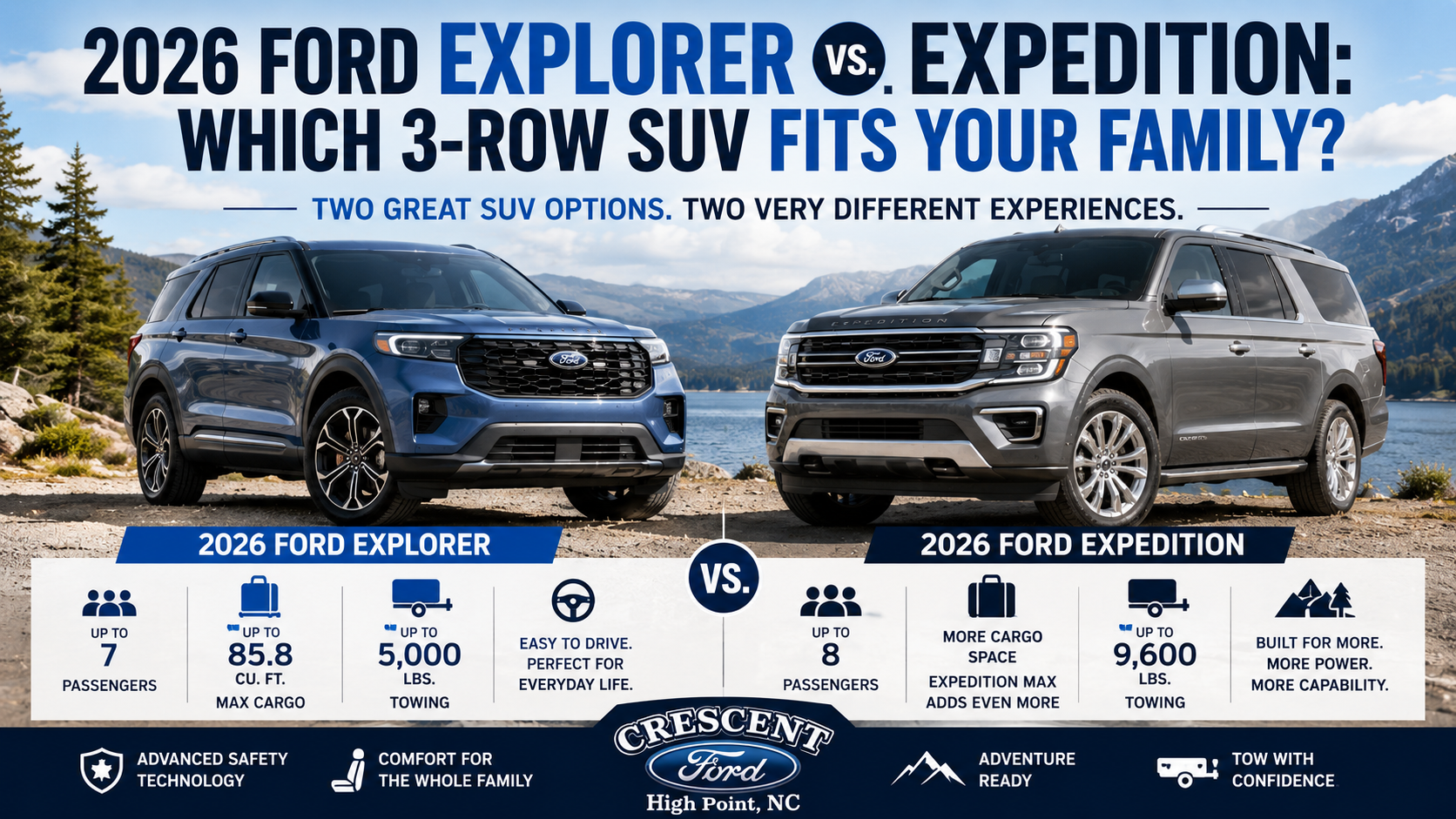
2026 Ford Explorer vs. Ford Expedition comparison for families, showing seating, cargo space and towing capability

2026 Ford Explorer vs. Expedition: Which 3-Row SUV Fits Your Family?

If your family needs three rows of seats, Ford gives you two very different ways to get them: the 2026 Ford Explorer and 2026 Ford Expedition.

At first, the decision might seem simple.

Explorer is the smaller one. Expedition is the bigger one.

But bigger isn't automatically better — especially when you're talking about the vehicle you'll use for school drop-offs, grocery runs, commuting, vacations, sports practices and everything else family life throws at it.

The better question is:

How much SUV does your family actually need?

For many families, the Explorer hits the sweet spot. It offers three rows, seating for up to seven, plenty of cargo flexibility and up to 5,000 pounds of towing capacity without moving into a full-size SUV.

The Expedition is for families who genuinely need more: more passenger capacity, more room, significantly more towing capability and the option of an extended-length Expedition MAX.

Here's how to decide which one makes more sense in your driveway.

2026 Explorer vs. Expedition at a Glance

Feature

2026 Ford Explorer

2026 Ford Expedition

SUV Class

Midsize 3-row SUV

Full-size 3-row SUV

Maximum Seating

Up to 7

Up to 8

Maximum Cargo Volume

Up to 85.8 cu. ft.

More overall cargo capacity; MAX adds additional space

Maximum Towing

5,000 lbs.

Up to 9,600 lbs.

Standard Engine

2.3L EcoBoost I-4

3.5L EcoBoost V6

Available Performance Engine

3.0L EcoBoost V6

High-Output 3.5L EcoBoost V6

RWD

Available

Available

4WD

Available

Available

Extended-Length Version

No

Expedition MAX

Best Fit

Most families needing 3 rows

Larger families, heavy towing and maximum space

Specifications vary by trim and configuration. Maximum towing ratings require proper equipment and can be affected by passengers, cargo and accessories. Verify specifications for the individual vehicle you're considering.

The quick answer

Choose the Explorer if you need three rows but still want something manageable for everyday driving, parking and commuting.

Choose the Expedition if you regularly use the third row, need seating for up to eight, carry a lot of people and cargo at the same time, or tow something that exceeds Explorer capability.

And if you're somewhere in between, that's exactly where this comparison gets interesting.

Compare New Ford SUVs at Crescent Ford


How Much Bigger Is the Ford Expedition Than the Explorer?

This is one of the biggest differences you'll notice before you even get behind the wheel.

The Explorer is a midsize SUV.

The Expedition is a full-size SUV.

The 2026 Explorer measures approximately 198.7 inches long, giving families three-row capability without the overall footprint of a full-size vehicle.

The Expedition is larger in virtually every meaningful dimension.

And then there's the Expedition MAX, which stretches the vehicle even farther to create additional cargo room.

That extra size can be fantastic when you need it.

It can also be more vehicle than some families need Monday through Friday.

Think about where you drive most

If your typical day involves:

  • School drop-off

  • Daycare

  • Grocery-store parking lots

  • Commuting

  • Downtown parking

  • Tight garages

  • Running errands around High Point or Greensboro

the Explorer's smaller dimensions can be a real advantage.

If your typical vehicle load looks more like:

two adults + three or four kids + luggage + sports equipment + a cooler + a dog, the Expedition's additional size starts looking less like a luxury and more like a necessity.

Our pick for everyday maneuverability: Explorer

Our pick for maximum space: Expedition


Which Has More Passenger Room?

Both are three-row SUVs, but don't let that make you think they provide the same passenger experience.

The Explorer can seat up to seven depending on configuration.

That's plenty for many families.

The Expedition can seat up to eight depending on configuration, and its full-size dimensions provide considerably more room for families who regularly fill all three rows.

The key word is regularly.

If your third row is mostly for:

"My kids occasionally bring a friend."

that's very different from:

"We have six people in this vehicle every single day."

If the third row is occasional seating, Explorer may be all the SUV you need.

If the third row is an everyday part of family life, we'd spend much more time looking at Expedition.


Which Third Row Is Better for Adults?

This deserves its own section because "three rows" doesn't always mean "three equally usable rows."

The Explorer provides a legitimate third row and can absolutely work for families.

But if you routinely expect adults or older teenagers to sit all the way in the back, the Expedition's larger dimensions become increasingly valuable.

This is something we'd strongly recommend testing in person.

Don't just sit in the driver's seat during your test drive.

Get out.

Move the second row.

Climb into the third row.

Then ask yourself:

Would I want to sit here for three hours on the way to the beach?

If the answer matters to your family, third-row comfort deserves much more weight than horsepower or wheel size.

Shop New Ford Explorer SUVs


Explorer vs. Expedition for Car Seats

If you have babies or younger children, the seating-capacity number only tells part of the story.

Car seats change everything.

A vehicle might technically seat seven people, but your real question could be:

Can I fit a rear-facing seat, a booster, two adults and all of our stuff without everyone climbing over each other?

Think about:

  • Rear-facing car-seat clearance

  • Access to the third row

  • Captain's chairs vs. bench seating

  • Where you'll install each child's seat

  • Whether older children need to pass between the second-row seats

  • How often you'll remove or reinstall seats

For families with one or two younger children, Explorer can make a lot of sense.

For larger families using multiple car seats while also needing the third row, Expedition's additional interior room deserves serious consideration.

One test-drive tip for parents

Bring your car seat with you.

Seriously.

Install it in the vehicle you're considering.

Move the front seat into your normal driving position.

Put the stroller in the cargo area.

Open and close everything.

A salesperson won't think it's strange.

It's much better to discover how your family actually fits before the vehicle is sitting in your driveway.


Which Has More Cargo Space?

The Expedition wins overall cargo capacity, particularly when you move into the Expedition MAX.

But there's another question that's more useful for families:

How much cargo space is left when you're actually using all three rows?

That's where three-row SUVs can surprise shoppers.

Folding the third row makes impressive maximum cargo numbers possible.

But if you've got children sitting back there, those seats can't also be folded down for luggage.

The 2026 Explorer provides 16.3 cubic feet of cargo space behind its third row and up to 85.8 cubic feet with the rear seating folded, depending on configuration.

That's useful flexibility for most day-to-day family tasks.

But if you regularly need:

all three rows + everyone's luggage, Expedition starts making a stronger case.

And if that describes every family vacation, Expedition MAX deserves a look.

Explorer makes sense when:

You occasionally use the third row and can fold seats when you need maximum cargo space.

Expedition makes sense when:

You need passengers and substantial cargo space simultaneously.

Expedition MAX makes sense when:

Your family looks at a regular Expedition and says:

"Where are we putting everything else?"


Explorer vs. Expedition for Strollers and Family Gear

This isn't the glamorous part of SUV shopping, but it might be one of the most important.

Babies come with an unbelievable amount of equipment.

Stroller.

Diaper bag.

Portable crib.

Groceries.

Maybe sports equipment for an older child.

Then someone decides you're going away for the weekend.

Maximum cargo volume doesn't tell you how easy those things are to load around your normal seating arrangement.

For a smaller family, Explorer's cargo area may be completely adequate.

For larger families — particularly those using the third row full-time — the Expedition's extra room can make everyday life noticeably easier.

Again, bring the stuff.

You don't need to bring your entire house to Crescent Ford.

But if your stroller is a major part of your daily routine, putting it into both SUVs will answer the question faster than reading another five comparison articles.


Which Is Easier to Drive Every Day?

Explorer.

For most people, there's not much debate here.

That doesn't mean Expedition is difficult to drive. Modern full-size SUVs have cameras, driver-assistance technology and features designed to make maneuvering easier.

But physics still exists.

The Expedition is larger.

The Explorer's approximately 199-inch length makes it more manageable in parking lots, garages and everyday traffic.

That's especially important if you're moving into a three-row SUV from something like an Escape, Bronco Sport or another compact crossover.

The Explorer gives you substantially more family capability without making the transition all the way to a full-size vehicle.

Our pick for High Point/Triad commuting: Explorer

If you're regularly driving between High Point, Greensboro, Winston-Salem and the surrounding Triad, Explorer provides a compelling combination of passenger capacity and everyday usability.


Which Is Better for Road Trips?

This one depends entirely on how many people are going.

Family of four?

Explorer may be the better road-trip vehicle.

You'll have plenty of passenger room and can fold some of the rear seating to create additional luggage space.

Family of five?

Still very much an Explorer conversation, depending on how you pack and how frequently you use the third row.

Six, seven or eight people?

Now we're leaning increasingly toward Expedition.

Once you're using all three rows and need luggage space at the same time, the additional size becomes extremely valuable.

Large family + luggage + long-distance travel?

Look closely at Expedition MAX.

There's a reason Ford offers the extended version.

Sometimes "more SUV" is exactly what a family needs.


Explorer vs. Expedition Engines

The two SUVs take different approaches to performance.

2026 Ford Explorer

Most Explorer models use a 2.3L EcoBoost four-cylinder producing up to 300 horsepower.

Select models offer a 3.0L twin-turbocharged EcoBoost V6 producing substantially more power.

That gives Explorer shoppers the ability to prioritize practical everyday performance or move into a more performance-oriented configuration.

2026 Ford Expedition

The Expedition uses a 3.5L EcoBoost V6.

The standard version produces up to 400 horsepower and 480 lb.-ft. of torque.

An available High-Output version increases that to up to 440 horsepower and 510 lb.-ft. of torque.

That additional output makes sense when you consider the Expedition's size and towing mission.

But don't choose between these SUVs solely based on horsepower.

If you're never towing a large trailer and mostly commuting with two kids, having more horsepower doesn't automatically make Expedition the better family vehicle.


Which Can Tow More: Explorer or Expedition?

This is one of the clearest victories for Expedition.

2026 Explorer maximum towing: 5,000 pounds

Ford equips every 2026 Explorer with a Class III Trailer Tow Package, and the maximum trailer rating is 5,000 pounds when properly equipped.

That's enough capability for a variety of recreational towing needs.

2026 Expedition maximum towing: 9,600 pounds

A properly equipped standard-wheelbase Expedition 4x4 can tow up to 9,600 pounds in eligible configurations.

Expedition MAX can tow up to 9,000 pounds when properly equipped.

That's a major difference.

If your family owns — or plans to buy — a larger camper, boat or trailer, Expedition may be the obvious choice.

See Available Ford Expedition SUVs


Do You Actually Need Expedition Towing Capacity?

This is where we'd caution against shopping entirely from maximum numbers.

If your trailer weighs 3,000 pounds loaded, you don't automatically need a vehicle capable of towing 9,600 pounds.

Explorer may handle your needs perfectly well when properly configured.

On the other hand, if you're shopping for a large camper and expect to carry the entire family, luggage and gear while towing, that's a much different scenario.

Remember:

Passengers and cargo matter when towing.

Don't simply look up the trailer's advertised dry weight and compare it with a vehicle's maximum towing number.

If towing will be an important part of your family's SUV use, bring the trailer specifications with you when you shop.

We can help you evaluate them against the specifications of the actual vehicle you're considering.


Explorer vs. Expedition for Fuel Economy

Generally, Explorer is the more fuel-conscious choice.

That's not surprising.

It's smaller and lighter and offers a 2.3L EcoBoost four-cylinder as its primary engine.

Expedition is a full-size SUV powered by a 3.5L EcoBoost V6 and designed to provide substantially greater towing and hauling capability.

Rather than fixating on a single MPG number here — ratings can vary by trim, drivetrain and configuration — think about your actual use.

If you drive 15,000 miles per year and tow twice, Explorer's everyday efficiency may matter much more than Expedition's additional capability.

If you're regularly towing a large camper with six people aboard, the Expedition's greater fuel use may simply be part of having the capability you actually need.


Which Is Better for a Family of Four?

For most families of four, we'd start with Explorer.

You get three-row flexibility without needing to drive a full-size SUV every day.

That third row can handle friends, grandparents or additional passengers when needed.

When it isn't needed, fold it down and use the space for cargo.

That's an extremely useful combination.

We'd move toward Expedition if the family regularly:

  • Tows heavier trailers

  • Carries a lot of equipment

  • Takes long trips with significant luggage

  • Wants substantially more passenger room

  • Simply prefers the size and driving position of a full-size SUV

But having two children doesn't automatically mean you need the largest three-row SUV available.


Which Is Better for a Family of Five?

This is where we'd drive both.

Explorer can absolutely work for a family of five.

But your children's ages matter.

Three teenagers have different space requirements than three young children.

Three children in car seats create another set of requirements entirely.

Then consider how often you travel.

If you're frequently loading five people, luggage, sports equipment and everything else into the vehicle, Expedition's additional space may become much more valuable.

For normal commuting and occasional travel, Explorer may still be the sweet spot.


Which Is Better for a Family of Six or More?

This is where Expedition starts to pull ahead.

The Explorer can seat up to seven depending on configuration, so the question isn't simply whether everyone technically has a seat.

It's whether everyone and everything fit comfortably.

A family of six using Explorer's third row every day may find that cargo space and passenger access matter more than they expected.

Expedition gives you more breathing room.

And the availability of eight-passenger configurations matters for larger households.

If you regularly carry six or more people, we'd put Expedition very high on the test-drive list.


Do You Need an Expedition MAX?

Not everyone does.

The standard Expedition is already a very large and capable SUV.

The MAX exists for families who need to solve a specific problem:

carrying lots of passengers and lots of cargo at the same time.

Think:

  • Large families

  • Frequent road trips

  • Sports equipment

  • Vacation luggage

  • Camping gear

  • Large strollers

  • Families who rarely have the luxury of folding the third row

If your family regularly fills a standard three-row SUV to the roof, MAX can be incredibly useful.

If you usually have four passengers and occasionally use the third row, it may simply be more vehicle than you need.


Explorer Tremor vs. Expedition Tremor

For 2026, both families can also shop a Tremor if outdoor capability matters.

But these aren't identical vehicles with different dimensions.

The Explorer Tremor gives families a more adventure-focused version of the midsize Explorer, including Intelligent 4WD and equipment aimed at getting farther away from pavement.

Expedition Tremor applies that idea to a full-size SUV with considerably more overall capability.

Which makes more sense?

The same rule applies.

If you want an adventure-ready family SUV but don't need full-size dimensions or heavy towing, start with Explorer Tremor.

If you're hauling a larger family, substantial gear and potentially a heavier trailer into your adventures, Expedition Tremor becomes much more compelling.


Which Is the Better Value?

We wouldn't answer this by simply comparing starting prices.

Value depends on whether you're paying for capability you'll actually use.

An Explorer can be a better value for a family that needs three rows but doesn't need full-size towing and cargo capacity.

An Expedition can be a better value for a family that would otherwise constantly struggle with space or towing limits.

Buying the less expensive vehicle isn't a bargain if it doesn't do what you need.

Buying the larger vehicle isn't necessarily a better value if you're paying for space and capability you never use.

The goal is to find the point where:

your needs + your budget + the vehicle's capability actually match.


Should You Buy an Explorer or Expedition?

Here's our simplest recommendation.

Buy the 2026 Ford Explorer if:

  • You need three rows but don't want a full-size SUV.

  • Your family typically has four or five people.

  • The third row is used occasionally or moderately.

  • Everyday maneuverability matters.

  • You commute frequently.

  • Up to 5,000 pounds of towing meets your needs.

  • You want flexible family space without going huge.

Buy the 2026 Ford Expedition if:

  • You regularly carry six or more people.

  • Adults or teenagers frequently use the third row.

  • You need more passenger and cargo room simultaneously.

  • You tow a heavier boat, camper or trailer.

  • You want seating for up to eight.

  • Full-size SUV space is a priority.

  • Your family simply needs more room.

Consider Expedition MAX if:

You read the Expedition list and thought:

"Yes, but we also bring a ridiculous amount of stuff."

That's exactly the problem MAX is designed to solve.


The Best Way to Decide? Bring Your Family

We're serious.

A three-row SUV is one of the worst vehicles to choose based entirely on specifications.

Bring the kids.

Bring the car seats.

If the stroller is always in your vehicle, bring the stroller.

Have everyone climb in.

Put someone in the third row.

Move the seats.

Open the cargo area.

Then drive both SUVs.

You may discover that Explorer has much more room than you expected.

Or you may get everyone into Explorer, look at the cargo area and immediately realize why Expedition exists.

Either result is useful.

Compare Explorer & Expedition Inventory in High Point


What About Your Current Vehicle?

If you're trading your current vehicle toward an Explorer or Expedition, knowing its value can make this decision easier.

A larger SUV may look outside your planned budget until you know how much equity you have in your trade.

Or your trade value may confirm that Explorer is the more comfortable financial choice.

Either way, don't guess.

Find Out What Your Current Vehicle Is Worth

Related reading: What Is My Car Worth in High Point, NC? How Trade-In Appraisals Actually Work

Related reading: Can You Trade In a Car You Still Owe Money On?


Compare the 2026 Ford Explorer and Expedition in High Point, NC

The Explorer and Expedition aren't really competing to be the same SUV.

They solve different family problems.

Explorer gives most families the space and flexibility of three rows without requiring them to drive a full-size SUV every day.

Expedition gives larger families and heavier towers the room and capability Explorer simply isn't designed to provide.

For families around High Point, Greensboro, Winston-Salem and the Piedmont Triad, the right answer comes down to how many people you regularly carry, how much stuff goes with them and whether towing is part of your family's plans.

At Crescent Ford in High Point, you can compare available Explorer and Expedition models in person.

And don't worry about showing up with car seats, kids and a stroller.

For this particular comparison, that's probably the best test-drive equipment you can bring.

Shop New Ford SUVs at Crescent Ford

Shop Ford Explorer
Shop Ford Expedition
Value Your Trade 


Frequently Asked Questions: Ford Explorer vs. Expedition

Is the Ford Expedition bigger than the Explorer?

Yes. The Expedition is a full-size three-row SUV, while the Explorer is a midsize three-row SUV. Expedition provides more overall passenger and cargo room, while Explorer's smaller dimensions make it easier to maneuver for everyday driving.

How many people can the 2026 Ford Explorer seat?

The 2026 Ford Explorer can seat up to seven people depending on configuration.

How many people can the 2026 Ford Expedition seat?

The 2026 Ford Expedition can seat up to eight people depending on seating configuration.

Which has more cargo space, Explorer or Expedition?

The Expedition provides more cargo capacity overall, and the extended-length Expedition MAX adds even more room. The Explorer offers up to 85.8 cubic feet of maximum cargo volume depending on configuration.

How much can a 2026 Ford Explorer tow?

Every 2026 Explorer comes with a Class III Trailer Tow Package and can tow up to 5,000 pounds when properly equipped.

How much can a 2026 Ford Expedition tow?

A properly equipped 2026 Expedition can tow up to 9,600 pounds in eligible configurations. Expedition MAX can tow up to 9,000 pounds when properly equipped.

Which is better for a family of four: Explorer or Expedition?

For many families of four, Explorer provides an excellent balance of three-row seating, cargo flexibility and manageable dimensions. Expedition becomes more attractive if you need substantially more cargo space or towing capability.

Which is better for a large family?

Expedition generally makes more sense for families who regularly carry six or more passengers because of its greater interior room and available eight-passenger seating.

Is Expedition MAX worth it?

Expedition MAX can be particularly useful for larger families who need all three seating rows and substantial cargo space at the same time. If you rarely fill the third row, the additional size may be unnecessary.

Should I test drive Explorer and Expedition back-to-back?

Yes. The difference in overall size, seating space and driving feel is significant enough that a back-to-back comparison can be more useful than specifications alone. If you're shopping for a family vehicle, bring the car seats or other equipment you regularly carry.

Schedule a test drive for an Expedition and Explorer

Posted in:

Related Posts

Trading in a financed car at Crescent Ford in High Point, NC, showing trade-in value, loan payoff and vehicle equity

Can You Trade In a Car You Still Owe Money On?

Can You Trade In a Car You Still Owe Money On? Yes. You can trade in a car even if you haven't finished paying off the loan. In fact, it's extremely common for drivers to trade vehicles that still have an outstanding loan balance. The important question isn't really whether you still owe money. It's this: Is your vehicle worth more or less than what you currently owe? If your vehicle is worth more than your loan payoff, you have positive equity. That equity can generally be applied toward your next vehicle. If your vehicle is worth less than your payoff, you have negative equity, sometimes called being "upside down" on your loan. You may still be able to trade, but you'll need to account for the difference. Here's how the process works and what you should know before deciding whether trading your financed vehicle makes sense. Find Out What Your Current Vehicle Is Worth How Do You Trade In a Car That Isn't Paid Off? The process is actually pretty straightforward. When you trade a financed vehicle, there are two numbers that matter: 1. Your vehicle's trade-in value This is what the dealership determines your vehicle is worth based on its year, make, model, mileage, equipment, condition, history and current market demand. 2. Your loan payoff amount This is the amount required to completely satisfy your existing auto loan. Then you compare the two. The basic formula is: Trade-In Value − Loan Payoff = Your Equity For example: Trade Value Loan Payoff Equity $25,000 $20,000 +$5,000 $25,000 $25,000 $0 $20,000 $25,000 -$5,000 That difference determines what happens next. What Is a Loan Payoff? Your payoff amount isn't necessarily the same number you see as the current balance when you log into your lender's website or app. A payoff quote is the amount necessary to completely satisfy the loan by a particular date. It can account for interest that accrues through the payoff date and potentially other amounts associated with the loan. That's why you don't want to estimate your equity using a loan balance from an old statement. You want a current payoff amount. When you're actually trading the vehicle, the dealership can typically work with the lender to obtain the necessary payoff information and pay off the existing lien as part of the transaction. Until your lender confirms that your previous loan has been satisfied, continue following your existing loan obligations. What Happens If My Car Is Worth More Than I Owe? This is the easiest scenario. You have positive equity. Let's say: Your trade is worth: $24,000 Your loan payoff is: $18,000 Subtract the payoff from the trade value: $24,000 − $18,000 = $6,000 positive equity That $6,000 represents value you have in the vehicle after satisfying the old loan. If you're trading toward another vehicle, that equity can generally be applied toward the transaction. Positive equity can reduce how much you need to finance Imagine you're purchasing a $35,000 vehicle. Your $6,000 of positive trade equity can reduce the amount that needs to be covered by your cash and/or financing, before considering applicable taxes, fees and other parts of the transaction. That's one reason knowing your equity position before you start seriously shopping can be helpful. You may have more buying power in your current vehicle than you realized. See What Your Trade Could Be Worth What If My Car Is Worth Exactly What I Owe? Then you're essentially at break-even. For example: Trade value: $20,000 Payoff: $20,000 Your vehicle's value satisfies the old loan, but there's no remaining positive equity to apply toward the next purchase. That isn't necessarily a bad position. It simply means your current vehicle isn't contributing additional equity toward your next one. You can evaluate the next purchase based on your budget, financing and whether changing vehicles makes sense for you. What If I Owe More Than My Car Is Worth? This is called negative equity. You may also hear it described as being: Upside down Underwater Buried in a vehicle They all refer to essentially the same situation: Your loan payoff is higher than your vehicle's current value. Suppose: Your trade is worth: $20,000 Your payoff is: $25,000 That leaves: $5,000 in negative equity. Trading the vehicle doesn't make that $5,000 disappear. The remaining balance still has to be accounted for as part of the transaction. Can You Trade In a Car With Negative Equity? Yes, it may be possible to trade a vehicle with negative equity. But this is where we want shoppers to slow down and look at the complete transaction. There are generally a few ways negative equity can be handled. Option 1: Pay the difference If you have $5,000 of negative equity, you could potentially contribute enough cash to cover that difference. That keeps the old debt from being added to the financing of your next vehicle. Whether that's the best use of your cash is a personal financial decision, but mathematically it's the cleanest solution. Option 2: Include the negative equity in new financing Depending on the new vehicle, your credit, the amount of negative equity and lender approval, it may be possible to include some or all of the remaining balance in the financing for your next vehicle. This is commonly referred to as "rolling negative equity" into the new loan. But there's something important to understand: The debt isn't erased. It's moved. Suppose you're buying a $35,000 vehicle and have $5,000 in negative equity. If that entire $5,000 were included in the new financing, you're effectively adding that previous debt to the amount being financed on the replacement vehicle, along with other applicable costs. That can mean: A larger loan A higher monthly payment More interest paid over time A greater chance of starting the next loan with negative equity Approval is also not automatic. Lenders have guidelines regarding how much they're willing to finance relative to a vehicle's value. Option 3: Wait and pay down your current loan Sometimes the best trade is not trading yet. If your current vehicle still meets your needs and you're significantly upside down, continuing to make payments can reduce the loan balance. You may eventually reach a point where the gap between your payoff and vehicle value is smaller — or where you have positive equity. That can put you in a stronger position for the next purchase. Option 4: Make an additional principal payment If you're close to breaking even and have available cash, you might choose to pay down the existing loan before trading. Check with your lender regarding how additional payments are applied and whether your loan has any relevant terms you should understand. How Do I Know If I'm Upside Down on My Car? You need two reasonably accurate numbers. Step 1: Find out what your vehicle is worth You can start with an online trade-in estimate. For a more complete picture, have the actual vehicle appraised. Mileage, condition, equipment, vehicle history and current market demand can all affect its value. Related reading: What Is My Car Worth in High Point, NC? How Trade-In Appraisals Actually Work Step 2: Get your current loan payoff Contact your lender or check whether a payoff quote is available through your online account. Step 3: Subtract If: Trade Value > Payoff You have positive equity. If: Trade Value = Payoff You're approximately break-even. If: Trade Value < Payoff You have negative equity. Don't assume you're upside down just because you still have several years of payments left. And don't assume you have equity simply because you've owned the vehicle for several years. Get the numbers. Start With Your Trade-In Value Why Do People End Up With Negative Equity? Negative equity isn't unusual. Vehicles depreciate, while auto loans are paid down according to a separate schedule. Those two numbers don't always move at the same speed. Several situations can contribute to negative equity. A small down payment If you financed most or all of a vehicle purchase, you may have started with relatively little equity. A longer loan term Longer loan terms can lower the monthly payment, but they can also mean the principal balance declines more slowly. Trading vehicles frequently If you replace vehicles before building much equity — particularly if negative equity was included in a previous loan — the problem can carry into the next transaction. High mileage or vehicle condition Mileage, accidents, mechanical issues and condition can affect the vehicle's market value. Changes in the used-car market Vehicle values don't remain fixed. The market value of a particular model can rise or fall based on supply, demand and broader market conditions. That's why knowing what you paid three years ago doesn't tell you what the vehicle is worth today. How Much Negative Equity Is Too Much to Trade? There isn't one dollar amount that applies to everyone. Having $2,000 in negative equity on one transaction can be very different from having $2,000 on another. The bigger questions are: What vehicle are you purchasing? How much negative equity do you have? How much cash are you putting down? What is the new vehicle worth? What amount will need to be financed? What loan terms are available? Does the lender approve the transaction? Does the resulting payment fit comfortably into your budget? Instead of asking: "Can I get approved?" we'd encourage you to also ask: "Does this transaction make financial sense for me?" Those aren't always the same question. A dealership finance department can show you what may be possible. You still get to decide whether it's the right move. Explore Auto Financing Options Can a Dealer Pay Off My Current Car Loan? When you trade a financed vehicle through a dealership, the existing loan is generally handled as part of the transaction. The dealer obtains the appropriate payoff information and sends payment to the lienholder. If you have positive equity, the difference is accounted for in your transaction. If you have negative equity, that difference also has to be addressed. This can make trading considerably simpler than trying to privately sell a vehicle with an active lien, because you're not personally coordinating the purchase, lien payoff and title process with a private buyer. But you should still review your paperwork. Make sure you understand: Your agreed trade value Your old loan payoff Your positive or negative equity The selling price of the next vehicle Amount financed APR Loan term Monthly payment Applicable taxes and fees Don't focus only on the payment. Understanding how the transaction gets to that payment gives you a much clearer picture. Does Trading In a Financed Car Hurt Your Credit? Simply having a loan on your trade doesn't inherently damage your credit. If you finance your next vehicle, however, the lender will generally review your credit as part of the new credit application. Your existing auto loan also remains your responsibility until it has actually been paid off. After a trade, keep an eye on the old account and continue following your lender's payment requirements until the payoff is completed and reflected by the lender. Can I Trade In My Car If I Just Bought It? Potentially, yes. There's no general rule requiring you to finish paying off a car before you're allowed to trade it. The bigger issue is usually equity. Vehicles can depreciate faster than the loan balance declines, particularly early in ownership. If you recently bought a vehicle and financed a large portion of the purchase, you may discover that you owe considerably more than its current trade value. That doesn't necessarily make trading impossible. It does mean you should understand exactly how much negative equity you're dealing with before proceeding. Should I Trade My Car If I'm Upside Down? Sometimes there are legitimate reasons to consider it. Maybe: Your family has outgrown the vehicle. You need a truck for work. Your commute has changed. You need different capabilities. The vehicle no longer works for your lifestyle. You're facing reliability concerns or other circumstances that make replacing it important. But if the only reason is: "I'm tired of my current car," and you're substantially upside down, waiting deserves serious consideration. Rolling negative equity from one vehicle to another repeatedly can make it increasingly difficult to reach a positive-equity position. There's nothing wrong with wanting a different vehicle. Just know what that decision actually costs. Can a Rebate or Discount Get Rid of Negative Equity? This is an area where terminology can become misleading. A manufacturer incentive, dealer discount or other savings may improve the overall numbers on a transaction. But it doesn't literally change what you owe on your old vehicle. If you owe $25,000 and your vehicle is worth $20,000, you still entered the transaction with a $5,000 equity deficit. What matters is how all of the numbers work together and what amount ultimately needs to be financed. Also remember that incentives change frequently and can depend on the vehicle, program, buyer qualifications and financing method. Don't choose a replacement vehicle solely because someone tells you a large rebate will "wipe out" your negative equity. Ask to see the complete numbers. Should I Put Money Down If I Have Negative Equity? Cash down can potentially reduce the amount you need to finance. For example, if you have $4,000 in negative equity and contribute $4,000 in cash, you've effectively offset that difference before considering the rest of the transaction. But whether you should use your cash that way depends on your finances. You may need to preserve emergency savings or have other financial priorities. The useful question is: How does this amount of cash change my new loan and payment? Have the numbers calculated both ways. Then you can make an informed decision. What Should I Bring When Trading a Car With a Loan? When you're ready to trade, it helps to have: Your driver's license Current vehicle registration Lender information Loan account information if requested All keys and key fobs Any relevant vehicle records you want considered You generally won't have a clear title in hand when a lender still has a lien on the vehicle, so don't assume that prevents you from starting the trade process. Requirements can vary depending on ownership, lender and individual circumstances, so confirm what documentation you'll need for your particular transaction. Can I Trade a Vehicle Financed Through a Different Bank or Credit Union? Generally, yes. Your vehicle doesn't have to be financed through the dealership or manufacturer you're buying your next vehicle from. The payoff process can involve banks, credit unions and other auto lenders. If you're considering trading, having your lender information available can make obtaining an accurate payoff easier. Can I Trade In My Car Without Buying Another One? A trade-in technically involves exchanging your current vehicle as part of another purchase. If you simply want to get rid of your current vehicle without replacing it, you're looking to sell the vehicle rather than trade it. An outstanding loan still has to be satisfied before ownership can be transferred free of the lien. If you're deciding between selling and trading, compare the actual numbers rather than assuming one approach is always better. What Should I Do Before Shopping for My Next Car? If you're trading a financed vehicle, we'd do things in this order. 1. Get your trade value Find out approximately what your vehicle is worth. 2. Get your payoff Use a current payoff amount rather than guessing from the balance on an old statement. 3. Calculate your equity Now you know whether you're positive, even or negative. 4. Establish your budget If you have positive equity, determine how much you want to apply toward the next purchase. If you're upside down, decide whether you're comfortable paying some of the difference or potentially financing it if approved. 5. Then shop for the replacement vehicle This gives you a much more useful budget. Instead of saying: "I need my payment to be $500." you can look at the entire transaction and understand how your trade, payoff, financing and replacement vehicle interact. Value Your Trade Browse New Ford Inventory Browse Used Cars, Trucks & SUVs Trading In a Financed Car in High Point, NC If you live around High Point, Greensboro, Thomasville, Trinity, Kernersville, Winston-Salem or elsewhere in the Piedmont Triad, you don't have to wait until your final loan payment to find out whether changing vehicles makes sense. Start with two numbers: What is your vehicle worth? and What is your payoff? From there, the picture becomes much clearer. At Crescent Ford in High Point, we can appraise your current vehicle and help you understand how its value compares with the amount you still owe. If you have equity, we'll show you how it affects the transaction. If you're upside down, we'll show you the numbers there too. And if the numbers don't make sense yet, knowing that is valuable information as well. The goal isn't simply to find out whether you can trade your vehicle. It's to understand what happens financially if you do. Find Out What Your Vehicle Is Worth Talk With Our Finance Team About Your Options Frequently Asked Questions About Trading In a Car With a Loan Can you trade in a car that isn't paid off? Yes. You can generally trade a vehicle while you still have an outstanding auto loan. The dealership obtains the loan payoff and accounts for it as part of the transaction. What happens to my old car loan when I trade? The existing loan must be paid off. When you trade through a dealership, the dealership typically obtains the payoff information and sends the required payment to your lender as part of completing the transaction. What happens if my trade is worth more than I owe? The difference is positive equity. For example, if your vehicle is worth $20,000 and your payoff is $15,000, you have $5,000 in positive equity that can generally be applied toward your next purchase. What happens if I owe more than my car is worth? You have negative equity. The difference must still be accounted for. You might pay it with cash or, subject to lender approval and the specifics of the transaction, some or all may potentially be included in new financing. Can a dealership roll my negative equity into another car loan? It may be possible, depending on lender approval, the amount of negative equity, your credit and the vehicle you're purchasing. Doing so increases the amount financed because the old debt doesn't disappear. How do I find out how much equity I have in my car? Subtract your current loan payoff from your vehicle's current trade-in value. A positive result means you have positive equity; a negative result means you're upside down. Is my payoff amount the same as my loan balance? Not necessarily. A payoff quote reflects the amount required to fully satisfy the loan by a specified date and can differ from the balance displayed on a statement or account screen. Should I trade in a car with negative equity? It depends on why you're replacing the vehicle, the size of the equity deficit and how the new transaction affects your finances. If replacing the vehicle isn't necessary, waiting and reducing your existing loan balance may put you in a better financial position. Can I trade a car I just financed? Potentially. However, trading soon after purchase can make negative equity more likely because the vehicle's market value may be lower than the remaining loan payoff. Do I need to pay off my car before bringing it to the dealership? No. You can have the vehicle appraised while it still has a loan. If you decide to trade, the existing lien and payoff are addressed as part of the transaction. Related reading: What Is My Car Worth in High Point, NC? How Trade-In Appraisals Actually Work

2026 Ford Maverick, Ranger and F-150 comparison showing truck sizes and towing capability

2026 Ford Maverick vs. Ranger vs. F-150: Which Truck Is Right for You?

2026 Ford Maverick vs. Ranger vs. F-150: How Much Truck Do You Actually Need? If you've decided you want a Ford truck, choosing between the Maverick, Ranger and F-150 might seem simple: Small. Medium. Large. But that's not really the best way to choose. The better question is: How much truck do you actually need? Buying more truck than you'll use can mean living with a larger vehicle every day when a smaller truck would have handled everything you needed. Buy too little truck, though, and you may discover that the camper, boat, trailer or workload you had in mind exceeds what your truck was designed to handle. For 2026, Ford gives shoppers three very different answers. The Ford Maverick is the compact choice, combining a genuinely useful pickup bed with easy everyday driving and an available hybrid powertrain. The Ford Ranger moves into midsize-truck territory with considerably more towing capability, a larger bed and available 4x4. And the Ford F-150 is the full-size choice, offering the most configurations, powertrain choices and capability of the three. Here's how to figure out which one actually fits your life. Maverick vs. Ranger vs. F-150 at a Glance Feature 2026 Maverick 2026 Ranger 2026 F-150 Truck Class Compact Midsize Full-size Cab SuperCrew SuperCrew Multiple configurations Max. Available Towing 4,000 lbs. 7,500 lbs. 13,500 lbs. Hybrid Available Yes No Yes 4x4/AWD Available AWD available 4x4 available 4x4 available Best For Commuting + light truck duty More capability without full-size dimensions Maximum versatility, towing and truck capability Maximum ratings require specific configurations and equipment. Payload and towing capacity vary by vehicle, equipment, passengers and cargo. Always verify the ratings of the specific truck you intend to purchase. The short answer Choose the Maverick if you want a truck primarily for everyday transportation but regularly need a bed for home projects, outdoor gear or lighter-duty hauling. Choose the Ranger if you need legitimate towing and off-road capability but don't necessarily want to drive a full-size truck every day. Choose the F-150 if towing, payload, bed/cab choices, powertrain options or maximum versatility are priorities. If you're already leaning toward one, start by seeing what's actually available. Compare New Ford Trucks at Crescent Ford When Does a Ford Maverick Make the Most Sense? The Maverick makes an interesting argument: Do you really need a traditional full-size pickup to do the things you want a truck to do? For plenty of drivers, the answer is no. Maybe you're commuting between High Point and Greensboro during the week, but on Saturday you're hauling mulch, taking bicycles to a trail, buying lumber for a home project or loading camping gear. That's exactly where a compact pickup starts making sense. The Maverick gives you four doors, seating for five and a useful pickup bed without the dimensions of a full-size truck. For 2026, the Maverick also continues to offer something neither the Ranger nor most conventional pickups can match: a standard hybrid powertrain with impressive fuel efficiency. The 2026 Maverick Hybrid FWD is EPA-estimated at up to 42 mpg city. That's an unusual number for a pickup. Who should buy a Maverick? The Maverick deserves serious consideration if: Your truck will also be your daily commuter. You don't regularly tow heavy trailers. You want something easy to maneuver and park. You haul DIY supplies, landscaping materials, bikes or outdoor equipment. Fuel economy matters. You want four doors and useful passenger space. You like having a pickup bed but don't need a full-size bed. You're moving from a car or compact SUV and want additional utility. The Maverick isn't pretending to be an F-150. That's actually part of its appeal. You're getting the utility you need without paying for — or driving around with — capability you may never use. Shop New Ford Maverick Trucks How Much Can the Ford Maverick Tow? A properly equipped 2026 Maverick can tow up to 4,000 pounds with the available 4K Tow Package and an eligible powertrain/drivetrain configuration. Without that package, the maximum loaded trailer weight is generally 2,000 pounds. That distinction is extremely important. Seeing “Maverick can tow 4,000 pounds” online does not mean every Maverick sitting on a dealer lot is rated to tow 4,000 pounds. If towing is part of your purchase decision, make that known while you're shopping so you can verify the equipment and rating of the specific vehicle. Is 4,000 pounds enough? Potentially. It depends entirely on what you're towing. A small utility trailer, lightweight boat or certain smaller recreational trailers may fit within the capabilities of a properly equipped Maverick. But don't choose a truck based solely on your trailer's advertised “dry weight.” Trailer cargo, fluids, equipment, passengers and cargo in the truck all matter when determining whether a particular truck-and-trailer combination is appropriate. If your towing needs are approaching the Maverick's upper limits regularly, we'd start looking at the Ranger. When Is the Ford Ranger the Better Choice? The Ranger occupies what may be the sweet spot of the Ford truck lineup. It's considerably more capable than the Maverick but doesn't require you to move all the way into a full-size F-150. For many buyers, that's exactly the point. A properly equipped 2026 Ranger can tow up to 7,500 pounds. That creates a big jump from Maverick capability and opens the door to heavier trailers and more demanding recreational or work uses. The Ranger also provides a 59.6-inch bed and, depending on trim and configuration, can offer maximum available payload exceeding 1,700 pounds. Who should buy a Ranger? Consider Ranger if: You tow more than a Maverick comfortably accommodates. You want a midsize truck rather than a full-size pickup. Off-road capability is important. You regularly haul equipment or supplies. You want a traditional body-on-frame pickup. You need more capability but don't need F-150-level towing. You're looking for a truck that can serve both work and recreation. This is where we'd encourage shoppers to be particularly realistic about their needs. If you tow a 5,000-pound trailer, there's no reason to try to make a Maverick work. But there's also no rule saying that automatically means you need an F-150. The Ranger may give you exactly the middle ground you're looking for. See Available Ford Ranger Trucks What Engines Are Available in the Ranger? The 2026 Ranger offers multiple EcoBoost powertrains depending on trim. The standard 2.3L EcoBoost provides a strong balance of everyday performance and capability. An available 2.7L EcoBoost V6 gives shoppers another step up in performance while retaining the Ranger's midsize dimensions. At the performance end of the lineup, Ranger Raptor uses a 3.0L EcoBoost V6. But here's an important point: Don't assume the most powerful Ranger automatically has the highest towing capacity. The Ranger Raptor is engineered around high-performance off-road capability and has a maximum loaded trailer rating of 5,510 pounds for 2026. Properly equipped Rangers with the 2.3L or 2.7L EcoBoost can reach the 7,500-pound maximum. This is a good example of why truck shopping requires looking beyond horsepower. Choose the configuration designed for the job you're actually going to do. When Should You Step Up to the Ford F-150? This is where the question changes. Instead of asking whether you need a truck, you're asking how much work you expect that truck to do. The F-150 provides substantially more choice than Maverick or Ranger. Different cab configurations. Different bed lengths. Multiple engines. Available hybrid power. Serious towing capability. Greater maximum payload. And configurations ranging from work-focused pickups to premium family trucks and high-performance off-road models. A properly configured 2026 F-150 can tow up to 13,500 pounds and offers maximum available payload of up to 2,440 pounds. Those are maximum figures, not ratings for every F-150. But they illustrate just how much capability becomes available when you step into Ford's full-size truck. Who should buy an F-150? The F-150 should probably be your starting point if: You regularly tow heavier trailers. You need more bed or cab configurations. Your truck is an important work tool. You regularly carry heavier payloads. You want a V8 option. You want an available full-hybrid powertrain in a full-size truck. You want available onboard power for tools, equipment or recreation. You need a truck that can comfortably transition between work, family duty and towing. You simply prefer the space and feel of a full-size pickup. For some buyers, F-150 capability isn't optional. For others, it's simply what they prefer. There's nothing wrong with buying more capability because you want it. The point is to understand what you're paying for and what you're getting. Browse New Ford F-150 Inventory Maverick vs. Ranger vs. F-150 for Towing Towing is one of the easiest ways to narrow this comparison. Up to 4,000 pounds: Start with Maverick If your towing needs are relatively light and you want the everyday benefits of a compact truck, a properly equipped Maverick with the 4K Tow Package may be enough. Up to 7,500 pounds: Look closely at Ranger Ranger dramatically expands your towing possibilities while keeping midsize dimensions. Heavier towing: F-150 The F-150 provides substantially greater available towing capacity, topping out at 13,500 pounds when properly configured. But don't buy your tow vehicle by looking only at the maximum number. Your actual truck needs to be configured correctly for your trailer. Payload matters too. Passengers matter. Cargo matters. Trailer tongue weight matters. Equipment matters. If towing is a major reason you're buying a truck, bring the specifications for your trailer when you shop. We can help you compare those requirements against the ratings of the actual trucks you're considering. One towing rule worth remembering Don't buy exactly enough truck on paper if you know you'll regularly operate near its limits. A little breathing room can make much more sense than choosing solely because a trailer technically falls below a published maximum. What About Payload? Towing gets most of the attention, but payload is equally important for many truck owners. Payload is the weight the truck itself is carrying. That includes more than whatever you throw into the bed. It can include: Passengers Cargo Tools Accessories Gear Trailer tongue weight That's why two people towing the same trailer can have different truck requirements. Imagine one driver towing with just one passenger and an almost empty bed. Now imagine another towing the same trailer with four passengers, coolers, luggage and equipment in the truck. The trailer hasn't changed. The load on the truck has. The F-150 offers the highest maximum available payload of these three trucks, followed by Ranger, while Maverick is designed around lighter-duty use. Most importantly, check the payload label on the specific truck you're considering. Maximum advertised payload ratings represent particular configurations and shouldn't be assumed to apply to every vehicle. Which Ford Truck Is Easiest to Drive Every Day? Maverick wins for most commuters. If you're going to work, picking up kids, running errands and squeezing into parking spaces most of the week, Maverick's compact size is a major advantage. It feels less like you're making a compromise just to own a pickup. Ranger is the middle ground. It gives you more of the traditional truck experience without the overall footprint of an F-150. That's attractive for someone who wants legitimate truck capability but still spends plenty of time driving through town. F-150 gives you the most space. If you're comfortable driving a full-size truck, the F-150 can be an excellent everyday vehicle — particularly when passenger room matters. The tradeoff is obvious. It's a larger vehicle. Whether that's a benefit or inconvenience depends entirely on how you use it. If you're driving around High Point most days but regularly heading toward Greensboro, Winston-Salem or elsewhere in the Triad, we'd weigh your normal commute just as heavily as what you plan to do on occasional weekends. You're going to experience the truck's size every day. Which Ford Truck Is Best for Families? This one is less obvious than you might expect. All three can work for family use, but they appeal to different families. Maverick A strong choice for smaller families who want four doors, five seats and truck utility without full-size dimensions. It can make particular sense if this vehicle replaces a compact crossover. Ranger A good middle ground for families that spend a lot of time outdoors, tow recreational equipment or want more traditional truck capability. F-150 The strongest choice when rear-seat space, long trips and maximum versatility are priorities. A SuperCrew F-150 can function as both a serious truck and a spacious family vehicle. If you're bringing car seats into the equation, don't make the decision from measurements alone. Bring the car seat. Install it. Sit in front of it. Try the doors. Look at where you'll put the stroller, diaper bag, sports equipment or luggage. A spec sheet can tell you how large a truck is. It can't tell you whether your family's stuff works in it. Which Has the Most Useful Truck Bed? Again, “biggest” and “most useful” aren't always the same thing. Maverick: Clever everyday utility Maverick's FLEXBED system is designed to make a relatively small bed more useful. For DIY projects, bikes, landscaping supplies and normal homeowner tasks, it can be surprisingly practical. Ranger: More traditional midsize capability The Ranger's approximately five-foot bed gives you more cargo volume while keeping the truck relatively manageable. Its 48.2 inches of width between the wheel wells is also worth noting for shoppers who regularly haul larger items. F-150: More choices F-150 gives you the greatest range of cab and bed configurations. That's valuable for contractors, business owners and anyone who needs the truck to fit a particular job rather than simply occasional weekend use. Ask yourself what you're actually putting in the bed. If the answer is usually: mulch, bicycles, furniture, camping gear and Home Depot runs, you may not need the biggest bed available. If the answer is: tools and materials five days a week, that's a very different conversation. What If I Want a Hybrid Ford Truck? Then you have two interesting options. Maverick Hybrid This is the fuel-economy-focused option. The 2026 Maverick's standard hybrid powertrain delivers an EPA-estimated 42 mpg city with front-wheel drive. For someone who wants pickup utility without giving up efficient commuting, that's a compelling combination. F-150 PowerBoost The F-150's available 3.5L PowerBoost Full Hybrid V6 takes a very different approach. Rather than focusing primarily on maximizing fuel economy, it combines hybrid technology with full-size-truck performance. For 2026, it produces 420 horsepower and 578 lb.-ft. of torque and can tow up to 11,600 pounds when properly equipped. Available Pro Power Onboard also allows the truck to provide electrical power for tools, equipment and other devices. So don't think of these as equivalent hybrid trucks in two sizes. The Maverick Hybrid is largely about efficiency plus utility. The F-150 PowerBoost is about capability plus electrified power. Maverick vs. Ranger vs. F-150 for Homeowners If you're buying a truck primarily because owning a house has taught you that everything eventually requires a trip for lumber, mulch, appliances or landscaping supplies, don't automatically jump to F-150. A Maverick may handle the majority of what the average homeowner needs. If you're renovating frequently, towing equipment or handling larger projects, Ranger starts making more sense. If you're hauling heavy materials regularly, towing substantial trailers or using the truck as part of a business, F-150 becomes much easier to justify. This is the theme throughout this comparison: Buy for your normal use, then make sure you have enough capability for the demanding things you reasonably expect to do. Don't buy solely around something you might do once every five years. Maverick vs. Ranger vs. F-150 for Outdoor Recreation Here's another useful way to decide. Camping, biking, kayaking and light towing Maverick You get a bed for dirty gear without giving up the everyday benefits of a compact vehicle. Boats, campers, trails and more serious off-road use Ranger The additional towing capability and available 4x4/off-road equipment make the Ranger a strong recreational truck. Larger campers, boats and heavier equipment F-150 When the toys get bigger, the truck usually needs to get bigger too. Before purchasing around a camper or boat, get its actual weight specifications and understand how you'll load it. “I'm planning to buy a camper later” is useful information when you're truck shopping. Which Ford Truck Should You Buy? Here's our simplest recommendation. Buy a Ford Maverick if... You want a truck sometimes and an easy-to-live-with daily vehicle all the time. It's particularly compelling for commuters, homeowners, small families and people moving into their first pickup. Buy a Ford Ranger if... You genuinely need more capability than Maverick provides but don't have a reason to move into a full-size truck. Ranger is the Goldilocks option in this comparison: substantially more truck without being the biggest truck. Buy a Ford F-150 if... You know you'll use the extra capability, need the additional configurations and space, tow heavier trailers or simply want a full-size pickup. F-150 gives you far more ways to build a truck around a specific job. Still can't decide? That's when we'd stop comparing numbers and drive them. A Maverick, Ranger and F-150 feel noticeably different from behind the wheel. Park them. Sit in the back seat. Open the beds. Look at the window stickers. Then think about what you'll actually do with the truck during the other 360 days of the year when you aren't taking that one big trip. Compare Ford Maverick, Ranger & F-150 Trucks in High Point Don't Forget Your Current Vehicle If you're trading a vehicle toward your next truck, knowing what it's worth can help determine which of these options fits your budget. Start with your trade value before deciding that a Ranger or F-150 is out of reach — or assuming you need to stretch your budget to get more truck. The important number isn't simply the price of the new truck. It's the whole transaction. Find Out What Your Current Vehicle Is Worth Related reading: What Is My Car Worth in High Point, NC? How Trade-In Appraisals Actually Work Compare Ford Trucks at Crescent Ford in High Point, NC There's no universal “best” truck among the Maverick, Ranger and F-150. That's exactly why Ford builds all three. For many Piedmont Triad drivers, the Maverick provides all the truck utility they need while remaining an excellent everyday vehicle. For buyers who need more towing and traditional pickup capability without full-size dimensions, Ranger fills an important gap. And when the job requires greater towing, payload, passenger space or configuration choices, it's hard to ignore what the F-150 brings to the table. The goal isn't to buy the biggest truck. It's to buy enough truck. At Crescent Ford in High Point, you can compare available Maverick, Ranger and F-150 models and see the differences for yourself. Because sometimes the easiest way to answer “How much truck do I need?” is to put all three next to each other. Shop New Ford Trucks at Crescent Ford Shop Ford Maverick Shop Ford Ranger Shop Ford F-150 Value Your Trade Frequently Asked Questions: Ford Maverick vs. Ranger vs. F-150 Is the Ford Maverick smaller than the Ranger? Yes. The Maverick is Ford's compact pickup, while Ranger is a midsize truck and F-150 is a full-size pickup. The smaller Maverick can be easier to maneuver and park for everyday use. How much can a 2026 Ford Maverick tow? A properly equipped 2026 Ford Maverick can tow up to 4,000 pounds with the available 4K Tow Package and an eligible configuration. Other configurations are rated for up to 2,000 pounds. How much can a 2026 Ford Ranger tow? A properly equipped 2026 Ford Ranger can tow up to 7,500 pounds with the available Trailer Tow Package. Ranger Raptor has a lower maximum tow rating because it is configured around high-performance off-road capability. How much can a 2026 Ford F-150 tow? A properly configured 2026 Ford F-150 can tow up to 13,500 pounds. Actual capacity varies significantly by engine, drivetrain, cab, wheelbase and equipment. Is the Maverick a good truck for homeowners? For many homeowners, yes. The Maverick provides a pickup bed for landscaping materials, home-improvement supplies, bicycles, furniture and other everyday cargo without requiring a full-size truck. Should I buy a Ranger or F-150? Choose Ranger if you want substantial towing and truck capability in a midsize package. Consider F-150 if you need heavier towing, more cab and bed choices, greater maximum payload or the versatility of a full-size pickup. Which Ford truck gets the best gas mileage? The Maverick Hybrid is the fuel-economy standout among these three trucks. The 2026 Maverick Hybrid FWD is EPA-estimated at up to 42 mpg city. Actual mileage varies. Does the Ranger tow more than the Maverick? Yes. A properly equipped Ranger can tow up to 7,500 pounds compared with up to 4,000 pounds for a properly equipped Maverick. Do I need an F-150 to tow a camper? Not necessarily. It depends on the camper's weight, tongue weight, cargo, passengers and the configuration of the truck. Some trailers may fall within properly equipped Maverick or Ranger ratings, while larger campers may require F-150 capability. Always evaluate the complete towing setup rather than trailer dry weight alone. Which is better for a daily driver: Maverick, Ranger or F-150? For drivers who prioritize maneuverability and fuel economy, Maverick is generally the strongest everyday choice. Ranger provides a middle ground between daily usability and greater truck capability, while F-150 provides more space and capability in a larger full-size package.

Car trade-in appraisal at Crescent Ford in High Point, NC showing factors that affect vehicle value

What Is My Car Worth in High Point, NC? | Trade-In Value Guide

What Is My Car Worth in High Point, NC? How Trade-In Appraisals Actually Work If you're thinking about trading your vehicle, there's probably one number you want before anything else: What is my car actually worth? You can enter your vehicle into an online calculator and get an estimate in a few minutes. You can search for similar vehicles for sale. You might even know what you paid for it or what you still owe. But none of those numbers necessarily tells you exactly what a dealership will offer for your vehicle today. A real trade-in appraisal considers your vehicle's year, make, model, mileage, equipment, condition and history — but it also considers something that's constantly changing: the current market for that specific vehicle. At Crescent Ford in High Point, we appraise vehicles from Ford and other manufacturers, and understanding how the process works can help you know what to expect before you trade. Here's what actually goes into determining your car's trade-in value. Find Out What Your Vehicle Is Worth How Is a Car's Trade-In Value Determined? There's no single formula that says a five-year-old vehicle with 60,000 miles is worth a specific amount. Two vehicles that look almost identical in an online listing can have very different trade values. A dealership appraisal generally comes down to a combination of: Year, make and model Mileage Trim level and equipment Mechanical condition Exterior condition Interior condition Accident and vehicle history Tire condition Previous use Local and regional demand Current wholesale and retail market conditions The important part is that these factors work together. For example, low mileage is generally a positive. But a low-mileage vehicle with significant body damage isn't necessarily worth more than a slightly higher-mileage example in excellent condition. Likewise, an expensive option package may add value, but how much it adds depends partly on whether shoppers in the current used-vehicle market are willing to pay more for it. That's why an appraisal requires more than looking up a year, make and model. What Does a Dealership Look at During a Trade-In Appraisal? When you bring your vehicle to a dealership for an appraisal, the goal is to determine what that particular vehicle is worth in the current market. Let's break down some of the biggest factors. 1. Year, Make, Model and Trim This establishes the starting point. A 2022 Ford F-150 XL and a 2022 Ford F-150 Lariat may share the same model name, but they're very different vehicles from a value standpoint. Trim level, engine, drivetrain and factory equipment can all matter. The same applies to other brands. A base-model SUV with front-wheel drive may have a different market value than a higher trim of the same SUV equipped with all-wheel drive and additional features. The VIN helps identify exactly what is being appraised so the comparison isn't simply “2022 F-150” or “2021 Explorer.” It's the specific vehicle. 2. Mileage Mileage is one of the most obvious factors affecting trade value, but there's no magic mileage number where a vehicle suddenly becomes undesirable. Instead, mileage is viewed in context. A newer vehicle with unusually high mileage for its age may be valued differently from an otherwise comparable vehicle driven significantly less. But don't assume high mileage automatically means your vehicle isn't worth trading. A well-maintained higher-mileage vehicle can still have plenty of market value, especially when there's strong demand for that make, model or type of vehicle. 3. Vehicle Condition This is where an in-person appraisal becomes particularly important. An appraiser can actually see, hear and experience things an online valuation tool can't fully evaluate. Exterior condition can include: Dents and scratches Paint condition Previous body repairs Windshield or glass damage Wheel damage Rust or corrosion Missing or damaged exterior pieces Inside, an appraiser may consider: Seat and upholstery condition Stains or tears Smoke or other strong odors Dashboard warning lights Electronics and features Overall wear Then there's mechanical condition. A vehicle needing tires, brakes or mechanical repairs has costs associated with making it ready for its next owner. That doesn't mean you should automatically repair everything before trading it — more on that later — but condition does affect the appraisal. Does Accident History Lower Trade-In Value? It can, but an accident doesn't automatically make a vehicle a bad trade. There's an enormous difference between a minor incident that was professionally repaired and a vehicle that sustained major structural damage. Appraisers may consider the severity of the damage, quality of the repairs and how the vehicle's history affects its resale market. That's one reason two cars with the same year, mileage and trim can receive different offers. The physical vehicle matters just as much as the specifications on paper. If your vehicle has an accident on its history report, there's no reason to hide it when getting an appraisal. The better approach is simply to get the vehicle evaluated and find out what it's worth in its current condition. Does My Car's Service History Matter? Potentially. A vehicle that has clearly been cared for can be more appealing than one showing signs of neglected maintenance. If you have service records, you can bring them with you, particularly if you've recently completed significant maintenance or repairs. But don't panic if you don't have a binder containing every oil-change receipt since the vehicle was new. An appraisal isn't based solely on paperwork. The vehicle's current condition and history still tell a substantial part of the story. Does Having New Tires Increase My Trade-In Value? Good tires can help the overall condition of a vehicle, but buying a brand-new set immediately before trading usually doesn't mean you'll get every dollar back in additional trade value. Suppose your vehicle needs $1,000 worth of tires. Spending $1,000 before the appraisal doesn't automatically increase the offer by $1,000. Dealerships routinely account for reconditioning when evaluating used vehicles. Depending on the vehicle and its condition, it may make more financial sense to trade it as-is. The same logic applies to many other repairs. Should I fix my car before trading it in? For inexpensive problems, maybe. Replacing a burned-out bulb, removing your personal belongings and giving the vehicle a reasonable cleaning can make sense. Spending thousands on: Body work New tires Major mechanical repairs Paint correction Cosmetic upgrades right before trading deserves more thought. Before putting significant money into a vehicle you intend to trade, get an appraisal first. You may discover that the repair won't increase the trade value enough to justify what you'd spend. Get a Trade-In Estimate Before Spending Money on Repairs Does Cleaning My Car Increase Its Trade-In Value? Cleaning your vehicle before an appraisal is a good idea, but you probably don't need to pay hundreds of dollars for a professional detail. Remove trash and personal belongings. Vacuum if it needs it. Give the exterior a wash. That's enough. A clean vehicle makes its condition easier to evaluate, but an experienced appraiser can tell the difference between dirt and permanent damage. A detail isn't going to erase a poor vehicle history or worn tires. And a little Goldfish cracker hiding underneath the back seat probably isn't going to destroy your trade value either. If you actually use your vehicle, we expect it to look like a vehicle that's been used. Why Is My Online Trade Estimate Different From My Actual Appraisal? Online valuation tools are extremely useful because they give you a starting point before visiting a dealership. But an online estimate and a physical appraisal serve slightly different purposes. An online tool relies on the information available to it and the information you provide. A physical appraisal allows someone to evaluate the actual vehicle. That can reveal: Options or equipment affecting value Actual tire condition Cosmetic damage Mechanical concerns Previous repairs Interior condition Features that aren't functioning correctly Condition that is better than expected Market conditions can also change. That's why we'd think of an online value as step one, rather than necessarily the final trade offer. Start online so you have an idea of where you stand. Then have the vehicle physically evaluated when you're getting serious about making a change. Why Does Market Demand Affect What My Car Is Worth? This is one of the most overlooked parts of vehicle valuation. A dealership isn't appraising your vehicle in a vacuum. The used-car market is constantly changing. Supply and demand for trucks, SUVs, fuel-efficient vehicles, hybrids, specific models and even certain configurations can affect market values. Dealers also look at comparable vehicles currently available in the market. If there are dozens of nearly identical vehicles for sale and they're taking a long time to sell, that affects the market. If a particular type of used vehicle is difficult to find and shoppers are actively looking for it, that matters too. This is also why an appraisal you received months ago shouldn't necessarily be treated as your vehicle's value today. Your vehicle gets older and accumulates mileage, while the market around it is changing at the same time. If you're seriously considering trading, a current appraisal is more useful than an estimate from several months ago. Is Trade-In Value the Same as Retail Value? No — and this is one of the most important things to understand when researching what your car is worth. You may find a vehicle similar to yours advertised online for $28,000 and wonder: “If they're selling one for $28,000, why isn't my trade worth $28,000?” Because retail price and trade value aren't the same thing. A vehicle acquired by a dealership may need: Mechanical inspection Maintenance Tires or brakes Cosmetic repairs Detailing Transportation Other reconditioning There's also a difference between an advertised asking price and what a vehicle ultimately sells for. The dealer also assumes the market risk. If the vehicle doesn't sell quickly or market values decline, that risk doesn't go back to the person who traded it. So when you're researching comparable vehicles online, retail listings can provide useful context — but they aren't a direct substitute for trade-in value. What If I Still Owe Money on My Car? You can generally trade a vehicle even if you haven't paid off the loan. What matters is the relationship between two numbers: Your vehicle's trade value and Your current loan payoff. For example, imagine your vehicle is appraised at $25,000. If your payoff is $20,000, you have approximately $5,000 in positive equity. That equity can generally be applied toward your next purchase. If the vehicle is worth $20,000 but your payoff is $25,000, you have approximately $5,000 in negative equity. That doesn't necessarily prevent you from trading, but it changes the financial side of the transaction. Depending on the vehicle you're purchasing, your credit and lender requirements, some or all of that difference may need to be paid or included in the new financing. This is where knowing your actual trade value becomes especially helpful. Instead of guessing whether you're “upside down,” you can compare an appraisal with your current payoff and see where you actually stand. Explore Your Auto Financing Options Does Trading In a Car Reduce the Tax in North Carolina? North Carolina handles vehicle purchases differently from an ordinary retail purchase. Rather than the normal sales tax you might pay when buying other goods, North Carolina generally charges a Highway Use Tax when a vehicle title is transferred. For a qualifying dealer transaction, the trade-in allowance can reduce the amount subject to the state's Highway Use Tax. Here's a simplified example: Vehicle purchase price: $40,000 Trade allowance: $15,000 Amount subject to Highway Use Tax: $25,000 That means a trade can have value beyond simply providing money toward your next vehicle. The exact tax treatment depends on the transaction, so the final figures should always be calculated for your specific purchase. Should I Trade My Car or Sell It Myself? A private sale may sometimes produce a higher selling price. But price isn't the only difference. Selling privately means you're responsible for: Advertising the vehicle Responding to inquiries Meeting prospective buyers Handling test drives Negotiating Working through payment Completing the transaction Dealing with your existing lender if there's a payoff Trading is designed to simplify that process. You can have the vehicle appraised, review the offer and potentially apply its value directly to another vehicle in the same transaction. In North Carolina, the potential Highway Use Tax treatment of a qualifying dealer trade should also be part of the comparison. So don't compare only: Private-sale price vs. trade offer. Compare the net financial difference, time, convenience and amount of work involved. For some people, selling privately is worth it. For others, the difference isn't enough to justify the hassle. Can I Trade a Ford to Crescent Ford? What About Another Brand? Despite the Ford sign out front, your trade doesn't have to be a Ford. Dealerships regularly appraise vehicles from many manufacturers. So if you're considering replacing your Chevrolet, Toyota, Honda, Jeep, Nissan, Hyundai, Kia, Subaru or another brand with a new or used vehicle, you can still have it appraised. You also don't need to know exactly what you want to buy before finding out what your current vehicle is worth. In fact, we'd argue for doing it the other way around. Know what you're working with first. Once you know your trade value and approximate equity, it's much easier to establish a realistic budget for your next vehicle. Browse New Ford Inventory Shop Used Cars, Trucks & SUVs What Should I Bring for a Trade-In Appraisal? If you're only getting an initial appraisal, you don't need to move your entire filing cabinet into the passenger seat. When you're ready to actually complete a trade, however, having the necessary information available can make things easier. Depending on your situation, that may include: Driver's license Vehicle registration Title, if you own the vehicle outright Loan or lender information if you still owe money All available keys and key fobs Service records you want the appraiser to see If another person is listed as an owner, additional signatures or documentation may also be required. If you're unsure what you need for your particular vehicle, ask before your visit. How Can I Get the Most for My Trade-In? There isn't a secret trick that suddenly adds thousands of dollars to a vehicle's market value. But you can make the process easier and put yourself in a better position to evaluate an offer. Be accurate when getting an online estimate Enter the correct mileage, trim and condition. An inflated online estimate doesn't help if it isn't based on the vehicle you're actually bringing in. Bring all your keys Modern key fobs can be expensive to replace. If you have two, bring two. Don't hide known problems An appraisal is intended to determine the vehicle's actual condition. Being straightforward makes the process easier. Don't automatically make expensive repairs Get the vehicle appraised before spending thousands preparing a vehicle you plan to trade. Know your payoff If the vehicle is financed, knowing approximately what you owe helps you understand your equity position. Look at the whole transaction A strong trade offer matters, but so does the price of the vehicle you're buying, financing terms, taxes and fees. Ultimately, you want to know what the entire transaction costs you. What Is My Car Worth in High Point, NC? The only way to know what your particular vehicle is worth right now is to evaluate your particular vehicle in the current market. That's true whether you live in High Point, Greensboro, Thomasville, Trinity, Kernersville or elsewhere in the Piedmont Triad. An online estimate is a great starting point. A real appraisal is the next step. At Crescent Ford in High Point, you can start by entering your vehicle information online. When you're ready, we can evaluate the vehicle itself and help you understand how its condition, mileage, equipment and current market affect its value. You don't have to buy a vehicle simply because you wanted to know what your current one is worth. Sometimes knowing the number is simply the information you need to decide whether now is the right time to trade. See What Your Car Is Worth Ready to see what your trade could put you into? Browse New Ford Inventory Browse Used Inventory Frequently Asked Questions About Trade-In Value How long does a trade-in appraisal take? The time can vary depending on the vehicle and dealership process. An online estimate can usually be started in just a few minutes, while a physical appraisal requires enough time to inspect the actual vehicle and evaluate current market information. Does mileage lower my car's trade-in value? Mileage is one factor in a trade appraisal. Higher-than-average mileage can affect value, but the vehicle's age, condition, model, equipment, history and market demand also matter. Will a cracked windshield hurt my trade-in value? Damage such as a cracked windshield can affect an appraisal because the repair or replacement may become part of the vehicle's reconditioning cost. That doesn't necessarily mean you should replace it before trading. Consider getting an appraisal first. Do I need to detail my car before trading it in? No. Removing personal belongings and giving the vehicle a basic cleaning is usually sufficient. An expensive professional detail immediately before an appraisal isn't necessary. Can I trade in a car with damage? Yes. Vehicles don't have to be in perfect condition to be appraised or traded. Damage will be considered when determining value. Can I trade in a car that isn't paid off? Yes, in many cases. The dealership can obtain your loan payoff and compare it with the trade value to determine whether you have positive or negative equity. Can I trade in a vehicle that isn't a Ford at Crescent Ford? Yes. Your current vehicle does not need to be a Ford to be considered for a trade-in appraisal. Does a trade-in lower vehicle taxes in North Carolina? For qualifying dealer transactions, North Carolina's 3% Highway Use Tax is generally calculated on the vehicle's net retail value after the trade-in allowance. The specific amount depends on the transaction. Is an online trade-in value a guaranteed offer? An online valuation is useful for estimating what your vehicle may be worth. The final value may depend on verification of the vehicle's equipment, mileage, condition, history and current market. Should I trade my vehicle before it reaches 100,000 miles? There's no universal rule that says you should trade before 100,000 miles. Mileage is only one part of an appraisal. Your vehicle's condition, age, model and current demand may matter just as much. If you're considering trading, getting a current appraisal is more useful than making the decision based solely on an odometer milestone.