
Blog / Automotive Buying Guides

2026 Ford Explorer Trim Levels Explained: Which Should You Buy?

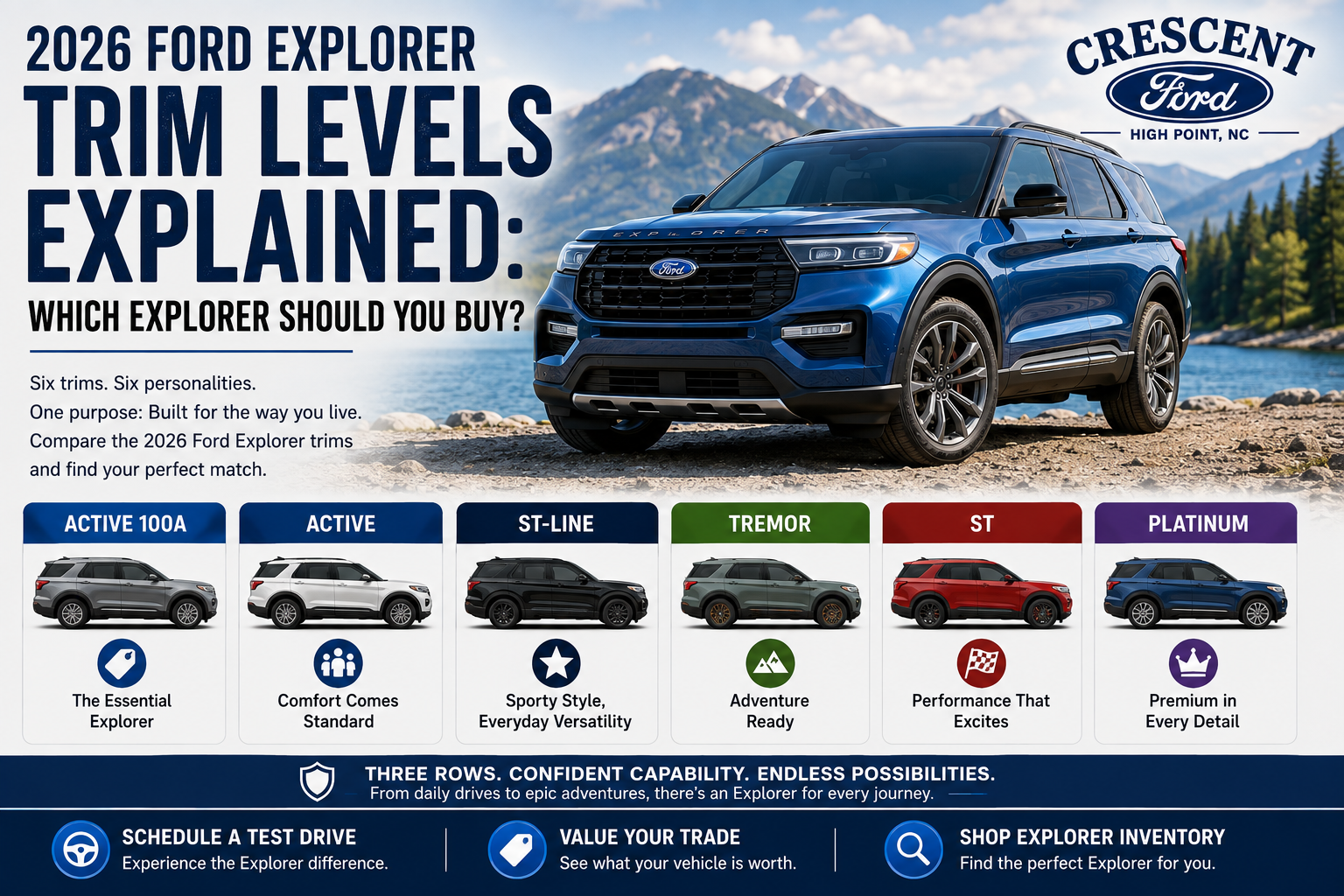
2026 Ford Explorer trim levels comparison including Active, ST-Line, Tremor, ST and Platinum at Crescent Ford in High Point, NC

2026 Ford Explorer Trim Levels Explained: Which Explorer Should You Buy?

So you've decided the Ford Explorer is probably the right SUV for your family.

Great.

Now you have another decision to make:

Which Explorer should you buy?

For 2026, Ford gives Explorer shoppers several distinctly different choices:

  • Explorer Active 100A

  • Explorer Active

  • Explorer ST-Line

  • Explorer Tremor

  • Explorer ST

  • Explorer Platinum

And choosing between them isn't simply a matter of working your way up the price ladder.

The ST-Line looks sportier without requiring you to move into the high-performance ST.

The ST gives you the 3.0L EcoBoost V6 and significantly more performance.

The Platinum prioritizes comfort and upscale features.

And the new Tremor takes Explorer in a completely different direction with standard 4WD and equipment designed for greater capability away from pavement.

In other words:

The most expensive Explorer isn't automatically the best Explorer for you.

Let's figure out which trim actually fits the way you'll use it.

Shop New Ford Explorer SUVs at Crescent Ford


2026 Ford Explorer Trim Levels at a Glance

Explorer

Personality

Engine

Drivetrain

Best For

Active 100A

Essential Explorer

2.3L EcoBoost

RWD or 4WD

Value-focused shoppers

Active

Comfort-focused

2.3L EcoBoost

RWD or 4WD

Everyday family use

ST-Line

Sporty appearance

2.3L EcoBoost

RWD or 4WD

Style + technology

Tremor

Adventure/off-road

2.3L EcoBoost; 3.0L available

4WD

Outdoor/adventure families

ST

High performance

3.0L EcoBoost V6

RWD or 4WD

Performance-focused shoppers

Platinum

Luxury-focused

2.3L EcoBoost

RWD or 4WD

Premium comfort

Features and options can vary by equipment group and configuration. Always verify the window sticker and equipment on the individual Explorer you're considering.

The quick answer

Active 100A: Choose it if your priority is getting into a new Explorer while keeping things simple.

Active: Our starting point for many traditional family-SUV shoppers.

ST-Line: Choose it if you love the sporty Explorer look but don't need the ST's V6 performance.

Tremor: Choose it if 4WD and greater off-pavement capability genuinely fit your lifestyle.

ST: Choose it if you want the Explorer that is genuinely fun to drive.

Platinum: Choose it if comfort and premium features matter more than maximum performance.

Now let's look at why.


2026 Ford Explorer Active 100A: The Essential Explorer

The Active 100A is new for 2026 and becomes the entry point into the Explorer lineup.

Think of this as the Explorer for someone who says:

"I want the space and capability of an Explorer, but I don't need every convenience feature."

It uses the same 2.3L EcoBoost four-cylinder engine found in several other Explorer trims and is available with rear-wheel drive or Intelligent 4WD.

Where Ford saves money is primarily in equipment.

Compared with the regular Active, the 100A simplifies some convenience features. For example, Ford's order guide shows a manual liftgate rather than the Active's power liftgate, simplified front-seat adjustments and other equipment differences.

That creates an interesting option for shoppers who care more about:

  • Three-row capability

  • Explorer size

  • Core technology

  • Engine performance

  • Available 4WD

  • Purchase price

than having every comfort feature.

Who should buy the Explorer Active 100A?

Consider it if:

  • You're shopping primarily around budget.

  • You want a new Explorer rather than a smaller SUV.

  • You don't mind a manual liftgate.

  • You don't need premium interior features.

  • You want the 2.3L EcoBoost powertrain.

  • You'd rather spend money on the vehicle size you need than convenience features you don't.

Who should move up to Active?

If you're already thinking:

"Wait — I definitely want the power liftgate."

Keep reading.

The regular Active may be the better fit.


2026 Ford Explorer Active: The Family Sweet Spot

For a lot of Explorer shoppers, Active is where we'd start the comparison.

It keeps the 2.3L EcoBoost powertrain but adds comfort and convenience features that can matter during everyday family use.

And that's really what Active is about.

Not showing off.

Not pretending you're headed rock crawling.

Not chasing maximum horsepower.

Just making life with a three-row SUV easier.

Why Explorer Active makes sense

If your typical week consists of:

  • School drop-offs

  • Work

  • Grocery runs

  • Sports practice

  • Family errands

  • Weekend trips

  • Occasional third-row passengers

you may not need to move much farther up the lineup.

That's important because trim shopping can easily become:

"For just a little more, I can get..."

Then you repeat that sentence four times and suddenly you're looking at a completely different SUV.

Instead, ask:

What features will I actually use?

If Active already checks the boxes, that's a very good reason to stop there.

Who should buy Explorer Active?

We'd put it high on the list for:

  • Families

  • Daily commuters

  • Buyers prioritizing value and comfort

  • Shoppers who don't need performance styling

  • Buyers who want available 4WD

  • Anyone looking for a well-rounded Explorer

Our take

Active is probably the Explorer trim most shoppers should use as their baseline.

Drive it first.

Then decide whether something on ST-Line, Tremor, ST or Platinum gives you enough additional value to move up.

See Available Ford Explorer SUVs


2026 Ford Explorer ST-Line: Sporty Without Going Full ST

This is one of the easiest Explorer trims to misunderstand.

The ST-Line is not an Explorer ST with a smaller badge.

It gives you much of the sporty appearance associated with the ST while retaining the 2.3L EcoBoost powertrain.

That's exactly why it exists.

Some shoppers love the appearance of the ST but don't necessarily need — or want to pay for — the 3.0L EcoBoost V6.

That's the ST-Line shopper.

What makes the ST-Line different?

Visually, ST-Line takes the Explorer in a much sportier direction.

For 2026, Ford equips it with 20-inch Ebony-painted machined aluminum wheels as standard equipment.

The overall theme is more aggressive than Active without requiring you to jump all the way to the performance-focused ST.

Who should buy Explorer ST-Line?

Consider ST-Line if:

  • Exterior styling matters to you.

  • You like blacked-out/sport-inspired details.

  • You want a more aggressive-looking Explorer.

  • The 2.3L EcoBoost already provides the performance you need.

  • You want more technology and available equipment.

  • You like the ST aesthetic but don't need the ST engine.

This is an important distinction.

ST-Line = sporty appearance

ST = sporty appearance + serious performance

If you're choosing primarily with your eyes, ST-Line can make a lot of sense.

If you're choosing with your right foot?

You probably want to drive the ST.


2026 Ford Explorer Tremor: The Adventure Explorer

This is the biggest addition to the 2026 Explorer lineup.

Explorer Tremor is new for 2026.

And unlike ST-Line, which primarily changes the Explorer's personality through appearance and equipment, Tremor is about capability.

The Tremor comes standard with Intelligent 4WD rather than offering rear-wheel drive as an alternative.

Ford also gives it 18-inch Ebony Black-painted wheels with all-terrain tires, helping distinguish it from the more street-focused Explorer trims.

What engine does the Explorer Tremor have?

Here's where Tremor gets particularly interesting.

The standard engine is the 2.3L EcoBoost.

But the 3.0L EcoBoost V6 is available.

That means you can configure Tremor in two very different ways.

2.3L Tremor

Makes sense if you want the Tremor's capability and styling without needing the more powerful V6.

3.0L Tremor

This is for someone who wants the more adventure-focused Explorer and considerably more power.

Ford pairs the 3.0L Tremor with its Tremor Ultimate Package, which brings additional premium equipment into the mix.

Who should buy Explorer Tremor?

We'd consider Tremor if:

  • You regularly drive on gravel, dirt or rougher roads.

  • Camping is part of your lifestyle.

  • You spend weekends in the mountains.

  • Standard 4WD matters.

  • You want all-terrain tires from the factory.

  • You want an Explorer that looks and feels more adventure-focused.

  • You like the idea of pairing Tremor capability with the available 3.0L EcoBoost.

For drivers in the Piedmont Triad who regularly head toward Boone, Blowing Rock, the Blue Ridge or campsites around North Carolina, Tremor gives Explorer shoppers an option they didn't previously have.

But be realistic.

If your Explorer will spend 99.9% of its life on pavement between High Point and Greensboro, you don't need Tremor.

You may still want it.

That's different.


Explorer Tremor vs. ST-Line

These two trims may appeal to shoppers who want something more visually interesting than Active.

But they have very different personalities.

Choose ST-Line if:

You want a sporty-looking Explorer primarily for pavement.

Choose Tremor if:

You want an adventure-oriented Explorer with standard 4WD and all-terrain equipment.

Think:

ST-Line = street

Tremor = trail

That's oversimplified, but it's a useful starting point.


2026 Ford Explorer ST: The Performance Choice

Now we get to the Explorer that actually backs up its sporty appearance with a different engine.

The 2026 Explorer ST uses a 3.0L EcoBoost V6 producing up to 385 horsepower and 415 lb.-ft. of torque.

That's a substantial jump from the 2.3L EcoBoost used by Active and ST-Line.

Ford also gives the ST a sport-tuned suspension, 21-inch Magnetite-painted aluminum wheels and other performance-oriented equipment.

This isn't simply an appearance package.

The ST drives differently.

Who should buy Explorer ST?

Consider the ST if:

  • You genuinely enjoy driving.

  • Acceleration matters to you.

  • You want the 3.0L EcoBoost V6.

  • You want a sport-tuned suspension.

  • You want three rows without giving up performance.

  • You'd actually appreciate the difference every time you drive it.

And that last point matters.

If you're never going to care how quickly your family SUV accelerates, you probably don't need the ST.

If you get into an ST, accelerate onto the highway and immediately grin?

Different story.

This is one trim you absolutely should test drive.

The reason to pay for an ST isn't simply a list of features.

It's how the SUV feels.

Schedule a Ford Explorer Test Drive


Explorer ST-Line vs. Explorer ST: What's the Difference?

This may be the most important trim comparison in the entire lineup.

The names are similar.

The vehicles aren't.

Explorer ST-Line

2.3L EcoBoost

Sport-inspired appearance

20-inch standard wheels

Designed for shoppers who want the ST look without the ST powertrain

Explorer ST

3.0L EcoBoost V6

Up to 385 horsepower

Up to 415 lb.-ft. of torque

Sport-tuned suspension

21-inch standard wheels

Designed for shoppers who actually want increased performance

Which should you buy?

If you love the look:

ST-Line.

If you love the performance:

ST.

If you're unsure whether the ST is worth the additional money, drive both back-to-back.

You'll know pretty quickly whether the performance difference matters to you.


2026 Ford Explorer Platinum: The Luxury Choice

Platinum takes the Explorer in another direction entirely.

Instead of asking:

"How can we make Explorer sportier?"

Platinum asks:

"How can we make Explorer more comfortable and premium?"

For 2026, Platinum uses the 2.3L EcoBoost engine.

That's worth pointing out because shoppers familiar with previous Explorer model years may remember the availability of the 3.0L EcoBoost on Platinum.

For 2026, Ford deleted the 3.0L engine option from Platinum.

If you want the V6, you're now looking primarily toward ST or an appropriately equipped Tremor.

If you want premium comfort, Platinum remains the luxury-focused Explorer.

What makes Platinum different?

Ford equips Platinum with upscale design and comfort features, including standard 20-inch Luster Nickel-painted aluminum wheels, with 21-inch wheels available.

BlueCruise equipment is also part of the Platinum story, with Ford offering hands-free highway-driving capability under applicable activation plans.

The emphasis is less:

"Look how aggressive my SUV is."

and more:

"This is a very comfortable place to spend two hours."

Who should buy Explorer Platinum?

Consider Platinum if:

  • Interior comfort is a major priority.

  • You want a more upscale Explorer.

  • Premium appointments matter more than performance.

  • You spend significant time commuting or traveling.

  • You're interested in available BlueCruise.

  • You don't need the ST's V6.

Platinum vs. ST

This is almost entirely about personality.

ST: performance.

Platinum: luxury.

Neither is inherently better.

They're built for different buyers.


Explorer Active vs. ST-Line: Is ST-Line Worth It?

For a lot of shoppers, this is where the decision will happen.

Both use the 2.3L EcoBoost.

Both can perform the basic family-SUV job extremely well.

So why spend more for ST-Line?

Mostly because you want what ST-Line adds.

If you prefer its appearance and equipment, that's legitimate value.

If you're indifferent to styling?

Active may give you everything you actually need.

This is where we'd encourage shoppers not to get caught in trim creep.

If the ST-Line makes you turn around and look at your Explorer after parking it, that matters.

If Active looks perfectly good to you?

Keep the money.


Explorer Active vs. Platinum: How Much Luxury Do You Need?

These trims represent two very different approaches to essentially the same family mission.

Active says:

Give me the features I need.

Platinum says:

I'm spending a lot of time in this SUV. Make it nice.

Both use the 2.3L EcoBoost for 2026.

So moving from Active to Platinum isn't primarily about needing more engine.

It's about how much you value comfort, appearance, convenience and premium equipment.

For someone driving 8,000 miles per year mostly around town, Active may make perfect sense.

For someone driving 25,000 miles per year and spending hours every week behind the wheel?

Those comfort upgrades may feel much more valuable.


Explorer ST vs. Tremor: Performance or Adventure?

This may be the most fun comparison in the lineup.

Both can be equipped with the 3.0L EcoBoost V6, but they're designed around different priorities.

Explorer ST

Built around on-road performance.

Sport-tuned suspension.

21-inch wheels.

Available RWD or 4WD.

Explorer Tremor

Built around greater off-pavement capability.

Standard Intelligent 4WD.

18-inch wheels.

All-terrain tires.

Available 3.0L EcoBoost.

Which one should you buy?

Ask where you'll actually drive.

If your idea of fun is a curvy paved road:

ST.

If your idea of fun is the dirt road at the end of it:

Tremor.


Which 2026 Explorer Trim Is Best for Families?

For most families, we'd start with:

Explorer Active.

Why?

Because it gives you the core Explorer experience without requiring you to pay for a specific personality you may not need.

Then ask what Active is missing.

Need sportier styling?

Move to ST-Line.

Spend a lot of time camping or on rougher roads?

Look at Tremor.

Want considerably more performance?

Drive the ST.

Want more premium comfort?

Look at Platinum.

That's a much better way to trim-shop than automatically asking:

"What's the highest trim?"


Which Explorer Trim Is Best for a Daily Commute?

We'd compare:

Active, ST-Line and Platinum.

Active gives you the practical value play.

ST-Line adds a sportier look.

Platinum emphasizes comfort.

If your commute regularly takes you between High Point, Greensboro, Winston-Salem or elsewhere around the Triad, we'd pay particular attention to the features you'll interact with every single day.

Seat comfort.

Driver-assistance technology.

Audio.

Interior materials.

Wheel/tire configuration.

Those things may matter more over 15,000 miles than an off-road feature you'll use twice.


Which Explorer Trim Is Best for Road Trips?

This one isn't necessarily about trim.

All Explorer models give you the basic three-row SUV format.

Instead, we'd look at what makes your road trips better.

Active

Great if you simply need a comfortable family vehicle.

ST-Line

Good if you want additional style and technology.

Platinum

Our first look if long-distance comfort is the priority.

ST

For the parent who wants the road trip to be fun after everyone else falls asleep.

Tremor

For the family whose road trip destination isn't always at the end of a paved road.


Which Explorer Trim Is Best for Snow and Bad Weather?

Don't choose solely from the trim badge.

Look at the drivetrain and tires.

Intelligent 4WD is available on several Explorer trims.

Tremor includes 4WD as standard equipment and comes with all-terrain tires, making it particularly interesting for shoppers who prioritize traction and more rugged use.

But an Active, ST-Line, ST or Platinum equipped with 4WD may make much more sense for someone who primarily wants additional confidence during poor weather without Tremor's adventure-focused equipment.


Which Explorer Has the Most Horsepower?

For conventional 2026 Explorer trims, the Explorer ST is the straightforward performance choice.

Its 3.0L EcoBoost V6 produces up to:

385 horsepower

and

415 lb.-ft. of torque.

The 3.0L EcoBoost is also available on Tremor, giving shoppers another route to V6 Explorer power.

If horsepower is a major reason you're choosing your trim, don't assume Platinum is the answer simply because it's positioned as a premium model.

For 2026:

Luxury = Platinum

Performance = ST

That's an important distinction.


Which Explorer Trim Is the Best Value?

If we're talking about value rather than lowest price, we'd start with Active.

Why?

Because it provides the features many families actually want without forcing you into styling, performance, off-road or luxury upgrades you may not use.

But value is personal.

For someone who desperately wants an ST, buying an Active and wishing every day that they'd bought the V6 isn't great value.

For someone who spends 25,000 miles a year commuting, Platinum's comfort features may provide value every single day.

For an outdoors-focused family, Tremor's standard 4WD and capability may be worth far more than premium interior trim.

The best value is:

the least expensive Explorer that gives you the things you'll genuinely miss if you don't have them.


What Features Should You Actually Pay For?

This is the question we'd ask before choosing any trim.

Make three lists.

Must Have

Features you genuinely won't buy the vehicle without.

Examples:

  • 4WD

  • Particular seating configuration

  • Heated seats

  • BlueCruise capability

  • Power liftgate

  • Specific engine

Nice to Have

Features you'd enjoy but could live without.

Don't Care

Features that sound impressive but won't change your ownership experience.

Then shop the trim that checks your Must Have list without paying unnecessarily for everything on someone else's list.

That's how you avoid spending thousands of dollars moving up trims for one feature you wanted.


Don't Forget Packages and Options

Here's another reason trim comparisons aren't always straightforward:

Two Explorers with the same trim badge may not have identical equipment.

Ford offers packages and standalone options that can substantially change an Explorer's features.

For example, 2026 brings an available panoramic fixed glass roof with power shade across the Explorer lineup, while trims such as Tremor have their own convenience and Ultimate packages.

BlueCruise availability also varies by trim, equipment and activation choice.

So once you've decided:

"I think I want an ST-Line"

don't stop there.

Compare the actual window stickers.

You may find one ST-Line has exactly what you want while another doesn't.

The VIN matters more than the badge when you're comparing specific vehicles.

Browse Available 2026 Ford Explorers


Do All 2026 Ford Explorers Have Three Rows?

Yes, Explorer remains a three-row SUV.

Depending on seating configuration, the 2026 Explorer can accommodate up to seven passengers.

One noteworthy 2026 change is that Ford now makes a second-row bench seat available on the ST, giving performance-focused shoppers another seating option.

That's useful for families who previously might have liked the ST but needed a different seating arrangement.


Can a 2026 Ford Explorer Tow?

Yes.

Ford rates the 2026 Explorer for up to 5,000 pounds of maximum towing capacity when properly equipped.

The Class III Trailer Tow Package is standard across the Explorer lineup.

But remember:

The maximum number doesn't mean every towing situation is automatically appropriate.

Trailer weight, passengers, cargo and the specific vehicle configuration still matter.

If you're buying an Explorer to tow a boat or camper, bring the trailer information with you when you shop.

We'll help you look at the actual Explorer you're considering rather than relying solely on a maximum number from a brochure.


Explorer or Expedition?

Sometimes trim shopping reveals a bigger question.

Suppose you're looking at Explorer Platinum because you need more family space.

Or you're loading an Explorer with seven passengers and realizing you won't have as much cargo room behind the third row as you'd like.

You may not need a different Explorer trim.

You may need an Expedition.

We've already built a full comparison for exactly that question.

RELATED READING

2026 Ford Explorer vs. Expedition: Which 3-Row SUV Fits Your Family?

That guide compares the two SUVs based on passenger space, cargo, towing and everyday family use.


What If You Need Something Smaller Than an Explorer?

The opposite can happen too.

Maybe you're shopping Explorer because you want an SUV, but:

  • You rarely carry more than four people.

  • You don't need three rows.

  • You primarily commute.

  • A smaller footprint would be easier every day.

In that case, don't pay for space you don't need.

A smaller Ford SUV may make more sense.

The goal isn't to sell yourself the biggest SUV your budget allows.

It's to find the vehicle you'll actually enjoy living with.


Trading Your Current Vehicle for an Explorer?

Your trade can also affect which Explorer trim comfortably fits your budget.

You may assume ST or Platinum is out of reach until you discover you have substantial positive equity.

Or you may decide Active is the smarter choice once you know the full transaction.

Start by finding out what your current vehicle is worth.

Find Out What Your Vehicle Is Worth

Related Reading

What Is My Car Worth in High Point, NC? How Trade-In Appraisals Actually Work

If you still have a loan:

Can You Trade In a Car You Still Owe Money On?


How Much Should You Put Down on an Explorer?

Once you've chosen a trim, the next question may be how to structure the purchase.

There's no universal percentage that every Explorer buyer should put down.

Trade equity, APR, loan term, cash reserves and your desired payment all matter.

We just built a full guide to help with that decision.

RELATED READING

How Much Should You Put Down on a Car?

That article walks through how different down payments affect the amount financed, payment, interest and equity.


Should You Test Drive Different Explorer Trims?

Yes — especially if you're deciding between trims with different personalities.

Reading a feature list can tell you that ST has a sport-tuned suspension and a 3.0L EcoBoost.

It can't tell you whether you care about the difference.

Likewise, you may discover:

  • Active already gives you everything you need.

  • ST-Line's appearance is worth the upgrade to you.

  • Tremor's ride and equipment fit your lifestyle.

  • ST's additional performance completely changes your decision.

  • Platinum's comfort makes it the obvious choice.

If possible, drive your top two trims back-to-back.

That's particularly useful for:

Active vs. ST-Line

ST-Line vs. ST

ST vs. Tremor

ST vs. Platinum

Schedule a Ford Explorer Test Drive


Which 2026 Ford Explorer Should You Buy?

Here's our final breakdown.

Buy Explorer Active 100A if:

You want the essential Explorer experience at the lowest point of entry and don't mind giving up some convenience equipment.

Buy Explorer Active if:

You want a comfortable, well-rounded family Explorer without paying for a specialized personality.

This is where we'd start most shoppers.

Buy Explorer ST-Line if:

You want the sporty Explorer appearance but don't need the ST's 3.0L V6.

Buy Explorer Tremor if:

Your family genuinely spends time away from pavement, you want standard 4WD and all-terrain equipment, or you simply love the adventure-oriented Explorer.

Buy Explorer ST if:

You want your three-row family SUV to be legitimately quick and fun to drive.

Buy Explorer Platinum if:

You care more about premium comfort and an upscale driving experience than maximum performance.


Compare 2026 Ford Explorer Trims at Crescent Ford in High Point, NC

Choosing an Explorer trim doesn't need to be complicated.

Start with Active.

Then ask yourself what you want that Active doesn't give you.

Want the sporty look?

ST-Line.

Want to head farther off pavement?

Tremor.

Want the V6 and on-road performance?

ST.

Want the premium experience?

Platinum.

Want to keep the price as low as possible while still getting an Explorer?

Active 100A.

For Explorer shoppers around High Point, Greensboro, Winston-Salem, Kernersville, Thomasville, Lexington, Trinity and the surrounding Piedmont Triad, comparing the actual vehicles in person is the easiest way to determine whether moving up a trim is worth it.

At Crescent Ford, you can compare available Explorer trims, check the equipment on individual vehicles and test drive your top choices.

Because the best Explorer isn't necessarily the one with the longest feature list.

It's the one that gives your family the features you'll actually use.

Shop New Ford Explorer SUVs at Crescent Ford

Schedule a Test Drive

Value Your Trade

Explore Financing Options


Frequently Asked Questions About 2026 Ford Explorer Trim Levels

What are the 2026 Ford Explorer trim levels?

The 2026 Explorer lineup includes Active 100A, Active, ST-Line, Tremor, ST and Platinum. Active 100A and Tremor are new additions for the 2026 model year.

What is the difference between Explorer Active 100A and Active?

Active 100A is a simplified entry configuration designed to provide the essential Explorer experience at a lower point of entry. The regular Active adds convenience equipment, including a power liftgate and additional comfort features. Compare individual window stickers because equipment can vary.

What is the difference between Explorer ST-Line and ST?

The ST-Line uses the 2.3L EcoBoost engine and emphasizes sporty styling. The ST uses a 3.0L EcoBoost V6 producing up to 385 horsepower and 415 lb.-ft. of torque and adds performance-oriented equipment including a sport-tuned suspension.

Is the 2026 Explorer Tremor new?

Yes. Tremor joins the Explorer lineup for 2026 and comes standard with Intelligent 4WD, 18-inch wheels and all-terrain tires. A 3.0L EcoBoost V6 is also available.

Does the Explorer Tremor have a V6?

It can. The 2.3L EcoBoost is standard on the 2026 Explorer Tremor, while the 3.0L EcoBoost V6 is available.

Which 2026 Explorer has a V6?

The Explorer ST comes standard with the 3.0L EcoBoost V6. The 3.0L EcoBoost is also available on Tremor. Platinum no longer offers the 3.0L EcoBoost for the 2026 model year.

Which Explorer trim is best for a family?

For many families, Active is a strong starting point because it balances everyday comfort, three-row practicality and available 4WD without requiring shoppers to pay for specialized performance, off-road or luxury equipment.

Which Explorer trim is the most luxurious?

Platinum is the luxury-focused trim in the 2026 Explorer lineup, emphasizing premium comfort and upscale features rather than the performance focus of ST.

Which Explorer trim is the fastest?

The ST is the performance-focused Explorer, using a 3.0L EcoBoost V6 producing up to 385 horsepower and 415 lb.-ft. of torque along with a sport-tuned suspension.

Is Explorer ST-Line the same as Explorer ST?

No. Although they share sporty styling themes, ST-Line uses the 2.3L EcoBoost engine while ST gets the more powerful 3.0L EcoBoost V6 and performance-oriented suspension.

Is Explorer Tremor or ST better?

It depends on how you drive. ST is designed around on-road performance, while Tremor emphasizes off-pavement capability with standard Intelligent 4WD and all-terrain tires. Tremor can also be equipped with the 3.0L EcoBoost V6.

Does the 2026 Explorer Platinum have the 3.0L V6?

No. Ford's 2026 Explorer order guide shows the 3.0L EcoBoost option deleted from the Platinum trim for the 2026 model year. Platinum uses the 2.3L EcoBoost engine.

Does the 2026 Ford Explorer have 4WD?

Intelligent 4WD is available on Active 100A, Active, ST-Line, ST and Platinum. Tremor comes with Intelligent 4WD as standard equipment.

How many people does the 2026 Ford Explorer seat?

The 2026 Explorer offers three-row seating for up to seven people depending on configuration. Ford also added second-row bench-seat availability to the ST for 2026.

How much can a 2026 Ford Explorer tow?

The 2026 Ford Explorer can tow up to 5,000 pounds when properly equipped. Actual capability depends on the vehicle configuration, passengers, cargo and trailer.

Should I test drive different Explorer trims before buying?

Yes. A back-to-back test drive is particularly useful when comparing trims such as Active vs. ST-Line or ST-Line vs. ST because differences in styling, equipment and performance may matter more in person than they do on a specification sheet. Schedule a Ford Explorer Test Drive to compare the trims you're considering.

Posted in:

Related Posts

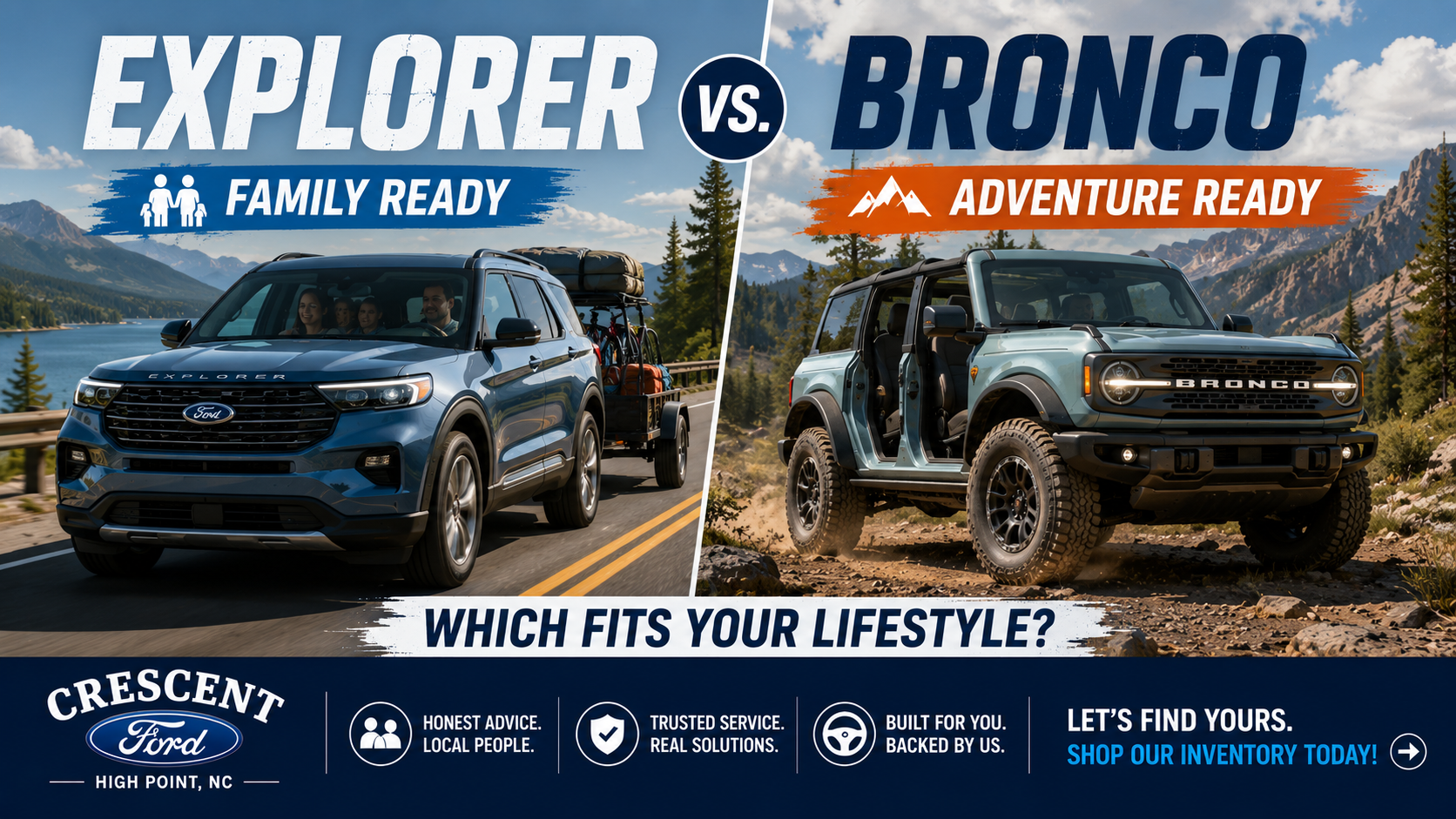
Ford Explorer vs. Bronco comparison showing the family-ready Explorer and adventure-ready Bronco for different lifestyles at Crescent Ford

2026 Ford Explorer vs. Bronco: Which SUV Fits Your Lifestyle?

Ford Explorer vs. Bronco: Which SUV Fits Your Lifestyle? You're shopping for a Ford SUV. You want something larger than a compact crossover. You want capability. You want space. And you've narrowed the list to two vehicles: Ford Explorer and Ford Bronco. At first, that sounds like a normal SUV comparison. Then you look a little closer. Explorer has three rows. Bronco has removable doors. Explorer can seat up to seven. Bronco can tackle terrain most family SUVs were never designed to see. Explorer is built around everyday family versatility. Bronco is built around adventure. So despite both wearing Ford badges and occupying a similar general part of the SUV market, these two vehicles answer very different questions. The easiest way to decide isn't: "Which SUV is better?" It's: "What do I actually need my SUV to do?" Let's figure that out. Shop Ford SUVs at Crescent Ford Ford Explorer vs. Bronco at a Glance Here's the simplest way to understand the difference: Ford Explorer Ford Bronco Primary Mission Family versatility Off-road adventure Rows 3 2 Maximum Seating 7 5 Doors 4 2 or 4 Drivetrain RWD or available Intelligent 4WD depending on model 4x4 Removable Doors No Yes Removable Roof No Yes Maximum Cargo Space Up to 85.8 cu. ft. depending on model Varies significantly by 2-door/4-door configuration Maximum Towing Up to 5,000 lbs. when properly equipped Varies by model/configuration Best For Families, commuting, road trips Off-roading, outdoor recreation, adventure If you need a third row? This comparison may already be over. Explorer. If removable doors, serious 4x4 hardware and trail capability are high on your priority list? Bronco. But for everyone in the middle, there's more worth considering. Ford Explorer: The Family-Focused Choice Explorer is Ford's midsize three-row SUV. And that third row is the biggest fundamental difference between these vehicles. The 2026 Explorer can seat six or seven people, depending on seating configuration. That immediately gives Explorer an advantage for: Larger families Families with multiple children Car pools Grandparents Kids bringing friends Road trips Anyone who regularly carries more than five people Explorer also provides up to approximately 85.8 cubic feet of maximum cargo capacity, depending on model and configuration. That combination of: three rows + flexible cargo space is what makes Explorer fundamentally a family SUV. Who Should Buy an Explorer? Someone who says: "I need my SUV to make everyday life easier." Think: School. Work. Groceries. Sports practice. Road trips. Vacation. Dinner with the grandparents. Home improvement runs. Explorer is designed to handle a little bit of everything without being particularly specialized in only one direction. Shop Ford Explorer SUVs RELATED READING Ford Explorer Trim Levels Explained: Which Explorer Should You Buy? Ford Bronco: The Adventure-Focused Choice Bronco takes a completely different approach. This isn't simply: "Ford's other midsize SUV." Bronco is a purpose-built 4x4. Ford designed it around things like: Trail driving Off-road capability Ground clearance Terrain management Outdoor recreation Removable doors Removable roof Customization Even the basic Bronco comes with standard 4x4 and removable doors and roof. That's a very different vehicle philosophy from Explorer. Who Should Buy a Bronco? Someone who says: "I don't just want my SUV to get me to the adventure. I want the SUV to be part of the adventure." That's Bronco. Camping. Trails. Beach trips. Mountain weekends. Outdoor recreation. Doors off. Roof off. Bronco is designed to make driving itself part of the experience. Shop Ford Bronco SUVs RELATED READING Ford Bronco vs. Bronco Sport: Which One Should You Buy? Explorer vs. Bronco: Which Is Better for a Family? For most families? Explorer. Not because Bronco can't work for a family. A four-door Bronco absolutely can. But Explorer was specifically designed around family practicality. You get: three rows instead of two. You can seat: up to seven instead of five. And the interior is designed around everyday passenger flexibility. That matters when your life includes: Car seats School bags Sports equipment Friends Grandparents Luggage Strollers If you have two children and never need more than five seats, though? Now Bronco becomes much more realistic. Especially if your family spends a lot of time outdoors. Can a Family of Four Use a Ford Bronco? Absolutely. A four-door Bronco can make a very fun family vehicle. A family of four still has room for: two adults + two kids without needing the third row Explorer provides. And if your weekends frequently involve: Camping Hiking Fishing Mountains Beach driving where permitted Outdoor recreation Bronco may actually fit your family's personality better. The question becomes: Do you need maximum family practicality? or Do you want enough family practicality plus much more adventure capability? That's where Explorer and Bronco separate. Explorer vs. Bronco With Car Seats If car seats are part of your life, don't make this decision from a specification table. Bring the car seats. Seriously. Install them. A rear-facing seat can require significant front-to-back space. Multiple car seats can change how useful the second row feels. And Explorer's third row can provide additional flexibility as your family grows. For example, if you have: two kids in car seats + an older child Explorer's three-row layout may be considerably easier to live with. If you have: one or two children and don't need additional passenger capacity? A four-door Bronco may work perfectly well. RELATED READING — Is a Ford Maverick Big Enough for a Family? Which Has More Passenger Space: Explorer or Bronco? This isn't really about inches. It's about layout. Explorer has three rows. Bronco has two. Explorer can accommodate up to seven passengers depending on configuration. Four-door Bronco seats up to five. Two-door Bronco seats four. So if your definition of passenger space is: "How many people can I bring?" Explorer wins easily. But if you only need four or five seats? Now you should compare how each vehicle actually feels to your family. Sit in the back. Bring the kids. Adjust the front seats where you'd normally drive. That's much more useful than comparing one isolated measurement. Which Has More Cargo Space: Explorer or Bronco? Explorer offers up to approximately 85.8 cubic feet of maximum cargo capacity on certain 2026 models. Bronco cargo capacity varies substantially depending on whether you choose a two-door or four-door model and how the vehicle is configured. But here's the more useful question: What are you carrying? Explorer's cargo area is built around family versatility. Think: Groceries Luggage Strollers Sports gear Home-improvement purchases Family road-trip cargo Bronco's cargo space may be more likely to carry: Camping equipment Coolers Hiking gear Recovery gear Outdoor equipment Muddy stuff you'd rather not put in your nice family crossover 😂 Same concept: cargo but very different lifestyles. Explorer vs. Bronco for Road Trips This one's interesting. For a conventional family road trip? Explorer gets our vote. Especially with more than four passengers. Explorer's three-row layout, passenger-focused interior and cargo flexibility make it naturally suited to long highway trips. But imagine your road trip looks like: High Point → Boone → cabin → trail → campsite. Now Bronco becomes a lot more interesting. The destination matters. Explorer Road Trip The SUV gets you comfortably to the adventure. Bronco Road Trip The SUV may BE part of the adventure. That's probably the cleanest explanation of these two vehicles. Explorer vs. Bronco for Commuting For most commuters? Explorer. It's designed more around conventional everyday road use. But that doesn't mean Bronco can't be a daily driver. Plenty of Bronco owners commute in them every day. The difference is what you're prioritizing. If your driving consists mostly of: Highway City streets School pickup Interstate commuting Explorer's mission aligns more naturally with your daily life. If you're willing to prioritize Bronco's personality and capability because that's what you really want? Buy the Bronco. Not every vehicle decision needs to be made by spreadsheet. RELATED READING — Best Ford Vehicles for Commuting Around the Piedmont Triad Explorer vs. Bronco for Off-Road Driving Bronco. Next question. 😂 This is exactly what Bronco was built to do. Standard 4x4. Available Sasquatch Package. Available locking differentials depending on configuration. Off-road suspension systems. Terrain-focused drive modes. Ground clearance. Trail technology. Bronco isn't simply an SUV that happens to be capable off pavement. Off-road performance is fundamental to its identity. But What About the 2026 Explorer Tremor? Now things get interesting. For 2026, Ford added Explorer Tremor. That gives Explorer shoppers a more adventure-oriented option without requiring them to leave the three-row SUV format. Explorer Tremor adds off-road-focused equipment and standard Intelligent 4WD while preserving Explorer's family-friendly layout. So if you're thinking: "I need three rows, but we also camp, explore forest roads and spend weekends outdoors," Explorer Tremor deserves a serious look. But don't confuse: Explorer Tremor with Bronco. Bronco still provides a fundamentally different level of off-road specialization, including removable doors and roof and an architecture built around trail capability. Explorer Tremor = Family SUV with additional off-road capability. Bronco = Off-road SUV that can also handle family duty. That's a very important distinction. Explorer vs. Bronco for Snow and Bad Weather Both can be configured for additional traction and capability. Explorer offers available Intelligent 4WD depending on model and powertrain. Bronco comes with 4x4. But don't forget: Tires matter enormously. Having 4WD doesn't magically overcome inappropriate tires or poor driving decisions. For most Piedmont Triad drivers dealing with: Rain Occasional snow Wet roads Winter trips toward Boone or the mountains either vehicle can be a capable choice when appropriately equipped. If you're specifically prioritizing rugged terrain beyond normal winter-road driving? Bronco begins pulling away. Explorer vs. Bronco for Towing Here's a category where Explorer may surprise people. The 2026 Explorer can tow up to 5,000 pounds when properly equipped. Mainstream Bronco configurations such as the Base and Outer Banks list maximum towing of 3,500 pounds when properly equipped. So don't assume: "Bronco looks tougher, therefore Bronco tows more." That's not how vehicle capability works. If towing is important, start with: What are you towing? Boat? Utility trailer? Small camper? Then look at the specific vehicle configuration. Never choose a tow vehicle based solely on model name or appearance. Explorer vs. Bronco for Camping Now we're going to annoy everyone by saying: It depends. 😂 Choose Explorer for Camping If: Camping means: Family + luggage + tent + coolers + highway drive to the campground. Explorer's passenger and cargo versatility can be extremely useful. Choose Bronco for Camping If: Camping means: Let's see how far down that trail the campsite is. Bronco. Easy. The more rugged your version of camping becomes, the stronger Bronco's case gets. Explorer vs. Bronco for Beach Trips Same idea. If you're driving the family to: Myrtle Beach with luggage, beach chairs, coolers and kids? Explorer may be the more practical road-trip vehicle. If your destination includes legal beach-driving areas where appropriate vehicle access is permitted? Now Bronco's 4x4 capability becomes much more relevant. Just remember that off-road and beach driving require appropriate preparation, knowledge of the terrain and compliance with local rules. Explorer vs. Bronco for Dogs Dog owners can make a good case for either. Explorer provides substantial interior flexibility and cargo space. Bronco offers a more rugged, outdoor-focused environment depending on configuration. But this is another: Bring your stuff decision. If you use: Large dog crate Barrier Travel kennel Ramp bring measurements—or better yet, bring the equipment. A cargo-volume number doesn't tell you whether your specific crate fits through the opening. Which Is Easier to Get In and Out Of? Generally, Explorer's family-oriented design will feel more conventional for everyday entry and exit. Bronco—especially more aggressively equipped off-road configurations—can have a taller step-in height. That matters for: Small children Older family members Anyone with limited mobility Loading kids repeatedly throughout the day Don't underestimate this. If Grandma rides with you every weekend, have Grandma get in the Bronco before you buy it. She gets a vote. 😂 Explorer vs. Bronco: Which Has the Better Interior? That's completely subjective because they're intentionally different. Explorer's interior is geared toward: comfort + passengers + everyday technology. Bronco's interior emphasizes: ruggedness + utility + adventure. Depending on trim, either can become very nicely equipped. For example, Bronco Outer Banks can be configured with more premium touches such as available leather-trimmed seating, while Explorer Platinum moves strongly toward a luxury-oriented family SUV experience. So don't ask: "Which interior is nicer?" Ask: "Which interior feels right for how I'm going to use it?" Explorer vs. Bronco: Which Is More Fun? Bronco. We're comfortable saying it. 😂 Removable doors. Removable roof. Trail capability. That is inherently fun. But here's the catch: Fun isn't everyone's #1 vehicle requirement. Loading three kids, a stroller and groceries without playing automotive Tetris can also bring a surprising amount of joy. Explorer wins a different kind of fun. Which Is More Practical? Explorer. That's what it's designed to be. Three rows. More passenger capacity. Family-oriented cargo flexibility. Conventional everyday driving. But practicality isn't automatically the same as: better. A minivan would probably be more practical than a Bronco too. Someone shopping for a Bronco probably doesn't care. And that's okay. Which Is Better for a Family of Four? This is where the comparison gets genuinely difficult. Because either could be excellent. Choose Explorer if: You want extra passenger capacity. You regularly bring friends or relatives. Cargo flexibility matters. You want a more conventional family SUV. Road trips are important. Choose Bronco if: Five seats are enough. Your family spends significant time outdoors. You value 4x4/off-road capability. You love the removable-door/roof experience. You simply WANT a Bronco. That last one matters. Sometimes both vehicles meet your practical needs. Then you're allowed to buy the one you like more. Which Is Better for a Family of Five? We'd lean: Explorer. A four-door Bronco can seat five. But Explorer gives five people the ability to spread across three rows. That's especially useful as children get older. Five people technically fitting inside a vehicle isn't the same as five people wanting to spend six hours inside it. For regular family-of-five duty, we'd test Explorer first. Which Is Better for Six or Seven People? Explorer. Bronco isn't a three-row SUV. If you regularly need seating for more than five, Explorer wins this comparison automatically. If Explorer isn't large enough for your passenger/cargo needs, the next comparison probably isn't Bronco. It's: Explorer vs. Expedition. RELATED READING — 2026 Ford Explorer vs. Expedition: Which 3-Row SUV Fits Your Family? Do You Need a Bronco or Just Want a Bronco? This is an important question. And we're not asking it to talk you out of one. You may never: Rock crawl Cross a stream Drive a difficult trail Need a locking differential and still absolutely love owning a Bronco. Vehicles aren't appliances. Sometimes we buy them because they make us happy. The key is simply understanding the trade-off. If Bronco gives you everything you need and you love it? Great. If you're sacrificing passenger space you genuinely need every day because the Bronco looks cool? Now we should probably have a longer conversation. Do You Need an Explorer or Just Think You Need Three Rows? Same question in reverse. If you're a family of four and the third row will be folded for 360 days per year? Maybe you don't need Explorer. Perhaps Bronco—or even a smaller Ford SUV—would fit your life better. Don't buy seats you'll never use simply because: "What if someday we need them?" Buy for your real life most of the time. Explorer vs. Bronco: Quick Decision Guide If Your Priority Is... Our Starting Point Three rows Explorer 6–7 passengers Explorer Family road trips Explorer Maximum everyday practicality Explorer Up to 5,000-lb. towing when properly equipped Explorer Traditional commuting Explorer Off-road capability Bronco Standard 4x4 Bronco Removable doors Bronco Removable roof Bronco Trail driving Bronco Open-air experience Bronco Family + light adventure/off-pavement use Explorer Tremor deserves a look Family of four + serious outdoor lifestyle Compare both What If You Want Something Between Explorer and Bronco? This is where Ford's SUV lineup gets interesting. Maybe Explorer feels bigger than you need. Maybe Bronco is more off-road-focused than you need. You still have: Bronco Sport and Escape in the Ford SUV lineup. And if Explorer isn't large enough? There's: Expedition. That's why we'd recommend thinking about Ford SUVs as a spectrum rather than trying to force yourself into one model. RELATED READING — Ford SUV Size Guide: Bronco Sport, Escape, Bronco, Explorer & Expedition Compared Should You Test Drive Explorer and Bronco Back-to-Back? Absolutely. This is one comparison where a back-to-back drive can settle things very quickly. Drive Explorer. Then drive Bronco. Pay attention to: Seating position Ride Visibility Entry/exit Rear-seat space Cargo access Road noise Maneuverability Technology Overall feel One may immediately feel more natural. And if you're shopping for your family? Bring them. Don't let Dad pick the family SUV by himself and then discover everyone hates the back seat. We see you, Dad. 😂 Schedule an Explorer vs. Bronco Test Drive Compare the Explorer and Bronco back-to-back at Crescent Ford and see which SUV fits your real-world passenger, cargo and driving needs. Ford Explorer vs. Bronco in High Point, NC Living around High Point and the Piedmont Triad makes this comparison particularly interesting. Your normal week might involve: I-85 Business 85 High Point Greensboro Winston-Salem and normal suburban driving. Then the weekend comes. Within a relatively short drive, you can be heading toward: Boone Blowing Rock the Blue Ridge Mountains campgrounds trails and outdoor recreation. That's why both SUVs make sense here. The question is which part of your life should your vehicle prioritize. Explorer: Everyday life first. Adventure when needed. Bronco: Adventure first. Everyday life still possible. That's the comparison. So, Should You Buy the Ford Explorer or Bronco? Let's make it simple. Buy the Explorer if: You need three rows. You regularly carry more than five people. Family practicality is your priority. You take long road trips. You want up to 5,000 pounds of towing capability when properly equipped. You want a more conventional everyday SUV. You want adventure capability but still need family versatility—especially if you're considering Explorer Tremor. Buy the Bronco if: You don't need a third row. Off-road capability genuinely matters. You want standard 4x4. You love outdoor recreation. You want removable doors. You want a removable roof. You want the vehicle itself to be part of the adventure. Or... you've always wanted a Bronco. That's a perfectly valid reason too. The Best SUV Is the One That Fits Your Actual Life It's easy to get lost comparing: horsepower cargo volume screens ground clearance towing capacity and hundreds of individual features. But Explorer vs. Bronco is actually simpler than that. Ask yourself: What will I do with this SUV 80% of the time? If the answer is: Carry people, commute, run errands and take family trips start with Explorer. If the answer is: Commute during the week so I can get outside and explore on the weekend start with Bronco. And if your answer is: Honestly...both. Drive them back-to-back. That's exactly what test drives are for. FINAL CTA / INTERNAL LINKS Ready to Compare Them? Shop Ford Explorer SUVs Shop Ford Bronco SUVs Schedule a Test Drive Value Your Trade Explore Financing Options RELATED READING Ford Explorer Trim Levels Explained: Which Explorer Should You Buy? Ford Bronco vs. Bronco Sport: Which One Should You Buy? 2026 Ford Explorer vs. Expedition: Which 3-Row SUV Fits Your Family? Ford SUV Size Guide: Bronco Sport, Escape, Bronco, Explorer & Expedition Compared Best Ford Vehicles for Commuting Around the Piedmont Triad Frequently Asked Questions About Ford Explorer vs. Bronco Is the Ford Explorer bigger than the Bronco? It depends on which Bronco configuration you're comparing because Bronco is offered in both two-door and four-door versions. More importantly, Explorer and Bronco use their size differently. Explorer is a three-row family SUV, while Bronco is a two-row off-road-focused 4x4. Does the Ford Bronco have a third row? No. Ford Bronco is a two-row SUV. Two-door Bronco models seat four, while four-door models can seat five. How many people does the Ford Explorer seat? The 2026 Ford Explorer seats six or seven depending on model and seating configuration. Second-row captain's chairs or a bench seat determine the available passenger capacity. Is the Bronco or Explorer better for families? Explorer is generally the more practical family choice because it offers three rows and seating for up to seven. A four-door Bronco can still work well for a family of four or five, particularly for families prioritizing outdoor recreation and off-road capability. Is the Explorer or Bronco better for off-roading? Bronco. It is purpose-built around off-road capability and comes standard with 4x4, removable doors and roof, with additional off-road hardware available depending on configuration. The 2026 Explorer Tremor adds meaningful adventure capability while retaining Explorer's three-row family layout. Is the Explorer Tremor like a Bronco? Not exactly. Explorer Tremor is an adventure-oriented version of a three-row family SUV. Bronco is fundamentally designed as an off-road 4x4 with removable doors and roof. The Tremor bridges some of the gap, but the two vehicles still have different missions. Which tows more, Ford Explorer or Bronco? The 2026 Explorer can tow up to 5,000 pounds when properly equipped. Mainstream Bronco configurations such as Base and Outer Banks list maximum towing of 3,500 pounds when properly equipped. Always verify the rating of the specific configuration you're considering. Does the Bronco come standard with 4WD? Yes. The 2026 Ford Bronco is a 4x4 vehicle. Explorer uses rear-wheel drive as standard on several models with Intelligent 4WD available, while some Explorer configurations such as Tremor include 4WD. Which is better for commuting, Explorer or Bronco? Explorer's family-focused design makes it a natural choice for conventional commuting and everyday road use. Bronco can certainly be daily-driven, but shoppers are generally choosing it because they also value its off-road capability, rugged design and open-air experience. Is the Bronco good for a family of four? A four-door Bronco can work very well for a family of four. Whether it's better than Explorer depends on whether you value Explorer's additional passenger and cargo flexibility or Bronco's adventure-oriented capability more. Is Explorer better for a family of five? Explorer deserves serious consideration for a family of five because its third row allows passengers to spread across multiple rows. A four-door Bronco can seat five, but it doesn't offer the same three-row flexibility. Can you remove the doors and roof on a Ford Bronco? Yes. Removable doors and roof are core features of the current Ford Bronco. That open-air capability is one of the most significant differences between Bronco and Explorer. Should I buy an Explorer or Bronco? Choose Explorer if three-row seating, family versatility, road-trip comfort and everyday practicality are your priorities. Choose Bronco if you don't need a third row and place greater value on 4x4 capability, off-road driving, removable doors and roof, and outdoor adventure. Should I test drive Explorer and Bronco before deciding? Yes. Because the two vehicles have such different personalities, a back-to-back test drive can be especially useful. Compare ride, seating position, rear-seat space, entry and exit, cargo access and how each SUV feels during the kind of driving you do most often.

Ford F-150 trim levels comparison featuring XL, STX, XLT, Lariat, Tremor and Platinum trucks at Crescent Ford in High Point, NC

2026 Ford F-150 Trim Levels Explained: XL vs. STX vs. XLT vs. Lariat vs. Tremor vs. Platinum

Ford F-150 Trim Levels Explained: XL vs. STX vs. XLT vs. Lariat vs. Tremor vs. Platinum You've decided you want an F-150. Great. Now Ford gives you another decision: Which F-150? Because an F-150 XL and an F-150 Platinum may share the same basic truck underneath, but they're designed for very different buyers. And then there's everything in between. XL. STX. XLT. Lariat. Tremor. Platinum. One shopper wants a straightforward work truck. Another wants a truck that looks great without paying for luxury features. Someone else wants heated seats, upgraded technology and a truck comfortable enough for a 45-minute commute every morning. And another shopper couldn't care less about any of that because they're heading off-road. That's why we don't think there's a single: "Best F-150 trim." There's a best F-150 trim for what you actually want your truck to do. Let's find yours. Shop Ford F-150 Trucks at Crescent Ford 2026 Ford F-150 Trim Levels at a Glance Here's the easiest way to understand the six trims we're comparing: F-150 Trim Think of It As Best For XL The essential F-150 Work, fleets, value-focused buyers STX Style without the luxury jump Buyers wanting a sharper-looking everyday truck XLT The all-around F-150 Daily driving, work and family use Lariat Premium everyday truck Comfort, technology and capability Tremor Off-road F-150 Trails, outdoor recreation and rugged use Platinum Luxury F-150 Premium comfort without giving up truck capability That's the short version. But there's an important thing to understand before comparing them: Moving up the F-150 lineup doesn't necessarily mean getting "more truck." Sometimes you're getting: More comfort More technology Different styling Additional convenience More premium materials And sometimes you're moving into a trim designed for an entirely different purpose. That's especially true with Tremor. So don't assume the highest trim is automatically the best truck for you. Ford F-150 XL: The Essential Truck The XL is where the F-150 lineup begins. But don't mistake: "base trim" for: "not a real F-150." The XL is fundamentally designed to do truck things without requiring you to pay for a long list of luxury features you may not care about. That's exactly why it remains attractive to: Contractors Businesses Fleet buyers Farmers Property owners Work-truck shoppers Value-conscious personal buyers Why Buy an F-150 XL? Because maybe you don't need your truck to feel like a luxury SUV. You need it to: haul tow carry equipment get dirty and go to work. In that situation, paying more simply to move into a higher trim may not accomplish anything important for you. XL also gives shoppers access to different cab, bed and drivetrain configurations, making it particularly relevant for buyers who care more about how the truck is configured than how fancy the interior is. Who Should Buy the XL? Someone who says: "Give me the F-150 capability I need and let me choose the options that actually matter." That's an XL shopper. Shop F-150 XL Trucks Ford F-150 STX: When Style Matters STX is where the F-150 starts becoming particularly interesting for personal-use buyers who don't necessarily want to jump into the more feature-heavy trims. Think of STX as: "I want my truck to look good." It gives the F-150 a more distinctive appearance while maintaining a more accessible position in the lineup. For many shoppers, that's exactly the balance they're looking for. Who Is the STX Best For? Someone who says: "I don't need every luxury feature. I just don't want my truck to look or feel like a basic work truck." STX can be especially attractive for: First-time truck buyers Daily drivers Younger truck shoppers Buyers who prioritize exterior styling Someone moving from an SUV or car into their first pickup Shoppers who want capability without moving far up the trim ladder And there's an important update for 2026: The 3.5L PowerBoost Full Hybrid V6 is now available on STX, giving shoppers another powertrain choice that previously required moving elsewhere in the lineup. STX vs. XL This is mostly a question of priorities. Choose XL if you're primarily focused on function and configuration. Choose STX if you want more visual personality in a truck that can still handle everyday work. Neither is automatically better. STX simply spends more of its attention on the things many personal-use buyers notice every day. Shop F-150 STX Trucks Ford F-150 XLT: The Sweet Spot for a Lot of Buyers If someone walks into Crescent Ford and says: "I want a nice F-150, but I don't need a luxury truck," XLT is one of the first places we'd look. Why? Because XLT sits right in the middle of what a huge number of truck buyers actually want: Capability + comfort + useful technology + lots of configuration choices. It's a truck that can: go to work Monday morning and take the family out Saturday afternoon without feeling particularly compromised in either role. What Makes XLT Different? As you move from STX to XLT, the conversation becomes less about appearance alone and more about everyday equipment and flexibility. For 2026, Zone Lighting is standard on XLT and above. Ford also offers multiple engine choices and appearance packages on XLT, so shoppers can configure the truck toward work, towing, appearance or everyday use. BlueCruise-equipped hands-free highway driving is also available on properly equipped XLT configurations. That gives XLT a surprisingly broad range. Who Should Buy the XLT? Someone who says: "This is my truck, but it's also my everyday vehicle." That's important. If your F-150 is going to be: Your commuter Your family vehicle Your weekend project truck Your road-trip vehicle Your towing vehicle then features you might not care about in a dedicated work truck suddenly become much more valuable. STX vs. XLT This will probably be one of the most common decisions for F-150 shoppers. Choose STX if: You care about styling and want to keep the truck relatively straightforward. Choose XLT if: You want more available comfort, technology and configuration flexibility. The right answer often comes down to this: How much time are you going to spend inside the truck? If the answer is: "A lot." XLT deserves a serious look. Shop F-150 XLT Trucks Ford F-150 Lariat: Where the F-150 Starts Feeling Premium Lariat is where the character of the truck changes again. Now we're not simply talking about: "a nicer work truck." We're moving into: premium everyday vehicle that happens to be a very capable pickup. That's an important distinction. For someone who spends an hour or more in their truck every day, comfort isn't frivolous. It's something you experience constantly. What Does Lariat Add to the Experience? This is where shoppers start looking for things such as: More premium seating Additional power adjustments Heated and ventilated front seats Upgraded interior materials More convenience technology Additional driver-assistance availability Premium appearance Greater everyday comfort For 2026, Ford also made power-adjustable pedals with memory available within Lariat equipment groups, and a Head-Up Display is available on certain configurations. But the reason to buy a Lariat isn't because one individual feature appears on a checklist. It's because the overall experience becomes more premium. Who Should Buy the Lariat? Someone who says: "I use my truck for everything, and I want it to be comfortable." Think: Long commuters Business owners Frequent travelers People who tow regularly Buyers coming from premium SUVs Anyone whose truck doubles as their primary family vehicle XLT vs. Lariat This is where we'd ask: Which features will you actually appreciate every day? If you don't care about the additional comfort and premium touches? Buy the XLT. Seriously. Don't pay for features because someone told you Lariat is "better." But if you sit in the Lariat and immediately think: "Yep. This is where I want to spend my commute." Then the upgrade may be worth every penny to you. Shop F-150 Lariat Trucks Ford F-150 Tremor: The F-150 for Going Off the Pavement Tremor is different. It isn't simply: "the trim above Lariat." In fact, thinking of Tremor as part of a straight: XL → STX → XLT → Lariat → Tremor → Platinum ladder misses the point. Tremor is a purpose-driven branch of the F-150 family. It's designed for buyers who want greater off-road capability directly from Ford. What Makes Tremor Different? Tremor is built around a more rugged mission. That means the things you're paying for are more focused on: Off-road capability Terrain management Trail use Ground clearance Rugged suspension tuning Off-road hardware Distinctive Tremor styling For 2026, the 3.5L EcoBoost V6 is standard on Tremor, while the 5.0L V8 is available. That's going to make the engine decision particularly interesting for Tremor shoppers. Who Should Buy the Tremor? Someone who actually says things like: "Where does that trail go?" 😂 More seriously, Tremor makes sense for: Outdoor enthusiasts Hunters Campers Property owners People regularly traveling on rough terrain Buyers who simply want more factory off-road capability Lariat vs. Tremor Don't ask: "Which one is better?" Ask: "Where am I driving?" If most of your miles happen on pavement and comfort is your priority: Lariat. If off-road capability is genuinely important: Tremor. That makes this comparison much easier. Tremor vs. Raptor Tremor is not simply a less expensive Raptor. They occupy different positions in the F-150 lineup. Tremor is designed to add meaningful off-road capability while remaining very much an everyday F-150. Raptor pushes much further toward high-performance off-road driving. For many buyers who want an off-road-capable truck they can comfortably use every day, Tremor may actually be the more logical choice. Shop F-150 Tremor Trucks Ford F-150 Platinum: Luxury Meets Capability Now we reach the shopper who says: "I want a truck. But I want a REALLY nice truck." That's Platinum territory. Platinum isn't trying to disguise the fact that it's a pickup. It's taking F-150 capability and wrapping it in a more luxurious ownership experience. Ford describes the current Platinum as combining luxury and capability, with features such as leather-trimmed seating, available multicontour front seats, heated and ventilated front seating, available premium B&O audio and available BlueCruise. Who Should Buy the Platinum? Someone who wants: F-150 capability without giving up: premium comfort. That's especially attractive for: Executives Business owners Long-distance drivers Luxury SUV owners moving into a truck Buyers who tow but want a premium cabin Someone who simply likes having a very well-equipped vehicle Lariat vs. Platinum This is an interesting comparison because Lariat is already a very nice truck. So the question becomes: How premium do you want to go? Lariat gives you a significant jump in comfort and equipment without going all the way to the top of the mainstream lineup. Platinum adds a more upscale design, additional premium appointments and a stronger luxury emphasis. If you're primarily interested in capability and comfort? Lariat may be plenty. If the luxury experience itself matters? Platinum starts making more sense. Shop F-150 Platinum Trucks Wait—What About F-150 King Ranch? Yes, King Ranch still exists. For 2026, Ford's complete F-150 model lineup includes: XL STX XLT Lariat King Ranch Platinum Tremor Raptor King Ranch occupies the premium end of the lineup alongside Platinum but brings its own distinctive Southwestern-inspired styling and interior personality. So if you're shopping Platinum because you want a luxury truck, sit in a King Ranch too. You may immediately prefer one interior personality over the other. That's exactly why both exist. And What About F-150 Raptor? Raptor deserves its own conversation. While Tremor adds substantial off-road capability to the traditional F-150 formula, Raptor is designed around a much more extreme performance mission. If your question is: "Which normal F-150 trim should I buy?" Raptor probably isn't the answer. If your question is: "Which F-150 was engineered specifically for serious high-performance off-road driving?" Now we're having a Raptor conversation. For this guide, we're concentrating primarily on the F-150 trims most mainstream truck buyers are likely to cross-shop. XL vs. STX: Which Should You Buy? Choose XL if: Value matters most It's primarily a work truck You want maximum configuration flexibility You don't care much about appearance upgrades You'd rather spend money on capability than styling Choose STX if: Styling matters It's primarily a personal truck You want something sportier-looking You want useful capability without jumping into a higher trim PowerBoost availability interests you Our shorthand: XL = Work first. STX = Style + value. STX vs. XLT: Is XLT Worth the Upgrade? For many buyers: Yes. But not everyone. XLT starts making sense when the truck becomes a major part of your everyday life. If you're commuting in it, road-tripping in it and carrying your family in it, additional convenience and technology can become worth the upgrade. But if you love the STX appearance and don't care about the extra equipment? Save your money. Our shorthand: STX = Give me the look. XLT = Give me the all-around truck. XLT vs. Lariat: Which Is the Better Daily Driver? Both can be excellent daily drivers. The difference is how much comfort matters to you. XLT gives you a very versatile F-150. Lariat moves noticeably toward a premium experience. If you drive: 10 minutes to work? Maybe you don't care. If you drive: 45 minutes each way? Heated and ventilated seating, additional power adjustments and premium cabin features may suddenly matter a lot more. Our shorthand: XLT = Everything I need. Lariat = More of what I want. Lariat vs. Tremor: Comfort or Off-Road Capability? This one's easy. Mostly pavement? Lariat. Regularly leaving pavement? Tremor. Want Tremor because it looks cool even though you'll never take it off-road? That's allowed too. We're not the truck police. 😂 Just understand what you're paying for. Lariat vs. Platinum: Is Platinum Worth It? That's almost entirely a personal-value question. Both can be extremely capable trucks. The difference is whether Platinum's additional luxury appointments and styling matter enough to you. There's no spreadsheet that can answer that. Sit in both. Drive both. Then decide whether you experience enough difference to justify moving up. Which F-150 Trim Is Best for Towing? Here's where we need to separate: trim from configuration. Don't choose an F-150 for towing based only on the badge on the fender. Towing capacity can depend on: Engine Cab Bed Drivetrain Axle ratio Equipment Trailer package Payload Specific vehicle configuration A properly configured XLT could be a better match for your trailer than a more expensive Platinum configured differently. If towing is your priority, start with: What are you towing? Then configure the truck. Don't start with: "What's the fanciest trim?" RELATED READING — Ford F-150 Engines Explained: Which Engine Is Right for You? Which F-150 Trim Is Best for Work? Start with: XL and XLT. XL makes excellent sense when function and value dominate the decision. XLT makes sense when the truck has to work during the day but also needs to serve as comfortable personal transportation. For someone spending all day driving between jobsites? That extra comfort may be worth moving up. Which F-150 Trim Is Best for a Family? We'd start with a SuperCrew configuration. Then we'd look at: XLT or Lariat depending on your desired comfort level. Platinum can obviously work beautifully as a family truck too, but you don't need to go that high in the lineup simply to get a comfortable family-friendly F-150. If your truck is going to replace an SUV as the household's primary vehicle, don't evaluate only the driver's seat. Put the family in it. Check the rear-seat space. Bring the car seats. Drive it like you actually plan to use it. Which F-150 Trim Is Best for Commuting? For many buyers: XLT or Lariat. XLT provides an excellent balance. Lariat becomes particularly attractive for longer commutes where premium comfort features are something you'll appreciate twice every workday. Platinum takes that even further for buyers who want a genuinely luxury-oriented truck. Which F-150 Trim Is Best for Off-Road Driving? Among the six trims we're concentrating on here: Tremor. That's exactly what it's designed to do. If you're looking for an even more specialized high-performance off-road F-150, then it's time to look at Raptor. Which F-150 Trim Gives You the Best Value? There is no objective answer. Because: Value = getting the features YOU care about without paying for the ones you don't. For a contractor? XL could be an incredible value. For someone who wants a stylish personal truck? STX. For a family using an F-150 as its primary vehicle? XLT might hit the sweet spot. For someone commuting an hour a day? Lariat's additional comfort could be worth every penny. Value isn't: "Which truck is cheapest?" It's: "Which truck gives me the most useful equipment for my money?" Don't Choose Your F-150 Trim Before Choosing Your Engine These decisions overlap. Not every engine is available with every configuration. And the engine can completely change how the truck fits your needs. The 2026 F-150 powertrain family includes choices such as: 2.7L EcoBoost V6 5.0L V8 3.5L EcoBoost V6 3.5L PowerBoost Full Hybrid V6 with availability depending on trim and configuration. So if you already know: "I absolutely want the V8." or "I want PowerBoost." tell your salesperson that first. That can immediately narrow your trim choices. RELATED READING — Ford F-150 Engines Explained: Which Engine Is Right for You? Don't Forget Cab and Bed Configuration Either This is another reason F-150 shopping is different from choosing a typical SUV. You're not simply picking: trim + color. You're potentially choosing: Trim Engine Cab Bed 2WD/4WD Packages Options That means two F-150 XLTs parked beside each other can be very different trucks. If you need a particular bed length, cab configuration or drivetrain, tell us that before falling in love with a trim. Which F-150 Trim Should You Buy? Here's our simplest recommendation. Buy the XL if: You need a truck to work. Capability and value matter more than luxury. Buy the STX if: You want style without going far up the trim ladder. You want a truck that looks sharp and handles everyday truck duty without paying for premium equipment you don't need. Buy the XLT if: You want the all-around F-150. Work. Family. Commute. Weekend projects. Road trips. Towing. XLT can be configured to handle a little bit of everything. Buy the Lariat if: Your truck is your primary vehicle and comfort matters. This is where the F-150 starts feeling significantly more premium. Buy the Tremor if: You actually want off-road capability. It's the specialized choice in this group rather than simply another step up the luxury ladder. Buy the Platinum if: You want your truck to feel luxurious. You still need F-150 capability. You just don't want to sacrifice premium comfort to get it. The Best Way to Choose an F-150 Trim Don't try to solve the entire decision from a feature chart. Narrow it down to two trims. Then drive them back-to-back. For example: STX vs. XLT or XLT vs. Lariat or Lariat vs. Platinum Sit in both. Drive both. Use the technology. Check the seats. Look at the bed. Put your family in the back. And then ask: "Do I actually notice enough difference to pay for the upgrade?" If yes? Move up. If no? Don't. That's one of the easiest ways to avoid paying for equipment you'll never appreciate. Schedule an F-150 Test Drive Compare your top two F-150 trims back-to-back and see which features actually matter once you're behind the wheel. Shopping for a Ford F-150 in High Point, NC? If you're shopping for an F-150 around High Point, Greensboro, Winston-Salem, Kernersville, Thomasville, Lexington, Trinity or elsewhere in the Piedmont Triad, don't worry about memorizing every option code before you visit. Start with three questions: 1. What do you need the truck to do? 2. Which features matter to you every day? 3. What do you absolutely NOT want to pay extra for? Those answers usually narrow the lineup quickly. At Crescent Ford, we can compare available F-150s side-by-side and help you work backward from your actual needs rather than simply pushing you toward the highest trim. Maybe XL is exactly what you need. Maybe STX gives you the look you want. Maybe XLT is your sweet spot. Maybe you spend enough time behind the wheel to appreciate Lariat. Maybe you're heading off-road and Tremor makes perfect sense. Or maybe you've decided: "If I'm buying a truck, I'm buying a REALLY nice truck." We know where the Platinum is. The goal isn't to buy the most F-150. It's to buy the right F-150. FINAL CTA / INTERNAL LINKS Ready to Compare F-150 Trims? Shop Ford F-150 Trucks Schedule an F-150 Test Drive Value Your Trade Explore Financing Options RELATED READING Ford F-150 Engines Explained: Which Engine Is Right for You? Ford Maverick vs. Ranger vs. F-150: How Much Truck Do You Actually Need? Ford F-150 vs. F-250: When Do You Actually Need a Super Duty? Frequently Asked Questions About Ford F-150 Trim Levels What are the 2026 Ford F-150 trim levels? The 2026 Ford F-150 lineup includes XL, STX, XLT, Lariat, King Ranch, Platinum, Tremor and Raptor. Each targets a different balance of work capability, styling, comfort, luxury or off-road performance. What is the difference between F-150 XL and STX? XL is primarily focused on essential truck capability, value and configuration flexibility. STX adds a stronger styling emphasis and can be appealing to personal-use buyers who want a more distinctive truck without moving far up the lineup. What is the difference between F-150 STX and XLT? STX emphasizes style and value, while XLT offers greater available comfort, technology and configuration flexibility. XLT is often attractive to buyers using their F-150 as both a truck and an everyday family or commuting vehicle. Is the F-150 XLT worth it over the STX? It depends on which features matter to you. If you spend significant time in the truck and value additional convenience and technology, XLT may be worth the upgrade. If you primarily want STX styling and don't need the extra equipment, STX may be the better value. Is F-150 Lariat better than XLT? Lariat is positioned above XLT and provides a more premium ownership experience with additional comfort, technology and interior appointments. That doesn't make it the better choice for everyone. XLT may offer everything a particular shopper actually needs. Is the F-150 Tremor above the Lariat? It's better to think of Tremor as a specialized off-road branch of the F-150 lineup rather than simply the next luxury level above Lariat. Tremor prioritizes rugged capability, while Lariat focuses more heavily on premium everyday comfort. What engine comes in the 2026 F-150 Tremor? For 2026, the 3.5L EcoBoost V6 is standard on Tremor, and the 5.0L V8 is available. Can you get a hybrid F-150 STX? Yes. For 2026, Ford made the 3.5L PowerBoost Full Hybrid V6 available on the STX. Which F-150 trim is best for everyday driving? XLT is a strong starting point for many everyday drivers because it balances capability, comfort and available technology. Lariat may be worth considering for shoppers who want a more premium daily-driving experience. Which F-150 trim is best for work? XL is the natural starting point for dedicated work use because of its focus on capability and value. XLT can be attractive when the truck also serves as a daily personal vehicle. Which F-150 trim is best for off-roading? Tremor is specifically designed for greater off-road capability within the trims compared in this guide. Raptor takes the F-150's off-road performance mission considerably further. Which is better, F-150 Lariat or Platinum? Neither is universally better. Lariat provides premium comfort and technology while Platinum takes the luxury experience further. The better choice depends on how much you value Platinum's additional premium appointments. Is King Ranch higher than Lariat? King Ranch sits in the premium portion of the F-150 lineup above Lariat and offers distinctive Southwestern-inspired luxury styling. Shoppers considering Platinum may also want to compare King Ranch because the two have different design personalities. Should I choose my F-150 engine or trim first? If you have a specific engine requirement—such as wanting the 5.0L V8 or PowerBoost hybrid—start there because engine availability varies by trim and configuration. Otherwise, narrowing down how you'll use the truck and which features matter most can help identify both the appropriate trim and powertrain. Should I test drive different F-150 trims before buying? Yes. Comparing two trims back-to-back is one of the best ways to determine whether an upgrade is worthwhile for you. Features that look important on a specification sheet may matter less in person, while seating, technology or convenience features you overlooked may become important once you drive the truck.

Trade-in vs. selling your car yourself comparison showing convenience, potential value, time, taxes and transaction effort

Is It Better to Trade In or Sell Your Car Yourself?

Is It Better to Trade In or Sell Your Car Yourself? You've decided it's probably time for another vehicle. Now there's one more decision to make: What should you do with the car you already own? You essentially have two common options: Trade it in to a dealership. or Sell it yourself. If you search online, you'll probably find some version of: "Always sell privately! You'll get more money!" Sometimes that's true. But it doesn't necessarily mean you'll be better off selling privately. A private sale may produce a higher selling price, while a trade-in can offer advantages in convenience, transaction simplicity and—when you're buying another vehicle in North Carolina—the way a qualifying trade allowance affects Highway Use Tax. The right question isn't simply: "Which gives me the highest number?" It's: "Which option leaves me with the best overall outcome?" Here's how to figure that out. Find Out What Your Vehicle Is Worth Before deciding whether to trade or sell privately, start by finding out what your vehicle may actually be worth as a trade. Trade-In vs. Private Sale: What's the Difference? Let's start with the basics. Trading In Your Car You take your vehicle to a dealership, it is appraised, and you receive a trade-in offer. If you accept the offer while purchasing another vehicle, the trade value can generally be applied directly to the transaction. Selling Your Car Privately You become the seller. That means you determine an asking price, advertise the vehicle, communicate with prospective buyers, arrange meetings and test drives, negotiate the sale, handle payment and complete the required ownership-transfer process. In exchange for doing that work yourself, you may be able to sell the vehicle for more than its trade-in value. So why wouldn't everyone sell privately? Because that higher selling price isn't the only thing that matters. Will You Get More Money Selling Your Car Yourself? Potentially. A private buyer is purchasing the vehicle for their own use. A dealership acquiring a trade has additional considerations before that vehicle ultimately reaches another owner. Depending on the vehicle, that can include: Inspection Maintenance Mechanical repairs Tires or brakes Cosmetic reconditioning Detailing Transportation Inventory expenses Market risk That's one reason trade-in value and retail value aren't the same thing. So yes, there can be a gap between what a dealership offers for a trade and what someone might be willing to pay in a private transaction. But don't stop the comparison there. Suppose you could: Trade your vehicle for $20,000 or Sell it privately for $22,000. It looks like selling privately automatically puts you $2,000 ahead. Maybe it does. But before deciding, you need to look at the rest of the transaction. The Most Important Number Is the Net Difference This is the part people sometimes miss. Don't compare: Trade offer vs. Private asking price. Compare: What you actually receive from each option after considering the entire transaction. Your private asking price isn't necessarily what someone will pay. And your trade value can potentially affect the Highway Use Tax calculation when you're purchasing another vehicle in North Carolina. So the comparison needs a little more math. How Does a Trade-In Affect Vehicle Taxes in North Carolina? North Carolina generally imposes a Highway Use Tax when a vehicle title is transferred rather than the conventional retail sales tax shoppers may be accustomed to with other purchases. For a qualifying dealer transaction involving a trade-in, the trade allowance generally reduces the net retail value used to calculate Highway Use Tax. Let's use a simplified hypothetical example. Suppose you're buying a: $40,000 vehicle and receiving: $20,000 for your trade. The applicable Highway Use Tax calculation may be based on the remaining $20,000 net retail value, subject to North Carolina's rules and the specifics of the transaction. If instead you sell your old vehicle privately and then purchase the $40,000 vehicle without a trade allowance, you don't have that same trade allowance reducing the taxable amount of the dealer purchase. That means the private sale needs to beat the trade offer by enough to account for any difference in the transaction—not merely by $1. The exact tax treatment depends on the transaction, so always compare the actual numbers for your specific purchase. What Does “Out-the-Door Price” Mean When Buying a Car in NC? A Better Way to Compare Trade-In vs. Private Sale Let's create a hypothetical example. Imagine your vehicle receives a: $20,000 trade offer and you believe you can sell it privately for: $22,000. At first: Private sale advantage = $2,000 But now evaluate: What would the actual private-sale price be after negotiation? How does the trade allowance affect your new-vehicle transaction? Will you spend money preparing the vehicle for sale? Will you need to advertise it? How much time will the process take? Are you comfortable handling test drives and payment? Do you still have a loan on the vehicle? Do you need your current vehicle until the replacement is ready? After answering those questions, maybe selling privately is still clearly better. If so? Sell it privately. There's nothing wrong with that. But you might discover the actual financial advantage is much smaller than the difference between the two headline numbers. That's why we'd calculate before deciding. The Biggest Advantage of Trading In: Convenience Trading a vehicle is relatively straightforward. You bring the vehicle in. It gets appraised. You review the offer. If you accept it, the trade becomes part of your vehicle-purchase transaction. You're not spending the next two weeks answering: "Is this still available?" You're not coordinating schedules with strangers. You're not meeting someone for a test drive. You're not negotiating with multiple prospective buyers. You're not trying to determine whether a payment method is legitimate. And you're not trying to coordinate selling one vehicle at exactly the right time to purchase another. For some people, that convenience is worth a lot. For others? They'd happily do the extra work for another $1,500. Neither person is wrong. What Does Selling Your Car Yourself Actually Involve? Private selling isn't necessarily difficult. But it is a process. You'll generally need to: Determine the Vehicle's Value Research comparable vehicles and establish a realistic asking price. Prepare the Vehicle You may want to clean it, remove personal belongings and address minor issues. Photograph It Good photos matter when you're competing with hundreds of other online listings. Create the Listing You'll need an accurate description including mileage, equipment and condition. Respond to Buyers Some will be serious. Some won't. Arrange Meetings You'll need a safe location and a time that works for both parties. Handle Test Drives That introduces questions about driver's licenses, insurance and personal safety. Negotiate Your asking price isn't necessarily your selling price. Handle Payment You'll need to make sure funds are legitimate before releasing the vehicle. Complete the Ownership Transfer The title and other transaction requirements need to be handled correctly. None of this means: "Don't sell privately." It simply means: Your time has value too. What About Safety When Selling a Car Privately? This deserves consideration. Selling privately means interacting with people you don't know while also advertising an asset potentially worth thousands—or tens of thousands—of dollars. Take sensible precautions. That can include: Meeting in a safe, public location Avoiding unnecessary disclosure of personal information Verifying a driver's license before allowing a test drive Understanding your insurance situation Being cautious with payment methods Confirming funds before transferring ownership Being alert for scams or unusual requests If something about a prospective buyer or transaction feels questionable, don't proceed simply because you want the vehicle sold. The convenience of trading also means transferring much of this process to the dealership. Is Trading Better If You Still Owe Money on Your Car? It can certainly be easier. If your vehicle still has a loan, you don't currently have completely unencumbered ownership of the vehicle. There is a lien that needs to be addressed as part of the sale. When trading to a dealership, the dealership can generally obtain the payoff information and incorporate it into the transaction. The basic math is: Trade Value – Loan Payoff = Equity For example: Trade value: $25,000 Loan payoff: $19,000 Approximate positive equity: $6,000 That equity can generally be applied toward your next vehicle. If the numbers are reversed: Trade value: $19,000 Loan payoff: $25,000 You have approximately $6,000 in negative equity. That situation requires a different conversation about how the remaining balance will be handled. Selling privately while a lien exists isn't necessarily impossible, but you'll need to coordinate payoff and title requirements with your lender and buyer. For many people, that's another reason trading is simpler. Can You Trade In a Car You Still Owe Money On? What If You Own the Car Outright? This simplifies either option. If there's no lien, you don't need to coordinate a lender payoff. That can make private selling more attractive because there's one less complication. But the same basic comparison still applies: Potential additional money vs. Time + effort + transaction complexity. Should You Fix Your Car Before Selling It Privately? This is where selling privately and trading can differ. A private buyer may be more sensitive to things like: Cosmetic appearance Warning lights Worn tires Interior condition Minor mechanical issues You may decide certain repairs make the vehicle easier to sell or justify a better asking price. But be careful about spending $2,000 to theoretically increase the selling price by $1,000. Do the math first. If you're considering trading instead, we'd recommend getting the vehicle appraised before making expensive repairs. You may find that the repair won't increase the trade value enough to justify your cost. Should I Fix My Car Before Trading It In? What Actually Affects Trade Value Should You Detail Your Car Before Trading or Selling? Clean it? Yes. Spend hundreds of dollars having it professionally detailed? Not necessarily. For a trade, remove your belongings, take out the trash, vacuum if necessary and give the vehicle a basic wash. A professional appraiser can distinguish dirt from actual vehicle condition. For a private sale, presentation may matter somewhat more because you're trying to attract an individual buyer from photos and a listing. Even then, don't assume every dollar you spend preparing the vehicle comes back to you in the selling price. Which Option Is Faster? Usually: Trading. If you're already buying another vehicle, the appraisal and purchase can potentially happen as part of the same transaction. A private sale could happen the first day you list it. Or the vehicle could sit for weeks. It depends on: Price Condition Mileage Vehicle type Local demand Season How aggressively you market it If you have plenty of time, this may not matter. If you need another vehicle immediately, it might matter a lot. What If You Need Your Current Car Until You Buy the Next One? This is an underrated advantage of trading. Suppose you sell your car privately today. Great. Now how are you getting to work tomorrow? If you already have another vehicle available, no problem. But if you need the proceeds from your current car to purchase your replacement, coordinating the timing can become tricky. Trading allows the outgoing vehicle and incoming vehicle to change hands as part of the same transaction. You drive in with one. You drive home with the other. For many shoppers, that's a significant practical advantage. Is It Easier to Trade If You're Buying a New Car? It can make the transaction simpler because you're handling: Purchase + trade + payoff + financing in one place. But don't let convenience prevent you from understanding the individual numbers. You should still know: What am I paying for the vehicle? What am I receiving for my trade? What do I owe on the trade? What are my taxes and fees? How much am I financing? That way, you can evaluate the entire deal instead of focusing only on: "They gave me $25,000 for my trade!" A huge trade number isn't impressive if another part of the transaction changed to compensate for it. Look at the whole deal. Can You Get a Trade-In Appraisal Without Buying a Car? Getting an appraisal before you've selected your next vehicle can be extremely useful. Why? Because now you know what you're working with. Maybe you thought you had: $2,000 in equity. The appraisal shows you have: $8,000. That could change your next-vehicle budget considerably. Or perhaps you discover you're upside down. Now you can evaluate your financing options before falling in love with a particular vehicle. Knowledge first. Shopping second. See What Your Car Is Worth RELATED READING What Is My Car Worth in High Point, NC? How Trade-In Appraisals Actually Work When Selling Your Car Yourself Probably Makes More Sense Let's give private selling its fair argument. Selling privately may make more sense when: Maximizing the selling price is your highest priority There's a substantial difference between private-sale value and trade value You own the vehicle outright You aren't in a hurry You're comfortable advertising and negotiating You're comfortable handling payment and paperwork You don't need to coordinate the sale with an immediate replacement purchase The additional net proceeds justify the time involved If you can realistically put substantially more money in your pocket and you're comfortable doing the work? Private sale can absolutely be the right answer. When Trading Your Car Probably Makes More Sense Trading may make more sense when: You're purchasing another vehicle immediately You value convenience You still have a loan You don't want to advertise the vehicle You don't want strangers test-driving your car You don't want to handle payment from a private buyer Timing the sale and replacement would be difficult The net financial difference between trading and selling is relatively small The trade allowance provides a meaningful advantage in your North Carolina purchase transaction The important word there is: net. Not asking price. Not trade offer. Net difference. What If the Dealer Trade Offer Seems Too Low? Ask how the vehicle was valued. And get another opinion if you want one. There's nothing wrong with comparing offers. Vehicle values aren't determined by a secret number hidden somewhere on the internet. They're influenced by: Mileage Condition Equipment History Current market demand Comparable vehicles Reconditioning needs Wholesale market conditions An offer from six months ago also isn't necessarily representative of what the vehicle is worth today. If you're making a trade-vs.-sell decision, use current numbers. Don't Compare Trade Value With Online Retail Listings This causes a lot of confusion. You search your vehicle online. You see one advertised for: $29,995. Then you receive a: $24,000 trade offer. And naturally think: "They're making $6,000 on my car!" Not necessarily. The advertised vehicle may: Have different mileage Be a different trim Have different equipment Have a different history Be in different condition Have received reconditioning Ultimately sell for a different price The dealership also incurs costs and assumes the risk of owning that inventory until it sells. Retail asking price is useful information. It just isn't the same thing as trade value. Should You Get Multiple Trade-In Offers? You certainly can. If the difference between trading and selling privately is driving your decision, having more than one real appraisal gives you better information. But compare the offers carefully. Make sure you're looking at: Actual offer Offer expiration Vehicle-condition requirements Whether anything changes if you don't purchase from that company The complete purchase transaction if you're also buying The goal isn't to find the biggest number printed on a screen. It's to determine what actually leaves you in the strongest financial position. Trade-In vs. Selling Privately: Quick Comparison Consideration Trade-In Private Sale Potential selling price Usually lower Potentially higher Convenience High Lower Advertising required No Yes Handling inquiries No Yes Test drives with buyers No Usually Negotiating with private buyers No Yes Existing loan Dealer can coordinate payoff Requires additional coordination Timing replacement vehicle Simple May require planning NC purchase tax consideration Trade allowance may reduce taxable amount No trade allowance on replacement purchase Transaction time Usually faster Varies Paperwork burden Lower Higher Best for Convenience and streamlined replacement Maximizing potential sale proceeds So, Is It Better to Trade In or Sell Your Car Yourself? There isn't one answer for everyone. If your only priority is obtaining the highest possible selling price, private sale may have the advantage. But that's not the same as saying private sale always leaves you financially better off. Calculate: Expected private selling price minus Trade offer Then consider: North Carolina Highway Use Tax impact Preparation expenses Time Convenience Loan payoff Transaction risk Replacement-vehicle timing Now ask: "Is the remaining difference worth it to me?" Maybe the answer is absolutely yes. Sell it yourself. Maybe you're doing all that work to come out only slightly ahead. Trade it. The important thing is making the decision with real numbers instead of assuming one option is automatically better. Trading Your Car in High Point, NC If you're considering replacing your vehicle in High Point, Greensboro, Winston-Salem, Kernersville, Thomasville, Lexington, Trinity or elsewhere around the Piedmont Triad, you don't have to decide between trading and selling privately based on guesswork. Start with an appraisal. Once you know what your vehicle is actually worth as a trade, you have something concrete to compare against the private-sale option. At Crescent Ford, we can appraise Ford vehicles and other makes and models. And getting an appraisal doesn't mean you have to buy something. Maybe the number confirms: "Yep. I'm selling this myself." That's fine. Or maybe you realize the difference isn't enough to make dealing with a private sale worthwhile. Now you know. Find Out What Your Vehicle Is Worth Get a current trade-in estimate first, then compare it with what you realistically expect to net from a private sale. Ready to See What Your Trade Could Put You Into? If trading makes sense, the next question becomes: What's next? Maybe you're moving from a sedan into an SUV. Maybe your family has outgrown your current vehicle. Maybe you're downsizing. Maybe you're finally replacing the truck you've had for 12 years. Once you understand your equity, you can start shopping with a much clearer idea of your budget. Value Your Trade Shop New Ford Vehicles Shop Used Cars, Trucks & SUVs Explore Financing Options Frequently Asked Questions About Trading vs. Selling a Car Do you get more money trading in or selling privately? A private sale may produce a higher selling price because you're selling directly to the next owner. However, compare the actual net difference rather than selling price alone. If you're purchasing another vehicle, factors such as trade-related tax treatment, preparation expenses, time and convenience can affect which option is better overall. Is trading in a car easier than selling it yourself? Generally, yes. Trading eliminates the need to advertise the vehicle, respond to private buyers, arrange test drives and coordinate a separate sale before or after purchasing your replacement vehicle. Does trading in a car reduce taxes in North Carolina? For qualifying dealer transactions, a trade-in allowance generally reduces the net retail value used to calculate North Carolina's Highway Use Tax. The exact treatment depends on the transaction, so compare actual purchase figures before deciding. Can I sell a car privately if I still owe money on it? Potentially, but the lien and loan payoff need to be resolved as part of the transaction. Contact your lender for its specific payoff and title-transfer procedures. Trading can simplify this because a dealership can generally coordinate the payoff as part of the transaction. Should I pay off my car before trading it in? Not necessarily. Vehicles with outstanding loans are commonly traded. The dealership can compare your payoff with the vehicle's appraised value to determine whether you have positive or negative equity. Should I repair my car before trading it? Not automatically. Get an appraisal before spending significant money on repairs. The repair may cost more than the amount it adds to your trade value. Do I need to detail my car before trading it? No. Removing personal belongings, cleaning out trash and doing a basic cleaning is generally enough. An expensive professional detail isn't necessary simply to have the vehicle appraised. Can I get my car appraised without buying another vehicle? Yes. Knowing your current vehicle's value can help you decide whether to trade, sell privately, keep the vehicle or begin shopping for a replacement. Can I trade in a vehicle that isn't a Ford at Crescent Ford? Yes. Your trade doesn't have to be a Ford. Vehicles from other manufacturers can be appraised as well. Should I get more than one trade-in offer? You can. Multiple current appraisals can give you additional context when evaluating your vehicle's value. Compare the actual terms of each offer and, if you're purchasing another vehicle, the complete transaction. How do I decide whether the extra money from a private sale is worth it? Estimate what you realistically expect the vehicle to sell for—not simply your asking price—and compare that with your trade offer. Then account for the financial effect of the trade on your replacement purchase, any selling expenses, your time, loan payoff requirements and the effort involved. The remaining difference is what you're effectively being compensated for handling the private sale yourself.