

Blog / Automotive Buying Guides

Is a Ford Maverick Big Enough for a Family? A Practical Guide

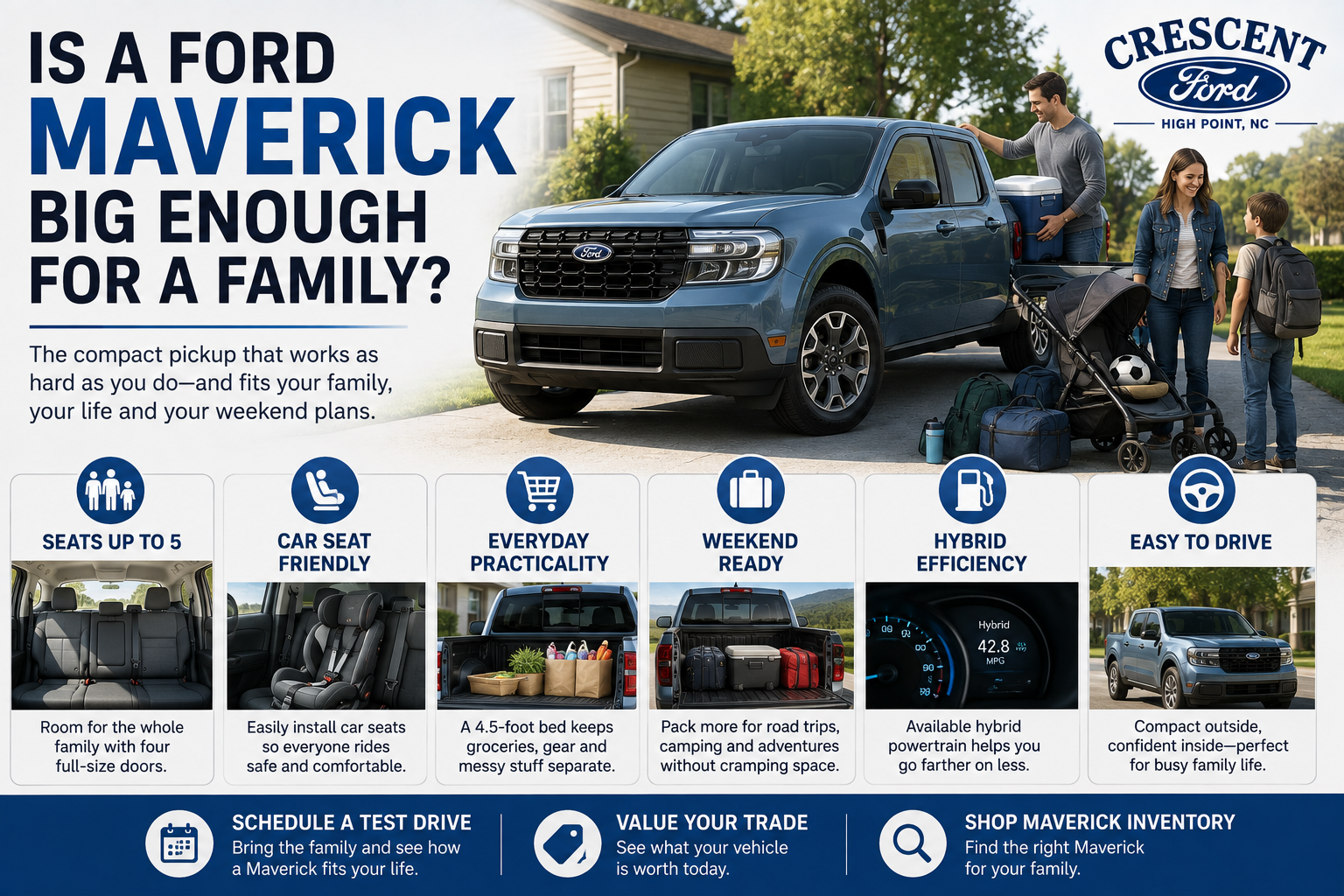
Ford Maverick family truck showing seating for five, car-seat space and everyday family practicality at Crescent Ford

Is a Ford Maverick Big Enough for a Family?

The Ford Maverick looks like it could be the perfect family vehicle.

It's easier to maneuver than a full-size pickup. You get a real truck bed. There's seating for five. And you can choose a hybrid powertrain if fuel economy matters to you.

Then you open the back door and start wondering:

Is a Ford Maverick actually big enough for my family?

That's a much better question than simply asking whether the Maverick has five seats.

Because there's a big difference between fitting five seat belts into a vehicle and comfortably living with that vehicle every day.

Can you install car seats?

Where does the stroller go?

What happens when you buy groceries and it's raining?

Can you take it on vacation?

Will teenagers fit in the back?

And if you're expecting another child, are you going to wish you'd bought something bigger two years from now?

Let's look at what living with a Ford Maverick as a family vehicle is actually like.

Shop New Ford Maverick Trucks at Crescent Ford


The Short Answer: Is a Ford Maverick Good for a Family?

Yes — for the right family.

The Maverick can make an excellent family vehicle for a family of three or four, particularly if you like the utility of having a pickup bed but don't need the size or capability of a larger truck.

A family of five can fit, too, but this is where we'd recommend spending some time inside one before deciding.

Three people across the rear seat is very different from two.

And three teenagers are very different from three small children.

The Maverick makes the most sense for families that want:

  • Seating for up to five

  • Four full-size doors

  • A useful pickup bed

  • A smaller exterior footprint

  • Easy everyday drivability

  • Available hybrid efficiency

  • Truck utility without stepping into a larger Ranger or F-150

Where we'd hesitate is a family that regularly needs:

  • Three bulky car seats across the rear

  • Lots of enclosed cargo space

  • Three-row seating

  • Significant rear-seat room for older/taller children

  • Heavy towing capability

  • Room for five people plus substantial vacation luggage inside the cabin

The Maverick can absolutely be a family truck.

The bigger question is:

What does your family bring with them?


How Many People Does the Ford Maverick Seat?

The Ford Maverick is a five-passenger SuperCrew pickup.

That means you get:

Two front seats

and

A three-person rear bench

There isn't a smaller extended-cab Maverick with tiny rear doors. Every Maverick gives you four full-size doors and a proper rear seating area.

That's one of the reasons it can work so well as a family truck.

If you're coming from a compact sedan or crossover, the Maverick doesn't require you to give up a usable back seat just because you want a pickup.

But let's talk about the reality of that back seat.


Is the Ford Maverick Big Enough for a Family of Four?

This is probably the Maverick's sweet spot.

Two adults + two kids gives you a very practical seating arrangement.

Each child can have an outboard rear position, and you aren't asking anyone to occupy the middle seat during every trip.

For a family of four, the Maverick can give you something that's difficult to find elsewhere:

A relatively compact everyday vehicle with a completely separate cargo area.

That's especially useful if your weekends involve things you don't necessarily want inside an SUV.

Think:

  • Muddy soccer gear

  • Bikes

  • Gardening supplies

  • Beach equipment

  • Camping gear

  • Home-improvement materials

  • Coolers

  • Wet outdoor equipment

Instead of putting all of that behind the second row, you have a truck bed.

For an active family, that's a legitimate advantage.


Is the Ford Maverick Big Enough for a Family of Five?

This answer is more complicated.

Technically?

Yes.

Practically?

You need to try it.

A family with two adults and three children can use a Maverick, but comfort will depend heavily on:

  • The children's ages

  • Their sizes

  • Whether anyone uses a car seat or booster

  • How often all five people ride together

  • How long your typical trips are

Three younger children may have different space requirements than three teenagers.

Likewise, putting three people across the rear seat for a 15-minute trip around High Point is different from putting them there for a six-hour family vacation.

Our recommendation for a family of five:

Bring everybody to the test drive.

Seriously.

Don't sit in the driver's seat for ten minutes and decide the Maverick has enough room.

Put everyone where they actually sit.

Bring the booster seats.

Bring the car seats.

Adjust the driver's seat to the position you actually use.

Then close the doors.

That's going to tell you far more than an interior-dimensions chart.


Can You Put Car Seats in a Ford Maverick?

Yes, families can use child restraints in the Maverick, but the important question isn't simply whether a car seat can be installed.

It's whether your particular combination of car seats, passengers and front-seat positions works comfortably.

Car seats vary enormously.

An infant seat with a base can take up very different space than a forward-facing convertible seat.

A narrow booster is different from a wide convertible seat.

And a rear-facing seat generally creates a different front-to-back space requirement than a forward-facing one.

One car seat

For most families, this is the easiest Maverick setup.

You still retain much of the rear seating area.

Two car seats

This is where the Maverick can make a lot of sense for a family of four.

Each child can occupy an outboard position.

Three car seats

This is where we would not make promises from an article.

Whether three specific child restraints fit safely across a particular rear seat depends on the seats themselves, their installation requirements and the vehicle.

If three-across seating is essential to your family, bring the actual child restraints you're going to use and verify that they can be properly installed according to both the Maverick owner's manual and the child-seat manufacturers' instructions.

Don't buy a vehicle because someone on the internet said:

"Yeah, three car seats fit."

Your seats may be completely different from theirs.


Should You Bring Your Car Seat to a Maverick Test Drive?

Absolutely.

This is one of the easiest ways to prevent buyer's remorse.

If you have an infant seat, bring it.

If you have a rear-facing convertible seat, bring it.

If you have two boosters, bring them.

Install them the way you'll actually use them and then sit in the front seat.

You want to know:

  • Can the front passenger sit comfortably?

  • Can your child get in and out easily?

  • Can you reach the buckles?

  • Does your stroller fit where you plan to carry it?

  • Can you live with this setup every day?

Those questions matter much more than whether the brochure says five passengers.

Schedule a Ford Maverick Test Drive

Bring your car seats, stroller or whatever your family uses every day. We'd rather help you make sure it fits before you buy.


What About Rear-Facing Car Seats?

Rear-facing seats deserve special attention because they can consume a surprising amount of front-to-back space.

A rear-facing seat installed behind a tall driver can create a very different situation than one installed behind a shorter passenger.

That's why we'd test the exact configuration.

If Mom usually drives and Dad is 6'3", don't test the car seat with Dad driving if Mom will actually be behind the wheel most of the time.

Set the truck up like your real life.

If you're expecting a baby, this matters even more.

A truck that feels spacious with an empty rear bench can feel completely different once an infant carrier is installed.


What About Strollers?

Here's where owning a pickup becomes interesting.

You have a 4.5-foot FLEXBED behind the passenger compartment.

That gives you plenty of flexibility for things like a stroller, wagon or other bulky family gear.

But there's an obvious difference between a truck bed and an SUV cargo area:

The truck bed is outside.

That can be an advantage or disadvantage depending on what you're carrying.

A muddy stroller?

Fantastic.

A load of beach chairs covered in sand?

Put them in the bed.

A week's worth of groceries during a thunderstorm?

Now you may wish you had enclosed cargo space.

A bed cover changes the equation

Families planning to use a Maverick as their primary vehicle may want to consider an appropriate tonneau cover or other cargo solution.

Covered bed storage can make the Maverick much more SUV-like when you need to carry:

  • Groceries

  • Luggage

  • Strollers

  • Sports bags

  • Christmas presents

  • Everyday family cargo

while still preserving the ability to use the bed for dirty or oversized items when needed.


Can You Fit Groceries in a Ford Maverick?

Of course.

But this question reveals one of the biggest lifestyle differences between a Maverick and an SUV.

In an Explorer or Escape, you open the liftgate and put your groceries inside.

In a Maverick, your primary cargo area is the bed.

For a normal grocery run, that isn't necessarily a problem.

But you'll want to think about:

Weather

Keeping bags from sliding around

Keeping purchases secure

Separating fragile groceries from other bed cargo

A bed organizer, storage system or tonneau cover can make a major difference if the Maverick is going to handle family grocery duty every week.


Is the Maverick Good for School Drop-Off?

This is one area where the Maverick's compact dimensions can be a real family advantage.

A full-size truck gives you considerably more interior and capability.

It also gives you considerably more truck to maneuver.

If your daily routine involves:

  • School pickup lines

  • Daycare

  • Grocery-store parking lots

  • Downtown parking

  • Tight garages

  • Commuting

the Maverick's smaller footprint can be refreshing.

You're getting the utility of a pickup without necessarily feeling like you're piloting a large truck through every parking lot.

For families who want a truck but don't really want a big truck, that's a big part of the Maverick's appeal.


Is a Ford Maverick Good for Teenagers?

This is where we'd start thinking about how long you plan to keep the truck.

Small children become big children remarkably quickly.

A Maverick that feels enormous when your kids are 3 and 6 may feel very different when they're 13 and 16.

That doesn't mean teenagers can't ride in the back.

They can.

But if you have multiple tall teenagers who regularly ride with you, we'd compare the Maverick directly with a Ranger and F-150 before deciding.

Think five years ahead

If you're financing a vehicle for five or six years, don't shop only for the family you have today.

Ask:

How old will my kids be when this loan is paid off?

That's one of the most useful questions a family can ask while vehicle shopping.


Is the Maverick Good for a Family Road Trip?

It can be.

But the answer depends heavily on family size.

Family of three

Very workable.

You have plenty of flexibility for passengers and can use the bed for luggage.

Family of four

Still a strong use case, particularly with an effective covered-bed cargo setup.

Family of five

This is where we'd test carefully.

Five people plus several hours on the highway plus everyone's luggage is a very different space test from five people driving to dinner.

If family road trips are a major part of your life, don't just test-drive the Maverick around the block.

Have everyone sit in it for a while.

Look at where the luggage will go.

Think about what happens when someone wants a backpack, blanket, snacks and electronics within reach.

The Maverick may still work.

But this is where an Explorer, Ranger or F-150 may begin making a stronger case depending on your priorities.


Where Does Family Luggage Go in a Maverick?

Mostly in the bed.

And that's actually one of Maverick's strengths.

Instead of trying to fit suitcases behind a rear seat, you have a 4.5-foot pickup bed designed to carry cargo.

The FLEXBED system is designed to make that space adaptable for different uses.

For family travel, we'd think about:

  • Weather-resistant luggage

  • A tonneau cover

  • Properly securing cargo

  • Keeping frequently needed items inside the cab

That last point matters.

If your toddler suddenly needs the bag containing their favorite stuffed animal while you're on I-40, you probably don't want that bag buried under four suitcases in the truck bed.

Pack accordingly.


Maverick vs. SUV for a Family

This is probably the real decision for many shoppers.

You're not necessarily deciding between a Maverick and another truck.

You may be deciding between:

Maverick vs. Escape

or

Maverick vs. Explorer.

Maverick advantages

  • Open pickup bed

  • Better for dirty or bulky cargo

  • Truck styling

  • Useful for home projects

  • Available hybrid powertrain

  • Compact exterior dimensions

  • Can tow when appropriately equipped

SUV advantages

  • Enclosed cargo space

  • Easier access to luggage from the passenger compartment

  • Better protection from weather without adding a bed cover

  • Explorer offers a third row

  • Cargo and passengers share one climate-controlled space

Neither layout is better.

They're useful in different ways.

Ask yourself this:

Would you rather have:

a separate pickup bed

or

a large enclosed cargo area?

That answer may tell you whether you're really a Maverick family or an SUV family.


Is a Maverick Big Enough for a Baby?

For many families, yes.

In fact, a Maverick can be particularly appealing to new parents who want a truck but don't want to move into a full-size pickup.

But don't test it empty.

Bring:

  • Infant seat

  • Stroller

  • Diaper bag

  • Any other bulky gear you use regularly

Then see how it all works together.

The infant seat might fit beautifully.

The stroller might fit beautifully.

The question is whether the entire system fits your life.


Is a Maverick Big Enough for Two Kids?

This is arguably one of its strongest family configurations.

Two adults up front.

Two kids in the outboard rear seats.

Bed for everything else.

For families that spend weekends at ball fields, parks, campsites, home-improvement stores or outdoor activities, the ability to throw messy equipment in the bed can be genuinely useful.

And during the week, you still have a compact truck that's easy to drive around High Point, Greensboro and the rest of the Triad.


Is a Maverick Big Enough for Three Kids?

Potentially.

But this is the point where we'd stop answering from a computer screen and start testing the truck.

Three kids means someone occupies the center rear position.

If car seats or boosters are involved, you also have to make sure the particular combination can be properly installed and used.

If the kids are older, shoulder room and comfort become more important.

Our recommendation:

If you're a family of five, compare the Maverick against something larger before you buy.

Not because the Maverick can't work.

Because you want to know what you're giving up in exchange for its smaller size.


Maverick vs. Ranger for a Family

This is an interesting comparison.

The Maverick is the smaller truck.

The Ranger gives you a step up in truck capability and size.

But bigger isn't automatically better for family use.

If you're mostly commuting, carrying kids and occasionally using the bed, the Maverick's compact dimensions may actually be an advantage.

If you need greater towing capability, more traditional truck capability or simply prefer a midsize pickup, Ranger becomes more attractive.

The right answer depends on whether you're buying:

a family vehicle that happens to be a truck

or

a truck that also needs to carry your family.

Those sound similar.

They're not.


Maverick vs. F-150 for a Family

If rear-seat room and truck capability are priorities, the F-150 deserves a look.

A properly configured F-150 can offer considerably more towing capability than the Maverick, and a SuperCrew F-150 provides the kind of rear-seat space that can make family duty much easier.

The tradeoff?

It's a much larger vehicle.

For someone who rarely tows, lives in suburban neighborhoods and mostly needs a bed for weekend projects, buying an F-150 solely for the larger back seat may be more truck than they actually want to drive every day.

Fortunately, we've already built a guide specifically around this decision.

RELATED READING

Ford Maverick vs. Ranger vs. F-150: How Much Truck Do You Actually Need?

That article is the perfect next step if you're realizing the question isn't whether the Maverick is good â€” it's whether you need more truck.


Can a Ford Maverick Tow a Family Camper?

Potentially, but this is where you need actual numbers.

For 2026, Ford rates the Maverick for 2,000 pounds of towing in its base configurations, with up to 4,000 pounds available when properly equipped with the 4K Tow Package.

That can work for some small campers and recreational trailers.

It absolutely does not mean every camper under 4,000 pounds should automatically be connected to any Maverick.

You need to consider:

  • Loaded trailer weight

  • Cargo

  • Passengers

  • Vehicle configuration

  • Equipment

  • Tongue weight

  • GCWR

Ford specifically notes that maximum towing varies based on cargo, vehicle configuration, accessories and number of passengers.

And that last item is especially important in an article about families.

The people and gear coming with you matter.

If camping is a major reason you're buying a truck, bring the specifications for the camper you're considering when you shop.


Does the Maverick Have Enough Bed Space for a Family?

The Maverick uses a 4.5-foot FLEXBED, which gives families a surprisingly useful cargo area without making the truck enormous. Crescent Ford's existing Maverick model page also highlights its five-passenger interior and 4.5-foot bed.

Is it an F-150 bed?

No.

That's not the point.

For family use, think about the things that are awkward to put inside a crossover:

  • Bikes

  • Scooters

  • Sports gear

  • Gardening supplies

  • Bags of mulch

  • Beach chairs

  • Coolers

  • Camping equipment

  • Dirty shoes

  • Wet umbrellas

  • Small furniture

  • Home-improvement supplies

The Maverick gives you somewhere to put those things other than next to your children.

That's a pretty underrated family feature.


What About the Maverick Hybrid for a Family?

This is where the Maverick becomes particularly interesting for someone who wants truck utility but spends most of the week doing normal family driving.

Think about the typical family routine:

School.

Work.

Grocery store.

Practice.

Daycare.

Dinner.

Home.

Repeat.

You may love having a truck bed on Saturday without wanting traditional full-size-truck operating costs Monday through Friday.

That's exactly the kind of use case that makes the Maverick Hybrid worth considering.

If you're comparing hybrid and EcoBoost Mavericks, we'd look at your entire use case rather than simply choosing whichever has the better fuel-economy number.

Ask:

  • How much do I drive?

  • Do I tow?

  • What drivetrain do I want?

  • What equipment matters?

  • How will I use the truck on weekends?

Then choose the powertrain around your actual life.

Browse Available Ford Maverick Trucks


What Families Might Outgrow a Maverick?

This is the part of the article where we're going to tell you not to buy a Maverick if it doesn't fit.

Because finding that out before you buy is much better than discovering it six months later.

We'd seriously compare something larger if:

You have three children in bulky child restraints

Don't assume they'll fit comfortably across the rear bench.

Test it.

You regularly carry five people

Occasional five-passenger duty and everyday five-passenger duty are different things.

Your children are already tall teenagers

Rear-seat comfort may matter more than compact exterior dimensions.

You need three rows

Then Maverick simply isn't the right category of vehicle.

Look at Explorer or Expedition.

You tow something substantial

The Maverick's available 4,000-pound maximum towing capability may not be enough for your needs.

You want all of your cargo enclosed

An SUV may fit your lifestyle better.

You expect your family needs to change soon

If baby number three is coming and you keep vehicles for eight years, shop for the family you'll have — not just the one sitting at the kitchen table today.


What Families Are a Great Fit for a Maverick?

On the other hand, Maverick can be a fantastic fit if:

You're a family of three or four

This is where the seating arrangement becomes particularly practical.

You want a truck without driving a huge vehicle

One of Maverick's biggest advantages.

You're active outdoors

The bed gives you a separate place for gear.

You own a home

Mulch, plants, tools, lumber and weekend projects suddenly become much easier.

You commute every day

You're not necessarily committing to full-size-truck dimensions just because you want a pickup.

You want the option of a hybrid

This can make the Maverick especially compelling as a vehicle doing double duty between family transportation and truck utility.

You don't need extreme towing capability

If your lifestyle doesn't require Ranger or F-150 capability, you don't have to buy it simply because those trucks are bigger.


The Best Way to Know If a Maverick Fits Your Family

Here's our recommendation:

Don't come to the dealership alone.

Bring the family.

And bring the stuff.

If you have a baby:

Bring the car seat and stroller.

If you have toddlers:

Bring their seats.

If you have teenagers:

Bring the teenagers.

If you're buying the Maverick because you mountain bike:

Let's look at how you're going to carry the bikes.

If you're buying it to tow:

Bring the trailer specifications.

We're not trying to determine whether a Maverick is big enough for some theoretical family.

We're trying to determine whether it's big enough for yours.

Schedule a Maverick Test Drive

Bring the family, car seats and stroller. We'll help you see how a Maverick fits your real life before you decide.


What If the Maverick Isn't Big Enough?

That's useful information.

It doesn't mean you've wasted your time.

It means you've narrowed down what you actually need.

If you love the idea of a truck but want to move up in size or capability, compare:

Ford Ranger

and

Ford F-150.

If you've realized you'd rather have enclosed family cargo space, compare:

Ford Escape

or

Ford Explorer.

And if three-row space is becoming the priority, we've already built another guide that can help:

RELATED READING

2026 Ford Explorer vs. Expedition: Which 3-Row SUV Fits Your Family?

That's exactly how vehicle shopping should work.

You don't have to force yourself into the vehicle you originally planned to buy.

You just need to find the one that solves the most problems for your family.


Trading Your Current Family Vehicle for a Maverick?

Before deciding what Maverick fits your budget, find out what your current vehicle is worth.

If you have positive equity, that can significantly change the amount you need to finance.

Find Out What Your Vehicle Is Worth

Related Reading

What Is My Car Worth in High Point, NC? How Trade-In Appraisals Actually Work

Link to: Previously published trade-value article

If you still owe money:

Can You Trade In a Car You Still Owe Money On?

And if you're deciding how much cash to bring:

How Much Should You Put Down on a Car?


Is a Ford Maverick Big Enough for Your Family?

For plenty of families, yes.

Especially families of three or four that want something that's easy to drive every day but much more useful on weekends than a typical sedan or small crossover.

The Maverick gives you five-passenger seating and a 4.5-foot truck bed in a package that's deliberately smaller than traditional pickups.

But we'd be more cautious for a family of five, families using multiple bulky car seats, or anyone who regularly needs substantial enclosed cargo space.

And that's okay.

The Maverick doesn't need to be the perfect family vehicle for everyone.

It just needs to be the right one for you.

For families around High Point, Greensboro, Winston-Salem, Kernersville, Thomasville, Lexington, Trinity and the surrounding Piedmont Triad, the best way to answer the question is surprisingly simple:

Load one up.

Put the kids in it.

Install the car seat.

Put the stroller where you think it'll go.

Sit in the back.

Open the bed.

Drive it.

If everything fits and you enjoy driving it, you've got your answer.

And if it doesn't?

We'll help you compare the next size up.

Shop New Ford Maverick Trucks at Crescent Ford

Schedule a Maverick Test Drive

Value Your Trade

Explore Financing Options


Frequently Asked Questions About the Ford Maverick for Families

Is a Ford Maverick a good family vehicle?

Yes, the Maverick can be a practical family vehicle, particularly for families of three or four that want four full-size doors, seating for up to five and the utility of a pickup bed without moving into a larger truck.

Is a Ford Maverick big enough for a family of four?

For many families, yes. Two adults and two children can use the two outboard rear seating positions while retaining the bed for strollers, sports equipment, groceries and other family cargo.

Is a Ford Maverick big enough for a family of five?

It can be, but we'd recommend having all five family members sit in the Maverick before buying. Three people will need to share the rear bench, and comfort depends on their size, age and whether child restraints are being used.

Can you fit car seats in a Ford Maverick?

The Maverick can accommodate child restraints, but fit depends on the particular car seat and installation position. Families should follow both the Maverick owner's manual and child-restraint manufacturer's instructions. If multiple car seats are required, bring the actual seats when you test drive the truck.

Can you fit three car seats in a Ford Maverick?

Don't assume that any three child seats will fit safely across the Maverick's rear bench. Child restraints vary substantially in width and installation requirements. If you need three-across seating, test your exact seats and verify that each can be properly installed according to the vehicle and child-restraint instructions.

Can a stroller fit in a Ford Maverick?

The Maverick's 4.5-foot FLEXBED gives families a useful place to carry a stroller or wagon. If the truck will be your primary family vehicle, consider how you'll protect everyday cargo from weather and whether a bed cover or cargo-management solution makes sense.

Is the Ford Maverick good for road trips?

It can be, particularly for families of three or four. The pickup bed provides useful luggage space, although families may want covered storage for weather protection. Families of five should evaluate rear-seat comfort before planning frequent long-distance trips.

Is the Maverick good for teenagers?

Teenagers can ride in the Maverick's rear seat, but families with several taller teens should compare it with larger trucks before buying. If you plan to keep the vehicle for many years, consider how much your children may grow during your ownership period.

Is the Maverick or an SUV better for a family?

It depends on how you use cargo space. Maverick gives you a separate pickup bed that's excellent for dirty, wet or bulky gear. An SUV gives you enclosed, climate-controlled cargo space that's easier to access from the passenger compartment. Families should decide which layout better matches everyday life.

Is a Maverick or F-150 better for a family?

Maverick is easier to maneuver and may provide all the truck utility a smaller family needs. An F-150 SuperCrew provides considerably more truck capability and passenger space but is also a substantially larger vehicle. Your family size, towing needs and daily driving should determine which makes more sense.

How much can a 2026 Ford Maverick tow?

Ford rates the 2026 Maverick for 2,000 pounds of base towing capacity, with up to 4,000 pounds available when properly equipped with the 4K Tow Package. Actual capability varies based on vehicle configuration, cargo, accessories and passengers.

Should I bring my car seats when I test drive a Ford Maverick?

Yes. Bringing your actual car seats is one of the best ways to determine whether the Maverick works for your family. Install them according to the appropriate instructions, adjust the front seats to your normal positions and make sure everyone can ride comfortably.

Should the whole family test drive the Maverick?

Ideally, yes. If the Maverick will be your primary family vehicle, have the people who will regularly ride in it come along. Schedule a Maverick test drive, bring the car seats or stroller if applicable, and test the truck the way you'll actually use it.

Posted in:

Related Posts

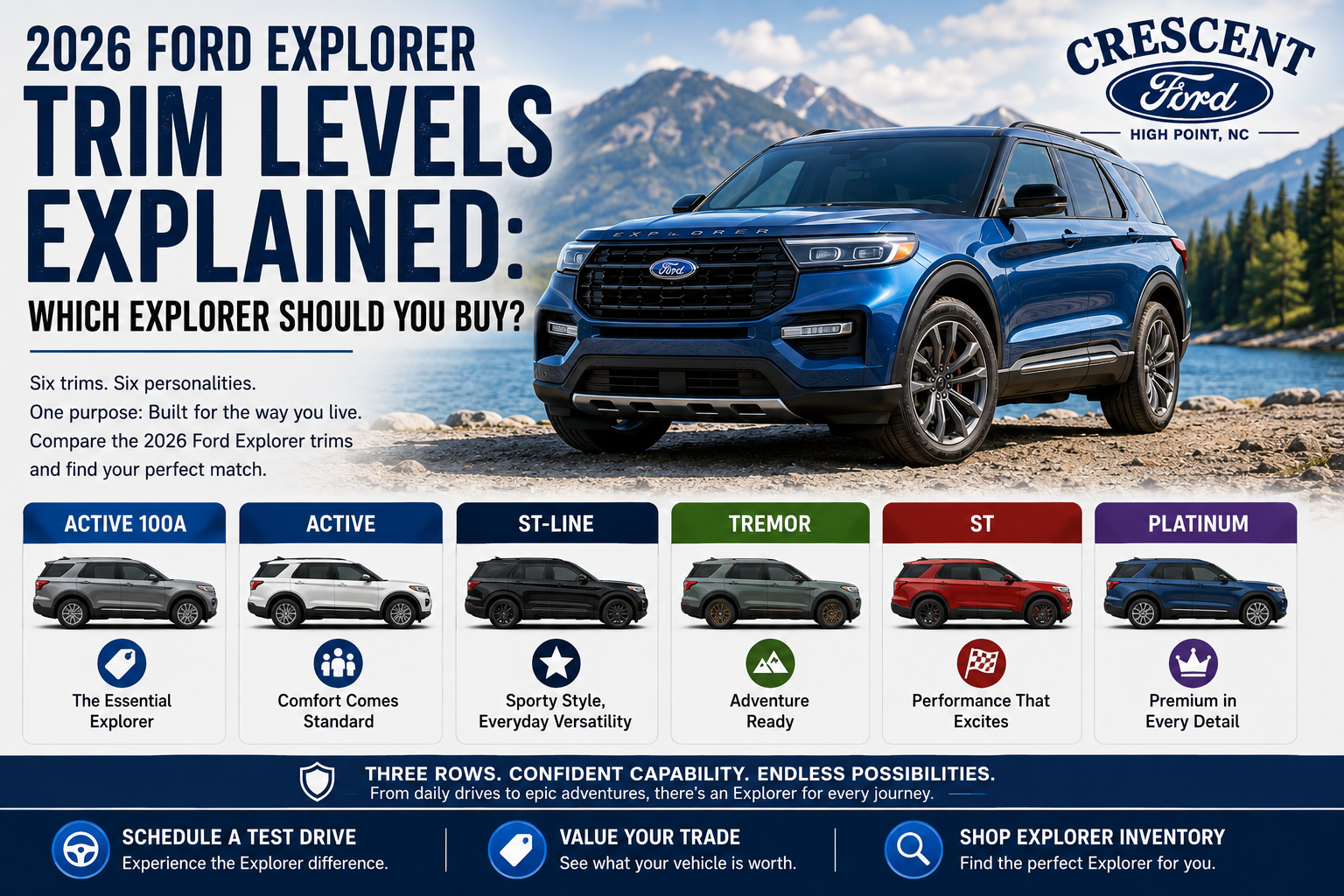
2026 Ford Explorer trim levels comparison including Active, ST-Line, Tremor, ST and Platinum at Crescent Ford in High Point, NC

2026 Ford Explorer Trim Levels Explained: Which Should You Buy?

2026 Ford Explorer Trim Levels Explained: Which Explorer Should You Buy? So you've decided the Ford Explorer is probably the right SUV for your family. Great. Now you have another decision to make: Which Explorer should you buy? For 2026, Ford gives Explorer shoppers several distinctly different choices: Explorer Active 100A Explorer Active Explorer ST-Line Explorer Tremor Explorer ST Explorer Platinum And choosing between them isn't simply a matter of working your way up the price ladder. The ST-Line looks sportier without requiring you to move into the high-performance ST. The ST gives you the 3.0L EcoBoost V6 and significantly more performance. The Platinum prioritizes comfort and upscale features. And the new Tremor takes Explorer in a completely different direction with standard 4WD and equipment designed for greater capability away from pavement. In other words: The most expensive Explorer isn't automatically the best Explorer for you. Let's figure out which trim actually fits the way you'll use it. Shop New Ford Explorer SUVs at Crescent Ford 2026 Ford Explorer Trim Levels at a Glance Explorer Personality Engine Drivetrain Best For Active 100A Essential Explorer 2.3L EcoBoost RWD or 4WD Value-focused shoppers Active Comfort-focused 2.3L EcoBoost RWD or 4WD Everyday family use ST-Line Sporty appearance 2.3L EcoBoost RWD or 4WD Style + technology Tremor Adventure/off-road 2.3L EcoBoost; 3.0L available 4WD Outdoor/adventure families ST High performance 3.0L EcoBoost V6 RWD or 4WD Performance-focused shoppers Platinum Luxury-focused 2.3L EcoBoost RWD or 4WD Premium comfort Features and options can vary by equipment group and configuration. Always verify the window sticker and equipment on the individual Explorer you're considering. The quick answer Active 100A: Choose it if your priority is getting into a new Explorer while keeping things simple. Active: Our starting point for many traditional family-SUV shoppers. ST-Line: Choose it if you love the sporty Explorer look but don't need the ST's V6 performance. Tremor: Choose it if 4WD and greater off-pavement capability genuinely fit your lifestyle. ST: Choose it if you want the Explorer that is genuinely fun to drive. Platinum: Choose it if comfort and premium features matter more than maximum performance. Now let's look at why. 2026 Ford Explorer Active 100A: The Essential Explorer The Active 100A is new for 2026 and becomes the entry point into the Explorer lineup. Think of this as the Explorer for someone who says: "I want the space and capability of an Explorer, but I don't need every convenience feature." It uses the same 2.3L EcoBoost four-cylinder engine found in several other Explorer trims and is available with rear-wheel drive or Intelligent 4WD. Where Ford saves money is primarily in equipment. Compared with the regular Active, the 100A simplifies some convenience features. For example, Ford's order guide shows a manual liftgate rather than the Active's power liftgate, simplified front-seat adjustments and other equipment differences. That creates an interesting option for shoppers who care more about: Three-row capability Explorer size Core technology Engine performance Available 4WD Purchase price than having every comfort feature. Who should buy the Explorer Active 100A? Consider it if: You're shopping primarily around budget. You want a new Explorer rather than a smaller SUV. You don't mind a manual liftgate. You don't need premium interior features. You want the 2.3L EcoBoost powertrain. You'd rather spend money on the vehicle size you need than convenience features you don't. Who should move up to Active? If you're already thinking: "Wait — I definitely want the power liftgate." Keep reading. The regular Active may be the better fit. 2026 Ford Explorer Active: The Family Sweet Spot For a lot of Explorer shoppers, Active is where we'd start the comparison. It keeps the 2.3L EcoBoost powertrain but adds comfort and convenience features that can matter during everyday family use. And that's really what Active is about. Not showing off. Not pretending you're headed rock crawling. Not chasing maximum horsepower. Just making life with a three-row SUV easier. Why Explorer Active makes sense If your typical week consists of: School drop-offs Work Grocery runs Sports practice Family errands Weekend trips Occasional third-row passengers you may not need to move much farther up the lineup. That's important because trim shopping can easily become: "For just a little more, I can get..." Then you repeat that sentence four times and suddenly you're looking at a completely different SUV. Instead, ask: What features will I actually use? If Active already checks the boxes, that's a very good reason to stop there. Who should buy Explorer Active? We'd put it high on the list for: Families Daily commuters Buyers prioritizing value and comfort Shoppers who don't need performance styling Buyers who want available 4WD Anyone looking for a well-rounded Explorer Our take Active is probably the Explorer trim most shoppers should use as their baseline. Drive it first. Then decide whether something on ST-Line, Tremor, ST or Platinum gives you enough additional value to move up. See Available Ford Explorer SUVs 2026 Ford Explorer ST-Line: Sporty Without Going Full ST This is one of the easiest Explorer trims to misunderstand. The ST-Line is not an Explorer ST with a smaller badge. It gives you much of the sporty appearance associated with the ST while retaining the 2.3L EcoBoost powertrain. That's exactly why it exists. Some shoppers love the appearance of the ST but don't necessarily need — or want to pay for — the 3.0L EcoBoost V6. That's the ST-Line shopper. What makes the ST-Line different? Visually, ST-Line takes the Explorer in a much sportier direction. For 2026, Ford equips it with 20-inch Ebony-painted machined aluminum wheels as standard equipment. The overall theme is more aggressive than Active without requiring you to jump all the way to the performance-focused ST. Who should buy Explorer ST-Line? Consider ST-Line if: Exterior styling matters to you. You like blacked-out/sport-inspired details. You want a more aggressive-looking Explorer. The 2.3L EcoBoost already provides the performance you need. You want more technology and available equipment. You like the ST aesthetic but don't need the ST engine. This is an important distinction. ST-Line = sporty appearance ST = sporty appearance + serious performance If you're choosing primarily with your eyes, ST-Line can make a lot of sense. If you're choosing with your right foot? You probably want to drive the ST. 2026 Ford Explorer Tremor: The Adventure Explorer This is the biggest addition to the 2026 Explorer lineup. Explorer Tremor is new for 2026. And unlike ST-Line, which primarily changes the Explorer's personality through appearance and equipment, Tremor is about capability. The Tremor comes standard with Intelligent 4WD rather than offering rear-wheel drive as an alternative. Ford also gives it 18-inch Ebony Black-painted wheels with all-terrain tires, helping distinguish it from the more street-focused Explorer trims. What engine does the Explorer Tremor have? Here's where Tremor gets particularly interesting. The standard engine is the 2.3L EcoBoost. But the 3.0L EcoBoost V6 is available. That means you can configure Tremor in two very different ways. 2.3L Tremor Makes sense if you want the Tremor's capability and styling without needing the more powerful V6. 3.0L Tremor This is for someone who wants the more adventure-focused Explorer and considerably more power. Ford pairs the 3.0L Tremor with its Tremor Ultimate Package, which brings additional premium equipment into the mix. Who should buy Explorer Tremor? We'd consider Tremor if: You regularly drive on gravel, dirt or rougher roads. Camping is part of your lifestyle. You spend weekends in the mountains. Standard 4WD matters. You want all-terrain tires from the factory. You want an Explorer that looks and feels more adventure-focused. You like the idea of pairing Tremor capability with the available 3.0L EcoBoost. For drivers in the Piedmont Triad who regularly head toward Boone, Blowing Rock, the Blue Ridge or campsites around North Carolina, Tremor gives Explorer shoppers an option they didn't previously have. But be realistic. If your Explorer will spend 99.9% of its life on pavement between High Point and Greensboro, you don't need Tremor. You may still want it. That's different. Explorer Tremor vs. ST-Line These two trims may appeal to shoppers who want something more visually interesting than Active. But they have very different personalities. Choose ST-Line if: You want a sporty-looking Explorer primarily for pavement. Choose Tremor if: You want an adventure-oriented Explorer with standard 4WD and all-terrain equipment. Think: ST-Line = street Tremor = trail That's oversimplified, but it's a useful starting point. 2026 Ford Explorer ST: The Performance Choice Now we get to the Explorer that actually backs up its sporty appearance with a different engine. The 2026 Explorer ST uses a 3.0L EcoBoost V6 producing up to 385 horsepower and 415 lb.-ft. of torque. That's a substantial jump from the 2.3L EcoBoost used by Active and ST-Line. Ford also gives the ST a sport-tuned suspension, 21-inch Magnetite-painted aluminum wheels and other performance-oriented equipment. This isn't simply an appearance package. The ST drives differently. Who should buy Explorer ST? Consider the ST if: You genuinely enjoy driving. Acceleration matters to you. You want the 3.0L EcoBoost V6. You want a sport-tuned suspension. You want three rows without giving up performance. You'd actually appreciate the difference every time you drive it. And that last point matters. If you're never going to care how quickly your family SUV accelerates, you probably don't need the ST. If you get into an ST, accelerate onto the highway and immediately grin? Different story. This is one trim you absolutely should test drive. The reason to pay for an ST isn't simply a list of features. It's how the SUV feels. Schedule a Ford Explorer Test Drive Explorer ST-Line vs. Explorer ST: What's the Difference? This may be the most important trim comparison in the entire lineup. The names are similar. The vehicles aren't. Explorer ST-Line 2.3L EcoBoost Sport-inspired appearance 20-inch standard wheels Designed for shoppers who want the ST look without the ST powertrain Explorer ST 3.0L EcoBoost V6 Up to 385 horsepower Up to 415 lb.-ft. of torque Sport-tuned suspension 21-inch standard wheels Designed for shoppers who actually want increased performance Which should you buy? If you love the look: ST-Line. If you love the performance: ST. If you're unsure whether the ST is worth the additional money, drive both back-to-back. You'll know pretty quickly whether the performance difference matters to you. 2026 Ford Explorer Platinum: The Luxury Choice Platinum takes the Explorer in another direction entirely. Instead of asking: "How can we make Explorer sportier?" Platinum asks: "How can we make Explorer more comfortable and premium?" For 2026, Platinum uses the 2.3L EcoBoost engine. That's worth pointing out because shoppers familiar with previous Explorer model years may remember the availability of the 3.0L EcoBoost on Platinum. For 2026, Ford deleted the 3.0L engine option from Platinum. If you want the V6, you're now looking primarily toward ST or an appropriately equipped Tremor. If you want premium comfort, Platinum remains the luxury-focused Explorer. What makes Platinum different? Ford equips Platinum with upscale design and comfort features, including standard 20-inch Luster Nickel-painted aluminum wheels, with 21-inch wheels available. BlueCruise equipment is also part of the Platinum story, with Ford offering hands-free highway-driving capability under applicable activation plans. The emphasis is less: "Look how aggressive my SUV is." and more: "This is a very comfortable place to spend two hours." Who should buy Explorer Platinum? Consider Platinum if: Interior comfort is a major priority. You want a more upscale Explorer. Premium appointments matter more than performance. You spend significant time commuting or traveling. You're interested in available BlueCruise. You don't need the ST's V6. Platinum vs. ST This is almost entirely about personality. ST: performance. Platinum: luxury. Neither is inherently better. They're built for different buyers. Explorer Active vs. ST-Line: Is ST-Line Worth It? For a lot of shoppers, this is where the decision will happen. Both use the 2.3L EcoBoost. Both can perform the basic family-SUV job extremely well. So why spend more for ST-Line? Mostly because you want what ST-Line adds. If you prefer its appearance and equipment, that's legitimate value. If you're indifferent to styling? Active may give you everything you actually need. This is where we'd encourage shoppers not to get caught in trim creep. If the ST-Line makes you turn around and look at your Explorer after parking it, that matters. If Active looks perfectly good to you? Keep the money. Explorer Active vs. Platinum: How Much Luxury Do You Need? These trims represent two very different approaches to essentially the same family mission. Active says: Give me the features I need. Platinum says: I'm spending a lot of time in this SUV. Make it nice. Both use the 2.3L EcoBoost for 2026. So moving from Active to Platinum isn't primarily about needing more engine. It's about how much you value comfort, appearance, convenience and premium equipment. For someone driving 8,000 miles per year mostly around town, Active may make perfect sense. For someone driving 25,000 miles per year and spending hours every week behind the wheel? Those comfort upgrades may feel much more valuable. Explorer ST vs. Tremor: Performance or Adventure? This may be the most fun comparison in the lineup. Both can be equipped with the 3.0L EcoBoost V6, but they're designed around different priorities. Explorer ST Built around on-road performance. Sport-tuned suspension. 21-inch wheels. Available RWD or 4WD. Explorer Tremor Built around greater off-pavement capability. Standard Intelligent 4WD. 18-inch wheels. All-terrain tires. Available 3.0L EcoBoost. Which one should you buy? Ask where you'll actually drive. If your idea of fun is a curvy paved road: ST. If your idea of fun is the dirt road at the end of it: Tremor. Which 2026 Explorer Trim Is Best for Families? For most families, we'd start with: Explorer Active. Why? Because it gives you the core Explorer experience without requiring you to pay for a specific personality you may not need. Then ask what Active is missing. Need sportier styling? Move to ST-Line. Spend a lot of time camping or on rougher roads? Look at Tremor. Want considerably more performance? Drive the ST. Want more premium comfort? Look at Platinum. That's a much better way to trim-shop than automatically asking: "What's the highest trim?" Which Explorer Trim Is Best for a Daily Commute? We'd compare: Active, ST-Line and Platinum. Active gives you the practical value play. ST-Line adds a sportier look. Platinum emphasizes comfort. If your commute regularly takes you between High Point, Greensboro, Winston-Salem or elsewhere around the Triad, we'd pay particular attention to the features you'll interact with every single day. Seat comfort. Driver-assistance technology. Audio. Interior materials. Wheel/tire configuration. Those things may matter more over 15,000 miles than an off-road feature you'll use twice. Which Explorer Trim Is Best for Road Trips? This one isn't necessarily about trim. All Explorer models give you the basic three-row SUV format. Instead, we'd look at what makes your road trips better. Active Great if you simply need a comfortable family vehicle. ST-Line Good if you want additional style and technology. Platinum Our first look if long-distance comfort is the priority. ST For the parent who wants the road trip to be fun after everyone else falls asleep. Tremor For the family whose road trip destination isn't always at the end of a paved road. Which Explorer Trim Is Best for Snow and Bad Weather? Don't choose solely from the trim badge. Look at the drivetrain and tires. Intelligent 4WD is available on several Explorer trims. Tremor includes 4WD as standard equipment and comes with all-terrain tires, making it particularly interesting for shoppers who prioritize traction and more rugged use. But an Active, ST-Line, ST or Platinum equipped with 4WD may make much more sense for someone who primarily wants additional confidence during poor weather without Tremor's adventure-focused equipment. Which Explorer Has the Most Horsepower? For conventional 2026 Explorer trims, the Explorer ST is the straightforward performance choice. Its 3.0L EcoBoost V6 produces up to: 385 horsepower and 415 lb.-ft. of torque. The 3.0L EcoBoost is also available on Tremor, giving shoppers another route to V6 Explorer power. If horsepower is a major reason you're choosing your trim, don't assume Platinum is the answer simply because it's positioned as a premium model. For 2026: Luxury = Platinum Performance = ST That's an important distinction. Which Explorer Trim Is the Best Value? If we're talking about value rather than lowest price, we'd start with Active. Why? Because it provides the features many families actually want without forcing you into styling, performance, off-road or luxury upgrades you may not use. But value is personal. For someone who desperately wants an ST, buying an Active and wishing every day that they'd bought the V6 isn't great value. For someone who spends 25,000 miles a year commuting, Platinum's comfort features may provide value every single day. For an outdoors-focused family, Tremor's standard 4WD and capability may be worth far more than premium interior trim. The best value is: the least expensive Explorer that gives you the things you'll genuinely miss if you don't have them. What Features Should You Actually Pay For? This is the question we'd ask before choosing any trim. Make three lists. Must Have Features you genuinely won't buy the vehicle without. Examples: 4WD Particular seating configuration Heated seats BlueCruise capability Power liftgate Specific engine Nice to Have Features you'd enjoy but could live without. Don't Care Features that sound impressive but won't change your ownership experience. Then shop the trim that checks your Must Have list without paying unnecessarily for everything on someone else's list. That's how you avoid spending thousands of dollars moving up trims for one feature you wanted. Don't Forget Packages and Options Here's another reason trim comparisons aren't always straightforward: Two Explorers with the same trim badge may not have identical equipment. Ford offers packages and standalone options that can substantially change an Explorer's features. For example, 2026 brings an available panoramic fixed glass roof with power shade across the Explorer lineup, while trims such as Tremor have their own convenience and Ultimate packages. BlueCruise availability also varies by trim, equipment and activation choice. So once you've decided: "I think I want an ST-Line" don't stop there. Compare the actual window stickers. You may find one ST-Line has exactly what you want while another doesn't. The VIN matters more than the badge when you're comparing specific vehicles. Browse Available 2026 Ford Explorers Do All 2026 Ford Explorers Have Three Rows? Yes, Explorer remains a three-row SUV. Depending on seating configuration, the 2026 Explorer can accommodate up to seven passengers. One noteworthy 2026 change is that Ford now makes a second-row bench seat available on the ST, giving performance-focused shoppers another seating option. That's useful for families who previously might have liked the ST but needed a different seating arrangement. Can a 2026 Ford Explorer Tow? Yes. Ford rates the 2026 Explorer for up to 5,000 pounds of maximum towing capacity when properly equipped. The Class III Trailer Tow Package is standard across the Explorer lineup. But remember: The maximum number doesn't mean every towing situation is automatically appropriate. Trailer weight, passengers, cargo and the specific vehicle configuration still matter. If you're buying an Explorer to tow a boat or camper, bring the trailer information with you when you shop. We'll help you look at the actual Explorer you're considering rather than relying solely on a maximum number from a brochure. Explorer or Expedition? Sometimes trim shopping reveals a bigger question. Suppose you're looking at Explorer Platinum because you need more family space. Or you're loading an Explorer with seven passengers and realizing you won't have as much cargo room behind the third row as you'd like. You may not need a different Explorer trim. You may need an Expedition. We've already built a full comparison for exactly that question. RELATED READING 2026 Ford Explorer vs. Expedition: Which 3-Row SUV Fits Your Family? That guide compares the two SUVs based on passenger space, cargo, towing and everyday family use. What If You Need Something Smaller Than an Explorer? The opposite can happen too. Maybe you're shopping Explorer because you want an SUV, but: You rarely carry more than four people. You don't need three rows. You primarily commute. A smaller footprint would be easier every day. In that case, don't pay for space you don't need. A smaller Ford SUV may make more sense. The goal isn't to sell yourself the biggest SUV your budget allows. It's to find the vehicle you'll actually enjoy living with. Trading Your Current Vehicle for an Explorer? Your trade can also affect which Explorer trim comfortably fits your budget. You may assume ST or Platinum is out of reach until you discover you have substantial positive equity. Or you may decide Active is the smarter choice once you know the full transaction. Start by finding out what your current vehicle is worth. Find Out What Your Vehicle Is Worth Related Reading What Is My Car Worth in High Point, NC? How Trade-In Appraisals Actually Work If you still have a loan: Can You Trade In a Car You Still Owe Money On? How Much Should You Put Down on an Explorer? Once you've chosen a trim, the next question may be how to structure the purchase. There's no universal percentage that every Explorer buyer should put down. Trade equity, APR, loan term, cash reserves and your desired payment all matter. We just built a full guide to help with that decision. RELATED READING How Much Should You Put Down on a Car? That article walks through how different down payments affect the amount financed, payment, interest and equity. Should You Test Drive Different Explorer Trims? Yes — especially if you're deciding between trims with different personalities. Reading a feature list can tell you that ST has a sport-tuned suspension and a 3.0L EcoBoost. It can't tell you whether you care about the difference. Likewise, you may discover: Active already gives you everything you need. ST-Line's appearance is worth the upgrade to you. Tremor's ride and equipment fit your lifestyle. ST's additional performance completely changes your decision. Platinum's comfort makes it the obvious choice. If possible, drive your top two trims back-to-back. That's particularly useful for: Active vs. ST-Line ST-Line vs. ST ST vs. Tremor ST vs. Platinum Schedule a Ford Explorer Test Drive Which 2026 Ford Explorer Should You Buy? Here's our final breakdown. Buy Explorer Active 100A if: You want the essential Explorer experience at the lowest point of entry and don't mind giving up some convenience equipment. Buy Explorer Active if: You want a comfortable, well-rounded family Explorer without paying for a specialized personality. This is where we'd start most shoppers. Buy Explorer ST-Line if: You want the sporty Explorer appearance but don't need the ST's 3.0L V6. Buy Explorer Tremor if: Your family genuinely spends time away from pavement, you want standard 4WD and all-terrain equipment, or you simply love the adventure-oriented Explorer. Buy Explorer ST if: You want your three-row family SUV to be legitimately quick and fun to drive. Buy Explorer Platinum if: You care more about premium comfort and an upscale driving experience than maximum performance. Compare 2026 Ford Explorer Trims at Crescent Ford in High Point, NC Choosing an Explorer trim doesn't need to be complicated. Start with Active. Then ask yourself what you want that Active doesn't give you. Want the sporty look? ST-Line. Want to head farther off pavement? Tremor. Want the V6 and on-road performance? ST. Want the premium experience? Platinum. Want to keep the price as low as possible while still getting an Explorer? Active 100A. For Explorer shoppers around High Point, Greensboro, Winston-Salem, Kernersville, Thomasville, Lexington, Trinity and the surrounding Piedmont Triad, comparing the actual vehicles in person is the easiest way to determine whether moving up a trim is worth it. At Crescent Ford, you can compare available Explorer trims, check the equipment on individual vehicles and test drive your top choices. Because the best Explorer isn't necessarily the one with the longest feature list. It's the one that gives your family the features you'll actually use. Shop New Ford Explorer SUVs at Crescent Ford Schedule a Test Drive Value Your Trade Explore Financing Options Frequently Asked Questions About 2026 Ford Explorer Trim Levels What are the 2026 Ford Explorer trim levels? The 2026 Explorer lineup includes Active 100A, Active, ST-Line, Tremor, ST and Platinum. Active 100A and Tremor are new additions for the 2026 model year. What is the difference between Explorer Active 100A and Active? Active 100A is a simplified entry configuration designed to provide the essential Explorer experience at a lower point of entry. The regular Active adds convenience equipment, including a power liftgate and additional comfort features. Compare individual window stickers because equipment can vary. What is the difference between Explorer ST-Line and ST? The ST-Line uses the 2.3L EcoBoost engine and emphasizes sporty styling. The ST uses a 3.0L EcoBoost V6 producing up to 385 horsepower and 415 lb.-ft. of torque and adds performance-oriented equipment including a sport-tuned suspension. Is the 2026 Explorer Tremor new? Yes. Tremor joins the Explorer lineup for 2026 and comes standard with Intelligent 4WD, 18-inch wheels and all-terrain tires. A 3.0L EcoBoost V6 is also available. Does the Explorer Tremor have a V6? It can. The 2.3L EcoBoost is standard on the 2026 Explorer Tremor, while the 3.0L EcoBoost V6 is available. Which 2026 Explorer has a V6? The Explorer ST comes standard with the 3.0L EcoBoost V6. The 3.0L EcoBoost is also available on Tremor. Platinum no longer offers the 3.0L EcoBoost for the 2026 model year. Which Explorer trim is best for a family? For many families, Active is a strong starting point because it balances everyday comfort, three-row practicality and available 4WD without requiring shoppers to pay for specialized performance, off-road or luxury equipment. Which Explorer trim is the most luxurious? Platinum is the luxury-focused trim in the 2026 Explorer lineup, emphasizing premium comfort and upscale features rather than the performance focus of ST. Which Explorer trim is the fastest? The ST is the performance-focused Explorer, using a 3.0L EcoBoost V6 producing up to 385 horsepower and 415 lb.-ft. of torque along with a sport-tuned suspension. Is Explorer ST-Line the same as Explorer ST? No. Although they share sporty styling themes, ST-Line uses the 2.3L EcoBoost engine while ST gets the more powerful 3.0L EcoBoost V6 and performance-oriented suspension. Is Explorer Tremor or ST better? It depends on how you drive. ST is designed around on-road performance, while Tremor emphasizes off-pavement capability with standard Intelligent 4WD and all-terrain tires. Tremor can also be equipped with the 3.0L EcoBoost V6. Does the 2026 Explorer Platinum have the 3.0L V6? No. Ford's 2026 Explorer order guide shows the 3.0L EcoBoost option deleted from the Platinum trim for the 2026 model year. Platinum uses the 2.3L EcoBoost engine. Does the 2026 Ford Explorer have 4WD? Intelligent 4WD is available on Active 100A, Active, ST-Line, ST and Platinum. Tremor comes with Intelligent 4WD as standard equipment. How many people does the 2026 Ford Explorer seat? The 2026 Explorer offers three-row seating for up to seven people depending on configuration. Ford also added second-row bench-seat availability to the ST for 2026. How much can a 2026 Ford Explorer tow? The 2026 Ford Explorer can tow up to 5,000 pounds when properly equipped. Actual capability depends on the vehicle configuration, passengers, cargo and trailer. Should I test drive different Explorer trims before buying? Yes. A back-to-back test drive is particularly useful when comparing trims such as Active vs. ST-Line or ST-Line vs. ST because differences in styling, equipment and performance may matter more in person than they do on a specification sheet. Schedule a Ford Explorer Test Drive to compare the trims you're considering.

How much should you put down on a car guide explaining down payments, monthly payments and vehicle financing at Crescent Ford

How Much Should You Put Down on a Car? A Practical Guide

How Much Should You Put Down on a Car? You've found a car you like. You've figured out roughly what you want your monthly payment to be. Then comes another question: How much money should you actually put down? You've probably heard plenty of rules. "Always put 20% down." "Ten percent is enough." "Never put money down on a car." "Put down as much as possible." The problem? None of those rules works for every buyer. There are good reasons to make a larger down payment. There are also situations where putting thousands of dollars down may not be the best use of your cash. And if you have a trade-in with equity, you may already have a down payment without writing a check at all. So instead of giving you an arbitrary percentage, let's look at what a down payment actually does — and how to decide what makes sense for your car purchase. Explore Auto Financing Options How Much Should You Put Down on a Car? The Quick Answer There isn't a universal amount that every buyer should put down. You'll often see 10% to 20% used as a general guideline, with some financial experts recommending even more. But that's a guideline — not a requirement. The better goal is to put down enough to: Keep the amount you're financing manageable Get a monthly payment that fits comfortably in your budget Reduce the amount of interest you'll pay Establish some equity in the vehicle Meet any lender requirements Avoid draining savings you may need for emergencies For one shopper, that could be $5,000. For another, it might be $1,000. Someone with substantial trade equity may not need to bring any additional cash at all. And some buyers may qualify to purchase a vehicle with little or no money down. The important question isn't: "What's the normal down payment?" It's: "What does putting more or less down do to this particular deal?" What Is a Down Payment on a Car? A down payment is money or equity applied toward the vehicle purchase upfront rather than financed as part of your auto loan. Suppose your amount to be financed before a down payment is $35,000. If you put $5,000 down, you'd reduce that amount to approximately $30,000, assuming everything else remains the same. That's important because you're now borrowing less money. And when you borrow less money, several other things can change. What Does a Bigger Down Payment Actually Do? A larger down payment can provide several benefits. 1. It reduces the amount you finance This is the most obvious one. If you put $5,000 down, that's $5,000 you don't have to borrow. 2. It can lower your monthly payment Borrowing less generally means a lower monthly payment when the APR and loan term stay the same. 3. It can reduce the interest you pay Interest is charged on the money you borrow. Reduce the amount borrowed, and you can reduce the total interest expense over the life of the loan. 4. It can improve your equity position Vehicles depreciate. Starting with more money down can help create a cushion between what the vehicle is worth and what you owe. 5. It may help with financing approval Depending on your credit profile, vehicle and lender, a lender may require a certain amount of money down. A down payment can reduce the lender's risk because you're financing a smaller portion of the transaction. But that doesn't mean: More down is always better. We'll get to that. How Does a Down Payment Affect Your Car Payment? Let's use a simple hypothetical example. Suppose you're financing a vehicle at $35,000 before any down payment. We'll use an example 7% APR for 60 months purely to demonstrate the math. Your actual APR will depend on your credit, lender, vehicle, loan term and available financing programs. Down Payment Approx. Amount Financed Approx. Monthly Payment $0 $35,000 $693 $2,500 $32,500 $644 $5,000 $30,000 $594 $7,500 $27,500 $545 $10,000 $25,000 $495 Hypothetical example only. Excludes taxes, fees, optional products and other transaction-specific amounts. That's a useful way to think about a down payment. In this example, every additional $2,500 down reduces the payment by roughly $50 per month. But here's where we want you to think beyond the payment. Would you rather have: $5,000 in your savings account and a payment around $693? or $0 of that $5,000 in savings and a payment around $594? There isn't enough information to answer that question yet. That's exactly the point. Your emergency savings, income stability, other debt and overall financial situation matter too. Is 10% a Good Down Payment on a Car? Ten percent can be a reasonable starting point for many shoppers, but don't treat it as a magic number. On a $30,000 vehicle, 10% would be: $3,000. On a $50,000 vehicle: $5,000. On a $70,000 truck: $7,000. The percentage may be the same, but those are very different amounts of cash. Before deciding that you "need" to put 10% down, look at what that money actually accomplishes. Ask: How much does it lower my payment? How much interest does it save? Does the lender require it? How much cash will I have left afterward? Do I already have trade equity? Would some of that cash be better used to pay down higher-interest debt? A percentage is a starting point—not a financial strategy. Should You Put 20% Down on a Car? Putting 20% down can put you in a strong equity position and substantially reduce the amount you're financing. But again, don't blindly follow the rule. Imagine you're buying a $45,000 vehicle. Twenty percent is: $9,000. If you have $40,000 sitting in savings and no high-interest debt, putting $9,000 down may be perfectly comfortable. If you have $10,000 total in savings? Putting $9,000 into a depreciating asset and leaving yourself with $1,000 for emergencies is a completely different decision. That's why we prefer: "How much can I comfortably put down?" over: "What percentage am I supposed to put down?" Can You Buy a Car With No Money Down? Potentially, yes. Some buyers may qualify for financing with $0 cash down, depending on factors such as: Credit Income Vehicle Amount financed Loan-to-value Lender requirements Trade equity Current financing programs But qualifying for $0 down and deciding that $0 down is your best financial choice are two different things. If you finance more of the purchase, you'll generally have: A larger loan A higher monthly payment More interest expense Less initial equity That doesn't make a zero-down purchase inherently bad. Keeping your cash might be valuable for other reasons. It simply means you should understand the tradeoff. Talk With Our Finance Team When Does $0 Down Make Sense? There are situations where keeping your cash can be reasonable. You have a very favorable interest rate If you're financing at a particularly low promotional APR, you may decide that keeping cash available is more valuable than using it to reduce a low-cost loan. Manufacturer financing programs change regularly, so this decision should be based on the actual offer available when you're shopping. You need to preserve an emergency fund Buying a car shouldn't leave you unable to handle an unexpected home repair, medical bill or other emergency. You already have substantial trade equity This is a big one. You might say: "I'm not putting any money down." But if your trade has $7,000 of positive equity and you apply that toward the transaction, you effectively have $7,000 reducing what you need to finance. No additional cash may be necessary. The payment already fits comfortably If your payment, loan term and total financing cost are reasonable without cash down, you may decide that keeping your savings is more important. When Should You Consider Putting More Money Down? There are also situations where we'd strongly consider a larger down payment. Your monthly payment is too high If the payment doesn't fit comfortably into your budget, a larger down payment can reduce it. But there's an important warning here: Don't use a huge down payment to make an unaffordable vehicle look affordable. If you have to empty your savings just to make the monthly payment work, you may simply be shopping for too much vehicle. Your lender requires it Depending on the transaction and credit profile, the lender may require money down for approval. You want to reduce total interest If you're borrowing at a higher APR, reducing the principal can become increasingly valuable. You want a stronger equity position A larger down payment can help reduce the chance that you'll owe significantly more than the vehicle is worth, particularly early in the loan. You're financing for a longer term If you're considering a longer loan, starting with more equity deserves additional consideration because you'll be paying down principal more slowly. Can Your Trade-In Be Your Down Payment? Absolutely. This is one of the most important things for shoppers to understand. Suppose your current vehicle is worth: $20,000 and your loan payoff is: $13,000. You have approximately: $7,000 in positive equity. If you trade the vehicle and apply that equity toward your next purchase, that $7,000 reduces the amount that otherwise needs to be financed. You may not need to bring additional cash. Find Out What Your Vehicle Is Worth Related Reading What Is My Car Worth in High Point, NC? How Trade-In Appraisals Actually Work Can You Trade In a Car You Still Owe Money On? What If You Have Negative Equity? Now we have the opposite situation. Suppose your vehicle is worth: $20,000 but you still owe: $24,000. You're approximately $4,000 upside down, or $4,000 in negative equity. That doesn't necessarily prevent you from trading. Depending on lender approval and the overall transaction, some or all of that negative equity may potentially be included in the new loan. But this is a situation where bringing money down can become particularly valuable. If you bring $4,000, for example, you could potentially offset that negative-equity amount rather than carrying it forward into your next loan. The specifics depend on the transaction and lender approval, but the principle is simple: Money down can help prevent old debt from becoming new debt. That's something worth discussing with the finance team before choosing your next vehicle. Should You Put Your Entire Trade Value Down? Not necessarily. If you own your trade outright, you have choices. Suppose your vehicle is worth $15,000 and you owe nothing. You could apply all $15,000 toward your next vehicle. But depending on the transaction, you may also want to discuss whether there are other options for how your equity is handled. The important thing is knowing what the vehicle is worth first. Your trade is part of your financial picture. Don't treat it as an afterthought. Should You Use Your Savings for a Car Down Payment? This is where we'd be cautious. Having $10,000 in a savings account doesn't automatically mean you should put $10,000 down. Before taking money from savings, consider: Your emergency fund Upcoming expenses Other debts The APR on those debts Job/income stability The auto-loan APR How much the additional down payment actually saves you Here's an extreme example: Suppose you have $10,000 in cash. You also have $5,000 in high-interest credit-card debt. Putting the entire $10,000 down on a relatively low-interest auto loan while continuing to carry expensive credit-card debt may not be the most efficient use of your money. This is where the "put as much down as possible" advice falls apart. Your car loan doesn't exist in isolation from the rest of your finances. Does a Bigger Down Payment Lower Your Interest Rate? Not automatically. A larger down payment reduces the amount you're borrowing, but your APR is determined by factors that can include: Credit history Credit score Loan term Vehicle Lender Amount financed Loan-to-value Current programs A larger down payment may help make a transaction more attractive to a lender or help meet lending requirements, but don't assume putting another $2,000 down automatically lowers your APR. Ask. Compare the actual financing scenarios. Does a Down Payment Help You Get Approved? It can. From a lender's perspective, financing $25,000 on a particular vehicle can present a different risk than financing $35,000 on that same vehicle. A down payment can reduce the loan-to-value ratio and the amount the lender is being asked to finance. For some borrowers, that may help create a financeable structure. But there's no universal amount that guarantees approval. Credit history, income, debt obligations, vehicle and lender guidelines still matter. What If You Have Bad Credit? If your credit is challenged, you may encounter lenders that require money down as part of the approval. In that situation, the question changes from: "How much do I want to put down?" to: "What financing structures are actually available to me?" That doesn't mean you should automatically agree to the first option presented. Look at: APR Amount financed Down payment Monthly payment Loan term Total of payments You want an affordable vehicle and an understandable loan. How Do I Get a Car Loan With Bad Credit? Is It Better to Put Money Down or Choose a Shorter Loan? This is a great question because both can reduce financing costs. Let's say you have enough income to handle a higher monthly payment. You might compare: Option A: Larger down payment + 72-month loan with Option B: Smaller down payment + 60-month loan Which is better? You can't tell from those descriptions alone. You need the actual: APR Amount financed Monthly payment Total interest Total of payments A shorter term generally means a higher monthly payment but can reduce the amount of interest paid. A larger down payment reduces the principal from the beginning. Sometimes the best answer is a combination of both. Explore Your Auto Financing Options Don't Choose Your Down Payment Based Only on the Monthly Payment This deserves its own section. Suppose you tell a salesperson: "I need to be at $500 per month." There are several ways the math could potentially get there. You could: Put more money down Choose a less expensive vehicle Extend the loan term Qualify for a lower APR Apply trade equity Use some combination of those factors Those aren't financially equivalent. Putting $8,000 down to reach $500 per month isn't the same thing as putting $2,000 down and reaching $500 because you qualified for a lower rate. And neither is the same as reaching $500 by extending the loan substantially. That's why we'd encourage shoppers to look at: Vehicle price + trade value + down payment + APR + term + payment + total financed rather than focusing on the payment alone. New vs. Used: Should Your Down Payment Be Different? You may see traditional rules recommending a larger percentage down on a new vehicle than a used vehicle. There's some logic behind that. A new vehicle begins its depreciation cycle when you purchase it, so putting more down can help establish an equity cushion. A used vehicle has already experienced some depreciation. But once again, we'd rather compare the actual transaction. A nearly new used vehicle with a high APR may benefit from a larger down payment. A brand-new vehicle with an attractive manufacturer APR may make keeping more cash appealing. There isn't a universal percentage that accounts for those differences. Related Reading Should You Buy New or Used in 2026? A Real-World Cost Comparison What About Taxes and Fees? This is another reason your down-payment calculation shouldn't begin and end with the vehicle's advertised price. The amount you're actually financing can include more than the vehicle price. Depending on the transaction, you'll also need to account for applicable: Taxes Registration Title fees Dealer documentation fees Optional products you choose to purchase Negative equity, if applicable That's why understanding the out-the-door price is useful before deciding how much cash to put down. Related Reading What Is the Out-the-Door Price of a Car? A Better Way to Decide How Much to Put Down Instead of starting with a percentage, try this process. Step 1: Determine what you can comfortably afford Figure out a comfortable vehicle budget before worrying about how to structure the loan. Step 2: Find out what your trade is worth You may already have thousands of dollars in equity available. Step 3: Find out your payoff Trade value minus payoff tells you whether you have positive or negative equity. Step 4: Look at your financing options Find out the actual APR and terms available to you. Step 5: Run several down-payment scenarios Ask to see the difference between: $0 down $2,500 down $5,000 down or whatever amounts are realistic for you. Step 6: Look at both payment AND total cost Don't stop when you see a monthly payment you like. Step 7: Protect your cash reserves Ask yourself what you'd have left after making the down payment. Step 8: Choose the balance that makes sense The goal isn't to put the most money down. It's to create a vehicle purchase that works comfortably within your finances. How Much Should You Put Down on a $30,000 Car? Let's make this practical. On a $30,000 vehicle: 5% = $1,500 10% = $3,000 15% = $4,500 20% = $6,000 That doesn't mean $6,000 is automatically the "correct" answer. If $3,000 creates a comfortable payment and allows you to maintain healthy savings, that may be more appropriate. If you have $6,000 in trade equity already, you may not need additional cash. If the lender requires $4,000 for the transaction, then your situation is different again. How Much Should You Put Down on a $40,000 Car? On $40,000: 5% = $2,000 10% = $4,000 15% = $6,000 20% = $8,000 Again, run the loan both ways. Seeing how much an additional $2,000 changes the payment and total interest makes the decision much easier than following an arbitrary rule. How Much Should You Put Down on a $50,000 Car? On $50,000: 5% = $2,500 10% = $5,000 15% = $7,500 20% = $10,000 This is where percentages can start representing substantial amounts of cash. Twenty percent sounds simple until it means moving $10,000 out of your savings account. Make sure the financial benefit justifies what you're giving up in liquidity. How Much Should You Put Down on a $60,000 Truck or SUV? On $60,000: 5% = $3,000 10% = $6,000 15% = $9,000 20% = $12,000 For higher-priced trucks and SUVs, trade equity can become especially important. If your current truck is worth $30,000 and you owe $20,000, that $10,000 in equity may do much of the work without requiring you to bring another large amount of cash. Value Your Trade Before You Shop Should You Put Money Down on a 0% APR Car Loan? This is one of the situations where the answer becomes especially interesting. If you qualify for a genuine 0% APR offer, you're not paying interest on the financed amount under the terms of that loan. That removes one of the major financial reasons for making a larger down payment: reducing interest expense. You may still choose to put money down to: Lower the payment Reduce the amount financed Create additional equity Meet program or lender requirements But if no down payment is required, you may prefer to keep more cash available. There is no universal answer. Also remember that manufacturer 0% APR programs are generally available only on certain vehicles, terms and for qualified buyers when offered. They may sometimes be an alternative to other incentives. Compare the complete offers before choosing. Should You Put Money Down on a Lease? A lease is different from financing a purchase. Generally, we'd be cautious about making a large capitalized cost reduction simply to lower a lease payment. Why? Because you're putting a substantial amount of cash upfront into a vehicle you don't own. Lease structures, requirements and protections can vary, so if you're considering leasing, ask the finance team to show you: Amount due at signing Any required fees Payment with minimal upfront cash Payment with additional cash down Then compare them before deciding. Don't put several thousand dollars down simply because the lower advertised monthly payment looks attractive. What Is the Best Down Payment on a Car? The best down payment isn't necessarily 10%. It isn't necessarily 20%. And it definitely isn't: "As much as you possibly can." A good down payment is one that helps create an affordable loan without putting the rest of your finances under unnecessary pressure. Ideally, after the transaction: Your payment fits comfortably. You understand your APR and loan term. You haven't emptied your savings. You have a reasonable equity position. You understand what your trade contributed. You know the total amount you're financing. You're comfortable with the total cost. If that happens with 20% down, great. If it happens with 10%, that's fine too. If you have enough trade equity that you don't need additional cash, that's worth considering. And if you're approved with $0 down, compare that option against putting money down before deciding. There is no prize for putting the most money down. The goal is to structure the purchase intelligently. Calculate Your Down Payment at Crescent Ford in High Point, NC If you're shopping for a new Ford or used vehicle around High Point, Greensboro, Winston-Salem, Kernersville, Thomasville, Lexington, Trinity or the surrounding Piedmont Triad, you don't have to decide on a down payment before you know the rest of the numbers. Start with the vehicle. Find out what your trade is worth. See what financing options are available. Then compare different amounts down. At Crescent Ford, our finance team can show you how changing the down payment affects the amount financed and monthly payment so you can make the decision based on actual numbers rather than an internet rule. Explore Financing at Crescent Ford Value Your Trade Shop New Ford Vehicles Shop Used Cars, Trucks & SUVs Frequently Asked Questions About Car Down Payments How much should I put down on a car? There isn't one required amount for every buyer. While 10% to 20% is commonly discussed as a guideline, the appropriate down payment depends on the vehicle, financing terms, trade equity, lender requirements and your personal finances. Is $2,000 a good down payment on a car? It can be. The more useful question is how $2,000 affects your specific loan. Compare the payment, amount financed and total interest with and without the $2,000 down. Is $5,000 a good down payment on a car? Depending on the vehicle's price, $5,000 can substantially reduce the amount financed. However, make sure making that down payment doesn't leave you without adequate savings for emergencies or other expenses. Is 10% enough for a car down payment? Ten percent is a commonly used guideline, but it isn't a universal requirement. Some buyers may benefit from putting more down, while others may qualify with less or no additional cash down. Is 20% down on a car too much? Not necessarily. A 20% down payment can reduce your loan balance, monthly payment and interest expense while improving your equity position. However, putting 20% down may not make sense if doing so would significantly deplete your savings. Can I buy a car with no money down? Some buyers can qualify for a vehicle loan without a cash down payment. Approval depends on the borrower, lender, vehicle and overall transaction. Keep in mind that financing more generally means a larger loan and higher monthly payment. Does my trade-in count as a down payment? Positive trade equity can be applied toward your next vehicle and reduce the amount that needs to be financed. For example, if your vehicle is worth $20,000 and you owe $13,000, you have approximately $7,000 in positive equity that could potentially be applied to the transaction. Should I put more money down if I have bad credit? A lender may require money down depending on your credit profile and the transaction. Putting more down reduces the amount being financed and may help create a structure a lender will approve, but it doesn't guarantee approval or a particular interest rate. Does putting more money down lower my car payment? Generally, yes. If the interest rate and loan term remain the same, reducing the amount financed with a larger down payment will lower the monthly payment. Does putting more money down lower the interest rate? Not automatically. Your APR depends on factors such as credit history, lender, vehicle, loan term and current financing programs. A larger down payment can reduce how much you borrow even if the APR stays the same. Should I use my entire savings for a car down payment? Generally, you should consider your emergency fund and other financial obligations before using a large portion of your savings for a vehicle. A lower car payment may not be worth leaving yourself without adequate cash reserves. Should I put money down if I have trade equity? You may not need to. Positive equity in your trade can already reduce the amount you need to finance. Compare the transaction using your trade equity before deciding whether adding cash provides enough additional benefit. Can Crescent Ford show me different down-payment options? Yes. Rather than choosing an amount based solely on a percentage, you can compare financing scenarios with different down payments to see how each affects the amount financed and monthly payment. Use the actual financing terms available to you when deciding.

2026 Ford F-150 engine options comparison showing EcoBoost, V8, PowerBoost Hybrid and Raptor engines at Crescent Ford

2026 Ford F-150 Engines Explained: Which Engine Is Best for You?

2026 Ford F-150 Engines Explained: Which Engine Is Right for You? Shopping for a Ford F-150 is relatively easy until you get to one particular question: Which engine should you get? For 2026, the Ford F-150 offers an unusually broad powertrain lineup. You can choose a twin-turbo V6, a traditional V8, a full-hybrid powertrain or — if you're shopping the Raptor lineup — engines designed primarily around high-performance off-road driving. And here's where F-150 shopping gets interesting: The biggest engine isn't automatically the best engine for you. The 5.0L V8 isn't the F-150's maximum-towing engine. The hybrid isn't simply an "MPG version" of the F-150. And plenty of truck owners who never tow anywhere near 10,000 pounds may be perfectly happy with the 2.7L EcoBoost. The right engine depends on what you actually expect your truck to do. Let's break down the 2026 F-150 engine lineup without assuming everyone needs the most powerful truck on the lot. Shop New Ford F-150 Trucks at Crescent Ford 2026 Ford F-150 Engines at a Glance Engine Horsepower Torque Max. Available Towing Best For 2.7L EcoBoost V6 325 hp 400 lb.-ft. 8,400 lbs. Daily driving + lighter truck duty 5.0L Ti-VCT V8 400 hp 410 lb.-ft. 12,800 lbs. V8 buyers, work and towing 3.5L EcoBoost V6 382 hp 500 lb.-ft. 13,500 lbs. Maximum F-150 towing 3.5L PowerBoost Full Hybrid V6 420 hp 570 lb.-ft. 11,600 lbs. Power, towing + onboard electricity High-Output 3.5L EcoBoost V6 450 hp 510 lb.-ft. 8,200 lbs. F-150 Raptor performance 5.2L Supercharged V8 720 hp 640 lb.-ft. 8,700 lbs. Raptor R extreme performance Ratings shown are Ford's maximum available figures for the 2026 F-150 lineup. Maximum towing and payload require specific configurations and equipment and vary based on cab, bed, drivetrain, axle ratio, equipment, passengers, accessories and cargo. Always verify the ratings of the specific truck you're considering. If you want the short version: 2.7L EcoBoost: The practical choice for many everyday F-150 owners. 5.0L V8: The traditional V8 choice with serious capability. 3.5L EcoBoost: The choice when maximum F-150 towing is the priority. 3.5L PowerBoost Hybrid: The technology-and-torque choice, especially if Pro Power Onboard matters. High-Output 3.5L EcoBoost: The Raptor engine. 5.2L Supercharged V8: The Raptor R engine — and an entirely different conversation. But those numbers don't tell the whole story. 2.7L EcoBoost V6: Do You Really Need More Engine? Let's start with the engine that can be easiest to overlook. The 2026 F-150's 2.7L EcoBoost V6 produces 325 horsepower and 400 lb.-ft. of torque. A properly configured truck can tow up to 8,400 pounds and offers maximum available payload of up to 1,775 pounds. Read those numbers again. Because "smallest F-150 engine" can make the 2.7L sound much less capable than it actually is. For someone whose F-150 is primarily a daily driver that also handles homeowner projects, recreational equipment, occasional towing and normal truck duty, the 2.7L deserves serious consideration. Who should consider the 2.7L EcoBoost? The 2.7L may be a great fit if: Your F-150 will be your daily driver. You rarely tow heavy trailers. You tow a smaller boat, utility trailer or other lighter load. You want strong low-end torque without stepping into a larger engine. You haul typical homeowner and recreational loads. You simply don't need the maximum capability available from an F-150. There's sometimes a tendency in truck shopping to buy capability for the one thing you might someday do rather than the things you actually do every week. If your biggest towing job is a 3,500-pound trailer a handful of times per year, you probably don't need to shop exclusively around a 13,500-pound maximum tow rating. The case for the 2.7L is simple: It may already be more engine than you need. That isn't a criticism. It's one of the reasons it's such an interesting F-150 engine. 5.0L Ti-VCT V8: The Traditional F-150 Choice For some truck buyers, there's still only one answer. V8. The 2026 F-150's 5.0L Ti-VCT V8 produces 400 horsepower and 410 lb.-ft. of torque. When properly configured, Ford rates it for up to 12,800 pounds of maximum available towing. That gives the V8 substantially more towing capability than the 2.7L EcoBoost while maintaining the naturally aspirated V8 layout many longtime truck owners prefer. Why choose the 5.0L V8? Some buyers simply prefer: Naturally aspirated power V8 sound and character Strong towing and hauling capability A familiar traditional truck powertrain The way a V8 delivers its power And there's nothing wrong with preference being part of the decision. A vehicle isn't a spreadsheet. If you've driven V8 trucks for 20 years and that's what you enjoy owning, the 5.0L gives you that option without sacrificing serious capability. But here's an important surprise: The V8 is not the maximum-towing F-150 engine. That distinction belongs to the 3.5L EcoBoost. So if your primary argument for buying the V8 is: "I need the biggest engine because I tow." keep reading. See Available Ford F-150 Trucks 3.5L EcoBoost V6: The F-150 Towing Champion If maximum towing capability is the priority, this is the engine you need to pay attention to. The 3.5L EcoBoost V6 produces 382 horsepower and 500 lb.-ft. of torque for 2026. More importantly, a properly configured F-150 with the 3.5L EcoBoost can tow up to: 13,500 pounds. That's the highest maximum available tow rating in the 2026 F-150 lineup. Not the V8. Not the hybrid. The 3.5L EcoBoost. Why is the 3.5L EcoBoost so good for towing? Torque matters tremendously when you're asking a truck to move a heavy trailer. The 3.5L EcoBoost produces 500 lb.-ft. of torque, considerably more than the 410 lb.-ft. from the 5.0L V8. Its turbocharged design also allows it to produce substantial torque at lower engine speeds. For buyers pulling campers, boats, equipment trailers or other substantial loads, that's a major reason to consider the 3.5L. Who should consider the 3.5L EcoBoost? We'd put it high on the list if: Towing is one of the main reasons you're buying an F-150. You tow regularly rather than occasionally. Your trailer is on the heavier end of half-ton capability. You want substantial torque. Maximum available F-150 towing matters to you. You want serious capability without moving into a Super Duty. But there's an important caveat. Buying a 3.5L EcoBoost does NOT automatically give you 13,500 pounds of towing capacity. That maximum requires a particular F-150 configuration and equipment. Cab. Bed. Drivetrain. Axle ratio. Tow equipment. Passengers. Cargo. Accessories. They all matter. If you're shopping specifically because you need to tow a 10,000-pound camper, don't walk onto a lot and say: "Just show me anything with the 3.5." Tell us what you're towing. Then we can help identify which 3.5L-equipped F-150 configurations actually meet your needs. 3.5L PowerBoost Full Hybrid V6: The F-150 Hybrid Is About More Than MPG The PowerBoost is probably the most misunderstood F-150 engine. Some shoppers hear "hybrid" and immediately assume: That's the fuel-economy engine. Efficiency is part of the PowerBoost story, but that description dramatically undersells what Ford has built. The 2026 3.5L PowerBoost Full Hybrid V6 produces 420 horsepower and 570 lb.-ft. of torque. That's more torque than the regular 3.5L EcoBoost. A properly configured PowerBoost F-150 can tow up to 11,600 pounds. So this isn't an F-150 that sacrifices truck capability in order to become a hybrid. It's a seriously capable powertrain that combines gasoline and electric power. Why would you choose PowerBoost? For many buyers, the most interesting feature isn't under the hood. It's in the bed. Pro Power Onboard PowerBoost-equipped F-150s include Pro Power Onboard capability designed to provide usable electrical power from the truck. Depending on configuration and equipment, that can be valuable for: Power tools Jobsite equipment Camping Tailgating Outdoor events Powering devices away from a traditional outlet For contractors and people who regularly work from their truck, that can be much more than a novelty. For campers, it can completely change how the truck is used away from home. Who should consider the PowerBoost? PowerBoost deserves a serious look if: You want substantial torque. You tow but don't require the F-150's absolute maximum rating. You want hybrid technology. Pro Power Onboard would be useful for work. You camp or spend significant time outdoors. You like the idea of your truck functioning as a mobile power source. You want one of the most technologically interesting F-150 powertrains. PowerBoost vs. 3.5L EcoBoost This is a much more interesting comparison than "hybrid vs. gas." Choose the 3.5L EcoBoost if maximum towing is the primary objective. Choose the PowerBoost if you value its combination of torque, towing capability, hybrid operation and onboard power. Neither is universally better. They solve slightly different problems. Compare 2026 F-150 Engine Options What About the F-150 Raptor Engines? Now we're moving away from conventional F-150 shopping. The Raptor engines exist for a different reason. These trucks are engineered around high-performance off-road capability rather than maximizing towing or payload. That distinction is important because someone looking only at horsepower might assume a Raptor should tow more than every other F-150. It doesn't. High-Output 3.5L EcoBoost V6 The standard 2026 F-150 Raptor uses a High-Output 3.5L EcoBoost V6 producing: 450 horsepower and 510 lb.-ft. of torque. Maximum available towing is 8,200 pounds. That number is lower than the regular 3.5L EcoBoost because Raptor's engineering priorities are different. You're buying suspension travel, off-road performance and high-speed capability over rough terrain — not a maximum-tow configuration. 5.2L Supercharged V8: Raptor R Then there's the Raptor R. Its 5.2L supercharged V8 produces: 720 horsepower and 640 lb.-ft. of torque. Maximum available towing is 8,700 pounds. Again: 720 horsepower does not mean maximum towing. That's an excellent example of why horsepower alone shouldn't determine which F-150 engine you buy. The Raptor R is about performance. The 3.5L EcoBoost is about maximum conventional F-150 towing. Completely different missions. F-150 EcoBoost vs. V8: Which Is Better? This is probably the debate we hear most often. And there isn't one winner. Choose EcoBoost if: You value high torque from a turbocharged engine, and particularly if maximum towing leads you toward the 3.5L. Choose the 5.0L V8 if: You prefer a naturally aspirated V8, want its particular driving character and still need substantial truck capability. That's really the answer. You don't need to join an internet team. The EcoBoost engines don't make the V8 obsolete. The V8 doesn't automatically make the EcoBoost engines inferior because it has two more cylinders. Drive them. A 5.0L and a 3.5L EcoBoost feel different. You may strongly prefer one. 2.7L EcoBoost vs. 3.5L EcoBoost: Which Should You Buy? This decision is largely about how much capability you need. 2.7L EcoBoost 325 hp / 400 lb.-ft. Up to 8,400 lbs. towing For many daily drivers and lighter-duty truck owners, that's plenty. 3.5L EcoBoost 382 hp / 500 lb.-ft. Up to 13,500 lbs. towing If towing is a major part of your truck's job, the 3.5L provides considerably more available capability. Our recommendation: Don't pay for capability simply because the larger number looks better. But don't undersize the truck if you already know what you're going to tow. If you're planning to buy a camper next year, figure out what camper you're considering before selecting the engine. 3.5L EcoBoost vs. 5.0L V8 This is where personal preference and intended use intersect. The 5.0L gives you: 400 hp / 410 lb.-ft. The 3.5L EcoBoost gives you: 382 hp / 500 lb.-ft. So the V8 actually produces slightly more horsepower. The EcoBoost produces considerably more torque. And the properly configured 3.5L EcoBoost carries the higher maximum available tow rating. For heavy towing: We'd lean 3.5L EcoBoost. For someone who simply wants a V8 F-150: Get the 5.0L. That may sound overly simple, but truck buyers sometimes talk themselves out of the engine they actually want because another specification is slightly higher. If both engines comfortably exceed your real capability requirements, preference is allowed to matter. PowerBoost vs. 5.0L V8 These two engines appeal to very different buyers. The PowerBoost produces significantly more torque: PowerBoost: 570 lb.-ft. 5.0L V8: 410 lb.-ft. But choosing between them isn't simply about output. PowerBoost brings hybrid technology and Pro Power Onboard into the equation. The 5.0L gives you the traditional V8 experience. We'd lean PowerBoost if: Onboard electrical power is valuable. You want the hybrid powertrain. High torque is important. Your truck serves multiple work/recreation roles. We'd lean 5.0L if: You specifically want a naturally aspirated V8. You don't particularly value the hybrid system or onboard-power advantages. You want substantial towing capability in a traditional powertrain. Which F-150 Engine Is Best for Towing? If you're chasing the maximum number: 3.5L EcoBoost V6. Ford rates a properly equipped 2026 F-150 with this engine for up to 13,500 pounds of maximum available towing. But this is where we need to make an important distinction: "Best towing engine" and "best engine for my trailer" are not the same question. Suppose your loaded trailer weighs 5,000 pounds. You don't automatically need 13,500 pounds of maximum towing capability. The 2.7L EcoBoost may potentially provide all the capability you need in an appropriate configuration. On the other hand, if your trailer approaches the limits of a particular F-150 configuration, we'd want to look much more carefully at: Loaded trailer weight Tongue weight Truck payload Passengers Cargo Hitch equipment GCWR Axle ratio Specific truck configuration Never select a tow vehicle solely from the maximum number advertised for an engine. Bring your trailer information when you shop If you're buying an F-150 specifically to tow a camper, boat or equipment trailer, bring the specifications with you. Even better, know its expected loaded weight rather than simply the manufacturer's dry weight. Then we're solving an actual problem rather than guessing. Which F-150 Engine Is Best for Daily Driving? For someone who wants an F-150 because they love having a truck but isn't regularly towing heavy trailers, we'd start with the: 2.7L EcoBoost. Its 325 horsepower and 400 lb.-ft. of torque already give it substantial capability. That doesn't mean it's automatically the right answer. If you want a V8, buy the V8. If you want PowerBoost technology, look at the hybrid. But don't dismiss the 2.7 simply because it's the smaller engine. For a High Point driver commuting around the Piedmont Triad during the week and using the bed for home projects, outdoor gear and normal truck duties on weekends, the 2.7 can make a very compelling case. Which F-150 Engine Is Best for Contractors? This one depends heavily on the job. If your truck is towing equipment regularly, the 3.5L EcoBoost's capability may make it the obvious choice. If you value a traditional V8 work truck, the 5.0L remains compelling. But we'd give the PowerBoost special attention for one reason: Pro Power Onboard. Being able to use the truck as a source of electrical power can potentially be extremely useful on a jobsite. The best contractor engine isn't necessarily the one with the largest towing number. It's the one that makes the truck most useful during your actual workday. Which F-150 Engine Is Best for Camping? Again, PowerBoost deserves attention. Not because you necessarily need hybrid technology to reach the campsite. Because onboard electrical power at the campsite can be incredibly useful. If you're also towing a larger camper, however, compare its loaded specifications against the PowerBoost's towing ratings and the ratings of the individual truck. If your trailer requires more capability, the 3.5L EcoBoost may be the better fit. This is a perfect example of why engine choice needs to follow how you use the truck, not the other way around. Which F-150 Engine Gets the Best Gas Mileage? This sounds like it should have a one-line answer. It doesn't. EPA fuel-economy ratings can vary with engine, drivetrain, configuration and equipment, and your real-world results will also depend heavily on how you drive and whether you're towing. PowerBoost adds hybrid operation. The 2.7L EcoBoost provides strong capability from the smallest-displacement conventional F-150 engine. But don't choose an engine based only on an MPG number if your truck regularly performs demanding work. Likewise, don't buy more engine than you'll use and then be surprised that your everyday ownership costs reflect that choice. For a shopper prioritizing fuel costs, we'd compare the EPA ratings of the specific F-150 configurations you're actually considering rather than applying one MPG figure to an entire engine family. Don't Forget Payload Towing gets most of the attention. Payload can be just as important. Ford's maximum available payload ratings for the 2026 engines include: 2.7L EcoBoost: up to 1,775 lbs. 3.5L EcoBoost: up to 2,440 lbs. 3.5L PowerBoost: up to approximately 1,740 lbs. 5.0L V8: up to approximately 2,235 lbs. Again, these are maximum available ratings, not the payload capacity of every truck with that engine. Your actual F-150 has a payload rating specific to its configuration. And payload includes more than what you throw in the bed. Passengers count. Cargo counts. Accessories count. Trailer tongue weight counts. That's why someone towing a camper with four passengers and a bed full of vacation gear needs to think about more than the trailer's weight. Check the specific truck. Which F-150 Engine Should You Buy? Here's where we'd start. Mostly commuting, errands and homeowner truck duty Start with: 2.7L EcoBoost Don't assume you need more until your actual use says otherwise. You specifically want a V8 Start with: 5.0L Ti-VCT V8 No need to overcomplicate it. Heavy towing is your priority Start with: 3.5L EcoBoost It's the engine behind the F-150's maximum available 13,500-pound tow rating. You want hybrid technology and onboard power Start with: 3.5L PowerBoost Especially compelling for work, camping and anyone who sees real value in Pro Power Onboard. You want high-performance off-road capability Start with: F-150 Raptor / High-Output 3.5L EcoBoost Raptor is built for a different mission than a conventional F-150. You want the wildest F-150 Ford makes Raptor R / 5.2L Supercharged V8 At 720 horsepower, we're no longer pretending this is simply about getting mulch home from the garden center. What If You're Still Not Sure? Drive them. Seriously. If you're deciding between a 2.7L EcoBoost, 3.5L EcoBoost and 5.0L V8, a back-to-back test drive can tell you things an engine chart can't. Pay attention to: Acceleration Throttle response Engine sound How the transmission behaves How the truck feels around town How each configuration fits your budget Then consider what you'll actually ask the truck to do. If towing is part of the equation, tell us what you're towing. If you just want a V8 because you love V8 trucks, tell us that too. There isn't a prize for buying the F-150 engine with the largest number. There's value in buying the engine that fits you. Compare Ford F-150 Trucks in High Point What If You're Not Sure You Need an F-150? There's another question worth asking. Maybe the engine decision feels complicated because you don't actually need a full-size truck. A Ford Ranger can tow substantially more than many people expect. A Maverick can handle everyday homeowner and recreational truck duties while being considerably smaller. If you're still deciding how much truck you need, we've already built a guide specifically for that: RELATED READING Ford Maverick vs. Ranger vs. F-150: How Much Truck Do You Actually Need? If that article confirms the F-150 is right for you, come back here and choose the engine. That's a much more logical shopping process than starting with horsepower. Trading Your Current Truck? If your current vehicle will be part of the transaction, knowing what it's worth can help narrow down which F-150 configuration fits your budget. Find Out What Your Current Vehicle Is Worth Related Reading What Is My Car Worth in High Point, NC? How Trade-In Appraisals Actually Work Can You Trade In a Car You Still Owe Money On? Compare 2026 Ford F-150 Engines at Crescent Ford in High Point, NC The 2026 F-150 engine lineup gives you something that's becoming increasingly rare: actual choices. You don't have to buy the same powertrain as every other F-150 owner. The 2.7L EcoBoost can be an excellent everyday truck engine. The 5.0L V8 keeps traditional V8 power in the lineup. The 3.5L EcoBoost delivers the F-150's greatest maximum towing capability. The PowerBoost combines serious torque with hybrid technology and onboard electrical power. And the Raptor engines take F-150 performance in an entirely different direction. For truck shoppers around High Point, Greensboro, Winston-Salem, Thomasville, Trinity, Kernersville, Lexington and the surrounding Piedmont Triad, our recommendation is simple: Don't start by asking which F-150 engine is best. Start by asking: What does my F-150 need to do? Once you know that, choosing the engine gets much easier. At Crescent Ford in High Point, you can compare available F-150 configurations, look at the actual towing and payload information for the trucks you're considering and drive different powertrains before deciding. Because the best F-150 engine isn't necessarily the biggest one. It's the one that fits the job — and the way you actually drive. Shop New Ford F-150 Trucks at Crescent Ford Value Your Trade Explore Financing Options Frequently Asked Questions About 2026 Ford F-150 Engines What engines are available in the 2026 Ford F-150? The 2026 F-150 lineup offers six engines: a 2.7L EcoBoost V6, 5.0L Ti-VCT V8, 3.5L EcoBoost V6, 3.5L PowerBoost Full Hybrid V6, High-Output 3.5L EcoBoost V6 for Raptor and a 5.2L Supercharged V8 for Raptor R. Which 2026 F-150 engine can tow the most? The 3.5L EcoBoost V6 provides the highest maximum available towing capacity in the 2026 F-150 lineup at up to 13,500 pounds when properly configured. Is the 5.0L V8 or 3.5L EcoBoost better for towing? The 3.5L EcoBoost has the higher maximum available tow rating: up to 13,500 pounds compared with up to 12,800 pounds for the 5.0L V8. Actual towing capacity varies by truck configuration. Is the 2.7L EcoBoost enough for an F-150? For many drivers, yes. It produces 325 horsepower and 400 lb.-ft. of torque and can tow up to 8,400 pounds when properly configured. Drivers who don't regularly tow heavy trailers may find it provides more than enough capability. How much horsepower does the 5.0L F-150 have? Ford rates the 2026 F-150's 5.0L Ti-VCT V8 at 400 horsepower and 410 lb.-ft. of torque. Is the F-150 PowerBoost a hybrid? Yes. The 3.5L PowerBoost is a full-hybrid V6 powertrain combining gasoline and electric power. For 2026 it produces 420 horsepower and up to 570 lb.-ft. of torque according to Ford's towing guide. Can the F-150 hybrid tow? Yes. A properly configured 2026 F-150 PowerBoost can tow up to 11,600 pounds. Which F-150 has 720 horsepower? The 2026 F-150 Raptor R uses a 5.2L supercharged V8 producing 720 horsepower and 640 lb.-ft. of torque. Does the F-150 V8 tow more than the EcoBoost? Not the 3.5L EcoBoost. The properly configured 3.5L EcoBoost has a maximum available tow rating of 13,500 pounds, while the 5.0L V8 reaches up to 12,800 pounds. Which F-150 engine is best for everyday driving? There isn't one answer for every driver, but the 2.7L EcoBoost is a strong starting point for shoppers primarily using an F-150 for commuting, household projects and lighter-duty towing. It provides 325 horsepower, 400 lb.-ft. of torque and substantial available towing capability without requiring shoppers to move into one of the larger powertrains. Should I get the 2.7L or 3.5L EcoBoost? If your truck is primarily a daily driver with occasional lighter towing, start by considering the 2.7L. If frequent or heavier towing is a priority, the 3.5L EcoBoost provides substantially greater torque and maximum available towing capability. Do I need the 3.5L EcoBoost to tow a camper? Not necessarily. It depends on the camper's loaded weight, tongue weight, the truck's configuration, passengers and cargo. Some campers may fit within the capability of a properly equipped 2.7L, 5.0L or PowerBoost F-150. Always match the trailer to the ratings of the specific truck rather than relying only on an engine's maximum advertised tow rating. Should I test drive an F-150 before choosing an engine? Yes. If you’re deciding between F-150 engines, a test drive can help you compare differences that specifications alone don’t show, including acceleration, throttle response, engine sound and overall driving feel. If possible, drive F-150s with the engines you’re considering back-to-back. And if towing is important, let us know what you plan to tow so we can help you compare the capabilities of the specific trucks you’re considering. Schedule an F-150 Test Drive