Blog

All Automotive Buying Guides Ford Ownership & Vehicle Tips High Point & Piedmont Triad Automotive Trade-In & Financing Ford Model Research & Comparisons
New vs. used car comparison at Crescent Ford showing key cost considerations for car buyers in 2026

Should You Buy New or Used in 2026? A Real-World Cost Comparison

Should You Buy New or Used in 2026? A Real-World Cost Comparison Buying used is cheaper. Right? Usually, a used vehicle will have a lower purchase price than a comparable brand-new one. But if you're deciding whether to buy new or used in 2026, purchase price isn't the only number worth comparing. Financing can cost more on a used vehicle. A new vehicle may qualify for manufacturer financing incentives that aren't available used. A used vehicle may have already absorbed some depreciation, but it could also need tires, brakes or other maintenance sooner. Then there's warranty coverage, insurance, how long you plan to keep the vehicle and what your current vehicle is worth. In other words: The cheapest vehicle to buy isn't necessarily the cheapest vehicle to own. And a new vehicle isn't automatically a bad financial decision simply because a used version costs less. Here's how we'd compare new vs. used if we were shopping for a vehicle in 2026. Compare New and Used Vehicles at Crescent Ford Shop New Ford Vehicles Shop Used Vehicles New vs. Used: The Quick Answer There isn't one answer that's right for every buyer. Buying new may make more sense if: You plan to keep the vehicle for a long time. Manufacturer financing makes the numbers attractive. You want full factory warranty coverage. You want the latest technology or features. You want a particular trim, engine, color or configuration. Predictable repair costs are important to you. The price difference between new and a comparable late-model used vehicle is relatively small. Buying used may make more sense if: Keeping the purchase price down is your biggest priority. You want more vehicle or a higher trim for your budget. You're comfortable with some previous mileage and ownership history. You're paying cash or have competitive financing. You don't mind that some factory warranty may already have been used. You find a well-maintained vehicle at a price that creates meaningful savings over new. But don't make the decision from that list alone. Put actual vehicles and actual numbers side by side. That's where things get interesting. 1. Start With Purchase Price — But Don't Stop There Used usually wins this category. A three-year-old vehicle will generally cost less than a comparable brand-new version. That lower price can mean: Less money down A smaller loan A lower monthly payment Less interest in total The ability to purchase a higher trim within the same budget For example, your budget might put you into a new vehicle's entry or mid-level trim but a better-equipped used version of the same model. That's a legitimate reason to shop used. But here's where shoppers sometimes make a mistake: They compare the advertised prices and assume they've completed the financial comparison. They haven't. If one vehicle costs $30,000 and another costs $34,000, you don't yet know that the $30,000 vehicle will cost you less overall. You still need to look at financing, warranty, maintenance, depreciation and how long you expect to own it. 2. Compare the Interest Rate — Not Just the Vehicle Price This is one of the most important parts of a real-world new-vs.-used comparison. New and used vehicles don't necessarily finance at the same interest rate. Used-car loans often carry higher rates than new-car loans. Meanwhile, manufacturers sometimes offer promotional APR programs on eligible new vehicles for qualified buyers. Those programs change frequently, so we're deliberately not quoting a current Ford APR in an evergreen article. But the principle matters. Consider a purely hypothetical example: Vehicle A: Used Purchase amount financed: $30,000 APR: 8% Term: 60 months Approximate payment: $608/month Approximate total of payments: $36,500 Vehicle B: New Purchase amount financed: $34,000 APR: 3.9% Term: 60 months Approximate payment: $625/month Approximate total of payments: $37,500 The new vehicle costs $4,000 more upfront, but in this hypothetical example the difference over five years is only around $1,000 because of the financing. That's a dramatically different comparison. And it doesn't mean buying new always wins. Change the interest rates, purchase prices or loan term and used might win easily. The point is to compare the entire loan—not just the sticker prices. Explore Auto Financing Options 3. Which Depreciates More: New or Used? This is where used vehicles have a traditional advantage. New vehicles generally experience significant depreciation during their early years of ownership. When you purchase used, someone else has already owned the vehicle during at least part of that depreciation period. But the familiar phrase: "A new car loses thousands the second you drive off the lot" isn't a particularly useful way to make a purchase decision. Vehicles don't all depreciate at the same rate. Resale value depends on factors including: Make and model Vehicle type Mileage Condition Equipment Supply Used-vehicle demand Fuel prices Broader economic conditions A desirable truck can behave very differently in the used market than a luxury sedan. And market conditions change. Depreciation matters most if you don't keep vehicles very long If you purchase new and trade every two or three years, depreciation deserves considerable attention. If you buy a vehicle and keep it for 10 or 12 years, early depreciation becomes less important to your ownership decision. Why? Because you aren't trying to sell it during those early years. That's why we'd ask: How long do you realistically keep your vehicles? Your answer changes this comparison. 4. New Cars Have a Warranty Advantage This is one of the clearest benefits of buying new. A new Ford begins with its applicable new-vehicle warranty coverage. That can make ownership costs more predictable during the early years because covered repairs are handled according to the warranty's terms. Your used-car situation can vary considerably. A late-model used vehicle might still have some original factory coverage remaining. An older vehicle may have none. A qualifying certified vehicle may include additional warranty coverage under its certification program. This is why we'd never treat "used" as one category. There's a huge difference between: a one-year-old vehicle with 12,000 miles and an eight-year-old vehicle with 120,000 miles. They're both used. Financially, they're completely different purchases. Learn How Ford Vehicle Warranties Work 5. Used Vehicles Can Bring Maintenance Costs Sooner Suppose you're choosing between: a brand-new vehicle with essentially no miles and a four-year-old used vehicle with 55,000 miles. The used vehicle may cost substantially less. But it's also 55,000 miles closer to needing certain wear items. Depending on its condition and maintenance history, that could include things such as: Tires Brakes Battery Fluids Belts or hoses Suspension components Other maintenance or repairs That doesn't make the used vehicle a bad purchase. It simply means you should consider what you're likely to spend after you buy it. Look at the actual used vehicle A used vehicle with four nearly new tires is different from one with four tires approaching replacement. A vehicle with documented maintenance is different from one with an unknown history. This is another reason price alone doesn't tell the entire story. 6. New Vehicles Give You More Choice If you're shopping new, you generally have more opportunity to find exactly what you want. That could mean: Exterior color Interior color Trim Engine Drivetrain Packages Technology Towing equipment Seating configuration Used-car shopping works differently. You're shopping from vehicles that already exist in the market. Sometimes that creates an incredible value. Other times it creates this conversation: "It's the right model, right price and right mileage…but I really didn't want red." How much does that matter? That's up to you. If you plan to own the vehicle for the next decade, we'd argue that getting the configuration you actually want has value. If your priority is getting the most vehicle possible for $25,000, being flexible about color might save you money. 7. Used Can Let You Move Up a Trim Level This is one of the strongest arguments for used. Suppose your budget allows you to choose between: a new mid-level trim or a two- or three-year-old premium trim. The used vehicle might give you features such as: Leather seating Premium audio Heated or ventilated seats Larger wheels Additional driver-assistance technology More powerful engine options Towing or convenience packages You may value those features more than being the vehicle's first owner. That's especially worth considering with trucks and SUVs, where trim and equipment differences can be substantial. Browse Used Cars, Trucks & SUVs 8. But Sometimes a New Vehicle Is Surprisingly Close in Price This is why we wouldn't automatically shop used simply because the goal is to save money. Late-model used vehicles can sometimes retain enough value that the gap between used and new isn't enormous. Imagine you're comparing: Used: Three years old, 30,000 miles New: Current model year, 10 miles If the used vehicle saves you $10,000, that's significant. If it saves you $2,500? Now you have a much more interesting decision. How much is it worth to you to get: No previous owner Full new-vehicle warranty Current technology Exactly the configuration you want Potential new-vehicle financing opportunities Several years and 30,000 miles removed from the odometer There isn't a universal dollar amount where new suddenly becomes better. But the smaller the new-vs.-used price gap becomes, the more carefully you should compare the complete cost. 9. Insurance Can Be Different Too Don't assume the more expensive vehicle automatically costs dramatically more to insure. Insurance premiums depend on many factors beyond whether a vehicle is new or used. These can include: Vehicle Driver Location Coverage Deductible Repair costs Safety equipment Claim history The easiest solution? Get an insurance quote for both VINs before buying. If you're deciding between a specific new vehicle and specific used vehicle, your insurance company can tell you much more than an online generalization can. You may discover almost no difference. Or you may find enough of a difference that it belongs in your cost comparison. 10. Don't Forget the Value of Your Trade If you already own a vehicle, your trade can change the new-vs.-used decision significantly. Suppose you discover you have $8,000 in positive equity. Now you're not really comparing a $30,000 used vehicle with a $35,000 new vehicle from zero. You're determining how that $8,000 affects each transaction. Likewise, if you still owe more than your vehicle is worth, you need to account for that before deciding what replacement vehicle fits your budget. Find Out What Your Vehicle Is Worth A Real-World New vs. Used Cost Comparison Let's put everything together. These numbers are hypothetical examples, not current Crescent Ford vehicles or offers. Imagine you're choosing between two comparable SUVs. Used SUV New SUV Purchase Price $28,000 $34,000 Mileage 40,000 10 Example APR 7.9% 3.9% Example Term 60 months 60 months Approx. Payment* $566 $625 Approx. Total Payments* $33,960 $37,500 Remaining/New Warranty Varies Full applicable new coverage Near-Term Wear Items Potentially sooner Generally farther away *Simplified examples excluding taxes, fees, down payment, trade equity and other transaction-specific amounts. Looking only at purchase price: Used saves $6,000. Looking at this hypothetical financing: The difference in total loan payments is closer to $3,500. Now add another hypothetical scenario. Suppose the used vehicle needs: Four tires: $900 Brakes: $600 within your first year. Now the financial gap could effectively shrink again. But suppose the used vehicle has nearly new tires and brakes, and you qualify for a 5.9% used-car rate instead of 7.9%. The math changes in favor of used again. That's the entire point. There isn't a rule that says: Used = smarter or New = better. You have to compare the vehicles actually available to you. How to Compare New vs. Used the Right Way If you really want to know which is the better deal, build a simple comparison. Step 1: Pick comparable vehicles Don't compare a base new model with a loaded used one without acknowledging the equipment difference. Try to get reasonably close in: Model Trim Engine Drivetrain Equipment Step 2: Compare selling prices Start with the actual vehicle prices rather than MSRP alone. Step 3: Compare financing Ask for: APR Term Amount financed Monthly payment Total of payments Step 4: Compare warranty Determine what coverage each vehicle actually has. Don't assume. Step 5: Inspect the used vehicle's wear items Look at tires, brakes, mileage, maintenance history and overall condition. Step 6: Get insurance quotes Use the actual VINs if possible. Step 7: Think about resale How long will you realistically own this vehicle? Step 8: Look at the entire transaction Now make the decision. Not from one payment. Not from one price. From the whole picture. When Buying New Makes the Most Sense We'd lean toward new when several of these are true: You're keeping the vehicle for a long time If you're planning to drive it for 10 years, getting exactly what you want and starting at zero miles can carry more value. New-car financing substantially improves the math A lower used-vehicle purchase price can lose some of its advantage if the financing is considerably more expensive. The new-vs.-used price gap is small If a lightly used vehicle isn't much cheaper than new, compare carefully before assuming used is the better deal. Warranty matters to you If unexpected repair costs would be particularly disruptive to your budget, full new-vehicle warranty coverage can be valuable. You need specific equipment Truck shoppers are a great example. If you need a particular tow package, drivetrain or configuration, buying the correct vehicle matters more than simply finding the lowest price. You want the latest features Technology changes quickly. New vehicles generally give you access to the latest version of available features and systems. Shop New Ford Vehicles When Buying Used Makes the Most Sense We'd lean toward used when: Purchase price is your biggest constraint Used opens significantly more possibilities at lower price points. The savings are substantial If the comparable used vehicle costs thousands less and the financing and condition still look good, that's meaningful. You want more features for your money Used can let you step into a higher trim without increasing your budget. You don't mind some mileage There's nothing inherently wrong with buying a vehicle that has already been driven. Condition and history matter much more than the psychological appeal of an odometer reading "10." You're paying cash If financing isn't part of the equation, the lower purchase price of used becomes easier to compare directly. You find the right vehicle Sometimes a particularly well-maintained used vehicle with the right equipment, mileage and price simply makes sense. Shop Used Vehicles in High Point What About Certified Pre-Owned? Certified pre-owned can occupy an interesting middle ground between new and traditional used. A qualifying certified vehicle can give you: Used-vehicle pricing A required inspection/certification process Defined eligibility requirements Additional warranty coverage associated with the certification program Other program benefits depending on certification level But don't buy something simply because the word "certified" appears next to it. Compare: Certified used vs. regular used vs. new. Sometimes certified provides exactly the balance you're looking for. Sometimes another option makes more financial sense. The correct comparison is still the complete transaction. Should You Buy a Brand-New Ford or a Used Ford? For Ford shoppers specifically, we'd use the same framework. Suppose you're deciding between a new F-150 and a two-year-old F-150. Don't just ask: "How much cheaper is the used one?" Ask: Are they comparable trims? Do they have the same engine? Does the used truck have the equipment I need? What's the mileage? What's its condition? What warranty remains? What financing is available on each? Are there current Ford incentives on the new truck? What will each cost me over the time I expect to own it? The same applies to Explorer, Bronco Sport, Maverick and the rest of the Ford lineup. Sometimes used will clearly win. Sometimes new will be closer than you expected. What If I'm Shopping on a Monthly Payment? This is where you need to be particularly careful. Very different vehicles can produce similar monthly payments simply by changing: Down payment Loan term Interest rate Trade equity Amount financed So don't ask only: "Can you get this to $550 per month?" Ask: What is the selling price? What is my trade worth? What's my payoff? How much am I financing? What's the APR? How long is the loan? What's the total of payments? A lower payment isn't automatically a cheaper vehicle. Sometimes it's simply a longer loan. Explore Your Financing Options Is New or Used Better for a First-Time Buyer? Either can work. For a first-time buyer, we'd prioritize: Affordable total cost Reliable transportation Affordable insurance A manageable loan The right vehicle for your actual needs A less expensive used vehicle can be an excellent first purchase. But a reasonably priced new vehicle with favorable financing and warranty coverage can also make sense. Don't assume first-time buyer automatically means: "Buy the cheapest used car you can find." An inexpensive vehicle that immediately needs substantial repairs isn't necessarily inexpensive transportation. What About a Used Vehicle With Very Low Mileage? This can be one of the most compelling comparisons. A late-model vehicle with low mileage may give you: A lower purchase price than new Modern features Potential remaining factory warranty Relatively little wear But these vehicles can also retain enough value that the price difference versus new is smaller. Again: Run the numbers. The closer the used vehicle gets to new-car pricing, the more important financing and warranty become. Is It Better to Buy New or Used If You Drive a Lot? High-mileage drivers have an interesting decision. Buying used can mean starting with a lower purchase price, but you're also starting with more miles already on the vehicle. Buying new means you're beginning at essentially zero miles but potentially absorbing more depreciation as you accumulate mileage quickly. There's no automatic winner. If you drive 25,000 miles per year, we'd pay particular attention to: Reliability Fuel economy Warranty mileage limits Maintenance Resale expectations How long you plan to keep the vehicle Your use case matters more than a generic new-vs.-used rule. Is It Better to Buy New or Used in 2026? For most shoppers, here's the answer: Shop both until the numbers give you a reason not to. Don't walk into the process saying: "I'll never buy new because it's a waste of money." And don't assume: "I need new because used cars aren't reliable." Both statements are too broad to be useful. Instead, identify what you need and what you can comfortably afford. Then compare actual new and used vehicles. At Crescent Ford in High Point, that means you can compare new Ford vehicles against used cars, trucks and SUVs from Ford and other manufacturers without having to decide which category you belong in before you start shopping. For drivers around High Point and the Piedmont Triad, we'd suggest this process: Find the vehicle you need. Compare new and used examples. Run the financing. Account for your trade. Then choose whichever complete transaction makes more sense for you. That's a much better way to buy a vehicle than following an old rule about whether new or used is always the smarter choice. Shop New Ford Vehicles Shop Used Cars, Trucks & SUVs Value Your Trade Frequently Asked Questions About Buying New vs. Used Is buying a new car a waste of money? Not necessarily. A new vehicle generally costs more and experiences early depreciation, but it can also provide full new-vehicle warranty coverage, the latest features and potentially different financing opportunities. Whether it's worth the additional cost depends on the specific new and used vehicles you're comparing and how long you plan to own them. Is it cheaper to buy new or used in 2026? Used vehicles generally have lower purchase prices than comparable new vehicles. However, financing rates, warranty coverage, maintenance needs and current manufacturer incentives can affect the total cost. Compare the actual vehicles and financing available when you're ready to buy. Are interest rates higher on used cars? Used-auto financing often carries higher rates than comparable new-auto financing, although your actual APR depends on factors including credit, lender, loan term and vehicle. New vehicles may also occasionally qualify for manufacturer promotional financing. Is a three-year-old used car better than buying new? It can be. A three-year-old vehicle may offer meaningful savings while still providing modern features and relatively low mileage. But if its price is close to new, compare financing, remaining warranty and condition before deciding. Is certified pre-owned better than regular used? Not automatically. Certification can add inspection requirements, warranty coverage and other program benefits, but the certified vehicle's price, condition, mileage and financing should still be compared with both non-certified used and new alternatives. Should I buy new if I plan to keep the car for 10 years? Buying new can become particularly appealing for long-term owners because you begin with essentially zero miles, receive the full applicable new-vehicle warranty and can choose the configuration you want. A well-maintained used vehicle can still be an excellent long-term purchase, however. Is used always better because someone else already paid the depreciation? No. Used vehicles generally avoid some early depreciation, but that doesn't automatically make them the better financial choice. Purchase price, financing, condition, repairs, warranty and expected ownership period all matter. Should I compare monthly payments when choosing new vs. used? Yes, but don't compare payments alone. Compare the selling price, APR, loan term, amount financed, down payment and total of payments. A lower monthly payment can simply result from stretching the loan over a longer period. Should I get my trade-in value before deciding between new and used? Yes. Knowing your current vehicle's approximate trade value and loan payoff, if applicable, gives you a much clearer picture of the amount you'll need to finance on either a new or used replacement. Can Crescent Ford help me compare a new Ford with a used vehicle? Yes. Crescent Ford carries new Ford vehicles along with pre-owned vehicles, allowing shoppers to compare options based on their budget, equipment needs and preferred ownership costs.

2026 Ford Bronco and Ford Bronco Sport comparison

2026 Ford Bronco vs. Bronco Sport: Which Should You Buy?

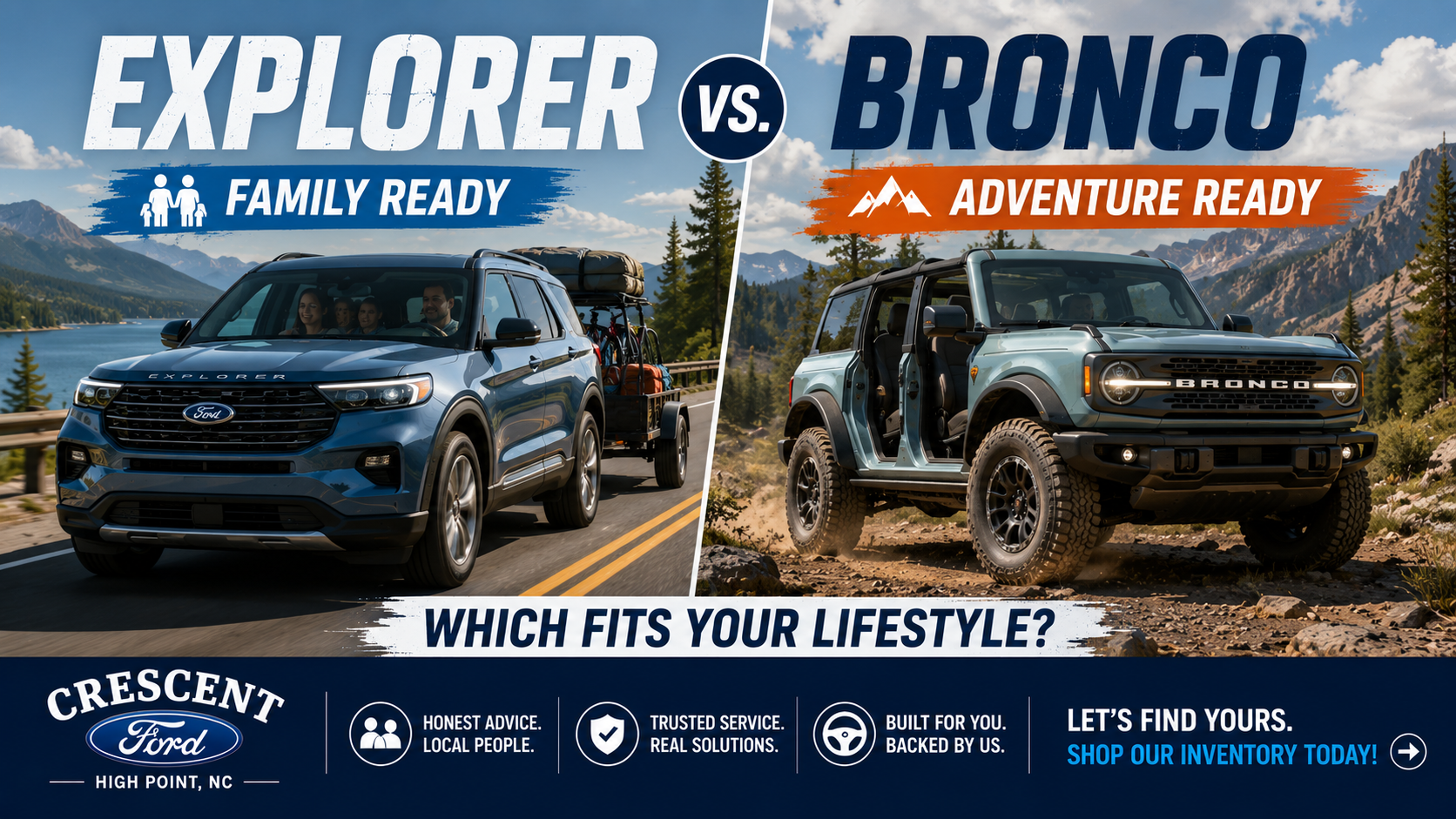
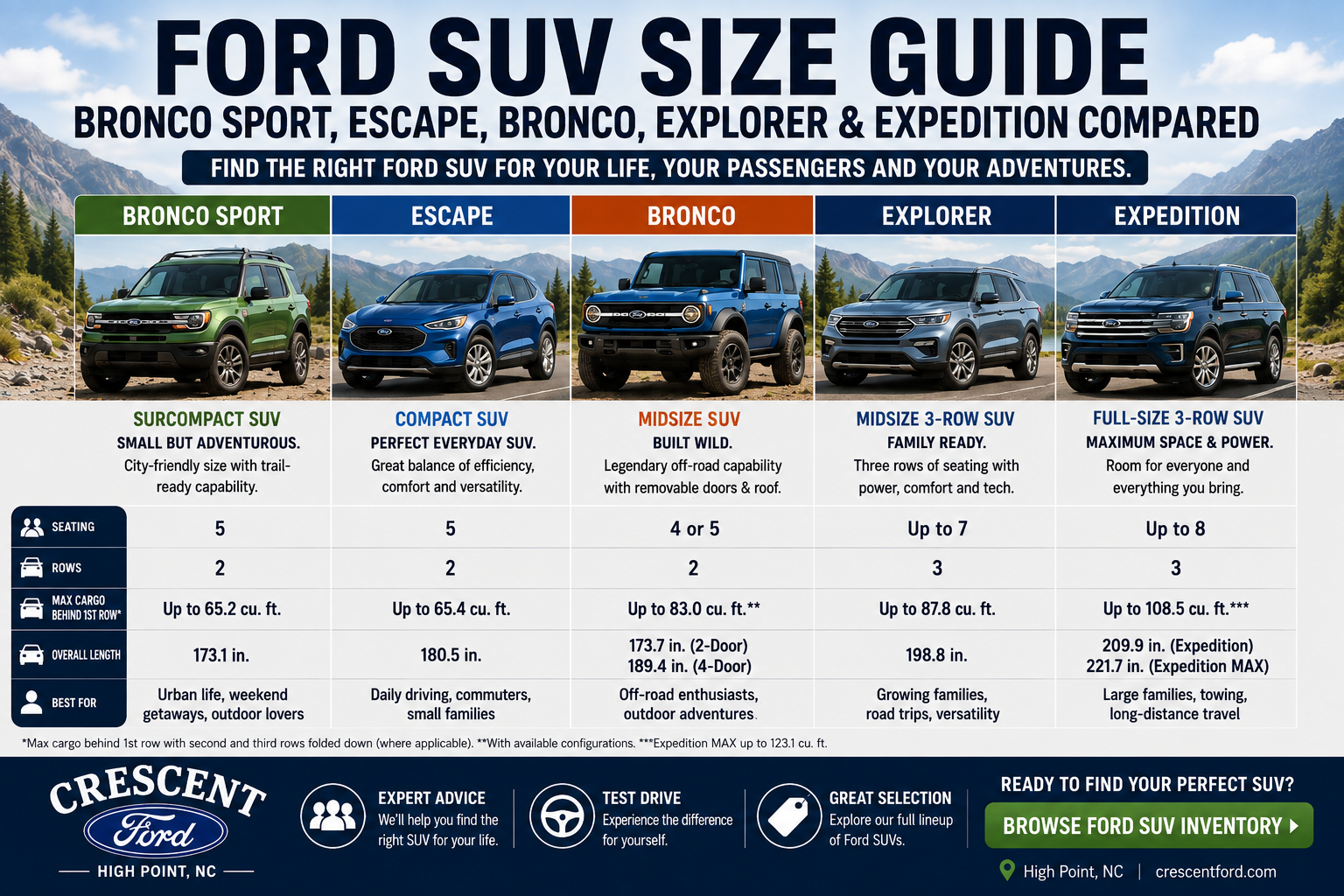
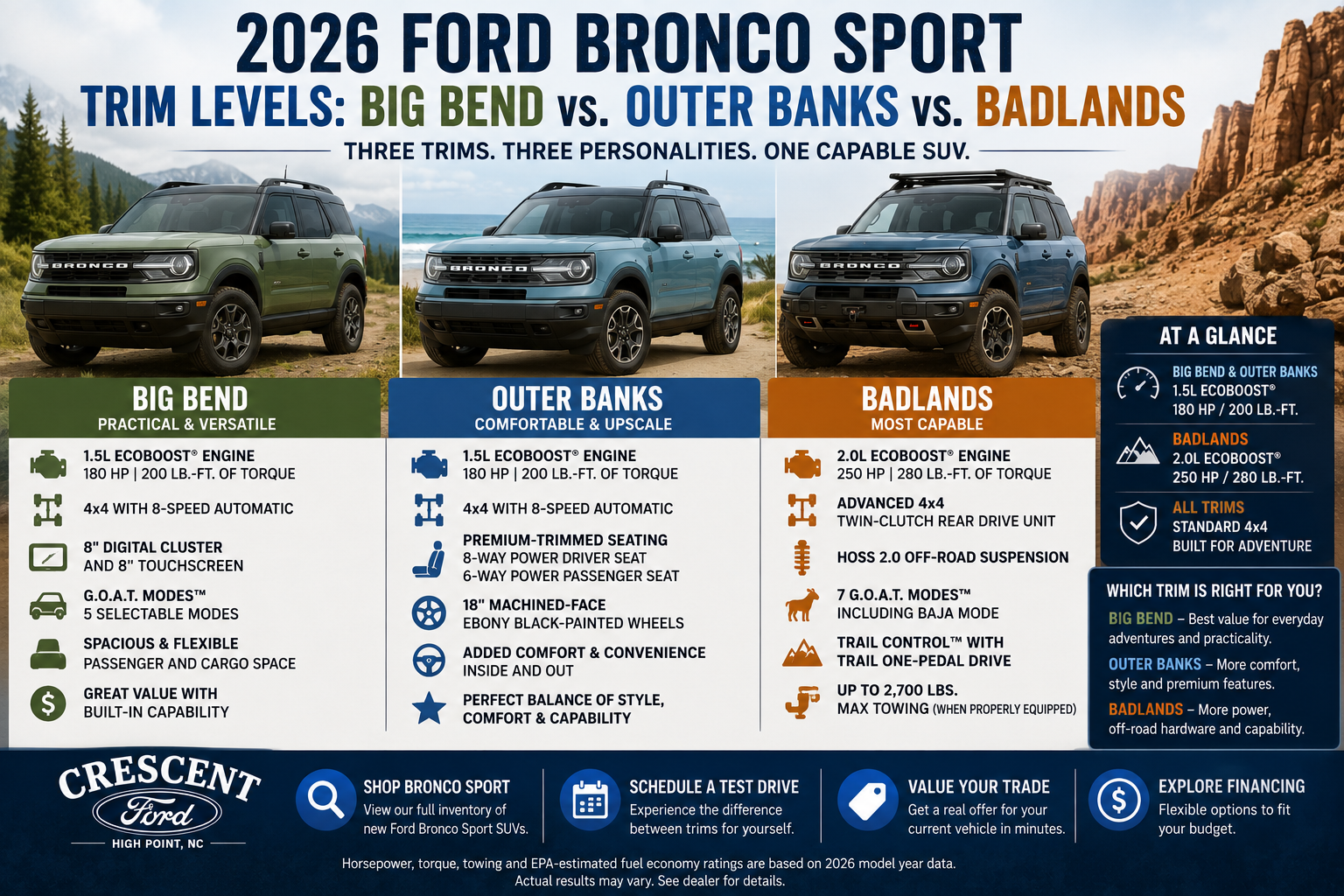
2026 Ford Bronco vs. Bronco Sport: Which One Should You Buy? The Ford Bronco and Ford Bronco Sport share a name, unmistakable Bronco styling and an adventurous personality. But if you're trying to decide which one belongs in your driveway, there's an important distinction to understand: The Bronco and Bronco Sport aren't simply two sizes of the same SUV. The 2026 Ford Bronco is the more rugged, highly configurable choice, built for drivers who want serious off-road capability, available 2-door or 4-door configurations, removable doors and roof options, stronger available engines and greater towing capability. The 2026 Ford Bronco Sport is the smaller, more everyday-friendly SUV. It's easier to maneuver, more fuel-efficient with its standard engine and still comes standard with 4x4. It's a particularly appealing option for shoppers who want Bronco-inspired capability and styling without needing everything the larger Bronco offers. So, which should you buy? Choose the Bronco if serious off-roading, open-air driving, greater towing capability and maximum customization are priorities. Choose the Bronco Sport if you want a practical five-passenger SUV that's easy to live with every day while still being ready for weekends away from the pavement. For many buyers, the decision becomes surprisingly easy once you stop comparing badges and start comparing how you'll actually use the vehicle. Bronco vs. Bronco Sport at a Glance Feature 2026 Ford Bronco 2026 Ford Bronco Sport Seating Up to 5 5 Door Configurations 2-door or 4-door, depending on model 4-door Drive System 4x4 4x4 Engine Options 2.3L EcoBoost, 2.7L EcoBoost V6, 3.0L EcoBoost V6 1.5L EcoBoost or 2.0L EcoBoost Maximum Horsepower Up to 418 hp Up to 250 hp Transmission 7-speed manual or 10-speed automatic, depending on configuration 8-speed automatic Maximum Towing Up to 4,500 lbs. on Raptor; most models up to 3,500 lbs. Up to 2,700 lbs. when properly equipped Removable Doors/Roof Yes No Best Fit Off-roading, customization, towing, open-air adventure Commuting, families, daily driving, light off-road adventures Specifications vary by trim, configuration and equipment. Always verify the specifications of the individual vehicle you're considering. Compare New Ford Bronco and Bronco Sport SUVs What's the Biggest Difference Between the Ford Bronco and Bronco Sport? Think of the Bronco as an off-road vehicle that can comfortably handle everyday life and the Bronco Sport as an everyday compact SUV that's surprisingly capable when the pavement ends. That's an oversimplification, but it's a useful starting point. The Bronco's design gives buyers considerably more opportunity to configure the vehicle around adventure. Depending on the model, you can choose 2-door or 4-door configurations, manual or automatic transmissions, different engines and increasingly serious off-road equipment. Then there's one of the Bronco's signature features: the doors and roof can come off. The Bronco Sport doesn't offer the same open-air configuration, but that's not necessarily a disadvantage. Plenty of shoppers love the Bronco look but don't actually plan to remove doors, tackle difficult trails or use all of the larger Bronco's capability. For them, the Bronco Sport can make considerably more sense. It's compact, practical and standard with 4x4 while providing the type of versatility that works for commuting during the week and loading up for a weekend in the mountains. Which One Is Better for Everyday Driving? For the average commute around High Point, Greensboro or Winston-Salem, we'd give the Bronco Sport the advantage for everyday practicality. The 2026 Bronco Sport is approximately 173 inches long depending on configuration. For comparison, a four-door Bronco is roughly 189 inches long in several popular configurations. That difference matters when you're pulling into a tight parking spot, navigating a crowded shopping center or simply fitting another vehicle in the driveway. The Bronco Sport also pairs its compact dimensions with useful passenger and cargo space. With the standard 1.5L EcoBoost configuration, it provides up to 32.5 cubic feet of cargo space behind the second row and up to 65.2 cubic feet behind the first row. If your SUV spends considerably more time carrying groceries, backpacks, strollers and luggage than climbing rocks, that's worth considering. None of this means the larger Bronco is difficult to drive every day. Far from it. A four-door Bronco can make a perfectly usable daily driver. You're simply accepting some additional size and capability in exchange for everything that makes the Bronco unique. Our pick for daily driving: Bronco Sport If your typical week consists of commuting, school drop-offs, errands and highway driving with occasional outdoor adventures mixed in, start your comparison with the Bronco Sport. Shop New Ford Bronco Sport SUVs Which Is Better Off-Road: Bronco or Bronco Sport? Here's where the Bronco earns its reputation. Both SUVs come standard with 4x4 for 2026, but the Bronco offers substantially more capability for shoppers who intend to use it. The 2026 Bronco lineup offers up to seven G.O.A.T. Modes — Ford's "Goes Over Any Type of Terrain" drive modes — depending on model. Available off-road equipment can include features such as electronic-locking axles, specialized HOSS suspension systems, steel bash plates and the Sasquatch Package. The Badlands trim is particularly interesting for buyers looking for serious trail capability without moving all the way to a Bronco Raptor. The Bronco Sport shouldn't be dismissed, though. Ford has pushed its smaller SUV beyond the typical compact crossover formula. Bronco Sport models come standard with 4x4, and the Badlands receives a 2.0L EcoBoost engine and Advanced 4x4 with a twin-clutch rear drive unit. Available off-road packages can take Bronco Sport capability even further. The practical question is how far off-road you actually intend to go. If "off-road" means gravel roads, muddy campsites, mountain trips, snow, fishing spots and occasional trails, a properly equipped Bronco Sport may provide all the capability you need. If you're specifically shopping for something to tackle difficult trails, rocks, deeper water crossings or more demanding terrain, the Bronco deserves the advantage. Our pick for serious off-roading: Bronco For buyers who genuinely intend to use their SUV's off-road hardware, the larger Bronco provides more capability and more ways to configure the vehicle around that purpose. Bronco vs. Bronco Sport Engine Options There's another significant difference under the hood. 2026 Ford Bronco Sport Engines The Bronco Sport offers two EcoBoost engine choices depending on trim. The 1.5L EcoBoost produces up to 180 horsepower and 200 lb.-ft. of torque and is used in Big Bend, Heritage and Outer Banks models. The 2.0L EcoBoost in the Badlands produces up to 250 horsepower and 280 lb.-ft. of torque. Both use an 8-speed automatic transmission. 2026 Ford Bronco Engines The Bronco gives buyers considerably more powertrain choice. The 2.3L EcoBoost four-cylinder produces up to 300 horsepower and 325 lb.-ft. of torque. An available 2.7L EcoBoost V6 increases output to up to 330 horsepower and 415 lb.-ft. of torque. At the top of the range, the Bronco Raptor's 3.0L EcoBoost V6 produces up to 418 horsepower. Depending on the Bronco model and configuration, buyers can also choose between a 7-speed manual and 10-speed automatic transmission. Do you actually need the extra Bronco power? That's the better question. For commuting and normal family use, the Bronco Sport's 1.5L engine may be perfectly appropriate. Buyers wanting more performance and off-road capability can move into the Bronco Sport Badlands and its 2.0L. If stronger acceleration, greater towing capability or serious off-road performance matters, the Bronco's available powertrains become much more compelling. See Available Ford Bronco SUVs in High Point Which Gets Better Gas Mileage? This is one area where the Bronco Sport has a clear advantage. The 2026 Bronco Sport with the 1.5L EcoBoost is EPA-estimated at 25 mpg city, 30 mpg highway and 27 mpg combined. The more powerful 2.0L Bronco Sport is EPA-estimated at 21 mpg city, 27 mpg highway and 23 mpg combined. Actual mileage varies, of course, and equipment such as off-road packages can affect the ratings. The larger Bronco prioritizes capability, power and off-road performance rather than maximizing fuel economy. If you're driving from High Point to Greensboro five days a week and heading to the mountains occasionally, fuel economy may deserve considerably more weight in your decision than maximum trail capability. Our pick for fuel-conscious buyers: Bronco Sport The 1.5L Bronco Sport is the more logical starting point if reducing fuel consumption during everyday driving is high on your priority list. Which Has More Cargo Space? This comparison is more interesting than simply saying "the bigger SUV has more room." A Bronco Sport with the 1.5L engine provides up to 32.5 cubic feet behind the second row and 65.2 cubic feet behind the first row. Bronco cargo capacity varies substantially depending on whether you choose a 2-door or 4-door configuration and the type of roof. A 2-door Bronco provides about 20.6 cubic feet behind the rear seats, while 4-door versions can provide considerably more. Depending on roof and configuration, maximum cargo capacity on a 4-door Bronco can exceed 70 cubic feet. For families, we'd pay particular attention to the configuration rather than simply the Bronco name. A 2-door Bronco might be the vehicle you love, but climbing into the rear seats and working around its cargo area is very different from loading children and all their gear into a Bronco Sport or four-door Bronco. If car seats, sports equipment, groceries and family trips are part of your normal routine, compare the vehicles in person with those needs in mind. Sometimes the spec sheet doesn't answer that question nearly as well as opening the doors and cargo area yourself. Bronco vs. Bronco Sport for Families For many families, we'd start with the Bronco Sport or a four-door Bronco. The Bronco Sport seats five and gives you four conventional passenger doors in every configuration. Its smaller exterior dimensions can make it particularly convenient for daily family duty. The four-door Bronco offers more of the Bronco experience without the compromises a 2-door configuration can create for regular rear-seat access. Parents should also think beyond passenger capacity. Ask yourself: How often are adults sitting in the second row? Are you installing rear-facing or forward-facing car seats? Do you regularly carry a stroller? How much luggage goes with you on vacation? Do your children bring sports equipment? Will this be your primary family vehicle or a second vehicle? There's no universal winner because two families of four can use their SUVs completely differently. Our pick for most everyday family use: Bronco Sport Our pick for families wanting more Bronco capability: Four-door Bronco Not sure which Ford SUV fits your family? Browse our new Ford SUV inventory Which One Can Tow More? If towing is part of the plan, the Bronco has the advantage. Most properly equipped 2026 Bronco models can tow up to 3,500 pounds, while Bronco Raptor can tow up to 4,500 pounds. The Bronco Sport can tow up to 2,200 pounds with applicable 1.5L models and the required Class II Trailer Tow Package. The Bronco Sport Badlands can tow up to 2,700 pounds with its Class II Trailer Tow Package. Those numbers shouldn't be treated as universal ratings for every Bronco or Bronco Sport on a dealer's lot. Towing capacity depends on the specific vehicle, equipment, passengers, cargo and configuration. If towing is important to your purchase, verify the capability of the specific VIN you're considering rather than assuming every vehicle with the same model name has the same rating. For a small utility trailer or similar lighter towing needs, Bronco Sport may be enough. For buyers who know they'll need more capacity, Bronco is the better place to start. Our pick for towing: Bronco What About Bronco Sport Badlands vs. Bronco? This may actually be the most interesting comparison in the lineup. A shopper considering a Bronco Sport Badlands is clearly interested in more capability than the average compact SUV provides. But does that mean it's time to move to a Bronco? Not necessarily. The Bronco Sport Badlands gives you the more powerful 2.0L EcoBoost, Advanced 4x4 with a twin-clutch rear drive unit and additional capability while retaining the Bronco Sport's compact dimensions and everyday practicality. That can be an excellent combination for someone who wants to explore trails and spend weekends outdoors but still wants a compact SUV Monday through Friday. Move toward the Bronco when you start prioritizing things such as removable doors and roof, more extreme off-road capability, greater available ground clearance, more powerful engine choices, manual-transmission availability or greater towing capability. In other words: Don't buy capability solely because it's available. Buy the capability you're actually going to use. That usually leads to a better vehicle — and a better use of your budget. Is the Bronco Sport Just a Smaller Bronco? No. They share styling cues, branding and an adventure-focused philosophy, but they're designed for different jobs. That's important because "Bronco Sport" can make it sound as though it's simply a trim or smaller version of the Bronco. It isn't. The Bronco is built around serious off-road capability and configurability. The Bronco Sport takes many of the ideas shoppers like about Bronco — rugged styling, standard 4x4 and outdoor versatility — and packages them into a compact SUV that's easier to use as an everyday vehicle. Neither approach is inherently better. The question is which one better matches your life. Should You Buy a Bronco or Bronco Sport? Here's the simplest way we'd break it down. Buy the Ford Bronco if: You want the doors and roof to come off. Serious off-roading is part of your plans. You want more available horsepower. You need greater towing capability. You want a manual-transmission option. You like having extensive off-road packages and configurations to choose from. The Bronco experience itself is part of why you're buying the vehicle. Buy the Ford Bronco Sport if: This will primarily be your everyday SUV. Fuel economy matters more than maximum capability. You prefer a smaller vehicle that's easier to maneuver and park. You want standard 4x4 without moving into a larger SUV. You need room for five but don't need a large vehicle. Your adventures typically involve camping, mountain roads, beaches, gravel roads or moderate trails rather than extreme off-roading. You like Bronco styling but don't need removable doors or a removable roof. And if you're still somewhere in the middle? Drive both. This is one comparison where 20 minutes behind the wheel can tell you more than another hour of online research. Compare Bronco and Bronco Sport Inventory at Crescent Ford Don't Forget to Compare the Cost of the Whole Purchase Choosing the right model is only part of the equation. Before deciding between Bronco and Bronco Sport, consider what you're trading, how much you want to put down and what monthly payment fits comfortably into your budget. If you currently own a vehicle, knowing its approximate trade value can make the comparison much easier. For example, you may discover that the equity in your current vehicle puts a Bronco configuration you prefer within reach. Or you may decide you'd rather keep more room in your monthly budget and choose a well-equipped Bronco Sport. Either way, it's better to make that decision with actual numbers instead of guessing. Find Out What Your Trade Is Worth Explore Auto Financing Options Compare the Ford Bronco and Bronco Sport in High Point, NC The Bronco vs. Bronco Sport decision doesn't have to come down to which vehicle has the biggest numbers on a spec sheet. It comes down to what you need your SUV to do. For drivers around High Point and the Piedmont Triad who want a practical daily vehicle with standard 4x4 and plenty of versatility for weekend adventures, the Bronco Sport is an excellent place to start. If you're looking for more power, serious off-road capability, greater towing potential or the unique experience of taking the doors and roof off your SUV, the Bronco is worth the step up. At Crescent Ford in High Point, you can compare available Bronco and Bronco Sport models side by side instead of trying to make the entire decision online. Sit in both. Check the back seat. Open the cargo areas. Drive them. The right choice usually becomes pretty obvious once you do. Shop New Ford Bronco & Bronco Sport Inventory Value Your Trade Frequently Asked Questions About the Ford Bronco vs. Bronco Sport Is the Bronco Sport smaller than the Bronco? Yes, particularly compared with a four-door Bronco. The 2026 Bronco Sport is approximately 173 inches long depending on engine, while many four-door Bronco configurations are approximately 189 inches long. Interestingly, a 2-door Bronco is similar to the Bronco Sport in overall length, although the vehicles have very different designs and proportions. Do the Ford Bronco and Bronco Sport both have 4x4? Yes. The 2026 Bronco and Bronco Sport both come with 4x4, although the specific systems and available off-road hardware differ by model and trim. Can you take the doors off a Bronco Sport? No. Removable doors and roof options are features of the larger Ford Bronco. The Bronco Sport uses conventional fixed doors and roof. Which gets better gas mileage, Bronco or Bronco Sport? The Bronco Sport generally has the advantage for fuel economy. The 2026 Bronco Sport with the 1.5L EcoBoost is EPA-estimated at 25 mpg city, 30 mpg highway and 27 mpg combined. Actual mileage varies. Which can tow more, Bronco or Bronco Sport? The Bronco. Most properly equipped 2026 Bronco models can tow up to 3,500 pounds, while Bronco Raptor can tow up to 4,500 pounds. The 2026 Bronco Sport can tow up to 2,700 pounds when properly equipped, depending on model. Is the Bronco Sport good for off-roading? Yes, particularly when properly equipped. Every 2026 Bronco Sport comes with 4x4, and models such as the Badlands add substantially more off-road capability. Drivers planning more difficult or technical off-roading should also consider the larger Bronco. Is the Bronco Sport better for commuting? For many drivers, yes. Its smaller dimensions and strong fuel-economy ratings with the 1.5L EcoBoost make the Bronco Sport particularly well suited to everyday commuting while still providing standard 4x4 and SUV versatility. Should I test drive the Bronco and Bronco Sport before deciding? Absolutely. Specifications can help narrow the choice, but seating position, ride, visibility, cargo access and overall size feel very different in person. Driving both back-to-back is one of the easiest ways to decide which one fits you better. Schedule a Bronco or Bronco Sport test drive

Best Gas Mileage Ford Vehicles in 2025: Save Money While Driving Smart

Top Fuel-Efficient Ford Cars, Trucks & SUVs for 2025 Fuel efficiency has become one of the most important factors car shoppers look for when buying a new vehicle. Whether you’re commuting to work in High Point, NC, planning a family road trip, or just want to cut down on trips to the pump, Ford offers a wide lineup of fuel-efficient cars, trucks, and SUVs. In this guide, we’ll break down the best gas mileage Ford vehicles in 2025, including hybrid and electric options, so you can find the perfect match for your lifestyle and budget. Why Fuel Efficiency Matters More Than Ever Rising Fuel Prices – Gas prices fluctuate, and owning a fuel-efficient vehicle can protect your budget. Environmental Impact – Lower emissions help reduce your carbon footprint. Long-Term Savings – A vehicle with better MPG or MPGe can save you thousands of dollars over its lifespan. Ford has made major strides in fuel economy, offering hybrids, plug-in hybrids (PHEVs), and all-electric models alongside traditional gas-powered vehicles. Top Fuel-Efficient Ford Vehicles in 2025 Here’s a breakdown of the top performers across Ford’s lineup, focusing on real-world MPG ratings and electric range where applicable. 1. 2025 Ford Maverick Hybrid Estimated MPG: 42 city / 33 highway / 37 combined Why It’s Efficient: The Maverick Hybrid is America’s first and only standard hybrid pickup. It’s compact yet practical, offering a truck bed for hauling but with fuel economy rivaling a sedan. Perfect For: Daily commuters who want truck utility without truck fuel costs. 2. 2025 Ford Escape Hybrid & Plug-In Hybrid Escape Hybrid MPG: 44 city / 37 highway / 41 combined Escape Plug-In Hybrid MPGe: Up to 101 MPGe combined, with 37 miles of all-electric driving range. Why It’s Efficient: The Escape Hybrid balances space, comfort, and economy. The plug-in hybrid version allows for short all-electric trips, perfect for city drivers. Perfect For: Families or individuals who want SUV space without sacrificing fuel efficiency. 3. 2025 Ford Mustang Mach-E (All-Electric) Range: 250–312 miles per charge depending on trim. Why It’s Efficient: As a fully electric SUV, the Mach-E eliminates fuel costs entirely. Charging at home or at one of the many growing networks in NC makes it practical for both commuting and travel. Perfect For: Eco-conscious drivers looking for style, performance, and efficiency in one package. 4. 2025 Ford F-150 PowerBoost Hybrid Estimated MPG: 25 city / 26 highway / 25 combined (2WD models). Why It’s Efficient: America’s best-selling truck gets an edge with a hybrid engine that provides both strong towing power and impressive fuel savings for a full-size pickup. Perfect For: Truck owners who need capability but also want to reduce fuel costs. 5. 2025 Ford Escape Gas Engine (EcoBoost) Estimated MPG: Up to 30 combined (28 city / 34 highway). Why It’s Efficient: Even without hybrid technology, the Escape with its 1.5L EcoBoost engine delivers strong MPG for a traditional SUV. Perfect For: Drivers who want affordability and efficiency without stepping into hybrid or EV territory. 6. 2025 Ford Mustang EcoBoost Fastback Estimated MPG: 22 city / 33 highway / 26 combined. Why It’s Efficient: The turbocharged EcoBoost Mustang delivers thrilling performance while still offering respectable fuel efficiency for a sports car. Perfect For: Drivers who want sporty style and power without breaking the bank at the pump. 7. 2025 Ford E-Transit (All-Electric Van) Range: Up to 159 miles per charge depending on configuration. Why It’s Efficient: For businesses, the all-electric E-Transit helps reduce fleet fuel costs and emissions. With customizable cargo options, it’s built for work without gas dependency. Perfect For: Business owners and commercial drivers looking for a cost-saving, eco-friendly solution. Comparing Ford’s Fuel-Efficient Lineup Model MPG / MPGe Fuel Type Best For Maverick Hybrid 37 combined Hybrid Budget-friendly truck shoppers Escape Hybrid 41 combined Hybrid Families & commuters Escape PHEV 101 MPGe Plug-In Hybrid Short daily commutes on electric power Mustang Mach-E 250–312 miles Electric Tech-savvy, eco-conscious drivers F-150 PowerBoost 25 combined Hybrid Full-size truck buyers Escape EcoBoost 30 combined Gas Affordable SUV shoppers Mustang EcoBoost 26 combined Gas Sporty drivers on a budget E-Transit 159 miles range Electric Businesses & fleets Tips for Maximizing Your Ford’s Fuel Efficiency Even the most fuel-efficient car performs best when driven smartly. Here are a few tips: Keep Tires Properly Inflated – Underinflated tires lower MPG. Avoid Aggressive Driving – Hard braking and quick acceleration burn more fuel. Use Eco Mode (if available) – Many Ford models come with selectable drive modes. Stay on Top of Maintenance – Oil changes, air filters, and spark plugs all impact fuel efficiency. Lighten Your Load – Extra weight in your trunk or bed decreases MPG. Why Buy a Fuel-Efficient Ford in High Point, NC? High Point drivers balance city commuting, family life, and weekend getaways. Fuel-efficient Fords make sense here because: You’ll spend less on gas while enjoying daily convenience. Ford’s hybrid and EV technology means you don’t have to sacrifice space or performance. Incentives and rebates may be available on EVs and hybrids, making them more affordable. Conclusion: Drive Smarter, Save More Ford has an option for every driver — from the budget-friendly Maverick Hybrid to the innovative Mustang Mach-E. Whether you’re shopping for a truck, SUV, or performance car, Ford’s 2025 lineup proves you don’t have to compromise fuel economy for capability or style. If you’re ready to explore these fuel-efficient Fords, visit us at Crescent Ford in High Point, NC. Our team is here to help you compare models, schedule test drives, and find the perfect fit for your lifestyle and budget.👉 Call Crescent Ford today (336) 869-2181 or schedule your test drive online! Click Here!

Everything You Need to Know About Trading In Your Vehicle: 7 Common Questions Answered

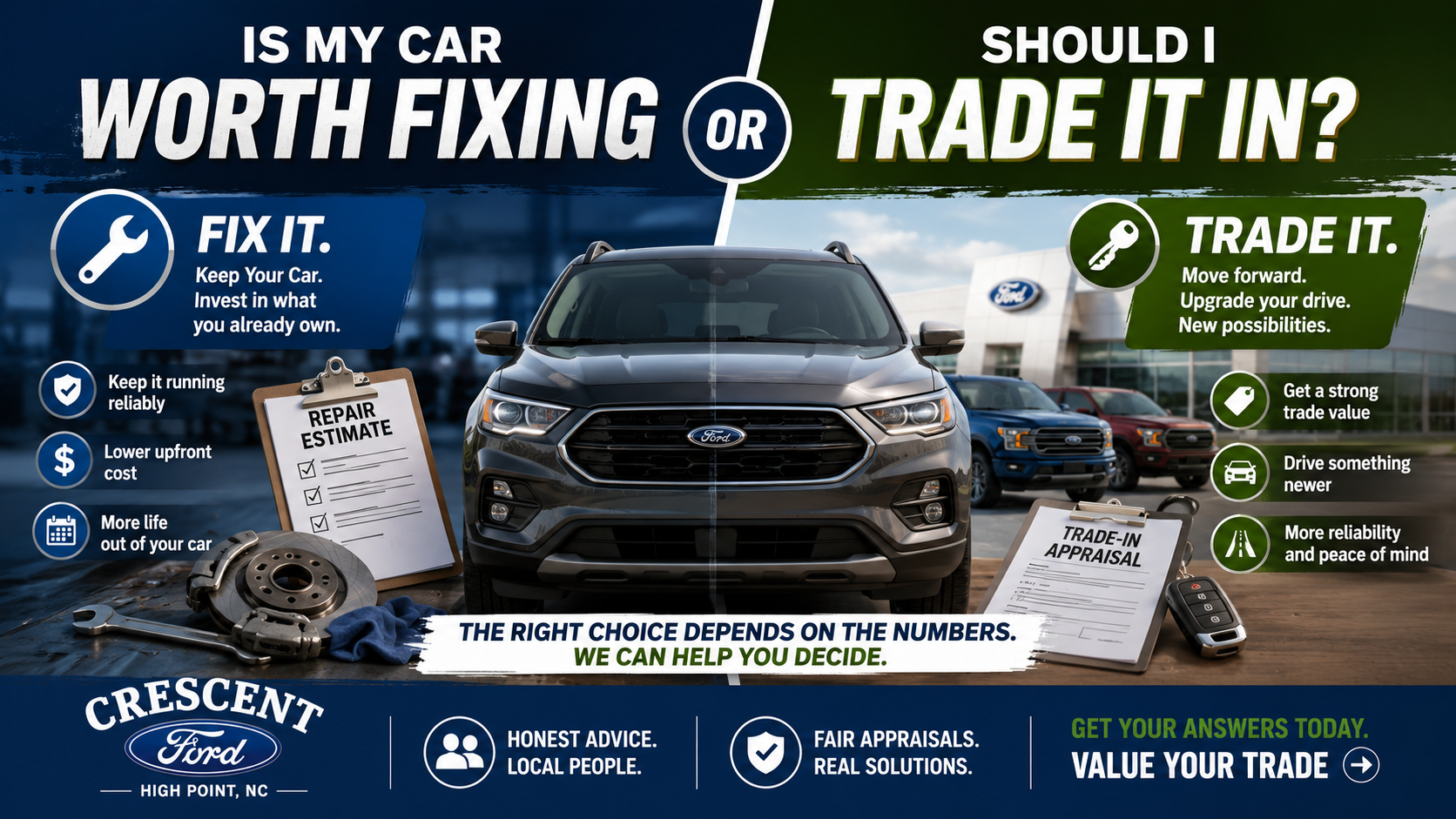
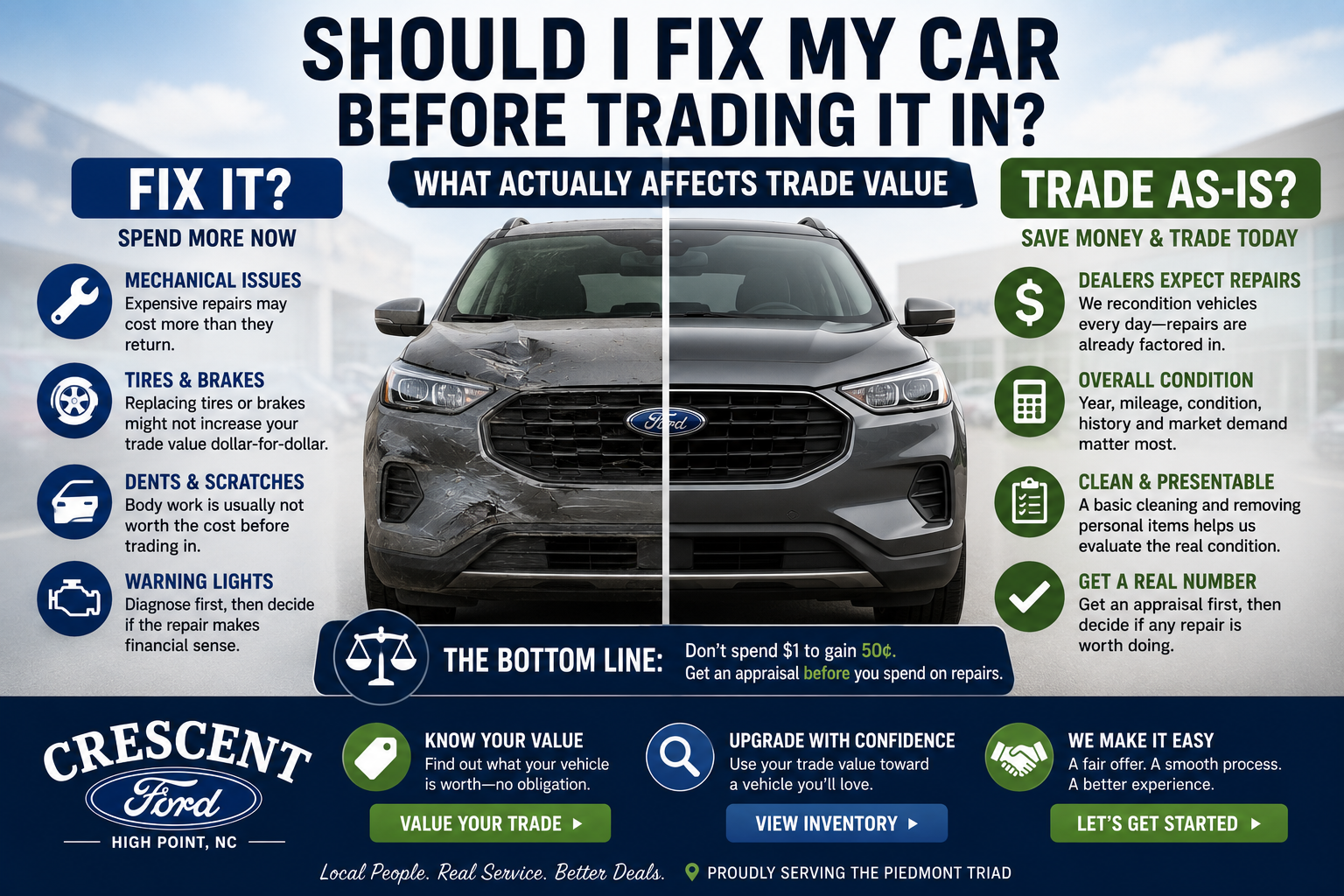
Thinking about trading in your current vehicle? You’re not alone. Many drivers choose to trade in their cars as a convenient way to upgrade to something newer, more efficient, or better suited to their current lifestyle. But if you're like most shoppers, you probably have questions—lots of them. At Crescent Ford in High Point, we believe in making the trade-in process transparent, easy, and beneficial for our customers. Whether you're trading in for a new Ford SUV or a reliable pre-owned truck, we've put together a guide to answer the most Googled questions about trading in a vehicle. Let’s dive in. 1. What Is My Car Worth? This is the #1 question most people ask when considering a trade-in. The answer depends on several factors, including: Year, Make & Model Mileage Condition (inside and out) Accident or repair history Service records Current market demand At Crescent Ford, we provide free appraisals and use up-to-date market data to offer a fair and competitive value. You can start by using our online Value Your Trade tool powered by Edmunds—it’s quick, easy, and gives you an idea of what your vehicle could be worth. Tip: Be honest about the condition of your vehicle to get the most accurate estimate. 2. Can I Trade In a Vehicle I Still Owe Money On? Yes, absolutely. This is a common situation, especially if you purchased your current vehicle within the last few years. Here's how it works: Positive Equity: If your vehicle is worth more than what you owe, the difference can be used as a down payment on your next vehicle. Negative Equity: If you owe more than your car is worth, you can still trade it in. The remaining balance can usually be rolled into your new loan, depending on credit approval and lender guidelines. Our finance team will walk you through the payoff process and help you understand your options clearly. 3. Will Trading In Affect My Loan or Credit? Trading in a vehicle can actually help reduce your loan amount if you have equity in your current car. Here’s how it affects your financing: Acts as a Down Payment: If you have equity, the trade-in value can lower the amount you need to finance. Credit Impact: Applying for a new loan may involve a credit check, but the trade-in itself doesn’t negatively impact your credit score. Our team works with trusted lenders through Ford Motor Credit and other partners to secure the best financing terms for your unique situation. 4. When Is the Best Time to Trade In? Timing can make a big difference. Here are some guidelines to consider: Before Major Repairs: If your vehicle is starting to show signs of wear, you may want to trade it in before it requires costly maintenance. High Demand Periods: SUVs, trucks, and fuel-efficient cars may bring higher trade-in values when demand peaks (often spring and summer). Before Mileage Milestones: Trade in before you hit 100,000 miles or the warranty expires—both can affect value. We can help you analyze the timing and value to get the most out of your trade. 5. Should I Fix Minor Issues Before Trading In? It depends. Small repairs or cosmetic upgrades (like replacing worn tires or getting a fresh detail) might help slightly boost your appraisal, but here’s the general rule: Do: Fix obvious issues like broken lights, extreme stains, or smoke odor. Don’t: Spend big on body work or mechanical repairs unless you’re confident the ROI will outweigh the cost. We recommend a professional detailing or a simple refresh—and our team can even help with that! Clean vehicles often get better appraisals because they show signs of good care. 6. Should I Negotiate the Trade-In Value Separately? Yes, and no. At Crescent Ford, we believe in transparent pricing, so we’ll give you a fair trade-in offer upfront. But here’s why it’s smart to understand the value separately: Separating Trade Value from Purchase Price helps you clearly see the numbers. Package Deals: Some promotions may include extra trade-in bonuses if you purchase a specific model. Always ask for the breakdown. We’re happy to walk you through every number, line by line, so you can feel confident in your decision. 7. Should I Get Multiple Trade-In Offers? Shopping around is always smart. We encourage it, because we’re confident in our offers. In fact, if you get a better written appraisal from another dealership, we’ll do our best to match or beat it. Some online buyers may offer high trade-in values but lower actual purchase flexibility. At Crescent Ford, you can do both—trade and buy—with a team that values your time and your trust. Bonus: Do I Get a Tax Benefit for Trading In? Yes! In North Carolina and many other states, the value of your trade-in reduces the taxable amount of your new vehicle. For example: New Vehicle Price: $40,000 Trade-In Value: $10,000 Taxable Amount: $30,000 This can save you hundreds in sales tax alone. Another reason why trading in is often a smarter choice than selling privately. Final Thoughts: Why Trade In at Crescent Ford? Trading in your vehicle shouldn't feel like a chore or a guessing game. At Crescent Ford, we make it simple, transparent, and fair. Here's what sets us apart: Fast, No-Obligation Appraisals Online Trade Value Tool Upfront, Market-Based Offers Flexible Financing Options Exceptional Trade-In Bonuses During Events Whether you’re ready to upgrade to a new Ford or just curious about your car’s current value, stop by Crescent Ford in High Point or start online. We’re here to help you keep rolling with confidence. Have questions about your trade-in? Call us at 336-869-2181 or send us a message today! Related Links: Value Your Trade Tool Shop New Inventory Shop Used Inventory

What Is the Out-the-Door Price of a Car? Crescent Ford Explains Everything You Need to Know

If you’re shopping for a new or used car, you've probably heard the phrase "out-the-door price" more than once. And if you're like many smart shoppers in High Point and the surrounding areas, you're asking one of the most important—and most searched—questions: "What is the out-the-door price of the car?" At Crescent Ford in High Point, NC, we hear this question daily. And we love it. Why? Because it shows you're focused on making a smart, informed decision. We believe in honesty, transparency, and making your car-buying journey simple and stress-free. So let’s break it all down. What Does "Out-the-Door Price" Mean? The out-the-door price is the total amount you'll pay to purchase a vehicle. That includes everything: The listed vehicle price Sales tax Title and registration fees Any dealership fees (like doc fees) Optional products or warranties Any discounts, incentives, or rebates applied In short, it’s what you’ll write on the final check or finance through your lender. There are no surprises, no hidden charges, no last-minute "gotchas." Why the Out-the-Door Price Matters Many dealerships focus on advertising low monthly payments or "special" sticker prices. But when you show up to finalize the deal, you might be met with unexpected fees, high-pressure upsells, or confusing paperwork. That’s not how we do things at Crescent Ford. When we talk about out-the-door pricing, we’re talking about trust. We believe every customer deserves to know exactly what they’re paying—before they sign anything. Transparency Builds Trust At Crescent Ford, we’ve built a reputation around: Honest, upfront pricing No hidden fees or surprise add-ons Customer-first service You deserve clarity at every step of the process. And the out-the-door price is the foundation for that clarity. What’s Included in the Out-the-Door Price? Let’s take a closer look at what makes up the final number. 1. Vehicle Price This is the MSRP (Manufacturer Suggested Retail Price) or negotiated price of the car, truck, or SUV you’re buying. At Crescent Ford, we provide competitive pricing on both new Ford models and our wide selection of used vehicles. 2. Sales Tax North Carolina applies a highway-use tax instead of traditional sales tax. It's typically 3% of the vehicle purchase price, with a maximum of $250 for leases and no cap on purchases. 3. Title and Registration Fees These are the DMV fees required to register and title your vehicle. We include them upfront so you're never caught off guard. 4. Doc (Documentation) Fee Most dealerships charge a fee for processing paperwork and filings. We keep ours minimal, reasonable, and fully disclosed from the start. 5. Add-Ons or Protection Packages (Optional) We never pressure you to buy extras. But if you want things like extended warranties, GAP insurance, or paint protection, we’ll clearly explain the cost and benefits. 6. Incentives or Rebates If Ford is offering factory rebates, incentives, or financing specials, we apply them directly to your out-the-door pricing. How Crescent Ford Does Pricing Differently We understand the frustrations that come with unclear pricing. That’s why we’ve made it our mission to create a car-buying process that puts you in control. No Hidden Fees When we say "no hidden fees," we mean it. Everything is itemized and explained clearly. Transparent Listings All of our vehicles are listed online with pricing that reflects what you can actually expect to pay. We don’t use bait-and-switch tactics. Stress-Free Shopping Whether you're online, on the phone, or in our showroom, our goal is to make the experience as easy and enjoyable as possible. We’re here to answer your questions, not push you into a deal. Customer-Centric Culture We’re proud to say that many of our customers become lifelong clients. Why? Because we treat every person who walks through our doors like family. What About Financing? Great question! Your out-the-door price is still the foundation of your financing deal. Whether you finance through Ford Credit, a local bank, or a credit union, you'll use the out-the-door price to determine your loan amount, monthly payment, and term. We’ll help you compare your options, explain everything clearly, and get you the best possible rate. Used Vehicles and Out-the-Door Pricing It’s just as important to know the OTD price when buying a used car. Our pre-owned vehicles come with the same level of clarity. No mysterious markups. No fake fees. Just fair, market-based pricing and the full breakdown from the start. Shopping Online? Ask for the OTD Price Instantly Found a vehicle on our site that you love? You can request the full out-the-door price with just one click. We’ll send you a clear breakdown, personalized to your location, tax rate, and any eligible incentives. No gimmicks. Just the real number. How to Get the Best Deal at Crescent Ford Start with the right question: Ask us for the out-the-door price. Compare apples to apples: Make sure you’re comparing OTD prices between dealerships, not just base prices. Ask about current offers: Ford often runs seasonal incentives, low APR specials, and lease deals. Value your trade-in: We offer competitive trade values and can apply that directly to your OTD cost. Check our online inventory: You can filter by model, price, and body style—and view OTD pricing anytime. 🌟 Real Reviews from Real Customers Here’s what people are saying about their experience with transparent pricing at Crescent Ford: "I went to three dealerships and Crescent Ford was the only one that gave me a real total cost without games. The process was easy and fast." – James W. "It was refreshing to feel like I was being told the truth. I didn’t have to ask twice for the full price." – Michelle R. "The team at Crescent Ford made everything simple. I knew what I was paying from the start and never felt pressured." – Lauren K. 🚀 Ready to Shop Without Surprises? We’re here to help you drive away with total confidence—and complete clarity. Whether you’re browsing online, comparing models, or ready to test drive, Crescent Ford is your trusted partner. Let us show you how car buying should be.Visit us in High Point, NC or reach out today for your personalized out-the-door price. No hidden fees. No stress. Just great vehicles, honest pricing, and friendly service. Let’s get you on the road—without the runaround. Visit us today at 100 Old Winston Rd, High Point, NC 27265 or visit our website: www.crescentford.com You can call us at 336-869-2181

What Car Should I Buy for My Budget and Lifestyle? | Crescent Ford of High Point, NC

Finding the right vehicle is a big decision, and at Crescent Ford, we make it easier. Whether you’re shopping new or preowned, our goal is to match you with the car, truck, or SUV that fits both your lifestyle and your budget. Located right here in High Point, NC, we serve drivers throughout the Triad who want smart, reliable choices from a team they can trust. Step 1: Set Your Budget Your first step? Know your budget. Crescent Ford offers: New Ford Vehicles: From the value-packed Ford Maverick to the powerful F-150 and adventure-ready Bronco, Ford’s lineup has something for everyone. Preowned Inventory: Explore quality used cars, trucks, and SUVs across multiple brands and price points. Many are Ford Blue Advantage Certified for added peace of mind. ➡️ Explore Financing Options | Value Your Trade Step 2: Choose Based on Lifestyle We break it down by category so you can quickly find what suits your life: 🚗 Daily Commuter Ford Escape (New or Preowned) Ford Maverick (New) Ford Fusion (Preowned) 👨‍👩‍👧‍👦 Family-Focused Ford Explorer – 3-row comfort and safety Ford Edge – 2-row spacious SUV Ford Expedition – Full-size capability 🛻 Truck & Utility Ford F-150 – America's best-selling truck Ford Ranger – Mid-size, high capability Ford Maverick – Hybrid efficiency, truck utility 🌲 Adventure & Off-Road Ford Bronco Sport / Bronco – Trail-ready and fun Preowned Subaru or Jeep Options – Rugged value ⚡ Tech-Lovers & Eco-Conscious Ford Mustang Mach-E – All-electric performance Ford Escape Hybrid – Fuel-saving smart choice ➡️ Browse New Inventory | Shop Preowned Vehicles Step 3: Prioritize Your Must-Have Features Consider what matters most: AWD or 4x4 for weather and terrain Apple CarPlay/Android Auto for seamless connectivity Advanced Safety Tech like blind spot monitoring or adaptive cruise Comfort Features such as heated seats, remote start, or power liftgate Pro Tip: Many mid-tier trims offer these upgrades without the premium price tag. ➡️ Schedule a Test Drive Step 4: New vs. Preowned? New Ford Benefits: Full warranty Latest tech & design Custom order options Preowned Perks: Lower cost Certified options Slower depreciation All our vehicles are price-transparently listed with free CarFax reports available on preowned models. ➡️ Learn About Ford Blue Advantage Step 5: Visit Crescent Ford in High Point, NC Nothing beats a real-world test drive. Bring your car seat, golf clubs, or bags—whatever you use daily—and see how your top picks feel in person. Our friendly team will: Compare trims and pricing Show you features in action Discuss trade-ins and financing ➡️ Contact Us | Start Your Deal Online FAQs from Local Shoppers Q: Should I lease or buy? A: Leasing is great for short-term flexibility. Buying helps build long-term value. Q: What’s a good first car for my teen? A: Consider a preowned Ford Escape or Fusion—safe, affordable, and easy to maintain. Q: Can I get approved with average or low credit? A: Yes! Our finance team works with multiple lenders to find flexible terms. ➡️ Apply for Financing Let’s Find Your Perfect Fit There’s no one-size-fits-all answer, but there is a best-fit Ford or preowned vehicle for you. We’re here to help you find it—honestly, affordably, and locally. 📍 Visit us at Crescent Ford, High Point NC 📞 Call: 336-869-2181 📆 Book your visit online or just stop in—we’re always happy to help.➡️ Browse Inventory | Schedule Test Drive | Get Pre-Approved Need help deciding? Our team is just a click or call away. We’ll help you compare, test drive, and find the best car for your life today—and the road ahead.

From America For America: What Tariffs Mean for Car Buyers—and How Ford’s Stepping Up

We know the car market’s been full of big headlines lately—tariffs, price shifts, global supply chains—and you’re probably wondering: “How does this affect me?” Whether you’re actively shopping or just curious about what’s changing, we’re here to break it all down in plain English. And here’s the good news upfront: For a limited time, Ford is making things easier with Employee Pricing for Everyone —part of our new campaign, From America For America. That means you pay what we pay—no gimmicks, no hidden fees. More on that in a minute! Let’s take a look at what’s happening in the market, why it matters, and how Crescent Ford is stepping up to keep things simple, transparent, and fair. 🧾 So… What’s Going on With Tariffs? Let’s start with the basics: tariffs are taxes placed on goods when they move between countries. In the automotive world, tariffs can hit parts, materials (like steel and aluminum), and even fully built vehicles. When tariffs go up, manufacturers usually pass those costs down the line—to dealerships, and ultimately to customers. That’s why headlines about new tariffs on imports from China or changes to trade deals with Mexico and Canada matter. Even American-made vehicles often include parts sourced globally. But don’t worry— you’re not expected to become a trade policy expert. That’s our job. And we’re here to help you navigate how these shifts may (or may not) affect your next purchase. 🚘 How Tariffs and Global Shifts Are Changing the Car Market We’re in a unique moment. Over the past few years, the auto industry has seen everything from chip shortages and inventory gaps to rising interest rates and evolving buyer habits. Now with new tariff talks making waves again, here’s how we’re seeing the market evolve: 1. Inventory Is Balancing Out—But Some Models Move Fast We’re no longer in the extreme shortage phase, but high-demand vehicles—like the Ford Maverick, Bronco Sport, and hybrids —still fly off the lot. If you’ve got your eye on a specific trim or feature set, don’t wait too long. 2. Prices Have Gone Up… But So Have Incentives Yes, some prices have climbed due to increased production costs (including tariffs). But automakers, including Ford, are fighting back with powerful incentives to keep vehicles affordable. Case in point? Ford’s new From America For America campaign, offering Employee Pricing for Everyone. That means: 💥 You pay what Ford employees pay—on select new 2024 models. 💥 No haggling. No markups. Just serious savings. We’ve never seen a clearer way to level the playing field and help buyers cut through market noise. 3. More People Are Going Hybrid or Electric Fuel efficiency is top of mind, and with rising fuel costs and government incentives still available, shoppers are seriously eyeing EVs and hybrids. Ford’s lineup is ready with options like: F-150 Lightning (all-electric truck) Mustang Mach-E (sporty electric SUV) Maverick Hybrid (versatile and budget-friendly) If you’re curious, we can walk you through tax credit eligibility, charging options, and the cost savings compared to gas-powered vehicles. 🤔 Should I Buy Now… or Wait It Out? We hear this question every single day, and we get it. Timing matters. But here’s our honest, real-world advice: ✔️ Why Buying Now Makes Sense: Employee Pricing is here—but only for a limited time. Trade-in values remain strong, especially on trucks and SUVs. Interest rates may rise again later this year, and buying now could lock in a lower payment. Tariffs could lead to further price hikes on both new and used inventory. We always recommend: if you see the vehicle you love at a price that works for your budget, don’t overthink it. Especially with this kind of limited-time savings on the table. 🕓 Why Some People Are Still Waiting: They’re not in a rush and want to keep an eye on upcoming incentives. They’re considering a custom factory order. They’re browsing pre-owned or certified vehicles and waiting for that perfect match. Either way, our job is to give you clear info so you can make the best decision for your situation. 🛠️ What We’re Doing at Crescent Ford to Help It’s easy to feel overwhelmed with talk of global trade policy and shifting prices. That’s why our team stays sharp so you don’t have to stress. Here’s how we’re supporting our customers right now: Price protection on factory orders, so you’re not caught off-guard by market changes. Upfront trade appraisals so you know exactly what your current vehicle is worth. Flexible financing options, with competitive rates and lender partners who understand today’s economy. Customer-first consultations —whether you want to come in or start with a quick call or text. We’ve also added more certified pre-owned options for buyers wanting the reliability of a new car without the new-car price. 🔄 What If You’re Coming Out of a Lease or Loan? If your lease is ending or your loan is almost paid off, now might be the perfect time to cash in your equity or trade for something new. Thanks to the Employee Pricing promotion, you may be able to move into a new Ford for less than you think, with little or no down payment—especially if you’ve taken care of your current ride and kept your mileage low. Our finance team can run the numbers and show you side-by-side comparisons. Sometimes it’s cheaper to buy new than to keep repairing older vehicles—especially with full warranty coverage and zero-mile reliability. 💬 Real Talk: What Customers Are Asking Us Let’s be honest. A lot of folks walk in with questions like: “Are these tariff changes going to spike prices even more?” “What’s really the best time to buy a car right now?” “Is this Employee Pricing deal actually legit?” Here’s what we tell them: Tariffs may impact prices down the line, especially if material and part costs rise—but right now, Ford is absorbing some of that impact with this employee pricing push. If you’re planning to buy within the next 3–6 months, it’s smart to explore now—especially before rates climb again or limited-time promos disappear. And yes— the Employee Pricing is real. No hidden fees. No gimmicks. It’s Ford’s way of showing appreciation to American drivers at a time when affordability matters most. 🧭 Your Next Step: We’re Here When You’re Ready No pressure, no pushy sales talk—just straightforward help from a team that knows cars and cares about people. If you’re even thinking about upgrading, downsizing, or just exploring your options, here’s how you can get started: ✅ Browse inventory online —with pricing transparency built in ✅ Schedule a test drive —or we’ll bring the car to you ✅ Use our trade-in tool —fast and accurate, no commitment ✅ Ask us about the From America For America pricing event ✅ Call or text our team with any questions We’re here to guide, not pressure. Think of us like your automotive co-pilot. 🇺🇸 From America For America: A Ford Tradition Ford’s Employee Pricing campaign isn’t just a marketing slogan. It’s a reflection of our values—supporting American manufacturing, American workers, and American drivers. At Crescent Ford, we’re proud to be part of that mission. Our dealership has deep roots in High Point, and we take pride in helping folks across our community find vehicles that truly fit their lives. So whether you're shopping for a weekend warrior, a family hauler, or your first-ever Ford, we’re here to make sure you feel confident and cared for from start to finish. Wrapping Up: This Is a Smart Time to Buy—And an Even Better Time to Talk to Us The car market is changing, but one thing hasn’t: our commitment to transparency, fairness, and great service. With limited-time Employee Pricing for Everyone and a range of models ready to go, now is one of the best times we’ve seen in years to get into a Ford. And we’re not just saying that—we’re seeing it on the lot every day. So if you’ve got questions, let’s talk. If you’re ready to drive, let’s find the right fit. And if you just want to learn a little more—we’re always happy to help.

What’s the Real Cost of Buying a Car? Crescent Ford Breaks It Down for You

Picture this: You’ve found your dream car—a sleek Ford F-150 or maybe a fuel-sipping Escape. The price looks perfect, and you’re ready to drive off the lot. But then, a week later, you’re hit with a bill that’s hundreds more than you expected. What happened? If you’ve ever felt blindsided by the car-buying process, you’re not alone. The truth is, the sticker price is just the beginning—and at Crescent Ford, we’re here to make sure you know exactly what you’re signing up for, with no surprises. The real cost of buying a car goes way beyond what’s on the window. Financing, taxes, fees, insurance, and maintenance all add up, and most people miss at least one piece of the puzzle. Let’s break it down so you can roll off our lot with confidence—and a clear picture of what you’re really paying. The Real Costs: What You’re Actually Paying For Here’s the scoop on what goes into owning that shiny new (or new-to-you) Ford: The Price You See: Let’s say it’s a $30,000 Ford Explorer. At Crescent Ford, that’s the starting point—no games, no gimmicks. Unlike some dealerships, we don’t require you to finance with us or trade in your old car to unlock our dealer discounts. What you see is what you get, plain and simple. Financing (If You Choose It): If you finance that $30,000 over 5 years at 6% interest, you’ll pay about $3,800 extra in interest. Your credit score plays a big role here, and we’re happy to walk you through your options—whether you finance with us or bring your own loan. Taxes and Fees: In North Carolina, there’s a 3% highway use tax ($900 on that $30,000 Explorer), plus title and registration costs. At Crescent Ford, our out-the-door price includes only what’s required: a documentation fee, filing fee, and state tax/tags. That’s it—no sneaky add-ons like Nitro Fill for tires, window tint, or paint protection you didn’t ask for. Insurance: Your rate depends on the car. A Mustang might cost $300 more per year to insure than a Fusion. We recommend calling your agent with the VIN before you buy—something we’re happy to help you coordinate. Maintenance: New Fords come with a warranty, but plan for oil changes ($50–$75) and eventually tires ($500–$1,000). Used cars might need a little more love upfront. Either way, our service team’s got your back. Why This Matters Focusing only on the sticker price or monthly payment can lead to sticker shock later. A $400 monthly payment sounds doable, but stretch it over 6 years with high interest, tack on insurance hikes, and suddenly you’ve spent thousands more than you planned. At Crescent Ford, we believe you deserve to know the full picture upfront—because buying a car should feel good, not stressful. How Crescent Ford Keeps It Simple We’re proud to do things differently: Transparent Pricing: Our price is the price—no forced financing or trade-ins to “qualify” for discounts. You decide how to pay, and we respect that. No Fluff in the Out-the-Door Cost: When we give you the final number, it’s just the essentials—documentation fee, filing fee, and state tax/tags. No upselling you on extras you don’t want. Help When You Need It: Got questions about insurance or financing? We’ll sit down with you, explain it all, and even help you get quotes if you’d like. Tips to Take Control of Your Purchase Here’s how to walk into Crescent Ford—or any dealership—ready to roll: Get Pre-Approved: Know your loan rate before you shop. It’s your power move. Ask for the Out-the-Door Price: At Crescent Ford, we’ll give it to you straight—no hidden extras. Check Insurance Early: Call your agent with the VIN for a real quote. We can hand you the keys to test drive while you’re on the phone! Think Long-Term: A car’s a commitment—factor in gas, upkeep, and how long you’ll keep it. Drive Away With Confidence Buying a car doesn’t have to be a mystery—or a math problem you solve after the fact. At Crescent Ford, we’re all about keeping it real: fair prices, no forced add-ons, and a team that’s here to help, not hustle. Ready to find your next ride without the guesswork? Swing by our lot in High Point, NC, or drop us a question below. Let’s get you behind the wheel with a smile—and a budget that makes sense.

Do Ford Vehicles Come with a Warranty?

If you're shopping for a car, you’ve probably heard about warranties—but what do they really cover? At Crescent Ford, we know that peace of mind matters, and that’s why every new and certified pre-owned Ford comes with some form of warranty protection. Let’s break it down in simple terms. New Ford Warranty: What You Need to Know All new Ford vehicles come with two main types of coverage: Bumper-to-Bumper Warranty (3 years/36,000 miles) – This is the most comprehensive coverage, taking care of nearly everything on the vehicle (except for normal wear and tear). Think of it as full protection for your car from the front bumper to the back. Powertrain Warranty (5 years/60,000 miles) – This covers the big stuff that keeps your car moving, like the engine, transmission, and drivetrain. And there’s more! Every new Ford also includes 5 years/60,000 miles of Roadside Assistance, so if you get a flat tire, need a tow, or lock your keys in the car, help is just a call away. For diesel trucks, Ford extends engine coverage to 5 years/100,000 miles, and for electric vehicles, the high-voltage battery is protected for 8 years/100,000 miles. What About Used and Certified Pre-Owned Fords? Not buying brand new? No worries—Ford’s Certified Pre-Owned (CPO) program ensures you still get great coverage. Gold Certified Fords (models up to 6 years old, under 80,000 miles) go through a 172-point inspection and come with: 12-month/12,000-mile Comprehensive Limited Warranty (covers many major repairs) 7-year/100,000-mile Powertrain Limited Warranty (protecting the engine, transmission, and drivetrain) 24/7 Roadside Assistance 22,000 FordPass™ Rewards Points to use toward your first two maintenance visits Blue Certified Vehicles (any make, up to 10 years old, under 150,000 miles) come with: 90-day/4,000-mile Comprehensive Limited Warranty 24/7 Roadside Assistance 11,000 FordPass™ Rewards Points for your first service visit Drive with Confidence at Crescent Ford No matter what Ford you choose—new, Gold Certified, or Blue Certified—you can count on solid warranty coverage. At Crescent Ford, we’re here to help you find the right car with the right protection. Stop by today or browse our inventory online to find your next ride!

image

Set a Budget First: Determine How Much You Can Afford to Spend on a Car

When starting your car shopping journey, setting a budget is one of the most crucial steps. Understanding how much you can afford to spend, including loan payments, insurance, maintenance, and fuel, will help ensure a smooth and stress-free buying experience. At Crescent Ford in High Point, NC, we're here to guide you through this process with transparent pricing, top-notch customer service, and a wide selection of budget-friendly Ford vehicles. Assess Your Financial Situation Before you even step into the dealership, take a close look at your finances. Calculate your monthly income and expenses to determine how much you can comfortably allocate toward a car payment. Financial experts typically recommend that your car payment should not exceed 15% of your monthly take-home pay. Consider All Costs Remember, the sticker price is just the beginning. Here are additional costs to factor into your budget: Loan Payments: Use online calculators to estimate your monthly loan payments based on the vehicle's price, your down payment, interest rate, and loan term. Psss... there's one on our website! Insurance: Get quotes from multiple insurance providers to find a policy that fits your budget. Maintenance and Repairs: Even new cars require routine maintenance. Factor in the cost of oil changes, tire rotations, and other regular services. At Crescent Ford, we offer comprehensive maintenance plans to help manage these expenses. Fuel: Estimate your monthly fuel costs based on your driving habits and the vehicle's fuel efficiency. Explore Financing Options At Crescent Ford, we offer competitive financing rates on new and Certified Preowned vehicles. Our low financing rates make it easier to fit a quality Ford vehicle into your budget. Additionally, our Courtesy Delivery vehicles come with the same rebates and incentives as new vehicles, plus additional savings from being part of our service loaner program. Choose the Right Vehicle Selecting a vehicle that meets your needs and fits your budget is essential. Here are some excellent Ford options to consider: Ford Bronco Sport: A budget-friendly SUV that doesn't compromise on style or capability. Ford Escape: Another affordable SUV with advanced safety features and great fuel efficiency. Ford Explorer: Perfect for families needing plenty of space and comfort. Ford F-150: A versatile and powerful truck capable of handling all your projects. Customer Testimonial Don't just take our word for it—here's what one of our satisfied customers has to say: "Some say they want to sell you a vehicle but don’t follow through with the necessary steps and information to make it a great experience. That is not the case with Crescent Ford. They have great prices, are very knowledgeable about their vehicles, and the process to complete the transaction. We could not have asked for a better experience." — Andy Parks Visit Crescent Ford Today At Crescent Ford, a family-owned dealership, we pride ourselves on providing transparent pricing and exceptional customer service. Whether you're looking for a new car or a Certified Preowned vehicle, our team is here to help you find the perfect match for your budget and needs. Visit us today, contact us for more information, or schedule a test drive to experience the Crescent Ford difference. Final Thoughts Setting a budget before buying a car is essential to ensure you can comfortably afford your new purchase. By considering all costs, exploring financing options, and choosing the right vehicle, you'll be well on your way to a successful car buying experience. Let Crescent Ford in High Point, NC, assist you every step of the way. With the right preparation and support from Crescent Ford, your car buying journey will be both enjoyable and financially sound. Visit us today and discover the best deals on Ford vehicles that fit your budget.

The Best Hybrid and Electric Cars for 2025

As the automotive world increasingly embraces sustainability, hybrid and electric vehicles (EVs) are becoming more popular than ever. Ford is at the forefront of this shift, offering a range of hybrid and electric models that combine cutting-edge technology, impressive performance, and eco-friendly features. Here’s a closer look at the best hybrid and electric cars available at Crescent Ford in High Point, NC. Ford Mustang Mach-E The Ford Mustang Mach-E is an all-electric SUV that delivers exhilarating performance and zero emissions. With multiple configurations available, including rear-wheel drive and all-wheel drive options, the Mach-E offers up to 305 miles of range on a single charge. It also features a spacious interior, advanced infotainment system, and Ford’s latest driver-assistance technologies. Key Features: Up to 305 miles of range 0-60 mph in as little as 3.5 seconds (GT Performance Edition) 15.5-inch touchscreen with SYNC 4A Ford Co-Pilot360™ Technology Ford F-150 Lightning The Ford F-150 Lightning is an all-electric version of the iconic F-150, combining the strength and capability of America's best-selling truck with innovative electric power. The F-150 Lightning offers impressive towing capacity, powerful acceleration, and the versatility to handle any job or adventure. Key Features: Dual electric motors with standard 4x4 Up to 300 miles of range Pro Power Onboard generator with up to 9.6 kW of power Advanced SYNC 4A system with a 15.5-inch touchscreen Over-the-air software updates Ford F-150 PowerBoost Hybrid The Ford F-150 PowerBoost Hybrid combines the power of a traditional pickup with the efficiency of a hybrid. This full-size truck features a 3.5L PowerBoost™ Full Hybrid V6 engine, delivering 430 horsepower and 570 lb-ft of torque, making it perfect for heavy-duty tasks while also providing excellent fuel economy. Key Features: 12,700 lbs. of towing capacity Pro Power Onboard generator Available 4x4 capability Advanced towing technologies Ford Escape Hybrid The Ford Escape Hybrid is a versatile and fuel-efficient SUV that’s perfect for families and commuters alike. With its hybrid powertrain, the Escape Hybrid delivers excellent fuel economy without compromising on performance or interior space. Key Features: 41 mpg city / 37 mpg highway Available all-wheel drive Ford Co-Pilot360™ suite of safety features Spacious cargo area and flexible seating Ford Explorer Hybrid The Ford Explorer Hybrid offers the perfect blend of power and efficiency in a midsize SUV. With a 3.3L Hybrid engine, the Explorer Hybrid delivers strong performance while achieving impressive fuel economy, making it ideal for both urban and off-road adventures. Key Features: 5,000 lbs. of towing capacity Intelligent 4WD with Terrain Management System™ 8.2-inch ground clearance Ford Co-Pilot360™ Assist+ Why Choose Crescent Ford? Crescent Ford in High Point, NC, is dedicated to providing exceptional customer service and a wide selection of Ford’s latest hybrid and electric vehicles. Here’s why you should consider Crescent Ford for your next car purchase: Expertise: Our knowledgeable sales team can help you find the perfect hybrid or electric vehicle to suit your needs. Service: Our certified technicians are trained to maintain and repair hybrid and electric vehicles, ensuring your car stays in top condition. Incentives: Take advantage of federal and state incentives for purchasing electric vehicles, making your new car even more affordable. Conclusion Hybrid and electric vehicles are the future of driving, offering eco-friendly alternatives without sacrificing performance or comfort. Ford’s lineup of hybrid and electric cars, including the Mustang Mach-E, F-150 PowerBoost Hybrid, Escape Hybrid, and Explorer Hybrid, showcases the brand’s commitment to innovation and sustainability. Visit Crescent Ford in High Point, NC, to test drive these exciting models and experience the future of driving today.

How Do I Get a Car Loan with Bad Credit? Tips for Financing at Crescent Ford

Buying a car with bad credit can feel like an overwhelming challenge, but at Crescent Ford in High Point, NC, we make it easier for you to drive away with the car you want. Whether you're dealing with a low credit score, limited credit history, or even a bankruptcy, securing a car loan is possible. With the right approach and support, you can get behind the wheel of a new or pre-owned Ford vehicle in no time. Here’s how you can navigate the process of getting a car loan with bad credit and improve your chances of approval. 1. Work with Trusted Lenders At Crescent Ford, we understand that everyone's financial situation is unique. That's why we partner with over 30 different lenders to help you find a financing option that fits your needs—regardless of your credit history. Whether you're a first-time buyer or have struggled with credit in the past, our lenders work with all types of credit to ensure you have access to the financing you deserve. 2. Take Advantage of Specialized Incentives If you're worried about higher monthly payments, don’t be! There are several ways to make car financing more affordable. Crescent Ford offers specialized incentives on select vehicles, which can reduce the overall cost and make your monthly payments more manageable. Plus, if you're a college student, we offer extra rebates to help ease the financial burden of buying a car. Ask our team about these programs to see how they can work for you. 3. Start with a Realistic Budget When you have bad credit, it’s important to set a realistic budget for your car purchase. Start by assessing your income and expenses to determine how much you can comfortably afford to pay each month. This will help you avoid overextending yourself and ensure that your loan terms match your financial capabilities. Be sure to factor in other costs, such as insurance and maintenance, to get a clear picture of the total cost of ownership. 4. Consider Pre-Owned Options If you're on a budget, a pre-owned Ford vehicle can be a great option. Crescent Ford offers a wide range of certified pre-owned vehicles, many of which are backed by Ford's Gold Certified program. This ensures you’re getting a high-quality vehicle at a more affordable price. Plus, many pre-owned vehicles come with warranties, so you can drive with confidence knowing that your investment is protected. 5. Check Your Credit Report Before applying for a loan, it’s helpful to check your credit report. Knowing where you stand will give you a better idea of what kind of loan terms you may be eligible for. If you find any errors, it’s a good idea to get them corrected before applying for financing. At Crescent Ford, we can help guide you through the process, even if your credit isn’t perfect. 6. Be Transparent with Your Lender When working with a lender, honesty is key. Be upfront about your credit situation and financial history. The more information you provide, the easier it will be to find a loan that works for you. Our team is here to help you navigate the loan application process and find the best financing terms for your needs. 7. Consider a Co-Signer If you have someone with good credit who’s willing to co-sign your loan, it can increase your chances of approval and help you secure better financing terms. A co-signer adds a layer of security for the lender and can help you get a loan with a lower interest rate. Get Started at Crescent Ford Today At Crescent Ford, we believe everyone deserves a chance to drive a reliable vehicle. We’re here to help you secure a loan, regardless of your credit score. Visit us in High Point, NC, to explore our wide range of Ford vehicles and discover financing options tailored to your needs. Whether you're interested in a new Ford truck, an SUV, or a pre-owned vehicle, our team at Crescent Ford is here to help. We make car buying easy and affordable, even with bad credit. Start your journey with us today!

Contact Us

Fill out this form below and we'll contact you shortly
*Required Fields