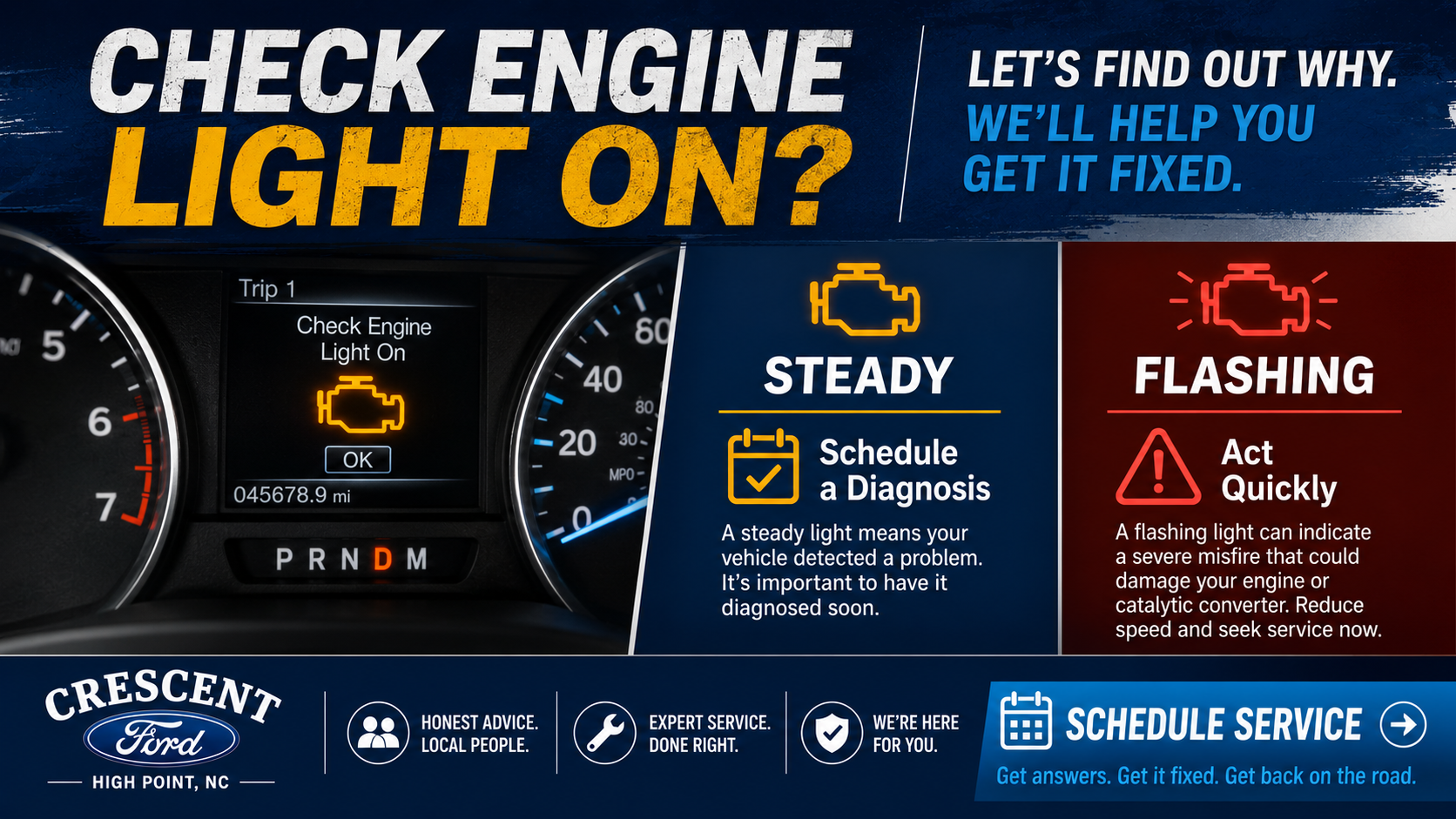

Why Is My Check Engine Light On? What to Do Next You're driving along normally when suddenly you notice it: The check engine light. Great. Now what? Is your engine about to quit? Can you keep driving? Is this going to cost $50? Or $5,000? The frustrating answer is: The check engine light alone can't tell you. It can illuminate for something relatively simple, but it can also warn you about a problem that deserves immediate attention. That's because the check engine light isn't connected to just one component. It's part of your vehicle's on-board diagnostic system, commonly called OBD or OBD-II. The system continuously monitors aspects of engine operation and emissions-related systems. When it detects certain faults, it can store a diagnostic trouble code and turn on the check engine light—also called the Malfunction Indicator Light (MIL). So the light isn't the diagnosis. It's the warning that tells you a diagnosis is needed. The first thing to look at is very simple: Is the check engine light steady—or is it flashing? That distinction matters. Steady vs. Flashing Check Engine Light: What's the Difference? If you remember nothing else from this article, remember this section. A Steady Check Engine Light A check engine light that comes on and stays illuminated means your vehicle's diagnostic system has detected a fault. That doesn't automatically mean: "Stop the car immediately." Depending on the problem, the vehicle may seem completely normal. But it also doesn't mean: "Ignore it until something actually breaks." A steady light should be diagnosed because seemingly minor problems can sometimes affect: Fuel economy Emissions Engine performance Other components Long-term repair costs In other words: Don't panic—but don't ignore it. A Flashing Check Engine Light A flashing or blinking check engine light deserves much more urgency. A flashing malfunction indicator light can indicate a severe engine misfire. Continuing to operate the vehicle under those conditions can potentially damage emissions-control components, particularly the catalytic converter. If the check engine light begins flashing: Reduce your speed and load on the engine. Avoid hard acceleration. If the vehicle is running poorly, shaking, losing power, overheating or showing other serious symptoms, find a safe place to stop and arrange assistance rather than continuing to drive. Consult the owner's manual for vehicle-specific guidance. Flashing = don't treat it like a normal warning light. Schedule Check Engine Light Service If your check engine light is on, a proper diagnosis can identify what's triggering the warning before you start replacing parts. What Does the Check Engine Light Actually Monitor? Modern vehicles contain computers and sensors constantly monitoring vehicle operation. For model-year 1996 and newer light-duty cars and trucks, OBD-II monitors emissions-related systems and aspects of powertrain operation. When the system detects a problem that meets certain criteria, it can: Store a diagnostic trouble code and Illuminate the check engine light. That stored code gives a technician a starting point for diagnosis. But this is important: A trouble code doesn't always tell you which part to replace. It tells you what the vehicle's computer detected. There's a difference. What Are the Most Common Reasons a Check Engine Light Comes On? There are many possible causes, and the exact answer depends on the vehicle. But some broad categories appear frequently. 1. Loose or Faulty Fuel Cap / EVAP Leak Yes. Something as simple as a loose fuel cap can potentially trigger a check engine light on vehicles that use a conventional cap. Your vehicle's evaporative-emissions system is designed to contain fuel vapors. If the system detects a leak, it may illuminate the check engine light. A loose, damaged or improperly sealed fuel cap can be one possible cause. What Should You Do? If your vehicle has a traditional fuel cap and the check engine light appeared shortly after refueling, safely check whether the cap is installed correctly. If it was loose, secure it properly. Don't expect the light to necessarily disappear immediately. The vehicle may need to complete additional self-checks before determining that the problem is no longer present. And if the light remains on? Get it diagnosed. Don't assume the fuel cap was the problem simply because that's the easiest explanation. 2. Oxygen Sensor Problems Your vehicle uses oxygen sensors as part of managing engine operation and monitoring the exhaust system. If an oxygen sensor or its related circuit isn't operating as expected, the diagnostic system may store a fault code and illuminate the check engine light. A sensor problem can potentially affect: Fuel management Emissions Fuel economy Engine operation But again: A code involving an oxygen sensor doesn't automatically mean "replace the oxygen sensor." There may be another condition affecting the sensor's readings. That's why diagnosis matters. 3. Catalytic Converter Efficiency Problems The catalytic converter is part of the vehicle's emissions-control system. Your vehicle's computer can monitor whether the system appears to be functioning properly. If catalytic-converter efficiency falls outside expected parameters, the check engine light may illuminate. This is one reason you don't want to ignore a severe misfire. A continuing misfire can potentially damage the catalytic converter—and that can turn one problem into a more expensive one. 4. Engine Misfire An engine misfire means combustion isn't occurring properly in one or more cylinders. Possible causes can involve things such as: Spark plugs Ignition coils Fuel delivery Air/fuel mixture Mechanical engine problems Electrical faults Symptoms might include: Rough idle Shaking Hesitation Loss of power Poor acceleration But sometimes a misfire is detected before the driver notices much of anything. A severe misfire is also one of the conditions that can cause the check engine light to flash. 5. EVAP System Problems The fuel cap is only one piece of the evaporative-emissions system. A fault elsewhere in that system can also trigger the check engine light. Potential problems can involve: Hoses Valves Sensors Connections Leaks elsewhere in the system So if you've already checked the fuel cap and the light remains on, don't keep tightening it harder and hoping. 😂 There may be something else going on. 6. Air/Fuel or Fuel-Delivery Problems Your engine needs the correct balance of: air + fuel + spark to operate properly. Problems affecting fuel delivery or the information the computer uses to manage the air/fuel mixture can trigger diagnostic codes. Depending on the cause, you might also notice: Rough running Hard starting Hesitation Reduced fuel economy Lack of power Or you might notice nothing except the light. 7. Sensor or Electrical Problems Modern vehicles depend heavily on electronic sensors. A fault involving a sensor, wiring, connector or related circuit can sometimes trigger the check engine light even when the vehicle appears to drive normally. That's another reason visual inspection alone can't always identify the problem. The vehicle may look and feel perfectly fine while its diagnostic system has detected something outside the expected range. Can I Drive With the Check Engine Light On? It depends on: the light and what the vehicle is doing. If the Light Is Steady and the Vehicle Feels Normal You generally don't need to panic. But schedule a diagnosis rather than ignoring the light indefinitely. Pay attention to the vehicle. If additional symptoms develop, your situation may change. If the Light Is Flashing Treat the situation with greater urgency. Reduce engine load and seek service promptly. If the Vehicle Is Running Poorly Even with a steady light, symptoms matter. If you're experiencing: Severe shaking Major loss of power Overheating Smoke Unusual noises Strong fuel smell Multiple warning lights Other significant changes in vehicle operation don't rely on the fact that the check engine light happens to be steady. Find a safe place to stop and get appropriate assistance. How the vehicle is behaving matters just as much as the light itself. Can a Check Engine Light Turn Off by Itself? Yes. Sometimes the condition that triggered the light stops occurring. The OBD system can continue monitoring the vehicle, and after enough successful checks, the light may turn off. For example, a loose fuel cap that has been corrected may eventually result in the light going out after the system confirms the leak is no longer present. That doesn't mean the warning light was malfunctioning. It means the system detected a problem and later determined that the condition was no longer present. If the light repeatedly comes on and goes off, however, don't assume: "It fixed itself again." An intermittent problem may still need diagnosis. Why Is My Check Engine Light On but My Car Runs Fine? This is extremely common. The check engine light can detect certain faults before they create an obvious drivability problem. That's one of the benefits of on-board diagnostics. Your car doesn't have to: Shake Stall Overheat Make noise Lose power before the system recognizes that something isn't operating as expected. So: "It drives fine." doesn't mean: "Nothing is wrong." It means: "Whatever the computer detected hasn't necessarily created a symptom you can feel yet." What Does a Check Engine Light Diagnostic Code Mean? When a scan tool is connected to the vehicle's diagnostic port, it can retrieve stored Diagnostic Trouble Codes, commonly called DTCs. You might see codes formatted something like: P0XXX But here's where people sometimes get into trouble. They search the code online. Google says: "Oxygen sensor." They buy an oxygen sensor. They replace it. And... the light comes back. Why? Because the code may describe the system or condition where the problem was detected—not necessarily identify one guaranteed failed part. A proper diagnosis can involve: Reading stored codes Looking at live vehicle data Checking related components Inspecting wiring or connections Performing tests Following manufacturer diagnostic procedures The scan is the beginning. Diagnosis is what determines why the code is there. Is a Free Check Engine Light Scan the Same as a Diagnosis? Not necessarily. A code scan can be very useful. It tells you what codes are stored in the vehicle's computer. But retrieving: PXXXX isn't always the same as knowing: "This exact part has failed and replacing it will fix the vehicle." Think of it like this: A thermometer tells you: You have a fever. It doesn't necessarily tell you: why. Likewise, a trouble code gives the technician valuable information about what the computer detected. Further testing may be necessary to determine the actual cause. Should I Clear the Check Engine Light Myself? Clearing a code doesn't repair the problem that caused it. If the underlying condition remains, the light may simply return. Clearing diagnostic information can also erase useful data a technician may need when trying to determine what happened. And there's another issue particularly relevant in North Carolina: Emissions readiness monitors. After codes are cleared or the battery is disconnected, some OBD monitors may show as not ready until the vehicle completes the conditions necessary to run those self-tests again. That matters if you're approaching an emissions inspection. So don't treat: "How do I turn the light off?" as the same question as: "How do I fix the problem?" They're not. Will a Check Engine Light Make You Fail NC Inspection? For vehicles subject to North Carolina's OBD emissions inspection, an illuminated malfunction indicator light can matter. North Carolina currently requires emissions inspections in 19 counties, including several directly within Crescent Ford's market: Guilford Randolph Davidson Forsyth There are exemptions for certain vehicles, including qualifying newer low-mileage vehicles, vehicles 20 years old or older, diesels and registered farm vehicles. If your applicable vehicle's OBD system indicates an emissions-related failure, it may not pass the emissions portion of inspection until the issue is addressed. Schedule Service in High Point, NC Check engine light on before your NC inspection? Have the cause diagnosed before inspection day rather than simply clearing the code. My Inspection Is Due—Should I Just Clear the Check Engine Light? That's usually not a useful strategy. North Carolina's OBD emissions inspection doesn't only look at whether the dashboard light happens to be off at that exact moment. The inspection system communicates with the vehicle's OBD system. If too many required readiness monitors haven't completed their checks, the vehicle may not be ready for the emissions test. In other words: Clearing the light right before inspection isn't the same as repairing the vehicle. Address the cause instead. How Urgent Is a Check Engine Light? Here's a simple way to think about it. LEVEL 1 — Steady Light, Vehicle Running Normally Action: Schedule diagnosis. Don't ignore it for months, but you generally don't need to assume an immediate catastrophe. LEVEL 2 — Steady Light + Noticeable Symptoms Examples: Rough idle Hesitation Reduced power Poor acceleration Difficult starting Action: Have it evaluated promptly. The symptoms give the warning more context. LEVEL 3 — Flashing Check Engine Light Action: Reduce speed/load and seek service quickly. A severe misfire can potentially cause additional damage. LEVEL 4 — Serious Vehicle Symptoms Examples: Overheating Heavy smoke Severe loss of power Strong fuel odor Loud mechanical noise Vehicle barely running Action: Safely stop driving and arrange assistance. Don't keep driving simply because: "It's only the check engine light." What Should I Do When My Check Engine Light Comes On? Here's the practical checklist. 1. Look at the Light Is it: Steady? or Flashing? That's your first clue about urgency. 2. Pay Attention to the Vehicle Is it: Shaking? Losing power? Running hot? Making unusual noises? Smelling unusual? Driving differently? Symptoms matter. 3. Check the Fuel Cap if Applicable If your vehicle uses a traditional fuel cap, make sure it's properly installed—particularly if the light appeared shortly after refueling. 4. Don't Start Replacing Parts Based on a Guess Get the diagnostic codes read and the cause properly evaluated. 5. Schedule Service Especially if: The light remains on The light returns The vehicle has symptoms Your inspection is approaching The light is flashing Schedule a Check Engine Light Diagnosis How Much Does It Cost to Fix a Check Engine Light? There isn't one check-engine-light repair. That's the problem with trying to answer this question with a single number. The light could be related to something relatively simple. Or it could point toward a much more significant repair. The useful sequence is: Diagnose first. Then: Price the actual repair. Don't assume the worst before diagnosis. And don't assume the cheapest possibility either. What If the Check Engine Light Reveals an Expensive Repair? Now we enter the part of this topic that connects naturally with the other side of Crescent Ford. Suppose diagnosis reveals that your vehicle needs a substantial repair. The next question may become: "Is this car actually worth fixing?" That's a legitimate financial question. But don't jump there simply because the check engine light came on. First: Find out what's actually wrong. Then determine: Repair cost Current vehicle value Mileage Overall condition Repair history Other upcoming maintenance Loan payoff How long you intended to keep the vehicle If repairing makes sense? Repair it. If the repair changes the economics of keeping the vehicle? Now it may be worth finding out what the car is worth as-is. I s My Car Worth Fixing or Should I Trade It In? Find Out What Your Vehicle Is Worth Can I Trade In a Car With the Check Engine Light On? Potentially, yes. An illuminated check engine light doesn't automatically prevent a dealership from appraising the vehicle. But the underlying problem can affect its value. That's why we'd recommend: Diagnosis first if practical. If the problem turns out to be relatively minor, repairing it and keeping the vehicle may make perfect sense. If it turns out to be a major repair on a vehicle you were already considering replacing, an as-is appraisal can give you another piece of information. Should I Fix My Car Before Trading It In? What Actually Affects Trade Value Why You Shouldn't Ignore a Check Engine Light for Months There's a difference between: "I don't need to panic." and "I don't need to do anything." A steady check engine light may not represent an immediate emergency. But ignoring it can potentially: Allow a problem to worsen Affect fuel economy Increase emissions Lead to additional component damage Cause inspection problems Make future diagnosis more complicated if additional faults develop If the vehicle is trying to tell you something? Eventually, it's worth listening. What If the Check Engine Light Comes On Right After Service? Don't immediately assume the service caused it. The timing may be related. Or it may be coincidence. Contact the service department and explain: When the light appeared What work was performed Whether the vehicle has symptoms Whether the light is steady or flashing That gives the technician useful context. If something related to the previous work needs to be checked, they can determine that during diagnosis. What If My Check Engine Light Comes On After Getting Gas? First, if your vehicle has a conventional fuel cap: Check the cap. Make sure it's properly secured. A loose or missing fuel cap can allow the OBD system to detect an evaporative-emissions leak. If that's what triggered the light, it may take several trips before the vehicle completes the necessary self-checks and turns the light off. If the light stays on? Don't assume the cap is responsible. Schedule diagnosis. Why Is My Check Engine Light On in My Ford? The basic meaning is the same: Your Ford's onboard diagnostic system has detected a condition that caused the malfunction indicator light to illuminate. But the actual cause depends on: Model Model year Engine Stored diagnostic codes Vehicle symptoms Operating conditions An F-150 check engine light doesn't automatically mean the same thing as an Explorer check engine light. And two identical F-150s can illuminate the same warning for different underlying reasons. That's why the diagnostic process matters more than guessing based on model alone. Check Engine Light vs. Wrench Light on a Ford Ford owners may also see a wrench-shaped warning indicator. Don't automatically assume the wrench light and check engine light mean the same thing. Warning indicators can have different meanings depending on the vehicle and model year. Your owner's manual is the best source for understanding the exact warning displayed on your specific Ford. And yes—we're going to give the Ford wrench light its own article rather than trying to cram every dashboard warning into this one. That lets this article stay focused on the check engine light. Check Engine Light Service in High Point, NC If your check engine light is on around High Point, Greensboro, Winston-Salem, Thomasville, Trinity, Kernersville, Lexington or elsewhere in the Piedmont Triad, the most useful thing you can do is stop guessing. Maybe it's simple. Maybe it isn't. But: A warning light isn't a diagnosis. At Crescent Ford, our service team can retrieve diagnostic information and evaluate what's causing the warning. And if the diagnosis turns into a larger question about whether your vehicle is still worth repairing? We can help with that too. But the order matters: Diagnose first. Understand your options second. Make the financial decision third. Sometimes the best answer will be: Fix it and keep driving. That's a win. And sometimes a major repair on an older or already unreliable vehicle may make you decide it's time to move on. That's when knowing your trade value becomes useful. Either way, you make the decision based on information instead of the little yellow light staring at you from the dashboard. FINAL CTA / INTERNAL LINKS Check Engine Light On? Schedule Service at Crescent Ford Facing a Major Repair? Is My Car Worth Fixing or Should I Trade It In? Considering Replacing the Vehicle? Value Your Trade Shop New Ford Vehicles Shop Used Cars, Trucks & SUVs Frequently Asked Questions About Check Engine Lights What is the most common reason for a check engine light? There isn't one cause that applies to every vehicle. Possible causes range from evaporative-emissions leaks, including a loose fuel cap on applicable vehicles, to sensor faults, misfires, catalytic-converter efficiency issues and other engine or emissions-related problems. Diagnosis is necessary to determine the actual cause. Can I drive with a solid check engine light? If the light is steady and the vehicle is otherwise running normally, it doesn't necessarily mean you must immediately stop driving. However, the problem should be diagnosed rather than ignored. If the vehicle is running poorly or displaying other serious symptoms, seek assistance sooner. Can I drive with a flashing check engine light? A flashing check engine light can indicate a severe misfire capable of damaging emissions-control components. Reduce engine load and seek service promptly. If the vehicle is running very poorly or displaying other serious symptoms, safely stop driving and arrange assistance. Why is my check engine light on but nothing seems wrong? OBD systems can detect certain faults before they produce symptoms a driver can feel. The vehicle may appear to drive normally even though the computer has detected an emissions-related or engine-operating condition requiring attention. Can a loose gas cap cause a check engine light? Yes, on vehicles equipped with a conventional fuel cap, a loose, missing or improperly sealed cap can potentially create an evaporative-emissions leak that triggers the check engine light. How long does it take a check engine light to go off after tightening the gas cap? It may not turn off immediately. The vehicle's OBD system typically needs to complete additional monitoring before confirming that the condition is no longer present. If the light remains on, have the vehicle diagnosed rather than assuming the fuel cap is the cause. Will a check engine light go away by itself? It can. If the condition that triggered the warning no longer occurs, the vehicle's OBD system may eventually turn the light off after successful self-checks. A recurring light may indicate an intermittent problem and should be evaluated. Does a code scanner tell you exactly what's wrong? Not always. A scanner retrieves diagnostic trouble codes that indicate what the vehicle's computer detected. Additional testing may be necessary to determine the actual failed component or root cause. Is a free check engine light scan a diagnosis? Not necessarily. Retrieving a trouble code is useful, but diagnosis may require testing components, examining vehicle data, inspecting wiring and following manufacturer diagnostic procedures. Will my car fail NC inspection if the check engine light is on? For vehicles subject to North Carolina's OBD emissions inspection, an illuminated malfunction indicator light can cause an emissions inspection failure. Emissions inspections currently apply in 19 North Carolina counties, subject to vehicle exemptions. Does Guilford County require emissions inspections? Yes. Guilford County is currently one of North Carolina's 19 emissions-inspection counties. Randolph, Davidson and Forsyth are also on the current list. Can I clear my check engine light before inspection? Clearing codes doesn't repair the underlying problem and can reset OBD readiness monitors. If required monitors aren't ready when the vehicle is inspected, that can create an inspection issue. Repairing the cause is the better approach. Can I trade in a car with the check engine light on? Potentially, yes. A warning light doesn't automatically prevent a vehicle from being appraised, although the underlying mechanical problem can affect its value. If you're deciding between repairing and trading, knowing both the repair cost and the vehicle's as-is value can help. Should I replace my car because the check engine light came on? No. A check engine light alone isn't a reason to replace a vehicle. Diagnose the problem first. If the diagnosis reveals a major repair, then compare repair cost, vehicle value, reliability, mileage, loan payoff and replacement cost before deciding whether to repair or trade.