Blog

How Do I Get a Car Loan with Bad Credit? Tips for Financing at Crescent Ford

Buying a car with bad credit can feel like an overwhelming challenge, but at Crescent Ford in High Point, NC, we make it easier for you to drive away with the car you want. Whether you're dealing with a low credit score, limited credit history, or even a bankruptcy, securing a car loan is possible. With the right approach and support, you can get behind the wheel of a new or pre-owned Ford vehicle in no time. Here’s how you can navigate the process of getting a car loan with bad credit and improve your chances of approval.

1. Work with Trusted Lenders

At Crescent Ford, we understand that everyone's financial situation is unique. That's why we partner with over 30 different lenders to help you find a financing option that fits your needs—regardless of your credit history. Whether you're a first-time buyer or have struggled with credit in the past, our lenders work with all types of credit to ensure you have access to the financing you deserve.

2. Take Advantage of Specialized Incentives

If you're worried about higher monthly payments, don’t be! There are several ways to make car financing more affordable. Crescent Ford offers specialized incentives on select vehicles, which can reduce the overall cost and make your monthly payments more manageable. Plus, if you're a college student, we offer extra rebates to help ease the financial burden of buying a car. Ask our team about these programs to see how they can work for you.

3. Start with a Realistic Budget

When you have bad credit, it’s important to set a realistic budget for your car purchase. Start by assessing your income and expenses to determine how much you can comfortably afford to pay each month. This will help you avoid overextending yourself and ensure that your loan terms match your financial capabilities. Be sure to factor in other costs, such as insurance and maintenance, to get a clear picture of the total cost of ownership.

4. Consider Pre-Owned Options

If you're on a budget, a pre-owned Ford vehicle can be a great option. Crescent Ford offers a wide range of certified pre-owned vehicles, many of which are backed by Ford's Gold Certified program. This ensures you’re getting a high-quality vehicle at a more affordable price. Plus, many pre-owned vehicles come with warranties, so you can drive with confidence knowing that your investment is protected.

5. Check Your Credit Report

Before applying for a loan, it’s helpful to check your credit report. Knowing where you stand will give you a better idea of what kind of loan terms you may be eligible for. If you find any errors, it’s a good idea to get them corrected before applying for financing. At Crescent Ford, we can help guide you through the process, even if your credit isn’t perfect.

6. Be Transparent with Your Lender

When working with a lender, honesty is key. Be upfront about your credit situation and financial history. The more information you provide, the easier it will be to find a loan that works for you. Our team is here to help you navigate the loan application process and find the best financing terms for your needs.

7. Consider a Co-Signer

If you have someone with good credit who’s willing to co-sign your loan, it can increase your chances of approval and help you secure better financing terms. A co-signer adds a layer of security for the lender and can help you get a loan with a lower interest rate.

Get Started at Crescent Ford Today

At Crescent Ford, we believe everyone deserves a chance to drive a reliable vehicle. We’re here to help you secure a loan, regardless of your credit score. Visit us in High Point, NC, to explore our wide range of Ford vehicles and discover financing options tailored to your needs.

Whether you're interested in a new Ford truck, an SUV, or a pre-owned vehicle, our team at Crescent Ford is here to help. We make car buying easy and affordable, even with bad credit. Start your journey with us today!

Recommended Posts

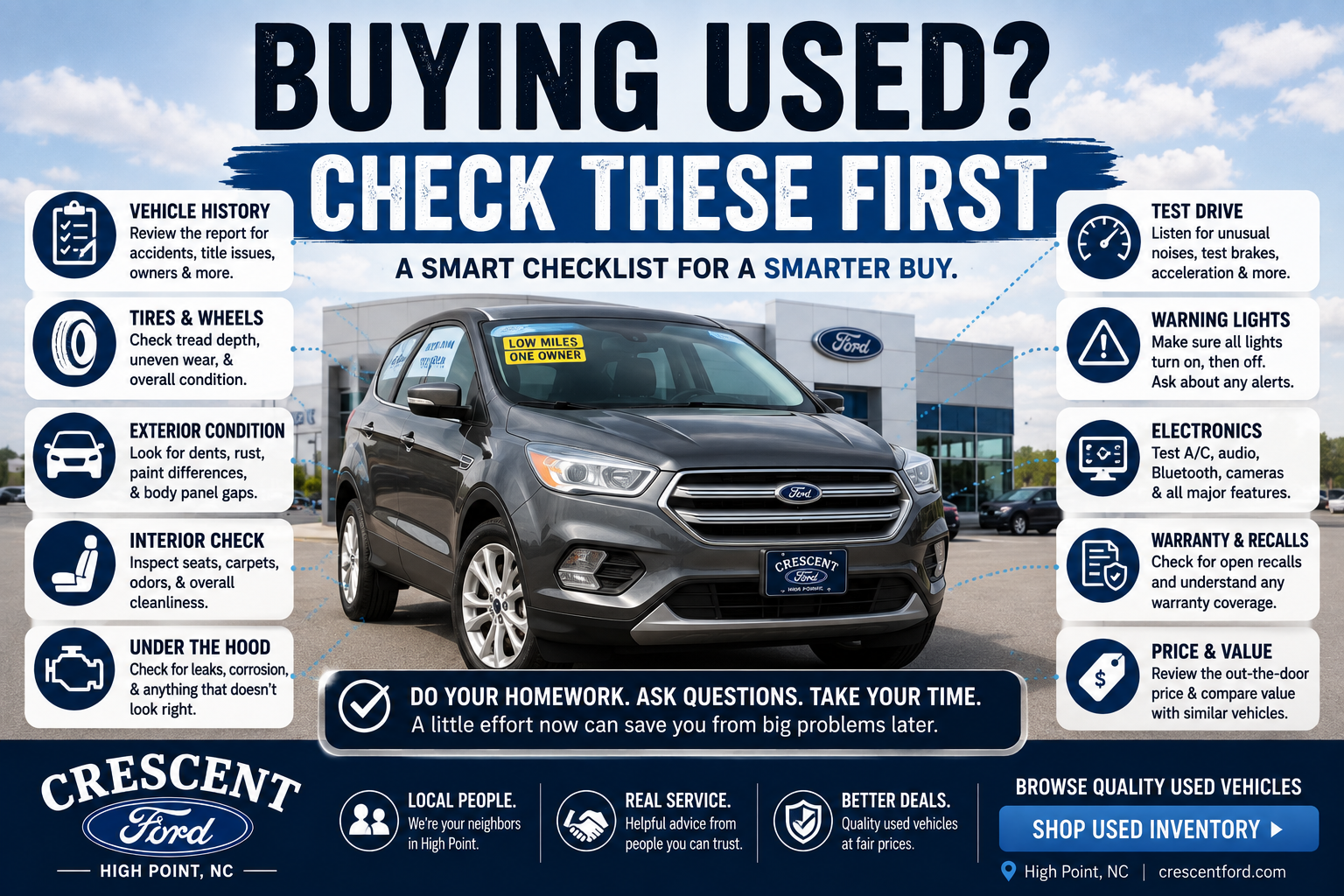
Used car buying checklist covering vehicle history, tires, exterior condition, test drive, warning lights and price at Crescent Ford in High Point, NC

Buying a Used Car in High Point, NC: What to Check Before You Buy

Buying a Used Car in High Point, NC: What to Check Before You Buy You've found a used car that looks promising. The mileage is reasonable. The pictures look good. The price fits your budget. So...what now? Buying used can be a great way to get more vehicle for your money, but there's one major difference between shopping new and used: No two used vehicles are exactly alike. Two vehicles can be the same year, make, model and trim with nearly identical mileage—and still be very different purchases. One may have been meticulously maintained. The other may have spent the last three years surviving teenagers, potholes and an owner who considered an oil-change reminder more of a suggestion. That's why shopping for a used vehicle isn't just about finding the right model. You're evaluating the individual vehicle. If you're shopping for a used car, truck or SUV in High Point or elsewhere around the Piedmont Triad, here's what we'd check before you buy. Start With the Right Used Vehicle—Then Inspect the Individual One Before worrying about scratches or tire tread, make sure you're looking at a vehicle that actually fits your needs. Ask yourself: How many people do I regularly carry? How much cargo space do I need? How many miles will I drive each year? Do I need AWD or 4x4? Do I tow? What's my realistic purchase budget? How much can I comfortably spend on fuel? What will insurance cost? Which features actually matter to me? There's no point finding a pristine used F-150 if what your life really needs is a compact SUV. And there's no point buying a small crossover because the price looks great if you'll immediately wish you had a third row. Browse Used Cars, Trucks & SUVs at Crescent Ford Start by narrowing the options to vehicles that fit your budget and lifestyle, then evaluate the individual vehicle. 1. Check the Used Car's Vehicle History This should be one of your first steps. A vehicle-history report can provide useful information about the vehicle's past, potentially including things such as: Reported accidents or damage Number of owners Title history Reported mileage Registration history Available service records Reported usage history But there's an important distinction: A vehicle-history report is a tool—not a mechanical inspection. If the report looks clean, that's good information. It doesn't mean you should skip everything else in this guide. Likewise, seeing an accident on a history report doesn't automatically mean you should walk away. You need context. What happened? How significant was the damage? Was it repaired properly? How does the vehicle look and drive today? Use the history report to help you know which questions to ask. RELATED READING How Do I Check a Used Car's History? 2. Verify the Mileage Mileage is one of the first numbers used-car shoppers look at. And it matters. But don't make the mistake of treating mileage as the entire story. Imagine you're choosing between: Vehicle A: 45,000 miles with questionable maintenance and Vehicle B: 60,000 miles with consistent service records and obvious signs of good care. Would you automatically choose Vehicle A? We wouldn't. Mileage tells you how much the vehicle has been driven. It doesn't tell you exactly how it was driven or maintained. Compare the mileage with: Vehicle age Service history Overall condition Price Intended use And look for consistency between the odometer and available history records. 3. Look at the Tires You don't need to be a mechanic to get useful information from the tires. Look at all four. Do they appear to have reasonable tread? Are they the same brand and type? Is one considerably more worn than the others? Do you see cracking, bulges or obvious damage? Is the wear even across the tread? Why uneven tire wear matters Uneven wear can sometimes indicate an alignment, suspension or tire-maintenance issue. It doesn't automatically mean there's a serious problem. But it's worth asking about. Also look at replacement cost. If you're considering a vehicle with large wheels or specialized tires, find out what a replacement set costs. A used vehicle with tires nearing the end of their useful life may still be a perfectly good purchase. You just don't want to discover the week after buying it that your first ownership expense is a set of four expensive tires. 4. Inspect the Exterior in Good Light Pictures can hide a lot. So can rain. So can darkness. Walk around the vehicle in good lighting and look at it from different angles. You're looking for things such as: Dents Scratches Paint chips Cracked lights Glass damage Wheel damage Rust or corrosion Panel alignment Paint differences Don't panic over every scratch. It's a used car. Normal wear is normal. You're trying to understand the vehicle's actual condition—not find evidence that someone has driven it before. 5. Look at the Body Panels Stand toward the front or rear corner of the vehicle and look down the side. Do the panels appear straight? Do the gaps between doors, hood, fenders and other panels look relatively consistent? Does one panel's paint appear noticeably different under the same light? Again, none of these observations alone proves that a vehicle has had significant damage. Repairs happen. The question is whether anything you see gives you a reason to ask: "Do we know what happened here?" Then compare what you see with the vehicle-history information. 6. Check the Windshield and Glass Look carefully at the windshield. Small chips can turn into cracks. Larger damage may eventually require replacement. Modern vehicles can also have cameras and driver-assistance technology associated with the windshield area, potentially making windshield replacement more involved than simply swapping the glass. Also check: Side windows Rear glass Mirrors Make sure everything appears intact and operates normally. 7. Open Every Door Seriously. Open them. All of them. Then: Close them. A vehicle can look fantastic in photos while having a rear door that doesn't quite operate the way you expect. Check: Driver's door Passenger doors Rear doors Liftgate Tailgate Hood If the vehicle has a power liftgate, test it. If it has a power tailgate, test it. If it has a sliding door, test it. Don't assume a feature works because the button exists. 8. Check the Interior Carefully The interior can tell you a lot about how a vehicle was treated. Look at: Driver's seat Passenger seats Rear seats Carpet Headliner Dashboard Door panels Cargo area Center console Some wear is normal. A vehicle with 80,000 miles shouldn't necessarily look like one with 8,000. What you're looking for is condition that makes sense for the age and mileage. Pay special attention to the driver's seat. That's usually where wear appears first. Check: Seat bolsters Upholstery Power adjustments Lumbar support Seat heaters/ventilation if equipped You may spend hundreds of hours sitting there. Make sure you actually like it. 9. Use Your Nose Yes, really. When you first open the vehicle, pay attention to how it smells. Strong odors can be difficult to remove. Look—or rather, smell—for: Smoke Heavy air freshener Mildew Pets Moisture A powerful air freshener isn't automatically hiding something. But if the vehicle smells like someone emptied an entire bottle of fragrance into it five minutes before you arrived? You might want to investigate. Check for signs of moisture. Look at carpets, floor mats, the cargo area and spare-tire area if accessible. Persistent dampness or mildew deserves further investigation. 10. Start the Vehicle Yourself Don't only inspect a vehicle that's already running when you arrive. When possible, start it yourself. Before starting, turn the ignition on and look at the instrument cluster. The warning lights should illuminate as part of the normal startup process and then behave as expected once the vehicle is running. Pay attention to any warning messages that remain. Listen to the startup. You don't need to diagnose every mechanical sound. You're simply looking for anything obviously unusual. If something concerns you: Ask. 11. Check the Dashboard for Warning Lights A warning light doesn't automatically mean: "Run away." But it does mean: "Find out why that's on." Pay attention to things such as: Check-engine light ABS warning Airbag/SRS warning Tire-pressure warning Charging-system warning Other vehicle-specific alerts Some warnings may have simple explanations. Others may not. The important part is not ignoring them. 12. Test the Air Conditioning and Heat If you're buying a used car in North Carolina, please don't skip this. Turn the A/C on. Let it run. Make sure the air gets appropriately cold. Change the fan speeds. Try different vents. Then check the heat. If the vehicle has: Dual-zone climate control Rear climate controls Heated seats Ventilated seats Heated steering wheel test those too. You'd much rather discover a climate-control issue before buying the vehicle than during the first 95-degree afternoon in High Point. 13. Test the Electronics This is where modern used-car inspections take longer than they used to. Test the equipment you care about. That may include: Power windows Power locks Mirrors Seat adjustments Infotainment Touchscreen Backup camera Bluetooth Apple CarPlay Android Auto USB ports Audio system Steering-wheel controls Remote start Sunroof/moonroof Driver-assistance features Bring your phone. Connect it. If using CarPlay or Android Auto is part of your daily routine, make sure you know how it works in the vehicle you're considering. 14. Don't Skip the Back Seat This is especially important for families. Sit back there. If you're bringing kids: Bring the car seats. We mean it. Something that looks spacious in photos may feel very different once a rear-facing car seat is installed behind the driver's seat. Check: Legroom Headroom Car-seat access USB ports Cupholders Rear vents Door opening Seat folding If you're shopping for the family, evaluate the vehicle as a family vehicle. 15. Check the Cargo Area Open the trunk, hatch or tailgate. Then picture what you actually carry. Could your: Stroller Groceries Golf clubs Work equipment Sports gear Luggage Dog crate fit? Don't rely entirely on cargo-volume numbers. Bring the item if it's important enough. We would much rather watch you put a stroller in the back of an SUV before you buy it than hear three days later: "I can't fit this thing without taking the wheels off." 16. Look Under the Hood You don't need to diagnose the engine. But there's nothing wrong with looking. Check for anything obviously unusual, including: Visible leaks Loose components Damaged-looking wiring Strong odors Obvious corrosion Anything that simply doesn't look right If you aren't mechanically inclined, that's okay. The goal isn't to turn yourself into a technician in ten minutes. It's to pay attention and ask questions. 17. Look Under the Vehicle You don't need to crawl underneath it in the parking lot. A quick look underneath can still be useful. Do you see obvious fluid dripping? Hanging components? Significant visible damage? Again: You're not performing a professional inspection. You're looking for obvious reasons to investigate further. 18. Review the Service History When Available A well-documented maintenance history can be valuable. Look for evidence of routine maintenance and repairs. But don't assume a vehicle was neglected solely because every oil change doesn't appear on a history report. Not every service facility reports information to every vehicle-history provider. Ask whether additional records are available. What you're trying to establish is: Does the vehicle's condition and available history suggest it has been reasonably maintained? 19. Understand the Difference Between Used and Certified Pre-Owned These terms aren't interchangeable. Used Vehicle A used vehicle is simply previously owned. Certified Pre-Owned A manufacturer-certified vehicle has to meet the requirements of that manufacturer's certification program. For Ford shoppers, that means programs such as Ford Blue Advantage may be worth comparing with conventional used inventory. Certification can include eligibility requirements, inspections and warranty coverage depending on the certification level. But don't assume every used Ford is certified. Ask. And don't assume "certified" is a generic term. Ask: Certified by whom? Manufacturer-backed certification and a dealer's own inspection program aren't necessarily the same thing. 20. Read What the Warranty Actually Covers Don't stop at: "It has a warranty." Ask: What warranty? Find out: Who provides it? What does it cover? What doesn't it cover? When does coverage begin? When does it expire? Is there a mileage limit? Is there a deductible? Where can repairs be performed? If the vehicle still has remaining manufacturer warranty, verify what coverage remains. If it's certified, review the certification coverage. If an additional service contract is available, understand that separately. Warranty details matter more than the word "warranty." 21. Check for Open Recalls Before buying, check whether there are any open safety recalls associated with the vehicle. Recall status can change, so this is something worth verifying for the specific VIN. If there's an open recall, ask: What is the recall? Is a remedy available? Has the repair been scheduled? Who performs it? This isn't something to guess about based on year and model alone. Recall information is VIN-specific. 22. Take a Real Test Drive This may be the single most important step. And please don't spend the entire drive talking to the salesperson. Listen to the car. Try: Neighborhood speeds Stop-and-go driving Highway speeds when practical Braking Acceleration Turns Parking Reverse Pay attention to how the vehicle: Steers Brakes Accelerates Shifts Tracks down the road Handles bumps Sounds Does anything vibrate? Pull? Clunk? Rattle? Feel strange? You don't need to know what causes it. You just need to notice it. Schedule a Used Vehicle Test Drive Found a used vehicle you like? Get behind the wheel and evaluate it where it matters most—the road. 23. Drive the Vehicle the Way You'll Actually Use It If you're buying a commuter car: Get it on the highway. If you're buying a truck: Pay attention to visibility and maneuverability. If you're buying a family SUV: Bring the family. If you're buying because you have a long drive between High Point and Winston-Salem every day: Don't make your entire decision after driving three blocks. A good test drive should answer: Can I see myself doing my normal life in this vehicle? 24. Check the Brakes During the Test Drive Pay attention when you brake. Does the vehicle stop smoothly? Do you feel unusual vibration? Does it pull? Do you hear concerning noises? Brake wear is normal maintenance on a used vehicle. The question is whether there's anything you should know about before purchasing. If you're unsure, ask about the condition of the brakes. 25. Pay Attention to the Transmission Again, you're not trying to diagnose it. You're observing it. As you accelerate and slow down, pay attention to how the vehicle shifts. If something feels unusual, ask about it. Different transmissions can feel different by design, so don't immediately assume unfamiliar behavior means something is wrong. But don't ignore something that concerns you either. 26. Test Driver-Assist Features If features such as: Blind-spot monitoring Lane-keeping assistance Adaptive cruise control Parking sensors Automatic emergency braking 360-degree cameras are important reasons you're buying the vehicle, understand how the equipped systems work. Driver-assistance technology varies considerably by: Manufacturer Model Year Trim and equipment package. Don't assume a feature is included simply because another vehicle of the same model has it. 27. Compare the Actual Vehicle—not Just the Model This is one of the biggest differences between new and used shopping. Suppose you're looking at two used Ford Explorers. Same year. Similar mileage. Similar price. One may have: Different trim Different options Different tires Different history Different condition Different warranty remaining Those aren't interchangeable vehicles. This is why shopping used purely by: Lowest price → click can be misleading. Look at what you're actually getting for the money. 28. Understand the Out-the-Door Price Once you've found a used vehicle you like, don't stop at the advertised vehicle price. Ask for the out-the-door price. That gives you the broader transaction amount, including applicable taxes and fees. It makes comparisons much easier. And it keeps you from trying to compare one dealer's advertised price with another dealer's actual transaction price. RELATED READING What Does “Out-the-Door Price” Mean When Buying a Car in NC? 29. Don't Shop by Monthly Payment Alone This is another common mistake. A payment can be adjusted by changing: Down payment Loan term Interest rate Amount financed So: "Can you get me to $500 per month?" doesn't tell you what the vehicle actually costs. Instead, understand: Vehicle price Out-the-door price Trade value Amount financed APR Loan term Total finance cost Then look at the payment. The payment matters. It just shouldn't be the only number that matters. 30. Get an Insurance Quote Before You Buy Insurance costs can vary substantially between vehicles. Before purchasing, call your insurance company with the VIN and ask for a quote. Don't assume: "It's used, so insurance will be cheap." Vehicle value is only one factor. Your insurer can give you a much better answer than a dealership blog can. And it's much better to discover the actual insurance cost before you sign. 31. Know How Much You Want to Put Down You don't automatically need to make the largest down payment possible. But you should understand how your down payment affects: Amount financed Monthly payment Loan-to-value Total interest cost If you're trading a vehicle, your equity may also become part of the equation. RELATED READING How Much Should You Put Down on a Car? 32. Know What Your Trade Is Worth Before You Buy If you're trading your current vehicle, evaluate that separately. Don't mentally combine: "They're giving me a lot for my trade!" with "I'm getting a good deal on the used car." Understand both numbers. Your current vehicle has a value. The vehicle you're purchasing has a price. Then you can evaluate the complete transaction. Find Out What Your Vehicle Is Worth RELATED READING What Is My Car Worth in High Point, NC? How Trade-In Appraisals Actually Work 33. Don't Automatically Fix Your Trade Before Shopping If your current vehicle needs work, you don't necessarily need to repair everything before trading it. Get an appraisal first. Then determine whether spending money on repairs actually makes financial sense. RELATED READING Should I Fix My Car Before Trading It In? 34. If You Still Owe Money, Know Your Payoff You can trade a vehicle that still has a loan. But know the difference between: Trade value and loan payoff. If the trade is worth more than the payoff, you have positive equity. If the payoff exceeds the trade value, you're dealing with negative equity. That doesn't necessarily prevent the purchase. It just needs to be part of the financing conversation. RELATED READING Can You Trade In a Car You Still Owe Money On? 35. Consider an Independent Pre-Purchase Inspection If you're buying a used vehicle—particularly an older or higher-mileage vehicle—an independent pre-purchase inspection can provide additional information before you commit. A qualified technician can evaluate areas that aren't practical for the average shopper to assess in a parking lot. That can include things such as: Mechanical condition Fluid leaks Suspension Brakes Tires Underbody condition Other potential concerns A pre-purchase inspection doesn't guarantee that nothing will ever go wrong. No inspection can predict every future repair. But it can help you make a more informed decision. If you're buying from a private seller, we'd consider this particularly important. 36. Ask What Has Already Been Reconditioned When buying from a dealership, ask what work has been completed since the vehicle was acquired. Maybe it received: Tires Brakes Maintenance Mechanical repairs Cosmetic reconditioning This can help you better understand what you're comparing. Imagine two similar vehicles: Vehicle A $500 cheaper but needs tires soon. Vehicle B $500 more but already has a new set. The cheaper vehicle isn't automatically the better value. 37. Don't Expect a Used Car to Be Perfect This is worth saying. A used vehicle has been used. A small stone chip doesn't necessarily make it a bad car. Neither does a minor interior scratch. The goal isn't to find: A used vehicle with absolutely no evidence of previous ownership. The goal is to find: A vehicle whose condition, history, mileage, equipment and price make sense together. Focus on what matters. 38. But Don't Ignore Something Because You Love the Car This is the other side of it. You found the exact color. It has the panoramic roof. The seats are perfect. Your spouse loves it. The payment works. Fantastic. Now don't let excitement convince you to ignore something that genuinely concerns you. Ask the question. Review the history. Take the test drive. Get the inspection if appropriate. You should be excited about buying the vehicle and comfortable with what you're buying. Both can be true. 39. Compare New vs. Used Before You Automatically Decide Sometimes shoppers assume: "Used is cheaper, so I'm definitely buying used." Often, yes. But not always in the way you expect. Compare: Purchase price APR Warranty coverage Mileage Equipment Expected ownership period Current incentives on comparable new vehicles Depending on the particular vehicle and available financing, the difference may be larger—or smaller—than you expected. Do the comparison before deciding. RELATED READING Should You Buy New or Used in 2026? A Real-World Cost Comparison 40. Make Sure the Vehicle Fits Your Life Before It Fits Your Budget Finding a vehicle for $25,000 doesn't automatically make it the right $25,000 vehicle. Think beyond today. Will your family grow? Will your commute change? Will you need to tow? Will your teenager start driving? Are you planning long road trips? Do you need room for car seats? Are you keeping it for two years or eight? A vehicle can be mechanically excellent and financially reasonable and still be the wrong vehicle for you. Our Used-Car Checklist Before You Buy If you want the condensed version, save this list: Before the Test Drive Review vehicle history. Verify mileage. Inspect tires. Look over the exterior. Check glass. Inspect the interior. Look for signs of moisture. Test doors, hatch and tailgate. Review available service history. Understand warranty/certification. During the Test Drive Start the vehicle yourself. Check warning lights. Test A/C and heat. Test electronics. Connect your phone. Drive at different speeds. Test braking. Pay attention to shifting. Listen for unusual noises. Check steering and tracking. Test important driver-assist features. Park and reverse. Before You Buy Review the out-the-door price. Get an insurance quote. Understand financing. Evaluate your trade separately. Know your payoff if applicable. Review warranty coverage. Check recall status. Consider a pre-purchase inspection. Ask about completed reconditioning. Make sure the vehicle actually fits your life. That's a much better used-car buying strategy than: "It looks good in the pictures." Buying a Used Car From a Dealership vs. Private Seller Both can work. But the buying process is different. With a private seller, more of the verification process falls directly on you. You may need to handle or verify: Vehicle history Inspection Title Lien status Payment Registration paperwork Mechanical condition A dealership handles much of the transaction process and may offer financing, trade-in options, reconditioning, warranties or certified vehicles depending on the vehicle. That doesn't mean you stop doing your homework at a dealership. It means you have additional resources available during the process. Buying a Used Car in High Point, NC If you're shopping around High Point, Greensboro, Winston-Salem, Kernersville, Thomasville, Lexington, Trinity or elsewhere in the Piedmont Triad, you have plenty of used vehicles to choose from. That's good. It also means you don't have to force yourself into the first vehicle you find. Start online. Narrow your choices. Review the history. Then go see the vehicle. Drive it. Ask questions. Compare the entire transaction. And if something doesn't make sense? Ask before you buy. A good used-car purchase shouldn't require crossing your fingers and hoping for the best. Browse Used Vehicles in High Point, NC Explore available used cars, trucks and SUVs, then schedule a test drive when you find one that fits your needs. What Should You Bring When Shopping for a Used Car? You don't need much. But a few things can make the process easier. Bring: Driver's license You'll need it to test drive. Insurance information Useful if you decide to purchase. Trade information If you're trading a vehicle. Payoff information If there's a loan on your trade. Your phone Connect it during the test drive. Car seats If they're part of your everyday life. Your must-have list This keeps you from falling in love with a vehicle that doesn't actually meet your needs. And if you're shopping for something to carry a specific item? Bring the measurements—or bring the item. Should You Test Drive More Than One Used Car? If you're undecided? Absolutely. Back-to-back test drives are extremely useful. You may think you want an Explorer until you drive an Edge. You may think you need an F-150 until you drive a Maverick. You may think a particular trim is worth paying extra for until you sit in the one below it. The internet is great for narrowing your choices. The driver's seat is where you finish the decision. Schedule Your Test Drive at Crescent Ford The Best Used Car Isn't Necessarily the Cheapest One This is probably the biggest takeaway. Imagine two similar used SUVs. One costs: $27,500 The other: $28,500 The second one might have: Lower mileage Better tires More desirable equipment Remaining warranty Better documented history Recent maintenance Suddenly that $1,000 difference looks different. Or maybe it doesn't. Maybe the $27,500 vehicle is the better buy. The point is: You can't determine value from price alone. A used vehicle is a package of: Price + mileage + condition + history + equipment + ownership costs. Compare the whole package. Shop Used Cars, Trucks & SUVs at Crescent Ford in High Point Buying used shouldn't feel like gambling. You don't need to know everything about cars. You just need to know what to look at, what to ask and when to get additional help. Start with: History. Then: Condition. Then: Test drive. Then: Price and financing. And finally: Does this vehicle actually make sense for my life? If those pieces line up, you've probably found a vehicle worth serious consideration. At Crescent Ford in High Point, you can browse used cars, trucks and SUVs from Ford and other manufacturers, compare options and test-drive the vehicles that fit your needs. Take your time. Ask us questions. Bring the car seats. Connect your phone. Open every door. We'd rather help you make sure it's the right vehicle before you take it home. Shop Used Vehicles at Crescent Ford Schedule a Test Drive Value Your Trade Explore Financing Options Frequently Asked Questions About Buying a Used Car What should I check before buying a used car? Review the vehicle's history, mileage, exterior and interior condition, tires, glass, electronics, available service records and warranty information. Take a thorough test drive and consider an independent pre-purchase inspection when appropriate. What should I look for during a used-car test drive? Pay attention to acceleration, braking, steering, shifting, ride quality, unusual noises and warning lights. Test the climate control, electronics, cameras and important features. When practical, drive at the speeds and on the types of roads you'll normally use. Should I get a pre-purchase inspection before buying a used car? It can be worthwhile, particularly with an older or higher-mileage vehicle or when buying from a private seller. A qualified technician can evaluate areas that may not be apparent during a normal walk-around and test drive. Is a clean vehicle-history report enough when buying used? No. A vehicle-history report is useful, but it shouldn't replace evaluating the actual vehicle. Not every event or repair is necessarily represented in a history report, and a report doesn't tell you everything about the vehicle's current mechanical condition. Is high mileage bad on a used car? Not automatically. Mileage should be considered alongside age, maintenance history, condition, price and how you intend to use the vehicle. A well-maintained higher-mileage vehicle can sometimes be a better purchase than a lower-mileage vehicle with poor maintenance. How old is too old for a used car? There's no universal cutoff. Condition, mileage, maintenance history, reliability, parts availability, price and your intended ownership period all matter more than age alone. Should I buy a used car with an accident on the history report? An accident doesn't automatically make a vehicle a bad purchase. Consider the severity of the damage, how it was repaired, the vehicle's current condition and whether the price appropriately reflects its history. What's the difference between used and certified pre-owned? A used vehicle has been previously owned. A manufacturer-certified pre-owned vehicle must meet the requirements of the manufacturer's certification program, which can include eligibility standards, inspections and specified warranty coverage. Always ask who provides the certification and what it includes. Should I buy a used car from a dealership or private seller? Either can work, but the process differs. A private purchase generally places more responsibility on the buyer for inspection, title verification, payment and paperwork. Dealerships can provide services such as financing, trade-ins, reconditioning and warranty or certification options depending on the vehicle. Should I buy the cheapest used car I can find? Not necessarily. Compare price with mileage, condition, history, equipment, tires, warranty coverage and expected ownership costs. A slightly more expensive vehicle may represent better overall value—or the less expensive one may genuinely be the better choice. Can I finance a used car? Yes. Financing is commonly available for used vehicles, although available rates and terms can depend on factors such as the borrower, lender, vehicle age, mileage and amount financed. Should I get an insurance quote before buying a used car? Yes. Giving your insurer the VIN can provide a more accurate estimate of what the specific vehicle will cost to insure before you commit to purchasing it. Can I trade in my current car when buying used? Yes. Your trade can be appraised and its equity can potentially be applied toward your used-vehicle purchase. If you still owe money, the payoff amount is compared with the trade value to determine your equity position. What paperwork should I review before buying a used car? Review the purchase agreement, pricing, applicable taxes and fees, financing documents if applicable, warranty or service-contract information, and any other documents associated with the transaction. Ask questions about anything you don't understand before signing. What is the most important thing to do before buying a used car? Don't evaluate it from the listing alone. See the actual vehicle, review its available history, inspect it, test-drive it and understand the complete purchase terms before making your decision.

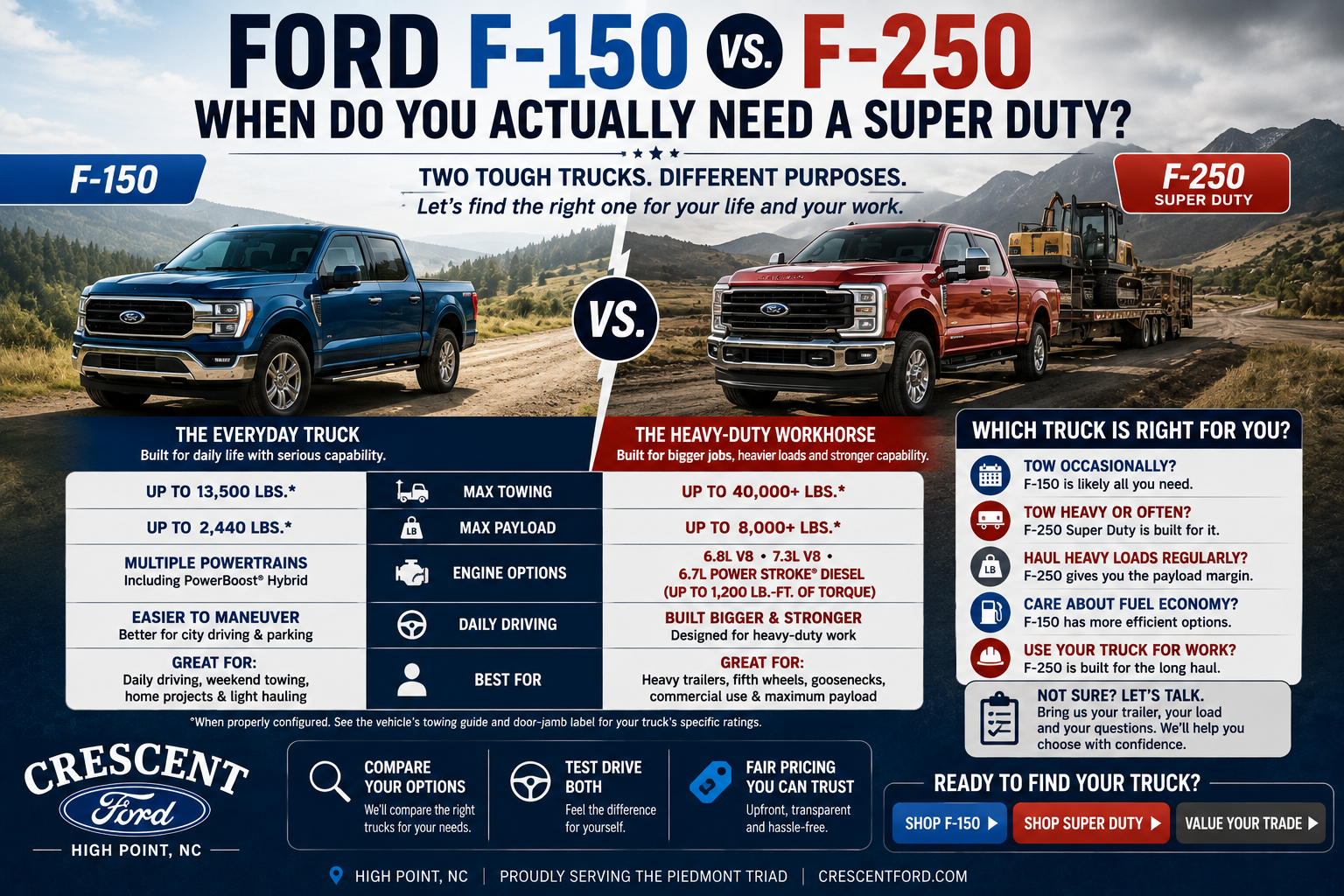
Ford F-150 vs. F-250 Super Duty comparison showing which Ford truck is best for everyday driving, towing, hauling and heavy-duty work

Ford F-150 vs. F-250: When Do You Actually Need a Super Duty?

Ford F-150 vs. F-250: When Do You Actually Need a Super Duty? You need a truck. Maybe you tow a camper. Maybe you've got a boat. Maybe you own a business. Maybe you're hauling equipment every week. And at some point while shopping Ford trucks, you arrive at the inevitable question: Do I need an F-250 — or is an F-150 enough truck? Here's the mistake we'd avoid: Buying an F-250 simply because it's "more truck." More capability isn't automatically better if you don't need it. An F-150 is easier to live with for many everyday truck owners and offers substantial towing and hauling capability when properly configured. An F-250 Super Duty is built for heavier work. So the real question isn't: Which truck is better? It's: What are you actually asking the truck to do? Let's figure that out. Ford F-150 vs. F-250: What's the Basic Difference? The Ford F-150 is a full-size light-duty pickup. The F-250 belongs to Ford's Super Duty family of heavy-duty pickups. That's the most important distinction. They're both Ford trucks. They can both tow. They can both haul. They can both be configured as extremely comfortable crew-cab daily drivers. But they're engineered around different levels of work. Think of it this way: F-150 Everyday truck that can do serious work. F-250 Super Duty Heavy-duty work truck that can also be an everyday vehicle. For a lot of buyers, that distinction tells us where to start. Shop Ford F-150 Trucks at Crescent Ford Shop Ford Super Duty Trucks F-150 vs. F-250 at a Glance If You Prioritize... Start With Everyday driving F-150 Occasional towing F-150 Light-to-moderate hauling F-150 Fuel economy F-150 Easier parking/maneuverability F-150 Heavy trailers F-250 Higher payload requirements F-250 Fifth-wheel/gooseneck towing F-250 Diesel torque F-250 Regular heavy-duty commercial use F-250 Notice we said: Start with. Not: Automatically buy. The actual truck needs to be matched to the actual load. When Is an F-150 Enough Truck? Probably more often than some shoppers expect. The modern F-150 can be configured for substantial towing and hauling capability. So if your truck life consists primarily of: Driving to work Home improvement projects Hauling furniture Landscaping supplies Bikes ATVs Occasional trailers A moderate-size boat A properly matched travel trailer Weekend projects you may not need to move into Super Duty territory. That's particularly true if the truck will spend significantly more time not towing than towing. If you tow your camper six weekends a year but commute in the truck 250 days a year, everyday drivability deserves a place in the decision. When Should You Start Looking at an F-250? We'd start moving the conversation toward Super Duty when the work becomes: heavier more frequent or closer to the F-150's limits. For example: Large travel trailers Fifth-wheel trailers Gooseneck trailers Heavy equipment Construction trailers Large enclosed trailers Heavy bed loads Commercial towing Regular towing through mountainous terrain Loads that push an F-150's payload limits There's another reason, too: Margin. Just because a properly configured F-150 can handle a particular trailer doesn't automatically mean that's the truck we'd recommend if you're going to tow that trailer every week. Sometimes stepping up gives you more appropriate capacity for the job you're actually doing. Don't Choose Between F-150 and F-250 Based on Trailer Weight Alone This may be the most important part of this entire article. A shopper comes in and says: "My camper weighs 8,000 pounds. Can an F-150 tow it?" We can't responsibly answer that from one number. We need to know more. Things such as: Loaded trailer weight Tongue weight Passengers Cargo in the truck Hitch equipment Truck configuration Engine Cab Bed Drivetrain Axle ratio Payload rating Gross Vehicle Weight Rating Gross Combined Weight Rating all matter. The advertised maximum towing number is not your truck's universal towing number. That's true for F-150. And it's true for F-250. You need to evaluate the specific truck you're considering. Payload May Decide F-150 vs. F-250 Before Towing Capacity Does This catches a lot of truck shoppers by surprise. They focus entirely on: "How much can it tow?" But sometimes the limiting factor isn't the trailer rating. It's payload. Payload includes weight carried by the truck. That can include: Driver Passengers Cargo Tools Equipment Accessories Hitch-related weight Trailer tongue or pin weight applied to the truck Imagine you're towing a camper. You've got: Two adults Three kids Coolers Camping gear A bed full of stuff and the trailer's tongue weight. All of that matters. This is one reason a truck that appears capable based solely on a headline tow rating may not be the right configuration once you look at the entire setup. How Do You Know Your Truck's Actual Payload? Look at the specific truck, not just a website comparison chart. Payload varies by configuration. Options add weight. Cab configuration matters. Drivetrain matters. Engine choice matters. Equipment matters. So two F-150s sitting next to each other can have different payload ratings. The same is true for two F-250s. When you're shopping for a truck specifically to tow or haul, tell us what you're carrying. We can help you look at the ratings for the actual truck rather than relying on a theoretical maximum. F-150 vs. F-250 for Towing a Travel Trailer This is probably one of the most common reasons people cross-shop these trucks. And there's no single travel-trailer weight where everyone should suddenly switch from F-150 to F-250. Why? Because travel trailers aren't loaded identically. Trucks aren't configured identically. And families don't pack identically. A lighter camper with a carefully matched F-150 can make perfect sense. As trailer size, tongue weight, passengers and cargo increase, F-250 starts becoming more compelling. Our advice: Shop using the trailer's realistic loaded weight — not just its empty or "dry" weight. The camper may leave the manufacturer at one weight. Then you add: Propane Batteries Water Food Clothing Chairs Grills Bikes Camping gear The truck needs to handle the way you actually travel. Do You Need an F-250 for a Fifth-Wheel Camper? This is where we'd start looking seriously at Super Duty. Fifth-wheel trailers transfer significant pin weight into the truck. That makes payload capacity extremely important. Ford Super Duty also offers configurations specifically designed around fifth-wheel and gooseneck towing. If you're shopping for a fifth-wheel camper, we'd recommend choosing the truck and trailer as a system rather than buying either one independently. Don't buy the camper and then ask: "Can my truck handle this?" And don't buy the truck without knowing what you're planning to tow. Match them from the beginning. What About a Gooseneck Trailer? Similar story. If you're regularly towing: Equipment trailers Horse trailers Agricultural trailers Commercial loads with a gooseneck setup, you're firmly in the territory where Super Duty deserves serious consideration. That doesn't automatically mean every buyer needs an F-350. But this is the type of work the Super Duty family is designed to handle. F-150 vs. F-250 Engines: A Very Different Approach The engine lineups help illustrate the difference between these trucks. The F-150 offers several powertrain choices designed to cover everything from everyday driving to towing, performance and hybrid use. Depending on configuration, the F-150 lineup offers EcoBoost engines, a 5.0L V8 and the PowerBoost Full Hybrid V6, among other performance-oriented configurations. Super Duty takes a different approach. For 2026, Ford offers engines including: 6.8L Gas V8 405 horsepower 445 lb.-ft. of torque 7.3L Gas V8 430 horsepower 485 lb.-ft. of torque 6.7L Power Stroke V8 Turbo Diesel 475 horsepower 1,050 lb.-ft. of torque High-Output 6.7L Power Stroke V8 Turbo Diesel 500 horsepower 1,200 lb.-ft. of torque Look at those torque numbers. That's what tells you what Super Duty is really about. Work. Do You Need the Diesel F-250? Not automatically. This is another place where shoppers sometimes jump straight to: "If I'm buying an F-250, I should get the diesel." Maybe. But don't assume that. Ford offers powerful gas engines in the Super Duty lineup for a reason. A gas F-250 may make plenty of sense if: You need Super Duty payload/capability. Your towing isn't extremely heavy. You don't accumulate huge towing mileage. You prefer a gas powertrain. The gas truck meets all your actual ratings. The Power Stroke becomes particularly compelling for buyers who want substantial torque and regularly perform heavy towing. Buy the engine for the job. Not the badge. F-150 vs. F-250 for Daily Driving Here's where F-150 has an important advantage for many people. The F-150 is generally the easier truck to live with when most of your driving isn't heavy-duty work. Think: Parking garages Grocery stores School pickup Restaurants Commuting Downtown areas An F-250 is larger and heavier because it is designed to do more demanding work. That's useful when you need it. It's unnecessary when you don't. If 95% of your truck's life will be commuting around High Point and Greensboro and 5% will be towing a relatively modest trailer, we'd start with F-150 and see whether a properly configured truck handles your needs. Is an F-250 Harder to Park? It can certainly require more attention. Exact dimensions vary by cab and bed configuration, but Super Duty is a substantial truck. If your daily routine involves: Tight parking decks Downtown parking Small garages School pickup lines Crowded shopping centers drive the exact configuration you're considering in those types of environments. A Crew Cab Super Duty with a long bed may be fantastic with a trailer attached. That doesn't mean you'll love navigating it through a cramped parking lot every afternoon. Is an F-250 More Comfortable Than an F-150? Don't assume that "bigger truck" automatically means "more comfortable truck." Both F-150 and Super Duty can be configured with extremely nice interiors. The bigger difference is what they're engineered to carry. A heavy-duty truck's suspension and chassis are designed around heavy-duty work. How a particular truck feels unloaded versus loaded can therefore be different. If you're buying an F-250 primarily as a personal vehicle, test-drive it unloaded. That's how you'll spend most of your time. F-150 vs. F-250 for Contractors Now the decision becomes more interesting. Suppose you're a contractor and your truck carries: Tools Toolboxes Equipment Materials Crew members Trailer tongue weight every day. Payload can add up surprisingly quickly. An F-150 may still be appropriate depending on the load. But if you're routinely loading the truck heavily or towing equipment, F-250 can provide capacity better suited to commercial work. Don't estimate your equipment weight. Know it. The difference between: "I carry some tools" and "My truck carries 1,200 pounds of tools and equipment every day" is enormous. F-150 vs. F-250 for Landscaping Again, look at the actual job. If you're a homeowner hauling mulch several times per year? F-150. If you're operating a landscaping business with equipment in the bed and a loaded trailer behind you five days per week? Start comparing Super Duty. Frequency matters. A truck that handles an occasional heavy task isn't necessarily the truck we'd choose for that same task every day. F-150 vs. F-250 for a Boat Boat weights vary tremendously. A smaller fishing boat and a large offshore boat aren't remotely the same towing job. You need to account for: Boat Trailer Fuel Batteries Gear Coolers Equipment Then look at the truck's specific towing and payload ratings. For many recreational boats, a properly configured F-150 may be plenty. As the boat and trailer get heavier, Super Duty becomes increasingly worth considering. F-150 vs. F-250 for a Horse Trailer This is another situation where we'd pay particularly close attention to loaded weight. The trailer itself is only part of the equation. Then you add: horses tack feed water equipment and other cargo. For larger horse trailers—particularly gooseneck configurations—Super Duty may be the more appropriate starting point. Again: Bring us the trailer information. That's more useful than telling us: "It's a horse trailer." What If the F-150 Can Technically Tow My Trailer? This is where we'd ask another question: How often are you towing it? Suppose you've verified that a particular F-150 configuration is properly rated for your loaded trailer and total setup. Great. Now: Tow it three weekends per year? F-150 may make perfect sense. Tow it three days per week? You may still want to compare F-250. There's a difference between: having enough rated capability and choosing the truck best suited to repeated heavy use. That doesn't mean you automatically need to move up. It means frequency belongs in the conversation. Don't Buy an F-250 Just for the Power Stroke We understand the appeal. The Power Stroke is a serious engine. The available High-Output 6.7L Power Stroke produces 1,200 lb.-ft. of torque. That's an incredible number. But if you don't tow anything heavier than a utility trailer twice a year? You probably don't need to build your entire vehicle purchase around that capability. There are plenty of reasons someone may simply want a diesel Super Duty. That's fine. Just distinguish: want from need. This article is about the second one. Don't Buy an F-150 Just Because It's Cheaper The opposite mistake is worse. If your trailer and load genuinely require Super Duty capability, don't try to make the F-150 work simply because you'd prefer the smaller truck or lower purchase price. Truck ratings aren't suggestions. If your actual use exceeds the capabilities of the F-150 configuration you're considering, move up. The right truck is the one properly rated for the work. Does F-250 Automatically Have More Payload Than Every F-150? Don't make comparisons based solely on the badge. Payload is vehicle-specific. Configuration matters tremendously. A heavily optioned crew-cab truck can have a different payload rating than a more basic configuration. That's why we're going to keep repeating this: Check the actual truck. Not: "an F-150." Not: "an F-250." The truck with the VIN you're considering. How Much Towing Capacity Do You Actually Need? Don't shop for the biggest number you can afford. Start with your load. Step 1: Determine realistic loaded trailer weight. Not just dry weight. Step 2: Determine tongue or pin weight. This matters for payload. Step 3: Account for passengers. Yes, people count. Step 4: Account for cargo. Everything you're carrying in the truck matters. Step 5: Look at the actual truck's ratings. Now compare configurations. This is a much safer and smarter shopping process than saying: "Give me whichever truck tows the most." Should You Leave Extra Towing Capacity? It's generally smart not to shop by trying to make every number land exactly on the truck's maximum rating. Real life changes. You add cargo. You add passengers. You buy equipment. Your camping setup gets heavier. Your next trailer may be larger. But there's also no universal rule that says every shopper must buy a truck with twice the capacity they actually need. The goal is: appropriate capability with reasonable room for the way you'll actually use the truck. What If You Plan to Buy a Bigger Camper Later? Tell us. This can absolutely change the recommendation. If your current camper fits comfortably within an F-150's capabilities but you're planning to move into a substantially larger fifth wheel in two years, buying the truck only for today's trailer may mean buying twice. On the other hand, don't buy an F-250 today for a hypothetical trailer you may never purchase. Be realistic about the plan. F-150 vs. F-250: What About Fuel Economy? If fuel cost is important and you don't need Super Duty capability, that's another reason to look carefully at F-150. The F-150 offers powertrains designed around a wider mix of everyday driving needs, including the available PowerBoost hybrid. Super Duty is designed around heavy-duty capability. Fuel economy shouldn't override the truck's ability to safely perform the job. But if both trucks can comfortably handle your actual needs, operating cost becomes a legitimate factor in deciding which one makes more sense. RELATED READING Ford F-150 Engines Explained: Which Engine Is Right for You? What About F-150 vs. F-250 Price? Don't compare only the sticker prices. Compare the trucks you would actually buy. Maybe you're considering a heavily equipped F-150. Maybe the F-250 you're considering has a diesel engine. Maybe one has four-wheel drive and the other doesn't. Maybe the trims are completely different. Then factor in: Purchase price Financing Insurance Fuel Maintenance Tires Registration How long you plan to keep it And most importantly: Whether you're paying for capability you'll actually use. RELATED READING What Does “Out-the-Door Price” Mean When Buying a Car in NC? Should You Buy a Used F-250 Instead of a New F-150? Sometimes this comparison comes up when budgets overlap. A used F-250 may offer more heavy-duty capability for a similar purchase price to a newer F-150. But don't compare only price and tow ratings. Consider: Mileage Previous use Maintenance history Engine Equipment Condition Warranty Tires How you'll use the truck A used diesel Super Duty that spent its life towing commercially is a very different purchase from a lightly used personal truck. Buy the vehicle, not just the specification sheet. Shop Used Ford Trucks at Crescent Ford What About Your Trade? If you're moving from an F-150 into an F-250 because your towing needs have increased, your current truck's equity can make a significant difference in the transaction. Before deciding what the next truck needs to cost: Find out what your current truck is worth. Find Out What Your Truck Is Worth RELATED READING What Is My Car Worth in High Point, NC? How Trade-In Appraisals Actually Work If you still have a loan: Can You Trade In a Car You Still Owe Money On? The Simplest Way to Decide Between F-150 and F-250 Ask yourself these questions. 1. What is the heaviest thing I'll actually tow? Get the real loaded weight. 2. What's the tongue or pin weight? Don't overlook payload. 3. How much weight will be in the truck? People, tools, cargo and equipment count. 4. How often will I tow? Twice a year and five days per week are very different use cases. 5. Will I tow a fifth wheel or gooseneck? That can push the conversation toward Super Duty quickly. 6. Is the truck primarily a daily driver? If yes, F-150's everyday advantages deserve more weight. 7. Do I genuinely need diesel torque? If not, don't assume diesel is automatically the right choice. 8. Are my needs likely to change soon? Consider the trailer or workload you realistically expect during the time you'll own the truck. Once you answer those questions, the decision usually becomes much clearer. When We'd Recommend an F-150 We'd start with F-150 if you tell us: "This is my daily driver." "I tow occasionally." "I need a truck bed but don't haul extremely heavy loads." "I have a boat or camper that fits comfortably within the ratings of the configuration I'm considering." "I want substantial truck capability without moving into a heavy-duty truck." For an enormous number of truck owners, F-150 is the right answer. And buying more truck won't necessarily make ownership better. Browse Ford F-150 Inventory When We'd Recommend an F-250 Super Duty We'd start moving toward F-250 when you tell us: "I tow heavy trailers regularly." "Payload is becoming an issue." "I'm buying a fifth wheel." "I'm towing a gooseneck." "I carry substantial tools or equipment every day." "My business depends on this truck." "I want the Power Stroke because my workload actually benefits from diesel torque." "I'm near the limits of the F-150 configuration I'd otherwise buy." That's what Super Duty is for. Browse Ford F-250 Super Duty Trucks Should You Test Drive an F-150 and F-250 Back-to-Back? Yes. Especially if your towing needs could realistically be handled by either. Drive the F-150. Then immediately drive the F-250. Pay attention to: Ride Steering Visibility Turning Braking feel Seating position Parking Acceleration Overall size If the truck is going to be your daily driver, don't evaluate it only for the ten days per year your camper is attached. Evaluate the other 355 days, too. And if you're buying specifically for towing, bring us the specifications for the trailer. That information is more useful than almost anything else you can tell us. Schedule an F-150 vs. F-250 Test Drive Drive an F-150 and Super Duty back-to-back and let us help compare the specific truck ratings with what you plan to tow or haul. F-150 vs. F-250: When Do You Actually Need the Super Duty? Here's the simplest answer. Choose the Ford F-150 when: You want a truck that's easy to live with every day. Your towing and payload requirements comfortably fit the specific F-150 configuration. You tow occasionally rather than constantly. You don't need fifth-wheel or gooseneck capability. You want more powertrain choices geared toward everyday use. For most personal-use truck buyers, we'd start here. Choose the Ford F-250 Super Duty when: Your trailer is getting heavier. Your payload requirements are substantial. You're towing frequently. You're moving into fifth-wheel or gooseneck territory. Your truck is an essential work tool. You need heavy-duty capability or diesel torque. Or the numbers show you're simply asking too much of an F-150. That's when moving to Super Duty makes sense. Compare Ford F-150 and F-250 Trucks in High Point, NC The goal isn't to sell you the biggest truck. It's to put you in enough truck. If an F-150 comfortably handles everything you need it to do, that's probably the better choice. If your towing, payload or workload genuinely requires Super Duty capability, don't try to squeeze the job into a light-duty truck. And if you're somewhere in the middle? That's exactly when you should compare them in person. For truck shoppers in High Point, Greensboro, Winston-Salem, Kernersville, Thomasville, Lexington, Trinity and throughout the Piedmont Triad, Crescent Ford can help you compare the actual trucks you're considering. Bring us: Your trailer weight. Your camper information. Your equipment. Your typical passenger/cargo load. Then we can look at the ratings on the specific trucks. Because when it comes to towing: The badge on the tailgate isn't enough information. Shop Ford F-150 Trucks at Crescent Ford Shop Ford Super Duty Trucks Schedule a Test Drive Value Your Trade Explore Financing Options Frequently Asked Questions About Ford F-150 vs. F-250 What is the main difference between an F-150 and F-250? The F-150 is Ford's full-size light-duty pickup, while the F-250 is part of the heavy-duty Super Duty lineup. The F-250 is engineered for higher levels of towing, payload and sustained heavy-duty work. Do I need an F-250 to tow a camper? Not necessarily. Many travel trailers can be appropriately matched with certain F-150 configurations. The decision depends on the trailer's actual loaded weight, tongue weight, passengers, cargo and the ratings of the specific truck. Larger trailers and fifth wheels can make an F-250 or another Super Duty more appropriate. Is an F-250 better for towing than an F-150? The F-250 is designed for heavier-duty towing, but that doesn't mean it is necessary for every trailer. A properly configured F-150 can provide substantial towing capability. Match the specific truck to the actual trailer rather than choosing based only on model name. Can an F-150 tow a travel trailer? Yes, depending on the F-150 configuration and the trailer. Use realistic loaded trailer weight rather than only the trailer's dry weight, and account for tongue weight, passengers and cargo when evaluating the truck. Do I need an F-250 for a fifth wheel? An F-250 may be appropriate for certain fifth-wheel trailers, but fifth-wheel towing requires careful attention to pin weight, payload and the specific truck's ratings. Depending on the trailer, an F-350 may also need to be considered. Is payload or towing capacity more important? Both matter. In some towing situations, payload becomes the limiting factor before the maximum trailer rating does because passengers, cargo and trailer tongue or pin weight all place weight on the truck. Does every F-250 have more payload than every F-150? Payload varies by configuration, so don't make a purchase based solely on the model badge. Check the ratings of the specific vehicle you're considering. Is an F-250 a good daily driver? It can be, especially for someone who also needs its heavy-duty capability. However, shoppers who don't need that capability may find an F-150 easier to maneuver and better suited to everyday use. A back-to-back test drive is worthwhile. Does the F-250 have a diesel engine? Ford offers the 6.7L Power Stroke V8 Turbo Diesel and a High-Output version in the 2026 Super Duty lineup, along with 6.8L and 7.3L gas V8 engines. How much torque does the 2026 F-250 diesel have? Ford rates the 2026 6.7L Power Stroke V8 Turbo Diesel at 1,050 lb.-ft. of torque and the available High-Output version at 1,200 lb.-ft. of torque. Do I need a diesel F-250 for towing? Not necessarily. Ford's gas Super Duty engines may provide sufficient capability depending on your trailer and usage. Diesel becomes particularly compelling for shoppers who regularly perform heavier towing and can benefit from its substantial torque. Is an F-250 better for contractors? It can be when tools, materials, passengers and trailers create substantial payload or towing requirements. Contractors with lighter loads may still be well served by an appropriately configured F-150. Should I buy an F-250 if my trailer is close to my F-150's limits? It's worth comparing. You need to consider all applicable ratings—not just maximum trailer weight—and your real passenger and cargo load. If your normal use puts the F-150 configuration near its limits, an appropriately configured Super Duty may be a better fit. How do I know exactly how much a Ford truck can tow? Use the specifications for the specific truck configuration and follow Ford's towing guidance. Engine, drivetrain, cab, wheelbase, axle ratio, equipment and other factors can affect ratings. Don't assume a headline maximum applies to every F-150 or F-250. Should I test drive an F-150 and F-250 before deciding? Yes. If both trucks can properly handle your intended workload, a back-to-back test drive can help you evaluate the differences in ride, maneuverability, size and everyday usability.

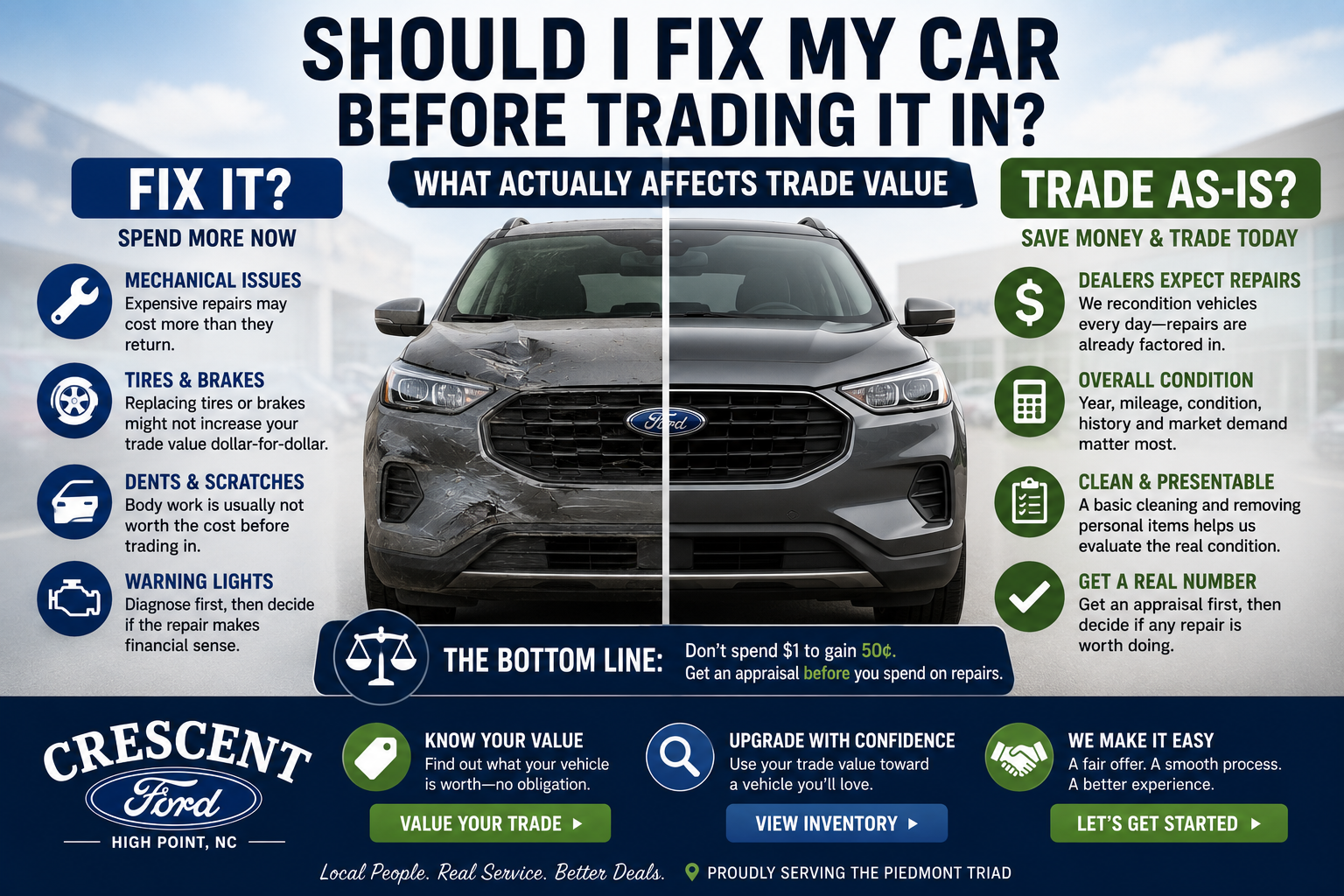
Should I fix my car before trading it in? Comparison of repairs versus trading as-is and what actually affects trade-in value

Should I Fix My Car Before Trading It In? What Affects Trade Value

Should I Fix My Car Before Trading It In? What Actually Affects Trade Value Your check-engine light is on. There's a scratch down the passenger door. The tires are getting close to needing replacement. And you've already decided you're probably trading the car. So now you're wondering: Should I fix all of this before I take it to the dealership? Usually, the answer isn't: "Fix everything." It's: "Figure out whether the repair will actually return what you're about to spend." That's an important distinction. Spending $2,000 repairing your vehicle doesn't automatically increase its trade-in value by $2,000. Sometimes fixing something before an appraisal makes sense. Sometimes cleaning the vehicle and replacing a $20 part is worthwhile. And sometimes the smartest financial decision is to leave the vehicle exactly as it is and let the dealership account for the repair when determining its value. Here's how to tell the difference. Do You Have to Fix Your Car Before Trading It In? No. You can trade in a vehicle that has: Mechanical problems Warning lights Dents Scratches Worn tires Interior damage Accident history High mileage Cosmetic wear A vehicle does not have to be in perfect condition to be traded. The condition will generally affect what it's worth, but that's very different from saying you need to repair everything before bringing it in. In fact, if you're planning to trade soon, making expensive repairs solely to increase the appraisal can sometimes cost you more than they return. Before authorizing a major repair, it may make sense to get the vehicle appraised first. Find Out What Your Vehicle Is Worth Before spending money on repairs, get an estimate of your vehicle's current trade value. You may find that trading it as-is makes more financial sense. The Most Important Rule: Don't Spend $1 to Gain 50 Cents This is the basic math behind deciding whether to repair a trade-in. Imagine your vehicle needs $1,500 worth of bodywork. You might naturally assume: "If I fix it, my car will be worth $1,500 more." Not necessarily. A dealership doesn't evaluate your vehicle by taking a perfect-condition value and subtracting exactly what a retail repair shop would charge you. Dealers consider what the vehicle is worth in its current condition, what it may cost to recondition, how desirable that vehicle is in the current market and what they reasonably expect to do with it. A dealership may also be able to complete certain repairs differently or at a different cost than you can as a retail customer. So if you spend $1,500 repairing something that only changes the appraisal by $800? You're $700 behind. That's why we'd rather have you get an appraisal before making a major repair solely for trade-in purposes. What Actually Determines Your Car's Trade-In Value? The dent you're worried about may not even be the biggest factor affecting your vehicle's value. An appraisal considers the vehicle as a whole. Some of the biggest factors include: Year, Make and Model This establishes the basic vehicle we're evaluating. A three-year-old F-150 is naturally being evaluated in a different market than a ten-year-old compact sedan. Mileage Mileage matters because it gives buyers and dealers an indication of how much use a vehicle has experienced. But there's no magic number where your car suddenly becomes worthless. A well-maintained higher-mileage vehicle can still have significant value. Likewise, unusually low mileage doesn't automatically erase condition issues or accident history. Mileage is one part of the appraisal. Overall Condition This includes much more than whether the car looks shiny. An appraiser may consider: Exterior condition Interior condition Tires Mechanical operation Warning lights Glass Wheels Upholstery Odors Evidence of previous damage General wear The question isn't: "Is this vehicle perfect?" It's: "What condition is this vehicle in relative to its age and mileage?" A six-year-old vehicle isn't expected to look like it rolled off the showroom floor yesterday. Vehicle History Accident and damage history can affect market value. So can how the vehicle was repaired. A professionally repaired minor incident isn't necessarily treated the same as significant structural damage. And trying to repair visible damage immediately before trading the vehicle doesn't erase the underlying vehicle history. Equipment and Configuration Two vehicles from the same model year can have very different values. Things such as: Trim level Engine Drivetrain Factory options Cab configuration Bed length Seating configuration Popular equipment can all affect desirability. This is especially noticeable with trucks and SUVs. Current Market Demand This one surprises some shoppers. Your car's value isn't determined in isolation. It's also influenced by: What people are currently willing to pay for vehicles like yours. Supply and demand matter. A particular model, configuration or price point that's selling quickly may be worth more than another vehicle with similar age and mileage that has less market demand. This is also why an online trade estimate from several months ago isn't necessarily your vehicle's value today. RELATED READING What Is My Car Worth in High Point, NC? How Trade-In Appraisals Actually Work Which Repairs Should You Consider Before Trading In? Let's get practical. Some inexpensive fixes can make sense. The key word is: Inexpensive. Replace Burned-Out Bulbs If you have a simple burned-out exterior bulb that's inexpensive and easy to replace, taking care of it can make sense. There's little reason to present a vehicle with an obvious small issue when fixing it costs very little. But if what appears to be a burned-out light is actually an expensive LED assembly or electrical problem? Different story. Get the cost before automatically repairing it. Replace Missing Inexpensive Items Is a floor mat missing? Did a cheap plastic trim piece fall off? Is there an inexpensive replacement part that takes five minutes to install? Those can be reasonable fixes. But again: Don't turn preparing your trade into a restoration project. Remove Your Stuff This one is free. Empty: Door pockets Center console Glove box Cargo area Truck bed Seat-back pockets Take out the collection of water bottles, receipts, kid toys, work equipment and whatever has been living under the passenger seat since 2023. You're not changing the vehicle's mechanical value. You're simply making it easier to evaluate. Give It a Basic Cleaning Yes, clean your vehicle. No, you probably don't need a $300 professional detail solely because you're trading it. Vacuum it. Throw away trash. Wipe down obvious dirt. Wash the exterior if it's filthy. That's enough in most cases. Don't try to make the vehicle look "new." Make it look cared for. There's a difference. Should You Detail Your Car Before Trading It In? A basic cleanup? Yes. An expensive professional detail? Usually not necessary solely for the appraisal. If your interior is unusually dirty, stained or full of pet hair, a more thorough cleaning could make sense. But don't assume every dollar spent detailing will come back in the appraisal. A dealer is evaluating the underlying vehicle. We know the difference between: a clean used car and a used car that was professionally detailed yesterday. A detail doesn't erase: Mechanical issues Accident history Worn tires High mileage Body damage Warning lights Clean it enough that its actual condition is easy to see. Then stop. Should You Fix Dents Before Trading In? Usually, we'd get the appraisal first. Small door dings and minor dents are common on used vehicles. If you already have access to inexpensive paintless dent repair and the damage is minor, you could ask what it would cost. But don't automatically schedule hundreds or thousands of dollars of bodywork because you're afraid a dent will destroy your trade value. Get two numbers: What will the repair cost me? and What is the vehicle worth as-is? Then make the decision. Should You Fix Scratches Before Trading In? It depends on the scratch. Light surface scratch? A simple polish or touch-up may help its appearance. Deep scratch through the paint? Don't automatically pay for body and paint work. Multiple panels scratched or damaged? Definitely get an appraisal before spending significant money. And please don't try to disguise major damage with a bottle of touch-up paint five minutes before arriving. It usually looks worse. Should You Replace the Tires Before Trading In? This is one of the biggest areas where shoppers can spend a lot of money right before trading. A set of tires can easily become a significant expense. And while worn tires absolutely can affect an appraisal, that doesn't automatically mean you should replace all four yourself. Suppose your vehicle needs tires. You spend $1,000 replacing them. Will the trade value increase by exactly $1,000? Don't assume it will. If you're trading the vehicle soon, get it appraised with the current tires first. Then you'll have actual information to work with. One exception: If a tire is unsafe to drive on, safety comes first. That's no longer simply a trade-value question. Should You Replace a Cracked Windshield Before Trading In? Again: Get the cost first. A windshield issue can affect the appraisal because the vehicle may need to be repaired before resale. But whether you should handle it yourself depends on: Size and location of the damage Whether repair is possible Replacement cost Insurance coverage Vehicle technology that may require calibration How soon you're trading Modern windshields can be more complicated than they appear because vehicles may have cameras or driver-assistance equipment associated with the windshield area. Don't assume it's a cheap piece of glass. Should You Fix a Check-Engine Light Before Trading In? This is where we'd separate: diagnosing from repairing. If your check-engine light is on and you have no idea why, knowing the cause can be useful. A loose or faulty component and a major mechanical problem are very different situations. But once you know the repair cost, you still have to ask: Does fixing this make financial sense if I'm trading the vehicle? If the repair is inexpensive? Maybe. If you receive a $4,000 repair estimate and were already planning to replace the vehicle? Get a trade appraisal before authorizing the work. Important: Don't clear warning codes simply to make the dashboard light disappear before the appraisal. The goal should be understanding the vehicle's condition — not hiding it. Should You Fix the Air Conditioning Before Trading In? North Carolina in August makes a broken air conditioner pretty noticeable. And yes, a non-functioning A/C system can affect value. But A/C repairs can range from relatively minor to very expensive. Before approving a major repair, compare: Repair cost against the vehicle's as-is trade value. If you're keeping the car for another year, repairing the A/C may be worthwhile because you'll benefit from using it. If you're trading it tomorrow? That's a different calculation. What About Mechanical Repairs? This is where we'd be especially cautious about spending money solely to improve trade value. Examples include: Transmission repairs Engine repairs Suspension work Major electrical repairs A/C system repairs Four-wheel-drive system repairs Significant oil or coolant leaks These issues can absolutely reduce a vehicle's value. But that doesn't mean paying retail for every repair is automatically your best option. Get the vehicle appraised as-is first. Then compare. What If My Car Needs Several Repairs? This is actually one of the situations where trading can make the most sense. Suppose your car needs: $1,200 in tires $1,500 in suspension work $800 in A/C repairs and you're approaching another major service interval. You could spend thousands getting everything caught up. But if you were already planning to replace the vehicle within six months? Ask yourself: Am I repairing this car because I want to keep it, or am I repairing it because I think I have to before trading it? Those are completely different decisions. Before writing checks to three repair shops, find out what someone will actually give you for the vehicle today. Will a Dealership Take a Car That Needs Major Repairs? Potentially, yes. A vehicle doesn't necessarily have to be retail-ready for a dealership to take it as a trade. Dealers handle vehicles differently depending on: Condition Age Mileage Marketability Reconditioning needs Some trades may eventually be offered for retail sale. Others may not. You don't need to transform your vehicle into something you'd expect to see on a used-car lot before bringing it in. That's the dealership's decision after it owns the vehicle. Should I Repair Accident Damage Before Trading My Car? Be particularly careful here. If your vehicle has accident damage, repairing it doesn't necessarily restore its value to what the same vehicle with no accident history would be worth. The history and the physical condition are separate considerations. If the repair is being handled through an active insurance claim, that's another situation entirely. But if you're thinking about paying thousands out of pocket solely because you plan to trade? Get an appraisal first. You want to know whether the difference in trade value justifies the repair expense. Does a Previous Accident Ruin Your Trade-In Value? Not necessarily. Accident history can affect value, but the amount depends on the circumstances. Consider: Severity Type of damage Quality of repair Structural involvement Vehicle age Mileage Current condition Market demand A minor accident years ago on an older vehicle isn't necessarily treated the same as recent major structural damage on a nearly new vehicle. This is why generic online advice such as: "An accident lowers your car by exactly X%" isn't particularly useful. Your actual vehicle needs to be evaluated. Does Regular Maintenance Increase Trade-In Value? Maintenance matters, but think of it more as protecting value than creating value. Changing your oil regularly doesn't suddenly add thousands of dollars to the appraisal. But poor maintenance can absolutely create problems that reduce value. If you have maintenance records, they're worth bringing. They can help document how the vehicle has been cared for. But don't schedule a giant list of routine maintenance immediately before trading solely because you think every dollar will be added to the appraisal. Should I Get an Oil Change Before Trading In? If the vehicle is due and you're still driving it? Sure. If you're trading it tomorrow and wondering whether a fresh oil change will significantly increase the offer? Probably not. A $70 oil change doesn't automatically create $70 in additional trade value. If the vehicle needs basic maintenance for safe continued operation, that's different. But don't confuse: maintaining a vehicle with preparing a vehicle for appraisal. Does Having Two Keys Increase Trade-In Value? Bring both keys if you have them. Modern vehicle keys and key fobs can be expensive to replace. Having all original keys, remotes and relevant accessories makes the vehicle more complete. The same applies to things such as: Owner's manuals Removable cargo accessories Factory equipment Wheel-lock keys Headphones/remotes for entertainment systems Charging equipment for EVs or plug-in hybrids Don't buy a second key solely because you're trading. But if you already have it? Bring it. Should I Remove Aftermarket Modifications Before Trading? This depends heavily on the modification. You may love: Oversized wheels Suspension modifications Custom exhaust Performance tuning Aftermarket lighting Audio upgrades Cosmetic accessories The next buyer may not. Aftermarket modifications don't automatically increase trade value by what you paid for them. In some cases, they may reduce the number of potential buyers for the vehicle. If you still have the original factory parts and the modification is easily reversible, ask whether returning the vehicle to stock makes sense. But don't spend a fortune undoing modifications without first getting an appraisal. Does a Clean Car Get a Better Trade-In Offer? Potentially — but not because we're fooled by Armor All. A reasonably clean vehicle allows the appraiser to evaluate the condition more easily. It can also indicate that the vehicle has been cared for. But we're still going to see: the scratch the dent the worn tire and the warning light. So yes: Clean it. But don't spend all weekend with a toothbrush cleaning the air vents because you're convinced it'll add $500. It won't. What Should You Do Before Getting Your Car Appraised? Here's the preparation we'd actually recommend. 1. Remove personal belongings. Empty the vehicle. 2. Give it a reasonable cleaning. Vacuum, wipe it down and wash it if needed. 3. Find both keys. Bring them if you have them. 4. Gather maintenance records. Especially if you've kept good documentation. 5. Know your payoff if you still have a loan. You don't need to pay the vehicle off before trading it. 6. Don't make expensive repairs yet. Get the appraisal first. 7. Be honest about known issues. It makes the process much easier. That's it. You don't need to prepare your car for the Pebble Beach Concours d'Elegance. You're trading it. Get Your Trade-In Value What If You Still Owe Money on a Car That Needs Repairs? You can potentially trade it. The fact that your vehicle: has a loan and needs repairs doesn't automatically prevent you from trading. Those are separate parts of the transaction. The dealership evaluates the vehicle's trade value. Then your current lender provides a payoff amount. If the vehicle is worth more than the payoff, you have positive equity. If the payoff is higher than the trade value, you have negative equity. The repair issue may affect the vehicle's value, but it doesn't change how equity fundamentally works. RELATED READING Can You Trade In a Car You Still Owe Money On? Should You Repair Your Car or Trade It? This is actually a bigger question than: "Will fixing this increase my trade value?" Maybe your vehicle needs a $2,500 repair. If the repair gives you another three reliable years with a vehicle you like and that's otherwise paid for? Repairing it could make perfect sense. But if: You've already outgrown the vehicle. You don't trust it anymore. Repairs are becoming frequent. You were planning to replace it soon anyway. Your needs have changed. then putting thousands into it immediately before trading may not make sense. The right decision isn't based solely on what the repair costs. It's based on: What does keeping the vehicle cost me? versus What does replacing it cost me? How to Decide Whether a Repair Is Worth Doing Before a Trade Here's a simple process. Step 1: Get the repair estimate. Find out what the issue actually costs to fix. Step 2: Get the vehicle appraised as-is. Now you know what the vehicle is worth without spending the money. Step 3: Ask whether repairing it would materially change the appraisal. Don't guess. Ask. Step 4: Compare the numbers. Suppose: Current trade value: $12,000 Repair cost: $2,000 Estimated value after repair: $13,000 Spending $2,000 to potentially gain $1,000 doesn't make much financial sense. But suppose: Repair cost: $200 and the issue materially affects the vehicle's usability or marketability. That could be a very different calculation. Use the numbers, not emotion. Don't Confuse Trade Value With What You Owe This is another common mistake. Suppose you owe: $20,000 on your vehicle. That doesn't mean it's worth $20,000. And spending $2,000 repairing it doesn't automatically mean it becomes worth $22,000. Your loan balance and your vehicle's market value are independent. This is why knowing both numbers before deciding what to do is so important. What If an Online Trade Tool Doesn't Know My Car Needs Repairs? An online valuation is a starting point. Your final appraisal requires evaluating the actual vehicle. That's where condition becomes much more specific. Two vehicles can have: Same year Same model Same trim Same mileage and still receive different appraisals because one needs substantially more reconditioning than the other. Use the online estimate to start the conversation. Then let the actual vehicle tell the rest of the story. Value Your Trade Online Should You Fix Your Car Before Selling It Privately? This can be different from trading. A private buyer generally expects a vehicle they can immediately use and may be less comfortable buying something with an obvious mechanical problem. That means certain repairs can have more value when you're trying to sell directly to another consumer. But private selling also means handling: Advertising Messages Test drives Negotiation Payment Paperwork Potential no-shows Trading is usually simpler. So when comparing private-sale value with trade value, don't compare only the two dollar amounts. Consider the cost, repairs, time and effort required to actually achieve the private-sale price. Should You Get Multiple Trade-In Appraisals? You can. But make sure you're comparing actual offers based on the vehicle's real condition. An online estimate generated without someone inspecting your car isn't necessarily the same thing as an appraisal after the vehicle has been evaluated. And make sure you're comparing the whole transaction if you're simultaneously buying another vehicle. A dealership giving you $1,000 more for your trade isn't necessarily giving you a $1,000 better overall deal if another part of the transaction costs more. RELATED READING What Does “Out-the-Door Price” Mean When Buying a Car in NC? When Should You Definitely NOT Repair Your Car Before Trading It? We'd be very cautious about making an expensive repair solely for trade value when: You're trading immediately. The repair costs thousands. You're assuming you'll recover 100% of the cost. You haven't gotten an appraisal yet. The vehicle has several other significant issues. You're trying to erase an accident history that will still exist. You're replacing tires solely because you think you'll get every dollar back. You're repairing something the dealership may handle more economically. There's a very easy way to avoid guessing: Appraise first. Repair second — if the numbers actually justify it. When Might Fixing Something Before Trading Make Sense? Consider taking care of an issue when: The repair is inexpensive. The fix is simple. It materially improves usability. It removes an obvious problem. You're still going to drive the vehicle for a while. Safety requires the repair. You know the repair meaningfully improves the vehicle's value relative to its cost. The key isn't whether the vehicle has a problem. The key is: What's the return on fixing it? Trading a Car That Needs Repairs in High Point, NC If you're in High Point, Greensboro, Winston-Salem, Kernersville, Thomasville, Lexington, Trinity or elsewhere around the Piedmont Triad and you're thinking about replacing a vehicle that needs work, you don't need to fix everything before finding out what it's worth. Bring it as-is. Let us evaluate it. Then you'll have a real number to work with. Maybe fixing the vehicle makes sense. Maybe trading it makes more sense. And maybe the difference isn't nearly as large as you expected. You won't know until you have the appraisal. Find Out What Your Car Is Worth at Crescent Ford Shop New Ford Vehicles Shop Used Vehicles Explore Financing Options Frequently Asked Questions About Fixing a Car Before Trading It In Should I fix my car before trading it in? Not necessarily. Small, inexpensive repairs may make sense, but expensive repairs don't automatically increase your trade value by the amount you spend. Consider getting an appraisal in the vehicle's current condition before making major repairs solely for trade-in purposes. Can I trade in a car that needs repairs? Yes. Dealerships can evaluate vehicles with mechanical, cosmetic and other condition issues. The needed repairs may affect the appraisal, but the vehicle doesn't have to be perfect to be traded. Should I fix a check-engine light before trading my car? Consider diagnosing the issue first so you understand what you're dealing with. If the repair is expensive and you're already planning to trade, get an appraisal before authorizing the work. Don't clear codes simply to hide a known problem. Should I replace my tires before trading in my car? Not automatically. Worn tires can affect value, but a new set may cost more than the increase you'd receive in trade value. Get the vehicle appraised with its current tires before replacing them solely for a trade. Should I detail my car before trading it in? A basic cleaning is worthwhile. Remove trash and personal belongings, vacuum the interior and wash the vehicle if needed. An expensive professional detail usually isn't necessary solely for a trade appraisal. Should I fix dents and scratches before trading my car? Minor cosmetic issues don't always justify professional bodywork before a trade. Get a repair estimate and an as-is appraisal before spending significant money. Will a cracked windshield lower my trade-in value? It can. The effect depends on the damage and replacement requirements. Modern vehicles may also require camera or driver-assistance-system calibration after windshield replacement, so get an accurate repair estimate before deciding. Does a previous accident affect trade-in value? It can. The impact depends on factors such as severity, repair quality, structural damage, vehicle age, mileage and current market demand. Repairing cosmetic damage doesn't necessarily erase the effect of accident history. Does high mileage lower trade-in value? Mileage is one factor used in an appraisal. Higher mileage can affect value, but age, condition, equipment, history and current market demand also matter. Do maintenance records help trade-in value? They can help document that a vehicle has been properly maintained. Maintenance is generally better viewed as protecting the vehicle's condition and value over time rather than creating a dollar-for-dollar increase at appraisal. Should I change the oil before trading in my car? If it's due and you're continuing to drive the vehicle, normal maintenance makes sense. But a fresh oil change immediately before an appraisal generally shouldn't be expected to increase the trade offer dollar-for-dollar. Should I bring both keys when trading in my car? Yes, if you have them. Modern replacement keys can be expensive, so bring all keys, remotes and original equipment that belongs with the vehicle. Is it better to repair my car or trade it in? That depends on the repair cost, current vehicle value, how long you plan to keep it and the cost of replacing it. If you're already planning to replace the vehicle soon, get an as-is appraisal before spending thousands on repairs. Can I trade in a car with a loan and mechanical problems? Potentially, yes. The dealership determines the vehicle's value based partly on its condition, while your lender provides the payoff. The difference between those two numbers determines whether you have positive or negative equity. What's the easiest way to know whether a repair is worth doing before trading? Get the repair estimate and an as-is trade appraisal. Then compare how much the repair costs with how much it is reasonably expected to change the vehicle's value. That takes the guesswork out of the decision.