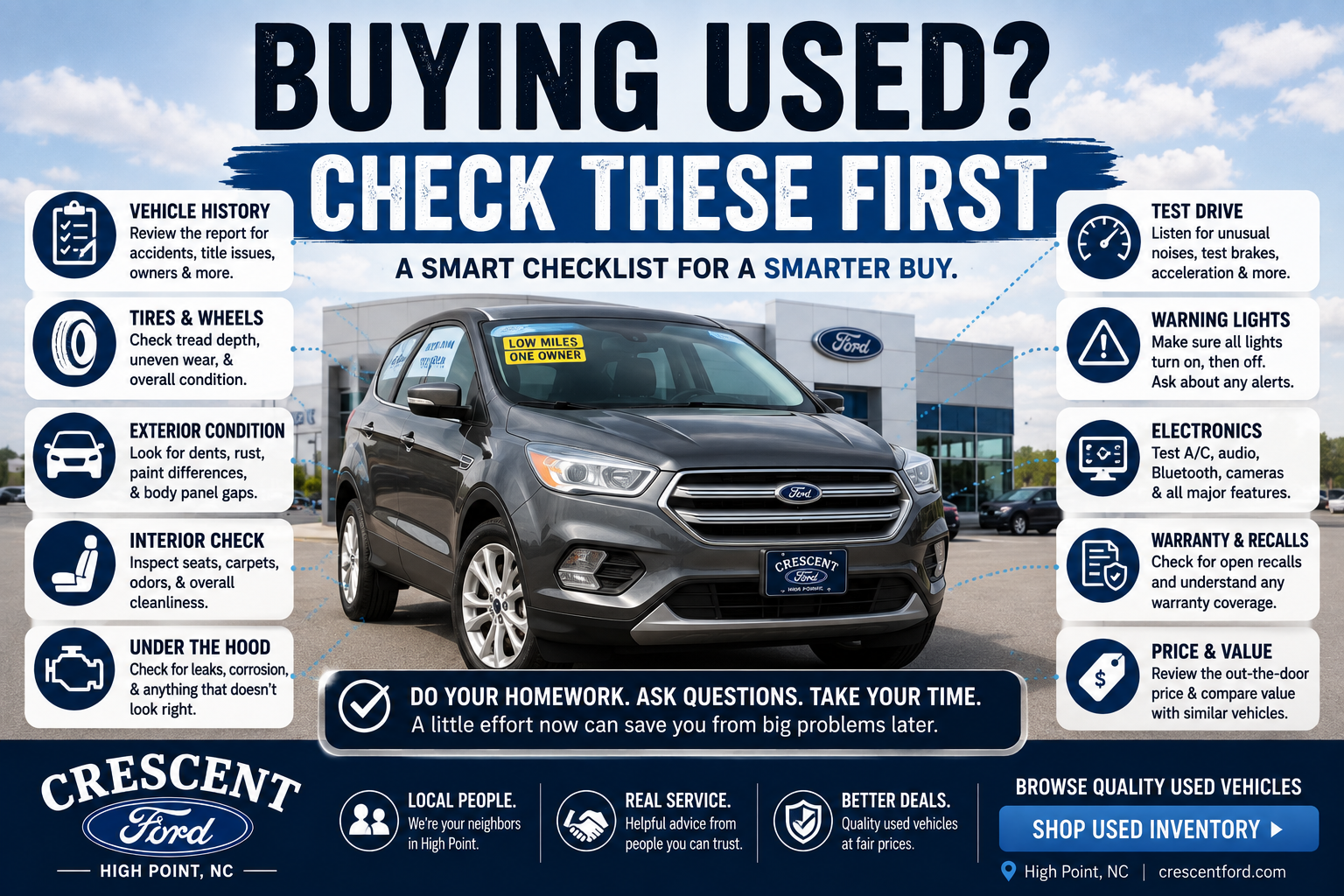
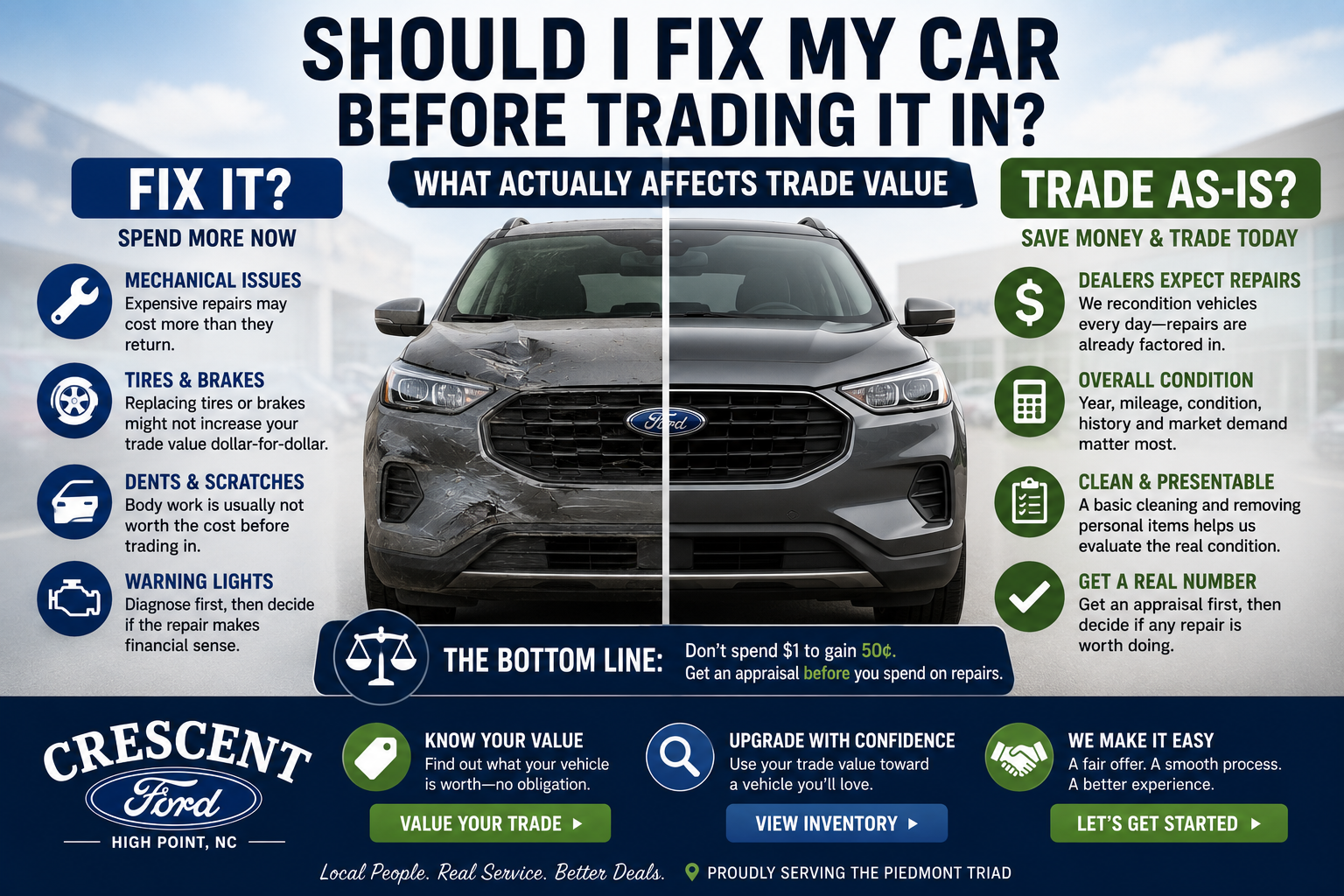
Buying a Used Car in High Point, NC: What to Check Before You Buy You've found a used car that looks promising. The mileage is reasonable. The pictures look good. The price fits your budget. So...what now? Buying used can be a great way to get more vehicle for your money, but there's one major difference between shopping new and used: No two used vehicles are exactly alike. Two vehicles can be the same year, make, model and trim with nearly identical mileage—and still be very different purchases. One may have been meticulously maintained. The other may have spent the last three years surviving teenagers, potholes and an owner who considered an oil-change reminder more of a suggestion. That's why shopping for a used vehicle isn't just about finding the right model. You're evaluating the individual vehicle. If you're shopping for a used car, truck or SUV in High Point or elsewhere around the Piedmont Triad, here's what we'd check before you buy. Start With the Right Used Vehicle—Then Inspect the Individual One Before worrying about scratches or tire tread, make sure you're looking at a vehicle that actually fits your needs. Ask yourself: How many people do I regularly carry? How much cargo space do I need? How many miles will I drive each year? Do I need AWD or 4x4? Do I tow? What's my realistic purchase budget? How much can I comfortably spend on fuel? What will insurance cost? Which features actually matter to me? There's no point finding a pristine used F-150 if what your life really needs is a compact SUV. And there's no point buying a small crossover because the price looks great if you'll immediately wish you had a third row. Browse Used Cars, Trucks & SUVs at Crescent Ford Start by narrowing the options to vehicles that fit your budget and lifestyle, then evaluate the individual vehicle. 1. Check the Used Car's Vehicle History This should be one of your first steps. A vehicle-history report can provide useful information about the vehicle's past, potentially including things such as: Reported accidents or damage Number of owners Title history Reported mileage Registration history Available service records Reported usage history But there's an important distinction: A vehicle-history report is a tool—not a mechanical inspection. If the report looks clean, that's good information. It doesn't mean you should skip everything else in this guide. Likewise, seeing an accident on a history report doesn't automatically mean you should walk away. You need context. What happened? How significant was the damage? Was it repaired properly? How does the vehicle look and drive today? Use the history report to help you know which questions to ask. RELATED READING How Do I Check a Used Car's History? 2. Verify the Mileage Mileage is one of the first numbers used-car shoppers look at. And it matters. But don't make the mistake of treating mileage as the entire story. Imagine you're choosing between: Vehicle A: 45,000 miles with questionable maintenance and Vehicle B: 60,000 miles with consistent service records and obvious signs of good care. Would you automatically choose Vehicle A? We wouldn't. Mileage tells you how much the vehicle has been driven. It doesn't tell you exactly how it was driven or maintained. Compare the mileage with: Vehicle age Service history Overall condition Price Intended use And look for consistency between the odometer and available history records. 3. Look at the Tires You don't need to be a mechanic to get useful information from the tires. Look at all four. Do they appear to have reasonable tread? Are they the same brand and type? Is one considerably more worn than the others? Do you see cracking, bulges or obvious damage? Is the wear even across the tread? Why uneven tire wear matters Uneven wear can sometimes indicate an alignment, suspension or tire-maintenance issue. It doesn't automatically mean there's a serious problem. But it's worth asking about. Also look at replacement cost. If you're considering a vehicle with large wheels or specialized tires, find out what a replacement set costs. A used vehicle with tires nearing the end of their useful life may still be a perfectly good purchase. You just don't want to discover the week after buying it that your first ownership expense is a set of four expensive tires. 4. Inspect the Exterior in Good Light Pictures can hide a lot. So can rain. So can darkness. Walk around the vehicle in good lighting and look at it from different angles. You're looking for things such as: Dents Scratches Paint chips Cracked lights Glass damage Wheel damage Rust or corrosion Panel alignment Paint differences Don't panic over every scratch. It's a used car. Normal wear is normal. You're trying to understand the vehicle's actual condition—not find evidence that someone has driven it before. 5. Look at the Body Panels Stand toward the front or rear corner of the vehicle and look down the side. Do the panels appear straight? Do the gaps between doors, hood, fenders and other panels look relatively consistent? Does one panel's paint appear noticeably different under the same light? Again, none of these observations alone proves that a vehicle has had significant damage. Repairs happen. The question is whether anything you see gives you a reason to ask: "Do we know what happened here?" Then compare what you see with the vehicle-history information. 6. Check the Windshield and Glass Look carefully at the windshield. Small chips can turn into cracks. Larger damage may eventually require replacement. Modern vehicles can also have cameras and driver-assistance technology associated with the windshield area, potentially making windshield replacement more involved than simply swapping the glass. Also check: Side windows Rear glass Mirrors Make sure everything appears intact and operates normally. 7. Open Every Door Seriously. Open them. All of them. Then: Close them. A vehicle can look fantastic in photos while having a rear door that doesn't quite operate the way you expect. Check: Driver's door Passenger doors Rear doors Liftgate Tailgate Hood If the vehicle has a power liftgate, test it. If it has a power tailgate, test it. If it has a sliding door, test it. Don't assume a feature works because the button exists. 8. Check the Interior Carefully The interior can tell you a lot about how a vehicle was treated. Look at: Driver's seat Passenger seats Rear seats Carpet Headliner Dashboard Door panels Cargo area Center console Some wear is normal. A vehicle with 80,000 miles shouldn't necessarily look like one with 8,000. What you're looking for is condition that makes sense for the age and mileage. Pay special attention to the driver's seat. That's usually where wear appears first. Check: Seat bolsters Upholstery Power adjustments Lumbar support Seat heaters/ventilation if equipped You may spend hundreds of hours sitting there. Make sure you actually like it. 9. Use Your Nose Yes, really. When you first open the vehicle, pay attention to how it smells. Strong odors can be difficult to remove. Look—or rather, smell—for: Smoke Heavy air freshener Mildew Pets Moisture A powerful air freshener isn't automatically hiding something. But if the vehicle smells like someone emptied an entire bottle of fragrance into it five minutes before you arrived? You might want to investigate. Check for signs of moisture. Look at carpets, floor mats, the cargo area and spare-tire area if accessible. Persistent dampness or mildew deserves further investigation. 10. Start the Vehicle Yourself Don't only inspect a vehicle that's already running when you arrive. When possible, start it yourself. Before starting, turn the ignition on and look at the instrument cluster. The warning lights should illuminate as part of the normal startup process and then behave as expected once the vehicle is running. Pay attention to any warning messages that remain. Listen to the startup. You don't need to diagnose every mechanical sound. You're simply looking for anything obviously unusual. If something concerns you: Ask. 11. Check the Dashboard for Warning Lights A warning light doesn't automatically mean: "Run away." But it does mean: "Find out why that's on." Pay attention to things such as: Check-engine light ABS warning Airbag/SRS warning Tire-pressure warning Charging-system warning Other vehicle-specific alerts Some warnings may have simple explanations. Others may not. The important part is not ignoring them. 12. Test the Air Conditioning and Heat If you're buying a used car in North Carolina, please don't skip this. Turn the A/C on. Let it run. Make sure the air gets appropriately cold. Change the fan speeds. Try different vents. Then check the heat. If the vehicle has: Dual-zone climate control Rear climate controls Heated seats Ventilated seats Heated steering wheel test those too. You'd much rather discover a climate-control issue before buying the vehicle than during the first 95-degree afternoon in High Point. 13. Test the Electronics This is where modern used-car inspections take longer than they used to. Test the equipment you care about. That may include: Power windows Power locks Mirrors Seat adjustments Infotainment Touchscreen Backup camera Bluetooth Apple CarPlay Android Auto USB ports Audio system Steering-wheel controls Remote start Sunroof/moonroof Driver-assistance features Bring your phone. Connect it. If using CarPlay or Android Auto is part of your daily routine, make sure you know how it works in the vehicle you're considering. 14. Don't Skip the Back Seat This is especially important for families. Sit back there. If you're bringing kids: Bring the car seats. We mean it. Something that looks spacious in photos may feel very different once a rear-facing car seat is installed behind the driver's seat. Check: Legroom Headroom Car-seat access USB ports Cupholders Rear vents Door opening Seat folding If you're shopping for the family, evaluate the vehicle as a family vehicle. 15. Check the Cargo Area Open the trunk, hatch or tailgate. Then picture what you actually carry. Could your: Stroller Groceries Golf clubs Work equipment Sports gear Luggage Dog crate fit? Don't rely entirely on cargo-volume numbers. Bring the item if it's important enough. We would much rather watch you put a stroller in the back of an SUV before you buy it than hear three days later: "I can't fit this thing without taking the wheels off." 16. Look Under the Hood You don't need to diagnose the engine. But there's nothing wrong with looking. Check for anything obviously unusual, including: Visible leaks Loose components Damaged-looking wiring Strong odors Obvious corrosion Anything that simply doesn't look right If you aren't mechanically inclined, that's okay. The goal isn't to turn yourself into a technician in ten minutes. It's to pay attention and ask questions. 17. Look Under the Vehicle You don't need to crawl underneath it in the parking lot. A quick look underneath can still be useful. Do you see obvious fluid dripping? Hanging components? Significant visible damage? Again: You're not performing a professional inspection. You're looking for obvious reasons to investigate further. 18. Review the Service History When Available A well-documented maintenance history can be valuable. Look for evidence of routine maintenance and repairs. But don't assume a vehicle was neglected solely because every oil change doesn't appear on a history report. Not every service facility reports information to every vehicle-history provider. Ask whether additional records are available. What you're trying to establish is: Does the vehicle's condition and available history suggest it has been reasonably maintained? 19. Understand the Difference Between Used and Certified Pre-Owned These terms aren't interchangeable. Used Vehicle A used vehicle is simply previously owned. Certified Pre-Owned A manufacturer-certified vehicle has to meet the requirements of that manufacturer's certification program. For Ford shoppers, that means programs such as Ford Blue Advantage may be worth comparing with conventional used inventory. Certification can include eligibility requirements, inspections and warranty coverage depending on the certification level. But don't assume every used Ford is certified. Ask. And don't assume "certified" is a generic term. Ask: Certified by whom? Manufacturer-backed certification and a dealer's own inspection program aren't necessarily the same thing. 20. Read What the Warranty Actually Covers Don't stop at: "It has a warranty." Ask: What warranty? Find out: Who provides it? What does it cover? What doesn't it cover? When does coverage begin? When does it expire? Is there a mileage limit? Is there a deductible? Where can repairs be performed? If the vehicle still has remaining manufacturer warranty, verify what coverage remains. If it's certified, review the certification coverage. If an additional service contract is available, understand that separately. Warranty details matter more than the word "warranty." 21. Check for Open Recalls Before buying, check whether there are any open safety recalls associated with the vehicle. Recall status can change, so this is something worth verifying for the specific VIN. If there's an open recall, ask: What is the recall? Is a remedy available? Has the repair been scheduled? Who performs it? This isn't something to guess about based on year and model alone. Recall information is VIN-specific. 22. Take a Real Test Drive This may be the single most important step. And please don't spend the entire drive talking to the salesperson. Listen to the car. Try: Neighborhood speeds Stop-and-go driving Highway speeds when practical Braking Acceleration Turns Parking Reverse Pay attention to how the vehicle: Steers Brakes Accelerates Shifts Tracks down the road Handles bumps Sounds Does anything vibrate? Pull? Clunk? Rattle? Feel strange? You don't need to know what causes it. You just need to notice it. Schedule a Used Vehicle Test Drive Found a used vehicle you like? Get behind the wheel and evaluate it where it matters most—the road. 23. Drive the Vehicle the Way You'll Actually Use It If you're buying a commuter car: Get it on the highway. If you're buying a truck: Pay attention to visibility and maneuverability. If you're buying a family SUV: Bring the family. If you're buying because you have a long drive between High Point and Winston-Salem every day: Don't make your entire decision after driving three blocks. A good test drive should answer: Can I see myself doing my normal life in this vehicle? 24. Check the Brakes During the Test Drive Pay attention when you brake. Does the vehicle stop smoothly? Do you feel unusual vibration? Does it pull? Do you hear concerning noises? Brake wear is normal maintenance on a used vehicle. The question is whether there's anything you should know about before purchasing. If you're unsure, ask about the condition of the brakes. 25. Pay Attention to the Transmission Again, you're not trying to diagnose it. You're observing it. As you accelerate and slow down, pay attention to how the vehicle shifts. If something feels unusual, ask about it. Different transmissions can feel different by design, so don't immediately assume unfamiliar behavior means something is wrong. But don't ignore something that concerns you either. 26. Test Driver-Assist Features If features such as: Blind-spot monitoring Lane-keeping assistance Adaptive cruise control Parking sensors Automatic emergency braking 360-degree cameras are important reasons you're buying the vehicle, understand how the equipped systems work. Driver-assistance technology varies considerably by: Manufacturer Model Year Trim and equipment package. Don't assume a feature is included simply because another vehicle of the same model has it. 27. Compare the Actual Vehicle—not Just the Model This is one of the biggest differences between new and used shopping. Suppose you're looking at two used Ford Explorers. Same year. Similar mileage. Similar price. One may have: Different trim Different options Different tires Different history Different condition Different warranty remaining Those aren't interchangeable vehicles. This is why shopping used purely by: Lowest price → click can be misleading. Look at what you're actually getting for the money. 28. Understand the Out-the-Door Price Once you've found a used vehicle you like, don't stop at the advertised vehicle price. Ask for the out-the-door price. That gives you the broader transaction amount, including applicable taxes and fees. It makes comparisons much easier. And it keeps you from trying to compare one dealer's advertised price with another dealer's actual transaction price. RELATED READING What Does “Out-the-Door Price” Mean When Buying a Car in NC? 29. Don't Shop by Monthly Payment Alone This is another common mistake. A payment can be adjusted by changing: Down payment Loan term Interest rate Amount financed So: "Can you get me to $500 per month?" doesn't tell you what the vehicle actually costs. Instead, understand: Vehicle price Out-the-door price Trade value Amount financed APR Loan term Total finance cost Then look at the payment. The payment matters. It just shouldn't be the only number that matters. 30. Get an Insurance Quote Before You Buy Insurance costs can vary substantially between vehicles. Before purchasing, call your insurance company with the VIN and ask for a quote. Don't assume: "It's used, so insurance will be cheap." Vehicle value is only one factor. Your insurer can give you a much better answer than a dealership blog can. And it's much better to discover the actual insurance cost before you sign. 31. Know How Much You Want to Put Down You don't automatically need to make the largest down payment possible. But you should understand how your down payment affects: Amount financed Monthly payment Loan-to-value Total interest cost If you're trading a vehicle, your equity may also become part of the equation. RELATED READING How Much Should You Put Down on a Car? 32. Know What Your Trade Is Worth Before You Buy If you're trading your current vehicle, evaluate that separately. Don't mentally combine: "They're giving me a lot for my trade!" with "I'm getting a good deal on the used car." Understand both numbers. Your current vehicle has a value. The vehicle you're purchasing has a price. Then you can evaluate the complete transaction. Find Out What Your Vehicle Is Worth RELATED READING What Is My Car Worth in High Point, NC? How Trade-In Appraisals Actually Work 33. Don't Automatically Fix Your Trade Before Shopping If your current vehicle needs work, you don't necessarily need to repair everything before trading it. Get an appraisal first. Then determine whether spending money on repairs actually makes financial sense. RELATED READING Should I Fix My Car Before Trading It In? 34. If You Still Owe Money, Know Your Payoff You can trade a vehicle that still has a loan. But know the difference between: Trade value and loan payoff. If the trade is worth more than the payoff, you have positive equity. If the payoff exceeds the trade value, you're dealing with negative equity. That doesn't necessarily prevent the purchase. It just needs to be part of the financing conversation. RELATED READING Can You Trade In a Car You Still Owe Money On? 35. Consider an Independent Pre-Purchase Inspection If you're buying a used vehicle—particularly an older or higher-mileage vehicle—an independent pre-purchase inspection can provide additional information before you commit. A qualified technician can evaluate areas that aren't practical for the average shopper to assess in a parking lot. That can include things such as: Mechanical condition Fluid leaks Suspension Brakes Tires Underbody condition Other potential concerns A pre-purchase inspection doesn't guarantee that nothing will ever go wrong. No inspection can predict every future repair. But it can help you make a more informed decision. If you're buying from a private seller, we'd consider this particularly important. 36. Ask What Has Already Been Reconditioned When buying from a dealership, ask what work has been completed since the vehicle was acquired. Maybe it received: Tires Brakes Maintenance Mechanical repairs Cosmetic reconditioning This can help you better understand what you're comparing. Imagine two similar vehicles: Vehicle A $500 cheaper but needs tires soon. Vehicle B $500 more but already has a new set. The cheaper vehicle isn't automatically the better value. 37. Don't Expect a Used Car to Be Perfect This is worth saying. A used vehicle has been used. A small stone chip doesn't necessarily make it a bad car. Neither does a minor interior scratch. The goal isn't to find: A used vehicle with absolutely no evidence of previous ownership. The goal is to find: A vehicle whose condition, history, mileage, equipment and price make sense together. Focus on what matters. 38. But Don't Ignore Something Because You Love the Car This is the other side of it. You found the exact color. It has the panoramic roof. The seats are perfect. Your spouse loves it. The payment works. Fantastic. Now don't let excitement convince you to ignore something that genuinely concerns you. Ask the question. Review the history. Take the test drive. Get the inspection if appropriate. You should be excited about buying the vehicle and comfortable with what you're buying. Both can be true. 39. Compare New vs. Used Before You Automatically Decide Sometimes shoppers assume: "Used is cheaper, so I'm definitely buying used." Often, yes. But not always in the way you expect. Compare: Purchase price APR Warranty coverage Mileage Equipment Expected ownership period Current incentives on comparable new vehicles Depending on the particular vehicle and available financing, the difference may be larger—or smaller—than you expected. Do the comparison before deciding. RELATED READING Should You Buy New or Used in 2026? A Real-World Cost Comparison 40. Make Sure the Vehicle Fits Your Life Before It Fits Your Budget Finding a vehicle for $25,000 doesn't automatically make it the right $25,000 vehicle. Think beyond today. Will your family grow? Will your commute change? Will you need to tow? Will your teenager start driving? Are you planning long road trips? Do you need room for car seats? Are you keeping it for two years or eight? A vehicle can be mechanically excellent and financially reasonable and still be the wrong vehicle for you. Our Used-Car Checklist Before You Buy If you want the condensed version, save this list: Before the Test Drive Review vehicle history. Verify mileage. Inspect tires. Look over the exterior. Check glass. Inspect the interior. Look for signs of moisture. Test doors, hatch and tailgate. Review available service history. Understand warranty/certification. During the Test Drive Start the vehicle yourself. Check warning lights. Test A/C and heat. Test electronics. Connect your phone. Drive at different speeds. Test braking. Pay attention to shifting. Listen for unusual noises. Check steering and tracking. Test important driver-assist features. Park and reverse. Before You Buy Review the out-the-door price. Get an insurance quote. Understand financing. Evaluate your trade separately. Know your payoff if applicable. Review warranty coverage. Check recall status. Consider a pre-purchase inspection. Ask about completed reconditioning. Make sure the vehicle actually fits your life. That's a much better used-car buying strategy than: "It looks good in the pictures." Buying a Used Car From a Dealership vs. Private Seller Both can work. But the buying process is different. With a private seller, more of the verification process falls directly on you. You may need to handle or verify: Vehicle history Inspection Title Lien status Payment Registration paperwork Mechanical condition A dealership handles much of the transaction process and may offer financing, trade-in options, reconditioning, warranties or certified vehicles depending on the vehicle. That doesn't mean you stop doing your homework at a dealership. It means you have additional resources available during the process. Buying a Used Car in High Point, NC If you're shopping around High Point, Greensboro, Winston-Salem, Kernersville, Thomasville, Lexington, Trinity or elsewhere in the Piedmont Triad, you have plenty of used vehicles to choose from. That's good. It also means you don't have to force yourself into the first vehicle you find. Start online. Narrow your choices. Review the history. Then go see the vehicle. Drive it. Ask questions. Compare the entire transaction. And if something doesn't make sense? Ask before you buy. A good used-car purchase shouldn't require crossing your fingers and hoping for the best. Browse Used Vehicles in High Point, NC Explore available used cars, trucks and SUVs, then schedule a test drive when you find one that fits your needs. What Should You Bring When Shopping for a Used Car? You don't need much. But a few things can make the process easier. Bring: Driver's license You'll need it to test drive. Insurance information Useful if you decide to purchase. Trade information If you're trading a vehicle. Payoff information If there's a loan on your trade. Your phone Connect it during the test drive. Car seats If they're part of your everyday life. Your must-have list This keeps you from falling in love with a vehicle that doesn't actually meet your needs. And if you're shopping for something to carry a specific item? Bring the measurements—or bring the item. Should You Test Drive More Than One Used Car? If you're undecided? Absolutely. Back-to-back test drives are extremely useful. You may think you want an Explorer until you drive an Edge. You may think you need an F-150 until you drive a Maverick. You may think a particular trim is worth paying extra for until you sit in the one below it. The internet is great for narrowing your choices. The driver's seat is where you finish the decision. Schedule Your Test Drive at Crescent Ford The Best Used Car Isn't Necessarily the Cheapest One This is probably the biggest takeaway. Imagine two similar used SUVs. One costs: $27,500 The other: $28,500 The second one might have: Lower mileage Better tires More desirable equipment Remaining warranty Better documented history Recent maintenance Suddenly that $1,000 difference looks different. Or maybe it doesn't. Maybe the $27,500 vehicle is the better buy. The point is: You can't determine value from price alone. A used vehicle is a package of: Price + mileage + condition + history + equipment + ownership costs. Compare the whole package. Shop Used Cars, Trucks & SUVs at Crescent Ford in High Point Buying used shouldn't feel like gambling. You don't need to know everything about cars. You just need to know what to look at, what to ask and when to get additional help. Start with: History. Then: Condition. Then: Test drive. Then: Price and financing. And finally: Does this vehicle actually make sense for my life? If those pieces line up, you've probably found a vehicle worth serious consideration. At Crescent Ford in High Point, you can browse used cars, trucks and SUVs from Ford and other manufacturers, compare options and test-drive the vehicles that fit your needs. Take your time. Ask us questions. Bring the car seats. Connect your phone. Open every door. We'd rather help you make sure it's the right vehicle before you take it home. Shop Used Vehicles at Crescent Ford Schedule a Test Drive Value Your Trade Explore Financing Options Frequently Asked Questions About Buying a Used Car What should I check before buying a used car? Review the vehicle's history, mileage, exterior and interior condition, tires, glass, electronics, available service records and warranty information. Take a thorough test drive and consider an independent pre-purchase inspection when appropriate. What should I look for during a used-car test drive? Pay attention to acceleration, braking, steering, shifting, ride quality, unusual noises and warning lights. Test the climate control, electronics, cameras and important features. When practical, drive at the speeds and on the types of roads you'll normally use. Should I get a pre-purchase inspection before buying a used car? It can be worthwhile, particularly with an older or higher-mileage vehicle or when buying from a private seller. A qualified technician can evaluate areas that may not be apparent during a normal walk-around and test drive. Is a clean vehicle-history report enough when buying used? No. A vehicle-history report is useful, but it shouldn't replace evaluating the actual vehicle. Not every event or repair is necessarily represented in a history report, and a report doesn't tell you everything about the vehicle's current mechanical condition. Is high mileage bad on a used car? Not automatically. Mileage should be considered alongside age, maintenance history, condition, price and how you intend to use the vehicle. A well-maintained higher-mileage vehicle can sometimes be a better purchase than a lower-mileage vehicle with poor maintenance. How old is too old for a used car? There's no universal cutoff. Condition, mileage, maintenance history, reliability, parts availability, price and your intended ownership period all matter more than age alone. Should I buy a used car with an accident on the history report? An accident doesn't automatically make a vehicle a bad purchase. Consider the severity of the damage, how it was repaired, the vehicle's current condition and whether the price appropriately reflects its history. What's the difference between used and certified pre-owned? A used vehicle has been previously owned. A manufacturer-certified pre-owned vehicle must meet the requirements of the manufacturer's certification program, which can include eligibility standards, inspections and specified warranty coverage. Always ask who provides the certification and what it includes. Should I buy a used car from a dealership or private seller? Either can work, but the process differs. A private purchase generally places more responsibility on the buyer for inspection, title verification, payment and paperwork. Dealerships can provide services such as financing, trade-ins, reconditioning and warranty or certification options depending on the vehicle. Should I buy the cheapest used car I can find? Not necessarily. Compare price with mileage, condition, history, equipment, tires, warranty coverage and expected ownership costs. A slightly more expensive vehicle may represent better overall value—or the less expensive one may genuinely be the better choice. Can I finance a used car? Yes. Financing is commonly available for used vehicles, although available rates and terms can depend on factors such as the borrower, lender, vehicle age, mileage and amount financed. Should I get an insurance quote before buying a used car? Yes. Giving your insurer the VIN can provide a more accurate estimate of what the specific vehicle will cost to insure before you commit to purchasing it. Can I trade in my current car when buying used? Yes. Your trade can be appraised and its equity can potentially be applied toward your used-vehicle purchase. If you still owe money, the payoff amount is compared with the trade value to determine your equity position. What paperwork should I review before buying a used car? Review the purchase agreement, pricing, applicable taxes and fees, financing documents if applicable, warranty or service-contract information, and any other documents associated with the transaction. Ask questions about anything you don't understand before signing. What is the most important thing to do before buying a used car? Don't evaluate it from the listing alone. See the actual vehicle, review its available history, inspect it, test-drive it and understand the complete purchase terms before making your decision.