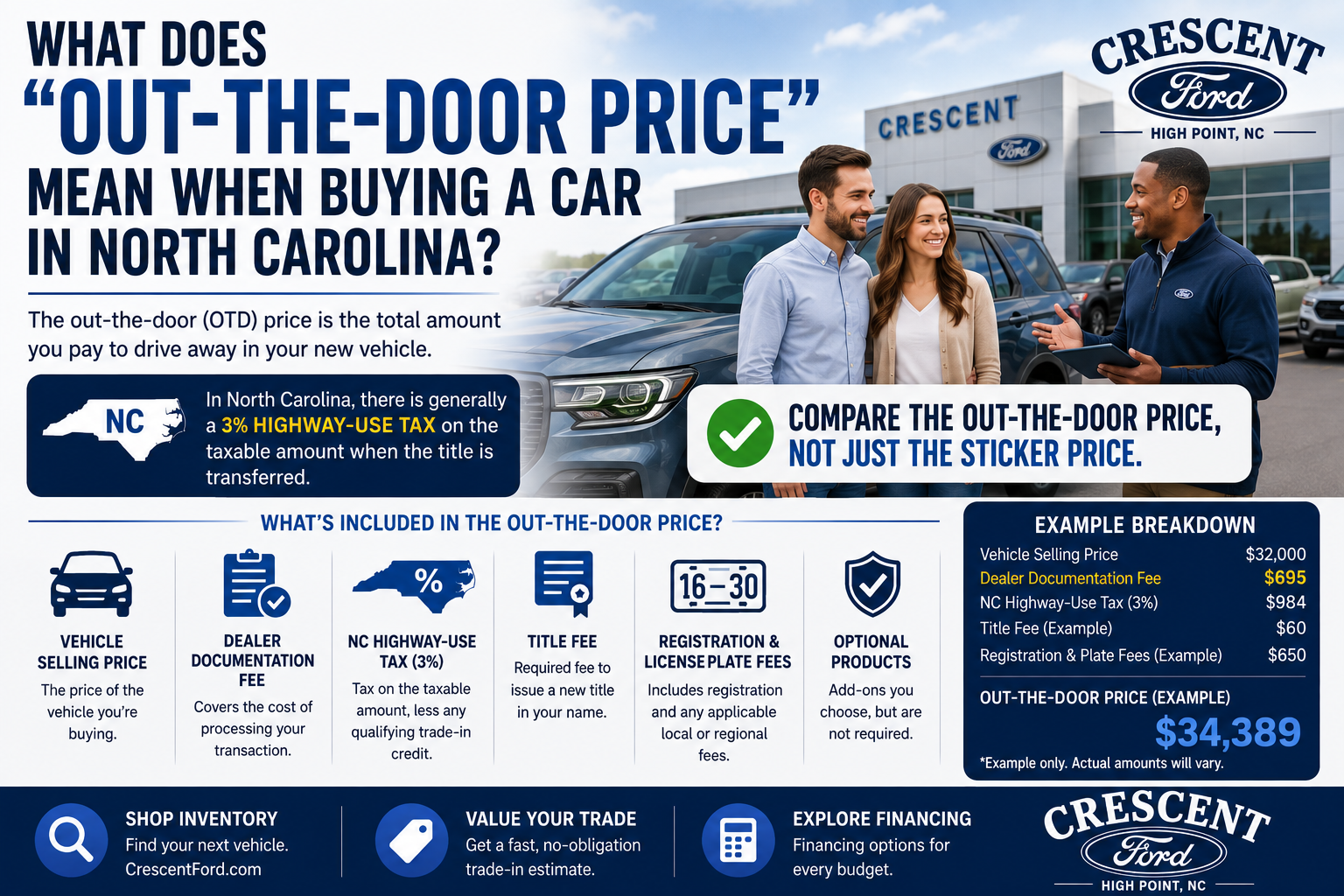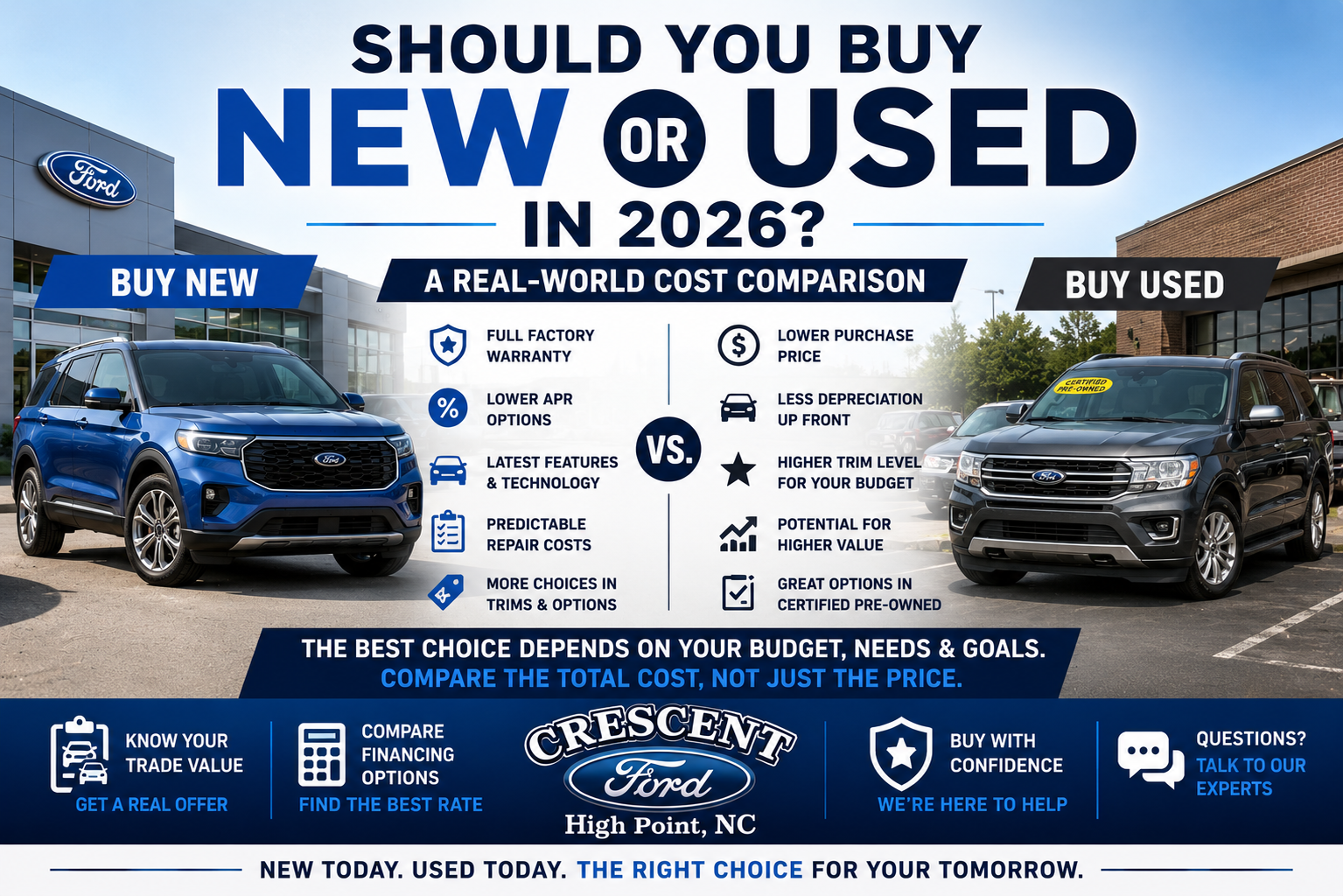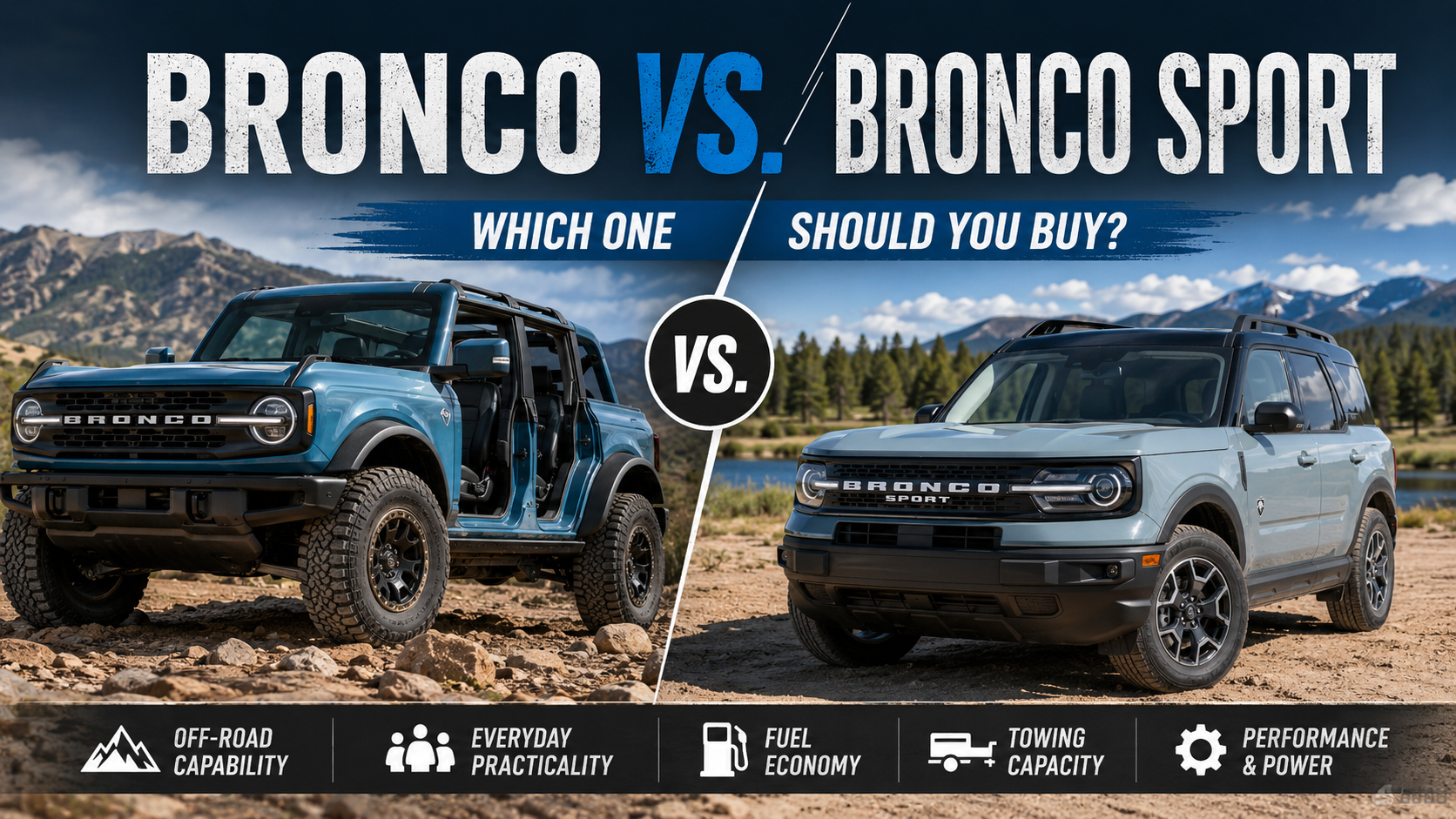

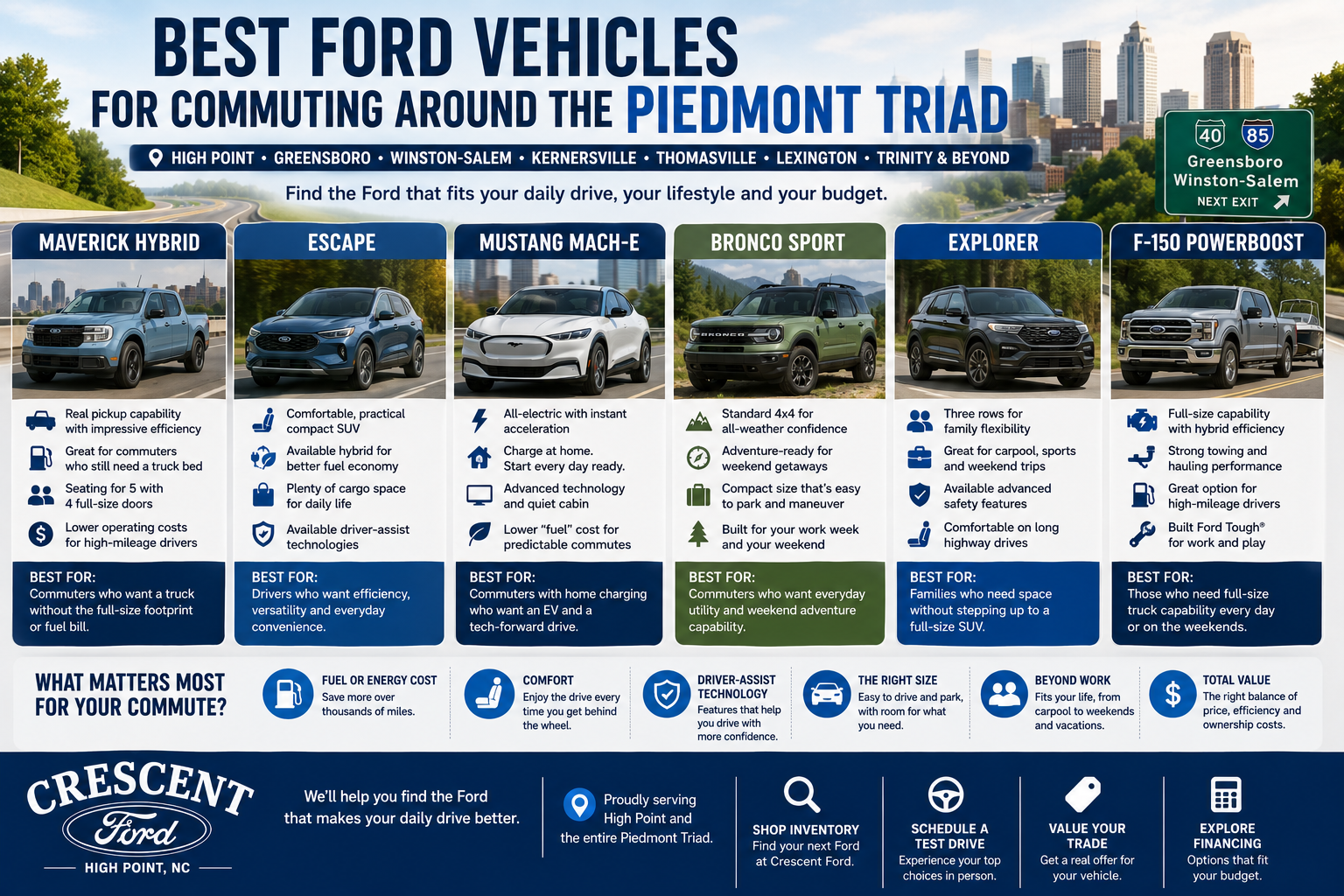
Best Ford Vehicles for Commuting Around the Piedmont Triad If your daily commute takes you from High Point to Greensboro, Winston-Salem, Kernersville or somewhere else around the Piedmont Triad, you probably spend more time in your vehicle than you realize. Twenty-five minutes each way doesn't sound like much. Until you calculate it. That's more than four hours behind the wheel every week — before grocery runs, school pickup, weekend errands or anywhere else life takes you. So when you're shopping for your next vehicle, there's a question worth asking: What Ford actually makes the most sense for my commute? And fuel economy isn't the only thing that matters. A good commuter vehicle should fit your daily mileage, passenger needs, cargo requirements, budget and the type of driving you actually do. Someone commuting alone from High Point to Greensboro may have very different needs than someone who drops two kids off at school before driving to Winston-Salem. And someone who needs a truck every weekend shouldn't necessarily buy a small SUV solely because it saves a little fuel Monday through Friday. So let's look at some of the best Ford options for commuting around the Piedmont Triad — and more importantly, which one makes sense for you. Shop New Ford Vehicles at Crescent Ford What Makes a Good Commuter Vehicle in the Piedmont Triad? Driving around our area isn't quite the same as commuting in a major downtown metro. Depending on where you live and work, your commute may include: I-40 I-85 Business 85 US-311 US-29 NC-68 City streets Two-lane roads Stop-and-go traffic Long stretches of highway That means there isn't one perfect Piedmont Triad commuter vehicle. Instead, we'd consider six things. Fuel or Energy Cost If you drive 50 or 60 miles every workday, efficiency can make a significant difference over several years of ownership. Comfort Don't underestimate this. The seat that feels fine during a five-minute test drive may feel very different after an hour in traffic. Driver-Assist Technology Available technologies such as adaptive cruise control can become much more valuable when you spend substantial time on highways. Size A larger vehicle gives you more passenger and cargo space. It also means you're driving that larger vehicle every single day. What You Do After Work Your commuter vehicle is probably also your grocery vehicle, weekend vehicle, family vehicle and vacation vehicle. Purchase Price Saving money at the gas pump doesn't automatically make a more expensive vehicle the least expensive choice overall. You need to look at the entire ownership picture. With those things in mind, here are the Fords we'd put on the shopping list. 1. Ford Maverick Hybrid: Best Commuter for Someone Who Still Wants a Truck This may be one of the most interesting commuter vehicles Ford makes. Because the Maverick Hybrid solves a problem that traditionally hasn't had a great solution: What if you want a pickup truck but spend most of your week commuting? You might need a truck bed on Saturday. But Monday through Friday? You're driving to work with a coffee cup and a laptop. Buying more truck than you need can mean hauling around size and capability every day that you rarely use. The Maverick changes that equation. You still get: A real pickup bed Four full-size doors Seating for five Useful truck capability but in a much more compact package. For someone commuting between High Point and Greensboro every day who also wants a truck for home projects, bikes, landscaping supplies or weekend activities, that's a compelling combination. Who Should Consider a Maverick Hybrid? Someone who says: "I want a truck, but I don't really need an F-150." It's particularly appealing if: You commute substantial mileage. You own a home and occasionally need a truck bed. You carry bikes or outdoor equipment. You want something easier to maneuver than a full-size pickup. Most of your truck use is light-duty. The Maverick isn't a substitute for an F-150 if you actually need F-150 capability. But that's exactly the point. Don't buy capability you don't need every day just because you want a truck. Shop Ford Maverick Trucks 2. Ford Escape: Best Traditional Commuter SUV If you don't need a truck bed, the Ford Escape deserves a serious look. The Escape's compact SUV format makes a lot of sense around the Triad. It's large enough to handle: Groceries Kids Luggage Work bags Weekend trips without feeling like you're commuting in a large three-row SUV every day. And depending on configuration, you can choose between conventional EcoBoost powertrains and hybrid options. That's valuable because different commuters have different priorities. Why Escape Works So Well for Commuting A compact SUV is something of a middle ground. You're not sitting as low as you would in a traditional sedan. You aren't driving a full-size SUV. You still have a hatch and useful enclosed cargo space. And you can choose a powertrain around your driving. For someone commuting from Thomasville or Trinity into High Point every day and needing a vehicle that can handle family duty afterward, Escape may be one of the most straightforward choices in Ford's lineup. Escape vs. Maverick for Commuting This is a surprisingly useful comparison. Choose Escape if you'd rather have: Enclosed cargo space Choose Maverick if you'd rather have: A pickup bed That's a lifestyle decision more than a specification decision. 3. Ford Mustang Mach-E: Best Commuter If You Can Charge at Home If you have reliable home charging, an EV can completely change the commuter equation. Instead of stopping at a gas station during the week, you can plug in at home and start the next morning with available charge. For someone driving a predictable route every weekday, that can be extremely convenient. And the Mustang Mach-E gives you something else commuters tend to appreciate: A quiet, smooth driving experience. But There's One Question You Should Answer First Before deciding you want an EV because it sounds perfect for commuting, ask: Where am I going to charge it? If the answer is: "In my garage every night," great. Mach-E deserves a look. If the answer is: "I don't know yet," figure that out before buying. We wouldn't recommend purchasing an EV and then figuring out charging afterward. Who Is Mach-E Best For? A commuter who: Can reliably charge at home Has predictable daily mileage Wants an EV Values technology Likes strong acceleration Wants crossover/SUV practicality For the right household, it can be an excellent Triad commuter. For someone without convenient charging? One of Ford's hybrid options may be much easier to live with. Shop Ford Mustang Mach-E Models 4. Ford Bronco Sport: Best Commuter for Weekend Adventurers Bronco Sport isn't the Ford we'd choose if maximum fuel economy were your only priority. But that's not everyone's only priority. Maybe Monday through Friday you drive to an office in Greensboro. Then Friday afternoon you load up and head toward Boone. Or Hanging Rock. Or the Blue Ridge Parkway. Or a campsite. Or the beach. That's where Bronco Sport becomes interesting. It can function as a manageable everyday compact SUV during the workweek while giving you standard 4x4 and more adventure-oriented capability for weekends. Bronco Sport vs. Escape for Commuting If you're primarily focused on: Efficiency + everyday practicality we'd look hard at Escape. If you're focused on: Everyday practicality + 4x4 + outdoor lifestyle we'd look hard at Bronco Sport. They're both compact Ford SUVs. But they have very different personalities. 5. Ford Explorer: Best Commuter for Someone Who Also Needs a Family SUV Nobody needs three rows of seating to commute alone to work. But most people aren't buying a vehicle only for their commute. Maybe your vehicle needs to handle: High Point → Winston-Salem Monday through Friday and then: Two adults + three kids Saturday and Sunday. Now Explorer starts making considerably more sense. The Explorer gives you three-row family versatility without stepping all the way into the size of an Expedition. When Does Explorer Make Sense as a Commuter? When your commute is only one part of the vehicle's job. For example: Morning: Take kids to school. Day: Commute to work. Afternoon: School pickup. Evening: Sports practice. Weekend: Family trip. That's not really a "commuter vehicle." That's a family vehicle that also commutes. And that's an important distinction. Don't buy something too small Monday through Friday if it creates problems every Saturday. Shop Ford Explorer SUVs 6. Ford F-150 PowerBoost: Best Commuter for Someone Who Actually Needs a Full-Size Truck Let's say you need an F-150. Not because you like trucks. Because you actually use one. Maybe you tow. Maybe you haul. Maybe your job requires it. Maybe you have equipment in the bed every week. Now telling you to buy a Maverick Hybrid because it's smaller and more efficient doesn't solve your problem. You still need an F-150. That's where the available PowerBoost Full Hybrid V6 becomes worth considering. It allows shoppers who genuinely need full-size truck capability to consider a hybrid powertrain rather than automatically choosing a conventional engine. Who Should Consider an F-150 PowerBoost? Someone whose thought process is: "I need an F-150 anyway. Which F-150 makes sense for the amount I drive?" That's very different from: "I commute a lot. Should I buy an F-150?" If you don't need full-size capability, Maverick may make more sense. If you do? Then choose the F-150 configuration that best fits both your work and commute. Which Ford Is Best for a High Point-to-Greensboro Commute? This is exactly the type of route where we'd put efficiency and comfort high on the list. If you're doing that drive five days per week, the mileage adds up quickly. Our first vehicles to compare would probably be: Ford Maverick Hybrid Ford Escape / Escape Hybrid Ford Mustang Mach-E Which one? That depends on lifestyle. Need a truck bed? Maverick Hybrid. Want a conventional compact SUV? Escape. Can charge at home and want to go electric? Mustang Mach-E. You don't need to make the decision from a fuel-economy chart. Decide what type of vehicle fits first. Then compare powertrains. What About High Point to Winston-Salem? For longer highway commutes, we'd start paying even more attention to: Seat comfort Road manners Driver-assistance features Fuel economy and Cabin noise These are things that are difficult to evaluate online. If you're going to spend an hour or more in the vehicle every workday, don't take a five-minute test drive. Take it on the highway. Get the seat adjusted properly. Drive at the speeds you normally drive. Listen to the cabin. Try the technology. Test the vehicle in the environment where you're actually going to use it. Schedule a Ford Test Drive Tell us what your normal commute looks like and which vehicles you're considering. Compare your top choices back-to-back. What If You Commute From Thomasville, Trinity or Lexington? For many commuters south of High Point, your daily route may combine two-lane roads, local traffic and highway driving. This is where buying the smallest or most efficient vehicle on paper isn't automatically the right answer. Think about: Daily mileage Road type Passenger needs Cargo Weekend use Whether you need AWD or 4x4 How long you plan to keep the vehicle A Maverick Hybrid might be perfect for someone commuting from Trinity who needs a bed on weekends. An Escape may make more sense for someone commuting from Thomasville who wants enclosed cargo space. An Explorer may make more sense for someone coming from Lexington who also has three kids. Same general commute. Completely different vehicle needs. Gas, Hybrid or Electric: Which Is Best for a Triad Commute? This question comes up more and more. And there isn't one correct answer. Gas The simplest choice for many shoppers. Fuel anywhere. Familiar ownership experience. Plenty of Ford models and configurations to choose from. Hybrid Especially interesting for high-mileage commuters who want better efficiency without plugging in. You drive it much like a conventional gas vehicle. Electric Potentially excellent for predictable commuting, particularly with home charging. But charging access needs to be part of the purchase decision. Don't choose the technology first. Choose based on your life. If you drive 60 miles per day and can charge at home, EV deserves consideration. If you drive substantial mileage but can't conveniently charge, hybrid may be more appealing. If your annual mileage is relatively low, don't assume you'll automatically save enough on fuel to justify choosing a vehicle you otherwise like less. How Much Can Better Fuel Economy Actually Save a Commuter? This is where you should use your own numbers. Suppose you drive: 50 miles per workday for approximately: 250 workdays per year. That's: 12,500 miles per year just commuting. And that doesn't include anything else. Now imagine Vehicle A uses significantly less fuel than Vehicle B. Over one month, the difference may not seem enormous. Over: 5 years and 60,000+ commuting miles? Now it can matter. But don't stop at MPG. Compare: Purchase price Insurance Fuel/electricity Maintenance Financing and how well the vehicle fits your needs. The cheapest vehicle to fuel isn't automatically the cheapest vehicle to own. Should You Buy a Hybrid If You Mostly Drive Highway Miles? Maybe. But this is where understanding your commute matters. Hybrid systems can provide particularly strong efficiency advantages in driving that involves stopping, slowing and restarting. If your commute is almost entirely steady-speed interstate driving, the difference between powertrains may look different than it does for someone spending every morning in stop-and-go traffic. That's why we'd compare the actual EPA city/highway ratings for the specific vehicles you're considering rather than simply assuming: Hybrid = automatically best for everyone. Is Adaptive Cruise Control Worth It for Commuting? For frequent highway commuters? We'd seriously consider it. Adaptive cruise control can automatically adjust vehicle speed to help maintain a selected following distance from traffic ahead when the system is engaged. Depending on the Ford and configuration, additional driver-assist features may also be available. These systems do not replace an attentive driver. But if you spend a lot of time on I-40 or I-85, certain driver-assistance technologies may be features you appreciate far more than something you originally thought was a must-have. Commuter shopping tip: When comparing trims, don't only ask: "Does this one have heated seats?" Ask: "What feature will make the 500th commute better?" That's a much better way to prioritize equipment. Is a Used Vehicle Better for a Long Commute? It can be. If you drive substantial mileage every year, buying used may let you get: More features or a higher trim within the same budget. But mileage and maintenance history become especially important when you're going to add miles quickly yourself. A commuter driving 20,000 miles per year has different needs than someone driving 5,000. For a high-mileage driver, we'd pay close attention to: Current mileage Service history Tire condition Remaining warranty Fuel economy Expected maintenance Overall condition And don't automatically assume new is more expensive overall. Manufacturer financing or incentives can sometimes change the equation considerably. RELATED READING Should You Buy New or Used in 2026? A Real-World Cost Comparison Shop Used Vehicles at Crescent Ford How Much Should You Spend on a Commuter Vehicle? There's no magic percentage that works for everyone. Instead, consider how the vehicle fits into your total monthly budget. Include: Payment Insurance Fuel Maintenance Registration/property tax and any other ownership costs. A vehicle with a slightly higher payment but substantially lower operating cost could potentially make sense. Or the opposite could be true. This is also why we wouldn't recommend putting yourself into a vehicle you don't really need just because the payment happens to fit. Don't Forget Your Trade-In If you're replacing your current commuter, your trade can change the entire purchase equation. Maybe you're driving an older SUV that uses considerably more fuel than you need. Or maybe you have substantial positive equity. Before deciding what your next vehicle needs to cost, find out what the current one is worth. Find Out What Your Vehicle Is Worth Should You Calculate Your Out-the-Door Price Before Comparing Commuter Vehicles? Absolutely. Especially if you're comparing different powertrains. Maybe you're considering: Maverick Hybrid vs. Escape or Escape Hybrid vs. Mach-E. Don't compare only: MSRP or monthly payment. Compare the actual transaction. Then look at estimated operating costs. That's how you determine whether paying more upfront for a particular powertrain makes sense for the amount you drive. RELATED READING What Does “Out-the-Door Price” Mean When Buying a Car in NC? Which Ford Commuter Would We Choose? Here's how we'd narrow it down. You commute a lot and want a truck. Ford Maverick Hybrid You want an efficient, traditional compact SUV. Ford Escape You can charge at home and want an EV. Ford Mustang Mach-E You commute during the week and adventure on weekends. Ford Bronco Sport You commute but also need three rows for the family. Ford Explorer You genuinely need full-size truck capability. Ford F-150, with the PowerBoost hybrid worth considering depending on your use. That's much more useful than declaring one vehicle: "The best commuter Ford." Because the best commuter vehicle is the one that works after you get home from work, too. How to Test Drive a Vehicle for Your Actual Commute This is one of our favorite pieces of advice. Don't test-drive a commuter vehicle only around the dealership. If you're seriously considering it, recreate part of your normal drive. Get on the highway. Sit in traffic. Try the seat for more than five minutes. Connect your phone. Listen to the stereo. Check visibility. Use the driver-assistance features appropriately. See where your coffee goes. Look at where your work bag will sit. These tiny things sound ridiculous when you're shopping. After three years of commuting? They're not tiny anymore. If you're deciding between two vehicles, drive them back-to-back. Your answer may become obvious very quickly. Schedule a Test Drive at Crescent Ford Tell us what your daily commute looks like and we'll help you compare vehicles that fit it. Finding the Best Ford for Your Piedmont Triad Commute If you commute around High Point, Greensboro, Winston-Salem, Kernersville, Thomasville, Lexington, Trinity or elsewhere in the Piedmont Triad, don't shop for your next vehicle based on fuel economy alone. Ask yourself: How many miles do I drive? What roads do I drive? Who rides with me? What do I carry? What do I do on weekends? Can I charge at home? Do I actually need a truck? How long am I keeping this vehicle? Then start narrowing the field. For one commuter, the answer may be a Maverick Hybrid. For another, Escape. For another, Mach-E. And for someone who needs to tow a boat every Saturday, it may still be an F-150. The goal isn't to buy the vehicle that uses the least fuel. It's to buy the vehicle that makes the most sense for the thousands of miles you're actually going to drive. Shop New Ford Vehicles at Crescent Ford Shop Used Vehicles Schedule a Test Drive Value Your Trade Explore Financing Options Frequently Asked Questions About Commuting Around the Piedmont Triad What is the best Ford for commuting? It depends on your commute and lifestyle. Maverick Hybrid is worth considering for commuters who want truck utility, Escape for shoppers wanting a compact SUV, Mustang Mach-E for drivers with convenient charging, and Explorer for commuters who also need three-row family space. What is the best Ford for a long commute? For a long commute, consider fuel or energy costs, seat comfort, driver-assistance technology and the type of vehicle you need outside work. Escape, Maverick Hybrid and Mustang Mach-E are three models we'd compare first for many high-mileage commuters. Is the Ford Maverick good for commuting? Yes. The Maverick can be particularly attractive for commuters who want a pickup but don't need a full-size truck. The available hybrid powertrain makes it especially interesting for drivers who accumulate substantial mileage. Is the Ford Escape good for commuting? Yes. Escape's compact SUV format combines manageable dimensions, enclosed cargo space and multiple available powertrain choices, making it a practical daily commuter for many drivers. Is the Mustang Mach-E good for commuting? It can be an excellent commuter EV, especially for drivers who can reliably charge at home and have predictable daily mileage. Determine your charging plan before purchasing an EV rather than afterward. Is the Bronco Sport a good commuter vehicle? Yes, particularly for someone who wants a compact everyday SUV with standard 4x4 and more adventure-oriented capability for weekends. If fuel economy is your highest priority, compare it with Escape and Ford's hybrid options. Is an Explorer too big for commuting? Not necessarily. If you regularly need three-row passenger space outside work, commuting in an Explorer may make more sense than owning a smaller vehicle that doesn't meet your family's needs. Is an F-150 good for commuting? It can be if you genuinely need full-size truck capability outside your commute. If you rarely tow or haul and primarily want a pickup bed, compare F-150 with Maverick before deciding. Should I buy a hybrid for commuting in North Carolina? A hybrid can make sense for drivers who accumulate substantial mileage and want better fuel efficiency without plugging in. Compare the actual EPA ratings, purchase prices and your particular mix of city and highway driving before deciding. Should I buy an EV for commuting around High Point? An EV can work very well for predictable daily commuting, particularly if you have convenient home charging. Consider your daily mileage, home-charging access and longer-trip habits before deciding. Should I test drive a commuter vehicle on the highway? Yes. If your normal commute includes I-40, I-85 or another highway, include highway driving in your test drive when practical. Seat comfort, road noise, visibility and driving characteristics can be difficult to judge from a short drive around a dealership. How do I know which Ford will cost me less to commute in? Estimate your annual mileage and compare fuel or electricity use along with purchase price, insurance, maintenance and financing. Fuel economy is important, but it is only one component of total ownership cost.
What Is My Car Worth in High Point, NC? | Trade-In Value Guide
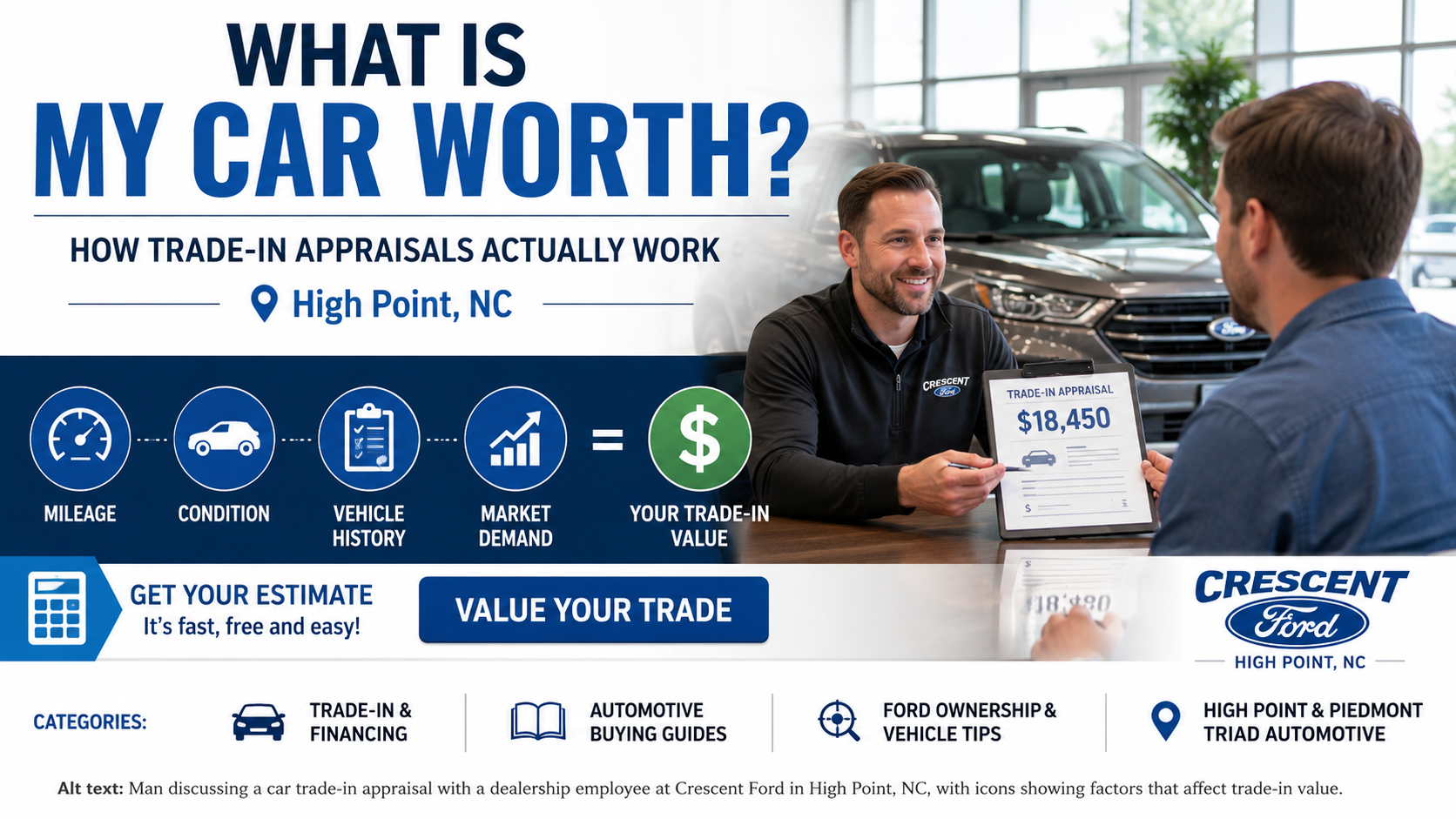
What Is My Car Worth in High Point, NC? How Trade-In Appraisals Actually Work If you're thinking about trading your vehicle, there's probably one number you want before anything else: What is my car actually worth? You can enter your vehicle into an online calculator and get an estimate in a few minutes. You can search for similar vehicles for sale. You might even know what you paid for it or what you still owe. But none of those numbers necessarily tells you exactly what a dealership will offer for your vehicle today. A real trade-in appraisal considers your vehicle's year, make, model, mileage, equipment, condition and history — but it also considers something that's constantly changing: the current market for that specific vehicle. At Crescent Ford in High Point, we appraise vehicles from Ford and other manufacturers, and understanding how the process works can help you know what to expect before you trade. Here's what actually goes into determining your car's trade-in value. Find Out What Your Vehicle Is Worth How Is a Car's Trade-In Value Determined? There's no single formula that says a five-year-old vehicle with 60,000 miles is worth a specific amount. Two vehicles that look almost identical in an online listing can have very different trade values. A dealership appraisal generally comes down to a combination of: Year, make and model Mileage Trim level and equipment Mechanical condition Exterior condition Interior condition Accident and vehicle history Tire condition Previous use Local and regional demand Current wholesale and retail market conditions The important part is that these factors work together. For example, low mileage is generally a positive. But a low-mileage vehicle with significant body damage isn't necessarily worth more than a slightly higher-mileage example in excellent condition. Likewise, an expensive option package may add value, but how much it adds depends partly on whether shoppers in the current used-vehicle market are willing to pay more for it. That's why an appraisal requires more than looking up a year, make and model. What Does a Dealership Look at During a Trade-In Appraisal? When you bring your vehicle to a dealership for an appraisal, the goal is to determine what that particular vehicle is worth in the current market. Let's break down some of the biggest factors. 1. Year, Make, Model and Trim This establishes the starting point. A 2022 Ford F-150 XL and a 2022 Ford F-150 Lariat may share the same model name, but they're very different vehicles from a value standpoint. Trim level, engine, drivetrain and factory equipment can all matter. The same applies to other brands. A base-model SUV with front-wheel drive may have a different market value than a higher trim of the same SUV equipped with all-wheel drive and additional features. The VIN helps identify exactly what is being appraised so the comparison isn't simply “2022 F-150” or “2021 Explorer.” It's the specific vehicle. 2. Mileage Mileage is one of the most obvious factors affecting trade value, but there's no magic mileage number where a vehicle suddenly becomes undesirable. Instead, mileage is viewed in context. A newer vehicle with unusually high mileage for its age may be valued differently from an otherwise comparable vehicle driven significantly less. But don't assume high mileage automatically means your vehicle isn't worth trading. A well-maintained higher-mileage vehicle can still have plenty of market value, especially when there's strong demand for that make, model or type of vehicle. 3. Vehicle Condition This is where an in-person appraisal becomes particularly important. An appraiser can actually see, hear and experience things an online valuation tool can't fully evaluate. Exterior condition can include: Dents and scratches Paint condition Previous body repairs Windshield or glass damage Wheel damage Rust or corrosion Missing or damaged exterior pieces Inside, an appraiser may consider: Seat and upholstery condition Stains or tears Smoke or other strong odors Dashboard warning lights Electronics and features Overall wear Then there's mechanical condition. A vehicle needing tires, brakes or mechanical repairs has costs associated with making it ready for its next owner. That doesn't mean you should automatically repair everything before trading it — more on that later — but condition does affect the appraisal. Does Accident History Lower Trade-In Value? It can, but an accident doesn't automatically make a vehicle a bad trade. There's an enormous difference between a minor incident that was professionally repaired and a vehicle that sustained major structural damage. Appraisers may consider the severity of the damage, quality of the repairs and how the vehicle's history affects its resale market. That's one reason two cars with the same year, mileage and trim can receive different offers. The physical vehicle matters just as much as the specifications on paper. If your vehicle has an accident on its history report, there's no reason to hide it when getting an appraisal. The better approach is simply to get the vehicle evaluated and find out what it's worth in its current condition. Does My Car's Service History Matter? Potentially. A vehicle that has clearly been cared for can be more appealing than one showing signs of neglected maintenance. If you have service records, you can bring them with you, particularly if you've recently completed significant maintenance or repairs. But don't panic if you don't have a binder containing every oil-change receipt since the vehicle was new. An appraisal isn't based solely on paperwork. The vehicle's current condition and history still tell a substantial part of the story. Does Having New Tires Increase My Trade-In Value? Good tires can help the overall condition of a vehicle, but buying a brand-new set immediately before trading usually doesn't mean you'll get every dollar back in additional trade value. Suppose your vehicle needs $1,000 worth of tires. Spending $1,000 before the appraisal doesn't automatically increase the offer by $1,000. Dealerships routinely account for reconditioning when evaluating used vehicles. Depending on the vehicle and its condition, it may make more financial sense to trade it as-is. The same logic applies to many other repairs. Should I fix my car before trading it in? For inexpensive problems, maybe. Replacing a burned-out bulb, removing your personal belongings and giving the vehicle a reasonable cleaning can make sense. Spending thousands on: Body work New tires Major mechanical repairs Paint correction Cosmetic upgrades right before trading deserves more thought. Before putting significant money into a vehicle you intend to trade, get an appraisal first. You may discover that the repair won't increase the trade value enough to justify what you'd spend. Get a Trade-In Estimate Before Spending Money on Repairs Does Cleaning My Car Increase Its Trade-In Value? Cleaning your vehicle before an appraisal is a good idea, but you probably don't need to pay hundreds of dollars for a professional detail. Remove trash and personal belongings. Vacuum if it needs it. Give the exterior a wash. That's enough. A clean vehicle makes its condition easier to evaluate, but an experienced appraiser can tell the difference between dirt and permanent damage. A detail isn't going to erase a poor vehicle history or worn tires. And a little Goldfish cracker hiding underneath the back seat probably isn't going to destroy your trade value either. If you actually use your vehicle, we expect it to look like a vehicle that's been used. Why Is My Online Trade Estimate Different From My Actual Appraisal? Online valuation tools are extremely useful because they give you a starting point before visiting a dealership. But an online estimate and a physical appraisal serve slightly different purposes. An online tool relies on the information available to it and the information you provide. A physical appraisal allows someone to evaluate the actual vehicle. That can reveal: Options or equipment affecting value Actual tire condition Cosmetic damage Mechanical concerns Previous repairs Interior condition Features that aren't functioning correctly Condition that is better than expected Market conditions can also change. That's why we'd think of an online value as step one, rather than necessarily the final trade offer. Start online so you have an idea of where you stand. Then have the vehicle physically evaluated when you're getting serious about making a change. Why Does Market Demand Affect What My Car Is Worth? This is one of the most overlooked parts of vehicle valuation. A dealership isn't appraising your vehicle in a vacuum. The used-car market is constantly changing. Supply and demand for trucks, SUVs, fuel-efficient vehicles, hybrids, specific models and even certain configurations can affect market values. Dealers also look at comparable vehicles currently available in the market. If there are dozens of nearly identical vehicles for sale and they're taking a long time to sell, that affects the market. If a particular type of used vehicle is difficult to find and shoppers are actively looking for it, that matters too. This is also why an appraisal you received months ago shouldn't necessarily be treated as your vehicle's value today. Your vehicle gets older and accumulates mileage, while the market around it is changing at the same time. If you're seriously considering trading, a current appraisal is more useful than an estimate from several months ago. Is Trade-In Value the Same as Retail Value? No — and this is one of the most important things to understand when researching what your car is worth. You may find a vehicle similar to yours advertised online for $28,000 and wonder: “If they're selling one for $28,000, why isn't my trade worth $28,000?” Because retail price and trade value aren't the same thing. A vehicle acquired by a dealership may need: Mechanical inspection Maintenance Tires or brakes Cosmetic repairs Detailing Transportation Other reconditioning There's also a difference between an advertised asking price and what a vehicle ultimately sells for. The dealer also assumes the market risk. If the vehicle doesn't sell quickly or market values decline, that risk doesn't go back to the person who traded it. So when you're researching comparable vehicles online, retail listings can provide useful context — but they aren't a direct substitute for trade-in value. What If I Still Owe Money on My Car? You can generally trade a vehicle even if you haven't paid off the loan. What matters is the relationship between two numbers: Your vehicle's trade value and Your current loan payoff. For example, imagine your vehicle is appraised at $25,000. If your payoff is $20,000, you have approximately $5,000 in positive equity. That equity can generally be applied toward your next purchase. If the vehicle is worth $20,000 but your payoff is $25,000, you have approximately $5,000 in negative equity. That doesn't necessarily prevent you from trading, but it changes the financial side of the transaction. Depending on the vehicle you're purchasing, your credit and lender requirements, some or all of that difference may need to be paid or included in the new financing. This is where knowing your actual trade value becomes especially helpful. Instead of guessing whether you're “upside down,” you can compare an appraisal with your current payoff and see where you actually stand. Explore Your Auto Financing Options Does Trading In a Car Reduce the Tax in North Carolina? North Carolina handles vehicle purchases differently from an ordinary retail purchase. Rather than the normal sales tax you might pay when buying other goods, North Carolina generally charges a Highway Use Tax when a vehicle title is transferred. For a qualifying dealer transaction, the trade-in allowance can reduce the amount subject to the state's Highway Use Tax. Here's a simplified example: Vehicle purchase price: $40,000 Trade allowance: $15,000 Amount subject to Highway Use Tax: $25,000 That means a trade can have value beyond simply providing money toward your next vehicle. The exact tax treatment depends on the transaction, so the final figures should always be calculated for your specific purchase. Should I Trade My Car or Sell It Myself? A private sale may sometimes produce a higher selling price. But price isn't the only difference. Selling privately means you're responsible for: Advertising the vehicle Responding to inquiries Meeting prospective buyers Handling test drives Negotiating Working through payment Completing the transaction Dealing with your existing lender if there's a payoff Trading is designed to simplify that process. You can have the vehicle appraised, review the offer and potentially apply its value directly to another vehicle in the same transaction. In North Carolina, the potential Highway Use Tax treatment of a qualifying dealer trade should also be part of the comparison. So don't compare only: Private-sale price vs. trade offer. Compare the net financial difference, time, convenience and amount of work involved. For some people, selling privately is worth it. For others, the difference isn't enough to justify the hassle. Can I Trade a Ford to Crescent Ford? What About Another Brand? Despite the Ford sign out front, your trade doesn't have to be a Ford. Dealerships regularly appraise vehicles from many manufacturers. So if you're considering replacing your Chevrolet, Toyota, Honda, Jeep, Nissan, Hyundai, Kia, Subaru or another brand with a new or used vehicle, you can still have it appraised. You also don't need to know exactly what you want to buy before finding out what your current vehicle is worth. In fact, we'd argue for doing it the other way around. Know what you're working with first. Once you know your trade value and approximate equity, it's much easier to establish a realistic budget for your next vehicle. Browse New Ford Inventory Shop Used Cars, Trucks & SUVs What Should I Bring for a Trade-In Appraisal? If you're only getting an initial appraisal, you don't need to move your entire filing cabinet into the passenger seat. When you're ready to actually complete a trade, however, having the necessary information available can make things easier. Depending on your situation, that may include: Driver's license Vehicle registration Title, if you own the vehicle outright Loan or lender information if you still owe money All available keys and key fobs Service records you want the appraiser to see If another person is listed as an owner, additional signatures or documentation may also be required. If you're unsure what you need for your particular vehicle, ask before your visit. How Can I Get the Most for My Trade-In? There isn't a secret trick that suddenly adds thousands of dollars to a vehicle's market value. But you can make the process easier and put yourself in a better position to evaluate an offer. Be accurate when getting an online estimate Enter the correct mileage, trim and condition. An inflated online estimate doesn't help if it isn't based on the vehicle you're actually bringing in. Bring all your keys Modern key fobs can be expensive to replace. If you have two, bring two. Don't hide known problems An appraisal is intended to determine the vehicle's actual condition. Being straightforward makes the process easier. Don't automatically make expensive repairs Get the vehicle appraised before spending thousands preparing a vehicle you plan to trade. Know your payoff If the vehicle is financed, knowing approximately what you owe helps you understand your equity position. Look at the whole transaction A strong trade offer matters, but so does the price of the vehicle you're buying, financing terms, taxes and fees. Ultimately, you want to know what the entire transaction costs you. What Is My Car Worth in High Point, NC? The only way to know what your particular vehicle is worth right now is to evaluate your particular vehicle in the current market. That's true whether you live in High Point, Greensboro, Thomasville, Trinity, Kernersville or elsewhere in the Piedmont Triad. An online estimate is a great starting point. A real appraisal is the next step. At Crescent Ford in High Point, you can start by entering your vehicle information online. When you're ready, we can evaluate the vehicle itself and help you understand how its condition, mileage, equipment and current market affect its value. You don't have to buy a vehicle simply because you wanted to know what your current one is worth. Sometimes knowing the number is simply the information you need to decide whether now is the right time to trade. See What Your Car Is Worth Ready to see what your trade could put you into? Browse New Ford Inventory Browse Used Inventory Frequently Asked Questions About Trade-In Value How long does a trade-in appraisal take? The time can vary depending on the vehicle and dealership process. An online estimate can usually be started in just a few minutes, while a physical appraisal requires enough time to inspect the actual vehicle and evaluate current market information. Does mileage lower my car's trade-in value? Mileage is one factor in a trade appraisal. Higher-than-average mileage can affect value, but the vehicle's age, condition, model, equipment, history and market demand also matter. Will a cracked windshield hurt my trade-in value? Damage such as a cracked windshield can affect an appraisal because the repair or replacement may become part of the vehicle's reconditioning cost. That doesn't necessarily mean you should replace it before trading. Consider getting an appraisal first. Do I need to detail my car before trading it in? No. Removing personal belongings and giving the vehicle a basic cleaning is usually sufficient. An expensive professional detail immediately before an appraisal isn't necessary. Can I trade in a car with damage? Yes. Vehicles don't have to be in perfect condition to be appraised or traded. Damage will be considered when determining value. Can I trade in a car that isn't paid off? Yes, in many cases. The dealership can obtain your loan payoff and compare it with the trade value to determine whether you have positive or negative equity. Can I trade in a vehicle that isn't a Ford at Crescent Ford? Yes. Your current vehicle does not need to be a Ford to be considered for a trade-in appraisal. Does a trade-in lower vehicle taxes in North Carolina? For qualifying dealer transactions, North Carolina's 3% Highway Use Tax is generally calculated on the vehicle's net retail value after the trade-in allowance. The specific amount depends on the transaction. Is an online trade-in value a guaranteed offer? An online valuation is useful for estimating what your vehicle may be worth. The final value may depend on verification of the vehicle's equipment, mileage, condition, history and current market. Should I trade my vehicle before it reaches 100,000 miles? There's no universal rule that says you should trade before 100,000 miles. Mileage is only one part of an appraisal. Your vehicle's condition, age, model and current demand may matter just as much. If you're considering trading, getting a current appraisal is more useful than making the decision based solely on an odometer milestone.