


Blog / Automotive Buying Guides

What Is My Car Worth in High Point, NC? | Trade-In Value Guide

Car trade-in appraisal at Crescent Ford in High Point, NC showing factors that affect vehicle value

What Is My Car Worth in High Point, NC? How Trade-In Appraisals Actually Work

If you're thinking about trading your vehicle, there's probably one number you want before anything else:

What is my car actually worth?

You can enter your vehicle into an online calculator and get an estimate in a few minutes. You can search for similar vehicles for sale. You might even know what you paid for it or what you still owe.

But none of those numbers necessarily tells you exactly what a dealership will offer for your vehicle today.

A real trade-in appraisal considers your vehicle's year, make, model, mileage, equipment, condition and history — but it also considers something that's constantly changing: the current market for that specific vehicle.

At Crescent Ford in High Point, we appraise vehicles from Ford and other manufacturers, and understanding how the process works can help you know what to expect before you trade.

Here's what actually goes into determining your car's trade-in value.

Find Out What Your Vehicle Is Worth


How Is a Car's Trade-In Value Determined?

There's no single formula that says a five-year-old vehicle with 60,000 miles is worth a specific amount.

Two vehicles that look almost identical in an online listing can have very different trade values.

A dealership appraisal generally comes down to a combination of:

  • Year, make and model

  • Mileage

  • Trim level and equipment

  • Mechanical condition

  • Exterior condition

  • Interior condition

  • Accident and vehicle history

  • Tire condition

  • Previous use

  • Local and regional demand

  • Current wholesale and retail market conditions

The important part is that these factors work together.

For example, low mileage is generally a positive. But a low-mileage vehicle with significant body damage isn't necessarily worth more than a slightly higher-mileage example in excellent condition.

Likewise, an expensive option package may add value, but how much it adds depends partly on whether shoppers in the current used-vehicle market are willing to pay more for it.

That's why an appraisal requires more than looking up a year, make and model.

What Does a Dealership Look at During a Trade-In Appraisal?

When you bring your vehicle to a dealership for an appraisal, the goal is to determine what that particular vehicle is worth in the current market.

Let's break down some of the biggest factors.

1. Year, Make, Model and Trim

This establishes the starting point.

A 2022 Ford F-150 XL and a 2022 Ford F-150 Lariat may share the same model name, but they're very different vehicles from a value standpoint.

Trim level, engine, drivetrain and factory equipment can all matter.

The same applies to other brands. A base-model SUV with front-wheel drive may have a different market value than a higher trim of the same SUV equipped with all-wheel drive and additional features.

The VIN helps identify exactly what is being appraised so the comparison isn't simply “2022 F-150” or “2021 Explorer.”

It's the specific vehicle.

2. Mileage

Mileage is one of the most obvious factors affecting trade value, but there's no magic mileage number where a vehicle suddenly becomes undesirable.

Instead, mileage is viewed in context.

A newer vehicle with unusually high mileage for its age may be valued differently from an otherwise comparable vehicle driven significantly less.

But don't assume high mileage automatically means your vehicle isn't worth trading.

A well-maintained higher-mileage vehicle can still have plenty of market value, especially when there's strong demand for that make, model or type of vehicle.

3. Vehicle Condition

This is where an in-person appraisal becomes particularly important.

An appraiser can actually see, hear and experience things an online valuation tool can't fully evaluate.

Exterior condition can include:

  • Dents and scratches

  • Paint condition

  • Previous body repairs

  • Windshield or glass damage

  • Wheel damage

  • Rust or corrosion

  • Missing or damaged exterior pieces

Inside, an appraiser may consider:

  • Seat and upholstery condition

  • Stains or tears

  • Smoke or other strong odors

  • Dashboard warning lights

  • Electronics and features

  • Overall wear

Then there's mechanical condition.

A vehicle needing tires, brakes or mechanical repairs has costs associated with making it ready for its next owner.

That doesn't mean you should automatically repair everything before trading it — more on that later — but condition does affect the appraisal.

Does Accident History Lower Trade-In Value?

It can, but an accident doesn't automatically make a vehicle a bad trade.

There's an enormous difference between a minor incident that was professionally repaired and a vehicle that sustained major structural damage.

Appraisers may consider the severity of the damage, quality of the repairs and how the vehicle's history affects its resale market.

That's one reason two cars with the same year, mileage and trim can receive different offers.

The physical vehicle matters just as much as the specifications on paper.

If your vehicle has an accident on its history report, there's no reason to hide it when getting an appraisal. The better approach is simply to get the vehicle evaluated and find out what it's worth in its current condition.


Does My Car's Service History Matter?

Potentially.

A vehicle that has clearly been cared for can be more appealing than one showing signs of neglected maintenance.

If you have service records, you can bring them with you, particularly if you've recently completed significant maintenance or repairs.

But don't panic if you don't have a binder containing every oil-change receipt since the vehicle was new.

An appraisal isn't based solely on paperwork.

The vehicle's current condition and history still tell a substantial part of the story.


Does Having New Tires Increase My Trade-In Value?

Good tires can help the overall condition of a vehicle, but buying a brand-new set immediately before trading usually doesn't mean you'll get every dollar back in additional trade value.

Suppose your vehicle needs $1,000 worth of tires.

Spending $1,000 before the appraisal doesn't automatically increase the offer by $1,000.

Dealerships routinely account for reconditioning when evaluating used vehicles. Depending on the vehicle and its condition, it may make more financial sense to trade it as-is.

The same logic applies to many other repairs.

Should I fix my car before trading it in?

For inexpensive problems, maybe.

Replacing a burned-out bulb, removing your personal belongings and giving the vehicle a reasonable cleaning can make sense.

Spending thousands on:

  • Body work

  • New tires

  • Major mechanical repairs

  • Paint correction

  • Cosmetic upgrades

right before trading deserves more thought.

Before putting significant money into a vehicle you intend to trade, get an appraisal first.

You may discover that the repair won't increase the trade value enough to justify what you'd spend.

Get a Trade-In Estimate Before Spending Money on Repairs


Does Cleaning My Car Increase Its Trade-In Value?

Cleaning your vehicle before an appraisal is a good idea, but you probably don't need to pay hundreds of dollars for a professional detail.

Remove trash and personal belongings. Vacuum if it needs it. Give the exterior a wash.

That's enough.

A clean vehicle makes its condition easier to evaluate, but an experienced appraiser can tell the difference between dirt and permanent damage.

A detail isn't going to erase a poor vehicle history or worn tires.

And a little Goldfish cracker hiding underneath the back seat probably isn't going to destroy your trade value either.

If you actually use your vehicle, we expect it to look like a vehicle that's been used.


Why Is My Online Trade Estimate Different From My Actual Appraisal?

Online valuation tools are extremely useful because they give you a starting point before visiting a dealership.

But an online estimate and a physical appraisal serve slightly different purposes.

An online tool relies on the information available to it and the information you provide.

A physical appraisal allows someone to evaluate the actual vehicle.

That can reveal:

  • Options or equipment affecting value

  • Actual tire condition

  • Cosmetic damage

  • Mechanical concerns

  • Previous repairs

  • Interior condition

  • Features that aren't functioning correctly

  • Condition that is better than expected

Market conditions can also change.

That's why we'd think of an online value as step one, rather than necessarily the final trade offer.

Start online so you have an idea of where you stand. Then have the vehicle physically evaluated when you're getting serious about making a change.


Why Does Market Demand Affect What My Car Is Worth?

This is one of the most overlooked parts of vehicle valuation.

A dealership isn't appraising your vehicle in a vacuum.

The used-car market is constantly changing.

Supply and demand for trucks, SUVs, fuel-efficient vehicles, hybrids, specific models and even certain configurations can affect market values.

Dealers also look at comparable vehicles currently available in the market.

If there are dozens of nearly identical vehicles for sale and they're taking a long time to sell, that affects the market.

If a particular type of used vehicle is difficult to find and shoppers are actively looking for it, that matters too.

This is also why an appraisal you received months ago shouldn't necessarily be treated as your vehicle's value today.

Your vehicle gets older and accumulates mileage, while the market around it is changing at the same time.

If you're seriously considering trading, a current appraisal is more useful than an estimate from several months ago.


Is Trade-In Value the Same as Retail Value?

No — and this is one of the most important things to understand when researching what your car is worth.

You may find a vehicle similar to yours advertised online for $28,000 and wonder:

“If they're selling one for $28,000, why isn't my trade worth $28,000?”

Because retail price and trade value aren't the same thing.

A vehicle acquired by a dealership may need:

  • Mechanical inspection

  • Maintenance

  • Tires or brakes

  • Cosmetic repairs

  • Detailing

  • Transportation

  • Other reconditioning

There's also a difference between an advertised asking price and what a vehicle ultimately sells for.

The dealer also assumes the market risk. If the vehicle doesn't sell quickly or market values decline, that risk doesn't go back to the person who traded it.

So when you're researching comparable vehicles online, retail listings can provide useful context — but they aren't a direct substitute for trade-in value.


What If I Still Owe Money on My Car?

You can generally trade a vehicle even if you haven't paid off the loan.

What matters is the relationship between two numbers:

Your vehicle's trade value

and

Your current loan payoff.

For example, imagine your vehicle is appraised at $25,000.

If your payoff is $20,000, you have approximately $5,000 in positive equity.

That equity can generally be applied toward your next purchase.

If the vehicle is worth $20,000 but your payoff is $25,000, you have approximately $5,000 in negative equity.

That doesn't necessarily prevent you from trading, but it changes the financial side of the transaction. Depending on the vehicle you're purchasing, your credit and lender requirements, some or all of that difference may need to be paid or included in the new financing.

This is where knowing your actual trade value becomes especially helpful.

Instead of guessing whether you're “upside down,” you can compare an appraisal with your current payoff and see where you actually stand.

Explore Your Auto Financing Options


Does Trading In a Car Reduce the Tax in North Carolina?

North Carolina handles vehicle purchases differently from an ordinary retail purchase.

Rather than the normal sales tax you might pay when buying other goods, North Carolina generally charges a Highway Use Tax when a vehicle title is transferred.

For a qualifying dealer transaction, the trade-in allowance can reduce the amount subject to the state's Highway Use Tax.

Here's a simplified example:

Vehicle purchase price: $40,000
Trade allowance: $15,000
Amount subject to Highway Use Tax: $25,000

That means a trade can have value beyond simply providing money toward your next vehicle.

The exact tax treatment depends on the transaction, so the final figures should always be calculated for your specific purchase.


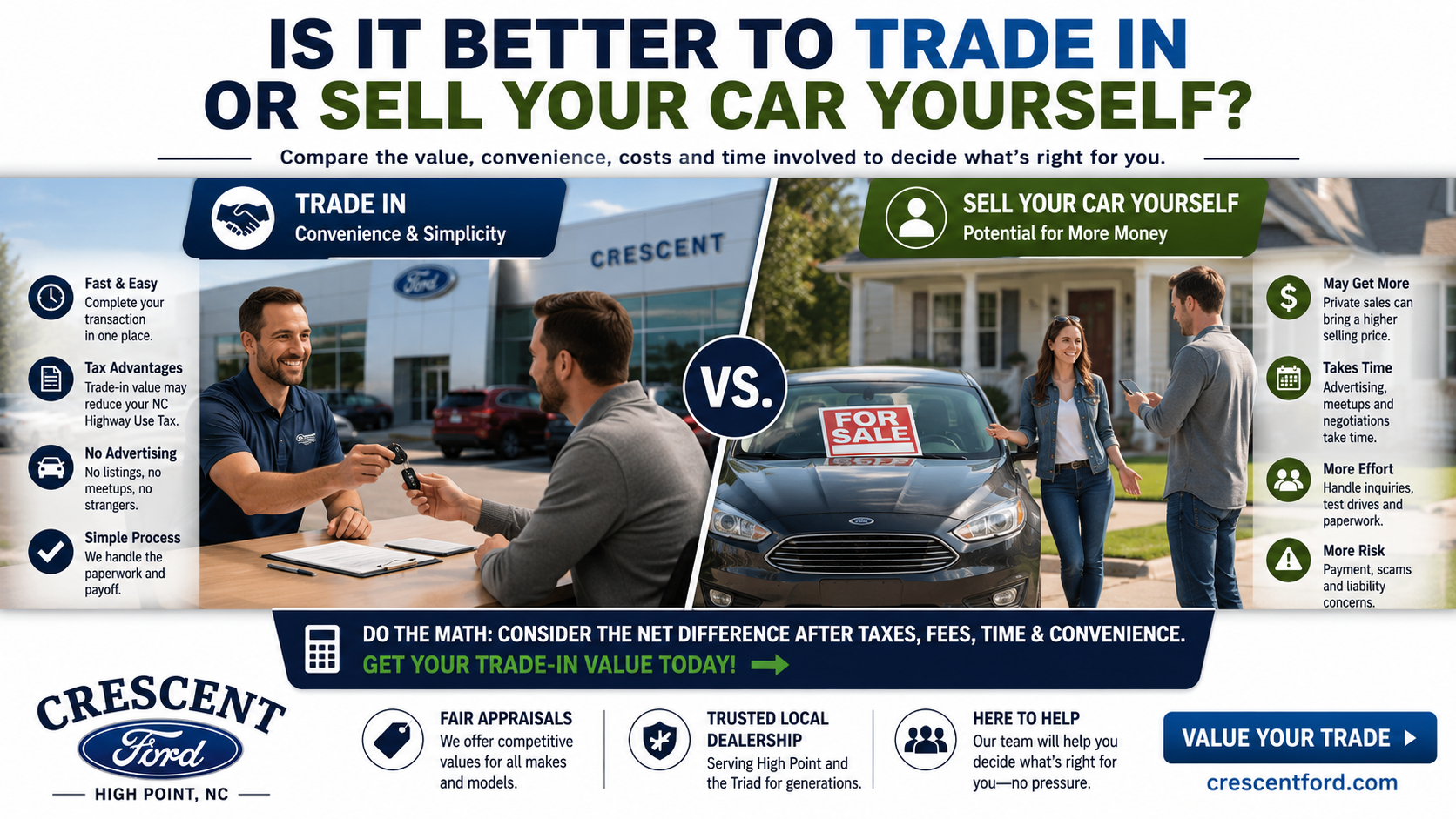
Should I Trade My Car or Sell It Myself?

A private sale may sometimes produce a higher selling price.

But price isn't the only difference.

Selling privately means you're responsible for:

  • Advertising the vehicle

  • Responding to inquiries

  • Meeting prospective buyers

  • Handling test drives

  • Negotiating

  • Working through payment

  • Completing the transaction

  • Dealing with your existing lender if there's a payoff

Trading is designed to simplify that process.

You can have the vehicle appraised, review the offer and potentially apply its value directly to another vehicle in the same transaction.

In North Carolina, the potential Highway Use Tax treatment of a qualifying dealer trade should also be part of the comparison.

So don't compare only:

Private-sale price vs. trade offer.

Compare the net financial difference, time, convenience and amount of work involved.

For some people, selling privately is worth it.

For others, the difference isn't enough to justify the hassle.


Can I Trade a Ford to Crescent Ford? What About Another Brand?

Despite the Ford sign out front, your trade doesn't have to be a Ford.

Dealerships regularly appraise vehicles from many manufacturers.

So if you're considering replacing your Chevrolet, Toyota, Honda, Jeep, Nissan, Hyundai, Kia, Subaru or another brand with a new or used vehicle, you can still have it appraised.

You also don't need to know exactly what you want to buy before finding out what your current vehicle is worth.

In fact, we'd argue for doing it the other way around.

Know what you're working with first.

Once you know your trade value and approximate equity, it's much easier to establish a realistic budget for your next vehicle.

Browse New Ford Inventory

Shop Used Cars, Trucks & SUVs


What Should I Bring for a Trade-In Appraisal?

If you're only getting an initial appraisal, you don't need to move your entire filing cabinet into the passenger seat.

When you're ready to actually complete a trade, however, having the necessary information available can make things easier.

Depending on your situation, that may include:

  • Driver's license

  • Vehicle registration

  • Title, if you own the vehicle outright

  • Loan or lender information if you still owe money

  • All available keys and key fobs

  • Service records you want the appraiser to see

If another person is listed as an owner, additional signatures or documentation may also be required.

If you're unsure what you need for your particular vehicle, ask before your visit.


How Can I Get the Most for My Trade-In?

There isn't a secret trick that suddenly adds thousands of dollars to a vehicle's market value.

But you can make the process easier and put yourself in a better position to evaluate an offer.

Be accurate when getting an online estimate

Enter the correct mileage, trim and condition. An inflated online estimate doesn't help if it isn't based on the vehicle you're actually bringing in.

Bring all your keys

Modern key fobs can be expensive to replace. If you have two, bring two.

Don't hide known problems

An appraisal is intended to determine the vehicle's actual condition. Being straightforward makes the process easier.

Don't automatically make expensive repairs

Get the vehicle appraised before spending thousands preparing a vehicle you plan to trade.

Know your payoff

If the vehicle is financed, knowing approximately what you owe helps you understand your equity position.

Look at the whole transaction

A strong trade offer matters, but so does the price of the vehicle you're buying, financing terms, taxes and fees.

Ultimately, you want to know what the entire transaction costs you.


What Is My Car Worth in High Point, NC?

The only way to know what your particular vehicle is worth right now is to evaluate your particular vehicle in the current market.

That's true whether you live in High Point, Greensboro, Thomasville, Trinity, Kernersville or elsewhere in the Piedmont Triad.

An online estimate is a great starting point.

A real appraisal is the next step.

At Crescent Ford in High Point, you can start by entering your vehicle information online. When you're ready, we can evaluate the vehicle itself and help you understand how its condition, mileage, equipment and current market affect its value.

You don't have to buy a vehicle simply because you wanted to know what your current one is worth.

Sometimes knowing the number is simply the information you need to decide whether now is the right time to trade.

See What Your Car Is Worth

Ready to see what your trade could put you into?

Browse New Ford Inventory

Browse Used Inventory


Frequently Asked Questions About Trade-In Value

How long does a trade-in appraisal take?

The time can vary depending on the vehicle and dealership process. An online estimate can usually be started in just a few minutes, while a physical appraisal requires enough time to inspect the actual vehicle and evaluate current market information.

Does mileage lower my car's trade-in value?

Mileage is one factor in a trade appraisal. Higher-than-average mileage can affect value, but the vehicle's age, condition, model, equipment, history and market demand also matter.

Will a cracked windshield hurt my trade-in value?

Damage such as a cracked windshield can affect an appraisal because the repair or replacement may become part of the vehicle's reconditioning cost. That doesn't necessarily mean you should replace it before trading. Consider getting an appraisal first.

Do I need to detail my car before trading it in?

No. Removing personal belongings and giving the vehicle a basic cleaning is usually sufficient. An expensive professional detail immediately before an appraisal isn't necessary.

Can I trade in a car with damage?

Yes. Vehicles don't have to be in perfect condition to be appraised or traded. Damage will be considered when determining value.

Can I trade in a car that isn't paid off?

Yes, in many cases. The dealership can obtain your loan payoff and compare it with the trade value to determine whether you have positive or negative equity.

Can I trade in a vehicle that isn't a Ford at Crescent Ford?

Yes. Your current vehicle does not need to be a Ford to be considered for a trade-in appraisal.

Does a trade-in lower vehicle taxes in North Carolina?

For qualifying dealer transactions, North Carolina's 3% Highway Use Tax is generally calculated on the vehicle's net retail value after the trade-in allowance. The specific amount depends on the transaction.

Is an online trade-in value a guaranteed offer?

An online valuation is useful for estimating what your vehicle may be worth. The final value may depend on verification of the vehicle's equipment, mileage, condition, history and current market.

Should I trade my vehicle before it reaches 100,000 miles?

There's no universal rule that says you should trade before 100,000 miles. Mileage is only one part of an appraisal. Your vehicle's condition, age, model and current demand may matter just as much. If you're considering trading, getting a current appraisal is more useful than making the decision based solely on an odometer milestone.
Posted in:

Related Posts

2026 Ford Bronco and Ford Bronco Sport comparison

2026 Ford Bronco vs. Bronco Sport: Which Should You Buy?

2026 Ford Bronco vs. Bronco Sport: Which One Should You Buy? The Ford Bronco and Ford Bronco Sport share a name, unmistakable Bronco styling and an adventurous personality. But if you're trying to decide which one belongs in your driveway, there's an important distinction to understand: The Bronco and Bronco Sport aren't simply two sizes of the same SUV. The 2026 Ford Bronco is the more rugged, highly configurable choice, built for drivers who want serious off-road capability, available 2-door or 4-door configurations, removable doors and roof options, stronger available engines and greater towing capability. The 2026 Ford Bronco Sport is the smaller, more everyday-friendly SUV. It's easier to maneuver, more fuel-efficient with its standard engine and still comes standard with 4x4. It's a particularly appealing option for shoppers who want Bronco-inspired capability and styling without needing everything the larger Bronco offers. So, which should you buy? Choose the Bronco if serious off-roading, open-air driving, greater towing capability and maximum customization are priorities. Choose the Bronco Sport if you want a practical five-passenger SUV that's easy to live with every day while still being ready for weekends away from the pavement. For many buyers, the decision becomes surprisingly easy once you stop comparing badges and start comparing how you'll actually use the vehicle. Bronco vs. Bronco Sport at a Glance Feature 2026 Ford Bronco 2026 Ford Bronco Sport Seating Up to 5 5 Door Configurations 2-door or 4-door, depending on model 4-door Drive System 4x4 4x4 Engine Options 2.3L EcoBoost, 2.7L EcoBoost V6, 3.0L EcoBoost V6 1.5L EcoBoost or 2.0L EcoBoost Maximum Horsepower Up to 418 hp Up to 250 hp Transmission 7-speed manual or 10-speed automatic, depending on configuration 8-speed automatic Maximum Towing Up to 4,500 lbs. on Raptor; most models up to 3,500 lbs. Up to 2,700 lbs. when properly equipped Removable Doors/Roof Yes No Best Fit Off-roading, customization, towing, open-air adventure Commuting, families, daily driving, light off-road adventures Specifications vary by trim, configuration and equipment. Always verify the specifications of the individual vehicle you're considering. Compare New Ford Bronco and Bronco Sport SUVs What's the Biggest Difference Between the Ford Bronco and Bronco Sport? Think of the Bronco as an off-road vehicle that can comfortably handle everyday life and the Bronco Sport as an everyday compact SUV that's surprisingly capable when the pavement ends. That's an oversimplification, but it's a useful starting point. The Bronco's design gives buyers considerably more opportunity to configure the vehicle around adventure. Depending on the model, you can choose 2-door or 4-door configurations, manual or automatic transmissions, different engines and increasingly serious off-road equipment. Then there's one of the Bronco's signature features: the doors and roof can come off. The Bronco Sport doesn't offer the same open-air configuration, but that's not necessarily a disadvantage. Plenty of shoppers love the Bronco look but don't actually plan to remove doors, tackle difficult trails or use all of the larger Bronco's capability. For them, the Bronco Sport can make considerably more sense. It's compact, practical and standard with 4x4 while providing the type of versatility that works for commuting during the week and loading up for a weekend in the mountains. Which One Is Better for Everyday Driving? For the average commute around High Point, Greensboro or Winston-Salem, we'd give the Bronco Sport the advantage for everyday practicality. The 2026 Bronco Sport is approximately 173 inches long depending on configuration. For comparison, a four-door Bronco is roughly 189 inches long in several popular configurations. That difference matters when you're pulling into a tight parking spot, navigating a crowded shopping center or simply fitting another vehicle in the driveway. The Bronco Sport also pairs its compact dimensions with useful passenger and cargo space. With the standard 1.5L EcoBoost configuration, it provides up to 32.5 cubic feet of cargo space behind the second row and up to 65.2 cubic feet behind the first row. If your SUV spends considerably more time carrying groceries, backpacks, strollers and luggage than climbing rocks, that's worth considering. None of this means the larger Bronco is difficult to drive every day. Far from it. A four-door Bronco can make a perfectly usable daily driver. You're simply accepting some additional size and capability in exchange for everything that makes the Bronco unique. Our pick for daily driving: Bronco Sport If your typical week consists of commuting, school drop-offs, errands and highway driving with occasional outdoor adventures mixed in, start your comparison with the Bronco Sport. Shop New Ford Bronco Sport SUVs Which Is Better Off-Road: Bronco or Bronco Sport? Here's where the Bronco earns its reputation. Both SUVs come standard with 4x4 for 2026, but the Bronco offers substantially more capability for shoppers who intend to use it. The 2026 Bronco lineup offers up to seven G.O.A.T. Modes — Ford's "Goes Over Any Type of Terrain" drive modes — depending on model. Available off-road equipment can include features such as electronic-locking axles, specialized HOSS suspension systems, steel bash plates and the Sasquatch Package. The Badlands trim is particularly interesting for buyers looking for serious trail capability without moving all the way to a Bronco Raptor. The Bronco Sport shouldn't be dismissed, though. Ford has pushed its smaller SUV beyond the typical compact crossover formula. Bronco Sport models come standard with 4x4, and the Badlands receives a 2.0L EcoBoost engine and Advanced 4x4 with a twin-clutch rear drive unit. Available off-road packages can take Bronco Sport capability even further. The practical question is how far off-road you actually intend to go. If "off-road" means gravel roads, muddy campsites, mountain trips, snow, fishing spots and occasional trails, a properly equipped Bronco Sport may provide all the capability you need. If you're specifically shopping for something to tackle difficult trails, rocks, deeper water crossings or more demanding terrain, the Bronco deserves the advantage. Our pick for serious off-roading: Bronco For buyers who genuinely intend to use their SUV's off-road hardware, the larger Bronco provides more capability and more ways to configure the vehicle around that purpose. Bronco vs. Bronco Sport Engine Options There's another significant difference under the hood. 2026 Ford Bronco Sport Engines The Bronco Sport offers two EcoBoost engine choices depending on trim. The 1.5L EcoBoost produces up to 180 horsepower and 200 lb.-ft. of torque and is used in Big Bend, Heritage and Outer Banks models. The 2.0L EcoBoost in the Badlands produces up to 250 horsepower and 280 lb.-ft. of torque. Both use an 8-speed automatic transmission. 2026 Ford Bronco Engines The Bronco gives buyers considerably more powertrain choice. The 2.3L EcoBoost four-cylinder produces up to 300 horsepower and 325 lb.-ft. of torque. An available 2.7L EcoBoost V6 increases output to up to 330 horsepower and 415 lb.-ft. of torque. At the top of the range, the Bronco Raptor's 3.0L EcoBoost V6 produces up to 418 horsepower. Depending on the Bronco model and configuration, buyers can also choose between a 7-speed manual and 10-speed automatic transmission. Do you actually need the extra Bronco power? That's the better question. For commuting and normal family use, the Bronco Sport's 1.5L engine may be perfectly appropriate. Buyers wanting more performance and off-road capability can move into the Bronco Sport Badlands and its 2.0L. If stronger acceleration, greater towing capability or serious off-road performance matters, the Bronco's available powertrains become much more compelling. See Available Ford Bronco SUVs in High Point Which Gets Better Gas Mileage? This is one area where the Bronco Sport has a clear advantage. The 2026 Bronco Sport with the 1.5L EcoBoost is EPA-estimated at 25 mpg city, 30 mpg highway and 27 mpg combined. The more powerful 2.0L Bronco Sport is EPA-estimated at 21 mpg city, 27 mpg highway and 23 mpg combined. Actual mileage varies, of course, and equipment such as off-road packages can affect the ratings. The larger Bronco prioritizes capability, power and off-road performance rather than maximizing fuel economy. If you're driving from High Point to Greensboro five days a week and heading to the mountains occasionally, fuel economy may deserve considerably more weight in your decision than maximum trail capability. Our pick for fuel-conscious buyers: Bronco Sport The 1.5L Bronco Sport is the more logical starting point if reducing fuel consumption during everyday driving is high on your priority list. Which Has More Cargo Space? This comparison is more interesting than simply saying "the bigger SUV has more room." A Bronco Sport with the 1.5L engine provides up to 32.5 cubic feet behind the second row and 65.2 cubic feet behind the first row. Bronco cargo capacity varies substantially depending on whether you choose a 2-door or 4-door configuration and the type of roof. A 2-door Bronco provides about 20.6 cubic feet behind the rear seats, while 4-door versions can provide considerably more. Depending on roof and configuration, maximum cargo capacity on a 4-door Bronco can exceed 70 cubic feet. For families, we'd pay particular attention to the configuration rather than simply the Bronco name. A 2-door Bronco might be the vehicle you love, but climbing into the rear seats and working around its cargo area is very different from loading children and all their gear into a Bronco Sport or four-door Bronco. If car seats, sports equipment, groceries and family trips are part of your normal routine, compare the vehicles in person with those needs in mind. Sometimes the spec sheet doesn't answer that question nearly as well as opening the doors and cargo area yourself. Bronco vs. Bronco Sport for Families For many families, we'd start with the Bronco Sport or a four-door Bronco. The Bronco Sport seats five and gives you four conventional passenger doors in every configuration. Its smaller exterior dimensions can make it particularly convenient for daily family duty. The four-door Bronco offers more of the Bronco experience without the compromises a 2-door configuration can create for regular rear-seat access. Parents should also think beyond passenger capacity. Ask yourself: How often are adults sitting in the second row? Are you installing rear-facing or forward-facing car seats? Do you regularly carry a stroller? How much luggage goes with you on vacation? Do your children bring sports equipment? Will this be your primary family vehicle or a second vehicle? There's no universal winner because two families of four can use their SUVs completely differently. Our pick for most everyday family use: Bronco Sport Our pick for families wanting more Bronco capability: Four-door Bronco Not sure which Ford SUV fits your family? Browse our new Ford SUV inventory Which One Can Tow More? If towing is part of the plan, the Bronco has the advantage. Most properly equipped 2026 Bronco models can tow up to 3,500 pounds, while Bronco Raptor can tow up to 4,500 pounds. The Bronco Sport can tow up to 2,200 pounds with applicable 1.5L models and the required Class II Trailer Tow Package. The Bronco Sport Badlands can tow up to 2,700 pounds with its Class II Trailer Tow Package. Those numbers shouldn't be treated as universal ratings for every Bronco or Bronco Sport on a dealer's lot. Towing capacity depends on the specific vehicle, equipment, passengers, cargo and configuration. If towing is important to your purchase, verify the capability of the specific VIN you're considering rather than assuming every vehicle with the same model name has the same rating. For a small utility trailer or similar lighter towing needs, Bronco Sport may be enough. For buyers who know they'll need more capacity, Bronco is the better place to start. Our pick for towing: Bronco What About Bronco Sport Badlands vs. Bronco? This may actually be the most interesting comparison in the lineup. A shopper considering a Bronco Sport Badlands is clearly interested in more capability than the average compact SUV provides. But does that mean it's time to move to a Bronco? Not necessarily. The Bronco Sport Badlands gives you the more powerful 2.0L EcoBoost, Advanced 4x4 with a twin-clutch rear drive unit and additional capability while retaining the Bronco Sport's compact dimensions and everyday practicality. That can be an excellent combination for someone who wants to explore trails and spend weekends outdoors but still wants a compact SUV Monday through Friday. Move toward the Bronco when you start prioritizing things such as removable doors and roof, more extreme off-road capability, greater available ground clearance, more powerful engine choices, manual-transmission availability or greater towing capability. In other words: Don't buy capability solely because it's available. Buy the capability you're actually going to use. That usually leads to a better vehicle — and a better use of your budget. Is the Bronco Sport Just a Smaller Bronco? No. They share styling cues, branding and an adventure-focused philosophy, but they're designed for different jobs. That's important because "Bronco Sport" can make it sound as though it's simply a trim or smaller version of the Bronco. It isn't. The Bronco is built around serious off-road capability and configurability. The Bronco Sport takes many of the ideas shoppers like about Bronco — rugged styling, standard 4x4 and outdoor versatility — and packages them into a compact SUV that's easier to use as an everyday vehicle. Neither approach is inherently better. The question is which one better matches your life. Should You Buy a Bronco or Bronco Sport? Here's the simplest way we'd break it down. Buy the Ford Bronco if: You want the doors and roof to come off. Serious off-roading is part of your plans. You want more available horsepower. You need greater towing capability. You want a manual-transmission option. You like having extensive off-road packages and configurations to choose from. The Bronco experience itself is part of why you're buying the vehicle. Buy the Ford Bronco Sport if: This will primarily be your everyday SUV. Fuel economy matters more than maximum capability. You prefer a smaller vehicle that's easier to maneuver and park. You want standard 4x4 without moving into a larger SUV. You need room for five but don't need a large vehicle. Your adventures typically involve camping, mountain roads, beaches, gravel roads or moderate trails rather than extreme off-roading. You like Bronco styling but don't need removable doors or a removable roof. And if you're still somewhere in the middle? Drive both. This is one comparison where 20 minutes behind the wheel can tell you more than another hour of online research. Compare Bronco and Bronco Sport Inventory at Crescent Ford Don't Forget to Compare the Cost of the Whole Purchase Choosing the right model is only part of the equation. Before deciding between Bronco and Bronco Sport, consider what you're trading, how much you want to put down and what monthly payment fits comfortably into your budget. If you currently own a vehicle, knowing its approximate trade value can make the comparison much easier. For example, you may discover that the equity in your current vehicle puts a Bronco configuration you prefer within reach. Or you may decide you'd rather keep more room in your monthly budget and choose a well-equipped Bronco Sport. Either way, it's better to make that decision with actual numbers instead of guessing. Find Out What Your Trade Is Worth Explore Auto Financing Options Compare the Ford Bronco and Bronco Sport in High Point, NC The Bronco vs. Bronco Sport decision doesn't have to come down to which vehicle has the biggest numbers on a spec sheet. It comes down to what you need your SUV to do. For drivers around High Point and the Piedmont Triad who want a practical daily vehicle with standard 4x4 and plenty of versatility for weekend adventures, the Bronco Sport is an excellent place to start. If you're looking for more power, serious off-road capability, greater towing potential or the unique experience of taking the doors and roof off your SUV, the Bronco is worth the step up. At Crescent Ford in High Point, you can compare available Bronco and Bronco Sport models side by side instead of trying to make the entire decision online. Sit in both. Check the back seat. Open the cargo areas. Drive them. The right choice usually becomes pretty obvious once you do. Shop New Ford Bronco & Bronco Sport Inventory Value Your Trade Frequently Asked Questions About the Ford Bronco vs. Bronco Sport Is the Bronco Sport smaller than the Bronco? Yes, particularly compared with a four-door Bronco. The 2026 Bronco Sport is approximately 173 inches long depending on engine, while many four-door Bronco configurations are approximately 189 inches long. Interestingly, a 2-door Bronco is similar to the Bronco Sport in overall length, although the vehicles have very different designs and proportions. Do the Ford Bronco and Bronco Sport both have 4x4? Yes. The 2026 Bronco and Bronco Sport both come with 4x4, although the specific systems and available off-road hardware differ by model and trim. Can you take the doors off a Bronco Sport? No. Removable doors and roof options are features of the larger Ford Bronco. The Bronco Sport uses conventional fixed doors and roof. Which gets better gas mileage, Bronco or Bronco Sport? The Bronco Sport generally has the advantage for fuel economy. The 2026 Bronco Sport with the 1.5L EcoBoost is EPA-estimated at 25 mpg city, 30 mpg highway and 27 mpg combined. Actual mileage varies. Which can tow more, Bronco or Bronco Sport? The Bronco. Most properly equipped 2026 Bronco models can tow up to 3,500 pounds, while Bronco Raptor can tow up to 4,500 pounds. The 2026 Bronco Sport can tow up to 2,700 pounds when properly equipped, depending on model. Is the Bronco Sport good for off-roading? Yes, particularly when properly equipped. Every 2026 Bronco Sport comes with 4x4, and models such as the Badlands add substantially more off-road capability. Drivers planning more difficult or technical off-roading should also consider the larger Bronco. Is the Bronco Sport better for commuting? For many drivers, yes. Its smaller dimensions and strong fuel-economy ratings with the 1.5L EcoBoost make the Bronco Sport particularly well suited to everyday commuting while still providing standard 4x4 and SUV versatility. Should I test drive the Bronco and Bronco Sport before deciding? Absolutely. Specifications can help narrow the choice, but seating position, ride, visibility, cargo access and overall size feel very different in person. Driving both back-to-back is one of the easiest ways to decide which one fits you better. Schedule a Bronco or Bronco Sport test drive

Best Gas Mileage Ford Vehicles in 2025: Save Money While Driving Smart

Top Fuel-Efficient Ford Cars, Trucks & SUVs for 2025 Fuel efficiency has become one of the most important factors car shoppers look for when buying a new vehicle. Whether you’re commuting to work in High Point, NC, planning a family road trip, or just want to cut down on trips to the pump, Ford offers a wide lineup of fuel-efficient cars, trucks, and SUVs. In this guide, we’ll break down the best gas mileage Ford vehicles in 2025, including hybrid and electric options, so you can find the perfect match for your lifestyle and budget. Why Fuel Efficiency Matters More Than Ever Rising Fuel Prices – Gas prices fluctuate, and owning a fuel-efficient vehicle can protect your budget. Environmental Impact – Lower emissions help reduce your carbon footprint. Long-Term Savings – A vehicle with better MPG or MPGe can save you thousands of dollars over its lifespan. Ford has made major strides in fuel economy, offering hybrids, plug-in hybrids (PHEVs), and all-electric models alongside traditional gas-powered vehicles. Top Fuel-Efficient Ford Vehicles in 2025 Here’s a breakdown of the top performers across Ford’s lineup, focusing on real-world MPG ratings and electric range where applicable. 1. 2025 Ford Maverick Hybrid Estimated MPG: 42 city / 33 highway / 37 combined Why It’s Efficient: The Maverick Hybrid is America’s first and only standard hybrid pickup. It’s compact yet practical, offering a truck bed for hauling but with fuel economy rivaling a sedan. Perfect For: Daily commuters who want truck utility without truck fuel costs. 2. 2025 Ford Escape Hybrid & Plug-In Hybrid Escape Hybrid MPG: 44 city / 37 highway / 41 combined Escape Plug-In Hybrid MPGe: Up to 101 MPGe combined, with 37 miles of all-electric driving range. Why It’s Efficient: The Escape Hybrid balances space, comfort, and economy. The plug-in hybrid version allows for short all-electric trips, perfect for city drivers. Perfect For: Families or individuals who want SUV space without sacrificing fuel efficiency. 3. 2025 Ford Mustang Mach-E (All-Electric) Range: 250–312 miles per charge depending on trim. Why It’s Efficient: As a fully electric SUV, the Mach-E eliminates fuel costs entirely. Charging at home or at one of the many growing networks in NC makes it practical for both commuting and travel. Perfect For: Eco-conscious drivers looking for style, performance, and efficiency in one package. 4. 2025 Ford F-150 PowerBoost Hybrid Estimated MPG: 25 city / 26 highway / 25 combined (2WD models). Why It’s Efficient: America’s best-selling truck gets an edge with a hybrid engine that provides both strong towing power and impressive fuel savings for a full-size pickup. Perfect For: Truck owners who need capability but also want to reduce fuel costs. 5. 2025 Ford Escape Gas Engine (EcoBoost) Estimated MPG: Up to 30 combined (28 city / 34 highway). Why It’s Efficient: Even without hybrid technology, the Escape with its 1.5L EcoBoost engine delivers strong MPG for a traditional SUV. Perfect For: Drivers who want affordability and efficiency without stepping into hybrid or EV territory. 6. 2025 Ford Mustang EcoBoost Fastback Estimated MPG: 22 city / 33 highway / 26 combined. Why It’s Efficient: The turbocharged EcoBoost Mustang delivers thrilling performance while still offering respectable fuel efficiency for a sports car. Perfect For: Drivers who want sporty style and power without breaking the bank at the pump. 7. 2025 Ford E-Transit (All-Electric Van) Range: Up to 159 miles per charge depending on configuration. Why It’s Efficient: For businesses, the all-electric E-Transit helps reduce fleet fuel costs and emissions. With customizable cargo options, it’s built for work without gas dependency. Perfect For: Business owners and commercial drivers looking for a cost-saving, eco-friendly solution. Comparing Ford’s Fuel-Efficient Lineup Model MPG / MPGe Fuel Type Best For Maverick Hybrid 37 combined Hybrid Budget-friendly truck shoppers Escape Hybrid 41 combined Hybrid Families & commuters Escape PHEV 101 MPGe Plug-In Hybrid Short daily commutes on electric power Mustang Mach-E 250–312 miles Electric Tech-savvy, eco-conscious drivers F-150 PowerBoost 25 combined Hybrid Full-size truck buyers Escape EcoBoost 30 combined Gas Affordable SUV shoppers Mustang EcoBoost 26 combined Gas Sporty drivers on a budget E-Transit 159 miles range Electric Businesses & fleets Tips for Maximizing Your Ford’s Fuel Efficiency Even the most fuel-efficient car performs best when driven smartly. Here are a few tips: Keep Tires Properly Inflated – Underinflated tires lower MPG. Avoid Aggressive Driving – Hard braking and quick acceleration burn more fuel. Use Eco Mode (if available) – Many Ford models come with selectable drive modes. Stay on Top of Maintenance – Oil changes, air filters, and spark plugs all impact fuel efficiency. Lighten Your Load – Extra weight in your trunk or bed decreases MPG. Why Buy a Fuel-Efficient Ford in High Point, NC? High Point drivers balance city commuting, family life, and weekend getaways. Fuel-efficient Fords make sense here because: You’ll spend less on gas while enjoying daily convenience. Ford’s hybrid and EV technology means you don’t have to sacrifice space or performance. Incentives and rebates may be available on EVs and hybrids, making them more affordable. Conclusion: Drive Smarter, Save More Ford has an option for every driver — from the budget-friendly Maverick Hybrid to the innovative Mustang Mach-E. Whether you’re shopping for a truck, SUV, or performance car, Ford’s 2025 lineup proves you don’t have to compromise fuel economy for capability or style. If you’re ready to explore these fuel-efficient Fords, visit us at Crescent Ford in High Point, NC. Our team is here to help you compare models, schedule test drives, and find the perfect fit for your lifestyle and budget.👉 Call Crescent Ford today (336) 869-2181 or schedule your test drive online! Click Here!

Everything You Need to Know About Trading In Your Vehicle: 7 Common Questions Answered

Thinking about trading in your current vehicle? You’re not alone. Many drivers choose to trade in their cars as a convenient way to upgrade to something newer, more efficient, or better suited to their current lifestyle. But if you're like most shoppers, you probably have questions—lots of them. At Crescent Ford in High Point, we believe in making the trade-in process transparent, easy, and beneficial for our customers. Whether you're trading in for a new Ford SUV or a reliable pre-owned truck, we've put together a guide to answer the most Googled questions about trading in a vehicle. Let’s dive in. 1. What Is My Car Worth? This is the #1 question most people ask when considering a trade-in. The answer depends on several factors, including: Year, Make & Model Mileage Condition (inside and out) Accident or repair history Service records Current market demand At Crescent Ford, we provide free appraisals and use up-to-date market data to offer a fair and competitive value. You can start by using our online Value Your Trade tool powered by Edmunds—it’s quick, easy, and gives you an idea of what your vehicle could be worth. Tip: Be honest about the condition of your vehicle to get the most accurate estimate. 2. Can I Trade In a Vehicle I Still Owe Money On? Yes, absolutely. This is a common situation, especially if you purchased your current vehicle within the last few years. Here's how it works: Positive Equity: If your vehicle is worth more than what you owe, the difference can be used as a down payment on your next vehicle. Negative Equity: If you owe more than your car is worth, you can still trade it in. The remaining balance can usually be rolled into your new loan, depending on credit approval and lender guidelines. Our finance team will walk you through the payoff process and help you understand your options clearly. 3. Will Trading In Affect My Loan or Credit? Trading in a vehicle can actually help reduce your loan amount if you have equity in your current car. Here’s how it affects your financing: Acts as a Down Payment: If you have equity, the trade-in value can lower the amount you need to finance. Credit Impact: Applying for a new loan may involve a credit check, but the trade-in itself doesn’t negatively impact your credit score. Our team works with trusted lenders through Ford Motor Credit and other partners to secure the best financing terms for your unique situation. 4. When Is the Best Time to Trade In? Timing can make a big difference. Here are some guidelines to consider: Before Major Repairs: If your vehicle is starting to show signs of wear, you may want to trade it in before it requires costly maintenance. High Demand Periods: SUVs, trucks, and fuel-efficient cars may bring higher trade-in values when demand peaks (often spring and summer). Before Mileage Milestones: Trade in before you hit 100,000 miles or the warranty expires—both can affect value. We can help you analyze the timing and value to get the most out of your trade. 5. Should I Fix Minor Issues Before Trading In? It depends. Small repairs or cosmetic upgrades (like replacing worn tires or getting a fresh detail) might help slightly boost your appraisal, but here’s the general rule: Do: Fix obvious issues like broken lights, extreme stains, or smoke odor. Don’t: Spend big on body work or mechanical repairs unless you’re confident the ROI will outweigh the cost. We recommend a professional detailing or a simple refresh—and our team can even help with that! Clean vehicles often get better appraisals because they show signs of good care. 6. Should I Negotiate the Trade-In Value Separately? Yes, and no. At Crescent Ford, we believe in transparent pricing, so we’ll give you a fair trade-in offer upfront. But here’s why it’s smart to understand the value separately: Separating Trade Value from Purchase Price helps you clearly see the numbers. Package Deals: Some promotions may include extra trade-in bonuses if you purchase a specific model. Always ask for the breakdown. We’re happy to walk you through every number, line by line, so you can feel confident in your decision. 7. Should I Get Multiple Trade-In Offers? Shopping around is always smart. We encourage it, because we’re confident in our offers. In fact, if you get a better written appraisal from another dealership, we’ll do our best to match or beat it. Some online buyers may offer high trade-in values but lower actual purchase flexibility. At Crescent Ford, you can do both—trade and buy—with a team that values your time and your trust. Bonus: Do I Get a Tax Benefit for Trading In? Yes! In North Carolina and many other states, the value of your trade-in reduces the taxable amount of your new vehicle. For example: New Vehicle Price: $40,000 Trade-In Value: $10,000 Taxable Amount: $30,000 This can save you hundreds in sales tax alone. Another reason why trading in is often a smarter choice than selling privately. Final Thoughts: Why Trade In at Crescent Ford? Trading in your vehicle shouldn't feel like a chore or a guessing game. At Crescent Ford, we make it simple, transparent, and fair. Here's what sets us apart: Fast, No-Obligation Appraisals Online Trade Value Tool Upfront, Market-Based Offers Flexible Financing Options Exceptional Trade-In Bonuses During Events Whether you’re ready to upgrade to a new Ford or just curious about your car’s current value, stop by Crescent Ford in High Point or start online. We’re here to help you keep rolling with confidence. Have questions about your trade-in? Call us at 336-869-2181 or send us a message today! Related Links: Value Your Trade Tool Shop New Inventory Shop Used Inventory